Korea Health Insurance for Foreigners in 2026: Who Pays ₩158,630 a Month, and Who Pays Less
Haesul Global living desk (AI-assisted). Last checked: 2026-11-13 (KST); first published 3 November 2026. The 2027 rates apply from January 1, 2027 — 49 days from November 13. The 2027 health insurance rate was re-read on Korea.kr (MOHW, 8 September 2026) on Nov 13. Originally written with information as of 3 November 2026 (KST), from the National Health Insurance Service (NHIS) and the Ministry of Health and Welfare notice on long-term foreign residents. This is general information, not legal, tax or insurance advice; check your own case with NHIS.
Quick answer: From January 1, 2027 — 49 days from November 13 — the health insurance rate stays at 7.19% and long-term care rises to 13.90% of the health premium (MOHW). The 2027 foreigner floor is reset from the November 2026 average premium and was not yet published on November 13. If you live in Korea as a foreigner and are not covered through an employer, NHIS normally enrolls you automatically six months after you arrive. Your premium is calculated from your Korean income and assets, but if that comes out lower than the national average, you pay the average instead. For January–December 2026 that floor is ₩158,630 a month (₩140,210 health insurance + ₩18,420 long-term care). Students on D-2 or D-4 visas can get 50% off, and permanent residents (F-5) and marriage migrants (F-6) are billed like Koreans, with no floor.
That first bill surprises many people: it arrives without an application, and it is often higher than they expected for someone with little Korean income. The rules are logical once you see how the floor works. This guide covers the timing, the amount, the discounts and what changes if you get a job. If you have just arrived, start with our guide to living in Korea as a foreigner, which puts health insurance in order with the residence card, phone and bank account.

Two ways to be insured: employee or “regional”
Korea has one public health insurance system, run by NHIS. Foreign residents are in it in one of two ways.
- Employee subscriber (직장가입자): you work at a workplace covered by the national health insurance. Your employer enrolls you and deducts your share from your pay. In 2026 the health insurance rate is 7.19% of monthly pay, split 50/50 with the employer, plus long-term care insurance at 0.9448%, also shared. Our Korean payslip deductions guide shows how that looks on a real pay statement.
- Regional subscriber (지역가입자): everyone else who qualifies, including freelancers, investors, job seekers, many students, working-holiday makers and people who are not working. This is where the ₩158,630 floor applies.
Since 16 July 2019, foreigners and overseas Koreans who have stayed six months are enrolled as regional subscribers without filing anything: NHIS processes it in bulk and starts billing.
When coverage starts: the six-month rule
NHIS’s guidance gives these start dates for regional coverage:
| Your situation | Coverage starts |
|---|---|
| Most visa types (D, E, F, H and some G-1 codes) | The day six months have passed since entry |
| F-5 permanent resident, F-6 marriage migrant | Date of entry |
| D-2 student, D-4-3 primary/secondary pupil | Date of entry |
| E-9 non-professional worker | Date of entry |
| Overseas Korean or F-4 holder with a proof-of-enrollment certificate | Date of matriculation (on submission) |
You also need all three of entry, foreigner registration and a qualifying status of stay; coverage begins on the date all three are met.
Trips abroad and the six-month clock. NHIS counts you as resident if your time abroad during the first six months adds up to 30 days or less. If one trip abroad lasts more than a month, the clock restarts from your re-entry date. If you leave two or more times and the total exceeds 30 days, the six-month period is recalculated from the first day of each following month after your first entry.
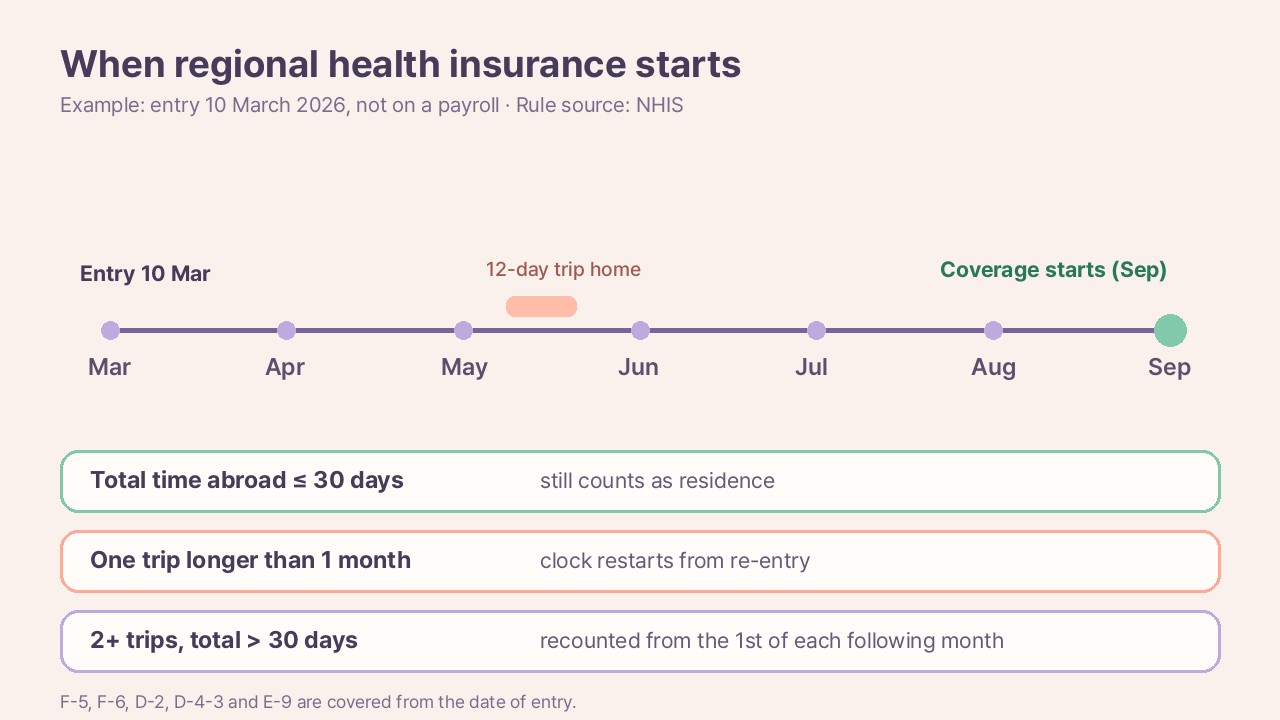
Worked example. You enter Korea on 10 March 2026 on an E-7 visa but start a job only later, so you are not yet an employee subscriber. You take one 12-day trip home in May. Twelve days is under the 30-day allowance, so your six-month period still runs from 10 March, and you become a regional subscriber in September 2026. If that May trip had lasted five weeks instead, the clock would restart from the day you came back.
How much: the ₩158,630 floor
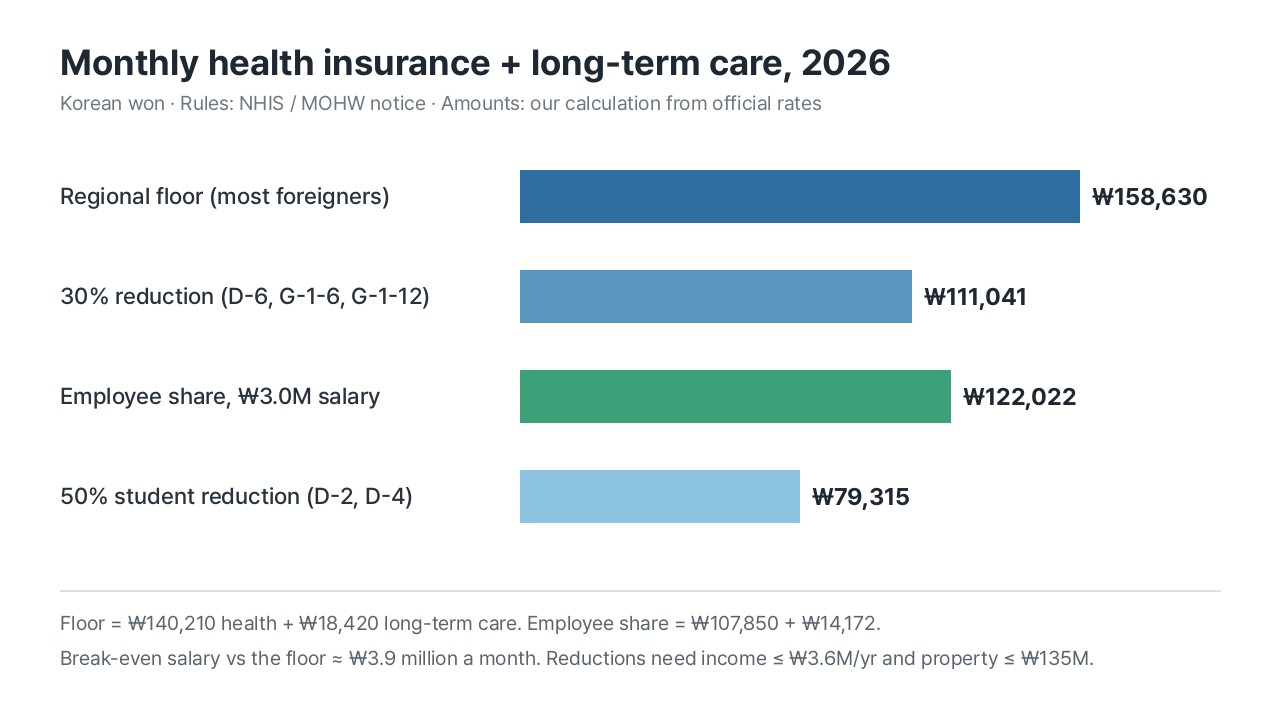
Regional premiums for foreigners are calculated “by the same standard as Korean regional subscribers”: a monthly income component at 7.19% plus property points at ₩211.5 per point. Then comes the foreigner rule. If the result is below the average premium of all subscribers at the end of November of the previous year, you pay that average for the following January to December. NHIS says it uses the average because income and assets in a foreigner’s home country are hard to verify.
| 2026 figure | Amount | Note |
|---|---|---|
| Average premium for foreign regional subscribers | ₩158,630 / month | +3.80% vs 2025 |
| of which health insurance | ₩140,210 | |
| of which long-term care insurance | ₩18,420 | |
| Annual cost at the floor | ₩1,903,560 | our calculation: ₩158,630 × 12 |
| Implied 2025 floor | about ₩152,800 | our calculation: ₩158,630 ÷ 1.038 |
Sources: NHIS 2026 premium notice; NHIS guidance for foreign residents. Calculations by Haesul Global.
You can check the long-term care part yourself. NHIS sets it as the health premium × 0.9448 ÷ 7.19: ₩140,210 × 0.9448 ÷ 7.19 = ₩18,424, which NHIS bills as ₩18,420 (rounded). The floor is a minimum, not a fixed price: a foreign freelancer with significant Korean income or property can be billed more.
Who is not held to the floor? Permanent-resident (F-5) and marriage-migrant (F-6) households are assessed exactly like Korean households. Recognised refugees (F-2-4), their families (F-1-16) and single-person households of under-19s are also calculated like Koreans, even if the result is below the average.
Rechecked on November 13, 2026 (MOHW / Korea.kr): the health insurance policy committee set the 2027 health insurance rate at 7.19%, unchanged, and kept the regional property rate at ₩211.5 per point. The 2027 long-term care rate is 0.9994% of income (0.9448% in 2026), which NHIS bills as 13.90% of the health premium (MOHW long-term care committee, read 11 November 2026). Two practical effects (our calculations):
- Employees: on ₩3,000,000 monthly pay your health share stays ₩107,850 (3.595%), while the long-term care share goes from about ₩14,172 to about ₩14,991 (+₩819 a month).
- Regional subscribers at the floor: the 2027 floor will be the average premium at the end of November 2026, so the ₩158,630 figure will change. For illustration only: if the health part stayed at ₩140,210, the care part would be ₩140,210 × 0.9994 ÷ 7.19 ≈ ₩19,489 instead of ₩18,420. Check your January 2027 bill rather than this estimate.
Who pays less: the 50% and 30% reductions
NHIS reduces the regional premium for some statuses:
| Status | Reduction | At the 2026 floor (our calculation) |
|---|---|---|
| D-2 student, D-4 general trainee, overseas Korean / F-4 students at eligible schools | 50% | ₩158,630 × 0.5 = ₩79,315 (university notices quote ₩79,320) |
| D-6 religious worker, G-1-6 humanitarian stay, G-1-12 family | 30% | ₩158,630 × 0.7 = ₩111,041 |
| F-5 permanent residents, F-6 marriage migrants | assessed and reduced like Korean households | depends on the case |
The reductions apply only if the household’s income is ₩3.6 million a year or less and its taxable property is ₩135 million or less. The student rate has been 50% since March 2023 (it was 70% and then 60% in the two years before). Your exact bill may differ by a few won from our arithmetic because of NHIS rounding.

Employee or regional? A worked comparison
Getting a job changes the math, because employees pay a share of their wage instead of the floor. Take a gross monthly salary of ₩3,000,000:
| Step (employee, 2026) | Calculation | Result |
|---|---|---|
| Total health premium | ₩3,000,000 × 7.19% | ₩215,700 |
| Your half | ₩215,700 ÷ 2 | ₩107,850 |
| Total long-term care | ₩215,700 × 0.9448 ÷ 7.19 | ₩28,344 |
| Your half | ₩28,344 ÷ 2 | ₩14,172 |
| Your monthly total | ₩107,850 + ₩14,172 | ₩122,022 |
So at ₩3 million a month, the employee’s share is about ₩36,600 less than the regional floor of ₩158,630 (our calculation), and the employer pays the other half. The two are equal at a salary of roughly ₩3.9 million: ₩158,630 ÷ (3.595% × 1.1314) ≈ ₩3,900,000 (our calculation). Above that, an employee pays more than the regional floor, but the coverage is identical.
Employees can also register family as dependents who pay nothing, if each dependent passes NHIS tests (for example, total income under ₩20 million a year and a property tax base under ₩540 million). Regional subscribers cannot have dependents in that sense; each foreigner is normally a household of one, but on request NHIS can put a spouse and children under 19 on one household bill.
Can you opt out?
Only in narrow cases, and mainly for employees. An employee subscriber can apply for exclusion by proving equivalent medical coverage under a foreign law, foreign insurance or the employment contract; the form must be filed within 14 days of the enrollment report. Do not assume an ordinary travel policy is enough; ask NHIS first.
When coverage ends
Under the NHIS guidance, regional coverage ends, among other cases, the day after your permitted stay ends, the day after you leave Korea for more than a month, the day you become an employee’s dependent, or the day you acquire Korean nationality. If you are leaving for good, settle the last bill and keep a way to receive refunds. Once you are in the system, adults can also use the national health checkup; see our Korean health checkup by age guide.
Practical checklist
- Six months after arrival (or on entry, for the statuses in the table), expect an NHIS bill if you are not on a payroll.
- Check the amount against ₩158,630. If it is higher, it reflects Korean income or property you have reported.
- Students: confirm your D-2 or D-4 reduction and that your income and property are under the limits.
- Report address changes accurately so NHIS mail reaches you.
- Set up automatic payment from a Korean bank account so you never fall behind.
- Questions in English: NHIS call centre 1577-1000, the English consultant line 033-811-2000, or +82-33-811-2001 from abroad.

Frequently asked questions
Q. Is health insurance mandatory for foreigners in Korea?
For most long-term residents, yes. Since 16 July 2019, foreigners who have stayed six months are enrolled automatically as regional subscribers, and employees are enrolled through their workplace.
Q. How much is Korean health insurance for foreigners in 2026?
Regional (non-employee) foreign subscribers pay their calculated premium or ₩158,630 a month, whichever is higher. The floor is ₩140,210 health insurance plus ₩18,420 long-term care and applies from January to December 2026.
Q. Do international students pay less?
Yes. D-2 students and D-4 trainees (and F-4 or overseas Korean students) get 50% off if their income is ₩3.6 million a year or less and taxable property ₩135 million or less. At the floor that is about ₩79,300 a month.
Q. Do permanent residents pay the ₩158,630 minimum?
No. F-5 permanent residents and F-6 marriage migrants are assessed like Korean households, without the foreigner floor.
Q. Does a trip home reset the six-month rule?
Only if it is long. Up to 30 days abroad in total during the six months still counts as residence; a single trip of more than a month restarts the clock from your return.
Q. Will the ₩158,630 minimum change in 2027?
Yes, it is reset every January to the average premium of all subscribers at the end of the previous November, so the 2027 floor follows November 2026 and was not yet published on 13 November 2026. From January 1, 2027 (49 days from November 13) the health insurance rate stays 7.19% and long-term care becomes 13.90% of the health premium.
Related reading
- K-ETA vs visa-free entry to Korea: the Dec 31 exemption cutoff
- Korea health insurance after retirement: 2027 premium math
- Korea Basic Pension 2026: ₩349,700 and the 2027 tiered plan
Sources
- Ministry of Health and Welfare via Korea.kr, 2027 health insurance rate frozen at 7.19%; property point ₩211.5, 8 September 2026 (checked 13 November 2026)
- Ministry of Health and Welfare, 2026 5th long-term care committee: 2027 rate 0.9994% (13.90% of the health premium), 30 October 2026 (checked 11 November 2026)
- National Health Insurance Service, “2026년도 보험료율 기준 안내” (2026 premium standards): https://www.nhis.or.kr/nhis/together/wbhaea01000m01.do?articleNo=11008009&mode=view (checked 3 November 2026)
- NHIS EDI, “2026년도 보험료율 인상 안내” (2026 premium rate notice): https://edi.nhis.or.kr/portal/images/popup/20251204_pop01longdesc.html (checked 3 November 2026)
- NHIS, “국내체류 외국인 가입자 안내” (foreign resident subscribers): https://www.nhis.or.kr/nhis/minwon/wbhapa01000m01.do?articleNo=10946854&mode=view (checked 3 November 2026)
- NHIS, “재외국민 및 외국인 지역보험료 부과기준” (Ministry of Health and Welfare notice No. 2019-151): https://www.nhis.or.kr/static/html/wbma/b/wbmab0103.html (checked 3 November 2026)
- NHIS (English), Guidance for foreigners: http://www.nhis.or.kr/english/wbheaa02900m01.do (checked 3 November 2026)
- Seoul Metropolitan Government, Insurance (living in Seoul): https://english.seoul.go.kr/service/living/insurance/ (checked 3 November 2026)
- Seoul Window, “Korea Health Insurance for Foreigners: NHIS Guide 2026”, updated 16 October 2026: https://seoulwindow.com/en/guides/korea-health-insurance-foreigners-nhis/ (checked 3 November 2026)
- Koreamoa, “Foreigner Health Insurance and Premiums (2026)”: https://koreamoa.co.kr/en/guides/health-insurance/ (checked 3 November 2026)
This article was written with AI assistance and checked against the NHIS pages above. It is general information, not legal, tax or insurance advice. Rules depend on your visa and household; confirm with NHIS (1577-1000).






17 Comments