Sick at Night or on a Holiday in Korea: Late-Night Pharmacies, Moonlight Clinics and 119
Haesul Health desk (AI-assisted). As of 15 November 2026 (KST). Based on the Ministry of Health and Welfare (MOHW) pages on public late-night pharmacies and convenience-store medicines, the 2026 operating guideline for Moonlight Children’s Hospitals published through the National Emergency Medical Center (NEMC), the government’s Easy Law guide to pharmacies, Seoul’s 120 Dasan Call Center and VISITKOREA, cross-checked with Doctors Times (23 September 2026), Kukinews (20 August 2026), ETNews (6 November 2026) and The Korea Herald (13 August 2026).
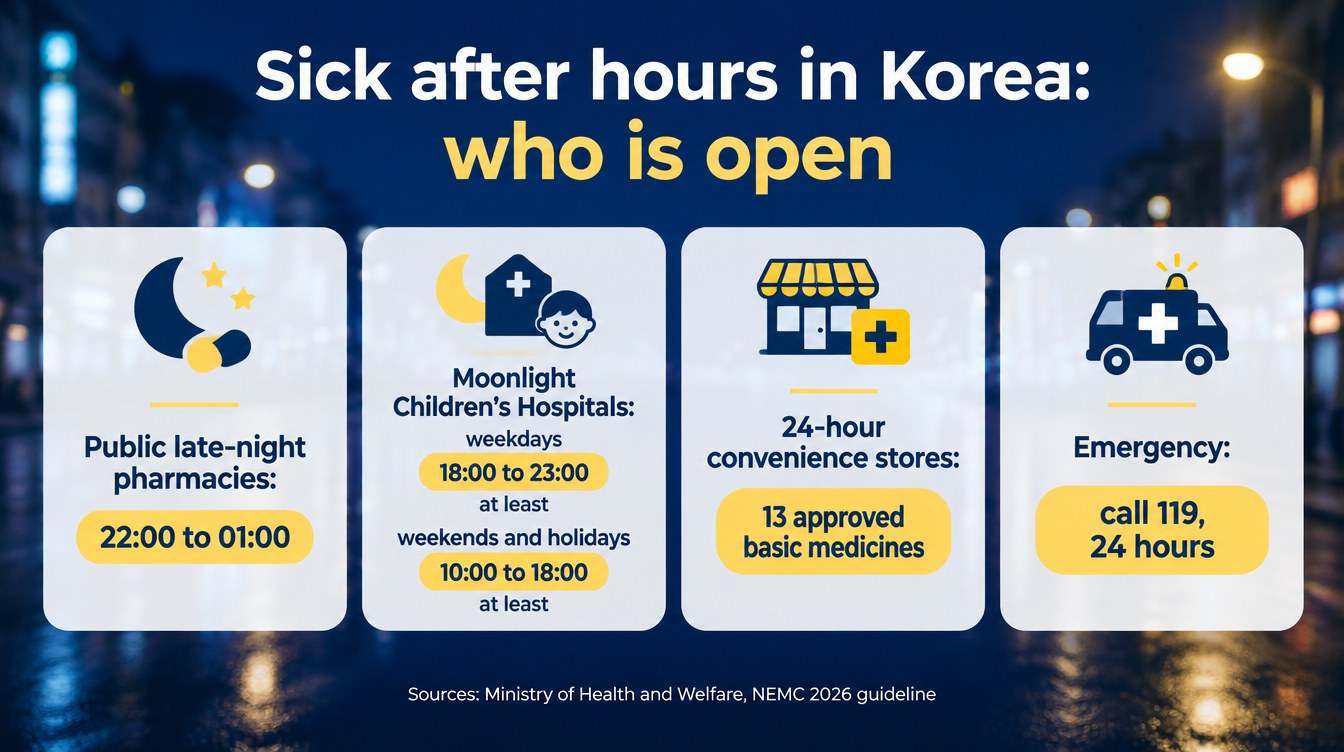
Quick answer: In Korea, a minor illness at night or on a Sunday or public holiday does not have to mean the emergency room. Public late-night pharmacies (공공심야약국) are designated to open from 22:00 to 01:00; about 240 were operating nationwide in July 2026. Moonlight Children’s Hospitals (달빛어린이병원) see children as walk-in outpatients at least 18:00–23:00 on their weekdays and 10:00–18:00 on their weekend and holiday days. Open pharmacies and clinics near you are listed on the E-Gen website and app, and 119 can also tell you. Registered 24-hour convenience stores sell 13 approved basic medicines (fever and pain relievers, cold medicines, digestives and pain patches), one pack per item. For anything serious, call 119 and say “English please” to get an interpreter.
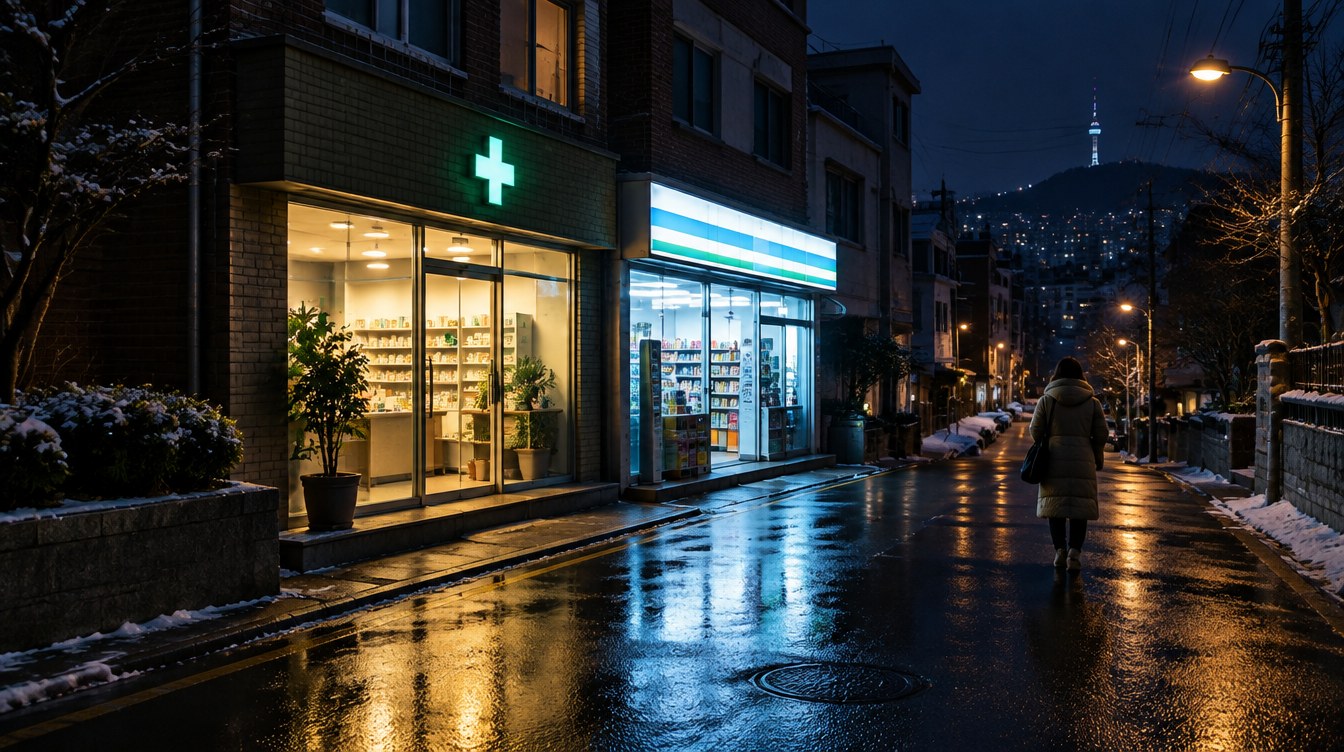
This guide is for foreigners living in or visiting Korea who get sick, or whose child gets sick, after the neighbourhood clinic has closed: late on a weeknight, on a Sunday, or over the Christmas and New Year holidays (1 January 2027 is 47 days from 15 November). It is general information, not medical advice.
Who is open when: the after-hours map
| Option | When (official rule) | Best for | How to find it |
|---|---|---|---|
| Public late-night pharmacy | 22:00 to 01:00; MOHW says some open every day of the year, others only on set days | Over-the-counter medicine and a pharmacist’s advice late at night; filling a prescription | E-Gen website/app (pharmacy search); call 119 |
| Moonlight Children’s Hospital | Minimum 18:00–23:00 on its weekdays; 10:00–18:00 on its Saturdays, Sundays and holidays | A child with fever, cough, vomiting or a rash that is not an emergency | E-Gen Moonlight page/app |
| Holiday duty pharmacy or clinic | Varies by day; local governments post the rota | Sunday and public-holiday daytime | E-Gen, the HIRA hospital/pharmacy finder, the pharmacists’ “holiday guardian pharmacy” search, 119; in Seoul also 120 |
| 24-hour convenience store | Store must be open 24 hours, all year, to sell medicines | Basic fever, pain, cold, indigestion or muscle-pain relief at 3 a.m. | Any store showing its medicine-seller registration |
| Emergency room / 119 | 24 hours | Anything severe or life-threatening | Call 119 |
Public late-night pharmacies (공공심야약국)
Public late-night pharmacies are ordinary neighbourhood pharmacies paid by the government to stay open after everyone else has shut. MOHW says they exist to guarantee access to medicines at night and on public holidays, and gained a legal basis in the Pharmaceutical Affairs Act (Article 21-3, amended 18 April 2023, in force from 19 April 2024). MOHW’s description: open 22:00 to 01:00, and “opening days and hours may differ by pharmacy, so check before you go.” The nearest one can be found on the E-Gen (emergency medical information) app or by QR code.
How many are there? In October 2023 MOHW counted 199. Data MOHW gave to the National Assembly, reported by Doctors Times on 23 September 2026, put the number at 240 as of July 2026, heavily concentrated around the capital:
| Region (July 2026) | Public late-night pharmacies |
|---|---|
| Gyeonggi | 62 (25.8% of the national total) |
| Seoul | 34 |
| Incheon | 20 |
| Gangwon, Gwangju | 6 each |
| Daejeon, Ulsan | 5 each |
| Sejong | 2 |
| Nationwide | 240 |
The same report says the national and local governments split the cost 50:50, paying ₩40,000 an hour per pharmacy, or ₩60,000 in depopulating areas from 2026. As a rough sense of scale (our calculation): a pharmacy open every night for 3 hours covers 21 hours a week, or 1,095 hours a year, which at ₩40,000 an hour is ₩43.8 million in support.
In practice: at a late-night pharmacy you can buy any over-the-counter (일반의약품) medicine the pharmacist stocks, ask for advice, and fill a prescription. Easy Law, the government’s plain-language legal guide, reminds readers that prescription-only (전문의약품) medicines cannot be sold without a doctor’s prescription, at night or any other time.
Moonlight Children’s Hospitals (달빛어린이병원)
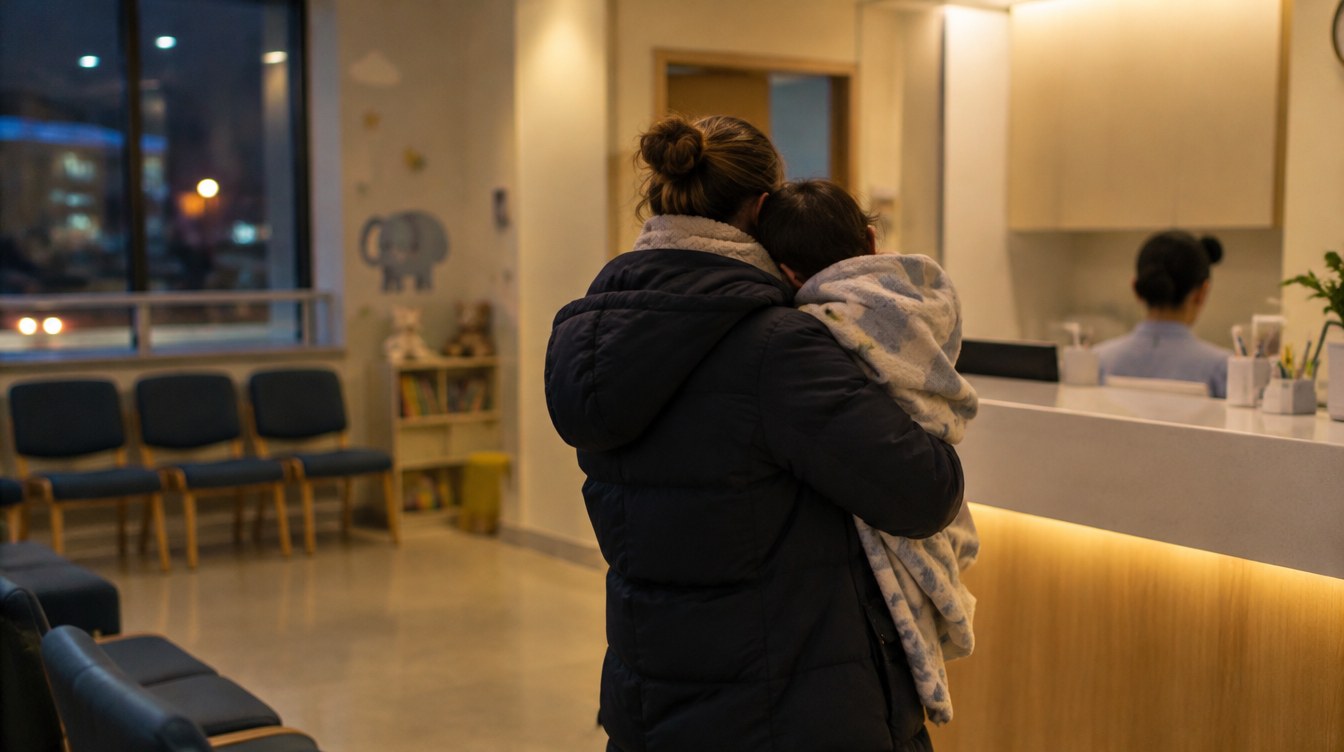
Moonlight Children’s Hospitals are clinics and hospitals designated under the Emergency Medical Service Act (Article 34-2) to give children outpatient care on weekday evenings and on weekends and holidays, so that parents do not have to queue in an emergency room for a fever or an ear infection. The 2026 operating guideline sets the hours, counted by registration time:
| Weekdays | Saturdays, Sundays and public holidays (incl. Seollal and Chuseok) | |
|---|---|---|
| Minimum hours (mandatory) | 18:00–23:00 | 10:00–18:00 |
| Model hours (encouraged) | 18:00–24:00 | 09:00–22:00 |
Our calculation from those hours: a site open 7 days a week at the minimum gives 5 hours × 5 weekdays + 8 hours × 2 weekend days = 41 hours a week, which matches the “minimum of 41 hours a week” Kukinews cites; at the model hours it is 56. Not every site opens every day, though: the guideline also allows group rotas and sites that run on some days only, so check the specific day.
What else the guideline says that matters to parents:
- A child who registers within the hours must be seen even if the queue is long; the clinic cannot turn patients away at closing time.
- It is outpatient care, separate from any emergency area, and the clinic cannot charge the emergency medical management fee. There is a small night-care fee on top of normal clinic charges, so MOHW asks clinics to tell parents that bills are slightly higher than a daytime visit.
- Each site has a partner pharmacy nearby that stays open until the clinic has finished; prescriptions are marked so the pharmacy knows the child was seen within Moonlight hours. Local governments may also make a public late-night pharmacy the partner.
- Sites may close on at most 3 of their designated days a year, and over long holidays (Seollal, Chuseok, substitute holidays) they are told to keep their hours strictly.
- 119’s dispatch centres are asked to direct parents of children with minor problems to a nearby Moonlight site after giving first-aid advice.
Kukinews reported on 20 August 2026 that 148 sites were operating nationwide, with local governments still adding more (for example, Yangcheon-gu in Seoul went from one to two in August), but with gaps in some cities. The live list and hours are on the E-Gen Moonlight page.
Sundays and public holidays: finding an open clinic or pharmacy
Korean clinics and pharmacies set their own hours, so on a Sunday or a holiday many are closed. Easy Law lists the official ways to find one that is open:
- E-Gen (e-gen.or.kr and the E-Gen app, run by NEMC): hospital and pharmacy search, including what is open now.
- HIRA (Health Insurance Review and Assessment Service) website: hospital and pharmacy finder.
- 119: the 119 safety report centre will tell you the nearest open pharmacy or duty pharmacy.
- The pharmacists’ association holiday guardian pharmacy (휴일지킴이약국) search for holiday duty pharmacies.
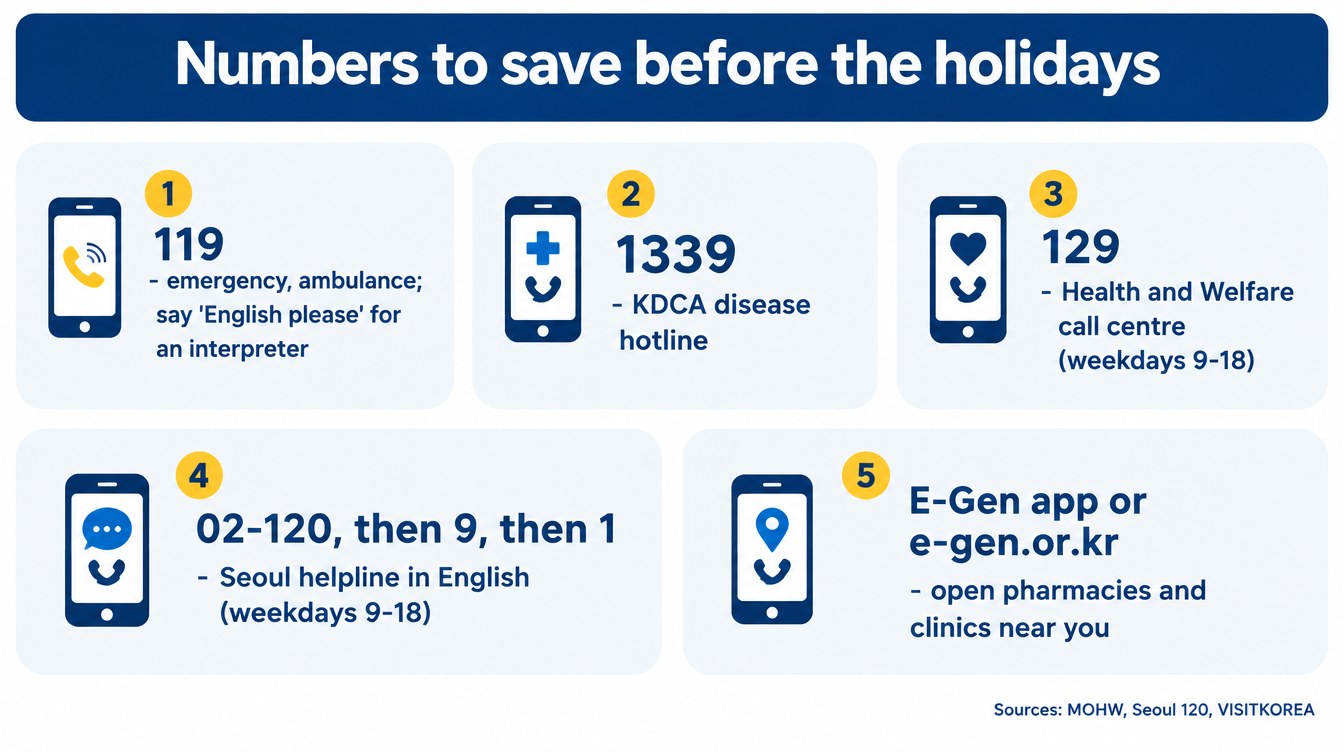
If you live in Seoul, the 120 Dasan Call Center is another option. Its foreign-language helpline (02-120, then 9, then 1 for English) runs on weekdays 09:00–18:00 and covers general living information with three-way interpretation. The Korea Herald reported that over the August 2026 Liberation Day holiday the centre gave round-the-clock information on open hospitals and pharmacies, and that medical questions on the holiday itself were 3.4 times the previous day’s (101 vs 30). For national health and welfare questions there is MOHW’s 129 call centre (weekdays 09:00–18:00; urgent welfare support 24 hours). For infectious-disease questions, KDCA’s 1339 helpline.
Convenience-store medicines (안전상비의약품)
Since 15 November 2012, exactly 14 years ago today, Korea has allowed a short list of “safe household medicines” to be sold outside pharmacies so people can buy basics when pharmacies are shut. MOHW’s rules:
- Only stores that open 24 hours, all year, register with the local public health centre, complete 4 hours of seller training and use a barcode system that blocks recalled products may sell them.
- One pack per item per purchase.
- No sales to children under 12 (including primary-school pupils).
- The medicines must be displayed separately from food and other goods, with usage warnings posted.
The list is capped at 20 items but has held 13 for years. By type (MOHW and Easy Law list the specific products):
| Type | Number of products | What they are |
|---|---|---|
| Fever and pain relievers | 5 | Acetaminophen tablets in two adult strengths and one children’s strength, a children’s acetaminophen suspension, and a children’s ibuprofen syrup |
| Cold medicines | 2 | One oral liquid, one tablet |
| Digestives | 4 | Digestive-enzyme tablets |
| Pain-relief patches | 2 | Cooling and pain-relief patches |
| Total | 13 |
ETNews reported on 6 November 2026 that plans to add more products (antacids, anti-diarrhoeals and artificial tears have been discussed) are still at the consultation stage, and that, according to store sales data, 57.2% of these medicines are sold between 18:00 and 06:00, and 20.1% on Sundays. Read the leaflet, follow the label, and ask a pharmacist or doctor if you are unsure, especially for children, during pregnancy, or if you take other medicines. This guide gives no dosing advice.
When to skip all of this and call 119
The options above are for minor problems. Call 119 at once for chest pain or pressure, sudden weakness or numbness on one side, slurred speech, trouble breathing, a seizure, heavy bleeding, confusion, or a baby or older person who is floppy, very drowsy or not drinking. Our guide to heart attack warning signs in Korea’s winter covers why every minute counts, and norovirus in Korea’s winter lists the dehydration signs that mean a doctor is needed.
VISITKOREA advises foreigners: when the call connects, say “English please” or “Interpreter please” and the operator will connect a professional interpreter; use nearby buildings or your phone’s GPS to give your location. Clinics, Moonlight sites and pharmacies charge National Health Insurance rates to insured patients, so if you are enrolled, bring your residence card or insurance details (see Korea health insurance for foreigners in 2026). Tourists without NHIS pay the full cost and claim on travel insurance.
A 2-minute plan before the holidays
- Install the E-Gen app (or bookmark e-gen.or.kr) and look up the nearest public late-night pharmacy and Moonlight site now, while you are well.
- Note their days. Many late-night pharmacies and Moonlight sites open only on certain days; write down which.
- Save the numbers: 119 (emergency, interpreter on request), 1339 (KDCA), 129 (MOHW), and in Seoul 02-120 then 9, 1 for English on weekdays.
- Keep a small home kit bought from a pharmacy in daytime, so a 2 a.m. fever does not depend on a store.
- Carry your residence card or insurance details for clinic visits.
Not urgent and can wait for normal clinic hours? See How to see a doctor in English in Korea for international clinics, the referral rule and what a visit costs. Flu is rising this month: latest flu figures and free shots for 65+.
Need cold or flu medicine rather than an open clinic? See Cold and flu medicine in Korea for what pharmacies sell without a prescription, all 13 convenience-store medicines by ingredient, and the label dose limits.
Year-end parties: before paying for a hangover drip, read what is in a hangover IV drip in Korea and what it costs.
FAQ
Q. Are there 24-hour pharmacies in Korea?
Some pharmacies keep long hours, but the official late-night option is the public late-night pharmacy, designated to open from 22:00 to 01:00; about 240 were operating in July 2026. After that, registered 24-hour convenience stores sell 13 basic medicines, and 119 or the E-Gen app can point you to what is open.
Q. What is a Moonlight Children’s Hospital?
A designated clinic or hospital that sees children as walk-in outpatients in the evening and on weekends and holidays, at least 18:00–23:00 on its weekdays and 10:00–18:00 on its weekend and holiday days. About 148 were operating in August 2026; the list is on E-Gen.
Q. What medicines can I buy at a Korean convenience store?
Thirteen approved products: five fever and pain relievers (including children’s acetaminophen and ibuprofen liquids), two cold medicines, four digestives and two pain-relief patches. Only one pack per item per purchase, and not to children under 12.
Q. How do I find a clinic open on a Sunday or public holiday?
Search the E-Gen website or app, the HIRA hospital finder or the holiday guardian pharmacy site, or call 119. In Seoul, the 120 Dasan Call Center can also help, in English on weekdays.
Q. Can a late-night pharmacy give me antibiotics without a prescription?
No. Prescription-only medicines need a doctor’s prescription at any time of day. A late-night pharmacy can sell over-the-counter medicines, give advice and fill a prescription you already have.
Q. Will 119 understand English?
Say “English please” or “Interpreter please” when the call connects; VISITKOREA says the operator will connect a professional interpreter. Have your location ready from a nearby building or your phone’s GPS.
General information, not medical advice. Decisions about diagnosis, treatment and medicines are for a doctor or pharmacist; do not use this page to choose medicines or doses. Opening rules are as published by MOHW and NEMC on the dates above; individual pharmacies and clinics set their own days, so check E-Gen (https://www.e-gen.or.kr) or call 119 before you go.
Sources
- MOHW via Korea Policy Briefing, “Now you can use a pharmacy late at night without worry” (public late-night pharmacies, 22:00–01:00, Pharmaceutical Affairs Act art. 21-3; 28 November 2023): https://www.korea.kr/news/policyNewsView.do?newsId=148923139
- MOHW, “Sale of safe household medicines outside pharmacies” (13 products, 24-hour store, one pack, under-12 rule; page updated 31 March 2026): https://www.mohw.go.kr/menu.es?mid=a10702040200
- MOHW / NEMC, “2026 operating guideline for paediatric night and holiday clinics (Moonlight Children’s Hospitals)” (January 2026, PDF): https://media.nemc.or.kr/file/download_file_encrypt.do?fileitemno=83cd7fc6ba288820e64b1902a9413f9d
- Ministry of Government Legislation, Easy Law, “Emergency care: using pharmacies” (finding pharmacies, holiday duty pharmacies, prescription rule, store medicines; as of 15 October 2026): https://www.easylaw.go.kr/CSP/CnpClsMain.laf?ccfNo=2&cciNo=1&cnpClsNo=2&csmSeq=906&menuType=cnpcls&popMenu=ov
- Seoul 120 Dasan Call Foundation, English helpline page: https://www.120dasan.or.kr/static/lang/lang1.html
- VISITKOREA, “Disaster Safety Services for International Visitors in Korea” (119 interpreter; 2 October 2025): https://english.visitkorea.or.kr/svc/contents/contentsView.do?vcontsId=248145
- Doctors Times (의사신문), “Only 240 public late-night pharmacies nationwide” (23 September 2026): http://www.doctorstimes.com/news/articleView.html?idxno=240154
- Kukinews, “Local governments expand Moonlight Children’s Hospitals, gaps remain” (20 August 2026): https://www.kukinews.com/article/view/kuk202608190184
- ETNews, “Expansion of convenience-store medicines stalls” (6 November 2026): https://www.etnews.com/20261106000217
- The Korea Herald, “Seoul’s 120 hotline to offer hospital, bus info during holiday” (13 August 2026): https://www.koreaherald.com/article/10840199
How we checked: We read the MOHW pages, the full 2026 Moonlight guideline PDF, the Easy Law pharmacy chapter and the Seoul 120 and VISITKOREA pages on 15 November 2026, and matched opening hours, counts and store-medicine rules against Doctors Times, Kukinews, ETNews and The Korea Herald. The weekly-hours figures (41 and 56 hours; 21 and 1,095 pharmacy hours) and the ₩43.8 million support figure are our own arithmetic from the published hours and hourly rate; site counts change often, so check E-Gen for the current list.
Researched and drafted with AI assistance; checked against the sources listed.
5 Comments