Korea’s Interim Income Tax for Foreign Freelancers: 50% Rule, ₩500,000 Line, 30 Nov 2026
Haesul Economy desk (AI-assisted). As of 15 November 2026 (KST). Based on the National Tax Service (NTS) interim prepayment guidance pages (who must pay, how the bill is calculated, installments, estimated-tax report), the NTS November 2026 tax calendar and English helpline page, and Tax & Finance Media (조세금융신문) reporting of the NTS announcement on 5 November 2026.
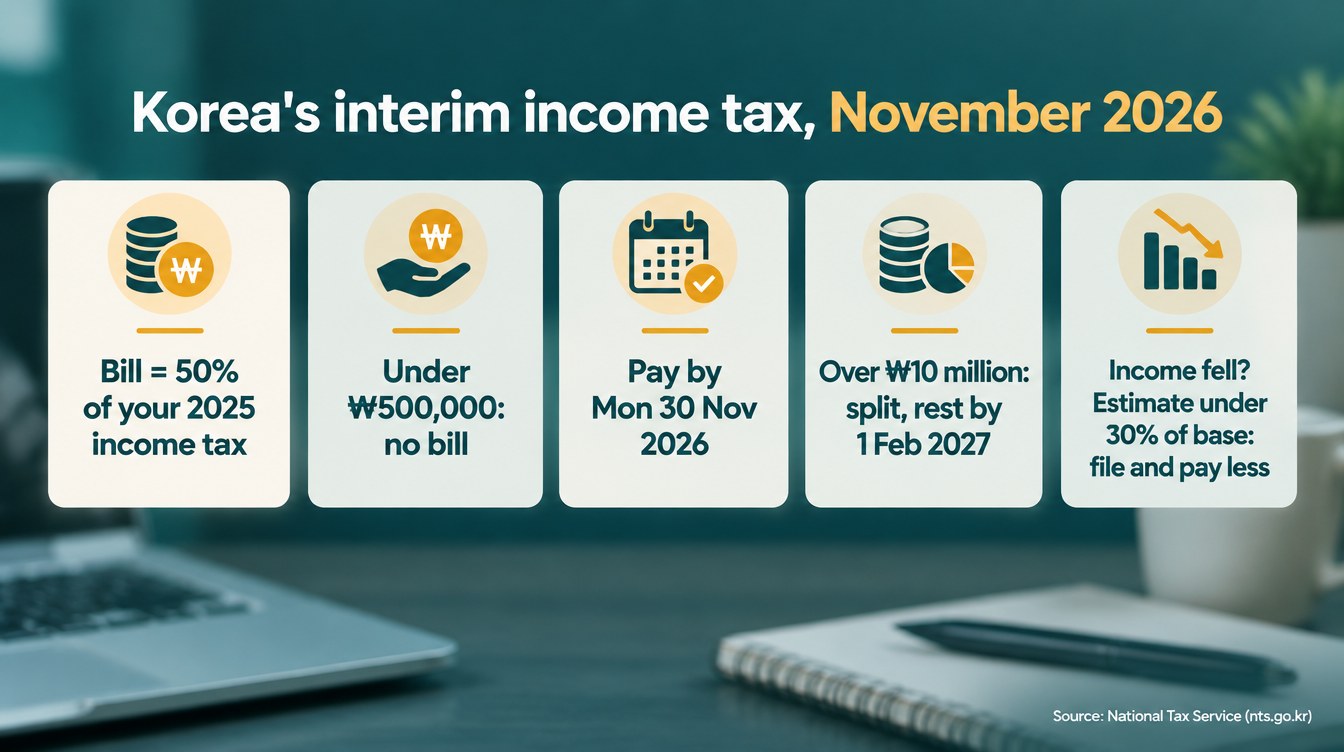
Quick answer: If you are a foreign resident of Korea with business income (freelance work paid with 3.3% withheld, a registered sole proprietorship, a small shop or online business) and you paid income tax for 2025, the NTS has probably sent you an interim income tax bill (종합소득세 중간예납). The bill is half of your 2025 income tax, it is not issued if that half comes to less than ₩500,000, and it must be paid by Monday 30 November 2026, which is 15 days from 15 November. If your first-half 2026 income fell so far that the tax on it is below 30% of last year’s figure, you can file an estimated-tax report (중간예납추계액 신고) by the same date and pay less. Bills above ₩10 million can be partly paid by 1 February 2027.

This guide is written for foreigners who live and earn in Korea: freelance teachers and translators, designers and developers who invoice Korean clients, and foreign sole proprietors with a business registration. It explains who receives the November bill, how the amount is worked out, how to pay it on Hometax, and what to do if your income dropped this year. It is general information, not tax or legal advice.
What the November bill is (and what it is not)
The NTS describes the interim prepayment in one line: it is not paying next May’s tax early; it is paying the income tax for the first half of this year (1 January to 30 June) in November. To save taxpayers from filing a mid-year return, the NTS does not ask you to calculate anything. Your local tax office simply bills you for half of last year’s tax. If the first half of the year went badly, the estimated-tax report exists to correct that.
Whatever you pay now is credited against your final return for tax year 2026, which you file in May 2027. Tax & Finance Media, reporting the NTS announcement on 5 November 2026, says the NTS began sending bills on 2 November to about 1.54 million individual business owners with global income, and that the amount paid is deducted as tax already paid (기납부세액) at the May return.
Who gets a bill, and who does not
The NTS rule starts from a simple principle: in principle, every resident with global income (종합소득) is subject to interim prepayment. For a foreigner, the important word is resident. Under Article 1-2 of the Income Tax Act, a resident is someone who has a domicile in Korea or has stayed in a place of residence for 183 days or more; the Enforcement Decree (as summarised in Korea’s OECD residency note) adds that a person whose job requires them to live in Korea for 183 days or more is treated as having a domicile here. A non-resident is not on the interim prepayment list.
The NTS then lists who is left out:
| Not billed | NTS wording, in plain English |
|---|---|
| New businesses | You were not a business owner on 31 Dec 2025 and started in 2026 |
| Closed or suspended | You suspended or closed the business on or before 30 Jun 2026 (and some later closures already taxed) |
| Only certain income | Only interest, dividends, salary, pensions or “other income”; or only business income from typing/stenography support, freelance artists (writers, painters, actors, singers, film directors, photographers), professional sports, insurance or securities sales commissions, some door-to-door sales commissions, or separately taxed housing rent |
| Tax union members | A tax union withheld your tax every month from January to June |
| Property traders | Your provisional tax on land or building sales in January–June is more than half of the base |
| Small amounts | The interim tax works out at less than ₩500,000 |
Two practical points follow for foreign residents:
- Salary only? No bill. If you are an E-2 teacher or an office employee paid a salary and you have no other business income, you are outside the system; your tax is handled through payroll and the year-end tax settlement.
- Many freelancers with 3.3% withheld are in. The NTS says a payer must withhold 3.3% (including local income tax) when paying a freelancer for VAT-exempt personal services, and it gives hagwon instructors among the 40 occupation types counted as freelance personal-service earners. That income is business income, so it is not on the exclusion list, unless your work falls into one of the excluded freelance-artist or sports categories above.
How the amount on your bill is calculated
The NTS formula is: interim tax = interim base × 1/2 (property traders subtract their provisional sales tax). The interim base is your income tax for the previous year, made up of:
- the interim tax you paid last November, plus
- the tax you paid yourself with your May–June final return, plus
- any extra tax the tax office assessed (with penalties), plus
- any tax paid with a late or amended return (with penalties), minus
- any refund you received.
For the 2026 bill, that means the tax for tax year 2025: the November 2025 interim payment plus what you paid with the May 2026 return, adjusted for assessments and refunds. (The itemised list on the NTS page still names the previous year’s dates; the rest of the page and the NTS announcement reported on 5 November refer to the 2025 tax year.)
Worked examples (our calculation from the NTS formula)
| Case | Interim base (2025 tax) | Bill = base × 1/2 | What happens |
|---|---|---|---|
| A. Freelance translator: paid ₩600,000 in Nov 2025 + ₩1,800,000 with the May 2026 return | ₩2,400,000 | ₩1,200,000 | Billed; pay by 30 Nov 2026 |
| B. Part-time online seller: paid ₩900,000 with the May 2026 return | ₩900,000 | ₩450,000 | Under ₩500,000, so no bill |
| C. Freelancer whose 3.3% withholding exceeded the tax, refunded in May, no 2025 interim | ₩0 or less | ₩0 | No bill |
| D. Café owner: base ₩30,000,000 | ₩30,000,000 | ₩15,000,000 | Billed; can split (see below) |
| E. Consultant: base ₩52,000,000 | ₩52,000,000 | ₩26,000,000 | Billed; can split up to 50% |
Case C is common: many freelancers who have 3.3% withheld through the year end up with a refund in May, and because a refund is subtracted from the base, they usually receive no November bill at all. Exactly ₩500,000 is billed; the NTS threshold is less than ₩500,000.
The deadline: Monday 30 November 2026
The NTS page and its November 2026 tax calendar both give 30 November 2026 (Monday) as the deadline to pay the interim tax and to file and pay an estimated-tax report for January–June 2026 income. Counting from 15 November, that is 15 days. Last year the 30th fell on a Sunday, so the 2025 deadline was 1 December; Tax & Finance Media’s November 2025 headline said the same. Do not carry last year’s date over.
According to Tax & Finance Media, a late payment triggers a late-payment penalty of 3% plus 0.022% per day, and the NTS says it will actively grant payment extensions of up to nine months to businesses in serious difficulty (natural disasters, a prolonged slump) that apply on Hometax or at a tax office. If you cannot pay, ask for an extension before the deadline instead of letting it pass.
How to pay on Hometax or the Sontax app
The NTS gives this path for both Hometax (website) and Sontax (the mobile app), which are open from 07:00 to 23:30:
- Log in (a certificate login is required).
- Go to 납부·고지·환급 (Payment, Notice, Refund) → 세금납부 (Tax payment) → 납부할 세액 조회/납부 (View and pay tax due).
- Pick the item whose 과세구분 (tax type) is 고지분 (billed).
- Choose 납부하기 (Pay) and a payment method: bank transfer, credit card or simple payment.
You can also pay by transfer to the virtual account or national tax account printed on the bill, or at a bank counter. Tax & Finance Media adds that the billed amount can be checked on Hometax through the income tax menu or under My Hometax → notices.
If you are not comfortable with Korean menus, the NTS runs a helpline for foreigners: +82-1588-0560 for English, Monday to Friday 09:00–18:00 (closed 11:30–13:00). For other languages, call 1345, choose your language and ask for a three-way call with the NTS 126 centre.

Bills over ₩10 million: paying in two parts
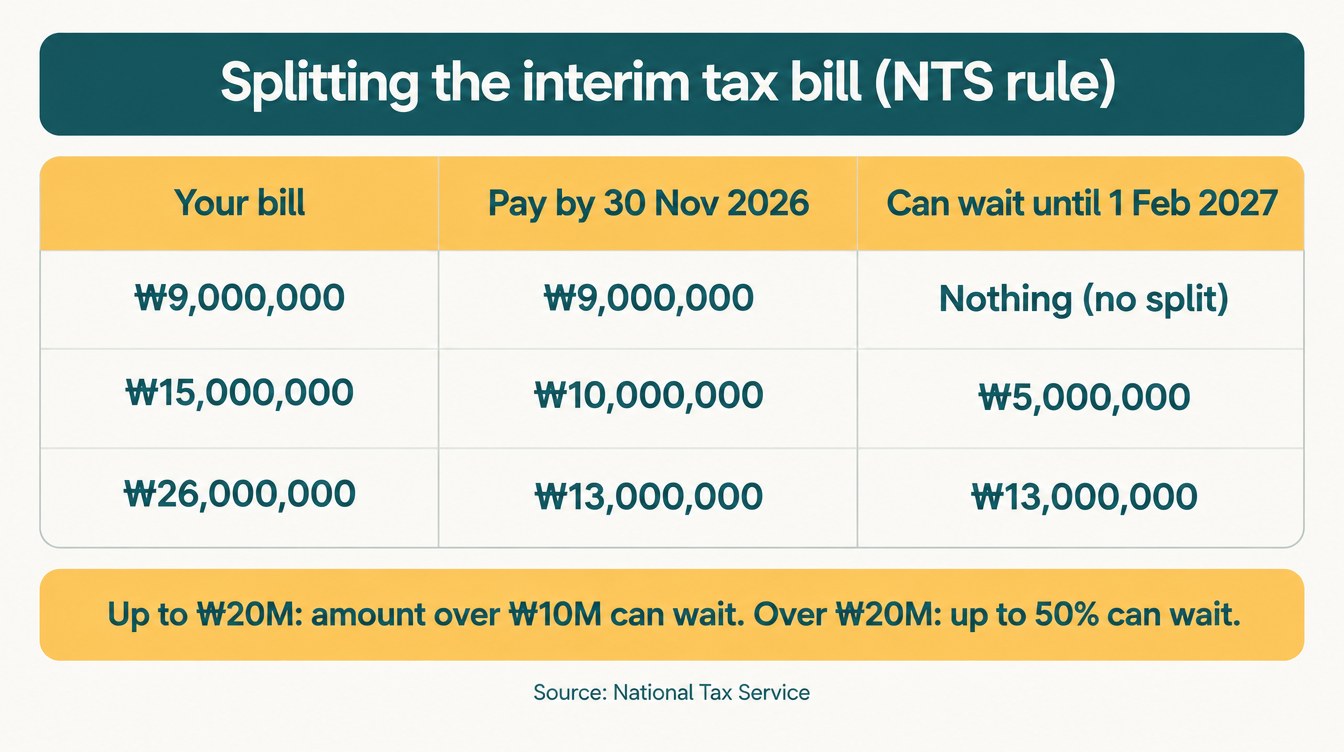
The NTS installment rule applies when the interim tax is more than ₩10 million:
| Your bill | Pay by 30 Nov 2026 (at least) | Can wait until 1 Feb 2027 (at most) |
|---|---|---|
| ₩10,000,000 or less | the full amount | nothing; no split |
| ₩12,500,000 (NTS example) | ₩10,000,000 | ₩2,500,000 |
| ₩15,000,000 (case D) | ₩10,000,000 | ₩5,000,000 |
| ₩18,000,000 (NTS example) | ₩10,000,000 | ₩8,000,000 |
| ₩26,000,000 (case E) | ₩13,000,000 | ₩13,000,000 |
| ₩30,000,010 (NTS example) | ₩15,000,010 | ₩15,000,000 |
Up to ₩20 million, the part above ₩10 million can wait; above ₩20 million, up to 50% can wait. There is no separate application: on Hometax you type the reduced amount into the payment field and pay only that, and the tax office sends a bill for the remainder in early January 2027, payable by Monday 1 February 2027. The NTS says the same split applies to an estimated-tax report whose tax exceeds ₩10 million.
If your income fell in 2026: the estimated-tax report
Because the bill is based on last year, it can be far too high if your work dried up in the first half of 2026. The NTS says you may file an estimated-tax report (중간예납추계액 신고) and pay that amount instead when the tax on your January–June 2026 income is below 30% of the interim base. (Business owners who keep double-entry books and had no base, but did have business income in January–June, must file one.)
The NTS calculation:
- Tax base = (January–June global income × 2) − loss carried forward − income deductions.
- Calculated tax = tax base × the basic rates (6% to 45%).
- Estimated amount = calculated tax ÷ 2 − credits and reductions to 30 June, provisional property tax, ad hoc assessments and tax withheld.
The 2026 basic rate table the NTS shows starts at 6% up to ₩14 million, 15% up to ₩50 million (minus ₩1.26 million), 24% up to ₩88 million (minus ₩5.76 million) and rises to 45% above ₩1 billion.
Worked example (our calculation; deductions are an assumption)
A foreign freelance designer had a 2025 tax of ₩10,000,000, so the November bill is ₩5,000,000. In January–June 2026, revenue fell to ₩20,000,000, with ₩8,000,000 of expenses, and clients withheld 3.3% on all of it.
| Step | Amount |
|---|---|
| Half-year business income (₩20,000,000 − ₩8,000,000) | ₩12,000,000 |
| × 2 | ₩24,000,000 |
| − income deductions (assumed ₩1,500,000 for this example) | ₩22,500,000 tax base |
| Calculated tax: ₩22,500,000 × 15% − ₩1,260,000 | ₩2,115,000 |
| ÷ 2 | ₩1,057,500 |
| − tax withheld Jan–Jun (national 3% part of the 3.3%: ₩20,000,000 × 3%) | ₩457,500 estimated amount |
| 30% test: 30% of the ₩10,000,000 base | ₩3,000,000, so ₩457,500 qualifies |
Two NTS rules then apply. The estimated amount is under ₩500,000, so nothing has to be paid, but the NTS says you must still file the estimated-tax report to cancel the ₩5,000,000 bill; if you just ignore the bill, it stands. The form (중간예납추계액신고서) is downloadable from the NTS page and is due by 30 November 2026.
Keep in mind that this only shifts timing. If your second half recovers, you pay the difference with the May 2027 return. And the figure must come from your real January–June books: an estimate that is wrong can be corrected by the tax office.
Before 30 November: a short checklist
- Check whether you are billed. Look on Hometax even if no paper bill reached your address; the notice may have gone to an old address.
- Compare the bill with your 2026 first half. If your income clearly fell, run the 30% test above or ask a tax accountant.
- Decide on a split if the bill is over ₩10 million, and put 1 February 2027 in your calendar.
- Pay or file by Monday 30 November 2026. Hometax and Sontax close at 23:30 each day.
- Keep the receipt for your May 2027 return.
The same month also brings other bills to many foreign residents: if you are a regional (self-employed) health insurance member, your premium was recalculated from 2025 income in November (see why your regional health insurance bill changed in November 2026 and our guide to Korea health insurance for foreigners in 2026). Property owners also face the December comprehensive real estate tax: see Korea comprehensive real estate tax 2026: when and how to pay.
Sending part of your income abroad? See Sending money home from Korea: the US$50,000 limit, fees and a worked example.
FAQ
Q. I am a foreigner. Does Korea’s interim income tax apply to me?
Yes, if you are a Korean tax resident (domicile in Korea or 183 days or more of residence) with business income, such as freelance work paid with 3.3% withheld or a registered sole proprietorship, and you paid income tax for 2025. Salary-only workers, new 2026 businesses and people whose interim tax would be under ₩500,000 are not billed.
Q. How much is the November 2026 interim income tax?
Half of your income tax for tax year 2025: the November 2025 interim payment plus the tax you paid with the May 2026 return, adjusted for any assessment or refund. A base of ₩2,400,000 gives a bill of ₩1,200,000.
Q. When is the deadline?
Monday 30 November 2026, for both paying the bill and filing an estimated-tax report. If your bill is over ₩10 million, part of it can be paid by Monday 1 February 2027.
Q. My income fell this year. Do I have to pay the full bill?
Not necessarily. If the tax on your January–June 2026 income is below 30% of last year’s base, you can file an estimated-tax report by 30 November and pay that amount instead. If the estimate is under ₩500,000 you pay nothing, but you must still file the report to cancel the bill.
Q. Can I pay the interim tax by credit card?
Yes. The NTS lists bank transfer, credit card and simple payment on Hometax and the Sontax app (open 07:00 to 23:30), plus transfer to the account printed on the bill or payment at a bank.
Q. What if I miss the deadline?
A late-payment penalty applies; Tax & Finance Media, reporting the NTS notice, gives it as 3% plus 0.022% per day. Businesses in serious difficulty can apply on Hometax or at a tax office for an extension, which the NTS says it will grant for up to nine months.
General information, not tax or legal advice. Rules are as published by the National Tax Service on the pages listed below, read on 15 November 2026. Your own bill, residency status and income type decide what applies to you: check Hometax, call the NTS foreigner helpline (+82-1588-0560, English) or ask a licensed tax accountant.
Sources
- NTS, “Interim prepayment guide: what it is and who must pay” (중간예납 안내, 2026): https://www.nts.go.kr/nts/cm/cntnts/cntntsView.do?cntntsId=7673&mi=2236
- NTS, “Calculating and paying the interim tax; installments” (2026, due 30 Nov 2026, installments by 1 Feb 2027): https://www.nts.go.kr/nts/cm/cntnts/cntntsView.do?cntntsId=7674&mi=2237
- NTS, “Estimated interim tax report” (2026, 30% test, calculation, rate table): https://www.nts.go.kr/nts/cm/cntnts/cntntsView.do?cntntsId=7675
- NTS, tax calendar, November 2026 (“소득세 중간예납 납부·추계액 신고 납부”, 30 Nov): https://www.nts.go.kr/nts/ad/taxSchdul/selectList.do?mi=135747
- NTS, simplified payment statement for residents’ business income (3.3% withholding incl. local income tax; hagwon instructors among personal-service occupations): https://www.nts.go.kr/nts/cm/cntnts/cntntsView.do?cntntsId=238925
- NTS English, Help Desk for Foreigners (helpline +82-1588-0560): https://www.nts.go.kr/english/cm/cntnts/cntntsView.do?cntntsId=8328&mi=10795
- Income Tax Act, Article 1-2 (definition of resident), English translation via KLRI: https://elaw.klri.re.kr/kor_service/ebook.do?hseq=72668
- OECD, “Korea – Information on residency for tax purposes” (Income Tax Act art. 1-2 and Enforcement Decree art. 2, incl. the 183-day occupation rule): https://www.oecd.org/content/dam/oecd/en/topics/policy-issue-focus/aeoi/korea-tax-residency.pdf
- Tax & Finance Media (조세금융신문), “NTS: November is interim income tax month, 1.54 million business owners” (5 November 2026): https://www.tfmedia.co.kr/news/article.html?no=208651
How we checked: We read the three NTS interim prepayment pages, the NTS November 2026 tax calendar and the NTS withholding and foreigner helpline pages on 15 November 2026, and matched the deadline, the 50% rule, the ₩500,000 threshold, the installment rule and the 30% test against Tax & Finance Media’s 5 November 2026 report of the NTS announcement. The worked examples (cases A–E and the designer’s estimate, including the assumed ₩1,500,000 of deductions) are our own arithmetic from the NTS formulas; the late-payment penalty rate and the nine-month extension come from that press report of the NTS notice.
Researched and drafted with AI assistance; checked against the sources listed.