Colon Cancer Screening in Korea: The Free Stool Test at 50+, What a Positive Result Means, and the Colonoscopy That Follows
By the Haesul Global health desk (AI-assisted). Last checked: 2026-11-10 (KST); countdown updated 2026-11-13. The 2026 colorectal screening window closes in 48 days (December 31, 2026). Rechecked on the NHIS cancer screening guide (HTTP 200 on Nov 8; period 1.1–12.31, no extension). This is not medical advice; your doctor interprets your own results.
Quick answer: Book the stool test by December 31, 2026 — 48 days left from November 13 (NHIS). If you’re 50 or older and enrolled in Korea’s National Health Insurance (NHIS), you can have a colorectal cancer stool test every year at no cost. It’s a fecal occult blood test, usually the fecal immunochemical test (FIT). Unlike most national cancer screenings, which carry a 10% co-payment for higher earners, NHIS pays the whole cost of colorectal screening for everyone. If the test finds hidden blood, you can have a follow-up colonoscopy, with any biopsy, under the same programme. Sedation and polyp removal may cost extra. Book the stool test by 31 December 2026 (48 days left). If it comes back positive, the colonoscopy can be done until 31 January of the following year (NHIS: second-step tests after a positive first-step result run until 31 January of the next year). One thing to know: if you skip the stool test and go straight to a colonoscopy, you pay the full price.

Who is eligible in 2026
Korea’s National Cancer Screening Program covers six cancers. For colorectal cancer, the rule on NHIS’s pages and on the National Cancer Information Center (run by the National Cancer Center) is simple: men and women aged 50 and over, once a year. Unlike some checkup items, it isn’t tied to even or odd birth years. Once you’re 50, you’re on the list every year.
That includes foreign residents. The national checkup belongs to NHIS membership, not nationality, and the NHIS English benefits page lists the six cancer checkups, colorectal included, among the benefits for the insured. If you’re unsure whether you’re enrolled, or what you pay as a local or employee subscriber, see our guide to Korea health insurance for foreigners in 2026. For everything else the national checkup adds at each age, see Korea’s national health checkup by age. This article goes into the colorectal part in more detail.
There are two exceptions where you may be left off the list (deferred), according to NHIS:
- you’re a registered colorectal cancer patient under the health insurance co-payment special case (산정특례); or
- you’ve had a colonoscopy within the last five years, either through cancer screening or billed to National Health Insurance or Medical Aid.
In both cases NHIS says you can still ask to be registered if you want the screening. You can check whether you’re on this year’s list on the NHIS website or app (건강검진 대상조회) or by calling 1577-1000.
What it costs
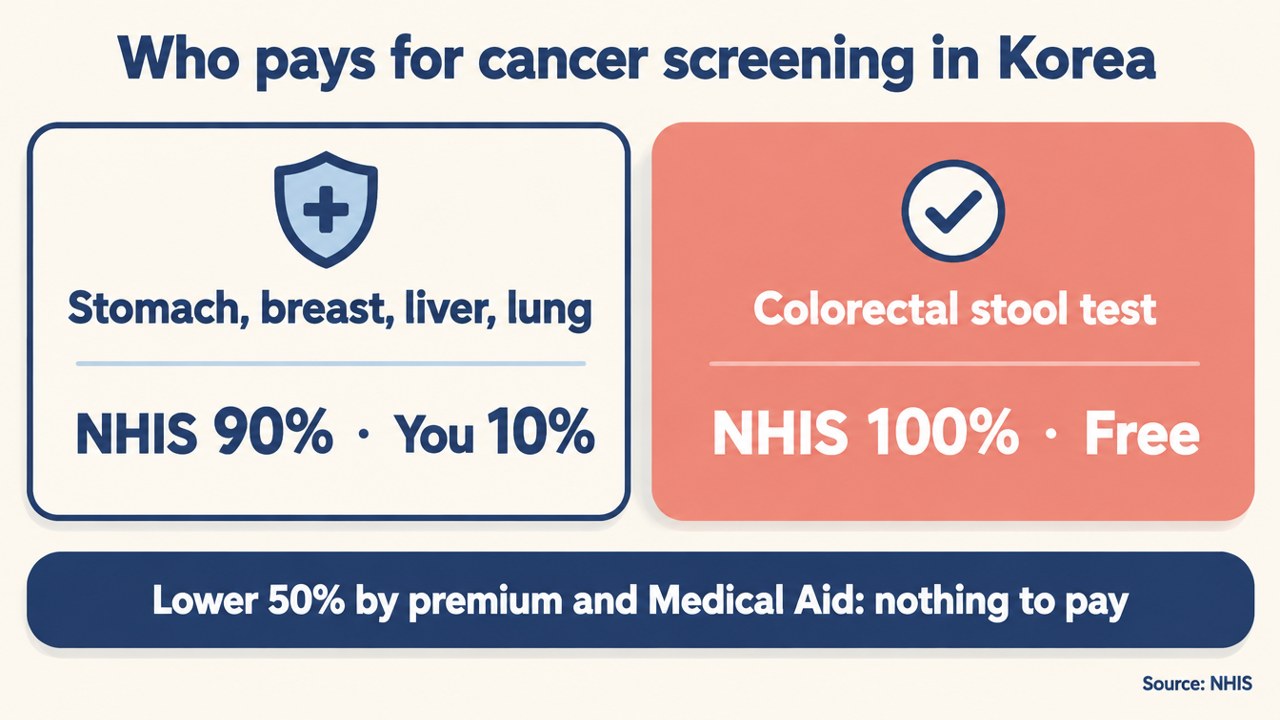
Cost is where colorectal screening differs from the other national cancer checks. Here’s how the official cost rules compare:
| Screening | Who pays (NHIS subscriber, higher 50% by premium) | Lower 50% by premium, or Medical Aid |
|---|---|---|
| Stomach, breast, liver, lung | NHIS 90%, you 10% | Nothing to pay |
| Colorectal (stool test) | NHIS 100%, nothing to pay | Nothing to pay |
| Cervical | NHIS 100%, nothing to pay | Nothing to pay |
Source: NHIS cancer screening page and NHIS English benefits page; National Cancer Information Center cost table. The “lower 50%” cut-off uses your premium from November of the previous year.
So you may have read that national cancer screening costs “10%”. For colorectal screening that isn’t true for anyone. The stool test is free whatever your income, and the follow-up colonoscopy after a positive test is part of the same programme.
What the programme doesn’t cover, according to the National Cancer Information Center and NHIS:
- Sedation (“sleep”) colonoscopy. The extra cost of sedation is yours.
- Polyp removal (polypectomy). Extra costs from removing polyps are yours. Biopsies taken for diagnosis during the screening colonoscopy are supported “in full or in part”.
- A colonoscopy without a stool test first. If you book a colonoscopy directly, without the stool test, you pay the whole cost.
The last point catches many people out. If you want the programme to pay for your colonoscopy, the order matters: stool test first, then a colonoscopy only if the result is positive.
How the stool test works
The national programme’s first step is a fecal occult blood test. NHIS and KDCA call it FOBT. A 2025 review in the Korean Journal of Gastroenterology describes Korea’s programme as using the immunochemical version, the FIT. MedlinePlus (US National Library of Medicine) explains that a FIT uses an antibody that sticks to haemoglobin (blood) in stool. It’s considered better at finding blood than the older chemical (guaiac) test, and, unlike some guaiac tests, it doesn’t usually require diet changes beforehand.
In practice it’s a small sample. National Health Insurance Ilsan Hospital, for example, asks for a stool sample “about the size of a ginkgo nut” in a collection tube or a dry plastic container. You hand it in at the checkup centre, and the hospital still asks you to book even if you’re only dropping off a sample. Practices vary, so ask your clinic for a container and instructions when you book.
Results come from the checkup clinic within 15 days of the test, by post or email, according to NHIS and the National Cancer Information Center.
What a positive result means, and what it doesn’t
A positive stool test (잠혈반응 있음, “occult blood reaction present”) means a trace of blood was found in your sample. It is not a cancer diagnosis. MedlinePlus lists many other possible causes of hidden blood, including polyps, haemorrhoids, diverticulosis, ulcers and inflammatory bowel disease. It also notes that the stool test alone can’t diagnose any condition. The US National Cancer Institute (NCI) warns that screening tests can give false positives, where the result looks abnormal but there’s no cancer, and false negatives.
The answer is the next step, not panic. For a positive result, the Korean programme offers a colonoscopy. If a colonoscopy is difficult for you, KDCA says a double-contrast barium enema (대장 이중조영검사) can be used instead. Research shows many people never take this step: the Korean Journal of Gastroenterology review reports that only about 47% of people with a positive screening result go on to have the follow-up test. Waiting doesn’t make a positive result go away.
A negative result is reassuring but not a guarantee, which is why the test is repeated every year. MedlinePlus also notes that FIT-based screening has to be done annually to work. And screening is for people without symptoms. The US CDC lists symptoms such as a change in bowel habits, blood in or on the stool, abdominal pain that doesn’t go away, unexplained weight loss and low iron (anaemia). If you have any of these, see a doctor. Don’t wait for your next screening slot.
The follow-up colonoscopy: what happens and what’s covered
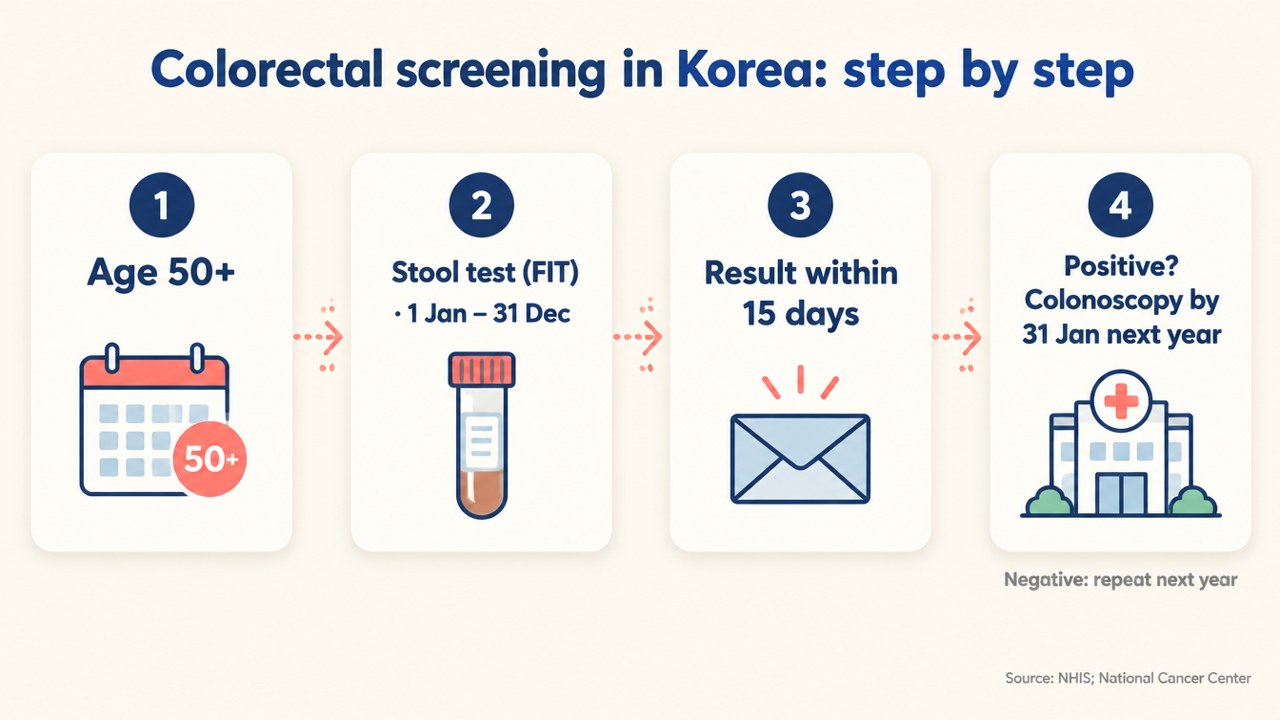
The stool test is stage 1 and the colonoscopy is stage 2. Here’s how it works, step by step:
| Step | What happens | Deadline / timing | Cost under the programme |
|---|---|---|---|
| 1. Check eligibility | Age 50+ in 2026; NHIS notice or 건강검진 대상조회 | Any time in 2026 | — |
| 2. Stool test (FIT) | Hand in a small stool sample at a designated clinic | 1 Jan–31 Dec 2026 (no extension) | Free |
| 3. Result | Letter or email from the clinic | Within 15 days | — |
| 4a. Negative | Nothing more this year | Repeat in 2027 | — |
| 4b. Positive | Book a colonoscopy (or barium enema if colonoscopy is difficult) | By 31 Jan 2027 | Colonoscopy and biopsy supported; sedation and polyp removal extra |
| 5. After colonoscopy | Doctor explains findings and any biopsy result | Next interval set by your doctor | — |
Sources: NHIS (건강iN cancer screening page), National Cancer Information Center, KDCA. The 31 January extension is for stage-2 tests after a stage-1 stomach or colorectal finding.
At NHIS Ilsan Hospital, a screening colonoscopy is listed as taking 1 to 1.5 hours, depending on the person. With your consent, the hospital removes polyps under 1 cm during the procedure, and refers larger ones to its gastroenterology department. Other hospitals may have their own rules, so ask in advance whether polyps can be removed on the same day and what that would cost. A colonoscopy needs bowel preparation beforehand. The clinic will give you instructions. The Korean Journal of Gastroenterology review notes that how well the bowel is cleaned strongly affects how accurate the exam is.
NCI notes that serious problems from colonoscopy are rare but can include tears in the bowel lining and bleeding, more often when a biopsy or polyp removal is done. Sedation can also carry heart and lung risks. When you book, tell the clinic which medicines you take, and it will tell you whether anything needs to change before the procedure.
Timing: why November and December matter
The national screening year runs 1 January to 31 December, and NHIS says there’s no extension for stage 1. If you’re 50+ and haven’t handed in a stool sample in 2026, book now. If that slot ends up positive, you still have until 31 January 2027 for the colonoscopy.
Missed a previous year? NHIS says people who missed the previous year can ask to be added to this year’s list, but the cost rules may differ, so call 1577-1000 or a local branch first. Our guide to Korea’s 31 December checkup deadline and catch-up rules covers booking, ID and missed checkups in more detail.
What’s changing: colonoscopy as the first test from 2028 (planned)

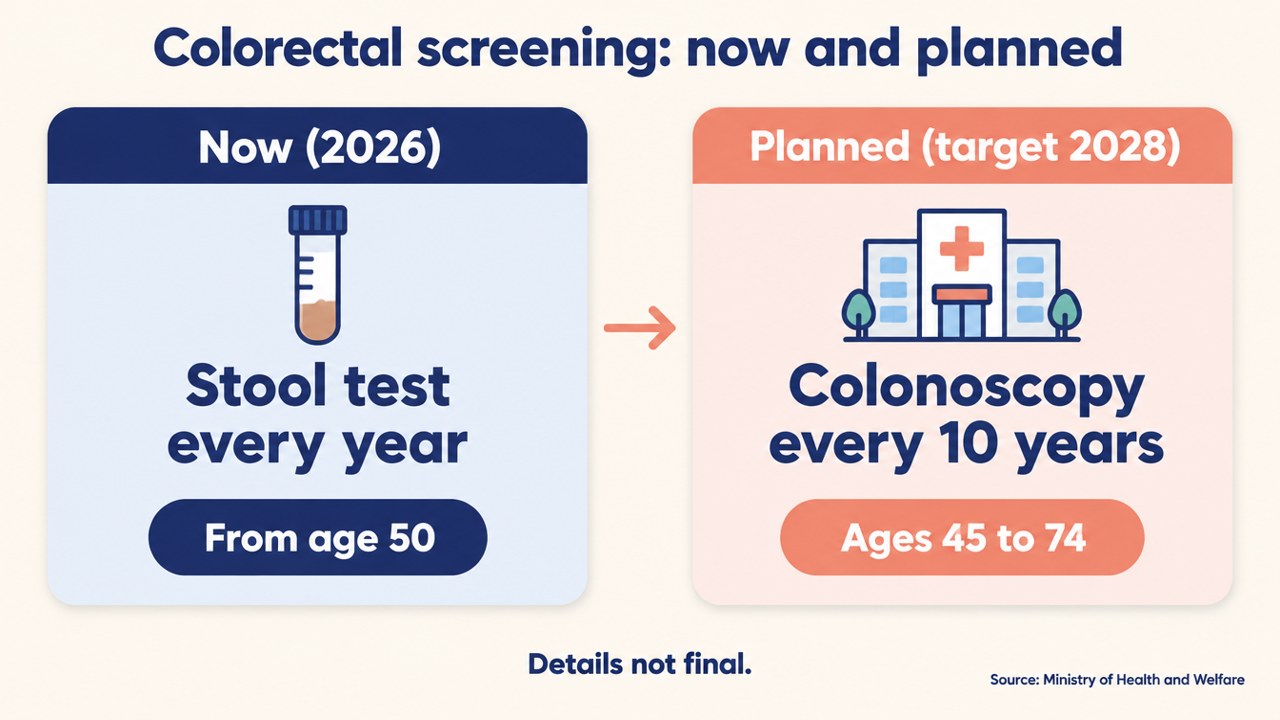
The current system won’t last forever. On 24 February 2026 the National Cancer Control Committee approved the 5th Comprehensive Cancer Control Plan (2026–2030). According to the Ministry of Health and Welfare’s announcement on Korea.kr, the plan will make colonoscopy the basic screening test instead of the stool test, recommended every 10 years for adults aged 45 to 74. The target start date is 2028. The government said colorectal screening has the lowest participation of the six cancers, 40.3%, and Yonhap reported the same figure as of 2024.
This follows a revised National Cancer Center recommendation in 2025 (45–74, colonoscopy every 10 years) and a colonoscopy screening pilot run in Goyang, Gimpo and Paju from 2019 to 2024. At a February briefing reported by Newspim, a ministry official said rules for people already past 45 when the change starts still had to be decided. In October 2026, the president of a checkup physicians’ society (대한검진의학회) told reporters that the detailed implementation plan was still to come, and that the 2028 system is effectively set to use both FIT and colonoscopy.
What this means for you now: nothing changes in 2026 or 2027 as far as official notices show. The free annual stool test at 50+ is the current programme, and a colonoscopy without a positive stool test is still self-paid. We’ll update this guide when the ministry publishes the detailed rules.
A practical checklist
| Before you book | Why |
|---|---|
| Confirm you’re on the 2026 list (NHIS site/app or 1577-1000) | Deferral applies if you had a colonoscopy within 5 years |
| Ask the clinic for a stool container and instructions | Sample handling differs by clinic |
| Decide in advance about sedation | Sedation costs are not covered |
| Ask whether polyps can be removed the same day, and the cost | Polyp removal is billed separately |
| Tell the clinic which medicines you take | Some may need changes before a colonoscopy; the clinic will advise |
| Note your symptoms, if any | Symptoms need a doctor, not a screening slot |
Frequently asked questions
Q. When does the 2026 colon cancer stool test window close?
December 31, 2026 — 48 days left from November 13. NHIS says the cancer screening period runs every year from January 1 to December 31 with no extension. If the first-step stool test is positive, the second-step colonoscopy window runs until January 31 of the following year (NHIS cancer screening guide, checked Nov 8).
Q. Is colon cancer screening in Korea really free?
Yes, for NHIS subscribers aged 50 and over. NHIS pays the full cost of colorectal cancer screening, unlike stomach, breast, liver and lung screening, where higher earners pay 10%. Sedation and polyp removal during a follow-up colonoscopy may cost extra.
Q. Can I skip the stool test and get a free colonoscopy?
Not under the current programme. NHIS says a colonoscopy done without the stool test first is entirely self-paid. The programme covers a colonoscopy only after a positive stool result.
Q. My stool test was positive. Do I have cancer?
Not necessarily. A positive result means hidden blood was found, which can come from polyps, haemorrhoids, ulcers or inflammation as well as cancer. The colonoscopy finds the cause. Book it by 31 January of the following year so it stays within the programme.
Q. I’m a foreigner with NHIS. Am I eligible?
Yes, if you’re enrolled in National Health Insurance and aged 50 or over. The checkup is a benefit of NHIS membership, and the NHIS English page lists colorectal screening with no co-payment. Check your eligibility on the NHIS site or call 1577-1000.
Q. I had a colonoscopy three years ago. Do I still need the stool test?
NHIS defers people from colorectal screening for five years after a colonoscopy done through screening or billed to health insurance, though you can ask to be added. When to have your next exam depends on what that colonoscopy found, so ask your doctor.
Related reading
- Korea health checkup Dec 31 deadline and catch-up
- Korea stomach cancer screening / gastroscopy
- Korea lung cancer screening / low-dose CT
Sources
- National Health Insurance Service, Cancer screening: eligibility, intervals and cost (checked 5 November 2026)
- National Health Insurance Service (건강iN), Cancer screening guide: deferral, cost, screening period (checked 5 November 2026)
- National Health Insurance Service (English), Benefits: health and cancer checkups (checked 5 November 2026)
- National Cancer Center, National Cancer Information Center, Screening intervals and methods and Results and cost (checked 5 November 2026)
- Korea Disease Control and Prevention Agency, National Health Information Portal, Health checkups (cancer screening) (checked 5 November 2026)
- Korea.kr (Ministry of Health and Welfare), 5th Comprehensive Cancer Control Plan: colonoscopy screening from 45, 25 February 2026 (checked 5 November 2026)
- MedlinePlus (US National Library of Medicine), Fecal occult blood test (FOBT) (checked 5 November 2026)
- National Cancer Institute, Colorectal cancer screening (PDQ), patient version (checked 5 November 2026)
- US Centers for Disease Control and Prevention, Symptoms of colorectal cancer (checked 5 November 2026)
- Newspim, Q&A: Ministry on colonoscopy screening from 45, every 10 years, 24 February 2026 (checked 5 November 2026)
- National Health Insurance Ilsan Hospital, National checkup centre: cancer screening (checked 5 November 2026)
- Korean Journal of Gastroenterology, National colorectal cancer screening program: FIT vs colonoscopy (2025; checked 5 November 2026)
- Yonhap News, Lung cancer screening to widen; colonoscopy for colorectal screening, 24 February 2026 (checked 5 November 2026)
- Uihak Sinmun / Ilgan Bosa (의학신문), Colonoscopy in national screening takes shape, 11 October 2026 (checked 5 November 2026)
This article is general health information, not medical advice. It was written with AI assistance and fact-checked against official sources. Only your doctor can interpret your results and decide on tests or treatment.






3 Comments