Korea’s Long-Term Care Insurance Grades: How Grades 1–5 Work, How to Apply for a Parent, and What You Pay in 2026
Last checked: 2026-11-11 (KST); countdown updated 2026-11-13; first published 5 November 2026. The 2027 home-care limits apply from January 1, 2027 — 49 days from November 13 (re-read on the MOHW long-term care committee notice on Nov 11). · General information, not legal or financial advice. Your parent’s grade, benefits and copay are decided by NHIS. Check your own case with NHIS on 1577-1000.
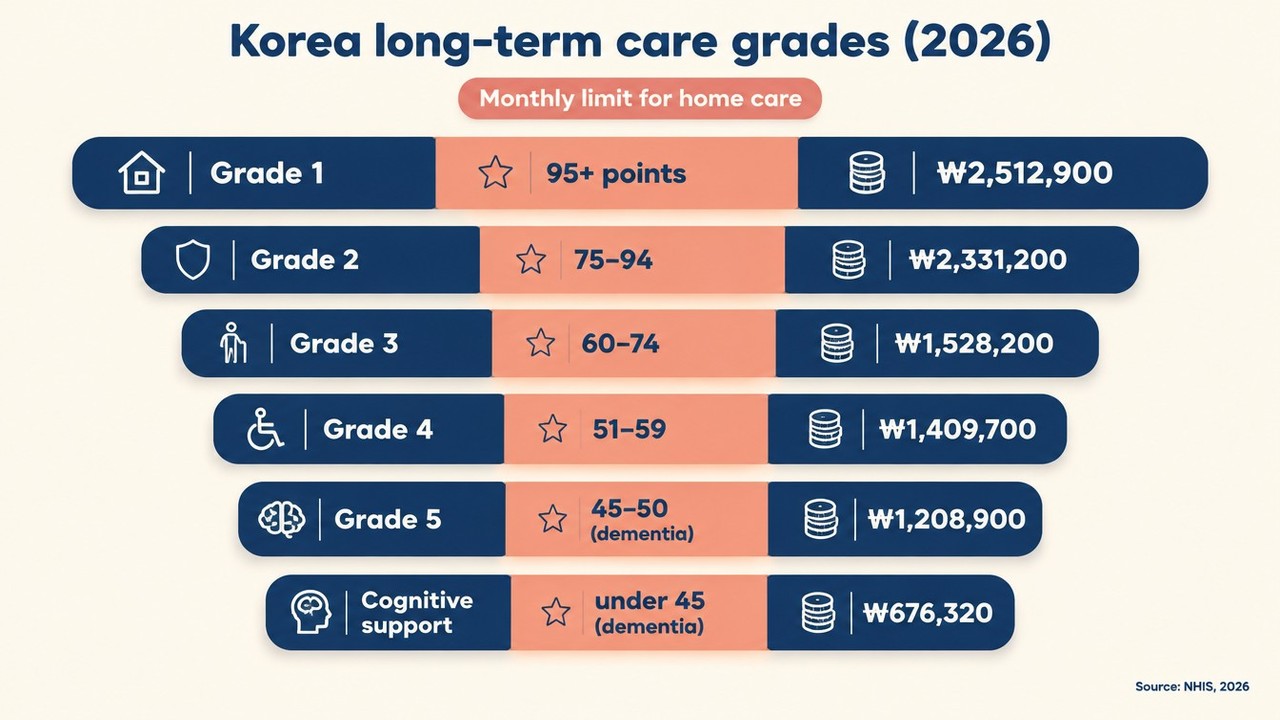
Quick answer: From January 1, 2027 — 49 days from November 13 — the grade 1 home-care limit rises to ₩2,891,400 and grade 2 to ₩2,682,300 a month (MOHW, 30 October 2026). Korea’s long-term care insurance gives a parent aged 65+ (or younger, with dementia, stroke or another geriatric disease) one of six grades, based on a score out of a home assessment by the National Health Insurance Service (NHIS). Grade 1 is 95 points or more and the cognitive-support grade is under 45 points, for dementia only. Grades 1–2 can use a care home or care at home. Grades 3–5 normally use care at home. In 2026 the monthly home-care limit runs from ₩2,512,900 (grade 1) down to ₩676,320 (cognitive-support grade). The family pays 15% of home care and 20% of facility care, and lower-income households pay less: 9%/12%, 6%/8% or nothing. NHIS should decide within 30 days of the application.

The six grades at a glance
The grade decides two things: which services your parent can use, and how much of them insurance will pay for each month. It comes from a “long-term care recognition score” that NHIS works out from a home visit. The bands are set in the Enforcement Decree of the Long-Term Care Insurance Act (article 7), and NHIS publishes the same table in Korean and English.
| Grade | Score | Who it describes (NHIS wording, paraphrased) | Services | 2026 monthly limit for home care |
|---|---|---|---|---|
| Grade 1 | 95 or more | Needs another person’s help with everything in daily life | Home care or a care facility | ₩2,512,900 |
| Grade 2 | 75 to under 95 | Needs help with most of daily life | Home care or a care facility | ₩2,331,200 |
| Grade 3 | 60 to under 75 | Needs help with part of daily life | Home care (facility only if the committee approves) | ₩1,528,200 |
| Grade 4 | 51 to under 60 | Needs help with some of daily life | Home care (facility only if the committee approves) | ₩1,409,700 |
| Grade 5 | 45 to under 51 | Has dementia (geriatric disease) | Home care (facility only if the committee approves) | ₩1,208,900 |
| Cognitive-support | Under 45 | Has dementia (geriatric disease) | Day/night care, short-term care, all-day home visits, welfare equipment | ₩676,320 |
Sources: Enforcement Decree art. 7 and NHIS grade pages (score bands); NHIS long-term care fee calculator, 2026 (monthly limits), cross-checked with a county office page and a Seoul senior welfare centre. Facility rules: Ministry of Health and Welfare (MOHW) Notice 2026-189, art. 2.
Three points families often miss:
- The monthly limit only applies to home care. Visits, day/night care centres and similar services count against it. Facility care is paid per day instead (see the cost section below).
- Anything above the limit is 100% yours. Under article 40 of the Act, costs beyond the monthly limit are paid in full by the family.
- Grades 3–5 can still get a place in a care home if the grading committee accepts one of three reasons, set out in MOHW Notice 2026-189: no family member can provide care, the home is unsuitable, or dementia-related behaviour makes care at home impossible.
Who can get a grade
Under article 12 of the Act and NHIS’s application page, the person needing care must meet both of these:
- Age or illness: 65 or older, or under 65 with a geriatric disease such as dementia or cerebrovascular disease (stroke).
- Coverage: a National Health Insurance member or dependant, or a Medical Aid recipient.
On top of that, the person must have had difficulty with daily life for six months or more (article 15 of the Act). A short recovery after surgery normally isn’t what the system is for.
Foreign residents and families abroad
Long-term care insurance sits inside National Health Insurance. Under article 7 of the Act, NHIS members are also long-term care members, and the premium is collected with the health premium. In 2026 it works out to 13.14% of the health premium; we explain how it appears on a payslip in our guide to Korea’s four social insurance deductions. So an insured foreign resident, or an insured parent living with you in Korea, can in principle be assessed in the same way.
Two exceptions are worth knowing:
- Some foreign workers can opt out. Under article 7(4) of the Act and the Enforcement Decree, workers under the Employment Permit System and employee subscribers holding D-3 or E-8 visas may ask to be excluded from long-term care insurance. Someone who opted out is not a long-term care member, so ask NHIS before applying.
- Foreigners cannot apply online. NHIS says the online application isn’t open to foreigners, so apply at an NHIS branch, by post or by fax.
If you’re not sure whether your parent is covered as your dependant, see our guide to Korea health insurance for foreigners in 2026.
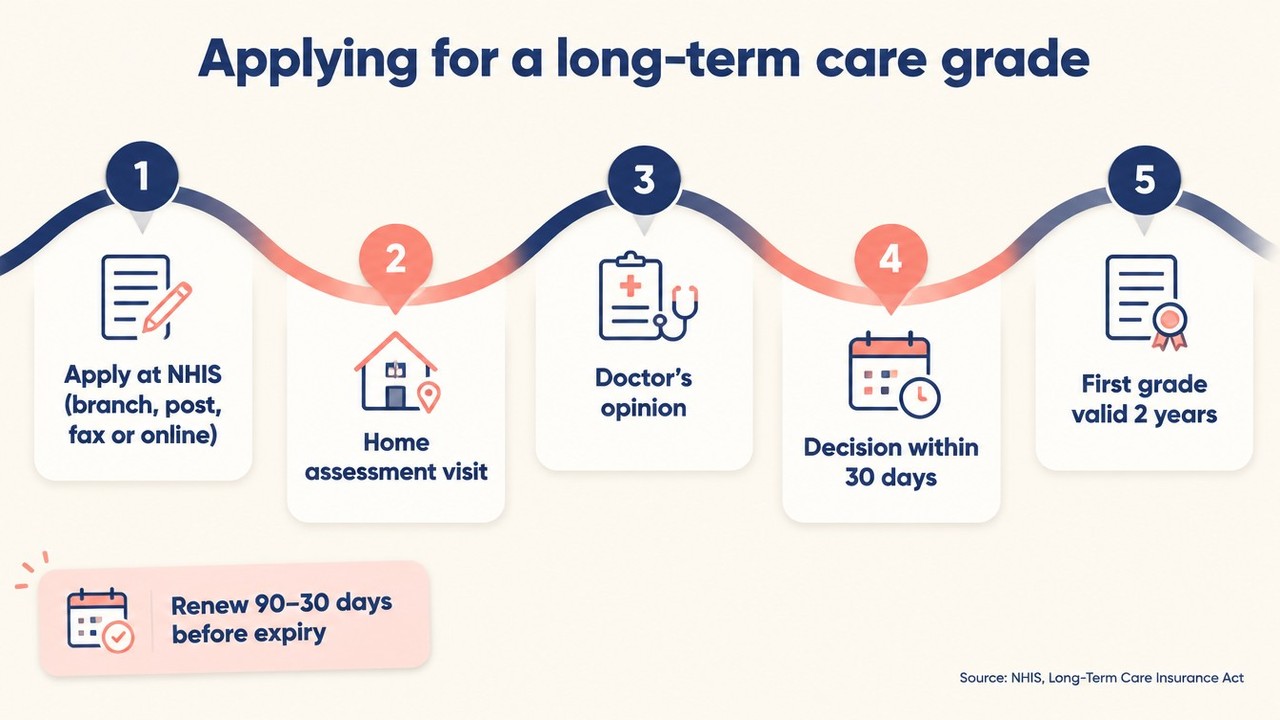
How to apply, step by step
| Step | What happens | Timing |
|---|---|---|
| 1. Application | Submit the form at an NHIS branch, by post, by fax or online (online: Koreans aged 65+, or renewals) | Any time |
| 2. Home assessment | NHIS staff visit and complete the assessment. NHIS tells you the date in advance | After the application |
| 3. Doctor’s opinion | A doctor’s opinion form (의사소견서) is sent to NHIS | Under 65: proof of the illness is attached when applying. 65+: may be sent later, before the committee meets |
| 4. Grading committee | The committee sets the grade from the score and the doctor’s opinion | Within 30 days of the application; can be extended by up to 30 days |
| 5. Notice | NHIS sends the grade, a long-term care certificate and a standard care-use plan | After the decision |
| 6. Choose a provider | You sign a contract with a home-care agency, day centre or facility | Services start after the contract |
Sources: NHIS application, grading and benefits pages; Long-Term Care Insurance Act arts. 13–16.
Who may apply. The parent, a family member or relative, an interested party, a social-welfare official, or (for a person with dementia) the head of a dementia relief centre. Adult children apply on their parent’s behalf all the time.
The home visit. NHIS uses a standard assessment of 90 items, and 65 of them across five areas give the score. The areas include physical function, cognition and behaviour, nursing needs and rehabilitation. Under article 14 of the Act, NHIS should try to send two or more staff. Be there if you can. Parents often overstate what they can do in front of strangers, and you can describe a normal bad day: nights, falls, bathing and toileting.
The committee. NHIS’s grading committee has 15 members and includes at least one doctor or Korean-medicine doctor.
The doctor’s opinion: who pays
The doctor’s opinion form costs money, and NHIS covers most of it if you use the request form it issues (발급의뢰서). Under article 4 of the Enforcement Rule:
| Applicant | Share paid by the family |
|---|---|
| General applicant | 20% |
| Medical Aid recipient (other than basic livelihood), or a low-income or hardship case | 10% |
| Basic livelihood Medical Aid recipient | Nothing (paid by the local government) |
| Got the form without NHIS’s request form | 100% at first. If a grade is granted, you can claim back the share NHIS would have paid |
The 2026 fee in NHIS’s calculator is ₩62,020 at a clinic or hospital and ₩60,570 at a public health centre. Calculated: 20% of ₩62,020 is ₩12,404, and 10% is ₩6,202. People expected to be grade 1–2 whose mobility is severely limited, and people living on islands or in remote areas, may be excused from submitting it.
How long a grade lasts, and renewals
- First grant: 2 years.
- After a renewal (from 1 July 2025): grade 1 5 years, grades 2–4 4 years, grade 5 and cognitive-support 2 years. The committee can shorten or lengthen this by up to six months.
- When to renew: between 90 and 30 days before the grade expires.
- If your parent gets worse: you don’t have to wait for the renewal. You can apply for a change of grade.
- If you disagree: you can ask NHIS to review the decision within 90 days of learning about it (and no later than 180 days after it). A further review request is possible within 90 days of the review result.
Sources: Enforcement Decree art. 8; MOHW press release, 24 June 2025; Enforcement Rule; Act arts. 55–56.
What you actually pay: the copay
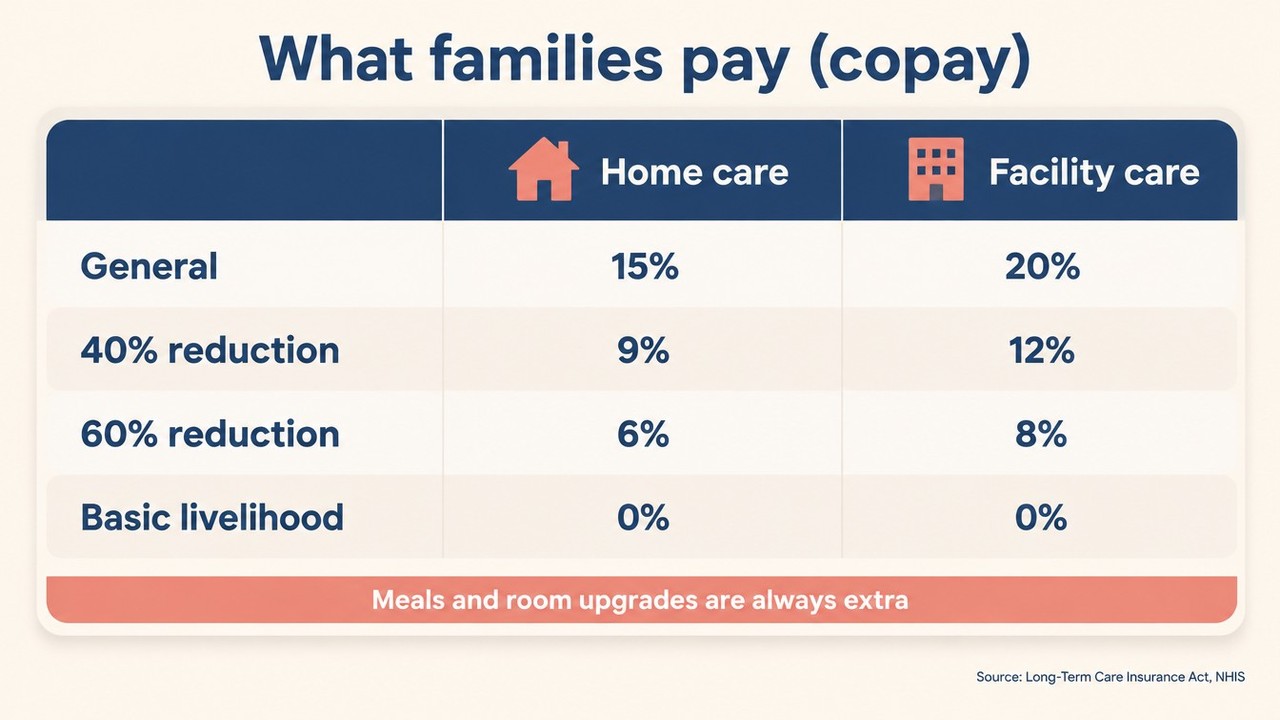
Insurance pays most of the cost of covered care, and the family pays a share called the copay (본인부담금). The share depends on where care happens and on household income:
| Household | Home care | Facility care |
|---|---|---|
| General | 15% | 20% |
| 40% reduction: households in the 25–50% premium band | 9% | 12% |
| 60% reduction: bottom 25% by premium (employee subscribers also face a property test), Medical Aid recipients other than basic livelihood, people with NHIS health-copay relief, hardship cases | 6% | 8% |
| Basic livelihood Medical Aid recipients | 0% | 0% |
Sources: Long-Term Care Insurance Act art. 40 and Enforcement Decree art. 15-8; NHIS copay page; Easylaw (Ministry of Government Legislation); Seocho senior welfare centre; options in the NHIS 2026 fee calculator.
Whatever the rate, some costs are always paid by the family: meal ingredients, a better room than the standard one, haircuts, and anything not covered by the long-term care fee schedule. In a care home, meals are often a large part of the monthly bill, so ask each facility for its written price list.
Worked examples with 2026 fees
The figures below use per-visit and per-day fees from NHIS’s 2026 calculator. Every total is calculated by us and is for illustration only. Real bills depend on the services actually used, extra charges and non-covered items.
| 2026 fee (NHIS calculator) | Amount |
|---|---|
| Home visit care, 3 hours (180 minutes) | ₩57,020 per visit |
| Home visit care, 1 hour | ₩25,320 per visit |
| Day/night care, 8 to under 10 hours, grade 3 | ₩59,640 per day |
| Day/night care, 8 to under 10 hours, grade 1 | ₩69,730 per day |
| Care home, grade 1 / grade 2 / grades 3–5 | ₩93,070 / ₩86,340 / ₩81,540 per day (higher-staffing rate) |
| Group home, grade 1 / grade 2 / grades 3–5 | ₩74,590 / ₩69,210 / ₩63,800 per day |
Example A: grade 3, day care centre on weekdays. 20 days × ₩59,640 = ₩1,192,800 (calculated), which is inside the ₩1,528,200 grade 3 limit. Family share: 15% = ₩178,920, 9% = ₩107,352, 6% = ₩71,568, 0% for basic livelihood recipients. Meals are extra.
Example B: grade 1, three-hour home visits. 44 visits × ₩57,020 = ₩2,508,880 (calculated), just inside the ₩2,512,900 grade 1 limit. That matches MOHW’s own statement that grade 1 can currently use up to 44 three-hour visits a month. Family share at 15%: ₩376,332. A 45th visit would go over the limit, and the amount above it would be paid in full by the family.
Example C: grade 3 in a care home, after committee approval. 30 days × ₩81,540 = ₩2,446,200 (calculated). Family share at 20%: ₩489,240. At 12% it is ₩293,544, and at 8% ₩195,696. Meals and room upgrades are extra. Some care homes are on a lower per-day rate (₩77,540 for grades 3–5), which gives ₩465,240 at 20%.
What’s changing in 2027
On 30 October 2026, MOHW’s long-term care committee approved changes for 2027:
- Grade 1 home-care limit: ₩2,512,900 → ₩2,891,400 (+₩378,500).
- Grade 2: ₩2,331,200 → ₩2,682,300 (+₩351,100).
- Three-hour home visits: grade 1 from 44 to 48 a month, grade 2 from 40 to 45 a month.
- Other grades: limits rise too (MOHW gives a range of ₩23,880 to ₩378,500 across grades). The exact 2027 amounts for grades 3–5 and the cognitive-support grade hadn’t been published in full when we checked, so we haven’t listed them.
- Premium: the long-term care rate rises from 0.9448% to 0.9994% of income, which is 13.90% of the health premium. The average household premium goes from ₩19,029 to about ₩20,129 a month.
Sources: MOHW committee notice and press release, 30 October 2026; NoCut News English and Etoday coverage.
Rechecked on November 11, 2026 (MOHW): the committee notice still reads grade 1 ₩2,512,900 → ₩2,891,400 and grade 2 ₩2,331,200 → ₩2,682,300 from 2027, with home-care limits rising by ₩23,880 to ₩378,500 depending on grade (it still gives no full table for grades 3–5 and the cognitive-support grade). Two more items for families: the home-nursing visit add-on rises from ₩3,000 to ₩5,000 per visit without raising the recipient’s copay, and the all-day home-care fee goes from ₩177,680 to ₩206,030. The premium side is unchanged from the October figures: 0.9994% of income, 13.90% of the health premium. What it means for the family share (our calculation, standard 15% home-care copay on a fully used limit): grade 1 goes from about ₩376,935 to ₩433,710 a month and grade 2 from about ₩349,680 to ₩402,345; households on the 9% or 6% reduced rates pay proportionally less (MOHW, read 11 November 2026).
If your parent is grade 1 or 2 and already uses nearly the full limit, the extra visits from January 2027 are worth planning with the care agency now.
Four common situations

You’re in your 40s, working abroad, and your father (78) lives alone in Korea. A relative or a community-centre social-welfare official can apply for him, so you don’t need to fly in. Ask them to be present at the home visit. Once he has a grade, all-day home visits or day care can cover the hours no one else can.
You’re in your 50s, working full time, and your mother (83) has early dementia. If she scores under 45, she still qualifies for the cognitive-support grade (₩676,320 a month in 2026). That covers day/night care and short-term care, which are often what makes a working week possible. If her score rises later, apply for a change of grade.
You’re in your 60s and caring for a spouse after a stroke. The under-65 route applies too: a stroke is a geriatric disease under the Act, so a spouse aged 62 can be assessed. Attach the doctor’s documents confirming the illness when you apply. Families caring for a grade 1–2 holder or a person with dementia can also use the family respite scheme: 12 days a year from 2026 (up from 11) of short-term care or all-day home visits, so the main carer can rest.
You’re a foreign resident whose parent came to live with you. First confirm that the parent is enrolled in National Health Insurance as your dependant or as their own subscriber. Then apply in person, by post or by fax, because foreigners can’t apply online. Ask the NHIS branch whether English-language help is available. The NHIS call centre is 1577-1000, and its English line is 033-811-2000. Long-term care is separate from the basic pension, which is for Korean nationals. Don’t assume one depends on the other.
A short checklist before you apply
| Before the visit | Why it helps |
|---|---|
| Write down a week of real difficulties (falls, nights, toileting, wandering) | The score reflects what the assessor learns |
| Gather hospital records and medicine lists | The doctor’s opinion and committee use them |
| Get the doctor’s opinion with NHIS’s request form | Without it you pay 100% up front |
| Check whether your household may qualify for 9%/6% | Reductions change the monthly bill a lot |
| Ask providers for a written price list, including meals | Non-covered items are never reduced |
| Put the expiry date in your calendar | Renewal opens 90 days before it |
Frequently asked questions
Q. Can I apply for my parent’s long-term care grade on their behalf?
Yes. Family members and relatives can apply for the person needing care, and so can an interested party, a social-welfare official or, for a person with dementia, the head of a dementia relief centre. NHIS will still visit the parent at home for the assessment.
Q. How long does it take to get a grade?
The grading committee should decide within 30 days of the application. Under article 16 of the Act this can be extended by up to 30 days in special cases, such as further investigation.
Q. Can a grade 3 parent move into a care home?
Normally grades 3–5 use home care. A care home is possible if the grading committee accepts one of three reasons: no family member can provide care, the housing is unsuitable, or dementia-related behaviour makes care at home impossible.
Q. What happens if we spend more than the monthly limit?
Covered care up to the limit is shared between insurance and the family at your copay rate. Anything above the limit is paid in full by the family.
Q. Can a foreign resident get a long-term care grade?
Generally yes, if the person is a National Health Insurance member or dependant and meets the age or illness condition. Some foreign workers (Employment Permit System, D-3 and E-8 employee subscribers) can opt out of long-term care insurance, and foreigners must apply offline rather than online. Confirm your case with NHIS.
Q. When do the 2027 long-term care limits start, and what changes for grades 1 and 2?
On January 1, 2027 — 49 days from November 13. MOHW lists the grade 1 home-care limit at ₩2,891,400 (from ₩2,512,900) and grade 2 at ₩2,682,300 (from ₩2,331,200), which allows up to 48 three-hour home visits a month for grade 1 (from 44) and 45 for grade 2 (from 40). At the standard 15% copay, a fully used grade 1 limit costs the family about ₩433,710 a month (our calculation). Plan the extra visits with the care agency in December.
Related reading
- Korea health insurance after retirement: 2027 premium math
- Korea NPS catch-up: apply by Nov 30 before the 10% rate
- Korea long-term care grade appeal: 90-day guide
Sources
- Ministry of Health and Welfare, 2026 5th Long-Term Care Committee (30 October 2026: 2027 limits for grades 1–2, visit counts, nursing add-on, all-day home-care fee, 0.9994% / 13.90%) (checked 11 November 2026)
- National Health Insurance Service (NHIS), Long-term care: applying for recognition (checked 5 November 2026)
- NHIS, Long-term care: grading and grade criteria (checked 5 November 2026)
- NHIS, Long-term care benefits and copay (checked 5 November 2026)
- NHIS English site, Long-term care insurance benefit and grade table (checked 5 November 2026)
- NHIS Long-Term Care, 2026 fee and monthly limit calculator (2026 figures, checked 5 November 2026)
- NHIS law database, Long-Term Care Insurance Act, Enforcement Decree and Enforcement Rule (checked 5 November 2026)
- Korea Law Information Center, MOHW Notice 2026-189 on long-term care benefits and fees (checked 5 November 2026)
- Ministry of Government Legislation Easylaw, Long-term care copay (checked 5 November 2026)
- Ministry of Health and Welfare, Grade renewal validity extended, 24 June 2025 (checked 5 November 2026)
- Ministry of Health and Welfare via Korea.kr, Home-care monthly limits for 2027, 30 October 2026 (checked 5 November 2026)
- Goesan County, Long-term care insurance services (checked 5 November 2026)
- Seocho-gu Yangjae Senior Welfare Centre, Long-term care guide (checked 5 November 2026)
- NoCut News English, Next year long-term care insurance premium up 1,100 won per month, 30 October 2026 (checked 5 November 2026)
- Etoday, Home visits up to 48 a month from next year, 30 October 2026 (checked 5 November 2026)
- Newspim, Home-care limits raised by up to ₩370,000, 30 October 2026 (checked 5 November 2026)
This article is general information, not legal or financial advice. It was written with AI assistance and fact-checked against official sources. Grades, benefits and copays are decided by NHIS for each person; confirm your own case with NHIS (1577-1000) before making care decisions.
4 Comments