Korea’s October 2026 Exports: $115.3 Billion, Chips Nearly Half of the Total
Haesul Global economy desk (AI-assisted). Data as of 3 November 2026 (KST), from the Ministry of Trade, Industry and Resources (MOTIR) release of 1 November 2026, compiled with Korea Customs Service clearance data. General information, not investment advice.
Quick answer: Korea exported $115.28 billion of goods in October 2026, up 93.7% from a year earlier. Imports were $72.78 billion (+36.0%), so the trade surplus was $42.50 billion. Semiconductors alone were $56.44 billion (+259.4%), close to half of everything Korea shipped. January–October exports reached $930.0 billion, which leaves $70 billion to the first-ever $1 trillion year.
October was the second month in a row above $110 billion, and only September 2026 was bigger. The headline growth rate looks extreme for a simple reason: last year’s October lost working days to the Chuseok holiday, so the base is unusually low. Below we split the number into items, markets and working days, and do the arithmetic the ministry leaves to readers. For what the export boom did to growth, see our Korea Q3 GDP explainer.
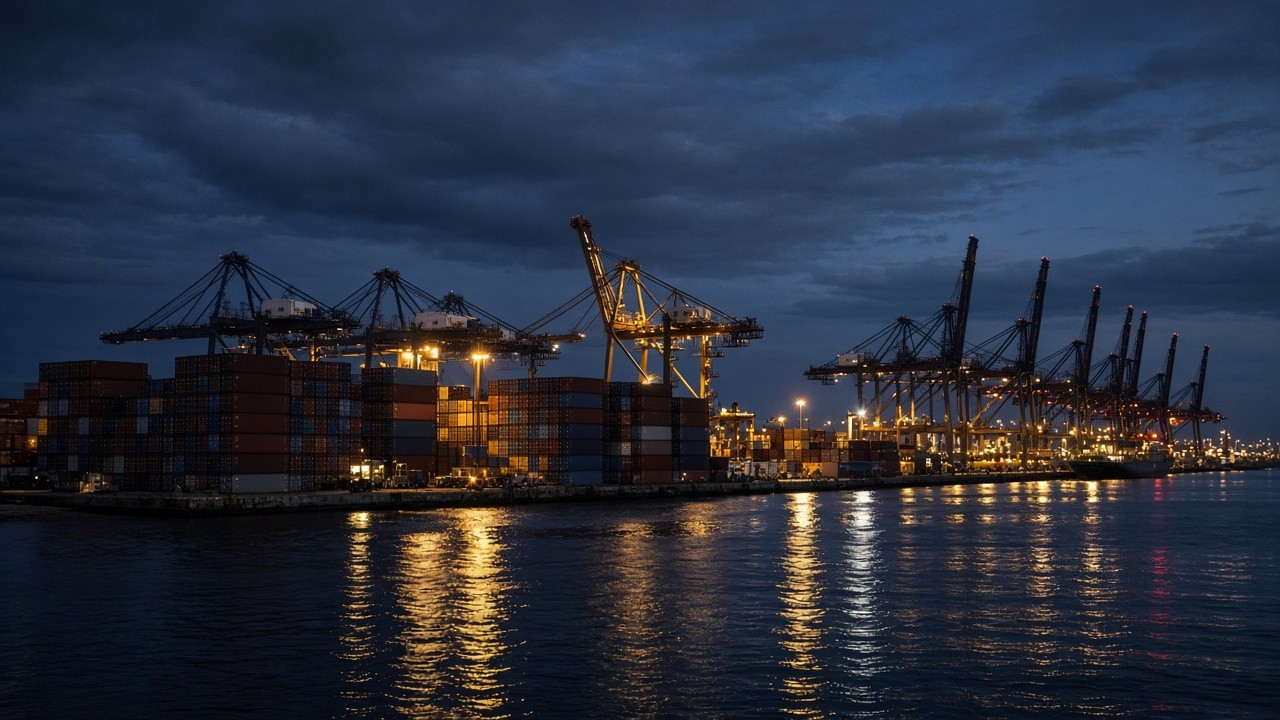
The October 2026 numbers at a glance
| Measure (October 2026) | Value | Change vs October 2025 |
|---|---|---|
| Exports | $115.28 billion | +93.7% |
| Imports | $72.78 billion | +36.0% |
| Trade balance | +$42.50 billion | up $36.50 billion |
| Semiconductor exports | $56.44 billion | +259.4% |
| Non-semiconductor exports | not given in dollars | +34% |
| Average daily exports (working-day adjusted) | $5.24 billion | +76% (76.1%) |
| January–October exports | $930.0 billion | +60.6% |
| January–October trade surplus | $294.9 billion | up $239.1 billion |
Sources: MOTIR English and Korean releases, 1–2 November 2026; cross-checked with Yonhap, The Asia Business Daily and Aju Business Daily, 1 November 2026.
In the ministry’s own ranking, October is the second-largest export month on record ($115.3 billion), behind September 2026 ($121.1 billion in the revised ranking table) and ahead of June 2026 ($102.0 billion). The same ranking puts October’s daily average ($5.24 billion) second, behind September’s $5.63 billion.
Worked calculation: what the growth rate really says
A 93.7% jump does not mean Korea’s economy doubled in a year. Three simple calculations put it in proportion. All three use only the official figures above; the results are our calculations, not ministry numbers.
- Implied October 2025 base. $115.28 billion ÷ 1.937 = about $59.5 billion. So October 2025 was a weak month to compare against, largely because the Chuseok holiday fell in October last year and in September this year. MOTIR says that shift added working days this October.
- How many working days? $115.28 billion ÷ $5.24 billion a day = about 22.0 working days, which matches the ministry’s detailed tables: 22 working days in October 2026 against 20 in October 2025. The daily figure rose 76.1%, less than the 93.7% headline. The gap between the two growth rates (about 18 points) is the calendar effect: two extra days on a base of 20 is 10% more time to ship goods (our calculation).
- How big are chips? $56.44 billion ÷ $115.28 billion = 49.0% on the rounded figures (the ministry’s figure is 48.9%, as reported by The Asia Business Daily). Everything else together is $115.28 − $56.44 = about $58.8 billion, up 34%.
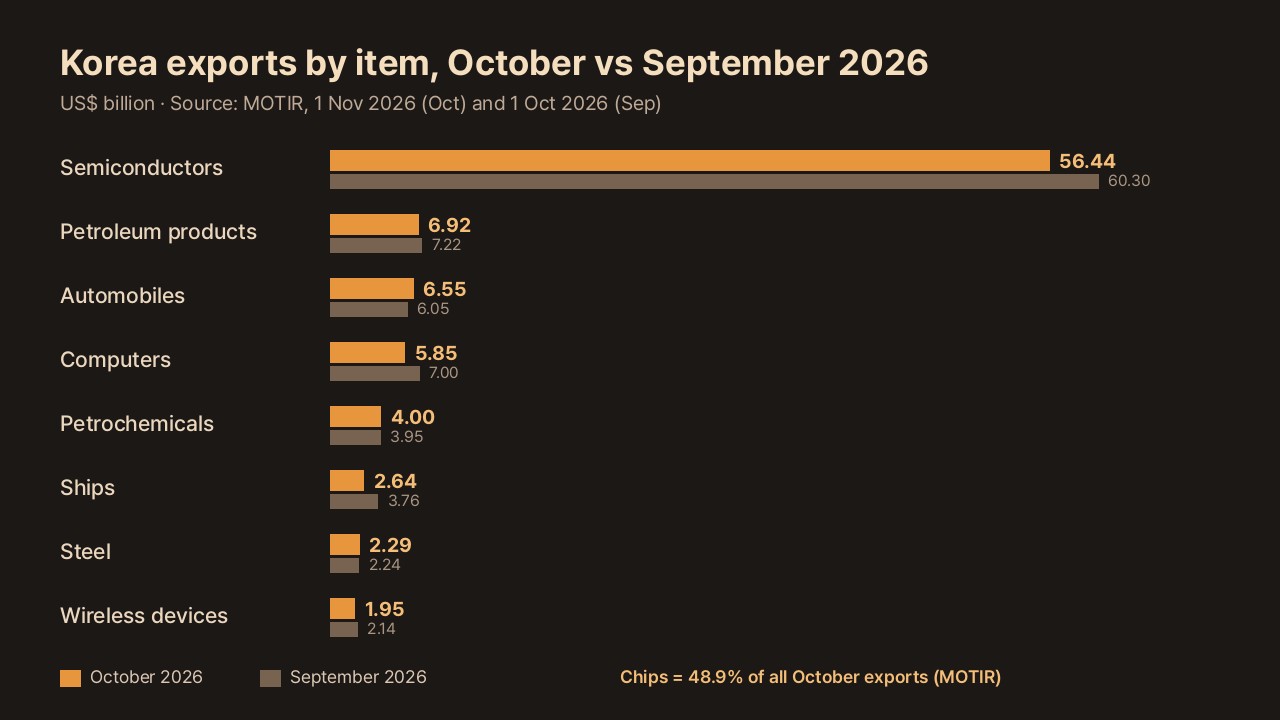
The second step is the one most foreign readers skip. If you compare October with September instead of with last year, the calendar problem disappears: daily exports fell from $5.63 billion in September to $5.24 billion in October, about −6.9% (our calculation). October was very strong, but it was not stronger than September.
Item by item: where the money came from
Exports rose for 18 of Korea’s 20 main export items. The table lists the ones the ministry described, with the month-on-month comparison against September 2026 from the ministry’s 1 October release.
| Item | October 2026 | YoY change | September 2026 |
|---|---|---|---|
| Semiconductors | $56.44 bn | +259.4% | $60.30 bn |
| Petroleum products | $6.92 bn | +80.0% | $7.22 bn |
| Automobiles | $6.55 bn | +18.1% (October record) | $6.05 bn |
| Computers (incl. server SSDs) | $5.85 bn | +496.6% | $7.00 bn |
| Petrochemicals | $4.00 bn | +27.5% | $3.95 bn |
| Ships | $2.64 bn | −43.6% | $3.76 bn |
| Steel | $2.29 bn | +22.3% | $2.24 bn |
| Electrical equipment | $1.99 bn | +74.0% (all-time monthly high) | not listed |
| Wireless devices | $1.95 bn | +6.7% | $2.14 bn |
| Biohealth | $1.53 bn | +30.2% (October record) | not listed |
| Cosmetics | $1.44 bn | +57.5% (October record) | $1.51 bn |
| Agri-food and fisheries | $1.11 bn | +11.6% (October record) | $1.11 bn |
Sources: MOTIR releases of 1 October and 1 November 2026; Yonhap and Aju Business Daily, 1 November 2026.
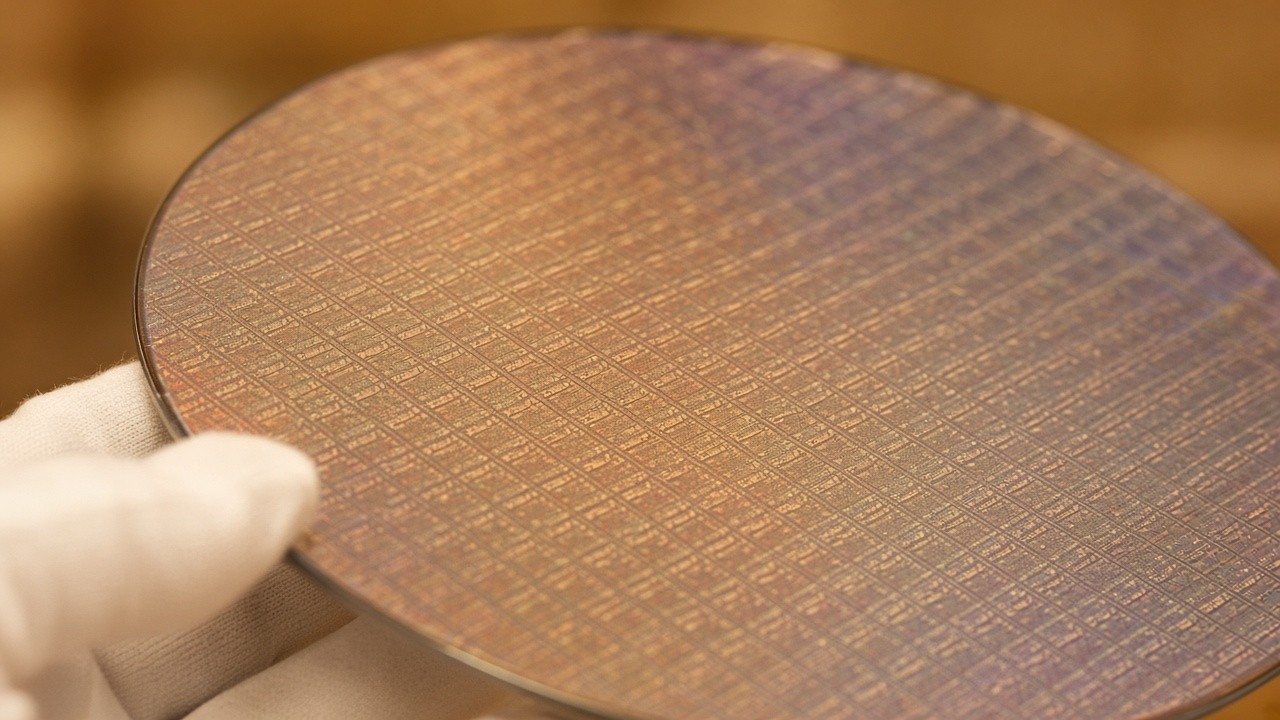
Chips: prices, not just volume. MOTIR says big tech companies kept spending on AI capacity, which kept both unit prices and volumes high. Its Korean release adds the memory price track behind that: the DDR5 16Gb fixed price rose from $40.0 in June to $48.0 in September and $50.0 in October, while NAND 128Gb was flat at $30.6. The ministry’s detailed tables split the total: memory chips rose from $10.89 billion to $50.14 billion (+360.5%) and system chips from $4.30 billion to $5.71 billion (+32.6%). A year ago, total chip exports were $15.70 billion. So the boom is almost entirely memory: memory alone is $50.14 ÷ $56.44 = 88.8% of chip exports (our calculation).
Oil-linked items grew in value but shrank in volume. Petroleum products (+80.0%) and petrochemicals (+27.5%) look strong, but export volumes fell 7.5% and 6.8%. The Dubai crude price averaged $110.7 a barrel, up 70.4%, according to MOTIR. In other words, higher prices made the numbers, not more shipments.
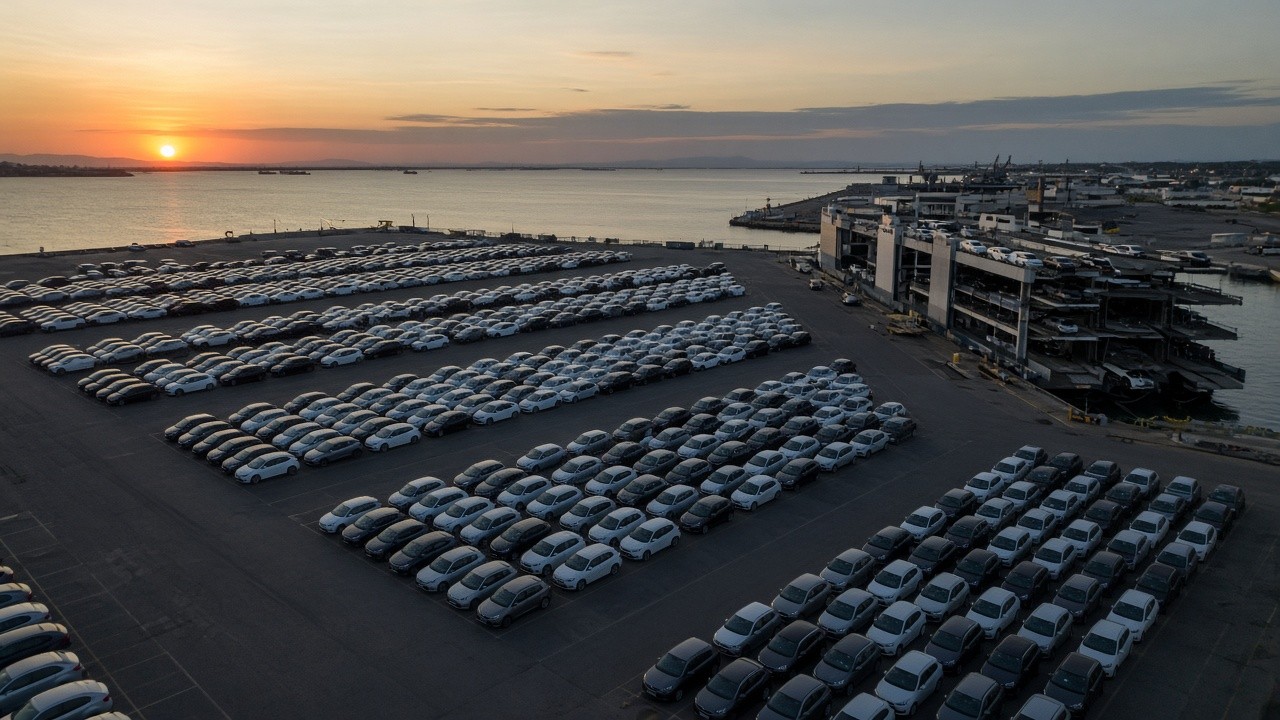
Cars set an October record. Automobile exports of $6.55 billion beat the previous October best of $6.20 billion (2024), helped by extra working days and hybrid demand. Ships fell 43.6% only because October 2025 included $2.47 billion of offshore plant exports.
Market by market: China, the US and ASEAN all above $20 billion
Exports grew in 7 of Korea’s 9 main markets.
| Market | October 2026 exports | YoY change |
|---|---|---|
| China | $26.98 bn | +133.6% |
| United States | $24.90 bn | +185.8% |
| ASEAN | $21.33 bn | +128.0% |
| EU (27) | $8.10 bn | +56.4% |
| Japan | about $3.2 bn | +44% |
| Latin America | about $3.0 bn | −37% |
| India | about $2.7 bn | +84% |
| Middle East | $1.67 bn | +11.0% |
| CIS | about $0.9 bn | −32% |
Sources: MOTIR (the “about” rows come from the rounded regional table in the Korean release); Yonhap for China, US, ASEAN and EU.
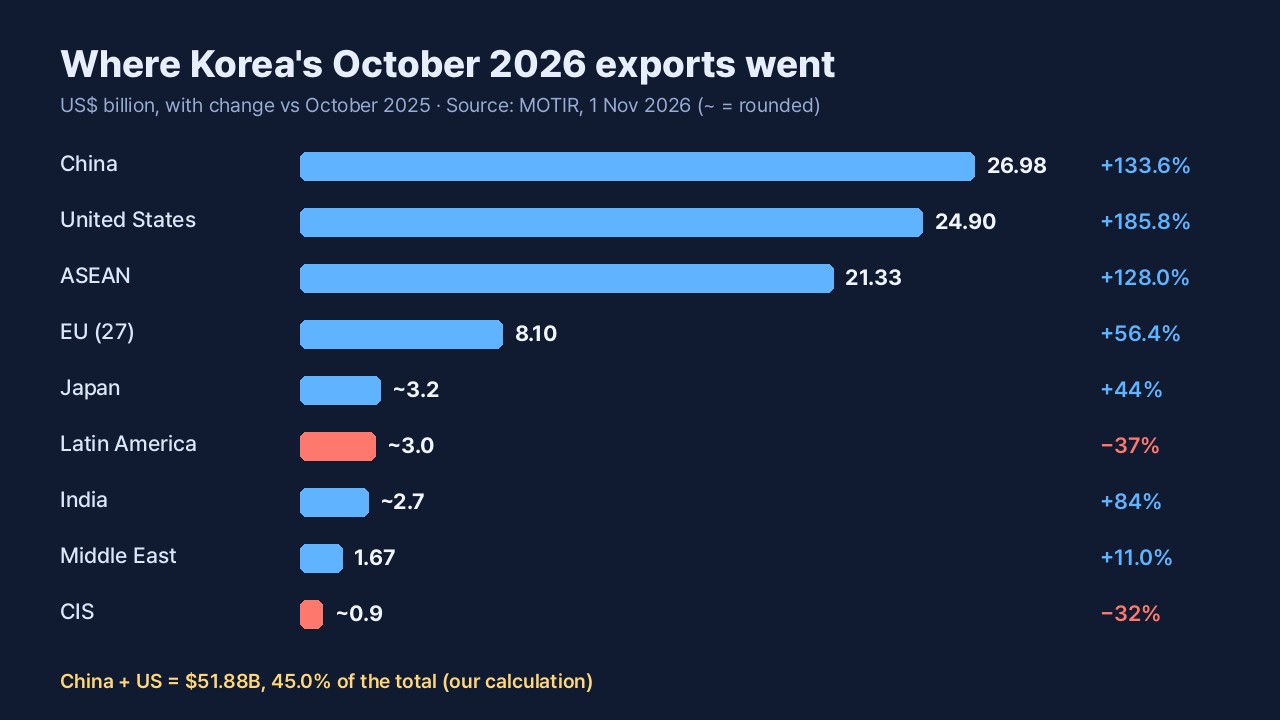
China and the US together took $26.98 + $24.90 = $51.88 billion, or 45.0% of all exports (our calculation). Sales to the US were led by AI-related goods: the ministry’s Korean release says US-bound chip exports for 1–25 October rose 497% and computer exports 816%. The Middle East still grew a little despite shipping problems in the Strait of Hormuz, again helped by the extra working days.
Imports and the trade surplus
Imports rose 36.0% to $72.78 billion. Energy imports jumped 63.1% to $16.49 billion; crude oil imports were $10.7 billion, up 51.9%, even though volumes fell 6.3%, because the import price was up 62.0%. Non-energy imports rose 29.7% to $56.29 billion, including semiconductor equipment ($2.52 billion, +49.2%), a sign that chipmakers are still building capacity at home.
The surplus of $42.50 billion was the second month above $40 billion (September’s record was $49.85 billion). Year to date, Korea has exported $930.0 billion and imported $635.1 billion: $930.0 − $635.1 = $294.9 billion, which matches the ministry’s cumulative surplus.
The $1 trillion question
Korea’s previous annual record was $709.3 billion in 2025, according to MOTIR, and the country had already passed it by the end of September. With $930.0 billion booked, it needs $70 billion more in November and December. October alone was $115.28 billion, which is why Minister Kim Jung-kwan said annual exports are “set to reach $1 trillion in November”. That is the ministry’s projection, not a reported figure. Customs publishes early November data (days 1–10) around 11 November, and the full November release is due on 1 December.
Korean stocks have been tracking this chip cycle closely; our KOSPI explainer covers how sharp the swings have been, and our Bank of Korea rate decision page explains why the central bank is watching the same numbers.
What this does and does not tell you
- It does show that Korea’s trade is now heavily concentrated in memory chips: one product line is close to half of all exports.
- It does not show a doubling of real activity. Part of the growth is calendar (Chuseok), and part is price (memory and oil).
- The ministry itself flags risks: protectionism in major economies, supply-chain shifts and Middle East instability, and the strain on small and mid-sized exporters.
- These are preliminary customs-basis figures. Monthly values can be revised; September moved from $120.94 billion in its first release to about $121.1 billion in the November ranking table.
Frequently asked questions
Q. How much did South Korea export in October 2026?
$115.28 billion, up 93.7% from October 2025, according to the Ministry of Trade, Industry and Resources. Imports were $72.78 billion, leaving a $42.50 billion surplus.
Q. Why did Korea’s exports almost double from a year earlier?
Mainly semiconductors, which rose 259.4% to $56.44 billion on AI-driven demand and higher memory prices. The Chuseok holiday also fell in October 2025 but in September 2026, so this October had more working days. Working-day-adjusted daily exports rose 76%, less than the headline.
Q. What share of Korea’s exports are semiconductors now?
About half. Chips were $56.44 billion of $115.28 billion in October, which works out to 49.0% on rounded figures; the ministry’s figure is 48.9%.
Q. Will Korea reach $1 trillion in exports in 2026?
The ministry expects it in November. January–October exports were $930.0 billion, so $70 billion more is needed. This is a government projection until the November data are released on 1 December.
Q. When is the next Korea trade data release?
Customs publishes provisional figures for days 1–10 around the 11th and days 1–20 around the 21st; full-month November results are due on 1 December 2026.
Sources
- Ministry of Trade, Industry and Resources (English), “October Exports Top $110 Billion and Trade Surplus Exceeds $40 Billion for Second Consecutive Month”, registered 2 November 2026: https://english.motir.go.kr/eng/article/EATCLdfa319ada/2773/view (checked 3 November 2026)
- 산업통상부 (MOTIR, Korean), “2026년 10월 수출입 동향”, 1 November 2026: https://www.motir.go.kr/kor/article/ATCL3f49a5a8c/172360/view (checked 3 November 2026)
- MOTIR (English), “September Exports Reach Record $120.9 Billion…”, 1 October 2026: https://english.motir.go.kr/eng/article/EATCLdfa319ada/2743/view (checked 3 November 2026)
- Yonhap News Agency, “(2nd LD) S. Korea’s monthly exports hit US$115.3 bln in Oct. on strong chip sales”, 1 November 2026: https://en.yna.co.kr/view/AEN20261101000952320 (checked 3 November 2026)
- Yonhap News Agency, “(LEAD) S. Korea’s Sept. exports hit record US$120.9 bln on robust chip sales”, 1 October 2026: https://en.yna.co.kr/view/AEN20261001002751320 (checked 3 November 2026)
- The Asia Business Daily, “Semiconductors Drive South Korea’s Exports, Accounting for 49% of October’s $115.3 Billion Total”, 1 November 2026: https://www.asiae.co.kr/en/article/2026110110285709510 (checked 3 November 2026)
- Aju Business Daily, “10월 수출 1153억 달러…”, 1 November 2026: https://www.ajunews.com/view/20261101091429172 (checked 3 November 2026)
- MOTIR detailed release (PDF “2026년 10월 수출입동향_3보_최종”), via Korea.kr briefing room, 1 November 2026: https://www.korea.kr/common/download.do?fileId=198581810&tblKey=GMN (memory/system split, working days; checked 3 November 2026)
- VLSI Korea, “Korea Chip Exports Hit USD 56.4B in October, Second-Highest Ever”, 2 November 2026: https://www.vlsi.kr/en/korea-semiconductor-exports-october-2026-flash-en/ (checked 3 November 2026)
- Korea Customs Service, 10-day provisional export statistics schedule (data.go.kr): https://www.data.go.kr/data/15157908/openapi.do (checked 3 November 2026)
This article was written with AI assistance and checked against the official releases above. It is general information, not investment advice. Figures are preliminary and may be revised.




One Comment