Going to the ER in Korea as a Foreigner: 119, KTAS Triage, the 90% Rule and What You Pay
Haesul Health desk (AI-assisted). As of 15 November 2026 (KST). Based on the Ministry of Health and Welfare (MOHW) briefings and press releases, the Health Insurance Review and Assessment Service (HIRA) FAQ and Q&A on emergency-room copayments, the government’s Easy Law guide to emergency care, the National Health Insurance Service (NHIS), the 119 rescue law and VISITKOREA, cross-checked with Yonhap (15 July 2026), E-today (25 September 2026), Pharmstoday (5 November 2026), SBS Biz (14 August 2026), The Hankyoreh (11 September 2024), Joseilbo (15 September 2024), Seoul Shinmun (2 November 2026) and GOV.UK travel advice.
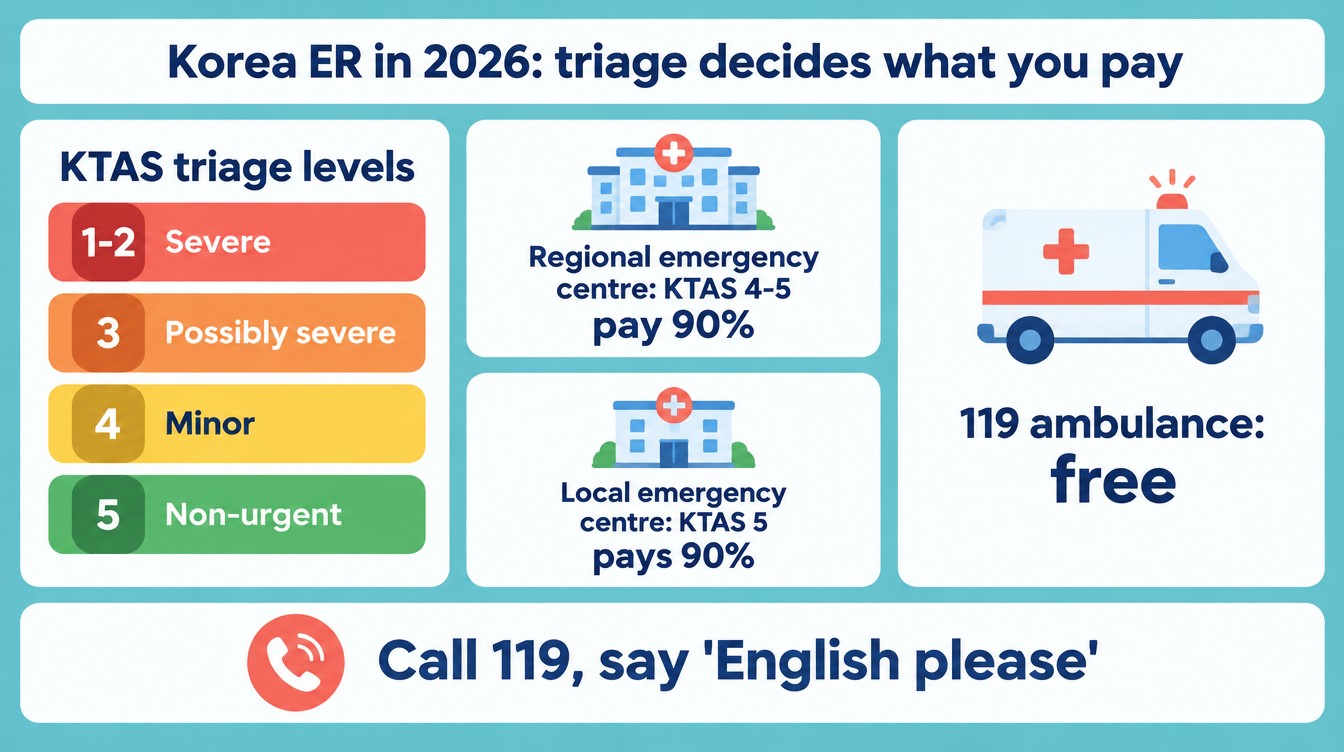
Quick answer: If it could be life-threatening, call 119: the fire-service ambulance is free anywhere in Korea, and saying “English please” gets you an interpreter. Every ER patient is sorted on the 5-level KTAS triage scale, and that grade, together with the type of ER, sets your bill. Since 13 September 2024, NHIS-insured patients graded KTAS 4 (minor) or 5 (non-urgent) at a regional emergency medical centre, and KTAS 5 at a local emergency medical centre, pay 90% of the ER bill instead of the usual 50–60%. Smaller local emergency medical institutions are outside that rule. Tourists without NHIS pay the whole bill and claim it from their travel insurance.
This guide is for foreigners living in Korea and visitors who need urgent care: which door to go to, how triage works, what each option costs, and what to bring. It is general information, not medical advice. If you are unsure whether something is an emergency, call 119; the operator can advise you and send an ambulance if needed.
119 or walk in? The 30-second decision
| Situation | What to do | Why |
|---|---|---|
| Chest pain, trouble breathing, collapse, seizure, heavy bleeding, sudden weakness on one side, unconsciousness | Call 119 at once | MOHW lists these as KTAS 1–2 (severe) examples; 119 takes you to a hospital that can treat the problem |
| Worrying but you can walk (abdominal pain with fever, hives, a fall) | Go to the nearest local emergency medical institution or an open clinic, or call 119 for advice | MOHW asks minor cases to use smaller ERs or neighbourhood clinics first; if a doctor finds something serious, you are transferred |
| A sprained ankle, diarrhoea without dehydration, a minor bite or a wound that needs dressing | An open clinic or a smaller ER; at night see our guide to late-night pharmacies and Moonlight clinics | These are MOHW’s KTAS 5 (non-urgent) examples, the grade that costs 90% at the big centres |
| Not sure | Call 119 | MOHW: “If you think it is serious, report to 119 and follow its guidance” |
Two points matter for foreigners. First, the 119 ambulance is a public service, and Easy Law says it is free regardless of distance or the number of patients. Second, 119 crews may decline a clearly non-urgent call. The Enforcement Decree of the 119 Rescue and Emergency Medical Services Act (Article 20) lets them refuse, for example, a simple toothache, a simple cold without a fever of 38°C or more or breathing difficulty, a minor cut or graze without continuing bleeding, a drunk person who responds and is not injured, or a request to go home or between hospitals. Crews must still judge each case on its history, symptoms and surroundings, so if you are in doubt, call and describe the symptoms.
Our heart attack warning signs guide explains why you should never drive yourself with chest pain, and the carbon monoxide guide covers what to do if a heater or boiler may be poisoning someone. This page picks up where they stop: what happens once you reach the ER.
Calling 119 as a foreigner
- Language: VISITKOREA advises foreigners to say “English please” or “Interpreter please” when the call connects; the operator links a professional interpreter. Provincial fire headquarters also run three-way interpreter lines. Jeonbuk, for example, said on 2 November 2026 that 117 volunteers covered 14 languages, including Vietnamese, Chinese, English, Uzbek, Mongolian, Nepali, Thai and Russian (Seoul Shinmun). The range of languages differs by province.
- Location: give a nearby building name, a subway exit, or the GPS position from your phone’s map. VISITKOREA also recommends the Ministry of the Interior and Safety’s Baro Emergency Reporting app, which works in English, Chinese, Japanese, Vietnamese and Filipino and lets you report by text or photo.
- Advice and directions: 119 also tells callers which ERs, clinics and pharmacies are open nearby, as both MOHW and Easy Law note. Emergency medical advice moved to 119 when the old 1339 medical hotline was merged into it in June 2012 (NEMA briefing, 26 June 2012). Today 1339 is the Korea Disease Control and Prevention Agency (KDCA) helpline for infectious diseases; VISITKOREA lists it as “Infectious Disease Emergencies”. It does not send ambulances.
- Tourists: the 1330 Korea Travel Hotline (+82-2-1330 from abroad) gives help in Korean, English, Japanese, Chinese, Russian, Vietnamese, Thai and Malay. Use it for help or interpretation that is not an emergency, never in place of 119.
Korea’s ERs: three tiers
Not every ER is the same. Under the Emergency Medical Service Act, Easy Law sets out these designated types:
| Type (Korean) | Who designates it | What it is for |
|---|---|---|
| Regional emergency medical centre (권역응급의료센터) | Minister of Health and Welfare, from tertiary or general hospitals | Severe emergencies; final treatment for serious cases |
| Specialised centres and regional trauma centres (전문응급의료센터, 권역외상센터) | Minister of Health and Welfare | Children, burns and poisoning; major trauma |
| Local emergency medical centre (지역응급의료센터) | Provincial or metropolitan governor, from general hospitals | Emergency patients in general |
| Local emergency medical institution (지역응급의료기관) | City mayor, county head or district head | Smaller 24-hour ERs, the first stop for minor cases |
How many? MOHW selected 53 regional centres for 1 November 2026 to 31 October 2029, up from 44. The capital region went from 18 to 21 and the rest of the country from 26 to 32 (MOHW release and Yonhap, 15 July 2026). Six of the 12 new centres were designated on condition that they meet staffing and facility rules by 30 April 2027, and are paid at their previous tier’s rates until then (Pharmstoday, 5 November 2026). At its 11 September 2024 briefing MOHW counted 136 local emergency medical centres, and in early September 2024 it counted 409 ERs in all. Check E-Gen (e-gen.or.kr, run by the National Emergency Medical Center) or call 119 for the current list near you. Easy Law also suggests phoning an ER before you go to check it can see you.
ERs restrict entry. Under the same Act, only patients, staff and a guardian needed to help with care may go in, and hospitals record who enters. Plan on one companion, not a group.
KTAS: the triage grade that drives your bill
When you arrive, a nurse or doctor assesses you and assigns a grade on the Korean Triage and Acuity Scale (KTAS, 한국 응급환자 중증도 분류기준). Patients are seen in order of severity, not arrival, so a long wait usually means others are sicker. MOHW explained the five levels for adults at its 6 September 2024 briefing:
| KTAS | Category | MOHW’s adult examples |
|---|---|---|
| 1–2 | Severe emergency (중증응급) | Cardiac arrest, major trauma, breathing difficulty, severe chest pain, abdominal pain or headache, vomiting blood, impaired consciousness |
| 3 | Possible severe emergency (중증응급의심) | Mild respiratory distress, moderate abdominal pain or headache, bloody diarrhoea |
| 4 | Minor emergency (경증응급): treat or reassess within 1–2 hours | Mild pain on urination, abdominal pain with fever, hives |
| 5 | Non-urgent (비응급): acute but not urgent | Diarrhoea without dehydration, a minor bite, muscle pain such as an ankle sprain, wound dressing |
MOHW adds that patients cannot reliably grade themselves, since the same illness can be mild or serious. That is why the advice is “119 if in doubt.” The grade can also change: HIRA’s billing Q&A says that if your condition changes after final triage, the hospital bills at the more severe grade.
The 90% rule for minor cases at big ERs
From 13 September 2024, an amendment to the Enforcement Rule of the National Health Insurance Act raised the patient share for minor and non-urgent cases at the larger ERs to 90%. HIRA restated the rule on 12 September 2026, so it is still in force. MOHW lifted its health-care crisis alert on 20 October 2025 and ended the emergency measures. The 90% copay is written into the Enforcement Rule itself, and HIRA was still applying it in September 2026. HIRA’s FAQ says:
| Where you go | KTAS 1–3 | KTAS 4 (minor) | KTAS 5 (non-urgent) |
|---|---|---|---|
| Regional emergency medical centre, specialised centre, regional trauma centre | Normal rate | 90% | 90% |
| Local emergency medical centre | Normal rate | Normal rate | 90% |
| Local emergency medical institution | Normal rate (set by length of stay, not KTAS) | Normal rate | Normal rate |
Details from HIRA’s Q&A of 12 September 2024 that matter to foreigners:
- It applies to NHIS-insured patients. If you have no NHIS, you pay the full cost anyway (see below).
- It covers the whole ER bill, including tests and medicines given in the ER. It still applies to people who usually get reduced copays, such as children and patients registered with rare or serious diseases, with a few listed exceptions.
- It does not apply if you are admitted to a ward and the ER costs are billed under the inpatient method.
There is also an older rule. The MOHW emergency medical fee standard says ERs charge an emergency medical management fee (응급의료관리료) on the first day, and if you turn out not to be an “emergency patient” under the Act’s list of emergency symptoms, you pay the whole fee yourself. Busan Paik Hospital’s ER page explains the same two rules to its patients.
What did the 90% rule do in won? Answering a reporter on 11 September 2024, MOHW said patients covered by the rule had paid about ₩130,000 on average at regional centres and would pay about ₩220,000, and about ₩60,000 rising to about ₩100,000 at local centres. It stressed that these are averages that vary with the case and the region (official transcript; also reported by The Hankyoreh). MOHW has not published newer averages that we could find.
Worked costs (our calculation from official figures)
1. The emergency medical management fee in 2026. The 2026 HIRA fee schedule lists the fee at 871.43 points for a regional centre, 763.13 for a local centre and 308.01 for a local emergency medical institution (as reproduced in the 2026 fee book and by Pharmstoday). NHIS sets the 2026 hospital conversion factor at ₩83.8 per point. Our arithmetic:
| ER type | Points (2026) | × ₩83.8 = fee (calculated) |
|---|---|---|
| Regional emergency medical centre | 871.43 | about ₩73,030 |
| Local emergency medical centre | 763.13 | about ₩63,950 |
| Local emergency medical institution | 308.01 | about ₩25,810 |
These are base amounts. Centres rated A in the government’s evaluation add 10% and those rated C deduct 10%; local institutions are not graded. If you are not an emergency patient, the whole fee is yours on top of everything else.
2. A hypothetical ₩200,000 ER bill (insured, discharged home). We assume ₩200,000 of NHIS-covered charges for illustration. The real figure depends on tests and treatment:
| Scenario | Patient share | You pay (calculated) |
|---|---|---|
| NHIS patient, KTAS 4 at a regional centre (90% rule) | 90% | ₩180,000 |
| Same visit before 13 September 2024 (MOHW: 50–60%) | 50–60% | ₩100,000–₩120,000 |
| NHIS patient, KTAS 4 at a local centre (outside the 90% rule; MOHW’s 50–60% band) | 50–60% | ₩100,000–₩120,000 |
| Tourist without NHIS | 100% | ₩200,000 or more |
Tourists pay at least the full amount, because NHIS pays nothing for them. Keep the receipts for your insurer.
3. Getting there. The 119 ambulance costs ₩0. Private ambulances, used for transfers or non-emergency trips, charge set fees under the Enforcement Rule of the Emergency Medical Service Act, raised on 14 August 2026 (Easy Law; SBS Biz). For a hospital-run ambulance:
| Ambulance | Base (first 10 km) | Each extra km | Night/weekend surcharge | 15 km trip at 23:00 (calculated) |
|---|---|---|---|---|
| General ambulance | ₩40,000 | ₩1,500 | +20% (weekdays 18:00–09:00, Saturdays, public holidays) | (₩40,000 + 5 × ₩1,500) × 1.2 = ₩57,000 |
| Special (critical-care) ambulance | ₩95,500 | ₩2,300 | +20% | (₩95,500 + 5 × ₩2,300) × 1.2 = ₩128,400 |
Non-profit operators charge less (₩26,600 and ₩63,600 base), and waiting at the hospital beyond 30 minutes costs ₩6,000 per 10 minutes. Easy Law says operators may not add charges for equipment, supplies, tolls, card fees or a guardian riding along.
NHIS residents vs tourists: who pays what
Registered foreigners on NHIS. Most foreign residents join NHIS: employees through work, others as regional members, usually after six months in Korea (some visa types join from entry). Our NHIS for foreigners guide covers the start dates and premiums. Once insured, you pay the same copays as Koreans, including the 90% rule. Since 20 May 2024, MOHW requires hospitals to check photo ID before applying NHIS rates. MOHW’s list includes the residence card and the passport, but only for ID that shows a photo and a registration number, and copies or screenshots do not count. Your residence card or the NHIS mobile card app is the safe choice. Emergency patients are exempt from the ID check, so you will not be turned away for lacking a card. Bring it anyway, because it makes billing simpler.
Tourists and short-term visitors. NHIS does not cover you. GOV.UK’s advice for British travellers puts it plainly: medical care in South Korea is usually good but can be expensive, so carry travel insurance that covers treatment and evacuation, and contact your insurer quickly if you are referred for treatment. In practice:
- Pay at the hospital, then claim. If your policy has an emergency assistance line, call it from the ER, especially before an admission or surgery.
- Ask for documents before you leave: the receipt (진료비 영수증), the itemised bill (진료비 세부산정내역서) and, if your insurer needs it, a medical certificate or doctor’s note (진단서 or 소견서), in English if possible.
- If you are admitted, GOV.UK notes that Korean hospitals may expect a guardian (보호자) to help with basic care, or a paid caregiver (간병인), who usually does not speak English.
Can’t pay at all in a true emergency? Korea has an emergency medical fee substitute payment scheme (응급의료비 대지급제도). When an emergency patient cannot pay, HIRA pays the hospital and later recovers the money from the patient or family, who can repay in instalments over up to 48 months (Easy Law). The hospital applies, not you. We could not confirm how it is applied to short-term visitors, so ask the hospital’s billing desk or HIRA (1644-2000).
What to bring (and what to ask for)
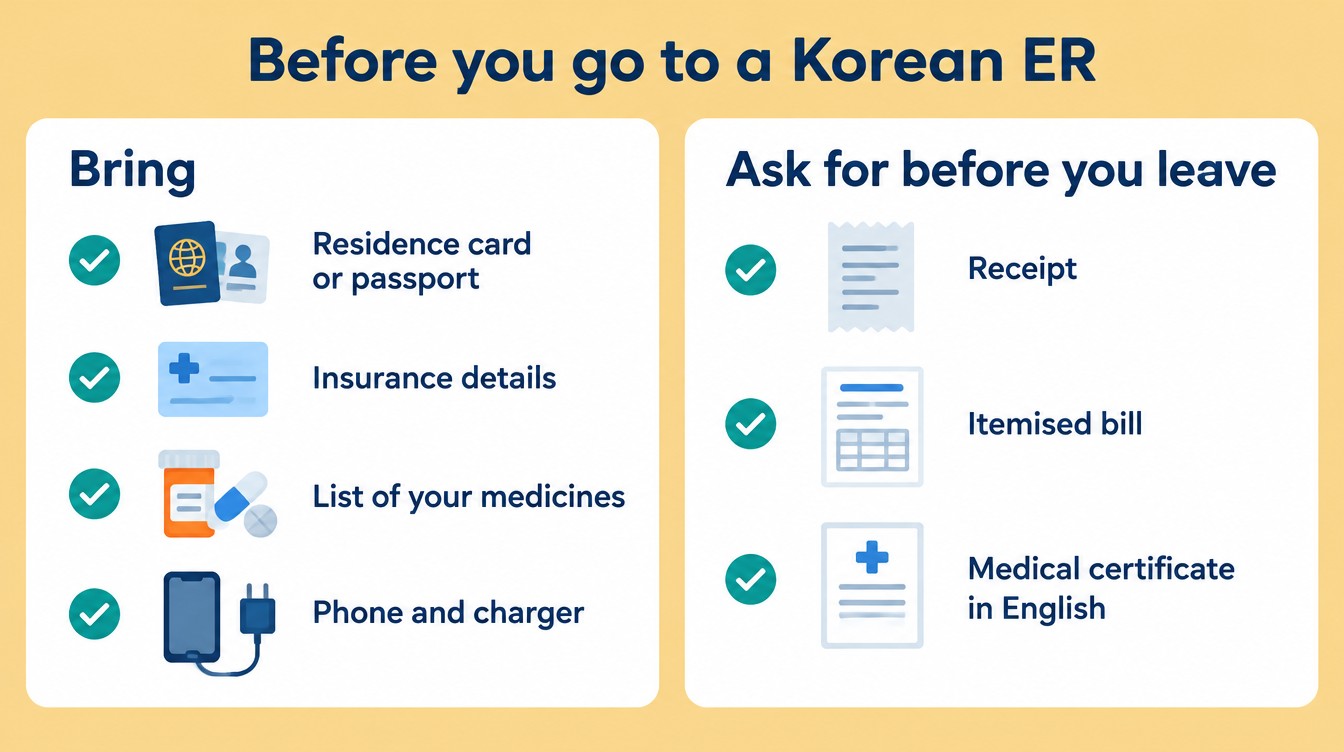
- ID: residence card (외국인등록증), or your passport if you have no card.
- Insurance details: your NHIS status, or your travel-insurance policy number and assistance phone number.
- A list of your medicines and allergies, in English, plus any medicines you are taking now. Ask the 119 operator or ER staff before taking anything new.
- Phone and charger, for translation apps, your location and calls to family or your insurer.
- One companion, if possible, because ERs limit visitors.
- Before leaving: your receipt, itemised bill and any certificate, plus your discharge instructions and prescription. ER prescriptions are filled at an outside pharmacy; if it is late, see our night and holiday care guide.
Common problems
- “Should I just go to the biggest hospital?” For a minor problem, MOHW asks people to use a smaller ER or an open clinic first. If the doctor there finds something serious, you are transferred quickly, and your costs stay at the normal rate (MOHW briefing, 13 September 2024). That also keeps you out of the 90% band.
- “I waited hours.” Triage puts the sickest first. If you get worse while waiting, such as more pain, fainting or breathing trouble, tell the triage nurse at once.
- “Can I go back if it gets worse?” Yes. Under HIRA’s rules, a return to the same ER for the same problem on the same day, or within 6 hours of leaving, is billed as one continuous visit.
- “Which ER is open, and is it busy?” Use E-Gen or call 119. (E-Gen’s site returned errors to our fetches on 15 November 2026, so call 119 if it does not load.)
If it is not an emergency, a clinic is faster and cheaper than the ER: see How to see a doctor in English in Korea. For a sick child, start with childhood vaccinations and the free child flu shot.
Hurt an ankle or wrist on the ice? See Slipped on ice in Korea for when an orthopedic clinic is enough, and what an X-ray and cast cost with and without NHIS in 2026.
FAQ
Q. Is the ambulance free in Korea?
The 119 fire-service ambulance is free anywhere in Korea, whatever the distance, for genuine emergencies. Private and hospital ambulances charge set fees; since 14 August 2026 a hospital-run general ambulance costs ₩40,000 for the first 10 km.
Q. How much does an ER visit cost in Korea?
It depends on the tests and treatment, your triage grade and the type of ER. MOHW’s 2024 averages for minor cases under the 90% rule were about ₩220,000 at regional centres and about ₩100,000 at local centres for insured patients. Without NHIS, you pay the full bill.
Q. What is KTAS?
The Korean Triage and Acuity Scale: a 5-level grade given at the ER door. Levels 1–2 are severe, 3 possibly severe, 4 minor and 5 non-urgent. At regional centres, insured KTAS 4–5 patients pay 90% of the ER bill; at local centres, KTAS 5 patients do.
Q. Does the 90% rule apply to tourists?
HIRA says the rule applies to NHIS-insured patients. Tourists without NHIS are not covered by NHIS at all, so they pay the full cost of any ER visit and claim it from their travel insurance.
Q. Will 119 understand English?
Say “English please” or “Interpreter please” when the call connects; VISITKOREA says the operator will connect a professional interpreter. Have your location ready from a nearby building or your phone’s GPS.
Q. Is 1339 the emergency number?
No. 119 is the number for ambulances and emergency medical advice; the old 1339 medical line was merged into 119 in 2012. Today 1339 is KDCA’s infectious-disease helpline.
General information, not medical advice. Call 119 in an emergency; diagnosis and treatment decisions are for a doctor. Copayment rules are as published by HIRA and MOHW on the dates above. Check E-Gen (https://www.e-gen.or.kr) or call 119 for open ERs, and NHIS (1577-1000) or your insurer for your own cover.
Sources
- HIRA FAQ, “Copayment for minor and non-urgent patients at emergency medical centres” (12 September 2026): https://www.hira.or.kr/bbsDummy.do?brdBltNo=47801&brdScnBltNo=4&pgmid=HIRAA010006011000
- HIRA, Q&A on the copay increase for minor and non-urgent ER patients (12 September 2024, PDF): https://www.hira.or.kr/bbs/157/2024/09/BZ202409120501445.pdf
- HIRA, administrative interpretation on ER copayment calculation (12 September 2024, PDF): https://www.hira.or.kr/bbs/157/2024/09/BZ202409120501444.pdf
- MOHW via Korea Policy Briefing, emergency-care briefing explaining KTAS levels (6 September 2024): https://www.korea.kr/briefing/policyBriefingView.do?newsId=156649494
- MOHW via Korea Policy Briefing, emergency-care briefing with average copay estimates (11 September 2024): https://www.korea.kr/news/policyNewsView.do?newsId=156650398
- MOHW via Korea Policy Briefing, emergency-care briefing on the 90% start date (13 September 2024): https://www.korea.kr/briefing/policyBriefingView.do?newsId=156650977
- MOHW press release, “53 regional emergency medical centres selected” (15 July 2026, with PDF): https://www.korea.kr/briefing/pressReleaseView.do?newsId=156770866
- MOHW via Korea Policy Briefing, health-care crisis alert lifted from 20 October (17 October 2025): https://www.korea.kr/news/policyNewsView.do?newsId=148951604
- MOHW press release, ID check at hospitals from 20 May 2024: https://www.mohw.go.kr/board.es?act=view&bid=0027&list_no=1481541&mid=a10503000000
- MOHW notice, Emergency Medical Fee Standard (응급의료수가기준), item 2-가 (via National Law Information Center): https://www.law.go.kr/행정규칙/응급의료수가기준
- National Law Information Center, Enforcement Decree of the 119 Rescue and Emergency Medical Services Act, Article 20: https://www.law.go.kr/법령/119구조ㆍ구급에관한법률시행령
- Easy Law (Ministry of Government Legislation), “Using hospitals” in the emergency-care chapter (as of 15 October 2026): https://www.easylaw.go.kr/CSP/CnpClsMain.laf?ccfNo=2&cciNo=1&cnpClsNo=1&csmSeq=906&menuType=cnpcls&popMenu=ov
- Easy Law, “Paying medical and ambulance fees”: https://www.easylaw.go.kr/CSP/CnpClsMainBtr.laf?ccfNo=2&cciNo=4&cnpClsNo=1&csmSeq=906&popMenu=ov
- Easy Law, “Emergency medical fee substitute payment”: https://www.easylaw.go.kr/CSP/CnpClsMainBtr.laf?ccfNo=2&cciNo=4&cnpClsNo=2&csmSeq=906&popMenu=ov
- NHIS, conversion factors by year (2026 hospital ₩83.8; as of 23 July 2026): https://www.nhis.or.kr/announce/wbhaec11413m01.do
- NEMA via Korea Policy Briefing, “Emergency number 1339 fully merged into 119” (26 June 2012): https://www.korea.kr/briefing/policyBriefingView.do?newsId=148735242
- VISITKOREA, “Disaster Safety Services for International Visitors in Korea” (2 October 2025): https://english.visitkorea.or.kr/svc/contents/contentsView.do?vcontsId=248145
- VISITKOREA, “Emergency Situations” (updated 11 September 2026): https://english.visitkorea.or.kr/svc/contents/infoHtmlView.do?vcontsId=140042
- GOV.UK, South Korea travel advice: Health: https://www.gov.uk/foreign-travel-advice/south-korea/health
- Busan Paik Hospital, emergency care page (management fee and 90% rule): https://busan.paik.ac.kr/busan/user/contents/view.do?menuNo=800085
- Yonhap, “53 regional emergency centres selected” (15 July 2026): https://www.yna.co.kr/view/AKR20260715070500530
- E-today, “Going to the ER first over the holiday could cost 90%” (25 September 2026): https://www.etoday.co.kr/news/view/2628565
- Pharmstoday, “Half of the upgraded regional centres are conditional” (5 November 2026): https://www.apsk.co.kr/news/articleView.html?idxno=540967
- SBS Biz, “Private ambulance fees rise from today” (14 August 2026): https://biz.sbs.co.kr/amp/article/20000328870
- The Hankyoreh, “Regional ER minor-case copay up ₩90,000 on average from the 13th” (11 September 2024): https://www.hani.co.kr/arti/society/health/1158130.html
- Joseilbo, “How to tell minor from severe” (15 September 2024): https://m.joseilbo.com/news/view.htm?newsid=525864
- Seoul Shinmun, “Jeonbuk fire HQ runs 14-language 119 interpreter team” (2 November 2026): https://www.seoul.co.kr/news/society/2026/11/02/20261102500160
How we checked: We read the HIRA FAQ and both HIRA 2024 PDFs, the MOHW briefing transcripts and the July 2026 release PDF, the Easy Law chapters, the NHIS conversion-factor table, the 119 decree text and the VISITKOREA and GOV.UK pages on 15 November 2026, and matched each rule and number against the news reports listed. The management-fee amounts, the ₩200,000 scenario and the ambulance totals are our own arithmetic from the published points, rates and fees. E-Gen did not load for us, so live ER lists are left to E-Gen and 119.
Researched and drafted with AI assistance; checked against the sources listed.


4 Comments