Why Your Korea Regional Health Insurance Bill Changed in November 2026, and How to Ask for an Adjustment if Your Income Fell
Haesul Living desk (AI-assisted). As of 12 November 2026 (KST). Based on the National Health Insurance Service (NHIS) pages on the premium income-settlement system (건강보험료 소득 정산제도) and regional premium adjustment (지역보험료 조정), the NHIS regional premium calculation page, the Ministry of Government Legislation’s EasyLaw guide to regional premiums and Article 44 of the National Health Insurance Act Enforcement Decree on law.go.kr. Independent cross-check: Yonhap News Agency’s report of the NHIS announcement on 7 November 2026. This is general information, not tax, legal or insurance advice; check your own bill with NHIS (1577-1000).
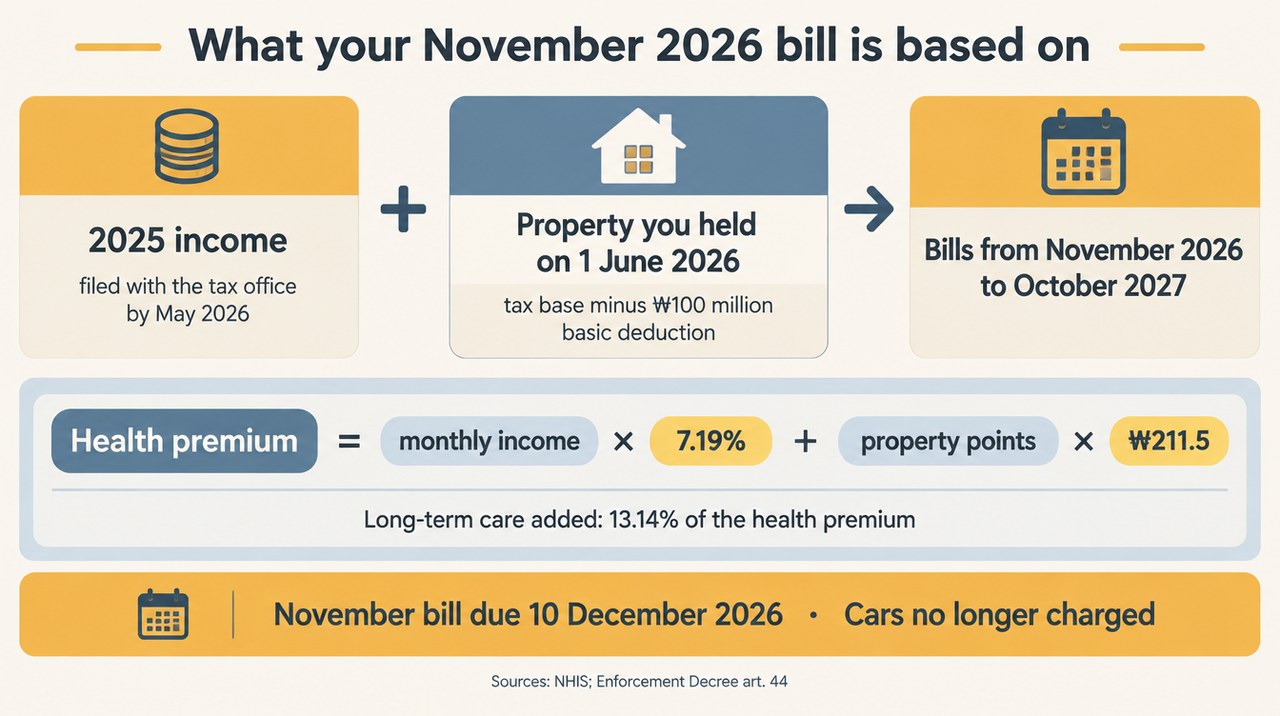
Quick answer: If you are on Korea’s regional (지역가입자) health insurance (self-employed, freelancers, most retirees, anyone not covered through an employer or as a dependant), NHIS recalculated your premium on the November 2026 bill. It now uses your household’s 2025 income (as reported to the National Tax Service) and the property you owned on 1 June 2026, and that amount applies from the November 2026 bill to the October 2027 bill. The November bill is due on Thursday 10 December 2026, 27 days from 13 November. If your income has fallen since 2025 (you closed a business, a contract ended, you retired), you can apply for an income adjustment and settlement (소득 조정·정산). NHIS says an application made between 1 November and 10 December can lower the bill from November. The catch: NHIS later checks your real income against tax-office data and bills or refunds the difference in a later November.
The letter looked like every other month’s, but the number didn’t. For many people who pay their own health insurance in Korea, November is the month the premium jumps or drops, sometimes by tens of thousands of won. This guide explains why that happens every year, what goes into the new figure, a worked example in won, and how the adjustment works if last year’s income no longer reflects your life.
If you have just retired and are still deciding between staying on your old employee premium and moving to the regional scheme, read our guide to voluntary continuation after retirement first; it covers that choice. This article covers only the November recalculation and the adjustment.

Why the bill changes every November
Employees pay health insurance on their monthly pay, so their premium moves with each payslip. Regional members pay on income and property, and NHIS only receives that data once a year. Its regional-premium adjustment page explains the timing: NHIS receives the previous year’s income data from the National Tax Service every November, and property data comes from local governments based on the property-tax reference date of 1 June, which is applied from November to October of the following year (NHIS, regional premium adjustment).
On 7 November 2026, NHIS announced the 2026 reset. Yonhap reported that from the November bill, regional premiums reflect 2025 comprehensive income and changes in the property-tax base of land, housing and buildings as of 1 June 2026; the new premium applies for a year, to the following October; the November bill is due by 10 December; and members who paid on 2024 income up to October will see their premium rise or fall from this month (Yonhap, 7 November 2026).
| What changed on the November 2026 bill | Before (bills to October 2026) | Now (November 2026 to October 2027) |
|---|---|---|
| Income used | 2024 income | 2025 income (tax-office data) |
| Property used | Property held on 1 June 2025 | Property held on 1 June 2026 |
| Health premium rate | 7.19% | 7.19% (unchanged in 2026) |
| Due date of the November bill | — | 10 December 2026 |
Sources: NHIS regional premium adjustment page; Yonhap, 7 November 2026; Enforcement Decree art. 44 (rate).
In practice that means a good year in 2025 shows up as a higher bill now, even if 2026 has been quiet. A home bought before 1 June 2026 shows up now too. A home sold before that date should drop out.
What goes into the new figure
The formula is set in law. EasyLaw, the government’s legal-information service, states that a regional household’s monthly premium is income part (monthly income × premium rate) + property part (property points × amount per point), that the rate is 7.19% (719 per 10,000) and the amount per point is ₩211.5, under Article 44 of the Enforcement Decree (EasyLaw, regional premium; Enforcement Decree art. 44, law.go.kr). Long-term care insurance is added on top: in 2026 it is 0.9448% of income, which equals 13.14% of the health premium (MOHW figures, set out in our 2027 payslip guide).
How each part is counted (NHIS regional premium calculation page, NHIS):
- Income: interest, dividend, business and “other” income count at 100% of the income amount; employment and pension income count at 50%. Monthly income is the annual figure divided by 12. EasyLaw adds that for public pensions the whole pension received counts as pension income, not the taxable figure after deductions.
- Property: housing, buildings, land (and ships or aircraft) at 100% of the property-tax base; if you own no home, your rental deposit and rent count as (deposit + monthly rent × 40) × 30%. A flat ₩100 million basic deduction comes off the household’s property before the points are worked out.
- Cars: no longer charged. NHIS notes that the car premium was abolished from the February 2024 bill, and Yonhap’s 7 November report repeats that cars are not charged.
- Floor and ceiling: for 2026, EasyLaw lists a monthly regional premium floor of ₩20,160 and ceiling of ₩4,591,740.
One caution about the NHIS calculation page itself: as we read it on 12 November 2026, it still showed the 2024 amount per point (₩208.4) and the 2024 floor. The 2026 figures above come from the Decree and EasyLaw, which match the ₩211.5 and 7.19% our earlier guides took from the NHIS calculator.
Our guide to health insurance for foreigners explains an extra rule for most foreign regional members: if the formula gives less than the national average premium, the average applies instead. The November reset still matters to them, but the floor often decides the bill.
A worked example in won
These two households are illustrations: the incomes are assumptions, the rates are the official 2026 ones, and the calculations are ours. They show only the income part; the property part (points × ₩211.5) is added on top and depends on your own property, so read it off your bill.
| Illustrative household | 2025 income counted | Monthly income | Health premium (× 7.19%) | Long-term care (0.9448% of income) | Income part per month |
|---|---|---|---|---|---|
| Freelancer, ₩36 million business income in 2025 | ₩36,000,000 (100%) | ₩3,000,000 | ₩215,700 | ₩28,344 | ₩244,044 |
| Retiree, ₩14.4 million national pension in 2025 | ₩7,200,000 (50% of ₩14.4M) | ₩600,000 | ₩43,140 | ₩5,669 | ₩48,809 |
Calculated by Haesul from the NHIS income rules and the 2026 rates; NHIS may round each amount. The pension example uses the 50% rule for pension income.
Two lessons sit in that table. First, a freelancer’s busy 2025 drives the bill from November 2026 all the way to October 2027, whatever 2026 looks like. Second, a retiree living mainly on a public pension is charged on half of it, so the property part is often the bigger line on a retiree’s bill.
If your income has fallen: the adjustment and settlement
Because the bill looks back a year, NHIS runs a way to pay on your current situation instead. Its income-settlement page describes the system: if you apply for a premium adjustment (조정), NHIS lowers (or raises) the premium now, and in November of the following year it recalculates the adjusted year using income confirmed by the National Tax Service and other agencies, then charges or refunds the difference (NHIS, premium income-settlement system). NHIS compares it to the year-end tax settlement for employees.
Who can apply. NHIS lists regional members whose income decreased or increased, and employees who pay a separate premium on income outside their salary. The page covers six kinds of income: business, employment, interest, dividend, pension and other income. Yonhap’s 7 November report says the same: adjustment covers not only business and employment income but also interest, dividend, pension and other income, so a retiree whose deposit interest or dividends fell can also apply (Yonhap). One mismatch: an older NHIS policy page we read on 12 November still says interest, dividend, pension and other income cannot be adjusted. The settlement page and the 7 November announcement are newer, but if your case rests on pension or financial income, confirm with NHIS before you count on it.
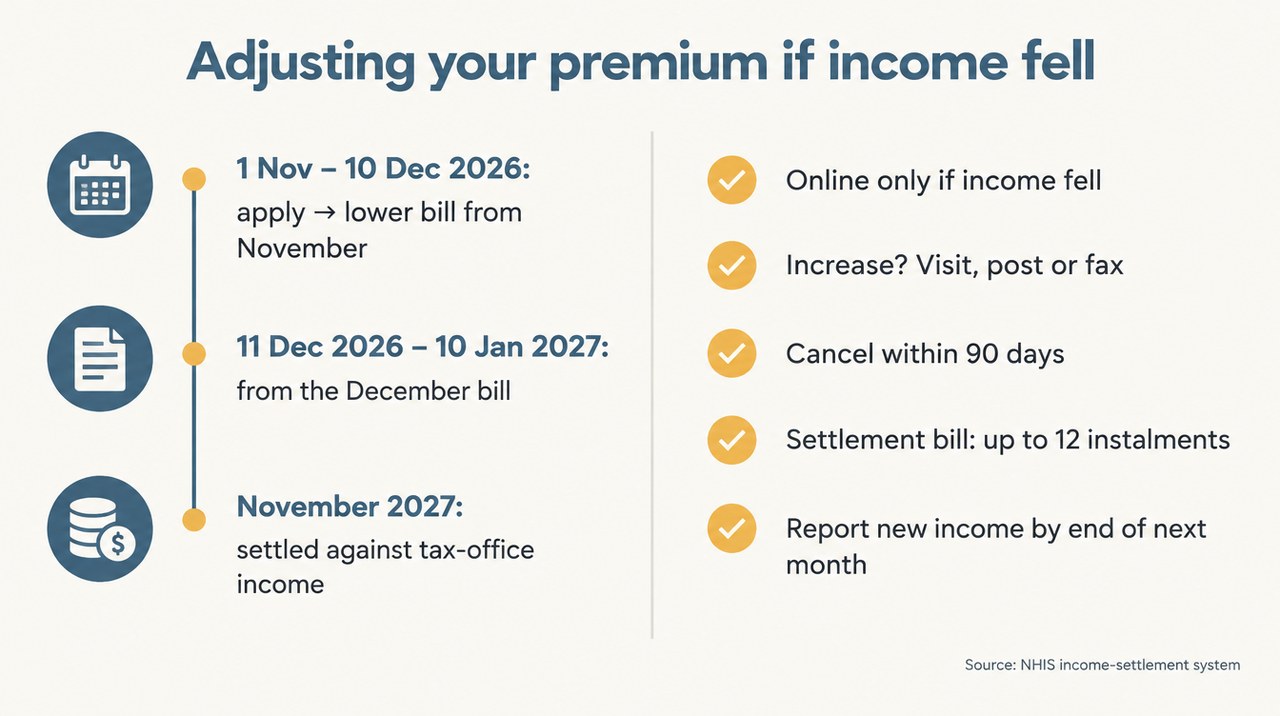
When it applies. Normally an adjustment runs from the month after you apply to December. NHIS lists exceptions, and the one that matters now is the November window:
| You apply between | Adjusted from | Source |
|---|---|---|
| 1 November – 10 December 2026 (the November bill’s due date) | The November 2026 bill, and on request through December 2027 | NHIS settlement page |
| 11 December 2026 – 10 January 2027 | The December 2026 bill (between 1 and 10 December you can choose November or December) | NHIS settlement page |
| 11 January – 10 February 2027 | The January 2027 bill | NHIS settlement page |
So if the November bill is based on income you no longer have, applying by 10 December is what lets the reduction start with that same bill.
How to apply. Online through the NHIS website or mobile app, but only for a fall in income; an increase must be reported in person, by post or by fax. NHIS lists a consent form for income settlement (소득 정산부과 동의서) and ID, plus evidence by reason: a business closure or suspension certificate, a retirement (or contract-termination) certificate, the previous year’s income certificate, or withholding receipts for interest, dividends or other income. NHIS’s adjustment page says online applicants can apply without attaching evidence.

What happens next. Read these before applying, because the settlement can go either way:
- It is provisional. If the income NHIS later confirms is higher than the figure you were adjusted to, you pay the difference. NHIS warns that you can be charged more even if your income fell, because the settlement compares what you actually paid with the recalculated premium.
- New income must be reported. If income arises in the year you applied for, report it to NHIS by the end of the month after it arises.
- Large settlement bills can be split. If the settlement bill is at least as large as that month’s regular premium, you can ask to pay it in up to 12 instalments, by the settlement bill’s due date.
- You can cancel within 90 days of applying, but not once the settlement premium has been calculated, and you cannot cancel only the adjustment or only the settlement.
- Knock-on effects. If the adjustment let you qualify as a dependant (피부양자), or for a premium-based benefit such as the out-of-pocket ceiling, NHIS can withdraw that status or reclaim the benefit after the settlement.
What an adjustment could look like
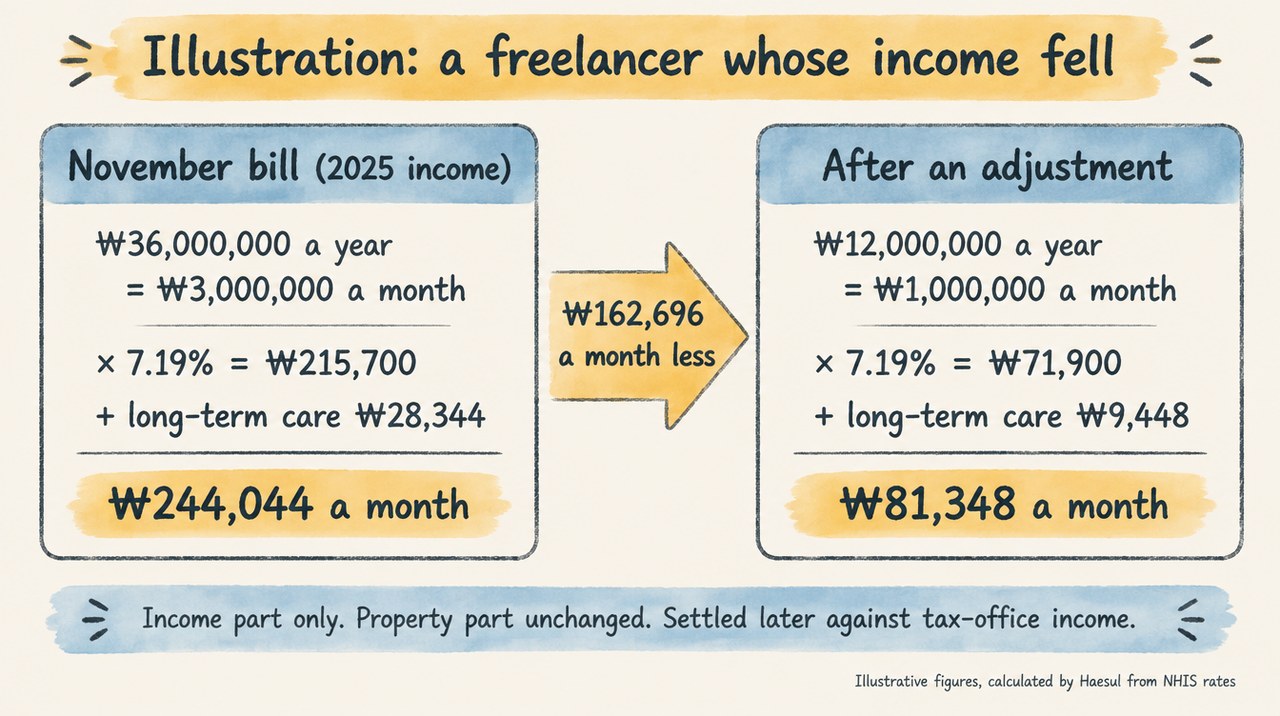
Take the illustrative freelancer above. Their 2025 income was ₩36 million, but a main contract ended in spring 2026 and they expect about ₩12 million of business income a year from now on.
| Illustration (income part only) | Monthly income used | Health + long-term care |
|---|---|---|
| November bill as issued (2025 income) | ₩3,000,000 | ₩244,044 |
| After an adjustment to ₩12M a year | ₩1,000,000 | ₩81,348 (₩71,900 + ₩9,448) |
| Difference | ₩162,696 a month lower |
Calculated by Haesul; the property part and any reductions are unchanged and not shown. If the freelancer applies by 10 December 2026, the lower figure can start with the November bill. If the tax office later shows that they actually earned more in the adjusted period, NHIS bills the difference at a later November settlement.
If your property changed
Property follows its own rule. The 1 June snapshot runs to the following October, but NHIS adjusts it if ownership changes through a sale, inheritance or expropriation: the change applies from the month after it happens (or the same month if it happens on the 1st). NHIS says it receives property-transfer data from the land ministry monthly, about two months behind, and adjusts in bulk; you can also apply with a registry extract or building or land ledger to speed it up (NHIS, regional premium adjustment).
Other property fixes on the same NHIS page: if the rental deposit on your bill does not match your real lease, submit the contract (leases above a ₩60 million deposit or ₩300,000 monthly rent must be the registered lease); if you live rent-free in a family member’s home, file the rent-free residence form. EasyLaw adds that a home purchase or rental loan for a home you live in can be excluded from the property points, but only if the loan is reported to NHIS.

A checklist for the November bill
- Ask for the breakdown. NHIS (website, app or 1577-1000) can tell you which income and property figures your bill uses.
- Compare with your 2025 tax return and your 1 June 2026 property. A wrong lease figure or a sold home still listed is a correction, not an adjustment.
- If your income has dropped since 2025, decide before 10 December whether to apply for an adjustment, remembering the later settlement.
- If it is the other way round (2026 income is well above 2025), NHIS and Yonhap note you can apply to pay more now and avoid a large settlement bill later; this has to be done in person, by post or by fax.
- Note the due date: the November bill is due on 10 December 2026, the same day the November adjustment window closes.
- Retired this year? Check the voluntary continuation deadline, which runs from your first regional bill.
Related reading
- Korea health insurance after retirement: voluntary continuation for up to 36 months
- Korea health insurance for foreigners in 2026: the ₩158,630 floor and who pays less
- Your January 2027 payslip: national pension 10%, health insurance 7.19%, long-term care up
Frequently asked questions
Q. Why did my regional health insurance premium change in November 2026?
Every November NHIS recalculates regional premiums with the previous year’s income and property held on 1 June. From the November 2026 bill it uses 2025 income and property owned on 1 June 2026, and that amount applies until the October 2027 bill.
Q. When is the November 2026 bill due?
By 10 December 2026, 27 days from 13 November. NHIS and Yonhap both give 10 December as the due date of the first bill at the new amount.
Q. My income dropped this year. Can I pay less now?
Yes, by applying for an income adjustment and settlement. NHIS says an application made between 1 November and 10 December can apply from the November bill. Online applications are accepted only for falls in income. NHIS later checks the income confirmed by the tax office and bills or refunds the difference in a later November.
Q. Can a retiree adjust for lower pension, interest or dividend income?
NHIS’s settlement page lists interest, dividend and pension income alongside business and employment income, and Yonhap’s 7 November report says retirees whose financial income fell can apply. An older NHIS policy page still says only business and employment income qualify, so confirm your case with NHIS (1577-1000) first.
Q. Is my car still part of the premium?
No. NHIS says the car premium was abolished from the February 2024 bill. Property is now housing, buildings, land and, for people who don’t own a home, a share of the rental deposit and rent, with a ₩100 million basic deduction.
Sources
- National Health Insurance Service (NHIS), 건강보험료 소득 정산제도 (premium income-settlement system): six income types, decrease or increase, 11.1.–12.10. application adjusts from the November bill, settlement every November, online for decreases only, 12 instalments, 90-day cancellation, income report by the end of the following month, dependant and benefit claw-back — https://www.nhis.or.kr/nhis/minwon/wbhapa01000m01.do?articleNo=10946867&mode=view (read 12 November 2026)
- NHIS, 지역·보수 외 소득월액 보험료 조정의 취지 / 지역 건강보험료 조정 (regional premium adjustment): tax-office income received every November; property as of 1 June applied November to the following October; property ownership changes; car premium abolished from February 2024; lease and rent-free corrections — https://www.nhis.or.kr/nhis/policy/wbhada09500m01.do (read 12 November 2026)
- NHIS, 지역가입자 보험료 산정방법 (regional premium calculation): income types at 100% / 50%, rental deposit formula, ₩100 million basic deduction (page still shows 2024 per-point amount and floor) — https://www.nhis.or.kr/nhis/policy/wbhada08000m01.do (read 12 November 2026)
- Ministry of Government Legislation, EasyLaw, 건강보험료의 산정 및 납부 등 (regional premium): formula, 7.19%, ₩211.5 per point, public pension counted in full, floor ₩20,160 and ceiling ₩4,591,740, housing-loan exclusion — https://www.easylaw.go.kr/CSP/CnpClsMainBtr.laf?ccfNo=4&cciNo=1&cnpClsNo=1&csmSeq=1141 (read 12 November 2026)
- National Health Insurance Act Enforcement Decree, Article 44 (rate 719/10,000; ₩211.5 per point), law.go.kr — https://www.law.go.kr/LSW/lsLinkCommonInfo.do?lspttninfSeq=69496 (read via search extract, 12 November 2026)
- Independent: Yonhap News Agency, “11월 지역가입자 건보료 재산정…소득감소 시 조정 신청 가능”, 7 November 2026 (2025 income and 1 June 2026 property from the November bill; applies to the following October; due 10 December; interest, dividend, pension and other income can be adjusted; increases can be adjusted too; ₩100 million deduction; no car premium) — https://www.yna.co.kr/view/AKR20261106123600530 (read 12 November 2026)
- Long-term care rate 2026 (0.9448% of income = 13.14% of the health premium): MOHW figures as cited in Haesul’s 2027 payslip guide — https://en.haesul.com/korea-payslip-2027-pension-10-percent/
This article is general information, not tax, legal or insurance advice. Premiums depend on your whole household’s income and property and on any reductions you receive. Check your bill and any adjustment with NHIS (1577-1000) before acting.






One Comment