Korea Inflation Rate October 2026: CPI 2.8% Year on Year, Fuel Still the Biggest Driver
Haesul Global economy desk (AI-assisted). Data as of 4 November 2026 (KST), from the Ministry of Data and Statistics release of 3 November 2026. General information, not investment advice.
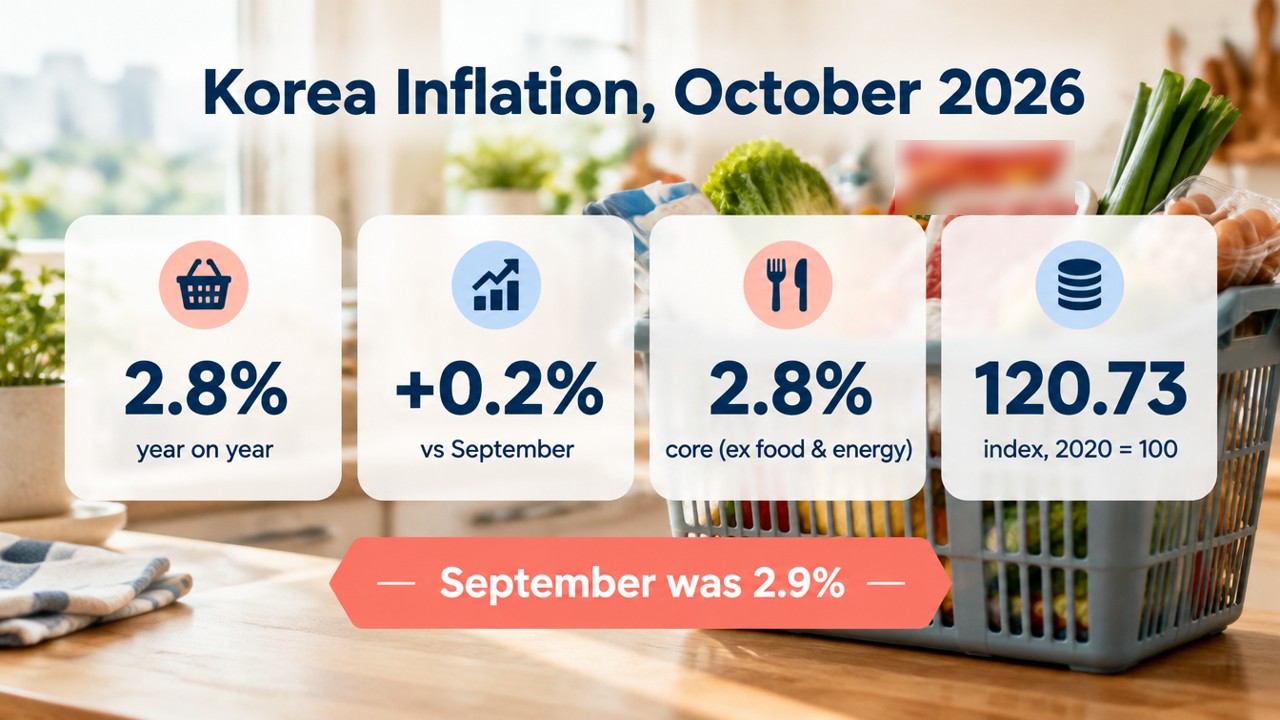
Quick answer: Korea’s consumer price index (CPI) rose 2.8% year on year in October 2026, down slightly from 2.9% in September and 3.1% in August. Prices were up 0.2% from September. Core inflation (excluding food and energy) was also 2.8%. Petroleum products jumped 14.9% and alone added 0.56 percentage points, while cheaper farm produce subtracted 0.14 points. The next CPI release is 2 December 2026.
The October 2026 numbers at a glance
Korea’s Ministry of Data and Statistics (국가데이터처, formerly Statistics Korea) published the October consumer price figures on 3 November 2026. The official press release on Korea.kr and its attached PDF give the following headline figures:
| Measure | October 2026 | September 2026 | Note |
|---|---|---|---|
| Headline CPI, year on year | 2.8% | 2.9% | Index 120.73 (2020 = 100) |
| Headline CPI, month on month | +0.2% | – | vs September 2026 |
| Core CPI (ex food & energy) | 2.8% | 2.8% | +0.4% m/m |
| Core CPI (ex farm products & petroleum) | 2.8% | 2.7% | Domestic-style core |
| Living necessities index | 2.6% | 2.5% | Food 1.5%, non-food 3.2% |
| Fresh food index | -6.2% | – | -3.8% m/m |
| January–October average | 2.7% | – | vs same period of 2025 |
The Ministry of Finance and Economy’s English release gives the same 2.8% headline and core figures, and Yonhap News Agency reported the same numbers independently.
Put simply, inflation has been at or above 2.8% for six straight months. Monthly year-on-year readings in 2026 were 2.0% (January), 2.0% (February), 2.2% (March), 2.6% (April), 3.1% (May), 3.2% (June), 2.8% (July), 3.1% (August), 2.9% (September) and 2.8% (October). The Bank of Korea’s target is 2%, so prices are still running well above it.
Worked check: from index level to the 2.8% headline
You can reproduce the headline rate yourself from the index levels in the release:
- October 2025 index: 117.42
- October 2026 index: 120.73
- 120.73 ÷ 117.42 = 1.0282, i.e. prices are 2.8% higher than a year earlier (rounded to one decimal).
- Month on month: 120.73 ÷ 120.43 (September 2026) = 1.0025, published as +0.2% after rounding at the item level.
What does 2.8% mean for a household? As our own illustration, not an official figure: a household that spent ₩2,000,000 a month on a typical CPI basket in October 2025 would need about ₩2,056,000 for the same basket in October 2026, which is roughly ₩56,000 more each month, or about ₩672,000 over a year. Your own number will differ because your spending mix is not the average basket. If you drive a lot, your personal inflation is probably higher; if you mostly buy fresh produce, it may be lower.
What pushed prices up, and what pulled them down
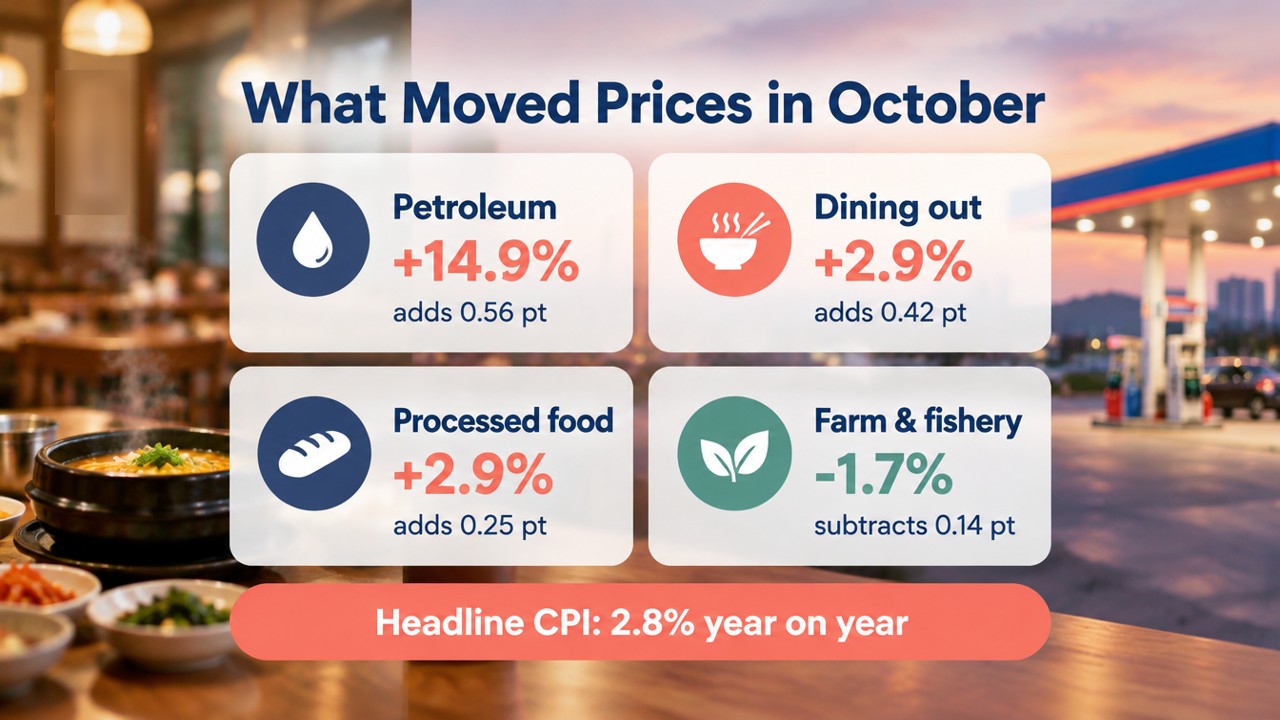
The statistics office breaks the 2.82-point headline into contributions from each group. Goods contributed 1.34 points and services 1.47 points.
| Component | Weight (per 1,000) | Change y/y | Contribution (pts) |
|---|---|---|---|
| Petroleum products | 46.6 | +14.9% | +0.56 |
| Dining out | 138.0 | +2.9% | +0.42 |
| Other personal services | 195.3 | +3.6% | +0.73 |
| Processed food | 82.7 | +2.9% | +0.25 |
| Public services | 120.0 | +1.7% | +0.19 |
| Housing rent | 99.1 | +1.4% | +0.13 |
| Electricity, gas & water | 33.7 | +0.4% | +0.02 |
| Farm, livestock & fishery products | 75.6 | -1.7% | -0.14 |
Source: Ministry of Data and Statistics, October 2026 CPI release (PDF attachment), contribution table.

Fuel: still the main story
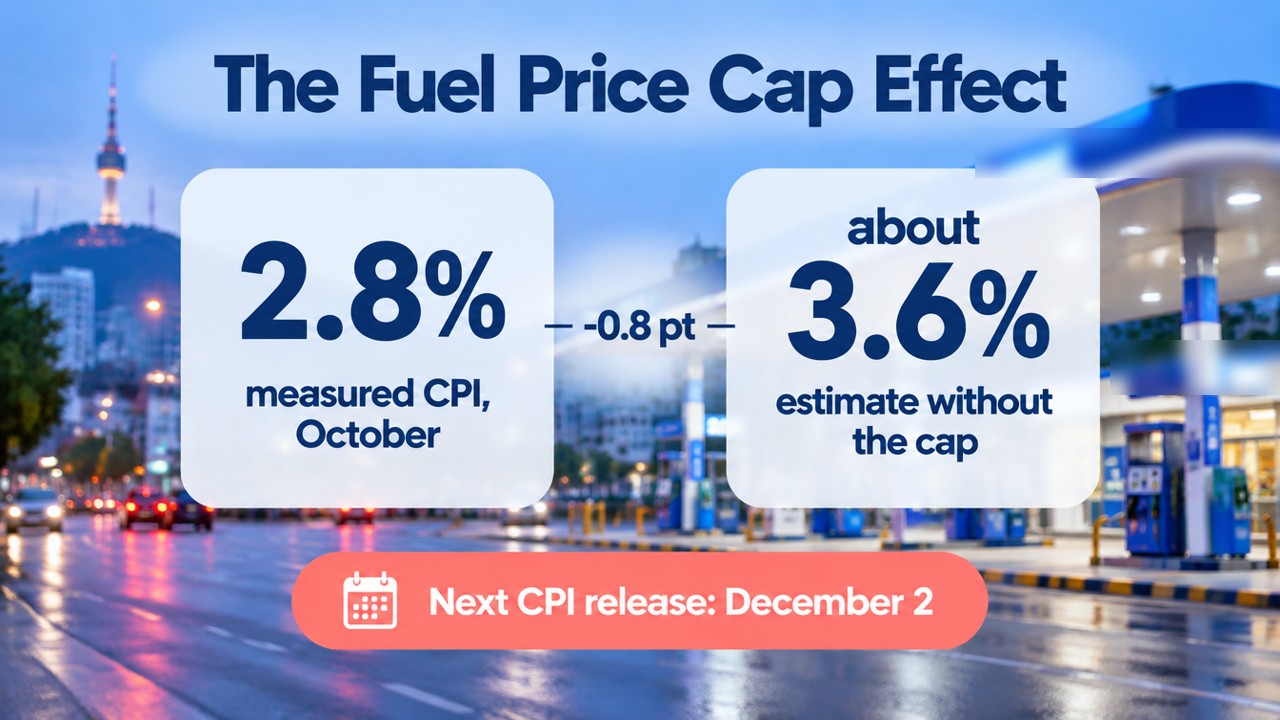
Petroleum prices were up 14.9% from a year earlier. Diesel rose 19.7% and gasoline 11.6%. Fuel alone added 0.56 points, so it accounts for about a fifth of the whole 2.8% rate. The government’s fuel price cap is softening the hit: the Ministry of Finance and Economy estimates that the cap lowered October inflation by about 0.8 percentage points, meaning the headline would have been around 3.6% without it. That is a government estimate, not a separately published index.
Transport as a spending category was up 6.8%, the fastest of the twelve expenditure groups, and contributed 0.69 points. International airfares (+20.7%) and overseas package tours (+11.5%) also stood out.
Food: cheaper produce, pricier meals
Fresh food got cheaper. Farm products fell 7.5% and vegetables 11.2%. Among items, lettuce fell 44.3%, cucumbers 39.5% and apples 13.4%. Not everything went down, though: domestic beef rose 9.1%, livestock 4.8% and fish 5.4%.
Prepared food is a different picture. Dining out rose 2.9%, and processed food was also 2.9% higher, with bread up 5.9% and ready-made meals 12.4%. That is why the living necessities index (2.6%) and the core measure (2.8%) stayed sticky even as vegetables got cheaper. The government has also set aside ₩64 billion for discounts on kimchi-making (gimjang) ingredients this season, according to Yonhap.
Services and housing
Services overall rose 2.7%. Personal services were up 3.3%, insurance services 13.4%, and rent (jeonse and monthly rent combined) was up a modest 1.4%, with jeonse +1.4% and monthly rent +1.5%. Public services rose 1.7%. Electricity, gas and water were nearly flat at +0.4%.
Regional differences
Inflation was highest in North Chungcheong (Chungbuk) and South Gyeongsang (Gyeongnam) at 3.2%, and lowest in Seoul and Daegu at 2.5%.

How Korea compares
The release also lists recent foreign inflation rates for September 2026: the United States 3.7%, the euro area 3.8%, the United Kingdom 3.6%, Germany 3.3%, France 3.4%, Japan 2.1% and China 0.9%. Korea’s 2.9% for September was below the US, euro area, UK, German and French rates but above Japan and China.
For context, Korea’s annual inflation was 3.6% in 2023, 2.3% in 2024 and 2.1% in 2025. The January–October 2026 average of 2.7% means this year is likely to come in above 2025.
What it means for interest rates and the economy
The Bank of Korea held its base rate at 3.00% on 22 October and its next rate decision is on 26 November 2026. We cover that meeting in our Bank of Korea base rate guide. Core inflation at 2.8% sits well above the 2% target, so the October data gives the board no reason to cut rates. Whether it raises them is the open question going into November. That outlook is analysis, not an official forecast.
On the growth side, the economy expanded 1.0% quarter on quarter in Q3 according to the advance estimate, covered in our Q3 GDP explainer. Exports stayed strong on chip demand, covered in our October 2026 export results. Solid growth plus above-target inflation is the mix that keeps central banks cautious.
Key dates ahead
| Date (KST) | Event |
|---|---|
| 26 November 2026 | Bank of Korea base rate decision |
| 2 December 2026 (Wed) | November 2026 CPI release |
| December 2026 | CPI rebased to 2025 basket weights (announced by the statistics office) |
| 31 December 2026 (Thu) | December and full-year 2026 CPI release |
Frequently asked questions
Q. What was Korea’s inflation rate in October 2026?
Consumer prices rose 2.8% year on year, down from 2.9% in September. Prices rose 0.2% from the previous month.
Q. What is Korea’s core inflation rate?
Core CPI excluding food and energy was 2.8% in October 2026, unchanged from September. The measure excluding farm products and petroleum was also 2.8%.
Q. Why are Korean fuel prices so high?
Petroleum product prices were 14.9% higher than a year earlier, with diesel up 19.7% and gasoline up 11.6%. The government says its fuel price cap reduced the headline inflation rate by about 0.8 percentage points.
Q. Are food prices in Korea going up or down?
Both. Fresh food was 6.2% cheaper than a year ago, led by vegetables, but dining out and processed food each rose 2.9%.
Q. When is the next Korean CPI release?
November 2026 figures are due on 2 December 2026, and December plus full-year figures on 31 December 2026.
Sources
- Ministry of Data and Statistics, “October 2026 Consumer Price Trends” press release and PDF attachment, via Korea.kr (checked 4 November 2026)
- Ministry of Data and Statistics, briefing transcript on Korea.kr (checked 4 November 2026)
- Ministry of Finance and Economy, English press release on October 2026 consumer prices (checked 4 November 2026)
- Yonhap News Agency, report on October 2026 consumer prices (checked 4 November 2026)
This article was written with AI assistance and fact-checked against official statistics. It is general information, not investment advice.





2 Comments