Dry Skin and Eczema in Korea’s Winter: When to See a Dermatologist, NHIS Cover and Costs
Haesul Health desk (AI-assisted). As of 17 November 2026 (KST). Based on the Korea Meteorological Administration (KMA) 1991–2020 climate normals, the Korea Disease Control and Prevention Agency (KDCA) health portal pages on atopic dermatitis and cold-wave health, the KMA/KDCA cold-wave health manual, the National Health Insurance Service (NHIS) health magazine, the Health Insurance Review and Assessment Service (HIRA) outpatient copayment rules, the NHIS benefit rules (Annex 2, non-covered items) and the Medical Service Act Enforcement Rule on clinic signs. Cross-checked with Wikipedia’s KMA climate tables, the UK NHS eczema pages, the government’s Easy Law service, Yonhap, Money Today and Hit News. General information, not medical advice.
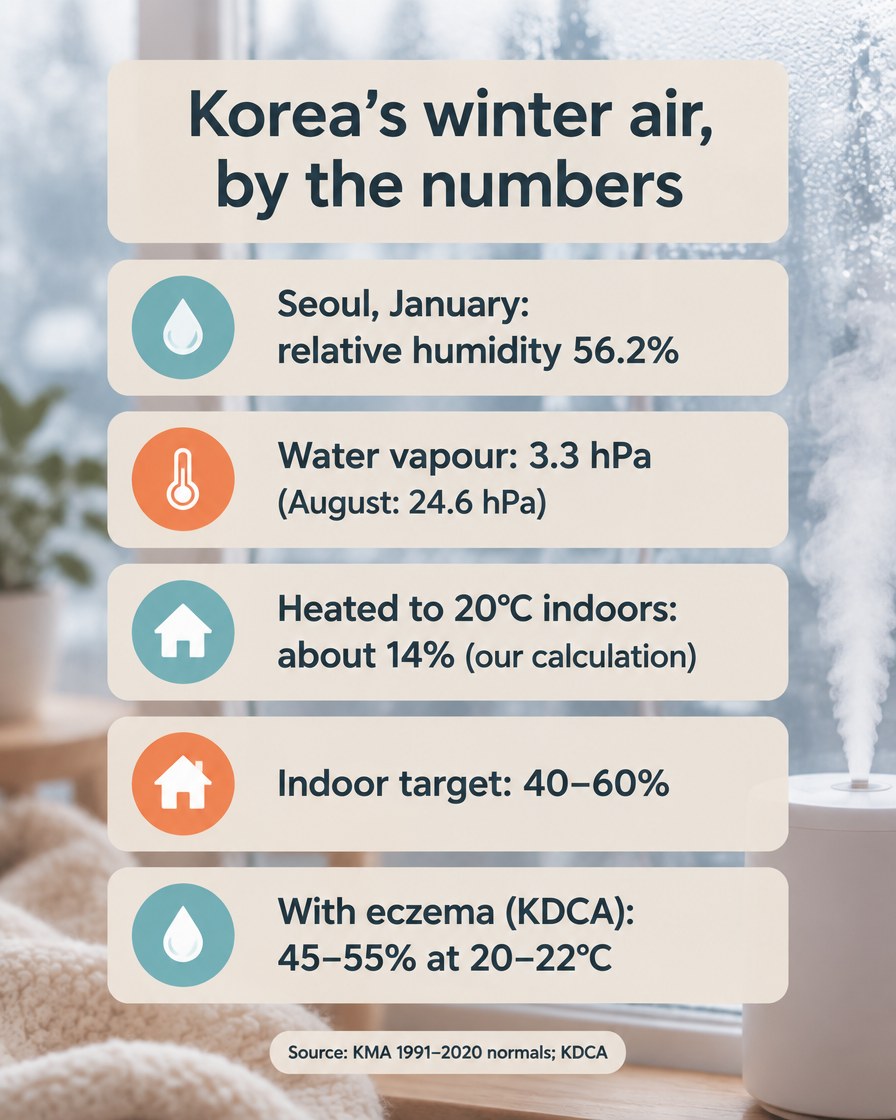
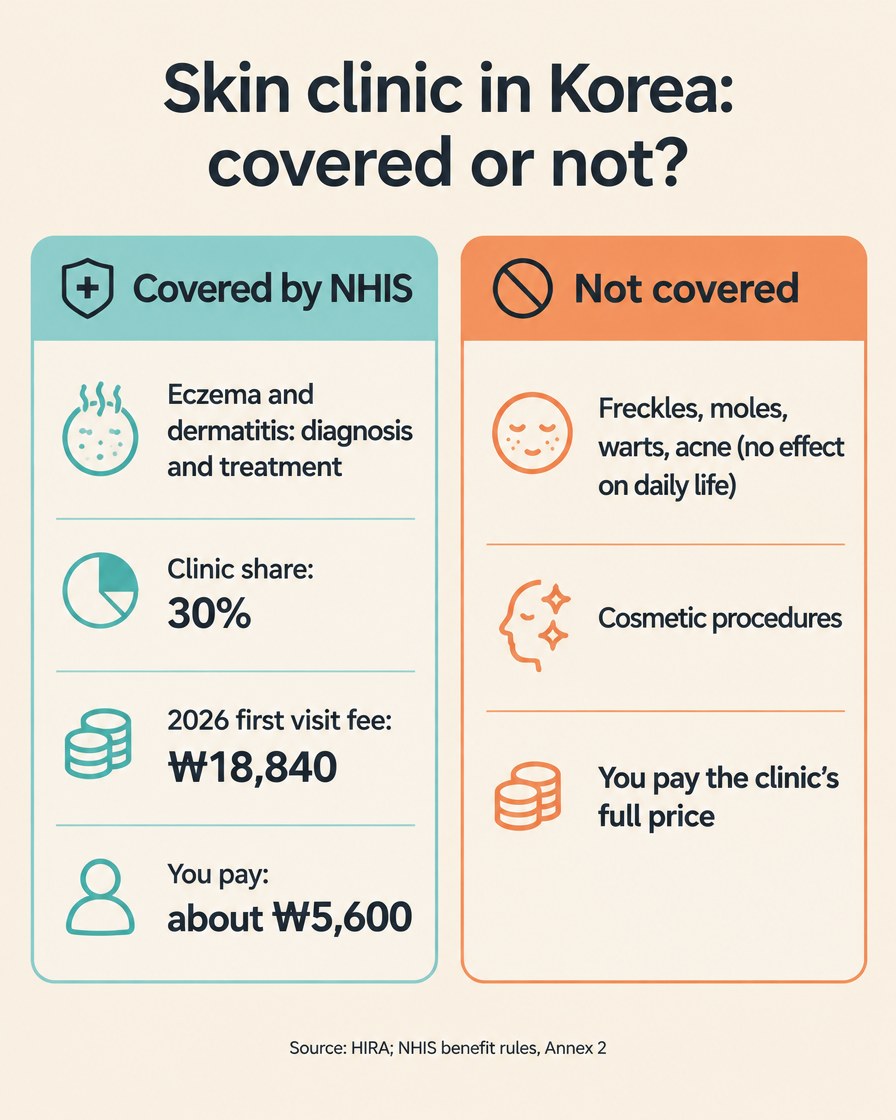
Quick answer: Korea’s winter air holds very little water. In Seoul the January air carries about one-seventh of the water vapour it holds in August (KMA normals: 3.3 hPa vs 24.6 hPa). Heat that air indoors and the room gets drier still. So the first fix is at home: short lukewarm showers, no scrubbing, a fragrance-free cream within 3 minutes of drying off, and an indoor humidity of roughly 40 to 60 percent, which is the range Korean health agencies give. See a doctor when a rash weeps, crusts, hurts or spreads, when you have a fever, or when two or three weeks of home care do not help. For eczema, a dermatology clinic visit is covered by NHIS: if you are enrolled, you pay 30 percent at a local clinic. On the 2026 first-visit fee of ₩18,840, your share is about ₩5,600. Cosmetic treatments are not covered, and neither are freckles, moles, warts or mild acne that don’t get in the way of daily life.
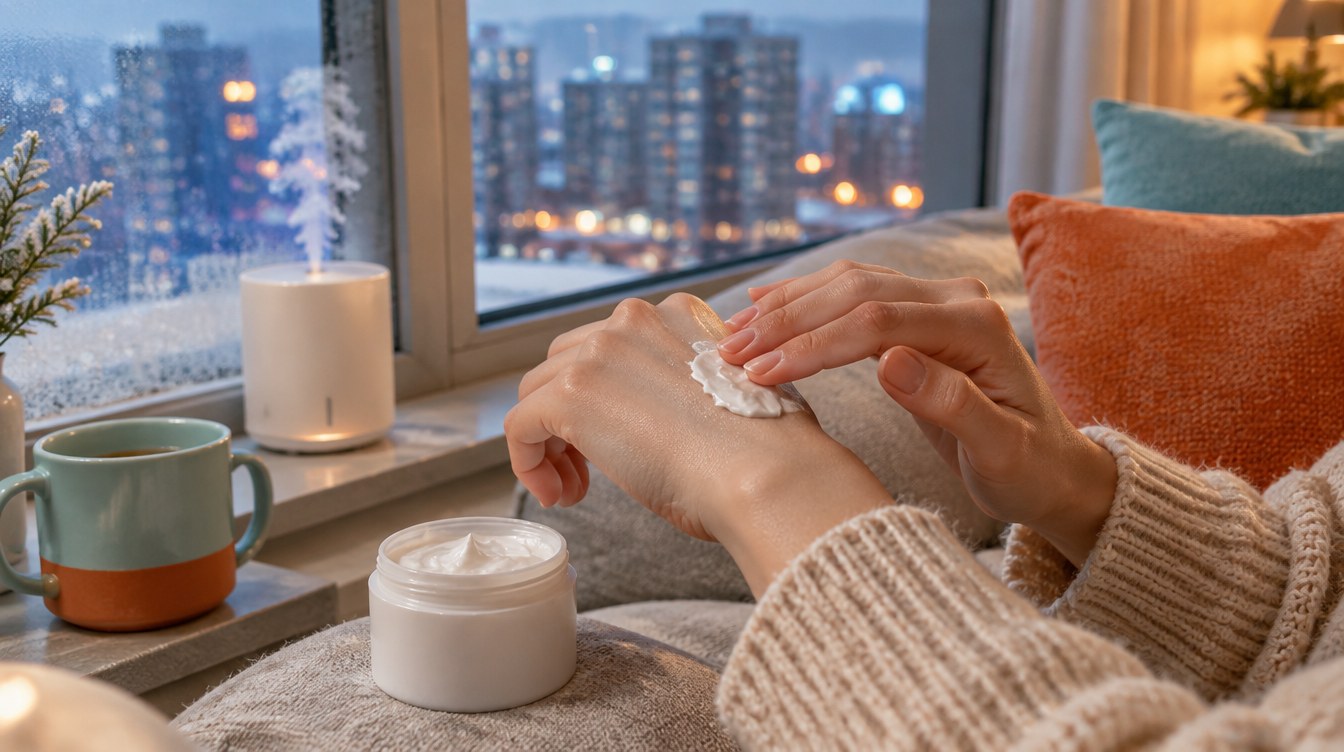
Why now: in KMA’s normals the winter months, December to February, carry the least water vapour of the year, and that is also when homes run the heating hardest. If you arrived this year from a humid climate, the cracked knuckles, itchy shins and flaking face usually come before your first snow. This guide explains why, what Korean health agencies tell residents to do, and how to get proper treatment without paying cosmetic-clinic prices.
Who this applies to
- Foreign residents enrolled in NHIS. Foreigners who have lived in Korea for six months or more are enrolled in national health insurance (see our guide to NHIS premiums for foreigners in 2026). You get the covered prices and the 30 percent clinic share below. Show your residence card (ARC) at reception.
- Tourists and short-stay visitors without NHIS. You can walk into the same clinics, but you pay the whole bill and claim it from your travel insurance. The home-care advice is the same for everyone.
- Children. Atopic dermatitis often starts in babies and young children, and some copayment rules differ for under-6s. This guide is written for adults; parents should follow their paediatrician or dermatologist.
Why Korean winter air dries your skin: the KMA numbers
Relative humidity on a winter weather app often looks moderate: Seoul’s January normal is 56.2 percent. The catch is temperature. Cold air can hold very little water, so the actual amount of vapour in it is tiny. KMA publishes this as vapour pressure (증기압), and the winter figures are a fraction of summer ones.
| City (KMA station) | Dec humidity | Jan humidity | Feb humidity | Jan vapour pressure | Aug vapour pressure | Jan average temp |
|---|---|---|---|---|---|---|
| Seoul (108) | 57.8 percent | 56.2 percent | 54.6 percent | 3.3 hPa | 24.6 hPa | −1.9°C |
| Incheon (112) | 61.8 percent | 61.1 percent | 61.2 percent | 3.6 hPa | 26.3 hPa | −1.5°C |
| Gangneung (105) | 45.6 percent | 46.8 percent | 49.2 percent | 3.4 hPa | 23.8 hPa | 0.9°C |
| Daejeon (133) | 67.9 percent | 65.3 percent | 60.3 percent | 3.9 hPa | 26.1 hPa | −1.0°C |
| Busan (159) | 48.1 percent | 46.8 percent | 49.4 percent | 4.0 hPa | 26.6 hPa | 3.6°C |
| Jeju (184) | 64.1 percent | 64.0 percent | 63.3 percent | 6.2 hPa | 27.3 hPa | 6.1°C |
Source: KMA climate normals 1991–2020, monthly table (data.kma.go.kr), read on 17 November 2026. Humidity figures match Wikipedia’s KMA-sourced climate tables for each city.
Two things stand out. The east coast (Gangneung) and Busan have the lowest winter humidity of these cities, below 50 percent even outdoors. Seoul’s January air holds about one-seventh of its August water vapour (3.3 vs 24.6 hPa).
What happens indoors (our calculation). When outdoor air comes inside and is warmed, it keeps the same water but can now hold far more. Using the standard Magnus formula for saturation vapour pressure (about 23.4 hPa at 20°C and 26.4 hPa at 22°C), the January air above would sit at roughly:
| City | Jan vapour pressure | Indoor humidity at 20°C | Indoor humidity at 22°C |
|---|---|---|---|
| Seoul | 3.3 hPa | about 14 percent | about 13 percent |
| Gangneung | 3.4 hPa | about 15 percent | about 13 percent |
| Busan | 4.0 hPa | about 17 percent | about 15 percent |
| Jeju | 6.2 hPa | about 27 percent | about 24 percent |
Our calculation: vapour pressure ÷ saturation vapour pressure at room temperature. It ignores the moisture that cooking, showers, plants and people add, so a real flat usually reads higher. It shows the direction, not your room. A cheap thermo-hygrometer (온습도계) is the only way to know.
That is why KDCA’s cold-wave page says that in winter, “a lack of water vapour in the air plus heating” makes homes very dry. It warns that dry air dries out the skin, eyes and the lining of the nose and airways.
What Korean health agencies tell you to do at home
These points come from KDCA’s atopic dermatitis page (updated 6 May 2026), KDCA’s atopic dermatitis prevention rules and the NHIS health magazine’s dry-skin article. The UK NHS gives the same core advice.
- Keep showers short and lukewarm. KDCA suggests lukewarm water of about 27 to 30°C, once a day, for 10 to 20 minutes at most. Hot water strips the skin’s protective lipids faster. NHIS adds that people with dry skin should avoid saunas and steam rooms.
- Do not scrub. KDCA’s rule is blunt: don’t scrub off “dead skin” (때를 밀면 안 됩니다). The Korean bathhouse scrub with an Italy towel (때밀이 수건) removes the outer layer that protects your skin. Save the full jjimjilbang scrub for when your skin is healthy, or skip it.
- Use a mild, weakly acidic liquid cleanser rather than a strongly alkaline bar soap (KDCA, NHIS).
- Moisturise within 3 minutes. Pat dry and apply a moisturiser (보습제, bosseupje) before the water evaporates, KDCA says. Use it at least twice a day even when your skin looks fine, and 4 to 5 times a day during a flare. For adults with atopic dermatitis that works out to 250 g or more a week. In winter, KDCA prefers a cream or ointment to a lotion. Choose products without fragrance or preservatives that irritate you.
- Wear soft cotton next to your skin rather than wool or nylon, wash new clothes before wearing them, and rinse detergent out well.
- Keep nails short. Scratching damages the skin and starts the itch–scratch cycle again.
- Keep indoor humidity in range (next section).
- Restrict foods only if a doctor has diagnosed an allergy. KDCA warns that unnecessary elimination diets lower quality of life and nutrition.
KDCA also lists air pollution among the triggers that can make atopic dermatitis worse. On high fine-dust days, see our fine dust season guide for the AirKorea grades and when to keep windows shut.
The humidity target: 40 to 60 percent, and how to get there
Korean agencies give slightly different ranges, and they all sit inside 40 to 60 percent:
| Source | Indoor humidity | Indoor temperature |
|---|---|---|
| KMA/KDCA cold-wave health manual (citing the Ministry of Environment’s 2012 indoor-air manual) | 40 to 60 percent | 18 to 20°C |
| NHIS health magazine, dry-skin article | 40 to 60 percent | 18 to 20°C |
| KDCA cold-wave health rules | 40 to 50 percent | 18 to 20°C |
| KDCA atopic dermatitis page (for people with eczema) | 45 to 55 percent | 20 to 22°C |
KDCA’s suggested ways to add moisture are low-tech: hang wet laundry or towels indoors, set out bowls of water or wet charcoal, and keep potted or water plants. A humidifier (가습기, gaseupgi) works faster, but clean it as the maker instructs, and keep the room within range rather than as humid as possible. House-dust mites, a common eczema trigger, thrive in damp rooms, so higher is not better. KDCA also recommends airing rooms three times a day for 10 to 30 minutes, ideally between 10:00 and 19:00, and avoiding sudden temperature swings.
A simple routine for an ondol (floor-heated) flat: put a hygrometer at bed height away from the humidifier. Aim for the 40s–50s in the evening. Dry laundry on a rack in the bedroom on heating days, and put your cream next to the shower so step 4 happens every time.
When to stop self-treating and see a doctor
NHIS’s magazine warns that dry skin left alone can turn into dermatitis. If lifestyle changes don’t help, it says to see a doctor. Its winter article also cautions against using steroid ointment without a diagnosis, because misuse can cause redness, visible blood vessels and thinning skin. The UK NHS lists the warning signs that need prompt care:
- the rash is blistered, crusty, weeping fluid or has pus-filled spots;
- it is painful, swollen or feels warm;
- it suddenly gets worse or spreads;
- you have a high temperature or feel generally unwell.
The NHS says these can mean infected eczema or a more serious condition called eczema herpeticum, which may need treatment such as antibiotics. In Korea, that means a same-day clinic visit. At night or on a holiday, see our guide to late-night clinics and pharmacies. If you are very unwell, go to an ER or call 119.
Book an ordinary appointment if the itch keeps waking you up, the rash keeps coming back, or two to three weeks of the routine above haven’t helped (our rule of thumb, not an official threshold). Also go if you aren’t sure it is eczema at all: fungal infections, contact allergies and psoriasis can look similar and need different treatment.
Medical dermatology vs cosmetic clinics: what NHIS covers
Korea’s skin clinics do two very different jobs. One is treating disease, which NHIS covers. The other is cosmetic work, which it does not. Annex 2 of the NHIS benefit rules (국민건강보험 요양급여의 기준에 관한 규칙, amended 15 April 2026) lists what is not covered:
| Situation | NHIS status | What it means for you |
|---|---|---|
| Diagnosing and treating eczema, atopic dermatitis, contact dermatitis, infected skin and other skin disease | Covered (급여) | You pay the normal copay: 30 percent at a clinic if enrolled |
| Freckles, excess or missing hair, white hair, rosacea, moles, warts, acne, age-related hair loss when they don’t affect work or daily life | Not covered (비급여) | You pay the clinic’s own price in full |
| Cosmetic procedures: wrinkle removal, cosmetic scar removal and other appearance-only treatments | Not covered | You pay in full; clinic prices vary widely |
| Medicines your doctor prescribes for a covered condition | Covered at the pharmacy | You pay your share at the pharmacy, a separate bill |
The government’s Easy Law service puts it simply: treating freckles or acne that don’t affect daily life is non-covered, so the patient pays the full cost. At reception, ask “보험 되나요?” (boheom dwenayo?, “Is this covered by insurance?”). Before any add-on such as a laser, a special cream sold in the clinic or a skin booster, ask “급여예요, 비급여예요?” (“Covered or non-covered?”). HIRA’s website also publishes each clinic’s non-covered prices, so you can compare before you go.
How to tell a dermatologist from a clinic that “does” dermatology
Many Korean signs say 피부과 (pibugwa, dermatology), but that does not always mean a dermatology specialist runs the clinic. The Medical Service Act Enforcement Rule (의료법 시행규칙) sets the wording:
| What the sign says | What it means |
|---|---|
| OO피부과의원 (dermatology inside the clinic’s name) | Article 40(4): only allowed when the founder is a certified specialist in that field |
| OO의원 + 진료과목: 피부과 (small “treatment subject” line) | The clinic offers dermatology care (Article 41). It does not say the doctor is a dermatology specialist |
| 전문의 line on the name board (e.g. 피부과 전문의) | Article 40(6): the founder’s specialist qualification and field |
Yonhap’s 18 December 2025 fact-check said the same. A dermatology specialist can sign a clinic “OO피부과의원”. A general practitioner who registers dermatology as a treatment subject usually signs “OO의원 진료과목: 피부과”. Names like “OO skin clinic” or “skin & aesthetic” may not have a dermatology specialist. Yonhap also noted that some cosmetic-focused clinics are run by doctors trained in other fields.
For eczema that keeps flaring, a specialist dermatology clinic (피부과의원) is usually the most direct route. If you need English, see our guide to seeing a doctor in English in Korea. University hospitals’ international centres can also book specialist departments, but at a tertiary hospital NHIS members need a referral letter, and the share is higher.
What a first dermatology visit costs (2026)
HIRA’s outpatient rules set the NHIS patient share at a local clinic (의원) at 30 percent of the covered cost for most adults under 65, rounded down to the nearest ₩100. The 2026 first-visit consultation fee at a clinic is ₩18,840. MOHW’s June 2026 fee reform was reported with that figure by both Yonhap and Money Today. On 28 October 2026, MOHW’s health insurance committee approved a rise to ₩21,210 from January 2027 (Hit News, Doctors News).
| Case (consultation only) | Calculation | You pay |
|---|---|---|
| NHIS member, clinic first visit, 2026 | 30 percent × ₩18,840 = ₩5,652, rounded down | about ₩5,600 |
| NHIS member, clinic first visit, from January 2027 | 30 percent × ₩21,210 = ₩6,363, rounded down | about ₩6,300 |
| No NHIS (tourist), clinic charging the standard fee | 100 percent × ₩18,840 | ₩18,840, plus any extras |
| Any patient, cosmetic or non-covered item | Clinic’s own price | Full price (check HIRA’s non-covered price list) |
Our arithmetic on the official fees. Tests, procedures and medicines are charged on top. The prescription is filled at a separate pharmacy, where NHIS members also pay their share (30 percent for most adults). Different rules apply to children under 6, people 65 and over and pregnant patients.
This is the same 30 percent clinic rule we explained for the dentist in our toothache and emergency dental guide. Only the fee schedule differs.
Your first visit, step by step
- Find a clinic. Search Naver Map or KakaoMap for 피부과 and check whether the name is “OO피부과의원” if you want a specialist. Check the opening hours in the map app and phone ahead or book there if the clinic offers it.
- Bring your ARC (or passport if you are a tourist), a list or photos of the creams and cleansers you use, and photos of the rash at its worst if it comes and goes.
- Say what you need. Useful lines: “피부가 너무 건조하고 가려워요” (my skin is very dry and itchy), “습진이 있어요” (I have eczema), “아토피가 있어요” (I have atopic dermatitis), “보험 되나요?” (is it covered?).
- Ask about the plan: what the prescribed cream is for, how long to use it and when to come back. Follow the doctor’s and pharmacist’s instructions for any steroid cream rather than stopping and starting on your own.
- Keep the receipt (진료비 영수증). Tourists need it, plus the itemised statement (진료비 세부산정내역서), for an insurance claim.
Common problems
- “The clinic tried to sell me a skincare package.” Many clinics do both medical and cosmetic work. You can say you only want treatment for the rash: “치료만 받고 싶어요.”
- “My cream stopped working.” Go back to the same clinic rather than buying stronger products online. NHIS warns that unsupervised steroid use has side effects.
- “Everything flares after the bathhouse.” Long hot soaks, saunas and scrubbing are exactly what KDCA and NHIS tell dry-skin and eczema patients to avoid. Shorten the visit, skip the scrub and moisturise straight after.
- “My humidifier makes the windows run with water.” That is too much. Aim for the 40–60 percent band and air the room. Damp corners grow mould and mites.
Dry indoor air also affects your eyes: seeing an eye doctor in Korea for dry eye, pink eye or glasses.
Frequently asked questions
Q. Why is my skin so dry in Korea in winter?
Cold air holds very little water. KMA’s 1991–2020 normals show Seoul’s January vapour pressure at 3.3 hPa against 24.6 hPa in August. When that air is heated indoors its relative humidity falls further: by our calculation, to about 14 percent at 20°C before cooking, showers or people add moisture back. Dry air and hot showers strip the skin barrier faster.
Q. What indoor humidity should I aim for?
Korean health agencies give ranges inside 40 to 60 percent: 40 to 60 percent in the KMA/KDCA cold-wave manual and the NHIS magazine, 40 to 50 percent in KDCA’s cold-wave rules, and 45 to 55 percent on KDCA’s atopic dermatitis page. Use a hygrometer, and avoid going higher because house-dust mites like damp rooms.
Q. Does Korean national health insurance cover a dermatologist visit for eczema?
Yes. Diagnosing and treating a skin disease such as eczema is covered, and an enrolled adult under 65 pays 30 percent at a local clinic. On the 2026 clinic first-visit fee of ₩18,840 that is about ₩5,600 for the consultation, by our calculation. Cosmetic treatments, and conditions such as freckles, moles, warts or acne that don’t affect daily life, are not covered.
Q. How do I know a skin clinic has a dermatology specialist?
Look at the name. Under the Medical Service Act Enforcement Rule, a clinic called “OO피부과의원” has a dermatology specialist as its founder. “OO의원” with a small “진료과목: 피부과” line only means the clinic offers dermatology care. The name board can also list the founder’s specialist qualification (전문의).
Q. When should I see a doctor instead of treating dry skin myself?
Go promptly if the rash is weeping, crusted, blistered or has pus, if it is painful, swollen or warm, if it suddenly spreads, or if you have a fever. These can be signs of infection (UK NHS). Book a routine visit if home care has not helped after a few weeks, if itching keeps you awake, or if you are not sure what the rash is.
Q. Is the Korean bathhouse scrub bad for eczema?
KDCA’s atopic dermatitis rules say not to scrub off “dead skin”, because it removes the protective outer layer. NHIS also advises people with dry skin to avoid saunas and steam rooms. If you enjoy jjimjilbang visits, keep them short, skip the scrub and moisturise right after.
Sources
- KMA, Climate normals 1991–2020, monthly table (humidity, vapour pressure, temperature; stations 108, 112, 105, 133, 159, 184): https://data.kma.go.kr/normals/table.do
- KDCA National Health Information Portal, Atopic dermatitis (아토피피부염; updated 6 May 2026): https://health.kdca.go.kr/healthinfo/biz/health/gnrlzHealthInfo/gnrlzHealthInfo/gnrlzHealthInfoView.do?cntnts_sn=6582
- KDCA, Allergic disease prevention rules, atopic dermatitis (2022, revised 2023): https://www.kdca.go.kr/kdca/3364/subview.do
- KDCA National Health Information Portal, Winter cold-wave health rules (indoor humidity 40–50 percent; updated 2 June 2026): https://health.kdca.go.kr/healthinfo/biz/health/gnrlzHealthInfo/gnrlzHealthInfo/gnrlzHealthInfoView.do?cntnts_sn=2048
- KMA/KDCA, Cold-wave health manual (indoor humidity 40–60 percent, citing the Ministry of Environment/NIER 2012 manual): https://www.weather.go.kr/wnuri_help/doc/wrn_coldwave_health_manual_1.pdf
- NHIS health magazine 건강iN, Dry skin (피부건조증) lifestyle advice: https://www.nhis.or.kr/magazin/162/html/sub7.html
- NHIS webzine, February 2024, Winter dry skin (steroid ointment caution): https://www.nhis.or.kr/static/alim/paper/oldpaper/202402/sub/section2_2.html
- HIRA, Outpatient copayment rates (외래진료시 본인부담률): https://www.hira.or.kr/dummy.do?pgmid=HIRAA030056020110
- NHIS benefit rules, Annex 2 Non-covered items (amended 15 April 2026), via the National Law Information Center: https://www.law.go.kr/LSW/flDownload.do?flSeq=163452831
- Easy Law (찾기쉬운 생활법령정보), Are freckle and acne treatments covered?: https://www.easylaw.go.kr/CSP/OnhunqueansInfoRetrieve.laf?onhunqnaAstSeq=97&onhunqueSeq=5103
- Medical Service Act Enforcement Rule, Articles 40–42 (clinic names and treatment subjects), National Law Information Center: https://www.law.go.kr/법령/의료법시행규칙
- Yonhap, Fact check on dermatology clinic signs (18 December 2025): https://www.yna.co.kr/view/AKR20251218072800518
- Yonhap, 25 June 2026, Health insurance fee overhaul (clinic first visit ₩18,840): https://www.yna.co.kr/view/AKR20260625018151530
- Money Today, 25 June 2026, Clinic consultation fees to rise: https://www.mt.co.kr/thebio/2026/06/25/2026062510502196029
- Hit News, 28 October 2026, Clinic first-visit fee ₩18,840 to ₩21,210 from January 2027: https://www.hitnews.co.kr/news/articleView.html?idxno=80300
- UK NHS, Atopic eczema, treatment and when to get help: https://www.nhs.uk/conditions/atopic-eczema/treatment/
- Wikipedia, KMA-sourced climate tables for Seoul, Incheon, Gangneung, Daejeon, Busan and Jeju City (cross-check of the humidity normals)
How we checked: On 17 November 2026 (KST) we pulled the KMA normals table directly from data.kma.go.kr and matched every humidity figure against Wikipedia’s KMA-sourced tables. We read the KDCA, NHIS and HIRA pages and the Annex 2 PDF in full, and read the Enforcement Rule text on law.go.kr. We matched each rule or fee against a second source (Easy Law, Yonhap, Money Today, Hit News, the UK NHS). The indoor-humidity and copay figures are our own arithmetic and are labelled as such.
This guide is general information, not medical advice. For your own skin, follow a doctor or pharmacist, and in an emergency call 119.
Researched and drafted with AI assistance; checked against the sources listed.


One Comment