Eye Doctor in Korea: Dry Eyes, Pink Eye, Glasses and What an Eye Clinic Visit Costs
Haesul Health desk (AI-assisted). As of 18 November 2026 (KST). Based on the 2026 national fee schedule of the Health Insurance Review and Assessment Service (HIRA), the National Health Insurance Service (NHIS) conversion-factor disclosure, HIRA’s outpatient co-payment rules, the NHIS benefit rules on non-covered items (Annex 2, amended 15 April 2026), the Ministry of Health and Welfare (MOHW) notice 2024-235 on single-use artificial tears, the Korea Disease Control and Prevention Agency (KDCA) week-45 sentinel surveillance report and its health-portal pages on dry eye, epidemic keratoconjunctivitis and contact lenses, the Korea Meteorological Administration (KMA) 1991–2020 climate normals, and the Medical Technicians Act and its Enforcement Decree on opticians. Independent cross-checks: the UK’s NHS, Yonhap, Hankook Ilbo, Pharmnews and Mediprice. General information, not medical advice.
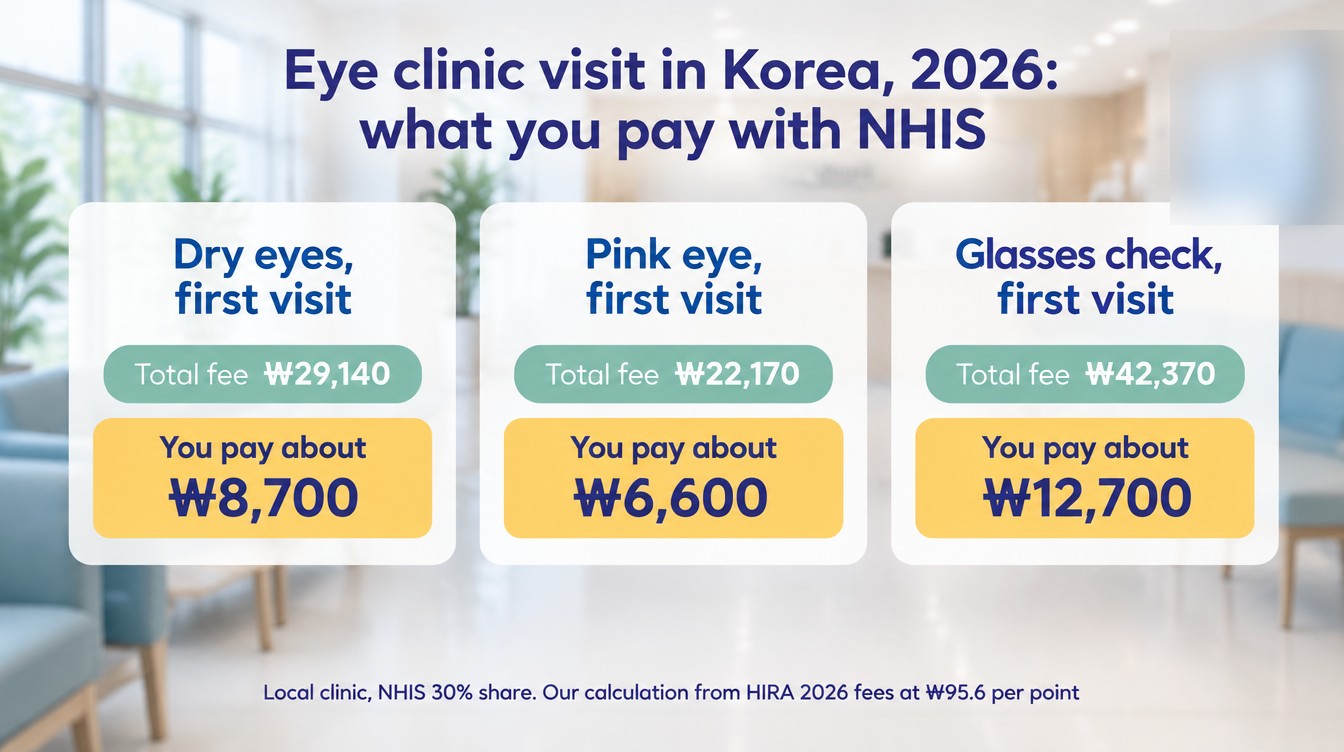
Quick answer: For dry, gritty eyes in winter, a red eye or new glasses, go to a neighbourhood eye clinic (안과, an-gwa). You don’t need a referral, and most take walk-ins. If you are on NHIS, a first visit with the usual tests costs about ₩6,600 to ₩12,700 out of pocket in 2026 (our calculation from HIRA’s fee schedule: total fees of ₩22,170 to ₩42,370, of which you pay 30 percent at a clinic). Glasses and contact lenses themselves are not covered by NHIS. You can buy them from a licensed optician (안경원) without a doctor’s prescription, except for children aged 6 or under. Contact lenses cannot legally be sold online in Korea. Pink eye caused by adenovirus spreads easily for about two weeks, so keep your towels separate and stay away from pools and public baths. Call 119 for a chemical splash, an eye injury, or sudden loss of sight or severe pain.
Why now: two things happen to eyes in a Korean winter. First, the air gets very dry. KMA’s 1991–2020 normals put Seoul’s January relative humidity at 56.2 percent, but the air holds only 3.3 hPa of water vapour, against 24.6 hPa in August. Once that air is heated indoors, its humidity drops to roughly 14 percent at 20°C, by our calculation (our winter dry-skin guide shows the working). KDCA says dry eye is now one of the most common reasons people visit an eye clinic, and it names closed, heated winter apartments with little ventilation as a typical trigger. Second, contagious pink eye never really stops. In KDCA’s 77 sentinel eye clinics, suspected epidemic keratoconjunctivitis ran at 7.0 per 1,000 patients in week 45 (1 to 7 November 2026). That was down from 9.2 the week before. In children aged 0 to 6 the rate was 41.1 per 1,000.
Who this applies to
- Foreign residents enrolled in NHIS. You pay the same as Korean patients for covered eye care: 30 percent of the fee at a clinic. Employees join through work, and most other residents are enrolled after six months in Korea. Our NHIS guide for foreigners explains the premiums and the six-month rule.
- Visitors and anyone not yet on NHIS. You can use the same clinics, but you pay the full fee, and clinics may charge uninsured patients more than the NHIS rate. Keep your receipts and the itemised bill for your travel insurance.
- Parents. Children’s eye problems go to the same clinics. One legal difference applies: glasses and contact lenses for a child aged 6 or under need a doctor’s prescription (see the glasses section below).
Eye clinic, optician or ER: where to go
Korea splits eye care between doctors and opticians more sharply than many countries do. An ophthalmologist (안과 의사) diagnoses and treats eye disease and can prescribe drugs. An optician (안경사, an-gyeong-sa) is a licensed health technician who can test your eyesight to fit glasses or contacts and sell them, but cannot diagnose or treat disease.
| Your problem | Where to go | Notes |
|---|---|---|
| Dry, gritty, tired eyes in winter | Pharmacy first, then an eye clinic if it doesn’t settle | Pharmacies sell several artificial tears without a prescription |
| Red, sticky or watery eye, possibly contagious | Eye clinic (안과) | Diagnosed by examination with a slit-lamp microscope |
| New glasses or contacts, eyesight changed slowly | Optician (안경원) or eye clinic | An eye clinic is the better first stop if anything else is wrong (pain, redness, floaters) |
| Child aged 6 or under needs glasses | Eye clinic first | Glasses or contacts for this age are dispensed only on a doctor’s prescription |
| Chemical in the eye, something pierced or hit the eye hard, sudden loss of sight, severe pain | 119 or an emergency room | Keep rinsing with clean water while you wait (chemicals) |
When to call 119 instead
The UK’s NHS lists the eye problems that need emergency care straight away. They include a strong chemical such as bleach or oven cleaner in the eye, a sharp object that has pierced the eye, something that hit the eye at high speed, any change in sight after an injury, severe eye pain, being unable to move the eye or keep it open, and blood or pus coming from it. For a chemical, it advises rinsing with clean, not hot, running water for at least 20 minutes and taking the product container with you. In Korea, call 119 for an ambulance, and read our ER guide for foreigners for how emergency fees work. At night or on a holiday, our guide to late-night pharmacies and moonlight clinics covers what is open.
For a red eye without an injury, see a doctor urgently if you also have eye pain, sensitivity to light, changes in vision such as wavy lines or flashes, or a very red eye. These are also NHS criteria. KDCA’s contact-lens page says the same for lens wearers: if your eye suddenly turns red, your sight drops or it hurts, take the lens out at once and go to an eye clinic.
Dry eyes in a Korean winter
KDCA’s health portal (page updated 4 August 2026) describes dry eye as a problem of the tear film: too few tears, tears that evaporate too fast, or a tear film that breaks up. Typical symptoms are dryness, a gritty or foreign-body feeling, stiffness, burning, redness, tiredness and blurred vision. KDCA cites a university hospital study in which more than 80 percent of people in Korea’s big cities said they had experienced dry eye.
What KDCA tells you to do at home:
- Keep indoor air moist, for example with a humidifier, and don’t let car heaters or fan heaters blow at your face. KDCA’s winter cold-wave health rules give an indoor humidity of 40 to 50 percent.
- Ventilate. KDCA lists sealed, dry winter apartments with little ventilation as a classic trigger.
- Rest your eyes about every 30 minutes on screens and blink often.
- Wear glasses outdoors on windy days. Soft contact lenses worn for long periods make dryness worse, because a soft lens soaks up some of the tear film and thins its oily layer.
- Use artificial tears if needed, and use a warm compress on the eyelids to help the oil glands (meibomian glands) release oil.
- Ask your doctor if a medicine you take could be the cause. KDCA names tranquillisers, blood-pressure drugs, osteoporosis hormone drugs and antihistamines, among others.
Artificial tears at the pharmacy. According to the Ministry of Food and Drug Safety, as reported by Hankook Ilbo, many artificial tears are sold over the counter in Korean pharmacies. Common ingredients are carboxymethylcellulose, carbomer, povidone, polysorbate, hypromellose and sodium hyaluronate. Sodium hyaluronate drops come in both kinds: some strengths and uses are over-the-counter, others are prescription-only. KDCA adds one practical point. Drops that contain a preservative are better kept to occasional use, and if you need drops more often than four times a day, it suggests single-use, preservative-free vials. Long-term use of preserved glaucoma drops can itself damage the eye surface. Hankook Ilbo also quotes the ministry’s advice to stop and see a doctor if the gritty feeling lasts more than three days. A pharmacist can tell you which product you are holding. Point at the ingredient name on the box if you don’t speak Korean.
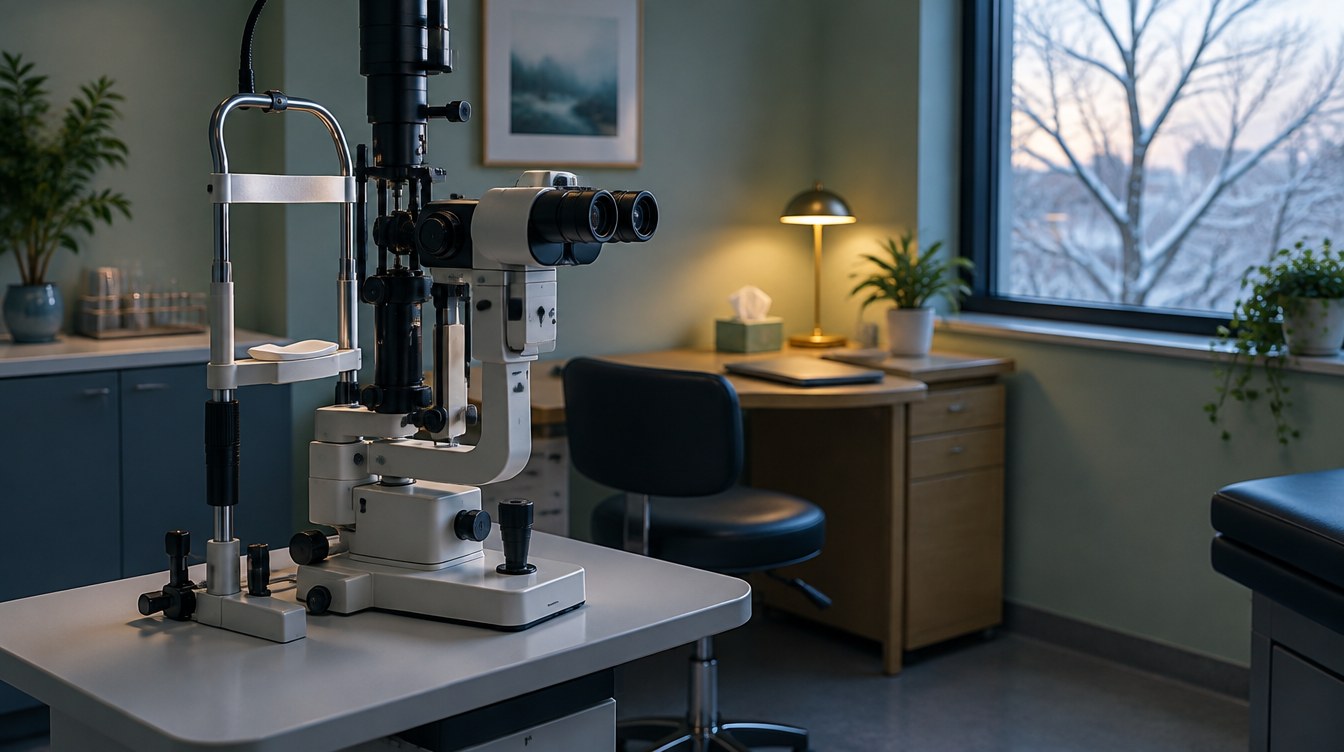
When to see an eye doctor. Go if home care doesn’t help, if one eye is much worse than the other, if the eye is painful or very red, or if your vision is blurred. KDCA describes dry eye as a chronic condition that usually needs to be managed, not cured, so a proper diagnosis is worth it. At the clinic, the doctor will usually examine the eye surface with a slit-lamp microscope (세극등현미경검사), often after a yellow fluorescein stain. The doctor may also measure tear production with a small paper strip in the lower lid (the Schirmer test, 눈물분비기능검사). These are NHIS-listed tests. Their 2026 fees are in the cost table below.
What NHIS covers for dry-eye drops. Since 1 December 2024, under MOHW notice 2024-235, NHIS covers single-use artificial-tear vials for dry eye only within set limits. Only one product per mechanism is covered, single-use sodium hyaluronate vials are capped at six vials a day, and for sodium hyaluronate drops, dry eye from an outside cause (such as contact lenses, surgery, drugs or injury) is in principle not covered. Pharmnews reported HIRA’s Q&A on the rule. It says a doctor can still diagnose an internal (endogenous) dry eye after tests such as the slit-lamp, Schirmer or tear break-up tests, and the drops are then covered. Multi-dose hyaluronate bottles have no daily limit. In practice, ask the doctor whether your prescription will be billed as covered or non-covered before you leave.
Fine dust also irritates the eyes in Korea’s winter and spring. Our fine-dust guide explains the PM2.5 grades and the seasonal management period that starts on 1 December 2026.
Pink eye: what Korea’s eye-clinic surveillance shows
“Pink eye” is a loose term. In Korea the contagious kind that worries clinics and schools is epidemic keratoconjunctivitis (유행성각결막염), caused mainly by adenovirus. KDCA’s health portal (updated 15 May 2026) gives the essentials:
- Spread: discharge from an infected eye, hands that touched it, and shared towels, washbasins, bedding and similar objects. KDCA also warns about swimming pools and public baths.
- Timing: symptoms start after an incubation period of usually 4 to 10 days (7 on average). Most cases clear up on their own within two to three weeks, though severe ones can last three to four weeks or more.
- Symptoms: a red, swollen eye, watering, a foreign-body feeling, glare and sometimes blurred vision. It usually starts in one eye and reaches the other a few days later. A swollen gland in front of the ear, fever and headache are possible, more often in children.
- Treatment: there is no specific antiviral. Doctors relieve symptoms with artificial tears and cold compresses and may use antibiotic drops to prevent a secondary bacterial infection.
- Contagious period: KDCA says the virus spreads most easily for two weeks after symptoms begin.
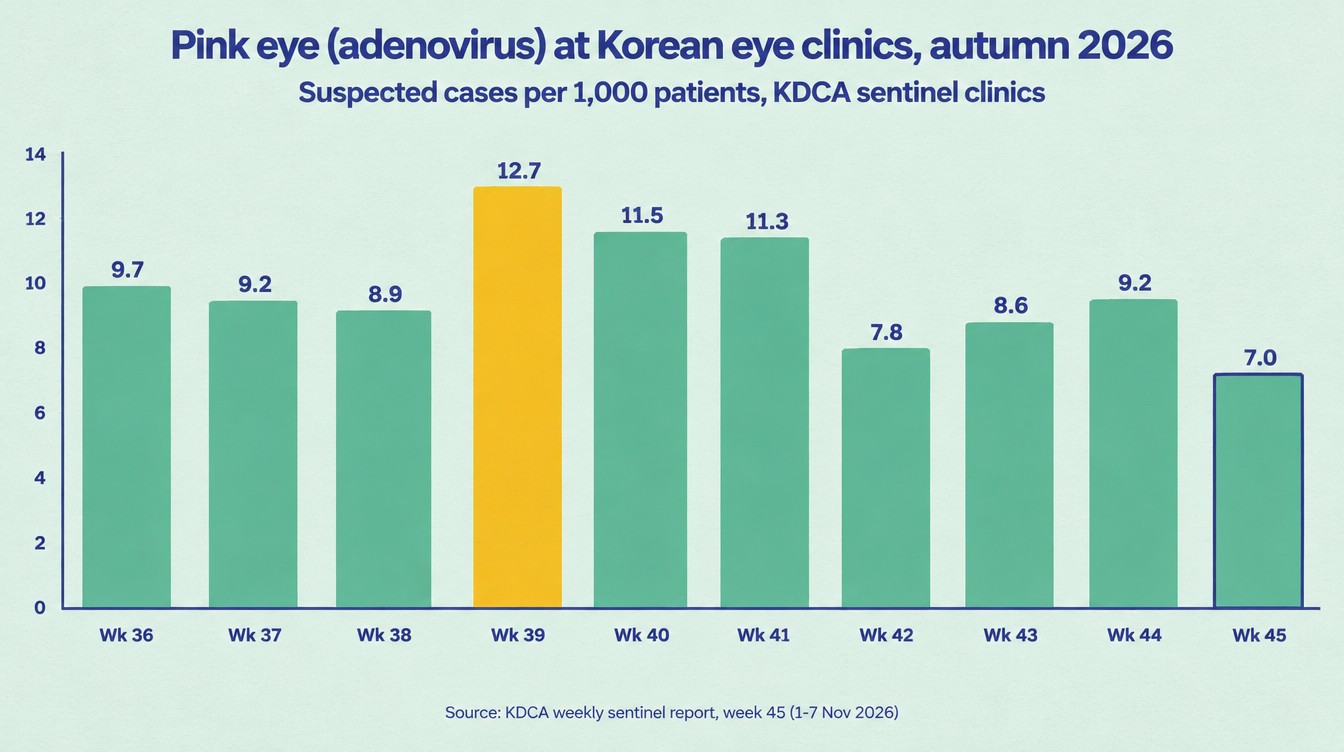
KDCA tracks this disease every week through 77 sentinel eye clinics. Its week-45 report (1 to 7 November 2026, published 12 November) shows the overall rate falling from a peak of 12.7 per 1,000 patients in week 39 to 7.0. That is also below the 8.2 recorded in the same week of 2025. Children carry most of it.
| Week (2026) | All ages | 0–6 years | 7–19 years | 20 and over |
|---|---|---|---|---|
| 39 | 12.7 | 61.5 | 26.7 | 9.8 |
| 42 | 7.8 | 25.1 | 21.6 | 6.2 |
| 44 | 9.2 | 36.7 | 24.2 | 7.2 |
| 45 (1–7 Nov) | 7.0 | 41.1 | 21.5 | 5.2 |
Suspected cases per 1,000 patients at KDCA’s sentinel eye clinics. Source: KDCA Korea Sentinel Surveillance Weekly Report, week 45, 2026 (provisional figures). Acute haemorrhagic conjunctivitis, a rarer type, ran at 0.5 per 1,000 that week.
What to do if you think you have it. See an eye clinic for a diagnosis, because allergic conjunctivitis looks similar but isn’t contagious. Then follow KDCA’s rules. Don’t touch or rub the eye, and wash your hands well whenever you do. Use your own towel, washbasin and bedding. Avoid crowded places, and stay away from pools, saunas and public baths (jjimjilbang) while the eye is red or has discharge. Don’t wear contact lenses until it has cleared. KDCA recommends follow-up visits until the eye has fully healed, because rare complications such as small spots of corneal clouding need checking.
Work and school. The NHS says adults with conjunctivitis generally don’t need to stay off work or school unless they feel very unwell. KDCA’s advice for this virus is stricter: avoid crowded places during the two contagious weeks. Schools and nurseries set their own return rules, so ask before sending a child back. If you work with the public, ask the clinic for a note (소견서) if your employer needs one.
Glasses and contact lenses: optician or eye clinic?
What an optician can do. Under the Enforcement Decree of the Medical Technicians Act (Annex 1, as amended on 2 July 2019), a licensed optician may make up and sell glasses and sell contact lenses, including cosmetic ones. To set the power of your lenses, the optician may do a subjective refraction test (reading letters through trial lenses) and an automated refraction with a machine, but no test that uses eye drops. For children aged 6 or under, glasses and contact lenses may be dispensed only on a doctor’s prescription. So for an adult whose eyesight has slowly changed, an optician is a legal and common first stop.
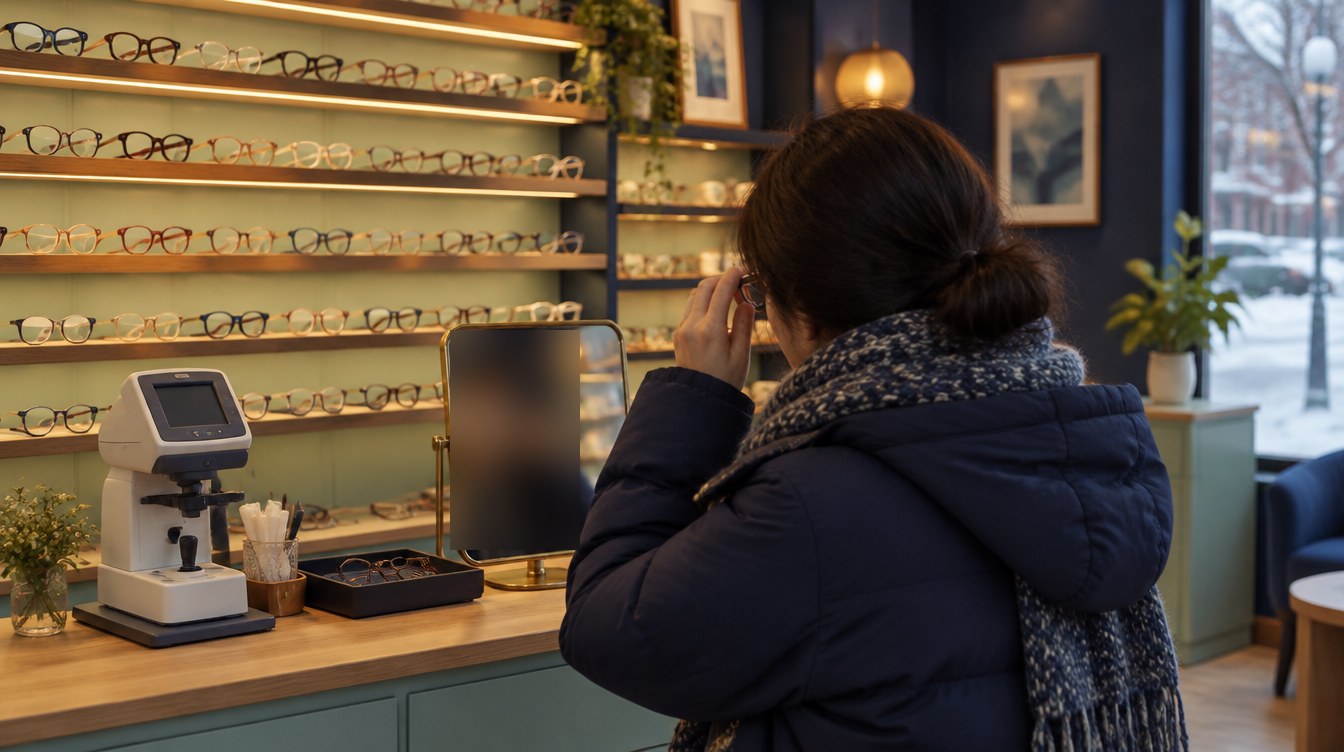
When the eye clinic is the better first stop. Go to the clinic if you have symptoms beyond blurry vision (pain, redness, flashes, floaters, a shadow in your vision), if you are over 40 and haven’t had your eye pressure checked, or if you have diabetes, high blood pressure or a family history of glaucoma. At a clinic the refraction test (굴절및조절검사, code E6710) is an NHIS-listed item, and its fee includes issuing a glasses prescription (안경처방전). You can take that prescription to any optician. Our guide to the vision test on Korea’s national checkup explains what the eye-chart figure on your result sheet does and doesn’t tell you.
Contact lenses can’t be bought online in Korea. Article 12(5) of the Medical Technicians Act bans anyone from selling glasses or contact lenses through e-commerce or mail order, or through purchase-and-delivery agents. Article 12(6) says opticians may sell them only in their shop, and Article 12(7) requires them to explain use, expiry dates and side effects when they sell contacts. On 28 March 2024 the Constitutional Court upheld the online ban 8 to 1 (case 2020Hun-Ga10), Yonhap reported. The judges said eyesight and eye health change over time and that face-to-face sale cuts the risk of careless lens wear. In practice, you buy contacts, including coloured ones, over the counter at an optician (안경원), and you should bring your current lens details or box.
Lens hygiene, KDCA’s version. Take lenses out for swimming and bathing. Keep the cleaning solution tightly capped, don’t rinse lenses or cases with tap water, clean the case at least weekly and let it air-dry upside down, and avoid handling lenses in the bathroom. Never share lenses. KDCA notes that the tear film left on a lens can pass on epidemic keratoconjunctivitis and other infections.
What NHIS does not pay for. The NHIS benefit rules (Annex 2, amended 15 April 2026) list glasses and contact lenses among non-covered aids. They also list vision-correction surgery done to replace glasses or contact lenses, such as LASIK-type operations, as non-covered. Eye exams for a health check with no symptoms, or as a work-up before vision-correction surgery, are generally billed as non-covered too, a Seoul eye hospital and Mediprice both note. Prices for frames, lenses and contacts are set by each shop and there is no official price list, so ask for the total before the lenses are made.
What an eye clinic visit costs in 2026: the official fees
Covered care in Korea is priced in points. HIRA’s 2026 fee schedule gives each test a point value, and NHIS multiplies it by a conversion factor: ₩95.6 per point at a clinic (의원) and ₩83.8 at a hospital in 2026. Clinics get no institution-type surcharge on these tests. Hospitals add 5 percent, general hospitals 10 percent and tertiary hospitals 15 percent. The fees below are for a clinic and are our own calculation, rounded to the nearest ₩10.
| Item (Korean name, code) | 2026 points | Clinic fee (our calc) | Note |
|---|---|---|---|
| First-visit consultation (초진 진찰료, AA154) | 197.12 | ₩18,840 | Any specialty at a clinic |
| Return-visit consultation (재진 진찰료, AA254) | 139.85 | ₩13,370 | |
| Slit-lamp microscope exam (세극등현미경검사, E6810) | 34.81 | ₩3,330 | Counted at most twice a week |
| Slit-lamp exam with fluorescein stain (각막생체염색하 세극등현미경검사, EY792) | 46.66 | ₩4,460 | Stains the eye surface to show dry or damaged spots |
| Tear secretion test (눈물분비기능검사, E6831) | 61.09 | ₩5,840 | The paper-strip (Schirmer) test |
| Eye pressure, detailed (안압 정밀측정, E6751) | 51.47 | ₩4,920 | One charge for both eyes |
| Refraction test incl. glasses prescription (굴절및조절검사, E6710) | 159.79 | ₩15,280 | One charge for both eyes |
| Detailed fundus exam, per eye (정밀안저검사, E6660) | 59.17 | ₩5,660 | Doubled if both eyes are examined |
Points: HIRA 2026 fee schedule (Part 2, Ch. 1 consultations and Ch. 2 Sec. 3 visual-function tests), as published item by item by Docple Check; the fundus, eye-pressure and conversion-factor figures match Mediprice’s 13 November 2026 calculations. Conversion factor: NHIS disclosure for 2026. Medicines, eye drops and pharmacy fees are extra.
Worked examples: what you actually pay
Your share at a clinic is 30 percent of the covered total, and the day’s total is rounded down to the nearest ₩100 (HIRA outpatient rules; Mediprice describes the same rounding). Which tests you get is the doctor’s decision. These examples only show how the bill is built.
| Scenario (clinic, NHIS member) | Items | Total fee | You pay (our calc) |
|---|---|---|---|
| A. Dry eyes, first visit | Consultation ₩18,840 + stained slit-lamp exam ₩4,460 + tear test ₩5,840 | ₩29,140 | about ₩8,700 |
| B. Pink eye, first visit | Consultation ₩18,840 + slit-lamp exam ₩3,330 | ₩22,170 | about ₩6,600 |
| B2. Pink eye, follow-up visit | Return consultation ₩13,370 + slit-lamp exam ₩3,330 | ₩16,700 | about ₩5,000 |
| C. Glasses check, first visit | Consultation ₩18,840 + refraction ₩15,280 + slit-lamp ₩3,330 + eye pressure ₩4,920 | ₩42,370 | about ₩12,700 |
The same pink-eye visit (B) somewhere bigger (our calculation):
| Where | How the share works | Total fee | You pay |
|---|---|---|---|
| Clinic (의원) | 30 percent | ₩22,170 | about ₩6,600 |
| Hospital (병원) | 40 percent; consultation 208.86 points and slit-lamp at ₩83.8, plus 5 percent on the test | ₩20,570 | about ₩8,200 |
| Tertiary university hospital | Consultation (255.79 points) paid in full, plus 60 percent of the rest; slit-lamp plus 15 percent; referral letter needed for NHIS rates | ₩24,800 | about ₩23,400 |
So a university hospital eye department costs about three to four times as much for the same simple problem, and without a referral letter you lose NHIS rates there altogether. Our guide to seeing a doctor in English explains the referral rule and which hospitals have international centres.
Without NHIS. Expect to pay at least the full total fee, for example ₩29,140 for scenario A, plus any prescription at full price. Many clinics charge uninsured patients more than the NHIS rate, so ask at reception first.
Your first visit, step by step
- Find a clinic. Search a map app for “안과” (an-gwa). Many eye clinics see walk-ins without a booking; call ahead if you want to check.
- Bring photo ID. Since 20 May 2024, patients must show ID to get NHIS rates. Accepted forms include a residence card, a passport or the mobile NHIS card (details in our English-doctor guide). Bring your glasses or contact-lens box if you have them.
- Pre-tests. Clinics often start with an eye-chart test and a machine reading of your prescription before you see the doctor; an eye-pressure test may be added.
- The doctor’s exam. Expect a slit-lamp exam, the main test for dry eye and pink eye. Some tests need dilating drops. Your vision will blur for a few hours, so don’t drive.
- Pay and ask for paperwork. Ask for the receipt (영수증) and the itemised bill (진료비 세부내역서). The codes on it match the table above. If you need a glasses prescription, ask for 안경처방전.
- Pharmacy. Take any prescription to a pharmacy (약국) next door. You pay your NHIS share there too.
If you need an interpreter, call 1330, the Korea Travel Helpline, which can set up three-way calls. For questions about infectious diseases such as pink eye, KDCA’s call centre 1339 runs 24/7. For foreign-language help, KDCA points foreigners to 1345 (English 09:00 to 18:00).
Common problems
- “The pharmacy drops didn’t help after a few days.” Stop and see an eye clinic. The ministry’s three-day advice applies, and a red, painful eye isn’t a dry-eye case to treat yourself.
- “My prescribed artificial tears were charged at full price.” Under the December 2024 rule, sodium hyaluronate drops for dry eye blamed on contact lenses or other outside causes are in principle not covered. Ask the doctor whether your diagnosis qualifies after the tests.
- “I wanted to order my usual contact lenses online.” Korean sites can’t legally sell them. Buy at an optician (안경원) with your lens details. Prices vary by shop.
- “My child’s school wants a note.” Ask the eye clinic for a medical note (소견서 or 진단서). Note that these documents carry their own non-covered fees.
- “The clinic charged me more than my Korean colleague.” If you are not on NHIS yet, that is legal. Once enrolled and with ID shown, you pay the same rates. Our NHIS guide explains enrolment.
Frequently asked questions
Q. Do I need a referral to see an eye doctor in Korea?
No, not at a neighbourhood eye clinic (안과 의원) or an ordinary hospital. You can walk in with your residence card or passport. A referral letter is needed only for NHIS rates at a tertiary university hospital, outside emergencies.
Q. How much does an eye doctor visit cost in Korea in 2026?
At a clinic, the first-visit consultation fee is ₩18,840 in 2026, and common tests add ₩3,330 to ₩15,280 each (our calculation from HIRA’s fee schedule at ₩95.6 per point). With NHIS you pay 30 percent at a clinic: about ₩6,600 for a pink-eye visit, about ₩8,700 for a dry-eye work-up and about ₩12,700 for a glasses check with eye pressure. Without NHIS you pay at least the full fee.
Q. Does NHIS cover glasses or contact lenses?
No. The NHIS benefit rules list glasses and contact lenses as non-covered aids, and vision-correction surgery that replaces them is non-covered too. The eye exam and refraction test are covered when a doctor does them for a medical reason, and the refraction fee includes a glasses prescription.
Q. Can I buy glasses or contacts without a prescription in Korea?
Yes, for adults. A licensed optician (안경사) can test your eyes without eye drops and sell you glasses or contact lenses. Glasses and contacts for children aged 6 or under need a doctor’s prescription. Contact lenses cannot legally be sold online in Korea; the Constitutional Court upheld that ban 8 to 1 on 28 March 2024.
Q. Is pink eye contagious, and how long should I stay away from others?
Epidemic keratoconjunctivitis, the adenovirus type common in Korea, spreads through eye discharge, hands, towels and bedding. KDCA says it is most contagious for two weeks after symptoms start, so use your own towels, wash your hands, and avoid pools, public baths and crowded places in that period. Ask the clinic when you or your child can go back to school or work.
Q. What can I do for dry eyes in a Korean winter?
KDCA advises humidifying the room, ventilating, not letting heaters blow at your face, resting your eyes from screens every 30 minutes, wearing glasses outdoors in wind and using artificial tears if needed. Pharmacies sell several artificial tears without a prescription. See an eye clinic if symptoms last more than three days, if the eye hurts, or if your vision blurs.
Sources
- HIRA, 2026 fee schedule as published item by item by Docple Check: visual-function tests (Part 2, Ch. 2, Sec. 3: E6660, E6710, E6751, E6810, E6831, EY792): https://check-app.docple-plus.com/sugabook/node/39 ; consultation fees (Ch. 1): https://check-app.docple-plus.com/sugabook/node/10 ; institution-type surcharges: https://check-app.docple-plus.com/sugabook/node/5
- NHIS, Conversion factors by year (2026: clinic ₩95.6, hospital ₩83.8): https://www.nhis.or.kr/announce/wbhaec11413m01.do
- HIRA, Outpatient co-payment rules (clinic 30 percent; tertiary: consultation in full plus 60 percent): https://www.hira.or.kr/dummy.do?pgmid=HIRAA030056020110
- Mediprice, Fundus and glaucoma test costs 2026 (independent calculation; points, factors, ₩100 rounding; 13 November 2026): https://mymedprice.co.kr/fundus-exam-cost-2026/
- NHIS benefit rules, Annex 2 (non-covered items incl. glasses, contact lenses and vision-correction surgery; amended 15 April 2026): https://www.law.go.kr/LSW/flDownload.do?flSeq=163452831
- MOHW, Notice 2024-235 on drug benefit criteria (single-use artificial tears; in force 1 December 2024): https://www.mohw.go.kr/board.es?act=view&bid=0026&list_no=1483695&mid=a10409020000
- Pharmnews, HIRA Q&A on single-use hyaluronate eye drops (4 December 2024): https://www.pharmnews.com/news/articleView.html?idxno=255166
- KDCA, Korea Sentinel Surveillance Weekly Report, week 45 of 2026 (1–7 November; eye infections section): https://dportal.kdca.go.kr/pot/bbs/BD_selectBbs.do?q_bbsDocNo=20261112163809554&q_bbsSn=1010&q_clsfNo=2
- KDCA National Health Information Portal, Epidemic keratoconjunctivitis (updated 15 May 2026): https://health.kdca.go.kr/healthinfo/biz/health/gnrlzHealthInfo/gnrlzHealthInfo/gnrlzHealthInfoView.do?cntnts_sn=5270
- KDCA National Health Information Portal, Dry eye (updated 4 August 2026): https://health.kdca.go.kr/healthinfo/biz/health/gnrlzHealthInfo/gnrlzHealthInfo/gnrlzHealthInfoView.do?cntnts_sn=6306
- KDCA National Health Information Portal, Contact lenses (updated 29 May 2026): https://health.kdca.go.kr/healthinfo/biz/health/gnrlzHealthInfo/gnrlzHealthInfo/gnrlzHealthInfoView.do?cntnts_sn=6458
- KDCA National Health Information Portal, Winter cold-wave health rules (indoor humidity 40–50 percent): https://health.kdca.go.kr/healthinfo/biz/health/gnrlzHealthInfo/gnrlzHealthInfo/gnrlzHealthInfoView.do?cntnts_sn=2048
- KDCA, Call Center 1339 (English page): https://www.kdca.go.kr/eng/4276/subview.do
- KMA, Climate normals 1991–2020, monthly table (Seoul, station 108): https://data.kma.go.kr/normals/table.do
- Medical Technicians Act, Article 12 (in force 11 September 2026): https://www.law.go.kr/LSW/lsLinkCommonInfo.do?lsJoLnkSeq=1026009521
- Enforcement Decree of the Medical Technicians Act, Annex 1 (optician scope, amended 2 July 2019): https://www.law.go.kr/LSW/flDownload.do?flSeq=122580493
- Yonhap, Constitutional Court upholds online contact-lens ban 8–1 (2 April 2024): https://www.yna.co.kr/view/AKR20240401120300004
- Hankook Ilbo, Artificial tears: what to check, citing MFDS (8 June 2024): https://www.hankookilbo.com/news/article/A2024060611480005902
- NHS, Conjunctivitis (reviewed 23 April 2024): https://www.nhs.uk/conditions/conjunctivitis/
- NHS, Eye injuries (reviewed 12 March 2026): https://www.nhs.uk/conditions/eye-injuries/
- Nune Eye Hospital blog, Why vision-test costs differ (health-check and pre-surgery exams non-covered): https://nunestory.com/eye-health/vision-test-cost-guide/
How we checked: On 18 November 2026 (KST) we read the eye-test and consultation sections of the 2026 fee schedule, NHIS’s conversion factors, HIRA’s co-payment rules, the Annex 2 non-covered list, MOHW’s 2024 artificial-tears notice, KDCA’s week-45 surveillance PDF and its three health-portal pages, and the Medical Technicians Act and Decree on law.go.kr. We matched the fees against Mediprice’s independent 2026 calculations, the contact-lens ruling against Yonhap, the drops rule against Pharmnews, and the emergency and pink-eye advice against the NHS. Every won figure in the cost tables is our own arithmetic from the official points and factors, and is labelled as such.
This guide is general information, not medical advice. Whether you need an eye test, drops or emergency care is for a doctor to decide. For an eye injury, a chemical splash or sudden loss of sight, call 119. For infectious-disease questions, call KDCA on 1339.
Researched and drafted with AI assistance; checked against the sources listed.