Busan in Winter: A 2-Day Plan from Seoul by KTX (Haeundae, Gamcheon, Jagalchi, Huinnyeoul)
Haesul Travel desk (AI-assisted). As of 17 November 2026 (KST). Based on Visit Busan (the city’s official tourism portal), Busan Transportation Corporation’s fare tables, Busan Metropolitan City, the Korea Meteorological Administration’s 1991–2020 climate normals, Haeundae-gu and Jung-gu district notices and Korail, cross-checked against Yonhap News and independent travel guides.
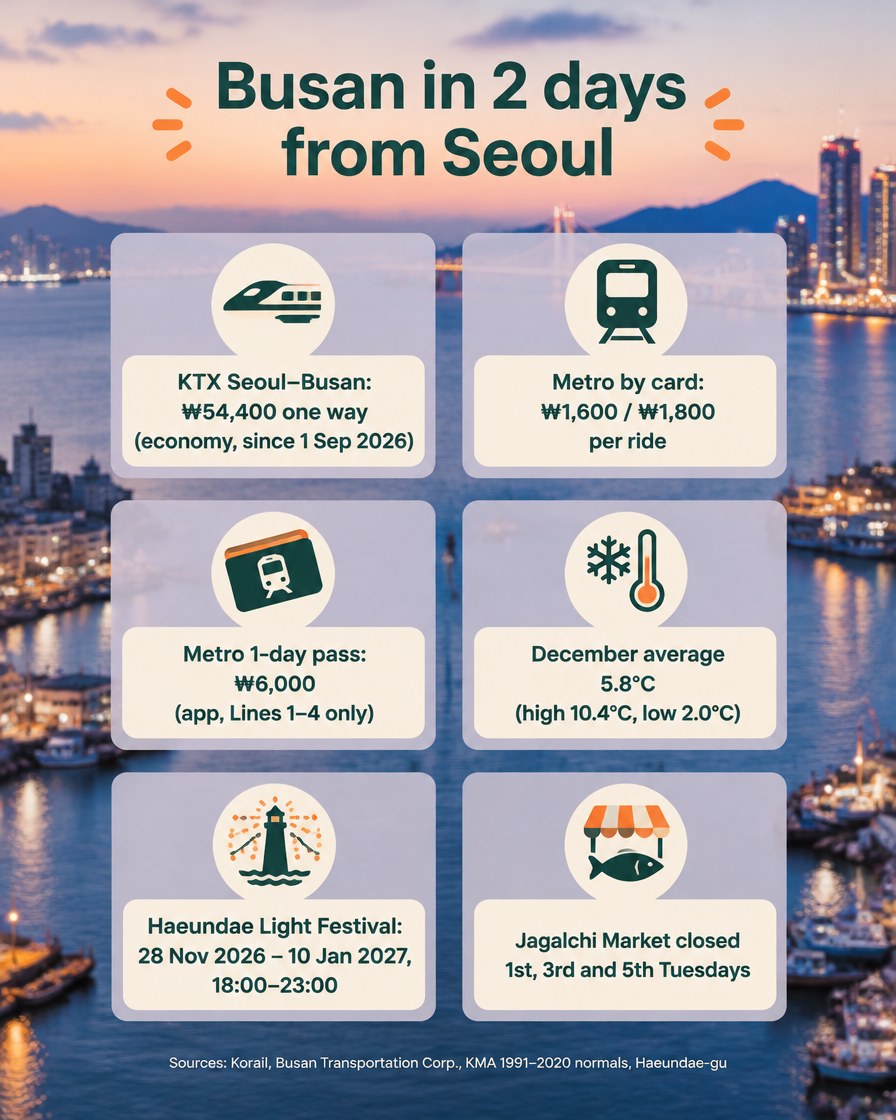
Quick answer: Busan works well as a two-day add-on to a Seoul trip in winter. Take an early KTX from Seoul (economy ₩54,400 each way since 1 September 2026), spend day one on Gamcheon Culture Village and Jagalchi Market, and day two on Haeundae Beach and Huinnyeoul Culture Village. A metro ride costs ₩1,600 or ₩1,800 by card, December in Busan averages 5.8°C (about 6°C warmer than Seoul), and the Haeundae Light Festival runs from 28 November 2026 to 10 January 2027, 18:00–23:00.
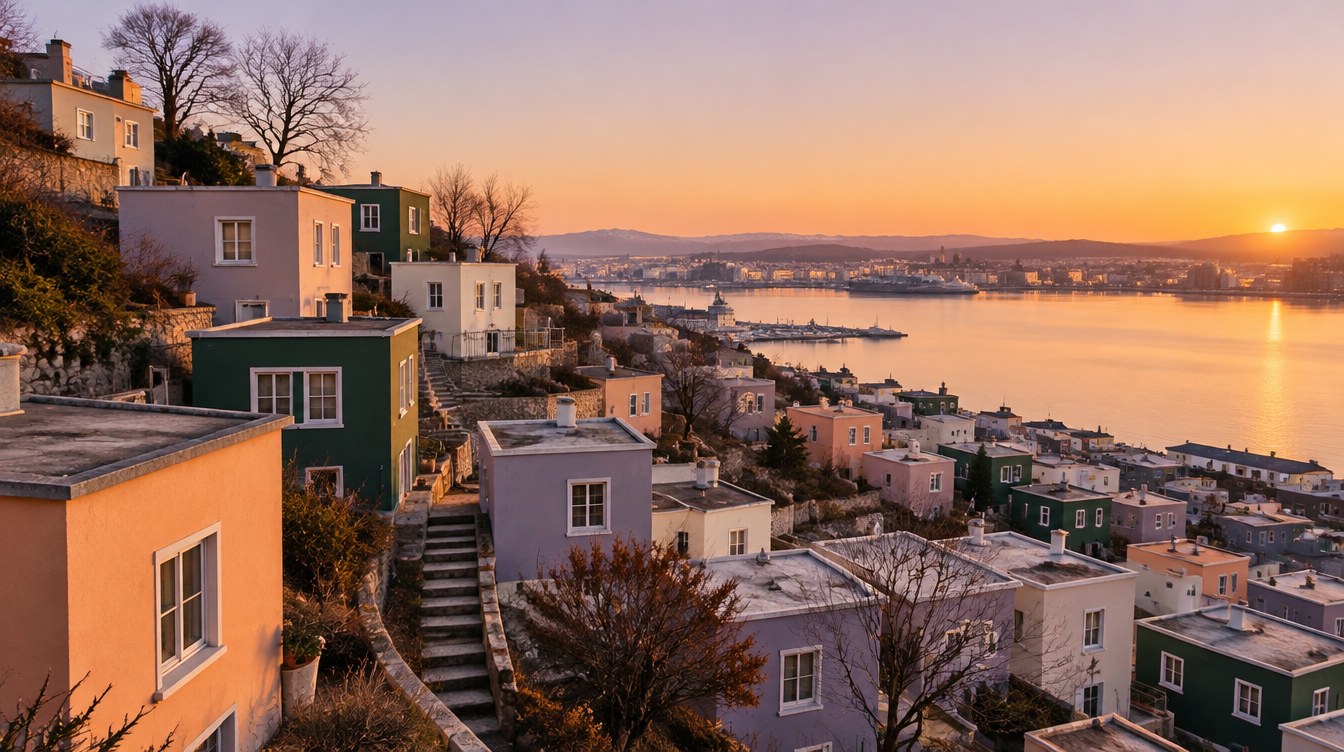
This guide is for visitors and foreign residents who want to see Busan between late November and January, for example over the Christmas break: 25 December 2026 is a Friday, 38 days from 17 November. It gives a realistic two-day route that uses only the metro, buses and your feet, the official fares and opening hours for each stop, what the weather is normally like, the winter light festivals that have officially announced 2026 dates, and a worked budget for one adult. It is general travel information; hours and fares can change, so check the official pages linked at the end before you go.
Is Busan worth it in winter?
Yes, if you come for the coast, the hillside villages and the food rather than for swimming. Busan is Korea’s second-largest city, and in winter it is noticeably milder and drier than Seoul. Visit Busan describes Haeundae Beach as “a hot place in all seasons”, and the two culture villages in this plan (Gamcheon and Huinnyeoul) are open every day of the year and free to walk around. The main winter drawbacks are wind off the sea and short opening hours at Gamcheon (it closes at 17:00 from November to February), which is why the plan below puts the villages in daylight and the beach and festival lights after dark.
Busan winter weather: what the KMA normals say
The Korea Meteorological Administration (KMA) publishes 30-year climate normals for each weather station. We read the 1991–2020 monthly table for the Busan station (no. 159) and the Seoul station (no. 108) from the KMA climate data portal; the same Busan figures appear in Wikipedia’s KMA-sourced climate table.
| Month (1991–2020 normal) | Busan average | Busan average high | Busan average low | Busan precipitation | Seoul average |
|---|---|---|---|---|---|
| December | 5.8°C | 10.4°C | 2.0°C | 33.8 mm | 0.2°C |
| January | 3.6°C | 8.2°C | −0.1°C | 34.5 mm | −1.9°C |
| February | 5.4°C | 10.2°C | 1.5°C | 49.6 mm | 0.7°C |
Source: KMA climate normals 1991–2020, monthly table (stations 159 Busan and 108 Seoul). Differences are our calculation.
What that means in practice (our reading of the table): December in Busan is on average 5.6°C warmer than Seoul (5.8°C vs 0.2°C), and the average December night stays just above freezing (2.0°C), while Seoul’s drops to −3.4°C. Afternoons around 10°C are good for walking, but the KMA table also lists an average wind speed of 3.3 m/s in December, and on the beach and the cliff paths it feels colder than the number suggests. Pack a windproof layer, gloves and a hat rather than a heavy parka. Relative humidity averages 48.1 percent in December, so lip balm and hand cream help. Rain is light (about 34 mm for the whole month) and snow is rare.
Getting there: Seoul to Busan by KTX
The KTX high-speed train is the easiest way in. Since Korail took over the former SRT on 1 September 2026, a Seoul–Busan economy ticket costs ₩54,400 one way, down from ₩59,800, according to Korail’s 5 August press release and Hankyung; a return trip is ₩108,800. Trains to Busan leave from Seoul Station and, since the merger, also from Suseo Station in southeast Seoul, which is handy if you stay in Gangnam. Visit Seoul, the city’s official tourism guide, puts the fastest Seoul–Busan journey at 2 hours 18 minutes; many trains stop more often and take longer, so check the times shown when you book.
Tickets go on sale at 07:00 Korea time two months before departure, and year-end trains sell out early. Our step-by-step guide to booking KTX as a foreigner covers the English website, the Korail Pass and refund fees. In short: for a single Seoul–Busan return trip, two economy tickets (₩108,800) cost less than the cheapest 2-day Korail Pass (₩131,000). If you are flying into Incheon and heading to Busan on the same day, our Incheon Airport to Seoul guide shows how to reach Seoul Station by AREX.
Busan Station is on Busan Metro Line 1, which is the line you will use most in this plan: Toseong (for Gamcheon), Jagalchi and Nampo (for the market, Gwangbok-ro and Huinnyeoul) are all a few stops south.
Getting around Busan: metro fares, passes and buses
Busan Transportation Corporation (often called Humetro) runs metro Lines 1 to 4. Fares depend on distance: “Section 1” for shorter trips and “Section 2” for longer ones (the operator’s Korean page calls it a distance-based zone system; independent guides such as City Rails put the boundary at 10 km). These are the adult fares on the operator’s English and Korean fare pages, matching Busan Metropolitan City’s own table:
| Busan metro, adult | Transit card or mobile ticket | Single-use QR ticket |
|---|---|---|
| Section 1 | ₩1,600 | ₩1,700 |
| Section 2 | ₩1,800 | ₩1,900 |
| 1-day pass (mobile app) | ₩6,000 | — |
| 3-day pass (mobile app) | ₩13,000 | — |
Source: Busan Transportation Corporation fare table; Busan Metropolitan City (fares in force since 3 May 2024).
Points that matter for visitors:
- Use a transit card. A card ride is ₩100 cheaper than a paper-style QR ticket, and the card also works on buses. A T-money card bought in Seoul generally works in Busan too; see our T-money guide for how to buy and top it up.
- The passes are metro-only and app-only. The operator says the 1-day, 3-day and 1-month passes cannot be used on buses, the Donghae Line or the Busan–Gimhae Light Rail. The Korean page says the 1-day pass is valid on the day you first pass the gate and the 3-day pass for three days from first use; the English page says “day of purchase”, so buy it on the day you plan to use it.
- Buses. According to Busan Metropolitan City, an adult city bus fare is ₩1,550 by card (₩1,700 cash) and a village bus (maeul bus, the small hillside buses) is ₩1,480 by card. Transfers between bus and metro with the same card can be discounted, which we ignore below so the budget is a ceiling.
- Help in English: the Busan Travel Hotline is 1330 (the national tourist helpline), and the metro operator’s 24-hour line is 1544-5005.
Day 1: Busan Station → Gamcheon Culture Village → Jagalchi Market → Haeundae
Morning: arrive at Busan Station. If you can, store your bag at your hotel’s front desk later or travel light; the villages are all stairs.
Late morning: Gamcheon Culture Village. Visit Busan describes it as a hillside village first built by Korean War refugees and turned into an art village from 2009, with murals, small museums and workshops along steep alleys. It is free and open every day, 09:00–17:00 from November to February (09:00–18:00 March–October). Take Line 1 to Toseong Station, Exit 6, then village bus Saha 1-1, Seo-gu 2 or Seo-gu 2-2 to Gamjeong Elementary School and walk about five minutes. The village association’s own site adds that Seo-gu 2-2 also runs from Busan Station, so you may be able to ride straight up from the train. Independent guides recommend riding up and walking down; the walk back to Toseong is mostly stairs downhill. It is a residential area, so keep voices down.
Afternoon: Jagalchi Market. One stop from Toseong on Line 1, Jagalchi is Busan’s best-known fish market, with an outdoor strip of stalls and a modern indoor market. Visit Busan lists it as open 05:00–22:00 daily, but closed on the 1st, 3rd and 5th Tuesdays of each month. Walk about six minutes from Jagalchi Station Exit 10 or Nampo Station Exit 2. Prices differ by stall. Visit Busan suggests sitting down for sliced raw fish, grilled fish or a spicy fish stew with a view of the harbour, and notes that the market is at its liveliest early in the morning.
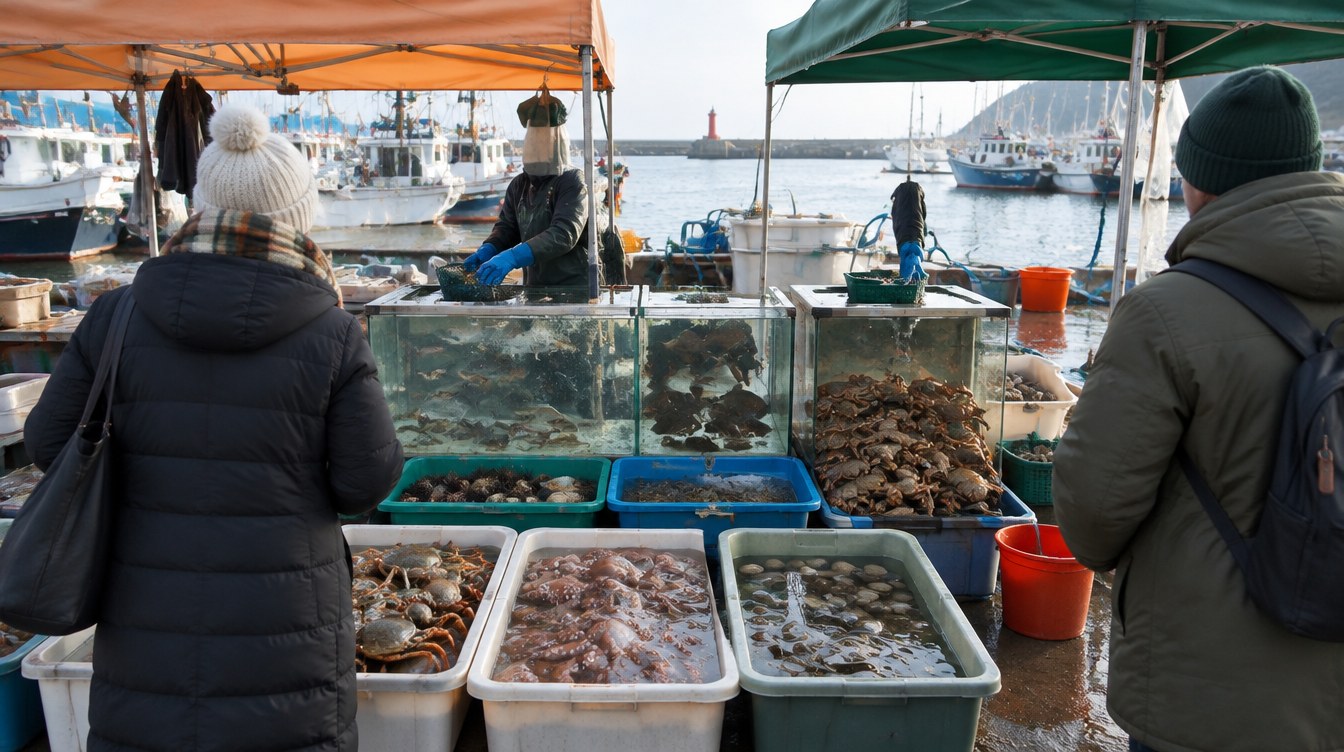
Jagalchi’s closing days over the holidays (our calculation from the “1st, 3rd and 5th Tuesday” rule):
| Month | Tuesdays | Jagalchi closed |
|---|---|---|
| December 2026 | 1, 8, 15, 22, 29 | Tue 1, Tue 15, Tue 29 December |
| January 2027 | 5, 12, 19, 26 | Tue 5, Tue 19 January |
Christmas Day (Friday 25 December) and New Year’s Day (Friday 1 January) are not closing days under that rule, but individual stalls set their own holidays, so expect some to be shut on public holidays.
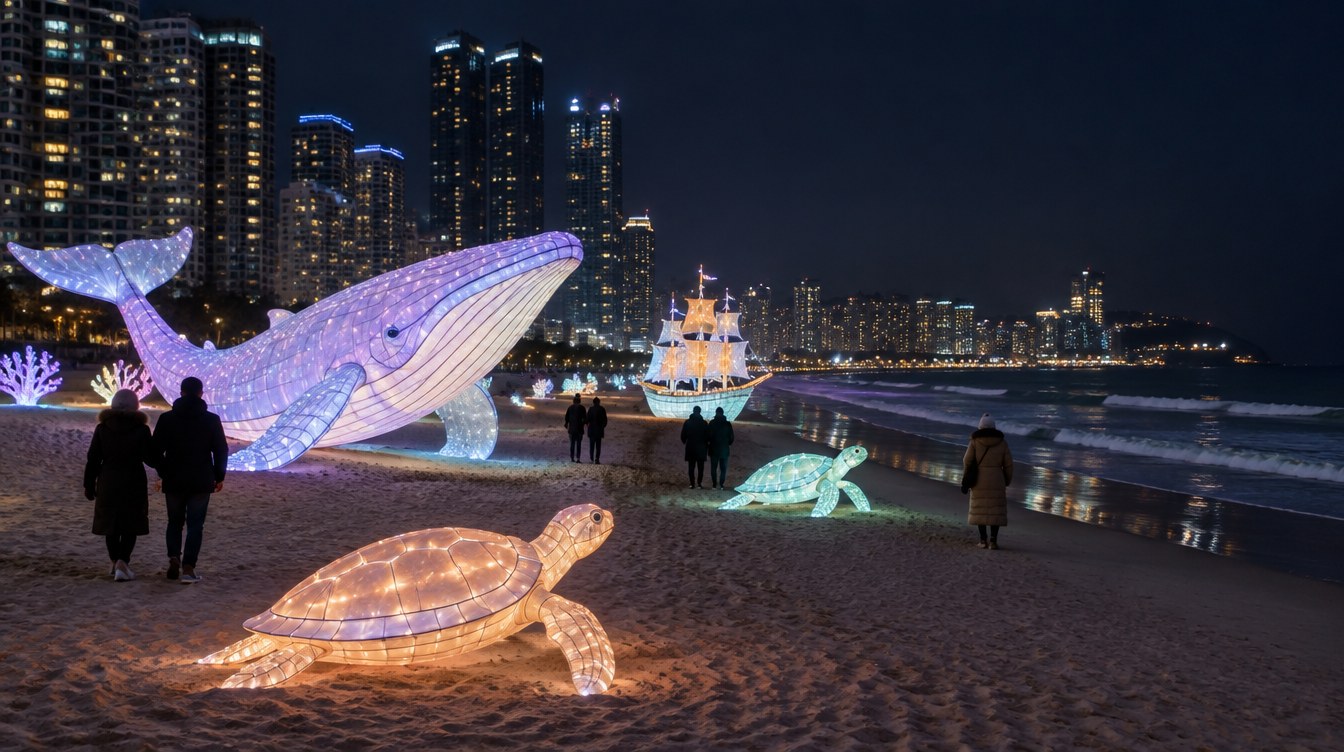
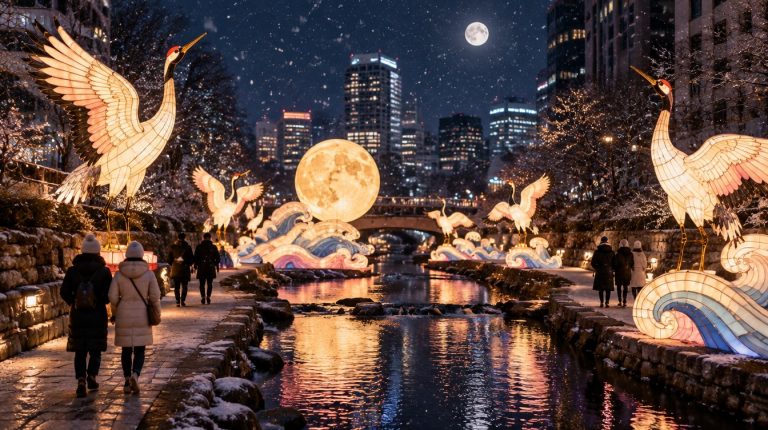
Evening: Haeundae and the Light Festival. Take the metro to Haeundae Station on Line 2 (change from Line 1 to Line 2 at Seomyeon) and check in. Visit Busan says the beach is a 15-minute walk from Exit 5. From Saturday 28 November 2026 to Sunday 10 January 2027, Haeundae-gu’s 13th Haeundae Light Festival (“Deep Dive Haeundae”) fills Haeundae Square (Gunam-ro) and the beach with light sculptures and media art, lit 18:00–23:00 every day; hands-on programmes run 18:00–21:00. The opening night on 28 November has a lighting ceremony on the beach from 18:00, with fireworks from 18:15 to 18:25, according to the district’s festival page. Yonhap reports a 30-metre light tunnel, a 12-metre ship sculpture on the sand, six Christmas trees up to 6 metres tall and snow machines on Christmas Day.
Day 2: Haeundae Beach → Huinnyeoul Culture Village → Nampo and Gwangbok-ro → KTX home
Morning: Haeundae Beach and Dongbaekseom. In daylight, walk the 1.5 km beach to Dongbaekseom Island at the western end, where Visit Busan describes an easy coastal trail through the woods with views of the sea and the Marine City skyline. December is one of Busan’s sunnier months: the KMA normal is about 206 hours of sunshine.
Midday: Huinnyeoul Culture Village (Yeongdo). Take the metro back to Nampo Station (Line 2 to Seomyeon, then Line 1). From Exit 6, ride bus 7, 71 or 508 to the Baengnyeonsa Temple (Yeongseon-dong) stop. Visit Busan describes Huinnyeoul as a cliff-top village of small houses above the Jeoryeong Coastal Trail, renovated into a culture and arts village in December 2011, with 14 alleys of cafés, workshops and small bookshops and wide views over the anchorage where ships wait off Busan Port. It is free and open every day. The coastal trail below has steps and can be windy, so wear proper shoes.
Afternoon and early evening: Nampo-dong and Gwangbok-ro. Back in Nampo, the shopping streets around Gwangbok-ro are an easy place to spend the afternoon before your train. Jung-gu lists the 2026 Gwangbok-ro Winter Light Tree Festival for December 2026 to January 2027 on its official events page; its procurement notice for the festival gives the planned lighting period as Friday 4 December 2026 to Sunday 31 January 2027, 17:30–22:30, subject to change. If you shop, many stores in Korea offer tax refunds for visitors on purchases above a minimum amount; our tourist tax refund guide explains instant and airport refunds. From Nampo, Busan Station is two stops away on Line 1.
Worked budget: transport for one adult, two days
Here is a ceiling for the transport in this plan, using the official fares above. We assume every metro ride is charged at Section 2 (₩1,800) and every bus at the full card fare, with no transfer discounts, so your actual cost should be the same or lower.
| Leg | Mode | Fare used |
|---|---|---|
| Seoul → Busan | KTX economy | ₩54,400 |
| Busan Station → Toseong | Metro | ₩1,800 |
| Toseong → Gamcheon (up) | Village bus | ₩1,480 |
| Toseong → Jagalchi | Metro | ₩1,800 |
| Jagalchi → Haeundae | Metro | ₩1,800 |
| Haeundae → Nampo | Metro | ₩1,800 |
| Nampo → Huinnyeoul and back | City bus × 2 | ₩3,100 |
| Nampo → Busan Station | Metro | ₩1,800 |
| Busan → Seoul | KTX economy | ₩54,400 |
| Total | ₩122,380 |
Our calculation from Korail’s post-September fare and Busan’s official metro and bus fares. Local transport in Busan comes to ₩13,580 at most (₩9,000 metro + ₩4,580 bus); KTX is ₩108,800.
Is the metro day pass worth it? Not for this plan. Day 1 has three metro rides (at most ₩5,400) and day 2 has two (at most ₩3,600), both below the ₩6,000 1-day pass. The pass only pays off from the fourth metro ride in one day: three rides cost at most ₩5,400, while four cost at least ₩6,400 (4 × ₩1,600). If you add Gwangalli or a return trip to Haeundae for the lights on day 2, count your rides before buying. The pass also does not cover buses, which this plan needs for Gamcheon and Huinnyeoul.
Practical tips for a winter weekend
- Book the KTX first. Christmas and New Year trains open two months ahead and Friday–Sunday tickets carry cancellation fees from the start, so book Monday–Thursday trains if your dates are flexible.
- Do the villages in daylight. Gamcheon closes at 17:00 in winter, and Huinnyeoul’s alleys and the cliff path are much easier before dark.
- Leave the lights for the evening. Haeundae’s festival lights come on at 18:00 and Gwangbok-ro’s at 17:30 (planned), so plan dinner near one of them.
- Check Jagalchi’s Tuesday closures in the table above before you plan a seafood lunch.
- Top up your transit card before you set off. Card fares are cheaper than cash or QR tickets on both the metro and buses (see the fare tables above).
- Save two numbers: 1330 for travel help in English and 119 for emergencies.
Common mistakes
- Planning Gamcheon for late afternoon. At 17:00 in winter it is closing time, not golden hour.
- Buying a metro day pass for a bus-heavy day. The passes cover Lines 1–4 only.
- Taking a Tuesday for Jagalchi without checking the week. Three Tuesdays in December 2026 and two in January 2027 are closing days.
- Trusting old festival dates. Some listings may still show last year’s dates; the 2026 Haeundae dates above come from the district’s own page, updated on 9 November 2026.
Adding a second city by KTX? See our Jeonju in winter guide: Hanok Village, bibimbap, hanok stays and a 1- or 2-day plan from Seoul.
Frequently asked questions
Q. How much is the KTX from Seoul to Busan in 2026?
An economy ticket costs ₩54,400 one way since Korail cut fares on 1 September 2026, so a return trip is ₩108,800. Trains leave from Seoul Station and Suseo Station.
Q. How cold is Busan in December?
The KMA 1991–2020 normal for December in Busan is 5.8°C on average, with an average high of 10.4°C and low of 2.0°C. That is about 5.6°C warmer than Seoul, but the sea wind makes it feel colder.
Q. When is the Haeundae Light Festival 2026?
From Saturday 28 November 2026 to Sunday 10 January 2027, with lights on from 18:00 to 23:00 at Haeundae Square (Gunam-ro) and Haeundae Beach, according to Haeundae-gu.
Q. How much is the Busan metro and is the day pass worth it?
An adult ride costs ₩1,600 or ₩1,800 by transit card depending on distance (₩100 more with a QR ticket). The ₩6,000 1-day pass, sold in the mobile app, only pays off from the fourth metro ride in a day and does not cover buses.
Q. What time does Gamcheon Culture Village close in winter?
From November to February it is open 09:00–17:00, and from March to October 09:00–18:00, according to Visit Busan. Walking around the village is free.
Q. Is Jagalchi Market open on Christmas Day?
Christmas Day 2026 is a Friday, and Jagalchi’s regular closing days are the 1st, 3rd and 5th Tuesdays of the month (1, 15 and 29 December 2026). Individual stalls may still close for the holiday.
Sources
- Visit Busan (official), Gamcheon Culture Village (hours, fees, bus routes): https://visitbusan.net/en/index.do?lang_cd=en&menuCd=DOM_000000301001001000&uc_seq=365
- Gamcheon Culture Village residents’ site, directions incl. Seo-gu 2-2 from Busan Station (Korean): https://www.gamcheon.or.kr/?param=intro4
- Visit Busan (official), Jagalchi Market (hours, closing Tuesdays, exits): https://visitbusan.net/en/index.do?lang_cd=en&menuCd=DOM_000000301003001000&uc_seq=412
- Visit Busan (official), Huinnyeoul Culture Village (history, buses 7/71/508): https://visitbusan.net/en/index.do?lang_cd=en&menuCd=DOM_000000301001001000&uc_seq=255
- Visit Busan (official), Haeundae Beach (Exit 5, Dongbaekseom): https://visitbusan.net/en/index.do?lang_cd=en&menuCd=DOM_000000301001001000&uc_seq=373
- Busan Transportation Corporation, fare guide (English): https://www2.humetro.busan.kr/homepage/english/page/subLocation.do?menu_no=100601040101
- Busan Transportation Corporation, 도시철도 운임 (Korean; pass validity from first use): https://www2.humetro.busan.kr/homepage/default/page/subLocation.do?menu_no=1001010501
- Busan Metropolitan City, metro fares (Korean): https://www.busan.go.kr/depart/ecnmahpublicfeerail
- Busan Metropolitan City, bus fares (Korean): https://www.busan.go.kr/depart/ecnmahpublicfeebus
- Korea Meteorological Administration, climate normals 1991–2020 (monthly table, stations 159 and 108): https://data.kma.go.kr/normals/table.do
- Haeundae-gu, 13th Haeundae Light Festival (Korean, updated 9 November 2026): https://www.haeundae.go.kr/index.do?menuCd=DOM_000000309006000000
- Yonhap News, Haeundae Light Festival lights up on 28 November (14 November 2026, Korean): https://www.yna.co.kr/view/AKR20261113126200051
- Jung-gu, Busan, 2026 culture and tourism events (Korean): https://www.bsjunggu.go.kr/tour/index.junggu?menuCd=DOM_000000203003000000
- Jung-gu procurement notice summary, 2026 Gwangbok-ro Winter Light Tree Festival (planned lighting 4 Dec 2026–31 Jan 2027): https://pikk.co.kr/bid/4117
- Korail press release, integrated high-speed rail and fares from September (5 August 2026, Korean): https://info.korail.com/info/selectBbsNttView.do?bbsNo=199&key=911&nttNo=27135
- Hankyung, Seoul–Busan KTX ₩54,400 from 1 September (31 August 2026, Korean): https://www.hankyung.com/article/2026083145861
- Visit Seoul (official), Intercity travel (KTX journey time): https://english.visitseoul.net/essential-Info-article/Intercity-Travel/ENN018812
- City Rails, Busan metro map and fares (independent): https://city-rails.com/en/busan-metro-map/
- Welcome Busan, Gamcheon Culture Village guide (independent): https://welcome-busan.com/guide/attractions/gamcheon-culture-village-guide/
- Wikipedia, Busan climate table (KMA 1991–2020 data): https://en.wikipedia.org/wiki/Busan
How we checked: We read each attraction’s page on Visit Busan, the metro operator’s English and Korean fare pages, the city’s bus and metro fare tables and the Haeundae-gu festival page on 17 November 2026 (KST), pulled the Busan and Seoul climate normals directly from the KMA portal, and compared them with Yonhap, the Jung-gu events list, Korail’s fare release and independent guides. Two conflicts are disclosed in the text: the metro pass validity wording (English page vs Korean page) and the Gwangbok-ro dates (district lists “December–January”; the procurement notice gives 4 December–31 January, subject to change). All totals, differences and closing dates are our own arithmetic and are labelled.
Researched and drafted with AI assistance; checked against the sources listed.


2 Comments