Jeonju in Winter by KTX: Hanok Village, Food, Hanok Stays and a 1- or 2-Day Plan
Haesul Travel desk (AI-assisted). As of 18 November 2026 (KST). Based on Jeonju City’s official tourism sites (Visit Jeonju and the Jeonju Hanok Village portal), Jeonju City press releases, Korail, the Jeonbuk provincial tourism portal and the Korea Consumer Agency’s price portal, cross-checked against independent timetable sites and Korean regional newspapers.
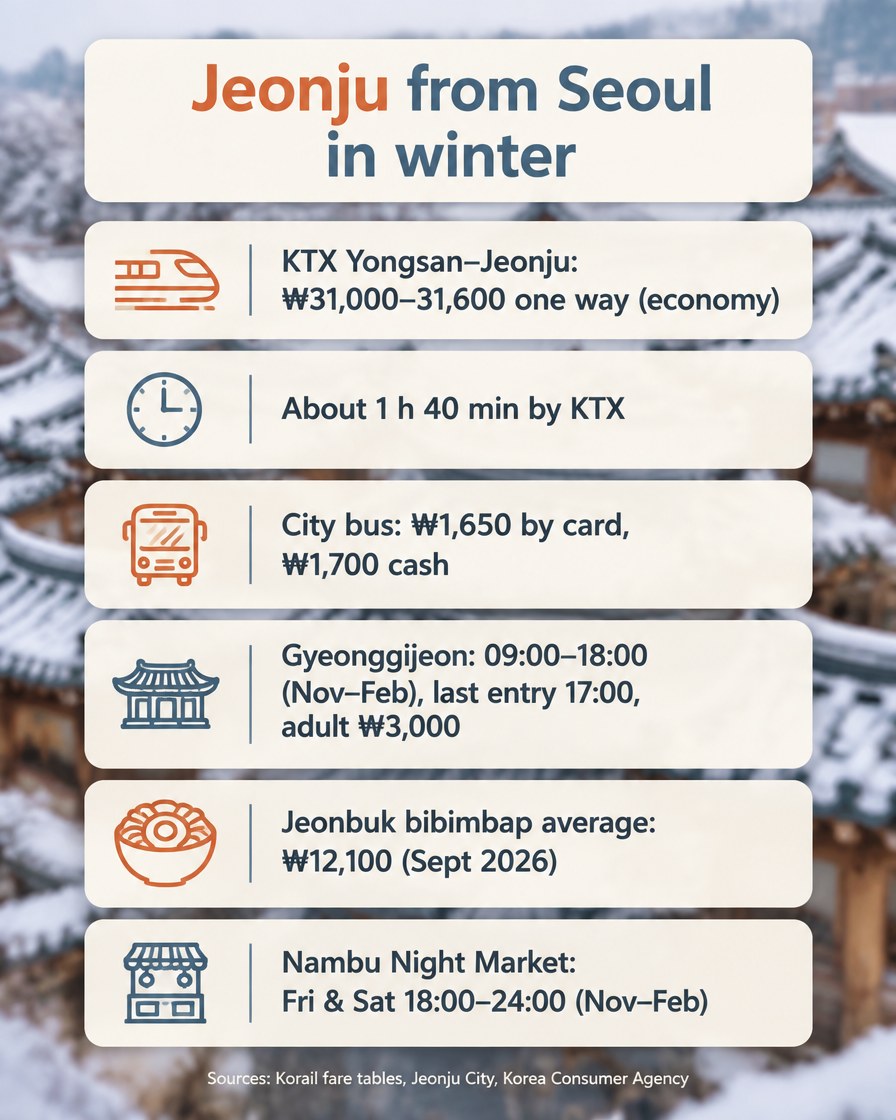
Quick answer: Jeonju is the easiest “second city” to add to a Seoul trip in winter. A KTX from Yongsan Station to Jeonju costs ₩31,000–31,600 one way in economy and takes about 1 hour 40 minutes. From Jeonju Station, a city bus (₩1,650 by transport card) takes about 25 minutes to the Hanok Village, where Gyeonggijeon shrine is open 09:00–18:00 from November to February (last entry 17:00, adults ₩3,000). Eat bibimbap at lunch (Jeonbuk’s average was ₩12,100 in September 2026, the highest of any region) and kongnamul gukbap for breakfast. One day works; two days let you add a hanok stay and the Nambu Night Market (Fridays and Saturdays, 18:00–24:00 from November to February).
This guide is for visitors and foreign residents who want a short trip out of Seoul between late November and February, for example over the Christmas break: 25 December 2026 is a Friday, 37 days from 18 November, and the Jeonju New Year’s Eve festival runs on 31 December. It covers how to get there by train, the official winter opening hours and fees of the main sights, what and where to eat, how hanok guesthouses work, a day-trip plan and a two-day plan, and a worked budget for one adult. It is general travel information; fares, hours and prices change, so check the official pages listed at the end before you go.
Why Jeonju in winter?
Jeonju, the capital of North Jeolla (now Jeonbuk State), is known in Korea for two things: its hanok village and its food. According to the official Jeonju Hanok Village portal, the village around Pungnam-dong and Gyo-dong is the largest traditional hanok cluster in Korea and the country’s only hanok district in the middle of a city. The city counts 947 buildings in the 298,260 m² area, of which 735 are hanok, plus 575 businesses (203 of them accommodation). Most sights sit within a 15-minute walk of each other, so a winter visit does not mean long, cold transfers.
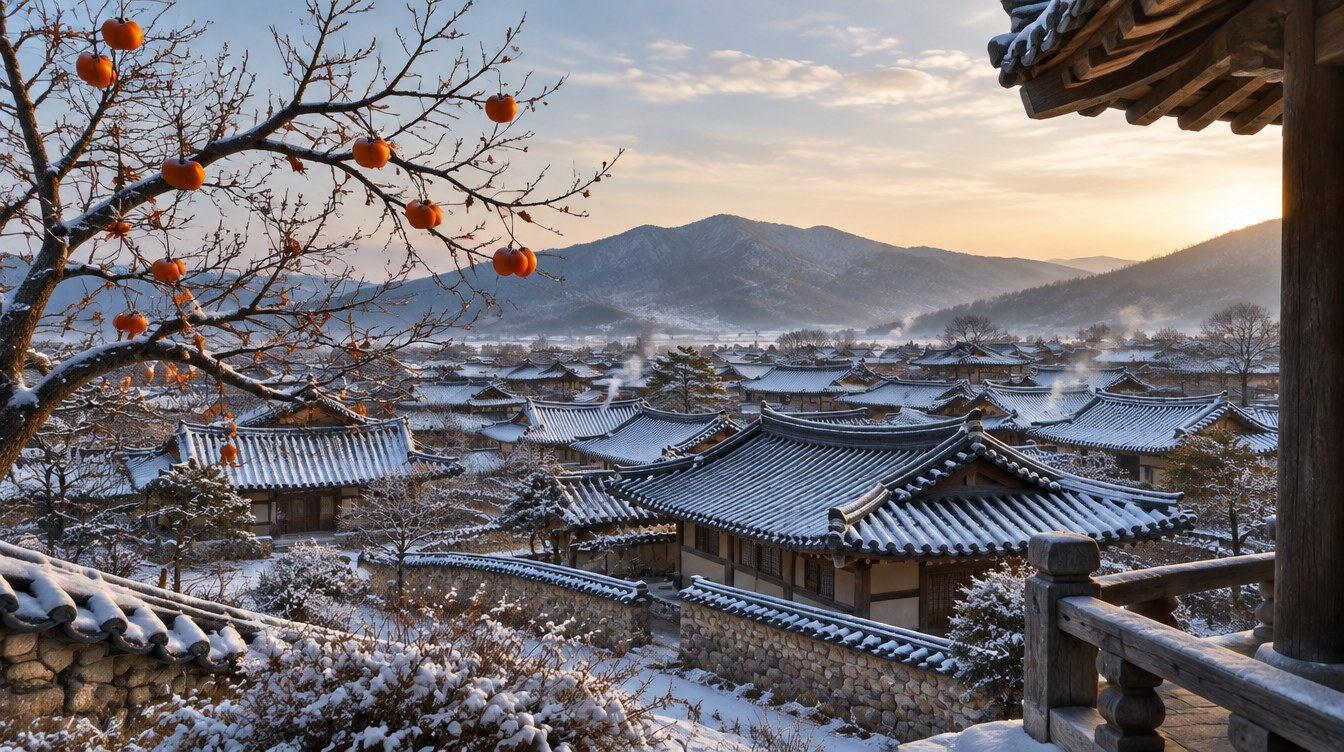
Winter has two real advantages. The village is calmer than in spring and autumn, when school trips and festival crowds fill the main street (Taejo-ro), and Jeonju’s signature foods are hot, filling dishes that suit cold weather. The drawbacks are short daylight, the 17:00 last entry at Gyeonggijeon and the fact that the old city gate, Pungnammun, is still partly behind safety fencing (see “Common mistakes” below).
Jeonju winter weather vs Seoul
Jeonju is a little milder than Seoul in winter but not by much, and it sees more snow days, which is when the tiled roofs look their best. The table below uses the Korea Meteorological Administration (KMA) 1991–2020 climate normals. Seoul’s figures come straight from the KMA normals table (station 108); KMA’s online table returned no data for the Jeonju station (146) when we queried it on 18 November 2026, so Jeonju’s figures are KMA normals as compiled in the Wikipedia climate table for Jeonju.
| Month (1991–2020 normals) | Jeonju mean | Jeonju high / low | Jeonju snow days | Seoul mean | Seoul high / low |
|---|---|---|---|---|---|
| December | 2.2°C | 7.1°C / −2.1°C | 7.2 | 0.2°C | 4.2°C / −3.4°C |
| January | 0.0°C | 4.8°C / −4.3°C | 8.3 | −1.9°C | 2.1°C / −5.5°C |
| February | 2.0°C | 7.5°C / −2.8°C | 5.0 | 0.7°C | 5.1°C / −3.2°C |
Worked comparison (our calculation from the table): Jeonju’s December mean is 2.0°C warmer than Seoul’s (2.2 − 0.2), and January is 1.9°C warmer (0.0 − (−1.9)). Nights still drop below freezing in all three months, so pack the same coat, hat and gloves you would wear in Seoul, plus shoes with grip for icy alleys.
Getting there: Seoul to Jeonju by KTX
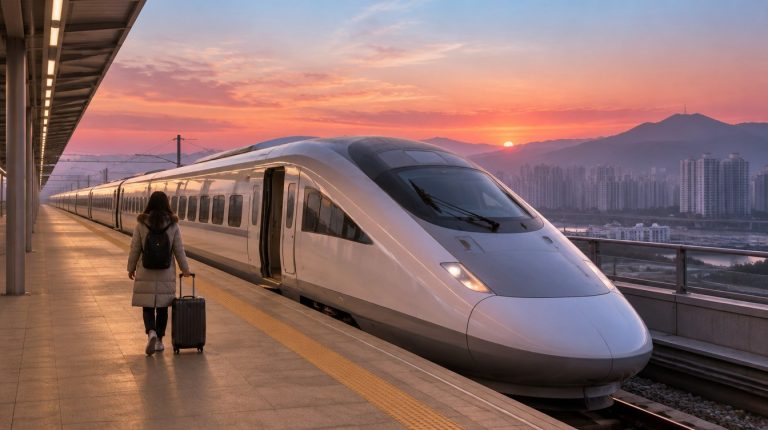
Visit Jeonju, the city’s official English tourism site, says the KTX from Seoul to Jeonju takes about 1 hour and 40 minutes, and that trains to Jeonju leave much more often from Yongsan Station than from Seoul Station. Yongsan is on Seoul Subway Line 1 and the Gyeongui–Jungang Line.
- Fare: Since Korail merged KTX and SRT operations on 1 September 2026, KTX fares are on average 10% lower (Korail press release, 5 August 2026). Independent fare tables based on Korail’s 1 September 2026 tariff list Yongsan–Jeonju economy at ₩31,000–31,600 one way (first class ₩45,000–45,800). The lower figure applies to trains that make more intermediate stops; most trains are ₩31,600. Your exact fare appears when you search on Korail.
- Journey time: Timetable sites that read the national transport data show most KTX trains taking 1 hour 37 minutes to 1 hour 49 minutes, with the fastest about 1 hour 32 minutes and the stopping trains up to about 2 hours 36 minutes. Pick a train with 2–4 stops if time matters.
- Cheaper, slower trains: ITX-Saemaeul and Mugunghwa trains also run from Yongsan to Jeonju (the Hanok Village portal lists all three types). They take roughly 3 to 3 hours 50 minutes.
- Booking: Use Korail’s English website or the app. For how to search, pay with a foreign card and what changed after the merger, see our guide to booking KTX trains in Korea as a foreigner. Visit Jeonju warns that weekend and holiday trains to Jeonju sell out fast, so book ahead for late December.
- Spelling: Visit Jeonju notes that people buy tickets to the wrong city by mistake. Jeonju (전주) is not Gyeongju, Cheongju or Jinju. Check the screen before you pay.
From Jeonju Station to the Hanok Village
The official Hanok Village portal gives these options:
- City bus: board at the bus stop in front of Jeonju Station and get off at Jeondong Cathedral (Hanok Village) (전동성당·한옥마을). Routes listed: 112, 79, 508, 536, 542, 545, 546, 101, 119 and 999; about 25 minutes. Routes change, so confirm in a map app on the day.
- Fare: Jeonju City raised city bus fares on 1 August 2025 to ₩1,700 cash for adults; a transport card (such as T-money) pays ₩50 less, ₩1,650. The city’s release says one free transfer is allowed within 40 minutes of getting off. Visit Jeonju’s English card guide describes the transfer window differently (30 minutes, up to two transfers), so tap your card when you get off and do not count on a free transfer.
- Taxi: the portal estimates ₩7,000–8,000 from Jeonju Station. Taxis take foreign cards in many cases, and Visit Jeonju recommends the k.ride app for foreigners.
- From the express bus terminal: routes 79, 999 and 1994, about 15 minutes (taxi ₩5,000–6,000), if you come by bus from Seoul’s Express Bus Terminal (Central City; about 2 hours 40 minutes).
What to see in the Hanok Village in winter
These sights are all inside or next to the village and all come from the city’s official heritage list.
| Sight | Winter hours | Fee (adult) | Note |
|---|---|---|---|
| Gyeonggijeon Shrine (경기전) | 09:00–18:00, Nov–Feb (last entry 17:00) | ₩3,000 (youth/military ₩2,000, child ₩1,000) | Free on the last Wednesday of each month; 50% off on the 4th Saturday (“Jeonju Hanbok Day”) |
| Jeondong Cathedral (전동성당) | 09:00–17:00, except during Mass | Free | Built 1907–1914; Romanesque and Byzantine style |
| Omokdae (오목대) | Open-air | Free | Short climb; view over the roofs |
| Nambu Market (남부시장) | Day market; night market Fri–Sat | Free entry | Walk from Pungnammun gate |
Gyeonggijeon was built in 1410 to hold the portrait of Taejo, the founder of the Joseon dynasty; the portrait is a National Treasure and the shrine’s main hall a Treasure. Inside the walls are the royal portrait museum and the Jeonju archive where the Annals of the Joseon Dynasty were once kept. Opposite is Jeondong Cathedral, one of the most photographed churches in Korea; the city says its foundation stones came from the demolished wall near Pungnammun, where Catholic martyrs were executed. Walk up to Omokdae, the hill where Yi Seong-gye, the future King Taejo, is said to have held a victory feast; from the path you get the classic view of tiled roofs, best after snow. Hanbyeokdang, a pavilion on a cliff above the Jeonju Stream at the edge of the village, is on the same official list.
Two dated details for this winter. The Jeonju New Year’s Eve festival (전주제야축제) runs from 21:00 on 31 December 2026 to 00:10 on 1 January 2027 at Nosong Square in front of Jeonju City Hall, with local performances, drumming, a media-façade show on the city hall building and fireworks (Yonhap, 17 November 2026, citing Jeonju City). And the city’s 2026 night-tourism programmes wind down in November: Visit Jeonju lists its “Midnight Cinema” in the village only until 28 November, so do not plan around them for December.
What to eat: bibimbap, kongnamul gukbap and the night market
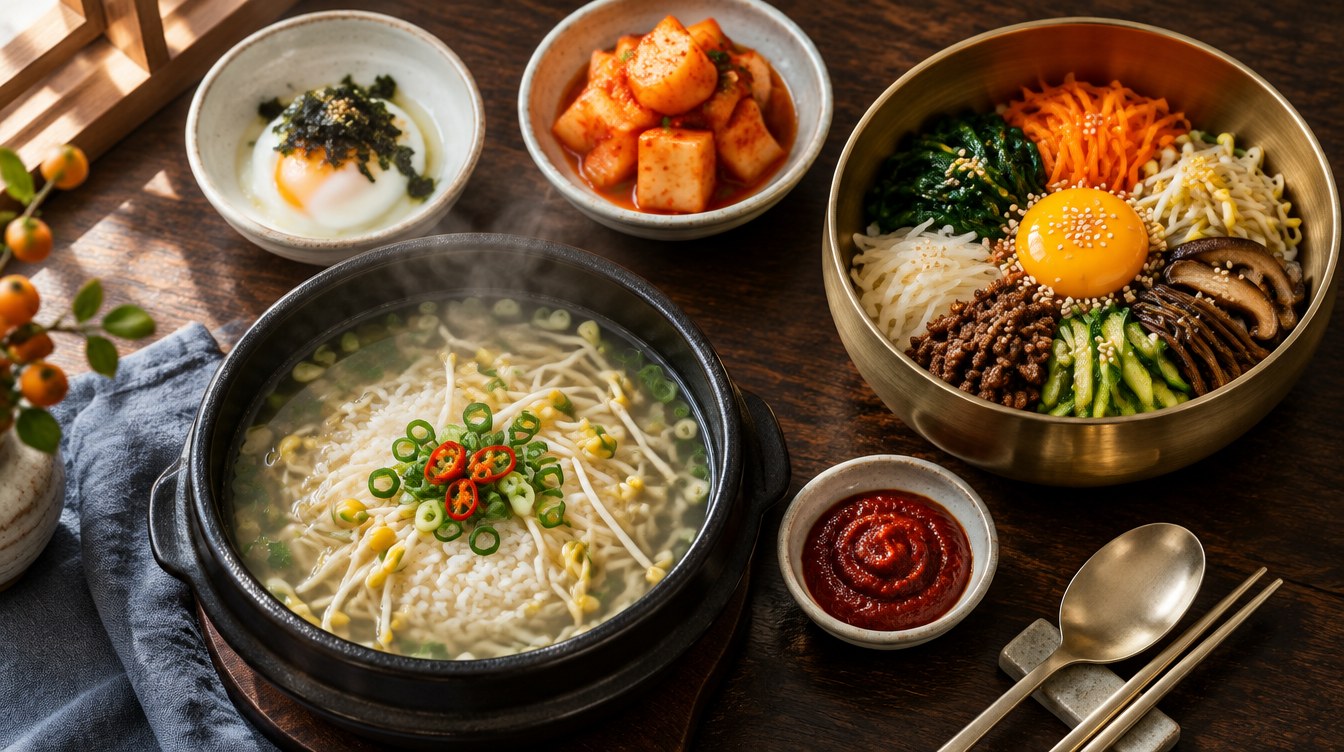
Jeonju bibimbap. Visit Jeonju calls the city “the home of bibimbap” and describes Jeonju-style bibimbap as rice cooked in beef-bone broth topped with more than 30 ingredients, including Jeonju bean sprouts, yellow mung-bean jelly (hwangpomuk) and traditionally fermented gochujang. It is not cheap. The Korea Consumer Agency’s price portal (Chamgagyeok), which publishes the government’s regional eating-out survey, put the average bibimbap in Jeonbuk at ₩12,100 for September 2026, the highest of the 16 regions listed and ₩100 above Seoul (₩12,000). The regional paper Jeonbuk Jeil Shinmun (4 November 2026) reported the same figure and noted that bowls at famous Jeonju restaurants can pass ₩20,000. Visit Jeonju’s own list includes value restaurants at around ₩10,000.
Kongnamul gukbap (bean-sprout soup with rice). This is Jeonju’s breakfast and hangover cure. Visit Jeonju describes the Nambu Market style: cooked rice and bean sprouts are warmed by pouring hot anchovy-and-kelp broth in and out of the bowl, served with a soft poached egg (suran) to which you add a spoon of broth and crushed seaweed, and eaten with radish kimchi (kkakdugi). There is no official average price. Independent guides checked in November 2026 list well-known Jeonju gukbap houses at ₩7,000–9,000 a bowl, which we use as an estimate in the budget below.
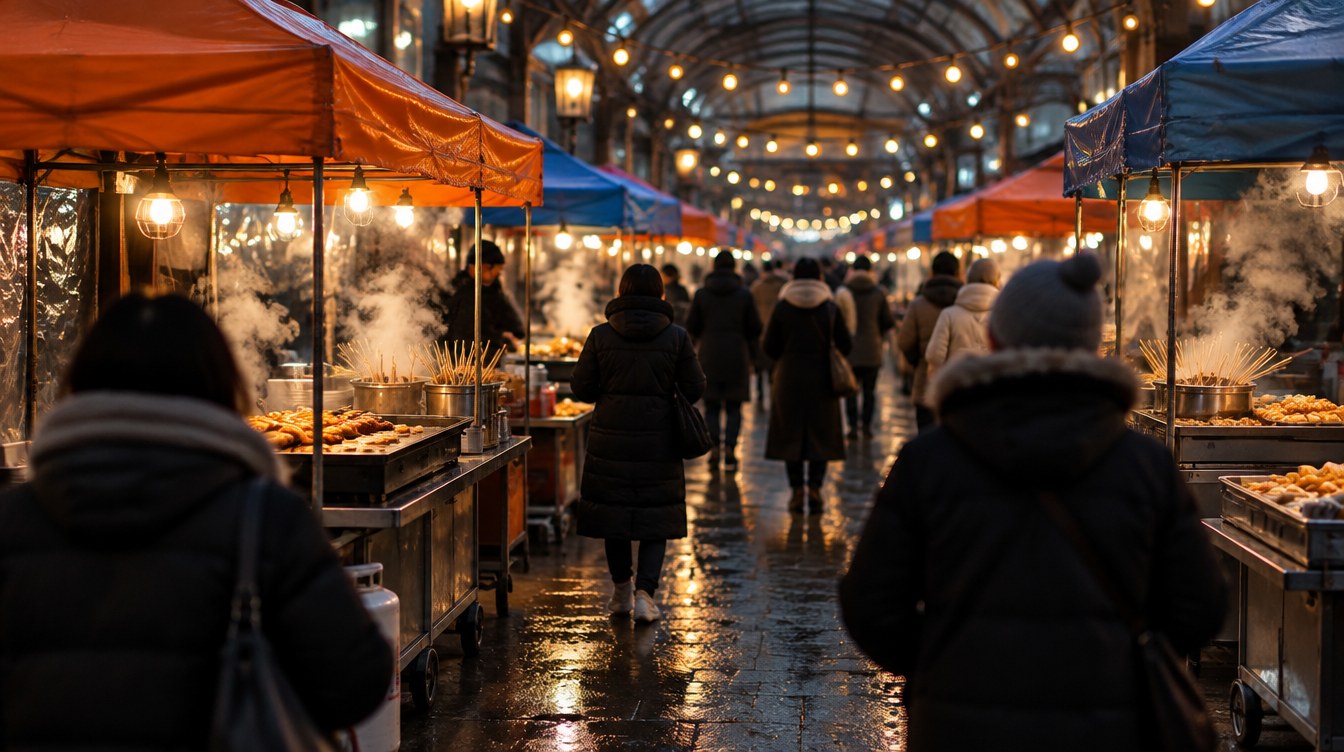
Nambu Night Market. The Jeonbuk provincial tourism portal says the night market inside Nambu Market runs every Friday and Saturday, 18:00–24:00 from November to February (18:30–23:30 from March to October), with about 40 stalls along a 250-metre aisle. A Korean regional newspaper reported it busy on a cold night in January 2026, so it does run in winter. If you are in Jeonju on a weekday, the day market and its rooftop youth mall are open instead.
Hanok stays: how they work and how to book
Sleeping in a hanok is the main reason to stay a night. The Hanok Village portal says there are about 160 hanok guesthouses (한옥체험업) in the village; the city’s status page counts 203 accommodation businesses in the wider area, which also includes non-hanok guesthouses. The portal points to the city-linked vacancy search at jeonjuhanokroom.kr; international booking sites also list many of them.
What to expect (general features of hanok stays; ask your host for specifics):
- Floor sleeping: many rooms use yo (floor mattresses) on an ondol heated floor rather than beds. If you need a bed, filter for it.
- Heating: ondol floors are heated by a boiler under the room and get very warm; turn the thermostat down rather than opening doors. Make sure the room has a working carbon-monoxide alarm and that you know the boiler is vented outside; our guide to carbon monoxide risks in Korea’s winter, including guesthouses explains what to check.
- Thin walls and paper doors: traditional rooms are quieter than hotels at night but carry sound; quiet hours are common.
- Bathrooms: check whether the bathroom is private or shared before booking.
- Price: we found no official price table for hanok stays, so compare listings for your dates. Weekend nights in late December fill first.
A 1-day plan from Seoul (winter)
This is our suggested route, not an official course. It puts the sights with closing times in daylight.
- 07:00–09:00: KTX from Yongsan to Jeonju (about 1 h 40 min). Take bus 79, 119 or another listed route, or a taxi, to Jeondong Cathedral (Hanok Village).
- Morning: kongnamul gukbap breakfast; then Jeondong Cathedral (opens 09:00).
- Late morning: Gyeonggijeon across the road (allow about an hour; the royal portrait museum is inside).
- Lunch: Jeonju bibimbap.
- Afternoon: walk the alleys and climb Omokdae for the roof view; continue to Hanbyeokdang if you have time.
- Late afternoon: Nambu Market for snacks; on a Friday or Saturday wait for the night market at 18:00.
- Evening: bus or taxi back to Jeonju Station and an evening KTX to Yongsan. Allow about an hour from the village to your train.
A 2-day plan with a hanok stay
- Day 1: follow the day-trip plan until mid-afternoon, check in to your hanok guesthouse, and spend the evening at the Nambu Night Market (Friday or Saturday) or a quiet dinner in the village.
- Day 2: an early walk before the day-trippers arrive, when the roofs are frosty and the lanes are empty; breakfast gukbap; Omokdae and Hanbyeokdang in the morning light; the Jeonju National Museum or Deokjin Park in the afternoon if you want to see more of the city; return KTX in the evening.
If Jeonju gives you a taste for regional trips, our Busan winter 2-day plan uses the same KTX logic, and if you are staying in Seoul for Christmas, see Seoul in December 2026: lights, markets and events by date.
Worked budget: one adult, day trip vs two days
Our calculation from the figures above (excluding the hanok stay and shopping):
| Item | Day trip | 2 days | Basis |
|---|---|---|---|
| KTX Yongsan–Jeonju return | ₩63,200 | ₩63,200 | ₩31,600 × 2 (₩62,000 on ₩31,000 trains) |
| City bus, station ↔ village | ₩3,300 | ₩3,300 | ₩1,650 × 2 by card |
| Extra city bus rides | ₩0 | ₩3,300 | 2 more rides, e.g. to the museum |
| Gyeonggijeon | ₩3,000 | ₩3,000 | Adult ticket |
| Bibimbap | ₩12,100 | ₩12,100 | Jeonbuk average, Sept 2026 |
| Kongnamul gukbap | ₩9,000 | ₩18,000 | Upper estimate, 1 or 2 bowls |
| Total | ₩90,600 | ₩102,900 | Plus your room |
What changes the total: a taxi instead of the bus adds roughly ₩10,700–12,700 for the return trip (₩7,000–8,000 each way minus the ₩3,300 bus fare); a famous bibimbap restaurant can add about ₩8,000 or more; and visiting Gyeonggijeon on the last Wednesday of the month (30 December 2026, 27 January 2027) saves ₩3,000.
Practical tips for a winter visit
- Start early: Gyeonggijeon’s last entry is 17:00 and Jeondong Cathedral closes to visitors at 17:00, while sunset in December is a little before 17:30.
- Use a transport card: T-money and other nationwide cards work on Jeonju buses; Visit Jeonju says cards cost about ₩3,000–5,000 at convenience stores and need topping up.
- Weekdays are calmer: the Hanok Village portal reports more than 10 million visitors a year (2019 figure); winter weekdays are the quietest time.
- Tourist help: the Hanok Village tourist information line is 063-282-1330, and the national 1330 travel hotline answers in English.
- Respect residents: people live in many of the hanok; keep voices down in side lanes and do not enter courtyards.
Common mistakes
- Expecting the New Year bell at Pungnammun. Older English pages still mention a watch-night bell at the gate. Jeonbuk Ilbo (16 October 2026) reports that the gate has been behind safety fencing since 2019 and the bell event has not been held there since; repairs are expected to finish in 2029 at the earliest. The 2026 New Year’s Eve festival is at Nosong Square instead.
- Booking Seoul Station instead of Yongsan. Most Jeonju trains leave from Yongsan.
- Arriving at Gyeonggijeon after 17:00 in winter.
- Planning the night market on a weekday. It runs only on Fridays and Saturdays.
- Buying a ticket to Gyeongju. Check the spelling.
Frequently asked questions
Q. How much is the KTX from Seoul to Jeonju in 2026?
Yongsan to Jeonju in economy costs ₩31,000–31,600 one way under the fares in force since 1 September 2026, when KTX fares fell by an average of 10%. Most trains are ₩31,600; trains with more stops are ₩31,000. A return costs about ₩62,000–63,200.
Q. Can I do Jeonju as a day trip from Seoul?
Yes. The KTX takes about 1 hour 40 minutes each way, and the Hanok Village is about 25 minutes from Jeonju Station by bus. Leave Yongsan by about 08:00, see Jeondong Cathedral and Gyeonggijeon before 17:00, and take an evening train back.
Q. What time does Gyeonggijeon close in winter?
From November to February it is open 09:00–18:00, with last entry at 17:00. Adult tickets cost ₩3,000, it is free on the last Wednesday of each month, and half price on the fourth Saturday.
Q. How much is bibimbap in Jeonju?
The government’s regional survey put the average bibimbap in Jeonbuk at ₩12,100 in September 2026, the highest in Korea. Value restaurants charge around ₩10,000, while famous Jeonju bibimbap restaurants can charge over ₩20,000.
Q. Is the Jeonju Nambu Night Market open in winter?
Yes, on Fridays and Saturdays only. From November to February it runs 18:00–24:00, according to the Jeonbuk provincial tourism portal; from March to October the hours are 18:30–23:30.
Q. Is a hanok stay in Jeonju warm in winter?
Usually yes: most hanok guesthouses use ondol floor heating, and rooms can get very warm. Check whether you will sleep on a floor mattress or a bed, whether the bathroom is shared, and that the room has a carbon-monoxide alarm.
Sources
- Visit Jeonju (Jeonju City), Getting to Jeonju, Transportation Cards, Bibimbap, The 10 Flavors of Jeonju, Traditional Markets, Night Tourism: https://tour.jeonju.go.kr/eng/index.jeonju (checked 18 Nov 2026)
- Jeonju Hanok Village official portal: status (947 buildings, 735 hanok), directions and bus routes, heritage sites and hours, hanok stays: https://hanok.jeonju.go.kr/ (checked 18 Nov 2026)
- Jeonbuk tourism portal (Tour Jeonbuk): Gyeonggijeon hours and fees; Nambu Night Market hours: https://tour.jb.go.kr/ (checked 18 Nov 2026)
- Jeonju City press release, city bus fares from 1 August 2025 (31 Jul 2025): https://www.jeonju.go.kr/ ; cross-checked Newspim, 30 Jul 2025
- Korail press release, integrated high-speed rail from 1 September 2026 (5 Aug 2026): https://info.korail.com/info/selectBbsNttView.do?bbsNo=199&key=911&nttNo=27135 ; cross-checked Yonhap, 6 Sep 2026
- Yongsan–Jeonju fares and times (based on Korail’s 1 Sep 2026 tariff and national transport data): Trovia, Bebop81 trainfo, GrepBoard, Mustard Data (checked 18 Nov 2026)
- Korea Consumer Agency, Chamgagyeok regional eating-out prices, September 2026: https://www.price.go.kr/ ; cross-checked Jeonbuk Jeil Shinmun, 4 Nov 2026
- Korea Meteorological Administration, climate normals 1991–2020 (Seoul, station 108): https://data.kma.go.kr/normals/table.do ; Jeonju figures from KMA normals as compiled on Wikipedia (“Jeonju”, climate table)
- Yonhap, Jeonju New Year’s Eve festival 2026 (17 Nov 2026); Jeonbuk Ilbo, Pungnammun fencing (16 Oct 2026); Jeollailbo, Nambu Night Market in winter (Jan 2026)
How we checked: We read the city, provincial and Korail pages directly on 18 November 2026 and matched each key number with a second, independent source (timetable sites, Korean newspapers). Where sources differ (bus transfer rules, hanok-stay counts) we show both.
Researched and drafted with AI assistance; checked against the sources listed.