Korea Unemployment Benefits 2026: Who Qualifies for Job-Seeker Allowance, How Much You Get a Day, and How Long It Lasts
Haesul Travel & Living desk (AI-assisted). Last checked: 2026-11-12 (KST); first published 6 November 2026. The 2027 minimum wage, which resets the benefit floor, applies to job losses from January 1, 2027 — 49 days from November 13. The floor rule was re-read in Employment Insurance Act Art. 46, the ceiling in Enforcement Decree Art. 68 and the pending ceiling change on MOLEG on Nov 12. Based on the Ministry of Employment and Labor (MOEL), Work24 / Employment Insurance pages, the Employment Insurance Act Enforcement Decree, and independent press. This is general information, not legal, tax or financial advice. Confirm your own case with your local Employment Centre (고용센터) or the MOEL helpline 1350 before you claim.
Quick answer: Your leaving date now matters. For job losses from January 1, 2027 — 49 days from November 13 — the floor for an 8-hour day rises to ₩68,480 (80% × the 2027 minimum wage of ₩10,700 × 8; our calculation), which is above the ₩68,100 ceiling still in the decree (Art. 46; Decree Art. 68). Korea’s main unemployment cash benefit is the job-seeker allowance (구직급여, gujik geubyeo) under Employment Insurance. For separations on or after 1 January 2026, the daily amount is 60% of your average daily wage, capped at ₩68,100 and floored at ₩66,048 for a full 8-hour day (80% of the 2026 minimum hourly wage of ₩10,320 × 8). You need at least 180 insured unit days in the 18 months before leaving, an involuntary (or otherwise justified) separation, and active job search. Payment runs 120 to 270 days by age and insured years. Apply on Work24 (work24.go.kr), finish the online eligibility training, then file at your local Employment Centre. The first 7 days after eligibility is recognised are a waiting period with no payment. Claim within 12 months of the day after you left the job.
Losing a job in Korea is stressful enough without decoding Employment Insurance jargon. This guide walks through the 2026 rules in plain English: who can claim, how the daily amount is calculated, how long the money lasts, and the Work24 / Employment Centre path. The same Employment Insurance line that funds this benefit also appears as a deduction on your payslip; see our payslip guide to the four social insurances for how that premium is taken. If you are a foreign resident, enrolment in Employment Insurance (and National Health Insurance) depends on your visa and workplace — our foreigner health-insurance premium guide covers the health side of that picture.

What “unemployment benefits” means in Korea
In everyday English, people say “unemployment benefits.” In Korean Employment Insurance law, the cash payment while you look for work is 구직급여 — literally job-seeker allowance. It is one piece of the wider 실업급여 (unemployment benefits) package, which can also include early-re-employment allowances, training allowances and a few other add-ons. This post focuses on the ordinary worker’s job-seeker allowance.
It is not a means-tested welfare payment. It is an insurance benefit. You (and your employer) paid Employment Insurance premiums while you worked; the benefit replaces part of that wage while you search. That is why the insured-period test and the involuntary-separation rules matter more than your household savings.
Who qualifies in 2026
MOEL’s Employment Insurance guide and Work24’s eligibility pages line up on four conditions that must hold together:
- Insured unit days. In the 18 months ending on your last working day, you need a combined 180 or more insured unit days (피보험단위기간) — roughly, days that counted as Employment Insurance enrolment with pay. Days from earlier jobs can count; periods already used for a previous claim generally do not.
- Involuntary (or justified) separation. Ordinary voluntary resignation for personal convenience usually fails. Redundancy, contract end, business closure and similar employer-side reasons qualify. MOEL also lists justified voluntary exits — for example unpaid wages for a sustained period, pay below the legal minimum wage, workplace closure, or other reasons recognised under the Employment Insurance Act — where you can still be treated as eligible.
- Able and willing to work. You must have the intention and ability to take a job, and you must be unemployed at the time you claim.
- Active re-employment effort. After eligibility is recognised, you must keep searching and report that activity at each unemployment-recognition appointment.
Gross misconduct dismissals (serious criminal conviction tied to the job, major company damage, long unjustified absence, and similar) generally bar a claim. Artists and platform-style “labour providers” have separate look-back windows (24 months with different month counts); this guide sticks to ordinary employees.
Foreign workers who were enrolled in Employment Insurance can claim on the same rules if the other conditions are met. If your workplace never enrolled you, there is usually nothing to claim — check your payslip deductions first.
Daily amount in 2026: 60%, with a tight floor and ceiling
Work24 states the formula as:
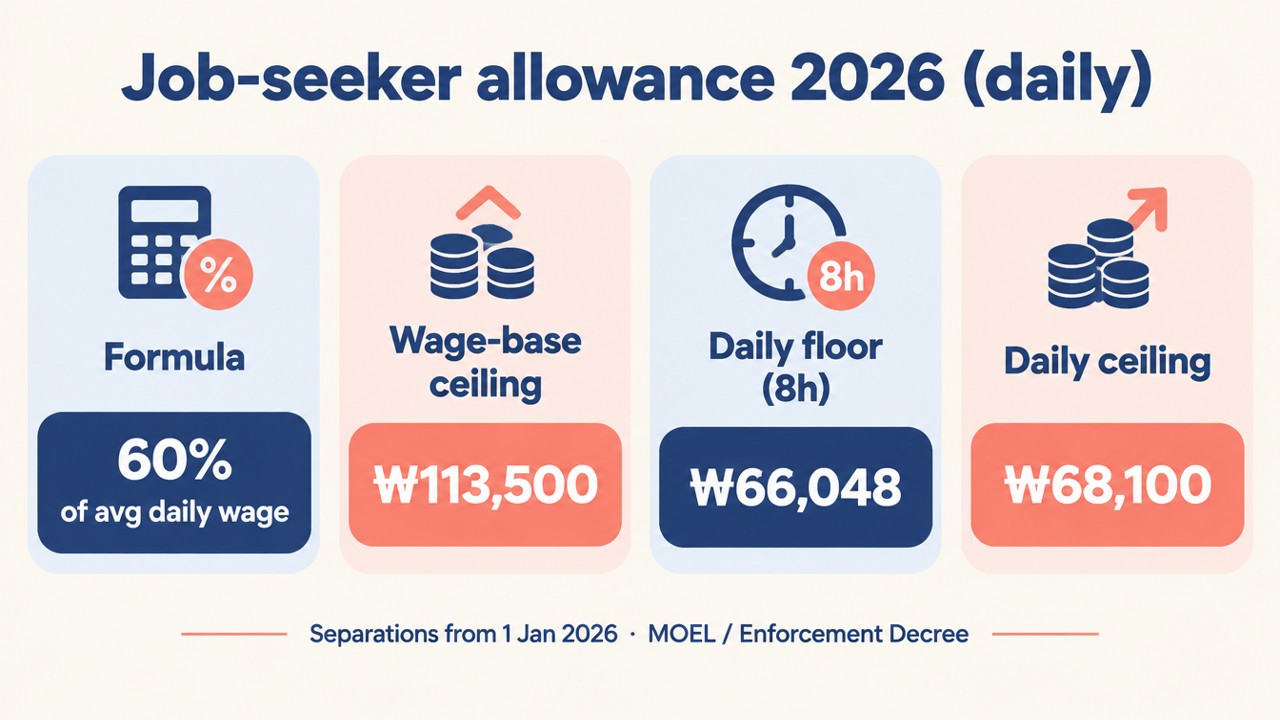
Daily job-seeker allowance = 60% of average daily wage before separation × prescribed benefit days
Two statutory clamps sit on top of that percentage.
| Item (separations on/after 1 Jan 2026) | Amount | How it is set |
|---|---|---|
| Benefit formula | 60% of average daily wage | Employment Insurance Act / Work24 |
| Wage-base ceiling (급여기초임금일액) | ₩113,500 a day | Enforcement Decree Art. 68 (as amended; in force 2026) |
| Daily upper limit (상한액) | ₩68,100 | 60% × ₩113,500; MOEL 1350 answer 10 Jul 2026 |
| Daily lower limit (하한액), 8-hour day | ₩66,048 | 80% × ₩10,320 × 8 hours |
| 2026 minimum hourly wage | ₩10,320 | MOEL notice used for the 2026 floor |
Sources: MOEL customer-centre answer (1350, 10 July 2026) for the ₩68,100 / ₩66,048 pair and the ₩113,500 wage-base ceiling; Employment Insurance Act Enforcement Decree Art. 68 on law.go.kr for the ₩113,500 figure; MOEL press release (Oct 2025 legislative notice) explaining why the 2026 ceiling was raised so the floor would not overtake it; Yonhap, 1 September 2026, confirming the 2026 daily upper limit of ₩68,100. Work24’s older “amount” HTML page still lists the pre-2026 ₩66,000 ceiling in places — treat the MOEL 2026 figures above as controlling for 2026 separations.
For shorter contracted days, the floor scales with hours. MOEL 1350 lists the 2026 hourly floors as ₩8,256 (1h), ₩16,512 (2h), … up to ₩66,048 (8h).
Because the floor and ceiling are only about 3% apart in 2026, most full-time claimants land in a narrow band. That is intentional: MOEL raised the ceiling precisely because the 2026 minimum-wage-linked floor (₩66,048) would otherwise have sat above the old ₩66,000 ceiling.
Worked example: three pay levels, same 8-hour day
Illustrative inputs. Average daily wage here means the Employment Insurance average used for the claim, not a casual guess from your last payslip.
| Prior average daily wage | 60% of that wage | After floor/ceiling | Daily benefit |
|---|---|---|---|
| ₩90,000 | ₩54,000 | Floor lifts it | ₩66,048 |
| ₩110,000 | ₩66,000 | Floor lifts it | ₩66,048 |
| ₩150,000 | ₩90,000 | Ceiling cuts it | ₩68,100 |
Our calculations from the official 60% rule and the 2026 ₩66,048 / ₩68,100 clamps. A mid-earner and a high earner can end up only ₩2,052 a day apart.
Rough calendar-month sketch under the current seven-days-a-week payment practice (still the rule as of 6 November 2026): ₩68,100 × 30 ≈ ₩2,043,000 at the ceiling, or ₩66,048 × 30 ≈ ₩1,981,440 at the floor. Actual deposit timing follows your Employment Centre’s recognition cycle, not a neat calendar month.

How long it lasts: 120 to 270 days
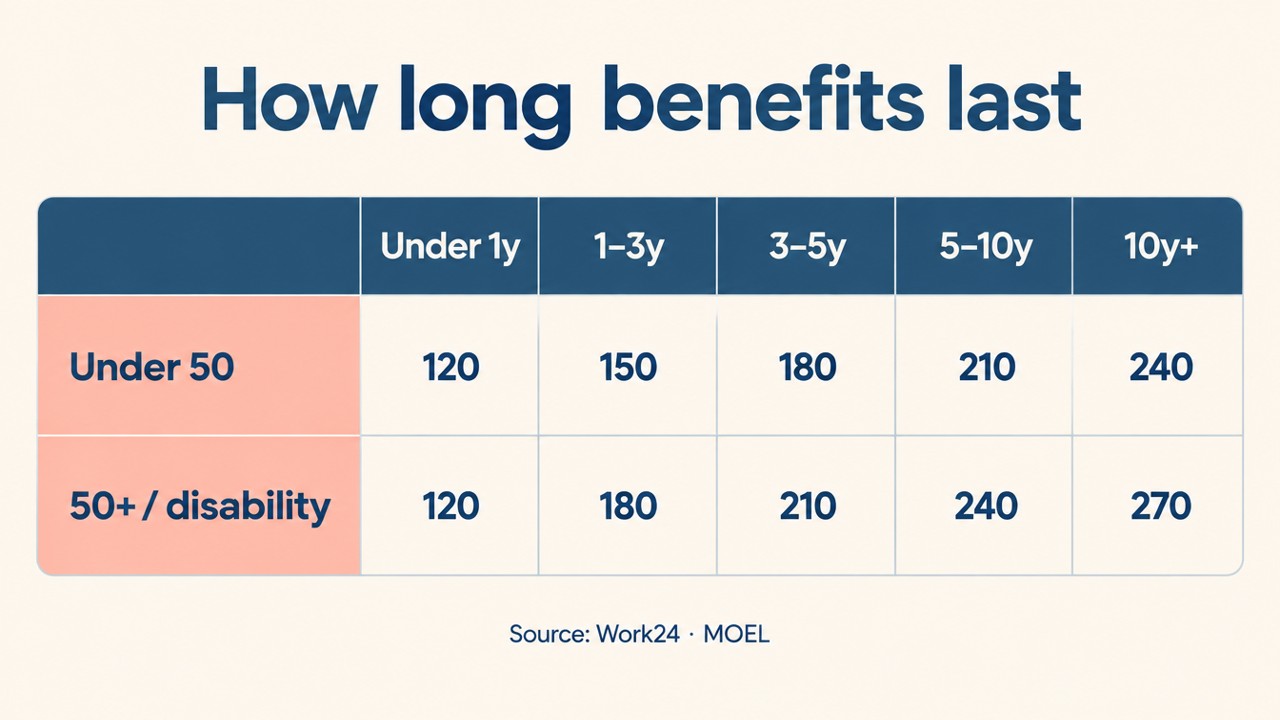
Prescribed benefit days (소정급여일수) depend on your age on the last working day and how long you were insured. For separations on or after 1 October 2019 (the table still used in 2026):
| Insured period → | Under 1 year | 1–under 3 | 3–under 5 | 5–under 10 | 10+ years |
|---|---|---|---|---|---|
| Under age 50 | 120 days | 150 days | 180 days | 210 days | 240 days |
| Age 50+ or registered disability | 120 days | 180 days | 210 days | 240 days | 270 days |
Source: Work24 Employment Insurance “job-seeker allowance amount / prescribed days” table; same grid in MOEL’s Employment Insurance guide and the MOEL 1350 answer of 10 July 2026.
Examples:
- Age 42, insured 4 years → 180 days
- Age 52, insured 4 years → 210 days
- Age 35, insured 11 years → 240 days
- Age 55, insured 11 years → 270 days (maximum ordinary run)
MOEL 1350 also notes that if you have not already drawn benefits on that Employment Insurance history and there was a gap of under three years, earlier enrolment periods can be added together when the centre counts your insured years.
Unused days do not stretch past the claim window: Work24’s payment-procedure page says benefits are only available for 12 months from the day after separation, even if prescribed days remain.
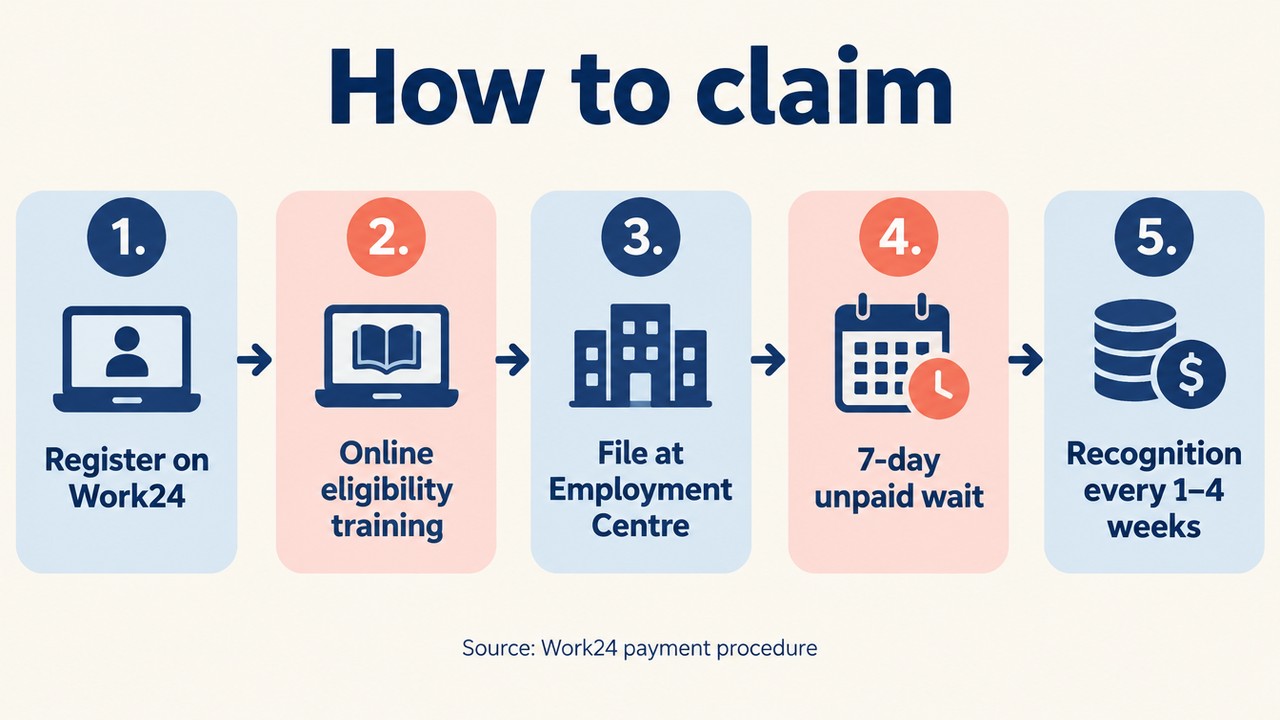
How to apply: Work24 and the Employment Centre
MOEL’s 2026 guide and Work24’s payment-procedure page describe the same path:
- Make sure your employer filed the separation confirmation (이직확인서). Employers must report it to the Employment Centre / Employment Insurance system after you leave. You can check status on Work24 or by calling 1350.
- Register as a job-seeker on Work24 (work24.go.kr; older materials still say WorkNet / work.go.kr — use the portal your centre points you to).
- Complete the mandatory online eligibility training on the Employment Insurance / Work24 personal menu before you apply.
- File the eligibility application (수급자격인정신청) at your local Employment Centre, with ID (Alien Registration Card for foreign residents) and bank details for deposits.
- Serve the 7-day waiting period. Work24 states that once eligibility is recognised, the first seven days are a waiting period with no job-seeker allowance.
- Attend unemployment recognition (실업인정) every 1 to 4 weeks on the day your officer sets — in person or, if designated, online by 17:00 that day — and document real job-search activity.
Missing a recognition day without an accepted reason does not merely delay payment; Work24 warns that unrecognised days can eat into your remaining prescribed days.
Planned reform (not yet the day-to-day rule)
On 1 September 2026, Yonhap reported that the Employment Insurance Committee agreed to change payment from seven calendar days a week to six (excluding unpaid holidays), while keeping total cash and the 120–270 day counts the same, so the calendar stretch of a claim would lengthen. The same package would link the daily ceiling to 103% of the floor and raise the Employment Insurance unemployment-account premium from 1.8% to 2.0%. Asia Business Daily’s English write-up of the same announcement projects, under the 2027 minimum wage of ₩10,700, a roughly ₩1.76 million monthly lower figure and ₩1.81 million upper figure for a 150-day claimant once the six-day method applies.
As of 6 November 2026, treat that package as a committee decision headed for legislation, not as the amount already on your next deposit. The numbers in the tables above — ₩68,100 / ₩66,048, seven-day practice, 120–270 days — are the ones MOEL 1350 and Work24 still use for current 2026 separations. For the 2027 hourly wage itself, see our Korea minimum wage 2027 guide.
Rechecked on November 12, 2026 (law.go.kr / MOEL / MOLEG): Employment Insurance Act Article 46 still sets the daily allowance at 60% of your base daily wage, with a floor (the “minimum job-seeker daily amount”) of 80% of a base worked out from the minimum hourly wage × your daily contracted hours, and it pays the floor whenever the 60% figure comes out lower. Enforcement Decree Article 68 (in force 18 September 2026) still caps the base at ₩113,500, which is the ₩68,100 daily ceiling. MOEL Notice No. 2026-60 sets the 2027 minimum wage at ₩10,700, so for separations from 1 January 2027 the floor works out to ₩68,480 for an 8-hour day and ₩34,240 for a 4-hour day (our calculation; MOEL 1350 applies the floor by separation date and daily hours). That 8-hour floor is ₩380 above the ceiling, and Article 46(2) means the higher floor is what you get. MOEL published a decree amendment on 22 September 2026 (Notice No. 2026-446; comments closed 2 November) that would replace the fixed ceiling with one linked to the floor to stop this inversion. As of 12 November we found no Cabinet approval and no final 2027 ceiling, so treat any 2027 ceiling figure you see as provisional.
| Leaving date (8-hour day) | Daily floor | Daily ceiling | 30 days at the floor |
|---|---|---|---|
| 1 Jan – 31 Dec 2026 | ₩66,048 | ₩68,100 | ₩1,981,440 |
| From 1 Jan 2027 (decree unchanged) | ₩68,480 | ₩68,100 (below the floor) | ₩2,054,400 |
30-day figures are our calculation under the current seven-days-a-week practice (Art. 46; Decree Art. 68; MOEL Notice No. 2026-446 on MOLEG; MOEL Notice No. 2026-60; MOEL 1350; read 12 November 2026).
Practical checklist after a layoff
| Step | Action |
|---|---|
| 1 | Confirm Employment Insurance enrolment on past payslips |
| 2 | Ask HR whether the separation confirmation was filed |
| 3 | Register as a job-seeker on Work24 |
| 4 | Finish the online eligibility training |
| 5 | Visit your Employment Centre with ID and bank details |
| 6 | Diary the 7-day wait and every recognition date |
| 7 | Keep proof of applications, interviews and training |
| 8 | Report any work or income during the claim |
If you fall ill after eligibility is recognised and cannot search for at least seven days, Work24 describes a sickness benefit (상병급여) path with medical proof — ask your centre; do not simply skip recognition days.
Frequently asked questions
Q. Can I claim Korea unemployment benefits if I resigned myself?
Usually no, if you left only for personal convenience. MOEL does recognise some justified voluntary exits — unpaid wages, pay below the minimum wage, workplace collapse and similar statutory reasons. Bring documents; the Employment Centre decides case by case.
Q. How much is the daily job-seeker allowance in 2026?
For separations on or after 1 January 2026 it is 60% of average daily wage, not more than ₩68,100 and not less than ₩66,048 for an 8-hour day (tied to the ₩10,320 hourly minimum wage). Most full-time claimants fall between those two figures.
Q. How many days can I receive?
Between 120 and 270 days, by age on your last working day and total insured years. Under 50 with under one insured year: 120 days. Age 50+ (or registered disability) with 10+ insured years: 270 days. The claim must still finish within 12 months of the day after separation.
Q. Where do I apply, and is there a waiting period?
Register on Work24, complete the online training, then file at your local Employment Centre. After eligibility is recognised, the first seven days are unpaid waiting days. Then you report job-search activity every 1–4 weeks.
Q. Do foreign workers get the same job-seeker allowance?
If you were enrolled in Employment Insurance and meet the same insured-days, separation and job-search tests, the cash rules are the same. No enrolment usually means no claim — check the Employment Insurance line on your payslip and ask 1350 if the line is missing.
Q. Will the job-seeker allowance change if I lose my job after January 1, 2027?
The floor will. It follows the minimum wage on your separation date, so leaving on or after January 1, 2027 (49 days from November 13) puts the 8-hour floor at ₩68,480 a day (80% × ₩10,700 × 8, our calculation) instead of ₩66,048. That is above the ₩68,100 ceiling in Enforcement Decree Art. 68, and MOEL’s proposal to link the ceiling to the floor (Notice No. 2026-446) had not been finalised as of November 12, so confirm your daily amount with your Employment Centre or MOEL 1350 when you claim.
Related reading
- Korea minimum wage 2027: ₩10,700 an hour from January 1
- Korea 19% flat tax for foreign workers: Dec 31 cutoff and the 2027 bill
- Korea payslip 2027: pension rises to 10%
Sources
- National Law Information Center, Employment Insurance Act Article 46 — 60% daily amount and 80% floor (checked 12 November 2026)
- Ministry of Government Legislation, Employment Insurance Act Enforcement Decree amendment notice (MOEL Notice No. 2026-446, 22 September 2026; ceiling linked to the floor) (checked 12 November 2026)
- Ministry of Employment and Labor, 2027 minimum wage notice (No. 2026-60): ₩10,700 an hour (checked 12 November 2026)
- Ministry of Employment and Labor, 1350 customer-centre answer on 2026 daily upper/lower limits and prescribed days (answered 10 July 2026; checked 6 November 2026)
- Ministry of Employment and Labor, Employment Insurance Act subordinate-decree legislative notice: 2026 ceiling raised to ₩68,100 (registered 10 October 2025; checked 6 November 2026)
- Ministry of Government Legislation / law.go.kr, Employment Insurance Act Enforcement Decree Art. 68 — wage-base ceiling ₩113,500 (decree in force 18 September 2026; checked 6 November 2026; re-checked 12 November 2026)
- Work24 / Employment Insurance, Job-seeker allowance amount and prescribed-days table (checked 6 November 2026; note outdated ₩66,000 ceiling text on that HTML page)
- Work24 / Employment Insurance, Job-seeker allowance payment procedure — 12-month window, 7-day wait, recognition cycle (checked 6 November 2026)
- Yonhap News, Employment Insurance reform: 7-day → 6-day pay, 2026 ceiling ₩68,100 (1 September 2026; checked 6 November 2026)
- Asia Business Daily (EN), Unemployment benefits reform and 2027 monthly illustrations (1 September 2026; checked 6 November 2026)
- Haesul, Korea payslip: four social insurance deductions 2026
- Haesul, Korea minimum wage 2027
- Haesul, Korea health insurance for foreigners 2026
General information only — not legal, tax or financial advice. Written with AI assistance and checked against the sources above. Your Employment Centre decides eligibility and amounts. Rules and the September 2026 reform timeline can change; verify on Work24 and with MOEL 1350 before you rely on any figure.