Gangneung and Sokcho in Winter: KTX or Bus from Seoul, Seoraksan and the New Year Sunrise
Haesul Travel desk (AI-assisted). As of 18 November 2026 (KST). Based on Gangneung City and Sokcho City official pages (bus information systems, Ojukheon museum, Sokcho facilities corporation), the Korea Astronomy and Space Science Institute (KASI), the Korea Meteorological Administration (KMA), the Korea National Park Service, the Korea Tourism Organization and the Seoraksan cable car operator, cross-checked against national transit-data timetable sites and Korean news reports.
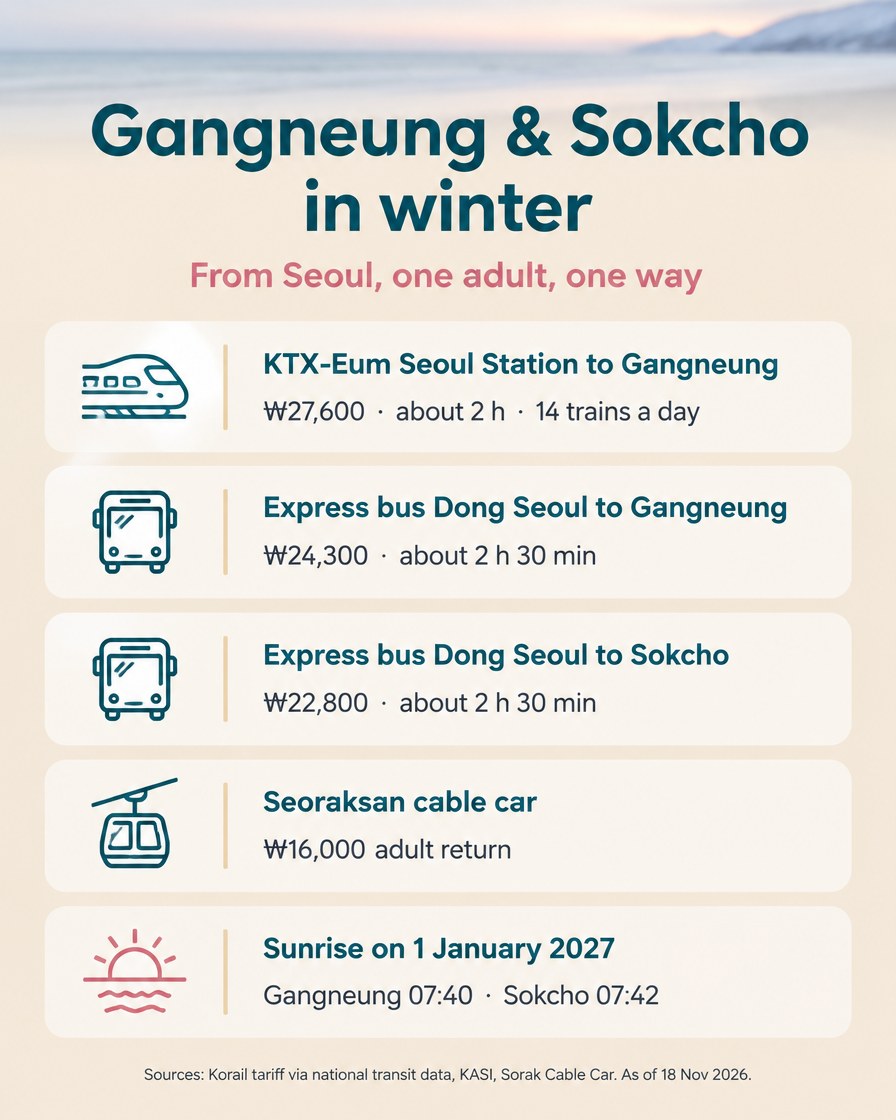
Quick answer: Gangneung (강릉) and Sokcho (속초) are Korea’s easiest winter beach-and-mountain trip from Seoul. A KTX-Eum train from Seoul Station to Gangneung costs ₩27,600 one way in economy and takes about 2 hours (1 h 51 min to 2 h 11 min, 14 trains a day). Sokcho has no train, so take an express bus: ₩22,800 from Dong Seoul or ₩24,300 (deluxe) from Seoul Express Bus Terminal, about 2 h 20–2 h 30 min. The Seoraksan cable car is ₩16,000 return for adults, and local buses in both cities cost ₩1,530 by transport card. On 1 January 2027, KASI puts sunrise at 07:40 in Gangneung and 07:42 in Sokcho, and Gangneung City runs its New Year sunrise events at Jeongdongjin and Gyeongpo on 31 December–1 January.
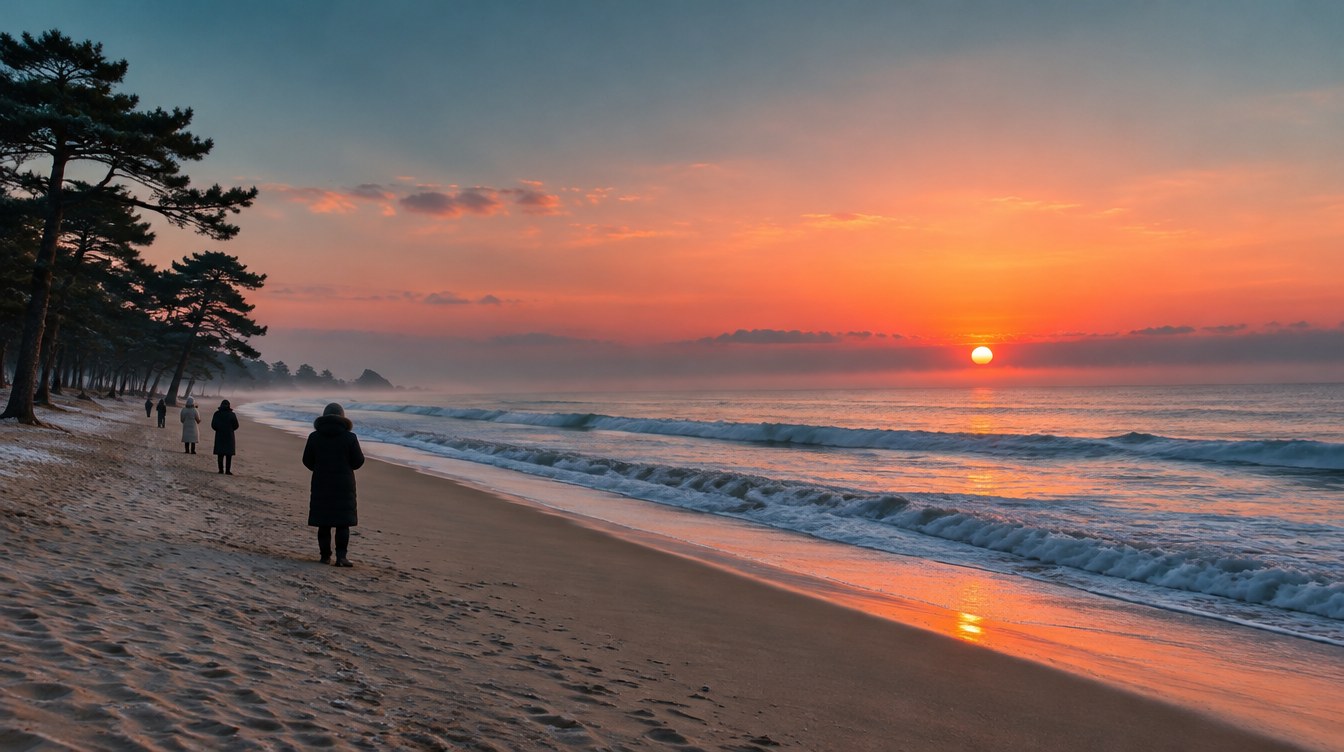
This guide is for visitors and foreign residents planning an east-coast trip between December and February, including the New Year sunrise: 1 January 2027 is a Friday, 44 days from 18 November, and it starts a three-day weekend. It covers how to get there by train or bus, how to move between Gangneung and Sokcho, the main winter sights (beaches, Anmok coffee street, Ojukheon, Seoraksan and its cable car, Sokcho’s markets), the New Year sunrise at Jeongdongjin, a one-day and a two-day plan, and a worked transport budget. It is general travel information; fares, timetables and event details change, so check the official pages listed at the end before you go.
Why the east coast in winter?
The Gangwon coast has two things Seoul lacks in winter: an open sea horizon facing east and more sunshine. KMA’s 1991–2020 climate normals show that January in Gangneung averages 0.9°C, almost 3 degrees milder than Seoul’s −1.9°C, and it gets about 190 hours of sunshine that month against Seoul’s 170. The catch is wind. Gangneung’s average January wind speed is 3.4 m/s against Seoul’s 2.3 m/s, and on an open beach before sunrise that wind is what makes it feel colder than the thermometer says.
The other draw is the mix. In one trip you can stand on a beach at dawn, drink coffee on a seafront café street, walk through a Joseon-era house in a bamboo grove, and ride a cable car up granite cliffs in Seoraksan National Park. Gangneung is the easy rail base; Sokcho, about an hour further north by bus, is the gateway to Seoraksan.
Winter weather: Gangneung and Sokcho vs Seoul
| Month (1991–2020 normals) | Gangneung avg / high / low | Sokcho avg / high / low | Seoul avg / high / low |
|---|---|---|---|
| December | 3.3 / 7.7 / −0.5°C | 2.5 / 6.6 / −1.5°C | 0.2 / 4.2 / −3.4°C |
| January | 0.9 / 5.3 / −2.7°C | 0.1 / 4.2 / −3.8°C | −1.9 / 2.1 / −5.5°C |
| February | 2.7 / 7.1 / −1.3°C | 1.9 / 6.0 / −2.2°C | 0.7 / 5.1 / −3.2°C |
| January sunshine | 190.2 h | 185.4 h | 169.6 h |
| January avg wind | 3.4 m/s | 2.6 m/s | 2.3 m/s |
Source: KMA climate normals 1991–2020 (stations 105 Gangneung, 90 Sokcho, 108 Seoul), read from data.kma.go.kr on 18 November 2026; temperatures match the KMA tables reproduced on Wikipedia.
In practice: daytime is often above freezing on the coast, mornings are around −3°C, and Seoraksan’s ridges are much colder than either city. Pack a windproof layer, gloves and a hat even if the forecast looks mild.
Getting there: KTX-Eum or express bus
KTX-Eum to Gangneung (and Jeongdongjin)
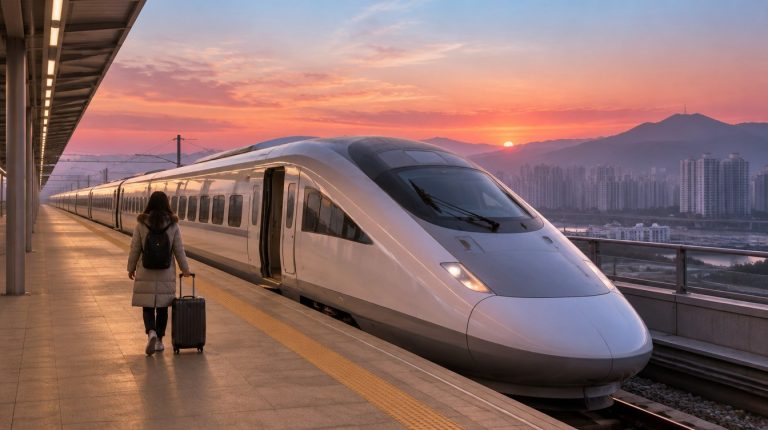
The KTX Gangneung Line runs from Seoul Station (also stopping at Cheongnyangni, and on some trains Sangbong) to Gangneung Station. According to Korail’s timetable as published in the national transit data (TAGO) and reproduced by several independent timetable sites on 18 November 2026:
| Route (KTX-Eum) | Trains a day | Time | Economy fare (first class, 우등실) | First / last from Seoul |
|---|---|---|---|---|
| Seoul → Gangneung | 14 | 1 h 51 min – 2 h 11 min | ₩27,600 (₩33,100) | 05:06 / 22:14 |
| Seoul → Jeongdongjin | 4 | about 2 h 8–10 min | ₩28,300 (₩34,000) | 10:59 / 19:50 |
The last train back from Gangneung leaves at 22:27 and reaches Seoul at 00:25, so a day trip is realistic. All fares are for one adult and follow Korail’s tariff in force since 1 September 2026. Korean holiday weekends sell out early; see our guide on how to book KTX trains in Korea as a foreigner for the English site, the app and Korail Pass rules. If you are heading for the slopes on the same line, Jinbu (Odaesan) and Pyeongchang stations are covered in ski resorts near Seoul without a car.
Note that the direct Jeongdongjin trains arrive in the afternoon or evening, so no regular train reaches Jeongdongjin before sunrise. For the New Year sunrise you need to stay nearby the night before (see below).
Express bus to Sokcho and Gangneung
Sokcho has no railway station in 2026, so buses are the public-transport link. Times below are for 18 November 2026 from the national express-bus data (as listed by two independent timetable sites); final fares and seats are confirmed when you book on the official express-bus site (kobus.co.kr) or app.
| Route (express bus) | Buses a day | Time | Fare (adult, one way) |
|---|---|---|---|
| Dong Seoul → Sokcho | 15 | about 2 h 30 min | ₩22,800 (deluxe), ₩29,600 (premium) |
| Seoul Express Bus Terminal → Sokcho | 45 | about 2 h 20 min | ₩18,700 (standard), ₩24,300 (deluxe), ₩31,500 (premium) |
| Dong Seoul → Gangneung | 12 | about 2 h 30 min | ₩24,300 (deluxe), ₩27,300 (premium) |
Dong Seoul Bus Terminal is next to Gangbyeon Station (Line 2); Seoul Express Bus Terminal is on Lines 3, 7 and 9. Bus times assume normal traffic; on weekends and over the New Year, road traffic can make buses run late.
Between Gangneung and Sokcho
Intercity buses run between Gangneung Intercity Bus Terminal and Sokcho Intercity Bus Terminal about 23 times a day (07:14 to 21:00 in the most recent public data, April 2026), with fares of ₩7,200–9,900 depending on the route and operator and a ride of roughly 1 to 1.5 hours. Book on the intercity bus sites (txbus.t-money.co.kr or bustago.or.kr) or at the terminal.
Getting around: local buses
Both cities use ordinary nationwide transport cards (T-money and the other cards accepted in Seoul work), and card fares are 10 percent cheaper than cash. From each city’s official bus information system:
| City | Adult fare (card / cash) | Free transfer |
|---|---|---|
| Gangneung (regular bus) | ₩1,530 / ₩1,700 | up to 2 transfers within 1 hour of tapping off |
| Sokcho (within Sokcho) | ₩1,530 / ₩1,700 | 1 transfer within 1 h 30 min of tapping off (not to the same route number, not on cash) |
Useful routes on Gangneung’s published schedule: 202 and 202-1 to Gyeongpo Beach, 300-1 to Anmok coffee street, and 112 and 113 towards Jeongdongjin (112 runs to Hourglass Park, 07:35–20:35). In Sokcho, 7 and 7-1 run to Seoraksan’s Sogongwon (the park entrance area, 06:30–20:35 for 7-1). Tap your card when you get off, or the transfer discount will not apply.
Gangneung in winter: beaches, coffee and Ojukheon
Gyeongpo Beach (경포해변) is Gangneung’s main beach, a long stretch of sand backed by pine trees and the Gyeongpo lagoon. In winter it is quiet except at New Year, when it is one of the city’s two official sunrise venues.
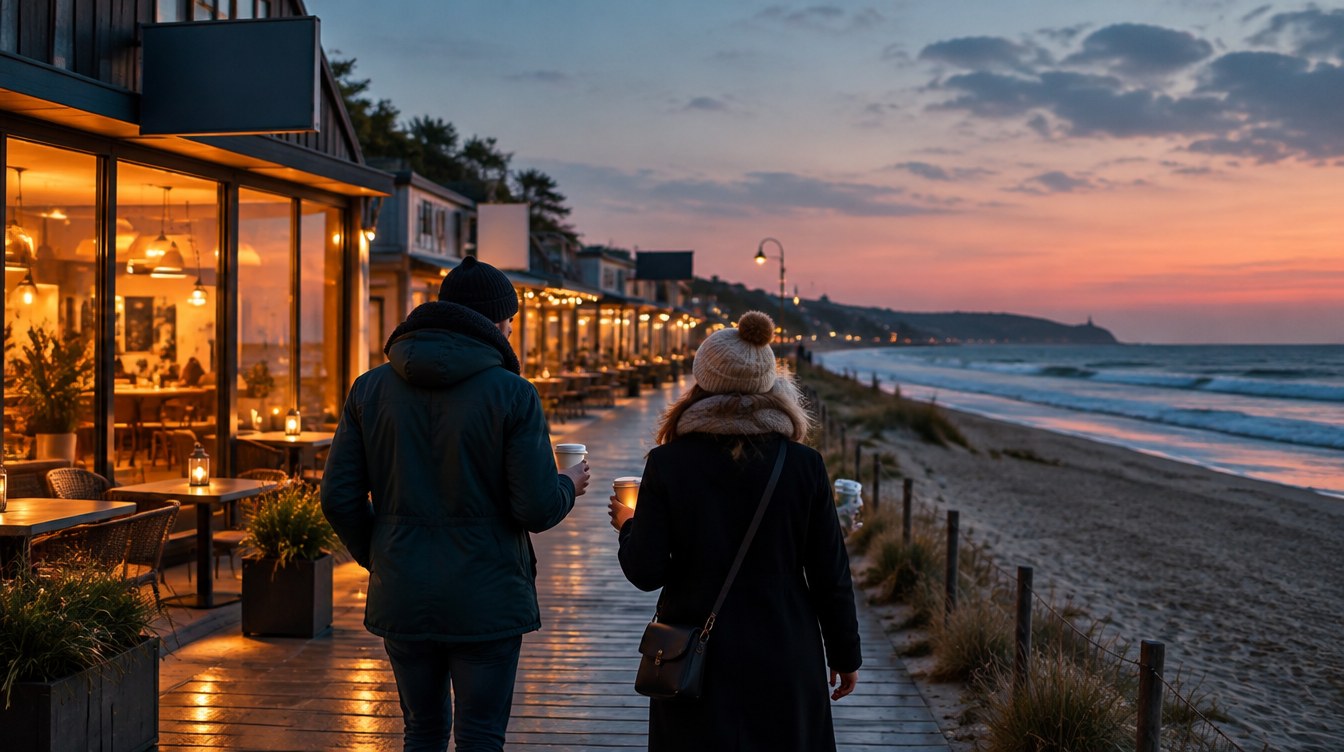
Anmok coffee street (안목해변 커피거리) is a row of cafés facing the sea at Anmok Beach near Gangneung Port. The Korea Tourism Organization describes more than 20 cafés along the beach, and recent counts put it closer to 30; Gangneung has built its “coffee city” image around this street. Second-floor windows facing the sea are the reason to go, so a weekday morning or late afternoon is better than a weekend lunchtime.
Ojukheon (오죽헌), the birthplace of the Joseon scholar Yulgok Yi I, is a traditional house in a grove of black bamboo, with the city museum next door. Gangneung City lists hours of 09:00–18:00 (last entry 17:00), open every day, with adult admission ₩3,000 (₩2,000 for youth, ₩1,000 for children; free from age 65). On 1 January, Seollal and Chuseok only Ojukheon is open and the indoor exhibition halls close. The last Wednesday of each month is half price.
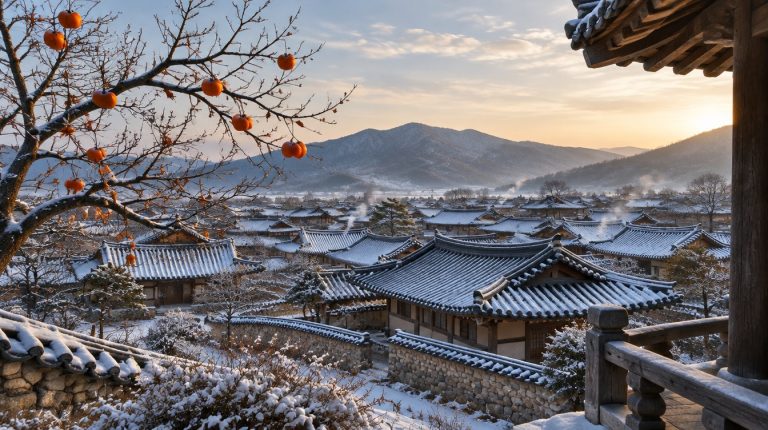
Jeongdongjin (정동진), on the coast south of the city centre (buses 112 and 113, or the train), is a small seaside village with a railway station almost on the beach and Hourglass Park (Sandglass Park), home of a giant hourglass; at the last New Year event it was turned at the midnight countdown. It is Korea’s best-known sunrise spot, which is exactly why it is crowded at New Year.
Sokcho in winter: Seoraksan, the cable car and the markets
Seoraksan National Park and the cable car
Seoraksan (설악산) is the best-known national park on the east coast. From central Sokcho, buses 7 and 7-1 run to Sogongwon, the park entrance area. Since 4 May 2023, Sinheungsa temple’s cultural-heritage admission fee has been waived along with those of other major temples in national parks (Korea Heritage Service, confirmed by Yonhap’s report from Seoraksan that day), so walking in is free; parking is charged separately.
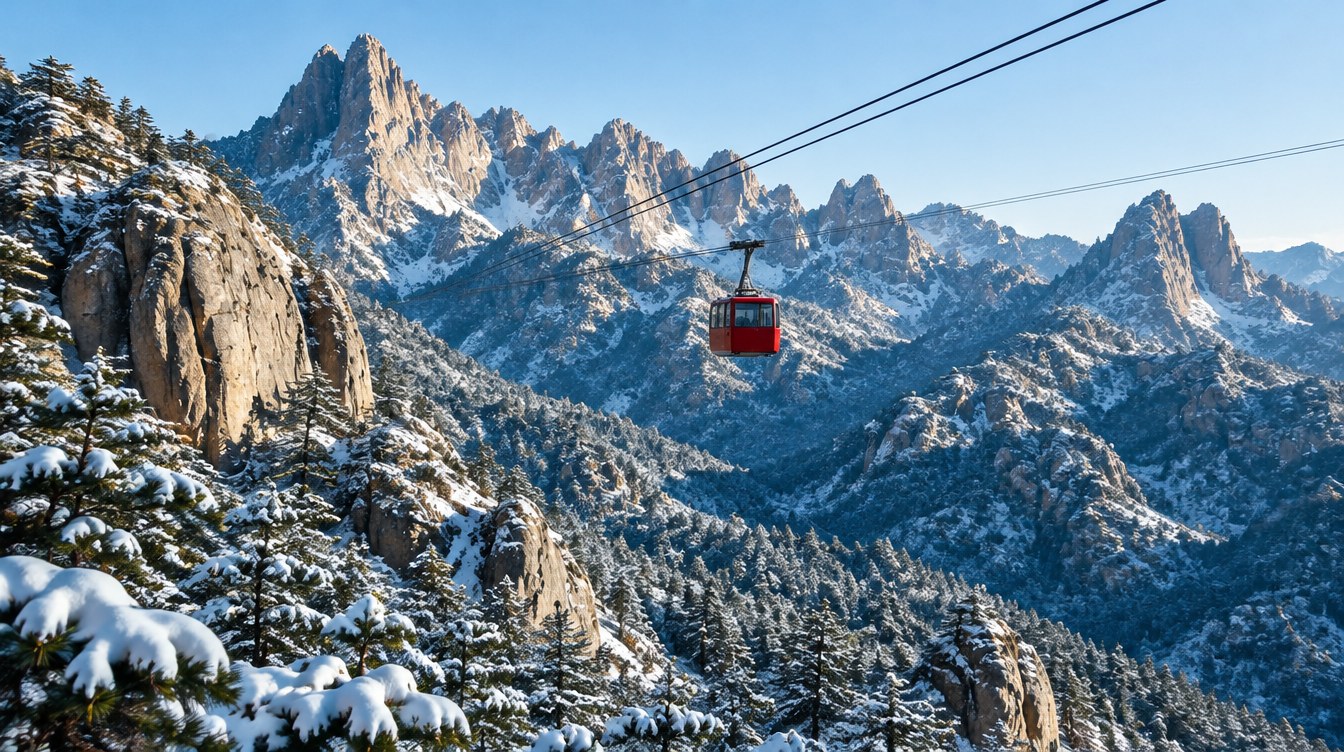
The Seorak cable car (설악 케이블카) runs from Sogongwon to Gwongeumseong, a rocky viewpoint at 699 m, on a 1,128 m line that takes about 5 minutes each way. The operator’s official page lists:
| Seorak cable car | Detail (operator page, read 18 Nov 2026) |
|---|---|
| Adult (middle school and older), return | ₩16,000 |
| Child (37 months to primary school), return | ₩12,000 |
| Under 36 months | free |
| Senior 65+ (off-peak only) | ₩14,000 |
| Tickets | return only; on-site sales only, no advance booking |
| Hours | not fixed; posted daily on the homepage; stops in strong wind |
| Refund | full refund up to 10 minutes before boarding; full refund if weather stops service |
There is no footpath down from Gwongeumseong, so you must ride back. Cabins have no heating, and if you take the last car up you only get about 20 minutes at the top. An independent guide that checked the page in 2026 gives about 08:30–17:00 as a typical winter pattern, but the operator itself only promises the daily posting, so check the homepage that morning. The Korea National Park Service applies winter (November–March) trail time limits in Seoraksan and closes trails during weather warnings; the short walks from Sogongwon (for example to Biseondae) are open from two hours before sunrise until sunset. Higher trails require proper winter gear, including crampons.
Sokcho’s markets and the Gaetbae ferry
Sokcho Tourist & Fishery Market (속초관광수산시장), also called Sokcho Jungang Market, is the city’s main food stop for dakgangjeong (sweet fried chicken), fish and street snacks; individual stalls set their own hours. A short walk away, the Gaetbae (갯배) is a hand-pulled cable ferry across the harbour mouth to Abai Village, settled by refugees from the North during the Korean War. The Sokcho facilities corporation lists winter hours (November–April) of 05:30–22:30 and a one-way fare of ₩500 for adults (₩300 for primary-school children), weather permitting. The crossing takes a couple of minutes and passengers help pull the boat along the cable.
The New Year sunrise: Jeongdongjin, Gyeongpo and Sokcho
Official sunrise times for 1 January 2027 from KASI’s monthly sunrise tables (calculated for sea level with a clear horizon):
| Place | Sky starts to brighten (civil twilight) | Sunrise |
|---|---|---|
| Gangneung (city reference point) | 07:10 | 07:40 |
| Sokcho | 07:13 | 07:42 |
| Seoul | 07:18 | 07:47 |
Independent calculators using the same method put Jeongdongjin at 07:39, a minute ahead of central Gangneung. Clouds on the horizon can delay the moment you actually see the sun by several minutes.
Events. The Korea Tourism Organization’s festival listing, organised by Gangneung City, gives the Jeongdongjin and Gyeongpo sunrise events as 31 December 2026 to 1 January 2027, with an evening programme from 20:00 to 00:30 and a sunrise programme from 06:00 to 08:00 on 1 January, free of charge. Gangneung City’s tender notice for the “2027 Jeongmi-year sunrise event” (posted 13 November 2026) names the same dates and three venues: Jeongdongjin Hourglass Park, Gyeongpo Beach central plaza and Jumunjin’s Yeongjin Beach, with exact zones still to be agreed with the police and other agencies. Detailed programmes, shuttle buses and road closures had not been published when we checked on 18 November; they usually appear in mid to late December. At the previous event, Gangneung closed some coastal paths (such as the Badabuchae-gil cliff walk) during sunrise hours, so do not plan on them.
How to do it. Because no regular train reaches Jeongdongjin before sunrise, the realistic plans are: (1) stay in Gangneung on 31 December and take a taxi or an early bus to Gyeongpo, which is closer to the centre; (2) stay in Jeongdongjin itself (book well ahead); or (3) watch from Sokcho, where the waterfront around Yeonggeumjeong and Sokcho Beach faces east and sunrise is 07:42. If you are staying in a guesthouse, pension or campsite with a gas or oil heater, read our winter carbon-monoxide safety guide first; and standing on a beach for an hour at −3°C with wind is a real cold-exposure risk, covered in our hypothermia and frostbite guide.
A 1-day plan: Gangneung from Seoul
- 07:59 KTX-Eum from Seoul Station, arriving Gangneung 10:03 (₩27,600).
- Bus to Ojukheon and spend an hour in the house and bamboo grove (₩3,000; last entry 17:00).
- Lunch in central Gangneung, then bus 202 or 202-1 to Gyeongpo Beach for a walk along the sand and the lagoon.
- Late afternoon at Anmok coffee street: coffee with a sea view as the light fades (KASI puts sunset in Gangneung at 17:16 on 1 January).
- Bus 300-1 back to Gangneung Station and an evening KTX-Eum home (the last one leaves at 22:27).
A 2-day plan: Gangneung and Sokcho
- Day 1 (Gangneung): the 1-day plan above, but stay in Gangneung overnight.
- Day 2 (Sokcho): an early intercity bus to Sokcho (about 1–1.5 h), bus 7 or 7-1 to Sogongwon, the Seoraksan cable car and a short walk, then back into town for the market and the Gaetbae ferry to Abai Village. Take an evening express bus back to Seoul (about 2 h 20–2 h 30 min).
- New Year version: do day 1 on 31 December, watch the sunrise at Gyeongpo or Jeongdongjin on 1 January, then continue to Sokcho. Expect heavy traffic and full buses on 1 January; book every leg in advance.
If you have more time and want a second city on another coast, our Busan in winter 2-day plan and Jeonju by KTX guides follow the same format.
Worked budget: transport and entry fees for one adult, 2 days
Our calculation from the official fares above; meals and accommodation are not included because they vary too widely to price honestly.
| Item | Fare |
|---|---|
| KTX-Eum Seoul → Gangneung (economy) | ₩27,600 |
| Gangneung local buses, 4 rides by card (no transfers counted) | 4 × ₩1,530 = ₩6,120 |
| Ojukheon admission | ₩3,000 |
| Intercity bus Gangneung → Sokcho (mid fare) | ₩7,700 |
| Sokcho buses to and from Seoraksan (2 rides by card) | 2 × ₩1,530 = ₩3,060 |
| Seoraksan cable car (adult return) | ₩16,000 |
| Gaetbae ferry, both ways | 2 × ₩500 = ₩1,000 |
| Express bus Sokcho → Seoul (deluxe, assuming the same ₩24,300 fare as the outbound route) | ₩24,300 |
| Total | ₩88,780 |
A one-day Gangneung trip by KTX-Eum both ways, with four bus rides and Ojukheon, comes to 2 × ₩27,600 + ₩6,120 + ₩3,000 = ₩64,320. Taking the Dong Seoul bus to Gangneung instead of the train saves ₩3,300 each way but adds about 30 minutes and traffic risk. Transfers within the time limits would make the bus lines cheaper than shown.
Practical tips for a winter trip
- Check the cable car and trail status the same morning. Strong wind stops the cable car; weather warnings close Seoraksan trails.
- Dress for wind, not temperature. January mornings average around −3°C on the coast; the beach wind makes it feel much colder.
- Book KTX early for weekends and the New Year. The 31 December–1 January trains and buses fill first.
- Use a transport card. Card fares are cheaper and only card users get free transfers.
- Bring a little cash for markets and the Gaetbae ferry, although cards are widely accepted.
- Entry rules: check whether you need a K-ETA before you fly in; see K-ETA vs visa-free entry.
Common mistakes
- Planning to arrive at Jeongdongjin by train for sunrise. The direct trains arrive between 13:08 and 21:58; stay the night before.
- Assuming there is a train to Sokcho. There is not in 2026; take the bus, or KTX to Gangneung and an intercity bus north.
- Arriving at the cable car late in the day. On the last car up you get about 20 minutes at the top.
- Booking an online “cable car ticket”. The operator sells tickets on site only.
- Forgetting the wind. Gangneung is milder than Seoul on paper but windier, especially on the sand before dawn.
Frequently asked questions
Q. How much is the KTX from Seoul to Gangneung?
A KTX-Eum economy ticket from Seoul Station to Gangneung costs ₩27,600 one way (₩33,100 in first class) under Korail’s tariff from 1 September 2026. There are 14 trains a day, taking 1 hour 51 minutes to 2 hours 11 minutes, from 05:06 to 22:14.
Q. Is there a train to Sokcho?
No. Sokcho has no railway station in 2026. Take an express bus from Seoul Express Bus Terminal (about 2 hours 20 minutes, ₩24,300 deluxe) or Dong Seoul (about 2 hours 30 minutes, ₩22,800), or take the KTX to Gangneung and an intercity bus north (₩7,200–9,900).
Q. What time is sunrise on 1 January 2027 in Gangneung?
The Korea Astronomy and Space Science Institute lists 07:40 for Gangneung and 07:42 for Sokcho on 1 January 2027, with the sky starting to brighten about 30 minutes earlier (07:10 in Gangneung). Jeongdongjin is about a minute earlier than central Gangneung.
Q. Is the Jeongdongjin sunrise festival on for 2027?
Yes. Gangneung City’s event listing on the Korea Tourism Organization site gives 31 December 2026 to 1 January 2027 at Jeongdongjin Hourglass Park and Gyeongpo Beach, free, with an evening programme from 20:00 and a sunrise programme from 06:00. A city tender notice from 13 November also names Jumunjin’s Yeongjin Beach. Detailed programmes and traffic controls are usually announced in December.
Q. How much is the Seoraksan cable car in winter?
The Seorak cable car costs ₩16,000 return for adults and ₩12,000 for children, sold on site only with no advance booking. Hours are posted daily on the operator’s homepage and the cable car stops in strong wind; unused tickets are refunded in full if it does.
Q. Can I do Gangneung as a day trip from Seoul?
Yes. With the first KTX-Eum at 05:06 and the last train back at 22:27, you can spend a full day in Gangneung. Adding Sokcho and Seoraksan works better as an overnight trip.
Sources
- Korail KTX-Eum timetable and fares (tariff from 1 Sep 2026) via the national transit data (TAGO, MOLIT): monoalda train, Moneydog, Mustard Data and makka.co.kr route pages for Seoul–Gangneung and Seoul–Jeongdongjin (checked 18 Nov 2026); booking: https://www.letskorail.com/
- Express and intercity bus timetables and fares from the national bus data: ojigo.kr, trans.minmins.kr, makka.co.kr (18 Nov 2026); allnosun.com and campmoa (Gangneung–Sokcho, data of Apr 2026); booking: https://www.kobus.co.kr/ , https://txbus.t-money.co.kr/
- Gangneung City bus information system, fares and schedules: https://bis.gn.go.kr/info and https://bis.gn.go.kr/schedule
- Sokcho City bus information system, fares, transfers and schedules: https://bis.sokcho.go.kr/info and https://bis.sokcho.go.kr/schedule
- Ojukheon and Gangneung City Museum, visitor information: https://gn.go.kr/museum/contents.do?key=891
- Seorak cable car, fares and FAQ: https://www.sorakcablecar.co.kr/guide ; cross-checked with independent 2026 guides (oh-my-post, narse)
- Korea Heritage Service, temple admission fees waived from 4 May 2023: https://www.khs.go.kr/ ; Yonhap, 4 May 2023
- Korea National Park Service, trail time limits: https://www.knps.or.kr/portal/main/contents.do?menuNo=8000198
- Sokcho facilities corporation, Gaetbae ferry: https://www.sokchosiseol.or.kr/biz/ferry.do
- Korea Astronomy and Space Science Institute, monthly sunrise and sunset tables (January 2027, Gangneung, Sokcho, Seoul): https://astro.kasi.re.kr/life/pageView/6 ; Jeongdongjin time cross-checked with calcstandard.com and tool.smithlab.co.kr
- Korea Tourism Organization, Jeongdongjin Sunrise Festival: https://english.visitkorea.or.kr/svc/contents/contentsView.do?vcontsId=89955 ; Gangneung City tender notice “2027 정미년 해맞이 행사 대행 용역” (13 Nov 2026, as listed on wnara.kr); Gangneung tourism portal festival list: https://www.gn.go.kr/tour/
- Korea Tourism Organization, Anmok coffee street feature (visitkorea.or.kr)
- Korea Meteorological Administration, climate normals 1991–2020: https://data.kma.go.kr/normals/table.do ; cross-checked with Wikipedia’s KMA climate tables for Gangneung and Sokcho
How we checked: We read the city bus systems, the Ojukheon, Gaetbae, cable-car and KASI pages directly on 18 November 2026 and matched each fare and timetable with at least two independent sources. Korail’s own search could not be queried automatically, so train fares come from Korail’s tariff as published in the national transit data. Where an official detail was not yet published (New Year programmes, winter cable-car hours), we say so.
Researched and drafted with AI assistance; checked against the sources listed.