Seeing a Doctor in English in Korea: International Clinics, Booking and First-Visit Costs
Haesul Health desk (AI-assisted). As of 16 November 2026 (KST). Based on the international-patient pages of Seoul National University Hospital, Severance Hospital, Samsung Medical Center and Asan Medical Center, the Health Insurance Review and Assessment Service (HIRA) and National Health Insurance Service (NHIS) co-payment rules, Ministry of Health and Welfare (MOHW) fee decisions of 25 June and 28 October 2026, the Korea Tourism Organization’s 1330 helpline page, KHIDI’s Medical Korea Information Center leaflet and the KDCA week-45 flu bulletin, cross-checked with Yonhap, Hit News, Doctors News, Korea Biomedical Review, the Seoul Metropolitan Government and GOV.UK. General information, not medical advice.
Quick answer: For a cold, a cough or a rash, the cheapest English route is usually a local clinic (의원, uiwon) with an English-speaking doctor. Big university hospitals in Seoul run international healthcare centres with English-speaking staff, and you book them by phone, email or an online form. If you have Korean national health insurance (NHIS), you need a referral letter (요양급여의뢰서) for most departments at these top-tier hospitals, or you pay 100% of the bill. At a clinic, an NHIS member pays 30%. In 2026 a clinic’s first-visit consultation fee is ₩18,840, so your share is about ₩5,600 (our calculation). Without NHIS you pay the whole bill, and hospitals can set their own prices for patients who aren’t insured. For free phone interpreting, call 1330 (24/7 in English).
This guide is for new arrivals and visitors who need a doctor for something that is not an emergency, like flu symptoms, a stubborn cough, a skin problem or a repeat prescription. The timing matters. Flu is rising again this month: in week 45 (1 to 7 November 2026), KDCA counted 28.9 people with flu-like illness per 1,000 clinic outpatients, the third weekly rise in a row, against an epidemic threshold of 12.9. Clinics and hospital international centres will be busier than usual, so book early. If someone is struggling to breathe, has chest pain or has collapsed, skip this guide and call 119. Our ER guide explains what happens next.
First decision: a local clinic or a hospital international centre?
Korea’s health system has levels. Local clinics (의원) are the first stop. Hospitals (병원) and general hospitals (종합병원) sit in the middle. At the top are the tertiary hospitals (상급종합병원), which are the big university hospitals. NHIS sets a higher patient share at each level up. The NHIS English site says this is meant to stop everyone heading straight to the top-tier hospitals.
| Your situation | Usually the better first stop | Why |
|---|---|---|
| Cold, flu symptoms, sore throat, mild stomach bug, skin rash | Local clinic (의원): internal medicine, ENT, dermatology or family medicine | Lowest NHIS share (30%). A tertiary hospital charges 100% for listed mild conditions such as a common cold |
| You are a tourist or not yet in NHIS and want a full English service | Hospital international healthcare centre | English coordinators, interpreting, English receipts and documents, and direct billing with some insurers |
| You have NHIS and want a specialist at a university hospital | Clinic first for a referral letter, then the hospital | Without a referral, NHIS doesn’t apply at tertiary level (some exceptions below) |
| It’s night, Sunday or a holiday | Late-night pharmacy or holiday clinic | See our night and holiday care guide |
| Emergency symptoms | 119 or the nearest ER | See our ER guide |
The “mild condition” rule is real money. HIRA’s co-payment table says outpatient care for mild conditions at a tertiary hospital is charged at 100% of the total covered cost. The Seoul Shinmun reported in 2020, when the government approved this change, that the list covers 100 conditions, including acute nasopharyngitis (the common cold), conjunctivitis and chronic rhinitis. A winter cold is a clinic visit, not a university-hospital visit.
International healthcare centres at major Seoul hospitals
Several of Seoul’s biggest hospitals have a dedicated centre for international patients. The details below are from each hospital’s own English pages, checked on 16 November 2026. Phone numbers are shown as you’d dial them from abroad. Inside Korea, drop +82 and add a 0 (so +82-2-2072-0505 becomes 02-2072-0505).
| Hospital | Centre and contact | Hours and languages (as published) | Notes from the hospital |
|---|---|---|---|
| Seoul National University Hospital (Jongno-gu) | International Healthcare Center, +82-2-2072-0505; online registration form | Mon to Fri 9:00 to 17:30; English, Chinese, Mongolian, Russian, Arabic | NHIS holders book through the Korean-language call centre 1588-5700. First-time visitors bring an ARC or passport. Card payment in won or US dollars |
| Severance Hospital (Seodaemun-gu) | International Health Care Center, 3rd floor, +82-2-2228-5800 / 5810, [email protected]; billing +82-2-2228-5822 | Interpreting always available in English, Japanese, Russian and Chinese; other languages on request | Gives a cost estimate on request before treatment. Says it was Korea’s first international clinic (1962) |
| Samsung Medical Center (Gangnam-gu) | International Healthcare Center, +82-2-3410-0200 | Hours not stated on the page we read. Your first visit is with one of the centre’s primary care physicians, who refers you on if needed | Arrive 30 minutes early. Pay in Korean won only. Outpatient tests are paid in advance |
| Asan Medical Center (Songpa-gu) | International Healthcare Center, 4th floor of the New Building, +82-2-3010-5001, [email protected] | Mon to Fri 8:30 to 17:30 (Korea time) | Book by phone, email or the website. NHIS holders “use it as Koreans do” |
Outside Seoul, KHIDI’s Medical Korea site lists hospitals with international healthcare centres, with contact details and interpreting languages for each. One example is Chosun University Hospital in Gwangju (+82-62-220-3770, English and Mongolian). Hours change, so confirm by phone before you travel.
How to book, step by step
- Pick the level. For everyday illness, a local clinic is usually enough (see the table above). For a university hospital, choose the international centre.
- Contact the centre. Use the phone line, email or online form in the table. SNUH’s form asks for your name, date of birth, contact details, private insurance, symptoms, the service you need and the dates you’re free. Severance’s form also asks for your alien registration number or passport number. SNUH says email replies can be slow and recommends phoning if you need a quick answer.
- If you have NHIS, sort out the referral first. See the next section. SNUH says NHIS holders should book through its Korean-language call centre (1588-5700) or the website. Once you’re under NHIS, you get the same service as Korean patients, and the international centre may not be able to interpret for you every time.
- If you have foreign or travel insurance, ask your insurer whether it has a contract with the hospital and, if so, for a guarantee of payment (GOP) letter before the visit. SNUH, Severance and Samsung Medical Center all say this. If the GOP isn’t issued by the day of your visit, you may have to pay yourself and claim later. Ask the hospital in advance which documents your insurer needs.
- Ask for an estimate. Severance says its centre can estimate costs on request before you agree to treatment.
- Go early. Samsung Medical Center asks international patients to arrive 30 minutes before the appointment. SNUH asks for the same if you’re bringing scans to register.
Walking in without an appointment is possible at some hospitals, but SNUH warns that you may have to wait or come back another day.
The referral rule for NHIS members
This is the rule most likely to catch out new residents. Seoul National University Hospital explains that, under the NHIS rules on how care is provided (국민건강보험 요양급여의 기준에 관한 규칙, Article 2), a patient must bring a referral letter (요양급여의뢰서, often called 진료의뢰서) from a clinic or hospital for NHIS to apply at a tertiary hospital. A checkup report in which a doctor notes that tertiary care is needed also works. SNUH’s FAQ adds:
- You can still be seen without one, but you pay 100% of the NHIS fee. If you then get a prescription, you also pay 100% at the outside pharmacy.
- The letter applies only to the department named on it. Seeing another department needs a new letter, unless the hospital itself refers you internally.
- The letter has no fixed expiry date, but a recent one is better. A doctor’s opinion letter (소견서) cannot replace it.
- Exceptions where no referral is needed include emergencies, childbirth, registered disabled patients in rehabilitation medicine, and family medicine (가정의학과).
Severance’s billing page gives the same rule. It adds that a clinic should not write a referral just because a patient asks for one: the doctor has to judge that you need hospital-level care. SNUH’s English page says a referral can come from an outside clinic or from SNUH’s own family medicine department (booked and paid for separately). Its international centre’s Korean-language guide says NHIS members are booked into family medicine first, so the insurance applies.
What a first visit costs: NHIS vs uninsured
There’s no single price, because the bill depends on the level of care and the tests you get. What’s fixed is the structure and the basic consultation fee.
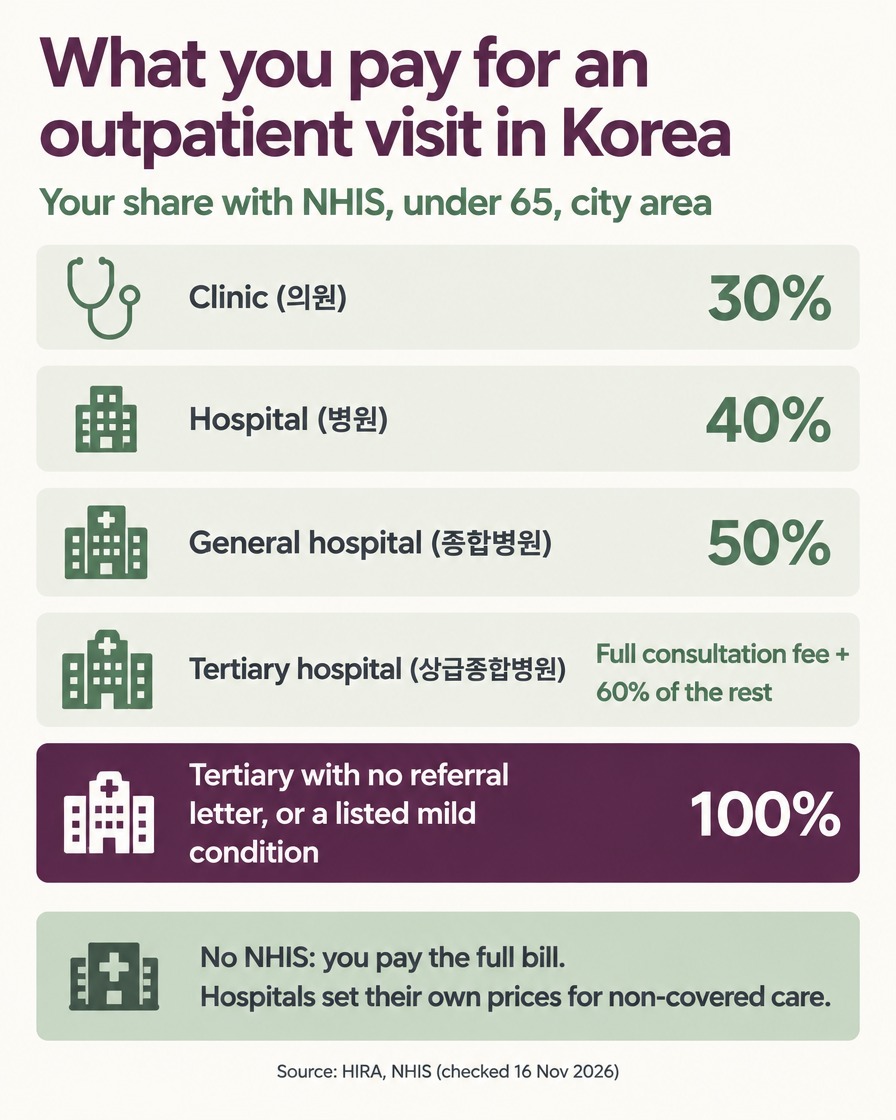
The patient share with NHIS (outpatient, under 65, city area):
| Where | Your share of the covered cost |
|---|---|
| Clinic (의원) | 30% |
| Hospital (병원) | 40% |
| General hospital (종합병원) | 50% (45% in eup and myeon areas) |
| Tertiary hospital (상급종합병원) with referral | 100% of the consultation fee + 60% of the rest |
| Tertiary hospital, no referral | 100% of the NHIS fee (SNUH FAQ) |
| Tertiary hospital, listed mild condition | 100% of the total covered cost |
| Not enrolled in NHIS | The whole bill. Non-covered items are priced by each hospital |
Sources: HIRA outpatient co-payment page and the NHIS English benefits page. Different rates apply to children under 6, pregnant patients, people 65 and over, and some specific treatments. Pharmacy prescriptions are a separate bill. Under NHIS, the pharmacy share is 30%.
The consultation fee itself. In 2026 the NHIS first-visit consultation fee (초진진찰료) is ₩18,840 at a clinic and ₩21,440 at a tertiary hospital. Yonhap and Money Today both reported these figures from MOHW’s 25 June 2026 fee reform. On 28 October 2026, MOHW announced that clinic first-visit fees will rise from January 2027. Hit News and Doctors News put the new clinic fee at ₩21,210. Tests, scans, injections and medicines are charged on top.
Worked examples (our calculation, consultation fee only, NHIS rounding to the ₩100 below):
| Case | Calculation | You pay |
|---|---|---|
| NHIS member, clinic first visit, 2026 | 30% × ₩18,840 = ₩5,652 | about ₩5,600 |
| NHIS member, clinic first visit, from January 2027 | 30% × ₩21,210 = ₩6,363 | about ₩6,300 |
| NHIS member, tertiary hospital with referral, plus a hypothetical ₩100,000 of covered tests | ₩21,440 + 60% × ₩100,000 | about ₩81,400 |
| Same visit, no referral | ₩21,440 + 100% × ₩100,000 | about ₩121,400 |
| No NHIS, clinic that charges the standard fee in full | 100% × ₩18,840 | ₩18,840 + any extras |
The ₩100,000 test bill is only an illustration, not a typical price. Real bills include other items, such as surcharges at night and on holidays.
If you’re not in NHIS. KHIDI’s Medical Korea FAQ says foreigners outside NHIS pay more than Korean patients because they aren’t members. It also says hospitals set their own prices for care that NHIS doesn’t cover, and that charging the posted price is not illegal just because it’s higher. A physician writing in OhmyNews (an opinion piece) said many hospitals that treat foreigners apply their own “international fee” (국제수가) that can be several times the NHIS fee. The prices aren’t published in one place, so ask for an estimate before treatment. Severance says it gives one on request. Asan says it can provide English receipts and other documents for an insurance claim.
Who gets NHIS rates? KHIDI’s FAQ says a foreign resident who joins NHIS pays the same as a Korean patient for covered care. Asan’s FAQ says the same thing. Most residents are enrolled after six months of stay, or straight away if employed. Our NHIS guide for foreigners explains the premiums and the six-month rule.
Interpreting: 1330 and other free lines
| Line | What it does | Hours and languages |
|---|---|---|
| 1330 Korea Travel Helpline (from abroad +82-2-1330) | Korea Tourism Organization’s helpline. It offers interpreting and can connect you to 119, the 1345 immigration line and other call centres. Free over Wi-Fi through the VisitKorea app | 24/7 in Korean, English, Japanese and Chinese. Russian, Vietnamese, Thai and Malay 08:00 to 19:00 daily |
| 1577-7129 Medical Korea Information Center (KHIDI; +82-2-1577-7129) | Hospital information and booking help, interpreting, complaints, medical disputes | KHIDI lists English, Chinese, Japanese and Russian. Walk-in desk at Seoul Station, Airport Railroad (AREX) level B2, Mon to Fri 09:00 to 18:00. Incheon Airport Terminal 1 desk next to Exit 7, 09:00 to 21:00 every day (+82-32-743-3506 / 3507) |
| 033-811-2000 NHIS English consultant | Questions about your health insurance | Listed on the NHIS English site |
| 119 | Emergencies (ambulance, fire) | 24/7 |
GOV.UK’s Korea travel advice says 1330 can set up three-way calls with an interpreter, for example between you and emergency services. GOV.UK gives the hours for this as 7am to midnight. KTO says the helpline itself runs 24/7. Korea Biomedical Review reported that the Medical Korea centre moved from Jongno to Seoul Station in January 2025, where it helps with bookings, interpreting and illegal-broker reports. For help with mental health, see our mental health guide, which covers the 109 line and Danuri (1577-1366).
What to bring
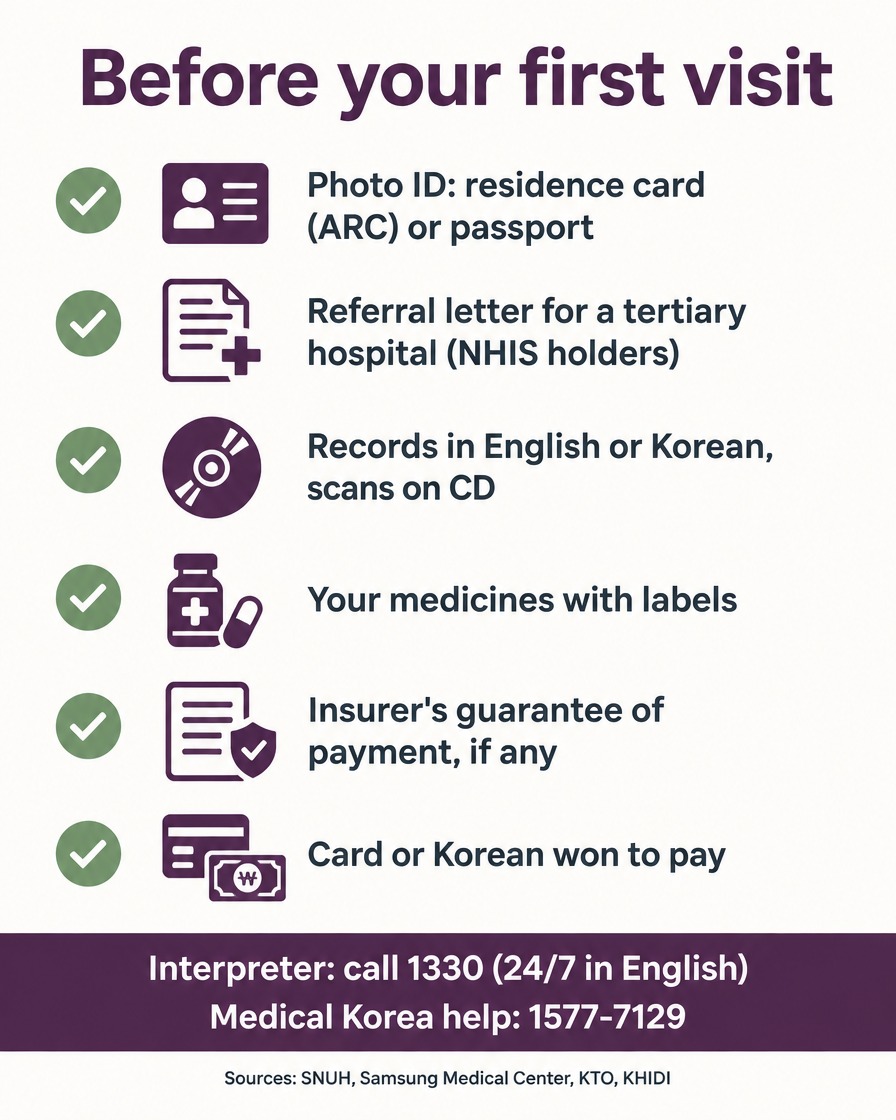
- Photo ID. Since 20 May 2024, patients must show ID for NHIS coverage, says the Seoul Metropolitan Government, citing MOHW. A residence card, passport or mobile NHIS card is accepted. Photos or copies of an ID are not. The rule doesn’t apply to patients under 19, to return visits within six months of an ID check, or to pharmacies. Without NHIS, SNUH still asks first-time visitors for an ARC or passport.
- A referral letter if you have NHIS and are going to a tertiary hospital, made out for the right department.
- Medical records and scans. SNUH accepts reports in Korean or English only. Samsung Medical Center asks for records from the past 3 months. Scans usually come on CD.
- Your medicines, with their labels or prescriptions (Samsung Medical Center). Korean pharmacies can’t fill a foreign prescription, says Asan’s FAQ, so you’ll need a Korean doctor’s prescription. Our guide to bringing medicine into Korea covers what you can carry in.
- Insurance papers: a GOP letter, or your policy details for a pay-and-claim.
- A way to pay. Samsung Medical Center takes Korean won only. SNUH takes cash or card, and card payments can be in won or US dollars.
- Requests for paperwork, made during the consultation. Both SNUH and Samsung Medical Center say a medical certificate has to be requested from the doctor at the visit. SNUH also issues English and itemised receipts for insurance claims.
Common problems
- “The hospital said NHIS doesn’t apply.” At a tertiary hospital this usually means you have no referral letter, or your letter names a different department. Get a letter from a clinic, or ask for family medicine where that’s allowed.
- “The NHIS phone line is only in Korean.” SNUH’s NHIS booking line (1588-5700) is Korean-only. Ask a Korean-speaking friend, book on the website, or call 1330 for an interpreter.
- “My bill was much higher than my Korean colleague’s.” If you’re not in NHIS yet, that’s expected. If you are enrolled, check that the hospital has your registration number and that your premiums are up to date. Our NHIS guide covers both.
- “My travel insurer won’t pay the hospital directly.” Severance notes that many outpatients pay first and claim later. Ask for English and itemised receipts before you leave.
- “I just landed and don’t know where anything is.” Our first-90-days guide for living in Korea covers registration, phone, bank and health insurance in order.
Itchy, cracked skin this winter? See Dry skin and eczema in Korea’s winter for KMA humidity data, when to see a dermatologist, what NHIS covers and what a first visit costs.
Hurt yourself on an icy pavement? See slipped on ice in Korea: orthopedic clinic or ER, and what X-rays and casts cost.
FAQ
Q. Where can I see an English-speaking doctor in Korea?
Large university hospitals such as Seoul National University Hospital, Severance, Samsung Medical Center and Asan Medical Center run international healthcare centres with English-speaking staff. KHIDI’s Medical Korea site lists more hospitals with international centres around the country. For everyday illness, many local clinics also have English-speaking doctors, and they cost less.
Q. Do I need a referral letter to see a doctor at a big Korean hospital?
If you use national health insurance at a tertiary hospital, yes, for most departments. Without a referral letter (요양급여의뢰서) you can still be seen, but you pay 100% of the NHIS fee. Exceptions include emergencies, childbirth and family medicine. Patients without NHIS pay the full bill either way.
Q. How much does a first doctor visit cost in Korea with NHIS?
At a local clinic an NHIS member pays 30% of the covered cost. In 2026 the clinic first-visit consultation fee is ₩18,840, so the patient share for the consultation alone is about ₩5,600 by our calculation. Tests and medicines are extra. MOHW has decided to raise the clinic fee from January 2027, and trade press put it at ₩21,210.
Q. How much does it cost without Korean health insurance?
You pay the whole bill. KHIDI says hospitals set their own prices for care NHIS doesn’t cover, and some charge foreign patients without NHIS more than the standard fee. Ask the international centre for an estimate before treatment and keep English, itemised receipts for your travel insurer.
Q. Is there a free interpreter for a doctor’s visit in Korea?
Yes. The 1330 Korea Travel Helpline offers interpreting 24 hours a day in English, Japanese and Chinese, and in Russian, Vietnamese, Thai and Malay from 08:00 to 19:00. The Medical Korea Information Center (1577-7129) also helps foreign patients in English, Chinese, Japanese and Russian. Hospital international centres have their own interpreters.
Q. Should I go to a university hospital for a cold or flu?
Usually not. A tertiary hospital charges 100% of the covered cost for listed mild conditions such as the common cold, even with NHIS. A local internal medicine, ENT or family medicine clinic is the usual first stop. At night or on holidays, use a late-night pharmacy or a holiday clinic, and call 119 for emergency symptoms.
General information, not medical advice. This guide explains how to get care in Korea. It does not tell you what care you need. Hospital phone numbers, hours and fees change, so confirm with the hospital before your visit. For insurance questions call NHIS (1577-1000, English consultant 033-811-2000). In an emergency call 119.
Sources
- Seoul National University Hospital, referral letter (요양급여의뢰서) rules and FAQ (Korean): https://www.snuh.org/content/M002005001.do
- SNUH Global, appointments (NHIS holders, referral, 1588-5700, hours): https://www.snuh.org/global/en/patients/appointmentMain.do
- SNUH Global, contacts and outpatient process (ID, records, payment, receipts): https://snuh.org/global/en/patients/EN02004.do and https://www.snuh.org/global/en/patients/EN02003001.do
- SNUH International Healthcare Center guide (Korean; NHIS members booked to family medicine): https://www.snuh.org/asset/layer/layerInter.html
- Severance Hospital, Contact Us, Appointment Guide, Treatment Appointment and Billing & Insurance pages: https://severance.healthcare/sev-en/patients/contact.do, https://sev-eye.severance.healthcare/sev-en/ihc/appointment-guide.do, https://severance.healthcare/sev-en/appointment/status-treatment.do, https://www.severance.healthcare/sev-en/ihc/billing.do, https://www.severance.healthcare/sev-en/ihc/overview.do
- Samsung Medical Center, International Services & Contact Info and IHC Outpatient Services: https://www.samsunghospital.com/en/patient-guide/contact.do, https://www.samsunghospital.com/en/international-healthcare-center/outpatient-services.do
- Asan Medical Center, Patients & Services FAQ and International Healthcare Services: https://eng.amc.seoul.kr/gb/lang/patients/faq/langPatientsFaqList.do, https://eng.amc.seoul.kr/gb/lang.patients.contents.remote_en.sp
- HIRA, outpatient co-payment rates (외래진료시 본인부담률): https://www.hira.or.kr/dummy.do?pgmid=HIRAA030056020110
- NHIS English, Insurance Benefits (co-payment table, English consultant line): https://www.nhis.or.kr/english/wbheaa02600m01.do
- MOHW, 28 October 2026 Health Insurance Policy Deliberation Committee (fee reform from January 2027, clinic first-visit fee rise): https://www.mohw.go.kr/gallery.es?act=view&bid=0003&list_no=380564&mid=a10505000000
- Yonhap, 25 June 2026, health insurance fee overhaul (₩18,840 and ₩21,440): https://www.yna.co.kr/view/AKR20260625018151530
- Money Today, 25 June 2026: https://www.mt.co.kr/thebio/2026/06/25/2026062510502196029
- Hit News, 28 October 2026 (clinic first visit ₩21,210 from January 2027): https://www.hitnews.co.kr/news/articleView.html?idxno=80300
- Doctors News (KMA), October 2026: https://www.doctorsnews.co.kr/news/articleView.html?idxno=166987
- Seoul Shinmun (Seoul Pn), 30 September 2020, 100 mild conditions at tertiary hospitals: https://go.seoul.co.kr/news/newsView.php?id=20200930010005
- KHIDI Medical Korea, foreign patient fee FAQ (Korean): https://www.medicalkorea.or.kr/korp/notice/faqView.do?faqSn=42
- KHIDI, Medical Korea Information Center leaflet (Seoul Station, Incheon T1, 1577-7129): https://www.khidi.or.kr/kohes/fileDownload?fileDownType=C&fileId=2¶mMenuId=MENU02458&titleId=511944
- Medical Korea, hospitals with international healthcare centres: https://www.medicalkorea.or.kr/en/mostvisitedmedicalinstitutions
- Korea Biomedical Review, Medical Korea Support Center moves to Seoul Station: https://www.koreabiomed.com/news/articleView.html?idxno=26391
- Korea Tourism Organization, 1330 Korea Travel Helpline: https://english1.visitkorea.or.kr/enu/TRV/TV_ENG_3_1.jsp
- GOV.UK, South Korea travel advice, Getting help: https://www.gov.uk/foreign-travel-advice/south-korea/getting-help
- Seoul Metropolitan Government, ID required at hospitals from 20 May 2024: https://english.seoul.go.kr/dont-forget-to-bring-your-id-to-hospitals-and-clinics-starting-from-may-20-2024/
- KDCA, sentinel surveillance weekly bulletin, week 45 of 2026: https://dportal.kdca.go.kr/pot/bbs/BD_selectBbs.do?q_bbsDocNo=20261112163809554&q_bbsSn=1010&q_clsfNo=2
- Newsis, 13 November 2026 (week-45 flu figures): https://www.newsis.com/view/NISX20261113_0003866616
- OhmyNews, opinion by an occupational-medicine physician on “international fees” (국제수가): https://www.ohmynews.com/NWS_Web/View/at_pg.aspx?CNTN_CD=A0003071421
How we checked: On 16 November 2026 (KST) we read the four hospitals’ international-patient pages, the HIRA and NHIS co-payment pages, the MOHW 28 October announcement, the KTO 1330 page, the KHIDI leaflet and FAQ and the KDCA week-45 bulletin in full. We matched each rule or figure against a second source (another hospital, Yonhap, Money Today, Hit News, Doctors News, Seoul Shinmun, Korea Biomedical Review, GOV.UK or Newsis). Hospital hours and languages are as each hospital publishes them. Severance’s and Samsung Medical Center’s pages we read did not give hours, so we left them out. The worked examples are our own arithmetic, and the ₩100,000 test bill is hypothetical.
Researched and drafted with AI assistance; checked against the sources listed.


3 Comments