Blood Pressure Ranges Explained: US, UK, WHO and Korea, Agency by Agency
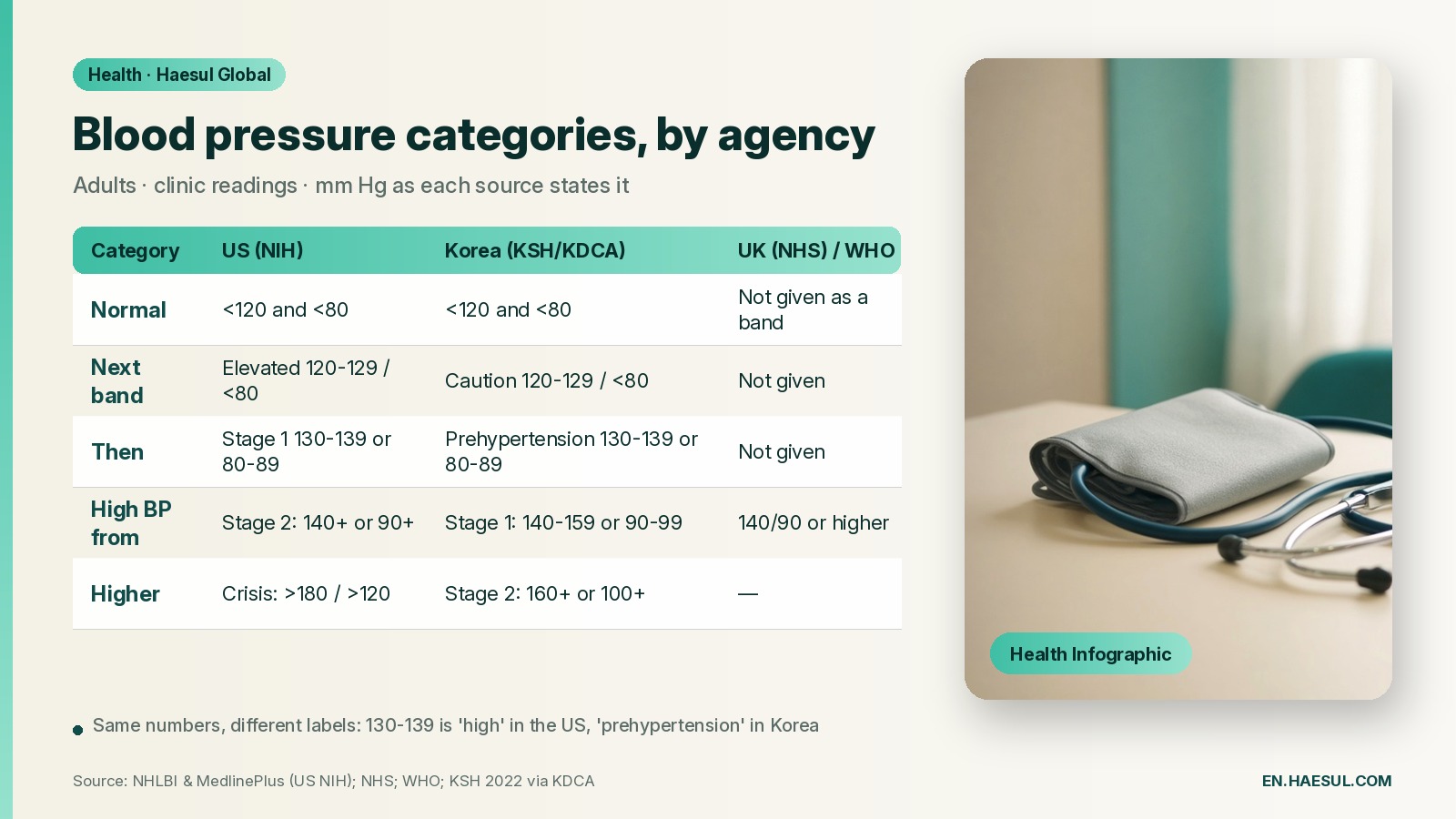
Quick answer: Every source here agrees that a normal adult reading is below 120/80 mm Hg (where they define “normal”), and that 140/90 or more is high. They disagree about the band in between. US guidance from the National Institutes of Health (NIH) calls 130–139 systolic or 80–89 diastolic “high blood pressure stage 1”. The UK’s NHS, the World Health Organization (WHO) and Korea’s guideline only call it hypertension from 140/90. Korea labels 130–139 / 80–89 as “prehypertension”. This guide gives each agency’s categories exactly as published. It doesn’t merge them.
How to read the two numbers
A reading such as 120/80 has two parts. The first number is systolic pressure, the pressure in your arteries when the heart beats. The second is diastolic pressure, the pressure between beats (MedlinePlus; WHO). Blood pressure is measured in millimetres of mercury (mm Hg). Blood pressure has no second unit to convert between, unlike cholesterol (mg/dL and mmol/L).
The categories, source by source
All figures are clinic readings for adults, in mm Hg.
| Category | US: NHLBI / MedlinePlus (NIH) | Korea: Korean Society of Hypertension 2022 (used by KDCA) |
|---|---|---|
| Normal | Under 120 and under 80 | Under 120 and under 80 (“normal”) |
| Next band | 120–129 and under 80 (“elevated”) | 120–129 and under 80 (“caution”, 주의혈압) |
| Next band | 130–139 or 80–89 (“high blood pressure stage 1”) | 130–139 or 80–89 (“prehypertension”, 고혈압전단계) |
| Higher | 140 or higher or 90 or higher (“stage 2”) | 140–159 or 90–99 (“hypertension stage 1”) |
| Highest | Above 180 and/or above 120 (“hypertensive crisis”, seek care right away) | 160 or higher or 100 or higher (“hypertension stage 2”) |
| Other | — | 140 or higher and under 90: “isolated systolic hypertension” |
Sources: NHLBI – High Blood Pressure: Diagnosis, MedlinePlus – High Blood Pressure, Korean Society of Hypertension – 2022 Hypertension Guideline, Table 1, KDCA National Health Information Portal – Hypertension.
The UK and WHO give a single threshold rather than a full ladder:
| Source | High blood pressure if |
|---|---|
| NHS (UK) | 140/90 or higher when checked by a healthcare professional; 135/85 or higher when checked at home |
| WHO | Systolic 140 or higher and/or diastolic 90 or higher, measured on two different days |
Sources: NHS – Blood pressure test, NHS – High blood pressure, WHO – Hypertension fact sheet.
At the low end, the NHS defines low blood pressure as a reading below 90/60 (NHS – Low blood pressure).
One small wording difference: for “hypertensive crisis”, the NHLBI says systolic above 180 or diastolic above 120, while the MedlinePlus table says above 180 and above 120. Both are NIH pages. WHO says very high blood pressure is “usually 180/120 or higher” and can cause symptoms such as severe headaches and chest pain.
Why the US line is 130/80 and the others use 140/90
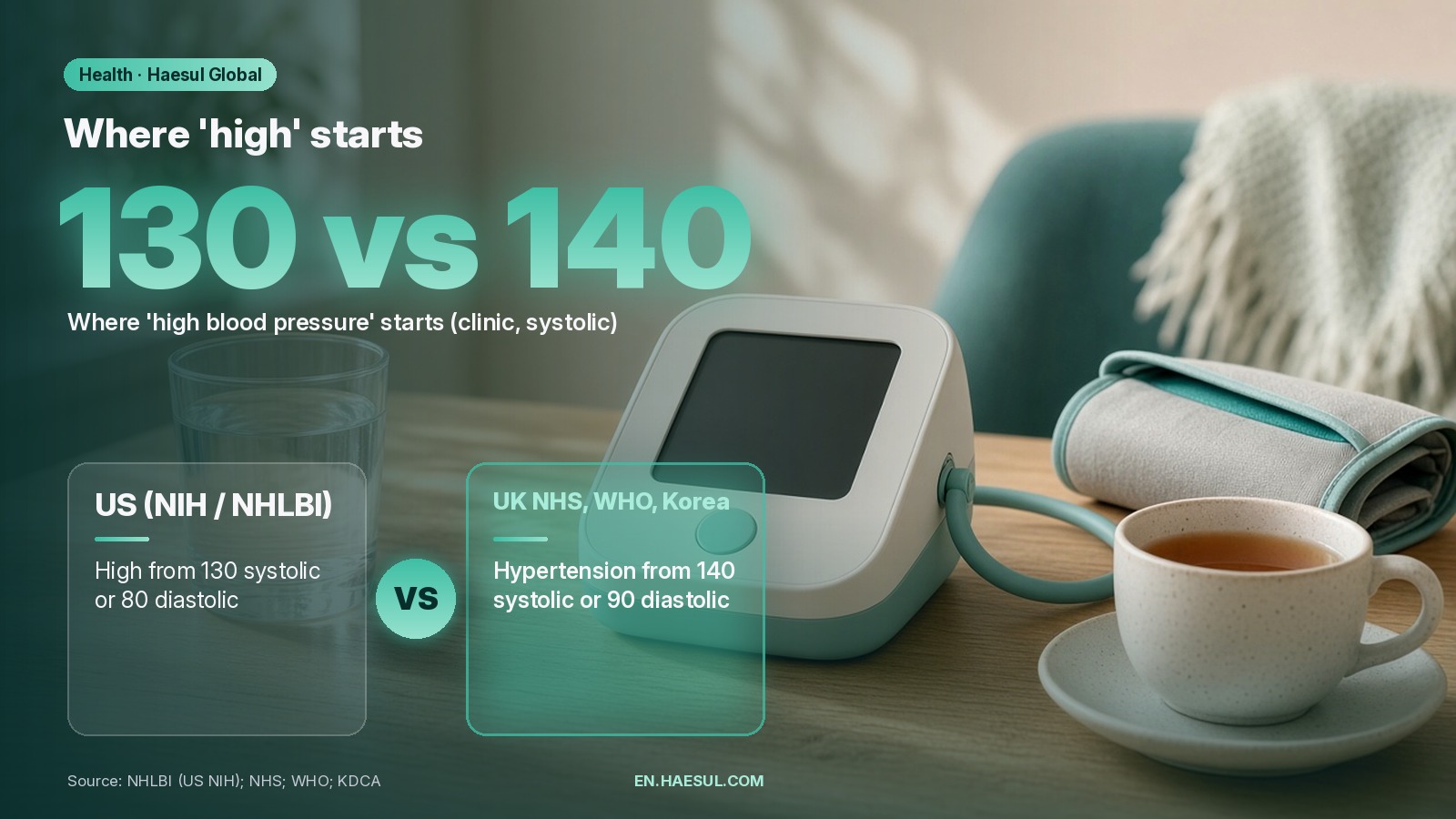
- The same numbers carry different labels. A reading of 134/84 is “stage 1 high blood pressure” on the NIH pages and “prehypertension” in Korea. The UK NHS and WHO pages put it below their hypertension threshold. The ranges match. Only the label changes.
- The sources explain their own lines. Korea’s guideline says it defines hypertension as the level above which drug treatment has proven benefit in rigorous randomized trials, which it currently puts at 140/90. It classifies lower ranges by epidemiological risk, where lifestyle measures apply. The NHLBI says research has shown that systolic pressure above 120 can harm health over time, including organ damage.
- Treatment goals are a separate question from diagnosis. WHO says the goal for most people is under 140/90, and under 130/80 for people with heart disease or stroke, diabetes, chronic kidney disease or high cardiovascular risk. KDCA gives a similar split: under 140/90 as the basic goal for most patients, and under 130/80 for high-risk patients, including some with diabetes or organ damage.
Clinic readings vs home readings
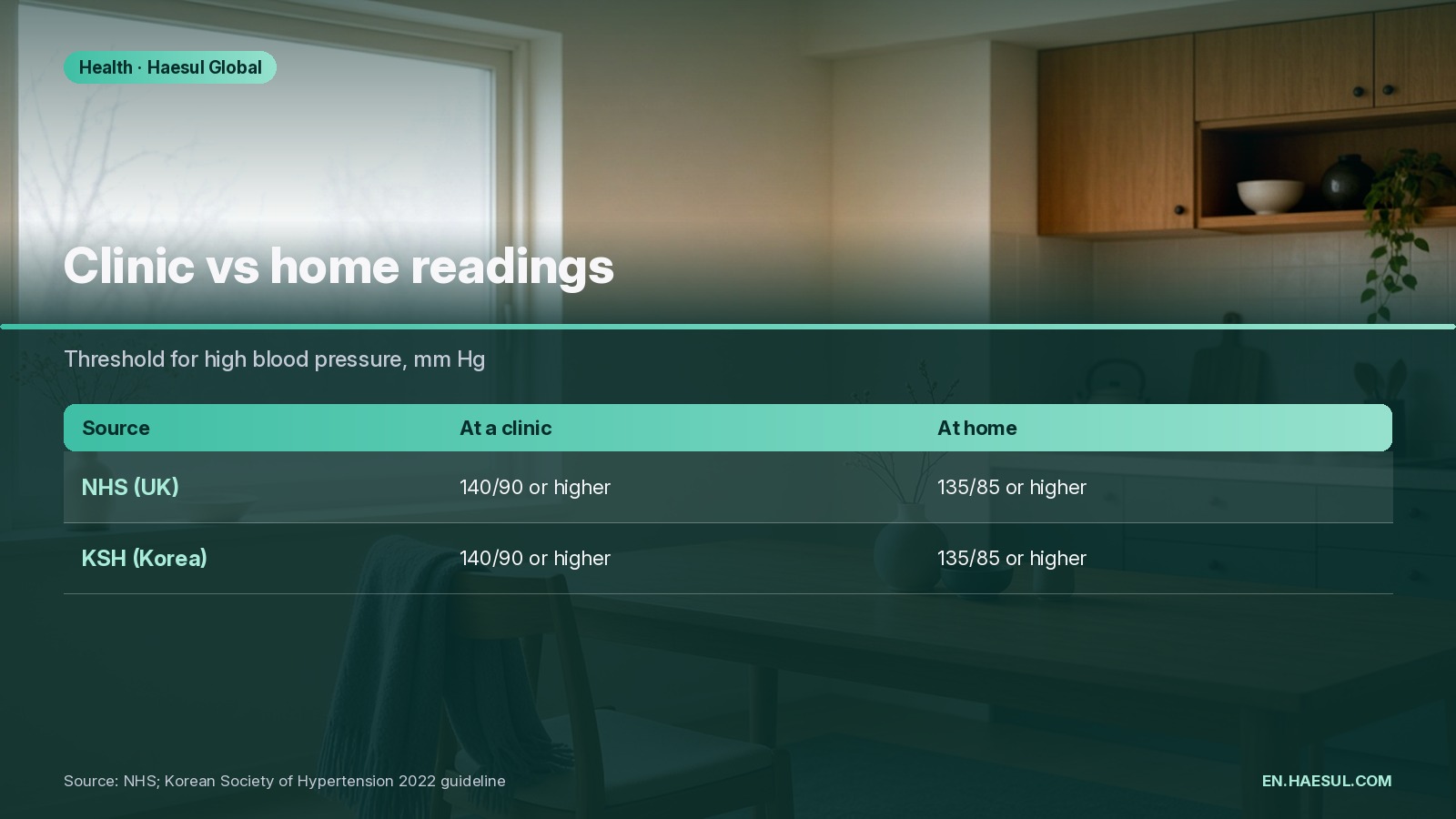
Home readings are usually lower than clinic readings, so the home threshold is lower too. The NHS and Korea’s 2022 guideline both use 135/85 or higher at home, compared with 140/90 at a clinic. Korea’s guideline also lists a 24-hour average of 130/80 or higher as its threshold for ambulatory monitoring. KDCA notes that some people only have high readings in the clinic (“white-coat hypertension”) and others only have high readings outside it (“masked hypertension”). Home and 24-hour readings help tell these apart.
A single high reading isn’t a diagnosis. MedlinePlus says providers take two or more readings at separate appointments, and WHO describes high readings on two different days.
Children
MedlinePlus and the NHLBI say children’s readings are compared with typical readings for children of the same age, sex and height. The adult numbers above don’t apply to children.
FAQ
Is 130/80 high blood pressure?
On US NIH pages, yes: 130–139 or 80–89 is stage 1. Under the NHS, WHO and Korea’s thresholds it is below the line for hypertension. Korea calls it “prehypertension”.
What is a normal blood pressure?
The NIH pages and Korea’s guideline both define normal as under 120 systolic and under 80 diastolic.
What counts as high on a home monitor?
The NHS and Korea’s guideline both use 135/85 or higher for home readings.
Which numbers should I follow?
Ask the doctor or service where you are treated. Their thresholds and your personal targets are what count for you.
Not medical advice. This article summarises public information from health agencies for general reading. It isn’t a diagnosis or a treatment recommendation. Ask a doctor about your own readings and targets, and get urgent help for very high readings with symptoms such as chest pain or severe headache.
Sources
- NHLBI (US NIH), “High Blood Pressure – Diagnosis”, accessed Oct 15, 2026: https://www.nhlbi.nih.gov/health/high-blood-pressure/diagnosis
- MedlinePlus (US National Library of Medicine), “High Blood Pressure”, accessed Oct 15, 2026: https://medlineplus.gov/highbloodpressure.html
- NHS (UK), “Blood pressure test”, last reviewed Nov 25, 2025, accessed Oct 15, 2026: https://www.nhs.uk/conditions/blood-pressure-test/
- NHS (UK), “High blood pressure (hypertension)”, last reviewed Jul 19, 2024, accessed Oct 15, 2026: https://www.nhs.uk/conditions/high-blood-pressure-hypertension/
- NHS (UK), “Low blood pressure (hypotension)”, last reviewed Jul 11, 2023, accessed Oct 15, 2026: https://www.nhs.uk/conditions/low-blood-pressure-hypotension/
- WHO, “Hypertension” fact sheet, accessed Oct 15, 2026: https://www.who.int/news-room/fact-sheets/detail/hypertension
- Korean Society of Hypertension, 2022 Hypertension Guideline (5th ed.), Table 1 and out-of-office BP sections, accessed Oct 15, 2026: https://www.koreanhypertension.org/reference/guide?mode=read&idno=10081
- KDCA National Health Information Portal, “고혈압 (Hypertension)”, updated Apr 27, 2026, accessed Oct 15, 2026: https://health.kdca.go.kr/healthinfo/biz/health/gnrlzHealthInfo/gnrlzHealthInfo/gnrlzHealthInfoView.do?cntnts_sn=6765