Vision and Hearing Tests on Korea’s Checkup: What Your Eye-Chart Figure and a Hearing “Refer” Mean, and What to Do Next
Haesul Health desk (AI-assisted). As of 13 November 2026 (KST). Based on the National Health Insurance Service (NHIS) general checkup guide, the Ministry of Health and Welfare (MOHW) checkup implementation standards (Annex 1, test methods, and Annex 4, result criteria) published on the National Law Information Center (law.go.kr), and the Korea Disease Control and Prevention Agency (KDCA) National Health Information Portal pages on the national checkup, presbyopia, glaucoma, age-related hearing loss and eye health by age. Independent cross-checks: the World Health Organization (WHO) fact sheets on hearing loss and vision impairment and Asan Medical Center’s ophthalmology department. This is general information, not medical advice.
Quick answer: Every Korean general health checkup includes a vision test and a hearing test. Vision is measured on a registered eye chart (a screen chart counts), and if you wear glasses or contact lenses the sheet marks it as “corrected”. The official result criteria give no pass or fail line for vision: your sheet shows the measured figure for each eye. Hearing is tested with a pure-tone test, and a result under 40 dB is a pass; 40 dB or more means possible hearing loss and you are referred for a detailed test. From 66, the clinic may use a whisper test instead: repeating at least 3 of 6 whispered numbers in each ear is normal. A pass is not a clean bill of health, because the checkup line is set well above the level doctors call normal hearing, and an eye-chart score cannot see glaucoma. If you have noticed changes, see an eye or ear, nose and throat (ENT) clinic.
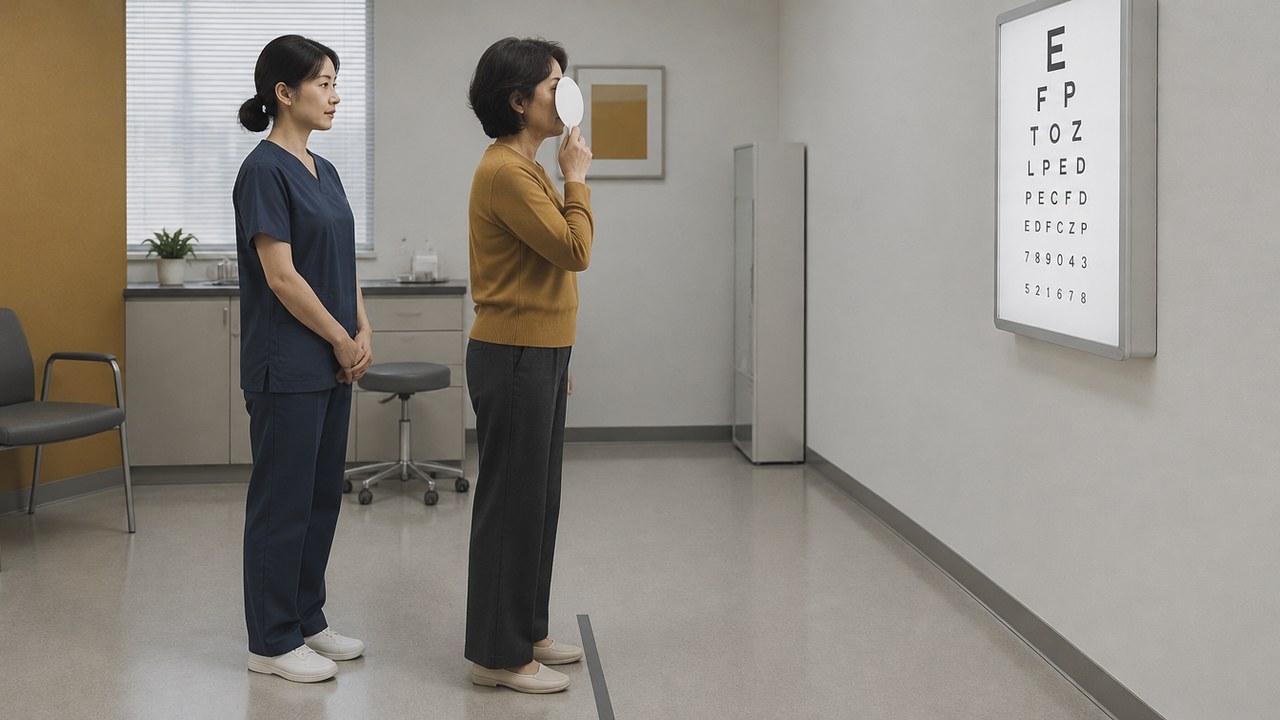
Of all the items on a Korean checkup result sheet, vision and hearing are the two people skim past. There is no blood involved, the test takes a minute, and the result is often just two numbers and the word “normal”. Yet for people in their forties, fifties and sixties these are exactly the senses that start to change, often so slowly that you only notice when someone else does. This guide explains what each test measures, how the result is graded, what the result cannot tell you and what to do next. If you still have not had your 2026 checkup, the window closes on 31 December, 48 days from 13 November.
Who gets the tests and how they are done
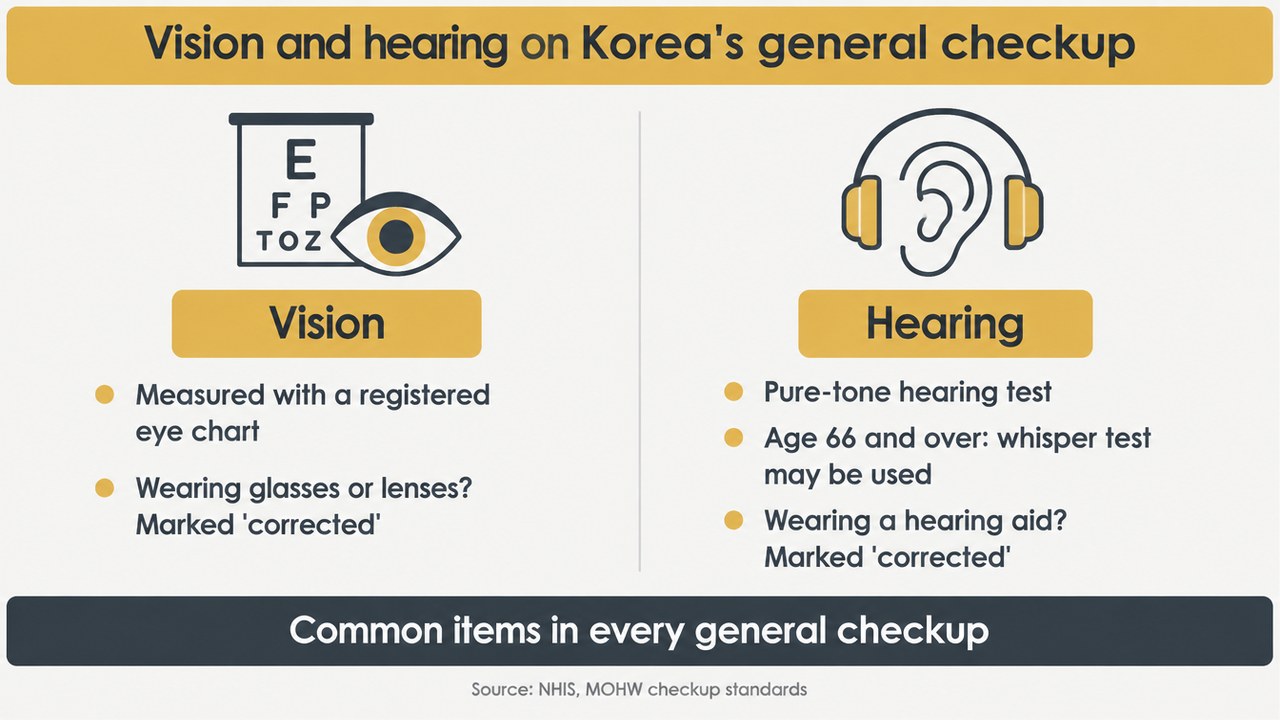
The NHIS general checkup guide lists “vision and hearing tests” among the common items that every general checkup includes, together with the doctor’s consultation, height, weight, waist, blood pressure, the chest X-ray, the basic blood panel, the urine test and the oral exam. The KDCA checkup page gives the same list. The checkup is free: NHIS pays the full cost, and for medical-aid recipients the state and local governments do. Workers in office jobs and household members are usually invited every two years, and workers in non-office jobs every year.
MOHW’s implementation standards (Annex 1) set the method for both tests:
| Test (MOHW Annex 1) | How it is done | What the sheet records |
|---|---|---|
| Vision | An eye chart registered as a medical device, including a screen-based chart | A figure for each eye; “corrected” if you wore glasses or lenses |
| Hearing | Pure-tone hearing test; from age 66 a whisper test may be used instead | Pass or refer for each ear; “corrected” if you wore a hearing aid |
For people aged 66 and over on medical aid, the separate “life-transition” checkup (의료급여생애전환기검진) also includes vision and hearing tests among its common items, NHIS and KDCA say.
How the vision result works
Korean eye charts express sharpness of sight as a decimal figure. The higher the number, the smaller the letters you could read at the set distance. KDCA’s own health pages use the same decimal scale: its presbyopia page, for example, defines the condition in one study as distance vision of 0.5 or better with near vision of 0.4 or worse.
The key point is in Annex 4, the official result criteria. It sets judgement lines for blood pressure, blood sugar, cholesterol, liver and kidney tests, bone density, the physical function test, depression and cognitive screening, and hearing. It sets none for vision. So the checkup does not label your eyesight “normal” or “disease suspected” in the way it labels your blood pressure. The doctor may comment, but the figure is information for you to act on.
Three practical ways to read your figures:
- A clear drop since your last checkup, or a big difference between the two eyes, is worth an eye-clinic visit even if nothing is flagged.
- “Corrected” means the figure was measured with your glasses or lenses on. If your corrected figure has fallen, your prescription may be out of date, or something else may be going on.
- Near vision is not tested. The checkup chart is a distance test. Difficulty reading a phone or a menu is the classic sign of presbyopia and will not show up in the figure.
What a normal eye-chart score cannot tell you
KDCA’s eye-health advice by age says people in their forties and fifties usually begin to experience presbyopia and cataract. For people 60 and over it names the three major causes of blindness: age-related macular degeneration, glaucoma and diabetic retinopathy. It says the Korean Ophthalmological Society recommends a fundus examination, a photograph of the back of the eye, and advises older people to have one once a year.
Glaucoma is the clearest example of why an eye chart is not enough. KDCA’s glaucoma page says it often causes no noticeable symptoms until the late stage, and that damaged optic nerve does not recover, which makes early diagnosis the most important way to prevent blindness. It lists people aged 40 and over, people with a family history, and people with diabetes or cardiovascular disease among those who need regular checks. Asan Medical Center’s ophthalmology department gives a matching rule of thumb: a comprehensive eye examination at 40, then every two to four years, and every one to two years as you get older, earlier if glaucoma runs in the family.
None of those examinations are part of the general checkup. A good figure on your result sheet tells you that you can read the chart, not that the optic nerve or retina is healthy.
How the hearing result is graded
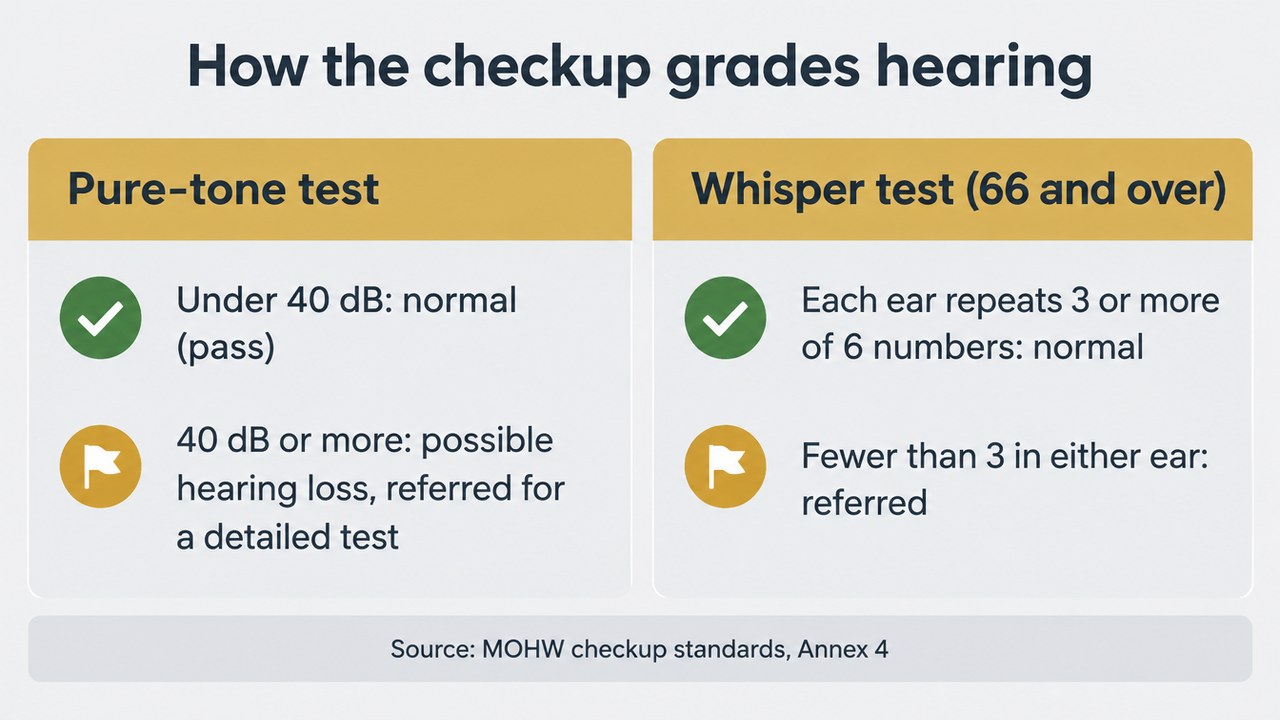
Annex 4 sets out the hearing criteria in a small table:
| Hearing test (MOHW Annex 4) | Normal (pass) | Disease suspected (refer) |
|---|---|---|
| Pure-tone test | Under 40 dB | 40 dB or more: possible hearing loss, referred for a detailed test |
| Whisper test (66 and over) | Each ear correctly repeats at least 3 of 6 whispered numbers | Fewer than 3 in either ear: possible hearing loss, referred |
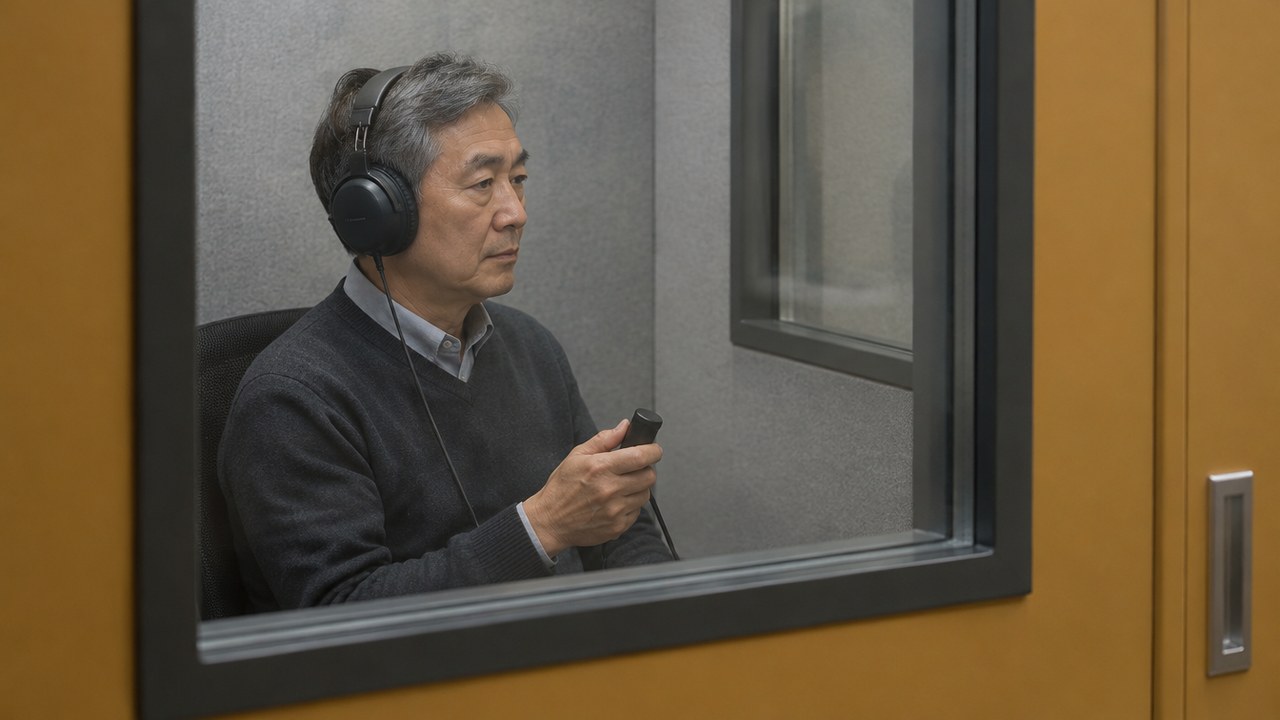
The decibel figure is the quietest sound you can hear. KDCA’s page on age-related hearing loss explains it: a threshold of 60 dB means you cannot hear anything quieter than 60 dB. Normal speech is around 65 dB, it says, so a threshold of 40 dB or better is needed to follow conversation without difficulty.
Why a “pass” is not the same as normal hearing
Here the checkup line and the clinical definitions differ, and it is worth knowing why. In KDCA’s description of a full hearing test, an average threshold of 25 dB or better counts as normal. WHO uses an even stricter line: hearing thresholds of 20 dB or better in both ears. Annex 4’s 40 dB pass line is a screening threshold set to catch hearing loss that already affects conversation. A pass can therefore still mean mild hearing loss.
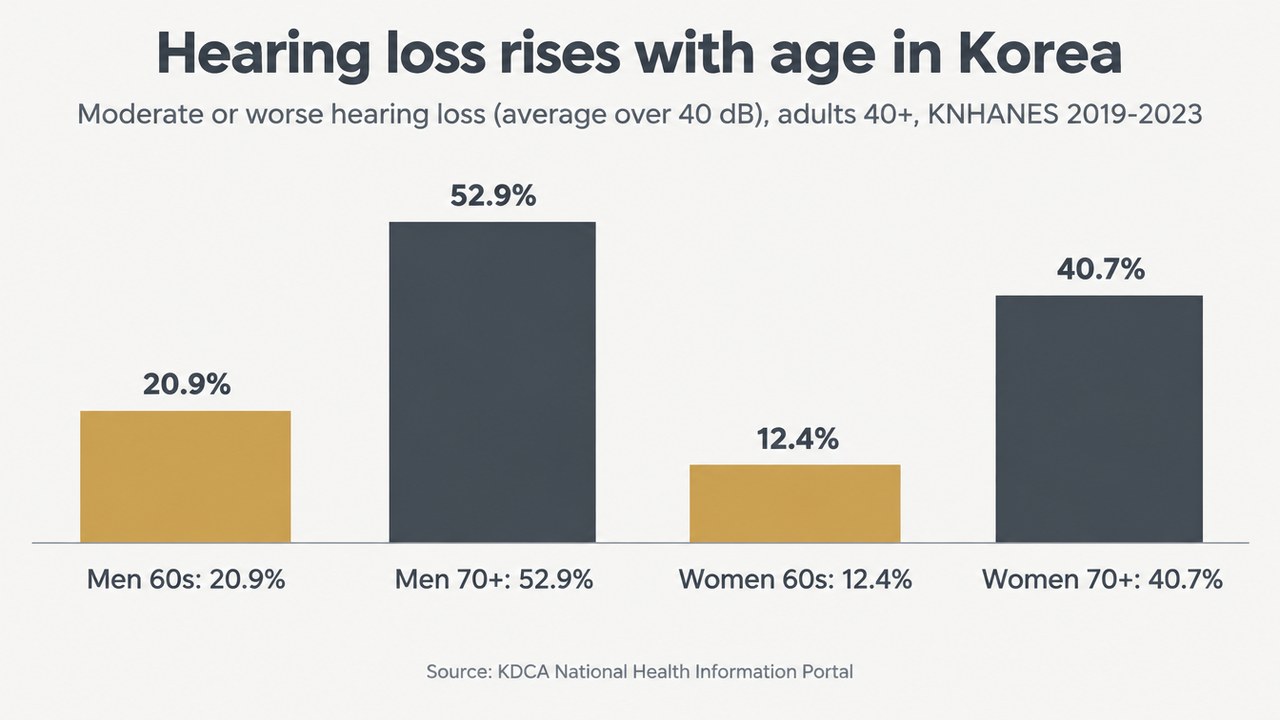
The numbers for Korea show how common that is. KDCA cites the Korea National Health and Nutrition Examination Survey for 2019 to 2023: among adults over 40, moderate or worse hearing loss (an average above 40 dB) affected 20.9% of men in their sixties and 52.9% of men aged 70 and over, and 12.4% of women in their sixties and 40.7% of women aged 70 and over. Using the milder 25 dB line, about 48% of men in their sixties and 31% of women in their sixties had some hearing loss. WHO reports that among people over 60 worldwide, more than 25% have disabling hearing loss.
Why bother with mild loss? KDCA says moderate hearing loss is the point at which hearing rehabilitation should start, because daily life becomes difficult. WHO lists social isolation, loneliness and an increased risk of dementia and faster cognitive decline among the effects of hearing loss that is not addressed. If you are 66 or over, the same checkup includes a cognitive screen; our cognitive test guide explains it.

Worked result sheets (illustrative)
These are examples, not real results, to show how the rules apply.
Example 1: a 48-year-old office worker. Vision 1.0 and 0.9, “corrected”. Hearing: both ears normal. Nothing is flagged. But she has started holding her phone further away to read it. That is consistent with what KDCA describes as presbyopia, which begins in the early forties. It is not measured by the checkup, so an eye-clinic visit for reading glasses, and a first full eye examination around 40 as Asan Medical Center suggests, is the next step.
Example 2: a 57-year-old factory worker. Vision unremarkable. Hearing: right ear normal, left ear “disease suspected” on the pure-tone test. One ear at 40 dB or more is enough to be referred. The next step is an ENT clinic for a full pure-tone and speech hearing test, especially with a history of workplace noise, which WHO lists as a common preventable cause.
Example 3: a 70-year-old checked with the whisper test. She repeated 4 of 6 numbers in the right ear and 2 of 6 in the left. Fewer than 3 in either ear means referral. Her family has also noticed that she turns the television up. An ENT assessment is the next step, and she should mention it at her cognitive screening as well.
What to do next
- Hearing “refer” (disease suspected): book an ENT clinic (이비인후과). KDCA says diagnosis starts with an examination of the ear canal and eardrum, then a pure-tone test and a speech test in a sound-proof booth. Earwax can lower a screening result, and an ENT can check for it.
- Sudden hearing loss in one ear, with or without ringing or dizziness, should not wait for a booked appointment. Get seen promptly.
- Vision figures falling or unequal: see an eye clinic (안과). Ask about a fundus examination and eye-pressure test if you are over 40, have diabetes or high blood pressure, or have glaucoma in the family.
- Diabetes or high blood pressure: KDCA notes that these raise the risk of retinal complications. Our blood pressure guide explains the checkup’s 140/90 line.
- Cost: the free follow-up test that comes with a general checkup covers only suspected high blood pressure, diabetes and pulmonary tuberculosis, according to NHIS. Eye and ENT visits are ordinary insured care with the usual co-payment.
- Driving: a licence renewal has its own eyesight check, separate from the checkup. See our driver’s licence renewal guide.
- Not had your checkup yet? Book it before 31 December. Our checkup-by-age guide lists what is added at each age, and the physical function test guide covers the balance and walking tests at 66, 70 and 80.
Related reading
- Korea’s national health checkup by age: what expats and foreign residents need to know
- Korea’s checkup physical function test at 66, 70 and 80
- Korea’s checkup cognitive test from 66: what the KDSQ-C score means
- Korea driver’s licence renewal in 2026: the 31 December deadline
Dry, gritty eyes this winter, pink eye or new glasses? See Eye doctor in Korea for when to see an eye clinic or an optician, and what a 2026 visit costs with NHIS.
Frequently asked questions
Q. Does everyone get a vision and hearing test on Korea’s national checkup?
Yes. NHIS lists vision and hearing tests among the common items of every general health checkup, whatever your age. The checkup is free, and for most people it is due every two years.
Q. What hearing result counts as normal on the checkup?
On the pure-tone test, a threshold under 40 dB is graded normal and 40 dB or more is “disease suspected”, meaning possible hearing loss and a referral for a detailed test. On the whisper test used from 66, repeating at least 3 of 6 numbers in each ear is normal.
Q. My hearing passed. Does that mean it is normal?
Not necessarily. The checkup pass line is 40 dB, while KDCA describes an average of 25 dB or better as normal in a full hearing test and WHO uses 20 dB. A pass rules out loss that clearly affects conversation, not mild loss.
Q. Is there a normal or abnormal line for the vision figure?
No. MOHW’s result criteria (Annex 4) set judgement lines for hearing but none for vision. Your sheet shows the figure for each eye, marked “corrected” if you wore glasses or lenses. A drop or a difference between the eyes is a reason to see an eye clinic.
Q. Can the checkup vision test find glaucoma or cataract?
No. It only measures how well you read a distance chart. KDCA says glaucoma often has no symptoms until late, and recommends fundus examinations for people over 60. Asan Medical Center suggests a full eye examination from 40.
Q. Is the follow-up hearing or eye test free?
No. The free follow-up attached to the general checkup covers only suspected high blood pressure, diabetes and pulmonary tuberculosis. ENT and eye-clinic visits are billed as ordinary insured care.
Not medical advice. Criteria are as published by NHIS, MOHW and KDCA on 13 November 2026. If you notice changes in your sight or hearing, see a doctor rather than waiting for your next checkup.
Sources
- National Health Insurance Service, general health checkup (targets, cycle and items, incl. vision and hearing): https://www.nhis.or.kr/nhis/policy/wbhada19700m01.do
- MOHW checkup implementation standards, Annex 1, test items and methods (law.go.kr): https://www.law.go.kr/LSW/flDownload.do?flSeq=160922447
- MOHW checkup implementation standards, Annex 4, result criteria incl. hearing (law.go.kr): https://www.law.go.kr/LSW/flDownload.do?flSeq=160922523
- KDCA National Health Information Portal, national health checkup: https://health.kdca.go.kr/healthinfo/biz/health/gnrlzHealthInfo/gnrlzHealthInfo/gnrlzHealthInfoView.do?cntnts_sn=6671
- KDCA, age-related hearing loss (thresholds, KNHANES 2019–2023 prevalence): https://health.kdca.go.kr/healthinfo/biz/health/gnrlzHealthInfo/gnrlzHealthInfo/gnrlzHealthInfoView.do?cntnts_sn=5489
- KDCA, presbyopia: https://health.kdca.go.kr/healthinfo/biz/health/gnrlzHealthInfo/gnrlzHealthInfo/gnrlzHealthInfoView.do?cntnts_sn=5226
- KDCA, glaucoma: https://health.kdca.go.kr/healthinfo/biz/health/gnrlzHealthInfo/gnrlzHealthInfo/gnrlzHealthInfoView.do?cntnts_sn=6690
- KDCA, eye health by age (monthly health information): https://health.kdca.go.kr/healthinfo/biz/health/ntcnInfo/healthSourc/thtimtCntnts/thtimtCntntsView.do?thtimt_cntnts_sn=31
- World Health Organization, deafness and hearing loss fact sheet (independent cross-check): https://www.who.int/news-room/fact-sheets/detail/deafness-and-hearing-loss
- World Health Organization, blindness and vision impairment fact sheet (independent cross-check): https://www.who.int/news-room/fact-sheets/detail/blindness-and-visual-impairment
- Asan Medical Center, ophthalmology: glaucoma clinic (independent cross-check): https://oph.amc.seoul.kr/asan/depts/oph/K/content.do?menuId=4226




One Comment