Norovirus in Korea’s Winter: Symptoms, How It Spreads, Cleaning and When to See a Doctor
Haesul Health desk (AI-assisted). As of 14 November 2026 (KST). Based on the Korea Disease Control and Prevention Agency (KDCA) weekly sentinel surveillance bulletin for week 45 of 2026 and its winter norovirus advisory of 8 December 2025, the Ministry of Food and Drug Safety (MFDS) oyster and food-poisoning guidance, the US Centers for Disease Control and Prevention (CDC), and Newsis reporting of 9 November 2026.
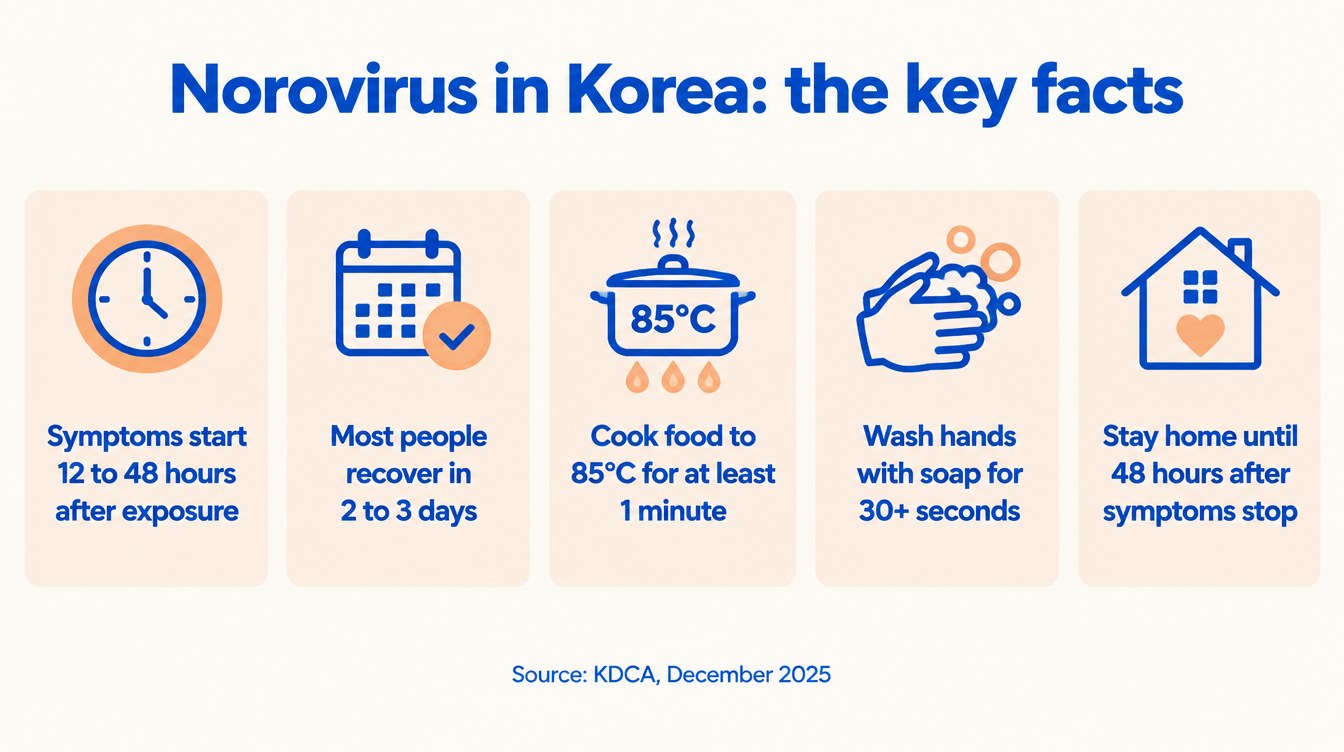
Quick answer: Norovirus (노로바이러스) is the winter “stomach bug” behind sudden vomiting and diarrhoea in Korea, and KDCA’s latest weekly bulletin says cases rose 17.1% in a week as the winter season begins. Symptoms start 12 to 48 hours after exposure and most people recover in 2 to 3 days. It spreads through raw or undercooked shellfish such as oysters, food handled by an infected person, and contaminated hands and surfaces at home. KDCA’s advice: wash hands with soap for at least 30 seconds, cook food to 85°C for at least 1 minute, clean with household bleach diluted 1 to 39, and stay away from work, school or daycare until 48 hours after symptoms stop. Watch closely for dehydration in babies, older people and anyone with a weak immune system.
This guide is written for foreigners living in or visiting Korea: what norovirus looks like, why winter is the season, what KDCA tells households to do, and how to get help through a clinic, a pharmacy or 119. It is general information, not medical advice.
What KDCA’s surveillance shows right now
KDCA runs sentinel surveillance of intestinal infections at about 210 hospitals. Its bulletin for week 45 of 2026, published on 12 November 2026, says:
- 536 patients with intestinal infections were reported, up from 520 the week before; 48.5% of cases were caused by viruses and 51.3% by bacteria.
- Among the virus-caused cases, norovirus was the largest share at 36.9%, ahead of group A rotavirus at 24.2%.
- Norovirus cases rose 17.1% from the previous week, and KDCA says continued monitoring is needed “in preparation for the winter epidemic”.
These are counts from sentinel hospitals, not every case in Korea; most people with norovirus never see a doctor.
The seasonal pattern is consistent. In its December 2025 advisory, KDCA said norovirus in Korea occurs mainly from winter to early spring (November to March), and that sentinel cases had risen from 70 in week 45 to 127 in week 48 of 2025, up 58.8% on the same week a year earlier. Newsis, reporting on 9 November 2026, cited KDCA surveillance showing that last season’s cases started rising in the first week of November and reached 617 a week in the third week of January, with 51.1% of patients aged 0 to 6.
Symptoms and how long it lasts
| What | KDCA | CDC (independent check) |
|---|---|---|
| Time from exposure to symptoms | 12 to 48 hours (incubation 10 to 50 hours) | 12 to 48 hours |
| Main symptoms | Vomiting, diarrhoea; sometimes stomach pain, chills, fever | Diarrhoea, vomiting, nausea, stomach pain; sometimes fever, headache, body aches |
| How long | Usually gets better on its own in 2 to 3 days | Most people get better in 1 to 3 days |
| Specific treatment | None; replace fluids and electrolytes | None; antibiotics do not help |
| Can you get it again? | Yes; many genotypes and immunity lasts up to about 18 months | Yes; one type may not protect against others |
Newsis, quoting a paediatrician, adds a point parents often miss: young children may have repeated, sudden vomiting without diarrhoea, so norovirus is worth suspecting even when there is no diarrhoea.
How it spreads in a Korean winter
Oysters and other shellfish
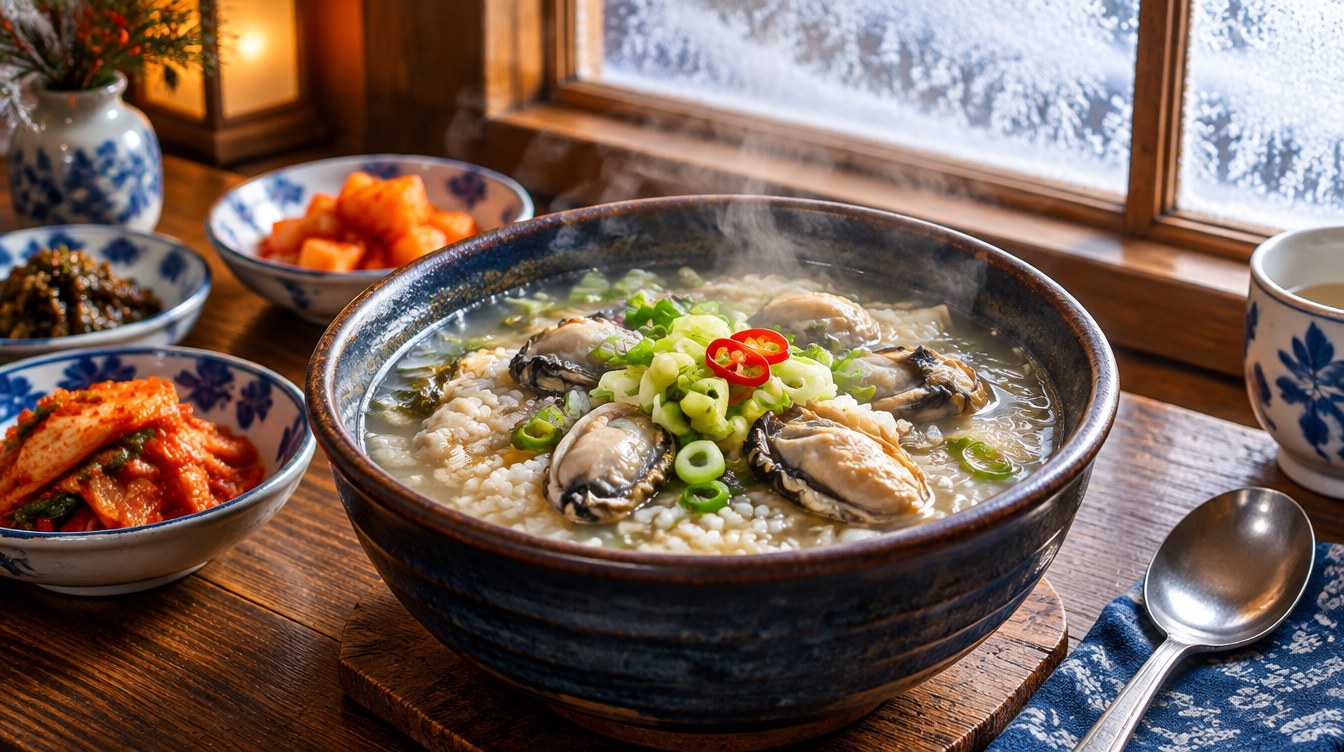
Winter is oyster season in Korea, and MFDS says the main food source of norovirus infection is raw or undercooked shellfish such as raw oysters. Its rule for shoppers is simple: if an oyster pack is labelled “for cooking” (가열조리용) or “cook before eating” (익혀 먹는), it must be heated to a core temperature of 85°C for at least 1 minute. MFDS recommends cooked dishes such as oyster rice soup (gulgukbap, 굴국밥) or oyster pancakes (guljeon, 굴전) in winter. CDC makes the same point: anyone who eats raw shellfish is at risk, quick steaming does not heat food enough, and contaminated food can look, smell and taste normal.
Shared food and group settings
MFDS analysed norovirus food poisoning from 2019 to 2023: 243 outbreaks with 4,279 patients, and 49% of outbreaks happened from December to February. The most common settings were group catering such as schools and daycare centres, followed by restaurants and then homes. Neither MFDS nor KDCA singles out buffets, but the mechanism is the same wherever many people share food or serving utensils: CDC lists eating food handled by an infected person as one of the main routes, and says a sick person should not prepare food for others until 48 hours after symptoms stop.
MFDS also warns about groundwater: water from a well or spring should be tested regularly and boiled if contamination is suspected, and KDCA’s rules say to drink boiled water. That matters for countryside guesthouses, campsites and mountain huts that use their own water.
Households
Norovirus is highly infectious. KDCA says a small amount of virus is enough to infect someone and that it can survive about three days in everyday environments. It spreads when someone touches a tap or door handle used by a patient and then touches their mouth, and through droplets from vomit. CDC adds that the virus can stay in stool for two weeks or more after a person feels better.
Cleaning up at home: KDCA’s bleach mix
KDCA’s household rules use ordinary Korean household bleach (락스), which it describes as 4% sodium hypochlorite.
| Job | KDCA instruction |
|---|---|
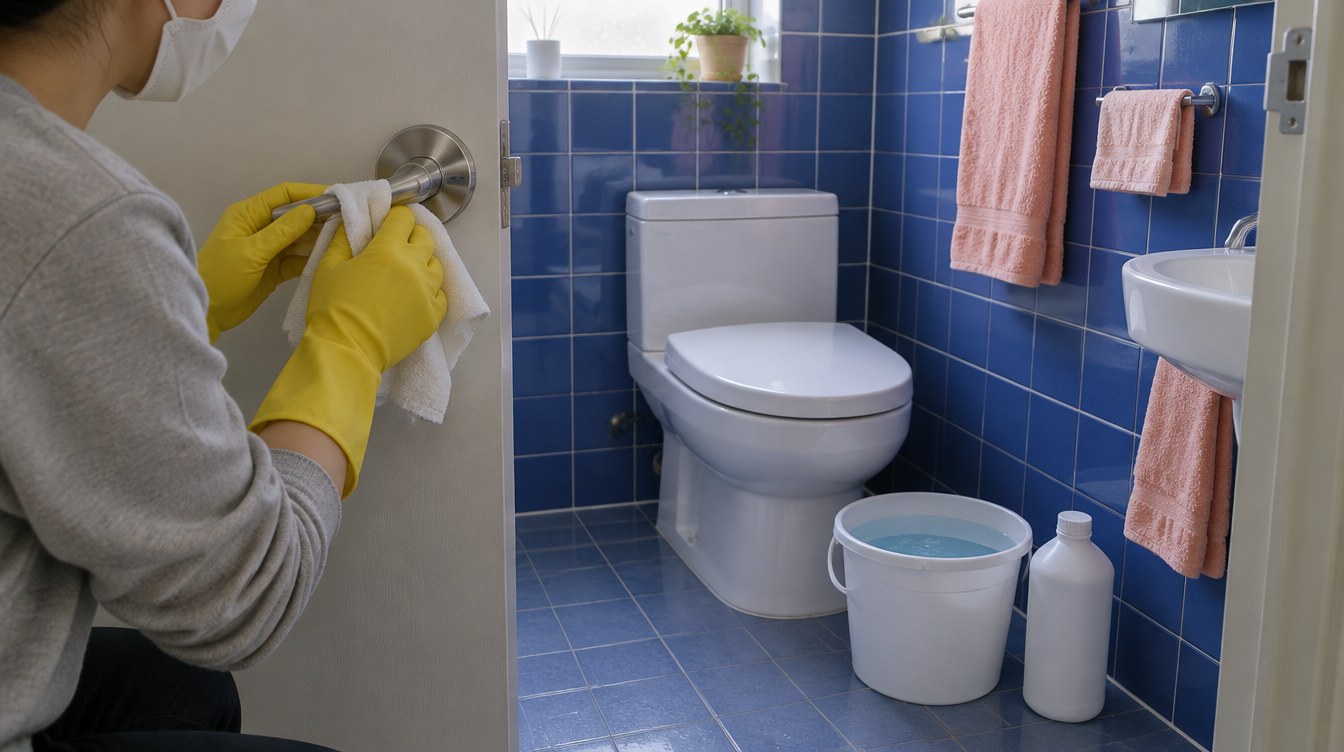
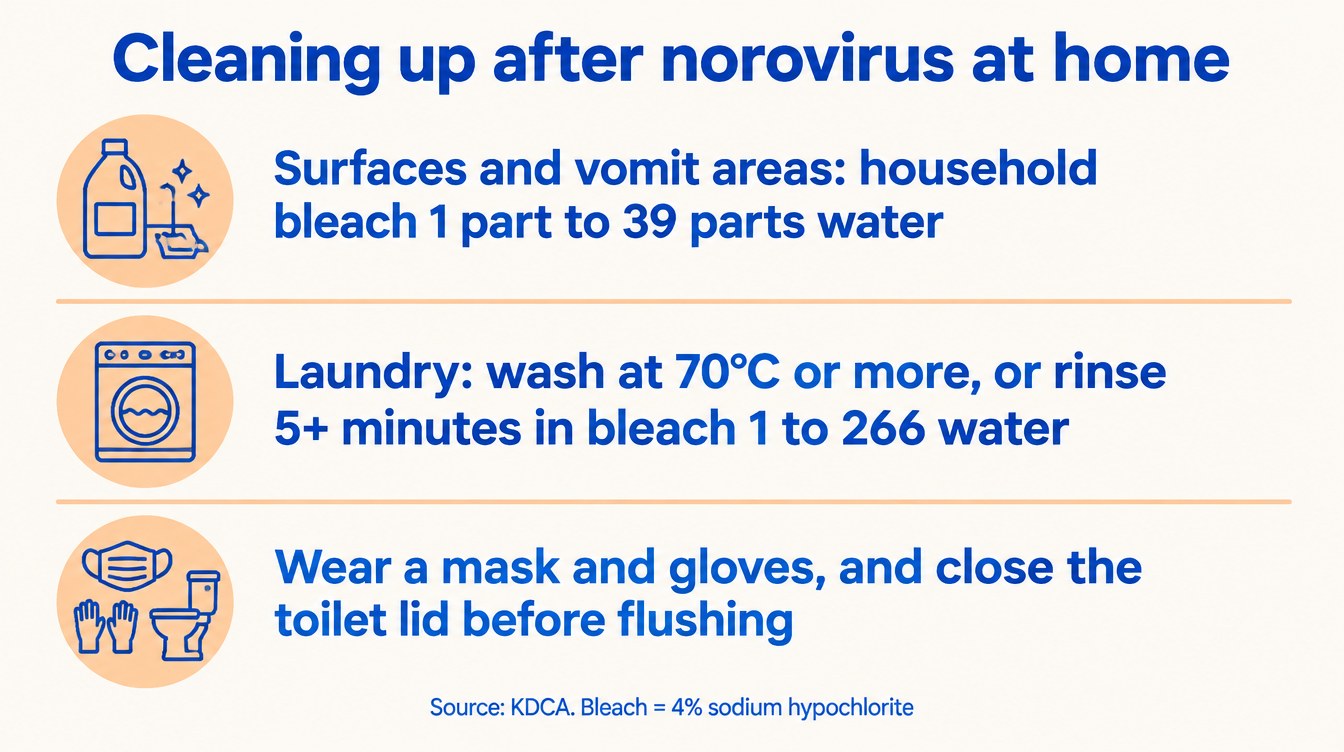
| Vomit, diarrhoea, toilet, surfaces the patient touched | Bleach diluted 1 part to 39 parts water, wiped on with a cloth; focus on door handles, taps and other things hands touch |
| Laundry | Wash at 70°C or higher, or rinse in bleach diluted 1 part to 266 parts water for at least 5 minutes |
| Protection while cleaning | Wear a KF94 mask and gloves |
| Toilet | Close the lid before flushing |
| Patient | Use a separate bathroom and space from the rest of the household if possible |
What the ratios mean (our calculation): one part 4% bleach in 40 parts total is about 0.1% chlorine, roughly 1,000 ppm, which sits at the low end of the 1,000 to 5,000 ppm range CDC recommends for norovirus clean-up. In practice, 25 ml of bleach plus 975 ml of water makes one litre at 1 to 39. CDC also says to leave the bleach solution on for at least 5 minutes, then clean the area again with soap and hot water. Never mix bleach with other cleaners, and check the strength printed on the bottle you buy, because concentrations vary.
Hand sanitiser is not enough. Both KDCA and CDC say to wash with soap and running water rather than relying on alcohol sanitiser. KDCA says at least 30 seconds; CDC says at least 20.
When to see a doctor, use a pharmacy or call 119
Most healthy adults ride it out at home in 2 to 3 days, drinking small amounts often. The danger is dehydration, which KDCA and CDC both say is most likely in infants, older people and people with weakened immunity. CDC lists the warning signs:
- passing much less urine than usual
- dry mouth and throat
- feeling dizzy when standing up
- in children, crying with few or no tears, and unusual sleepiness or fussiness
What to do in Korea, in rough order:
- Pharmacy (약국). For mild illness, ask a pharmacist for an oral rehydration solution (경구수분보충액). CDC notes that over-the-counter oral rehydration fluids are the most helpful option for mild dehydration; sports drinks help a little but do not replace all the minerals. Ask the pharmacist before taking anything to stop diarrhoea, especially for children.
- Clinic (의원). See an internal-medicine (내과) or paediatric (소아청소년과) clinic if vomiting stops you keeping fluids down, symptoms go beyond about three days, there is blood in the stool or a high fever, or the patient is a baby, an older person or someone with a chronic illness. With NHIS you pay the normal clinic copay; travellers pay in full and claim on travel insurance. Keep the receipt and the itemised bill.
- Emergency (119). Call 119 for an ambulance if someone is confused, very drowsy, cannot keep any fluid down and is passing almost no urine, or seems seriously unwell. Our heart attack warning signs guide explains how 119 works for foreigners.
For questions about infectious disease, KDCA’s call centre is 1339; for interpretation, the Korea Travel Hotline 1330 offers a free interpreter. KDCA also asks institutions to report clusters of cases to the local public health centre (보건소).
Going back to work, school or daycare
KDCA recommends that people with norovirus stay away from daycare, school and work until at least 48 hours after symptoms disappear. KDCA’s case-management guidance specifically restricts cooks, childcare and care-home workers, nurses, carers and healthcare workers while they have symptoms. If you work in a Korean kitchen, an English academy with young children, or a care setting, tell your employer; the 48-hour rule is about protecting others, since the virus is still being shed.
Prevention checklist for this winter
- Wash hands with soap for at least 30 seconds after the toilet, before eating and cooking, and after caring for someone sick.
- Buy oysters labelled for raw eating only if you accept the risk; cook anything labelled 가열조리용 to 85°C for at least a minute.
- Wash vegetables and fruit under running water and peel them; keep separate knives and boards for vegetables, meat and fish.
- Drink boiled water where the supply is a well or spring.
- If someone at home is sick: separate bathroom if possible, lid down before flushing, bleach 1 to 39 on touched surfaces, hot wash for laundry.
- Stay home until 48 hours after symptoms stop.
Winter brings other risks too: see our guides to cold-related illness and hypothermia and the free pneumococcal vaccine for over-65s.
FAQ
Q. What are the first symptoms of norovirus?
Sudden vomiting and diarrhoea, usually 12 to 48 hours after exposure, sometimes with stomach pain, chills or a mild fever. In young children repeated vomiting can appear without diarrhoea. Most people get better within 2 to 3 days.
Q. Are Korean oysters safe to eat raw in winter?
MFDS says raw or undercooked shellfish such as raw oysters is the main food source of norovirus, and that oysters labelled 가열조리용 (“for cooking”) must be heated to 85°C for at least 1 minute. Cooked dishes such as oyster rice soup are the safer choice.
Q. How do I clean up after someone with norovirus?
Wear a mask and gloves, wipe the area with household bleach diluted 1 part to 39 parts water, and focus on door handles, taps and the toilet. Wash laundry at 70°C or higher, or rinse it in bleach diluted 1 to 266 for at least 5 minutes. Close the toilet lid before flushing.
Q. Does hand sanitiser kill norovirus?
Not reliably. KDCA and CDC both say to wash with soap and running water; KDCA says for at least 30 seconds. Sanitiser can be used in addition, not instead.
Q. When can I go back to work or school?
KDCA recommends staying away from work, school or daycare until at least 48 hours after symptoms stop. Food handlers, childcare and care workers and healthcare staff should follow the same rule.
Q. When should I see a doctor in Korea?
If you cannot keep fluids down, pass much less urine, feel dizzy on standing, have blood in the stool or a high fever, or if the patient is a baby, an older person or someone with a chronic illness. Call 119 if someone is confused or seriously unwell.
General information, not medical advice. Diagnosis and treatment are for your doctor or pharmacist; do not use this page to decide on medicines or doses. Guidance is as published by KDCA and MFDS on the dates above; check KDCA’s infectious disease portal at https://dportal.kdca.go.kr or call 1339.
Sources
- KDCA, 2026 sentinel surveillance weekly bulletin, week 45 (published 12 November 2026): https://dportal.kdca.go.kr/pot/bbs/BD_selectBbs.do?q_bbsDocNo=20261112163809554&q_bbsSn=1010&q_clsfNo=2
- KDCA, “Winter norovirus infection advisory” (press reference material, 8 December 2025, PDF with overview, Q&A and prevention rules): https://www.kdca.go.kr/bbs/kdca/42/240806/download.do
- Korea Policy Briefing, KDCA press release listing (8 December 2025): https://www.korea.kr/briefing/pressReleaseView.do?newsId=156733635
- MFDS via Korea Policy Briefing, “Winter norovirus: oysters labelled for cooking must be cooked” (22 November 2024): https://www.korea.kr/news/policyNewsView.do?newsId=148936609
- MFDS via Korea Policy Briefing, “How to eat oysters safely in winter” (13 February 2025): https://www.korea.kr/news/policyNewsView.do?newsId=148939513
- CDC, “About Norovirus”: https://www.cdc.gov/norovirus/about/index.html
- CDC, “How to Prevent Norovirus”: https://www.cdc.gov/norovirus/prevention/index.html
- Newsis, “Norovirus alert for young children as winter arrives” (9 November 2026): https://www.newsis.com/view/NISX20261109_0003860131
How we checked: We read the KDCA week-45 bulletin page, the full KDCA December 2025 advisory PDF and the MFDS releases on 14 November 2026, and matched symptoms, timing, hand-washing and cleaning advice against CDC’s norovirus pages and Newsis. The bleach strength in ppm and the 25 ml per litre mix are our own arithmetic from KDCA’s 1-to-39 ratio and 4% strength; all other figures are as published.
Researched and drafted with AI assistance; checked against the sources listed.


One Comment