Slipped on Ice in Korea: Sprains, Fractures, Clinic or ER, and X-ray and Cast Costs
Haesul Health desk (AI-assisted). As of 18 November 2026 (KST). Based on the 2026 national fee schedule published by the Health Insurance Review and Assessment Service (HIRA), the National Health Insurance Service (NHIS) conversion-factor disclosure and its English guidance for foreigners, HIRA’s 3 September 2026 release on non-covered fees, the Korea Disease Control and Prevention Agency (KDCA) injury statistics of 26 August and 29 October 2026 and its fall-prevention page (updated 23 October 2026), KDCA’s press-release board, and the Ministry of Health and Welfare (MOHW) winter plan of 10 November 2026. Independent cross-checks: the UK’s NHS, the Korea Health Industry Development Institute (KHIDI), Pax Medical News, Seoul Economic TV, YTN, Yonhap, Modoodoc and Doctornow. General information, not medical advice.
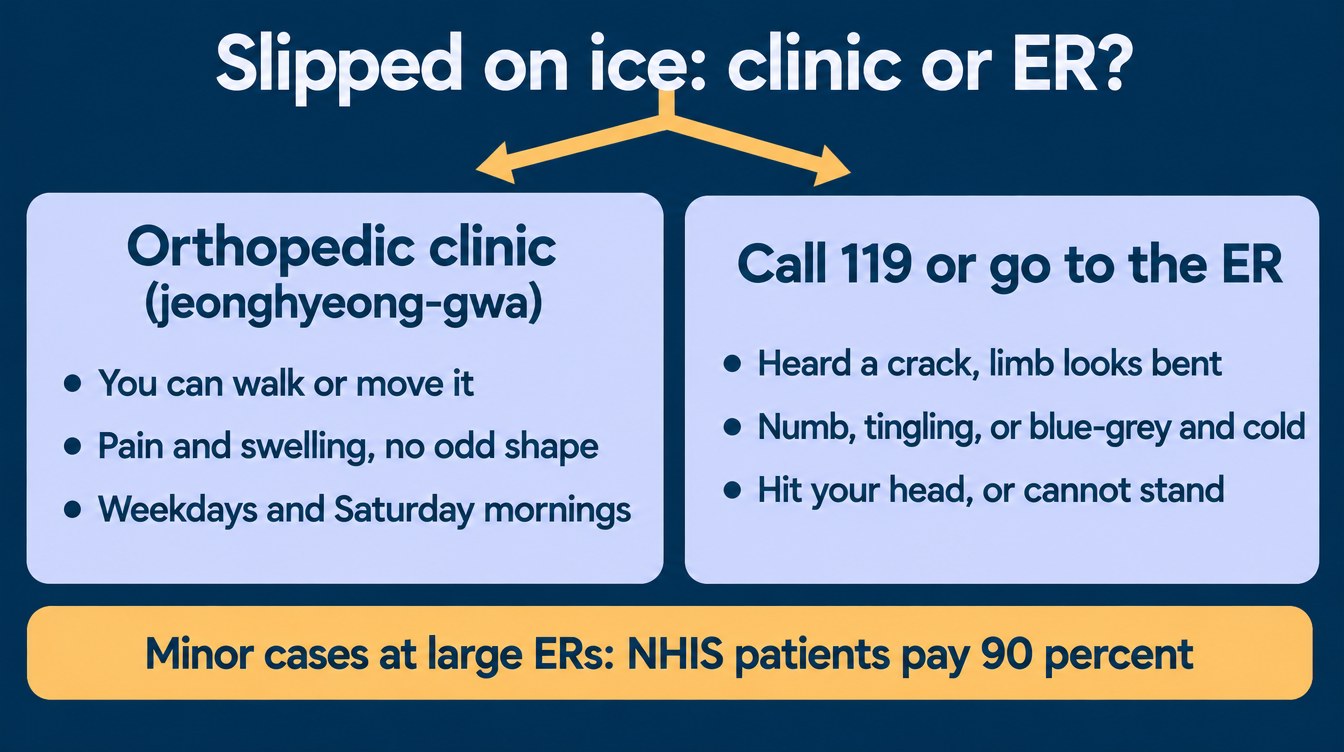
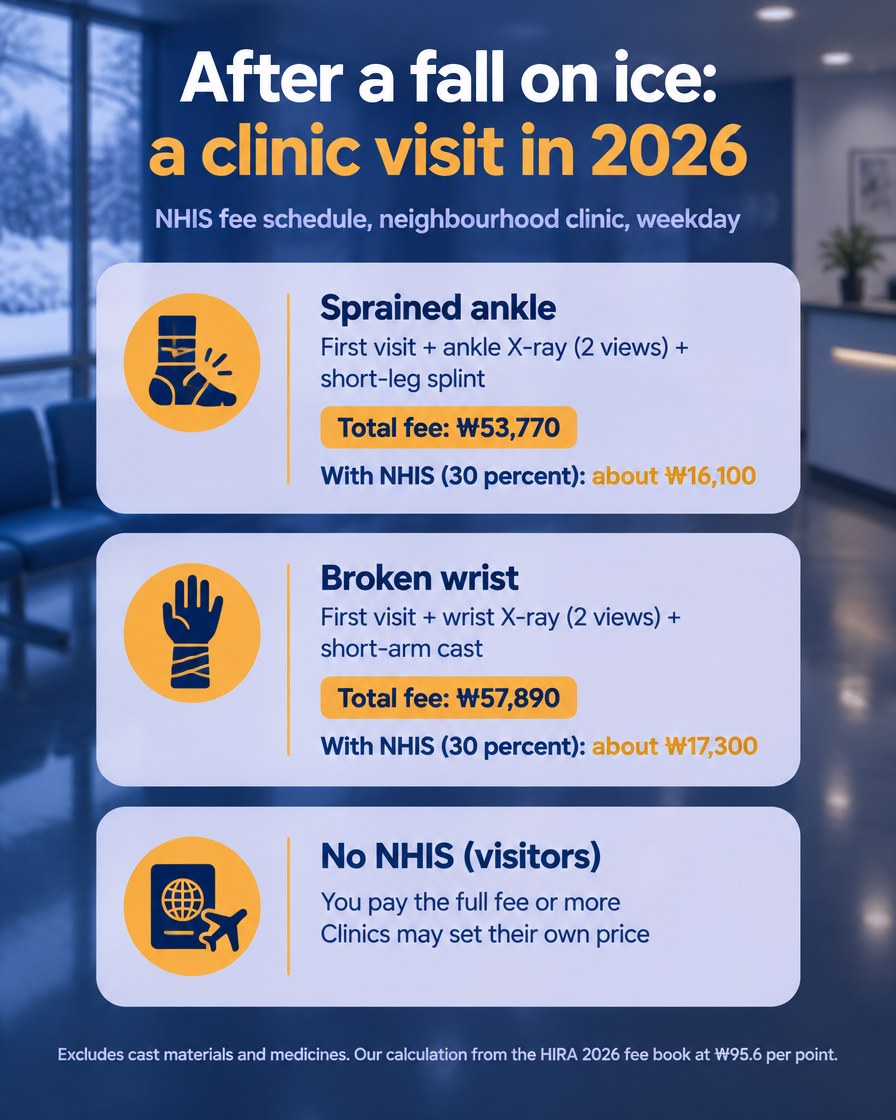
Quick answer: For a twisted ankle or a sore wrist after a fall on ice, a neighbourhood orthopedic clinic (정형외과, jeonghyeong-gwa) is usually the place to start: no referral is needed, many see walk-in patients, and most can take an X-ray on site. With NHIS, a first visit with a two-view X-ray and a splint or cast comes to about ₩16,000 to ₩17,000 out of pocket in 2026 (our calculation from HIRA’s fee schedule: total fees of ₩53,770 to ₩57,890, of which you pay 30 percent at a clinic). Visitors without NHIS pay the full fee or more. Call 119 or go to an ER if you heard a crack and the limb looks bent, it is numb or cold and blue-grey, you hit your head, or you cannot get up. Minor cases at large ERs cost NHIS patients 90 percent of the bill.
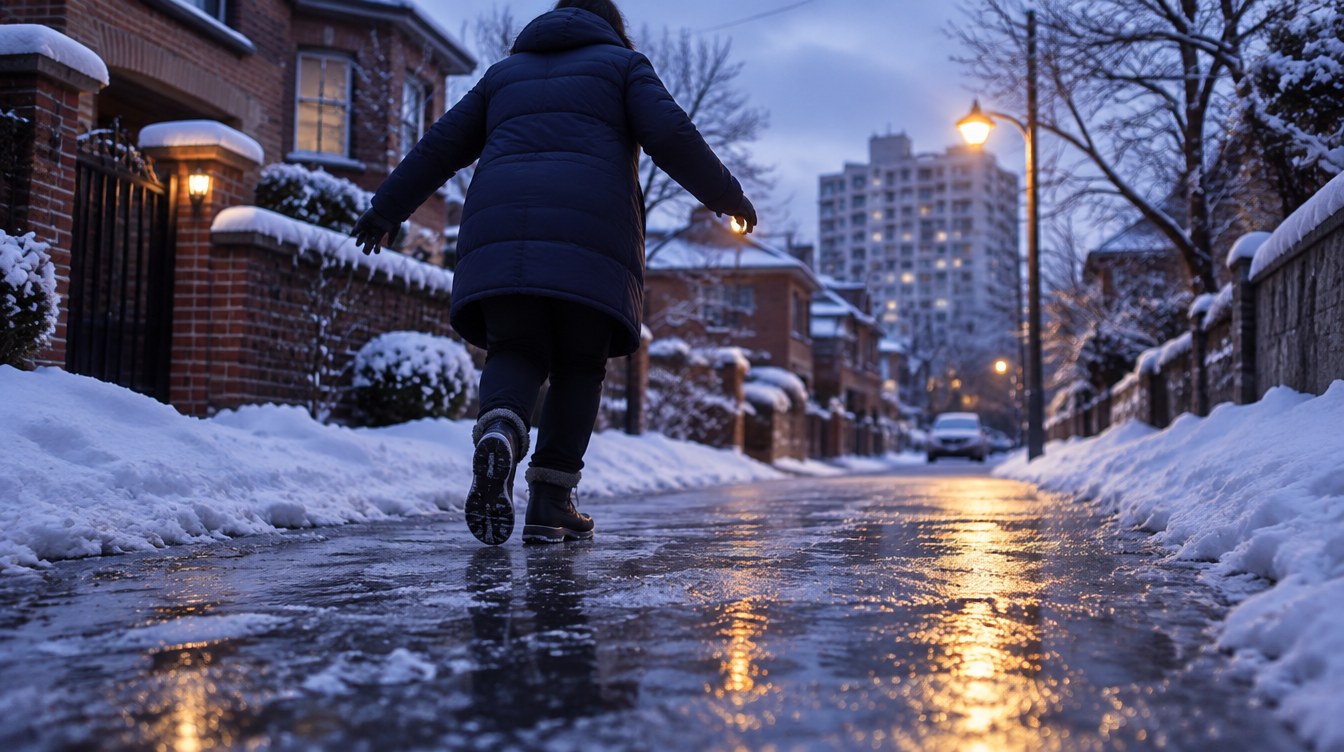
Why now: falls are the biggest single cause of injury that brings people to Korean emergency rooms. In KDCA’s 2025 emergency-room injury survey of 29 hospitals, published on 26 August 2026, falls from height and same-level falls together made up 40.0 percent of all injury visits, up from 29.6 percent in 2015. Same-level falls, the slip-and-trip kind, accounted for 29,065 patients, and 50.4 percent were 60 or older. KDCA’s injury factbook of 29 October 2026 adds that the hospital admission rate for falls rose 56.1 percent in ten years, from 736 to 1,149 per 100,000 people (2014 to 2024). Winter makes it worse: Yonhap reported on 20 January 2026 that one fire station in Wonju took 82 people to hospital after falls on icy pavements in the first 19 days of that year alone.
What happens when you slip on ice
People who slip tend to land on an outstretched hand, a twisted ankle, a knee, the hip or the back of the head. KDCA’s fall page (updated 23 October 2026) says that after head injuries, arm injuries (21.7 percent) and leg injuries (15.8 percent) are the most common among fall patients in emergency rooms, and that wrist fractures are frequent because people instinctively put a hand out to break the fall. Outdoors, KDCA says most falls happen on slopes and on pavements covered in water, snow or ice, and its advice is simple: avoid those routes if you can, wear non-slip shoes and walk slowly.
The two injuries most people worry about are:
- A sprain: a stretched or torn ligament, most often at the ankle, wrist, thumb or knee. The NHS describes pain, swelling or bruising and difficulty putting weight on the joint, and says most sprains feel better after about two weeks, though severe ones can take months.
- A fracture: a broken bone. It can look like a bad sprain. That is why clinics in Korea, as in most countries, usually take an X-ray first.
You cannot reliably tell the two apart yourself, so this guide does not try to. It explains where to go in Korea, what the visit involves and what it costs.
Orthopedic clinic, hospital or ER: where to go
Korea has no GP gatekeeper. You can walk into a specialist clinic directly, and orthopedic clinics are everywhere: look for 정형외과 on Naver Map or Kakao Map, or on a building’s directory board. Many clinics also open on Saturday mornings; the national fee schedule even has a Saturday-morning surcharge for them. Here is how the main options compare for a fall injury.
| Where | Best for | What you pay with NHIS | Notes |
|---|---|---|---|
| Orthopedic clinic (정형외과 의원) | Sprains, suspected simple fractures of the wrist, ankle, finger or toe; follow-up visits | 30 percent of the fee | X-ray on site at most clinics; splints and casts done the same day |
| Hospital (병원) or general hospital (종합병원) orthopedics | Larger clinics with more equipment; referrals for surgery | 40 percent (hospital) or 50 percent (general hospital) | No referral needed for NHIS rates; phone ahead to check orthopedic hours |
| Tertiary hospital (상급종합병원) | Surgery and complex fractures | Consultation fee in full plus 60 percent of the rest | Needs a referral letter for NHIS rates outside emergencies |
| Emergency room | Obvious deformity, open wounds, head injury, cannot walk, night-time severe pain | Normal ER rates; 90 percent for minor cases (KTAS 4 and 5) at larger ERs | Extra emergency management fee on day one |
The copay rates come from HIRA’s outpatient copayment rules (clinic 30 percent; hospital 40 percent in cities; general hospital 50 percent; tertiary hospital the full consultation fee plus 60 percent of the rest). For referral letters and English-speaking options, see our guide to seeing a doctor in English in Korea.
When to call 119 instead
Korea’s 119 handles both fire and ambulance calls and is free. The NHS lists these as signs to go to an emergency department straight away after an injury: you heard a crack, the body part has changed shape or points at an odd angle, it is numb, tingling or has pins and needles, or the skin has turned blue or grey and feels cold. We would add any head injury that worries you and anyone who cannot get up. The NHS also says not to drive yourself.
Our guide to going to the ER in Korea as a foreigner explains 119, the three tiers of ER and how triage works. One detail from it matters here: MOHW’s own example of a non-urgent (KTAS 5) case is “muscle pain such as an ankle sprain”. Since 13 September 2024, NHIS patients graded KTAS 4 or 5 at a regional emergency medical centre pay 90 percent of the bill, and KTAS 5 patients at a local emergency medical centre do too. If you are not an emergency patient under the law, you also pay the whole emergency management fee yourself, about ₩73,030 at a regional centre in 2026 (our calculation in that guide). In September 2024 MOHW put the average bill for patients caught by the 90 percent rule at about ₩220,000 at regional centres. A sprain that would cost ₩16,000 at a clinic can cost many times that at a big ER.
What happens at an orthopedic clinic
- Reception (접수): show your residence card (외국인등록증) or passport. Since 20 May 2024 clinics must check photo ID before applying NHIS rates; a mobile NHIS card also works. Say what happened: “bingpangil-eseo neomeojyeosseoyo” (빙판길에서 넘어졌어요, “I fell on an icy road”) and point to where it hurts.
- Consultation (진료): the doctor examines the joint and usually orders an X-ray.
- X-ray (엑스레이, 단순촬영): two views (front and side) are typical for an ankle or wrist. It usually takes only a few minutes.
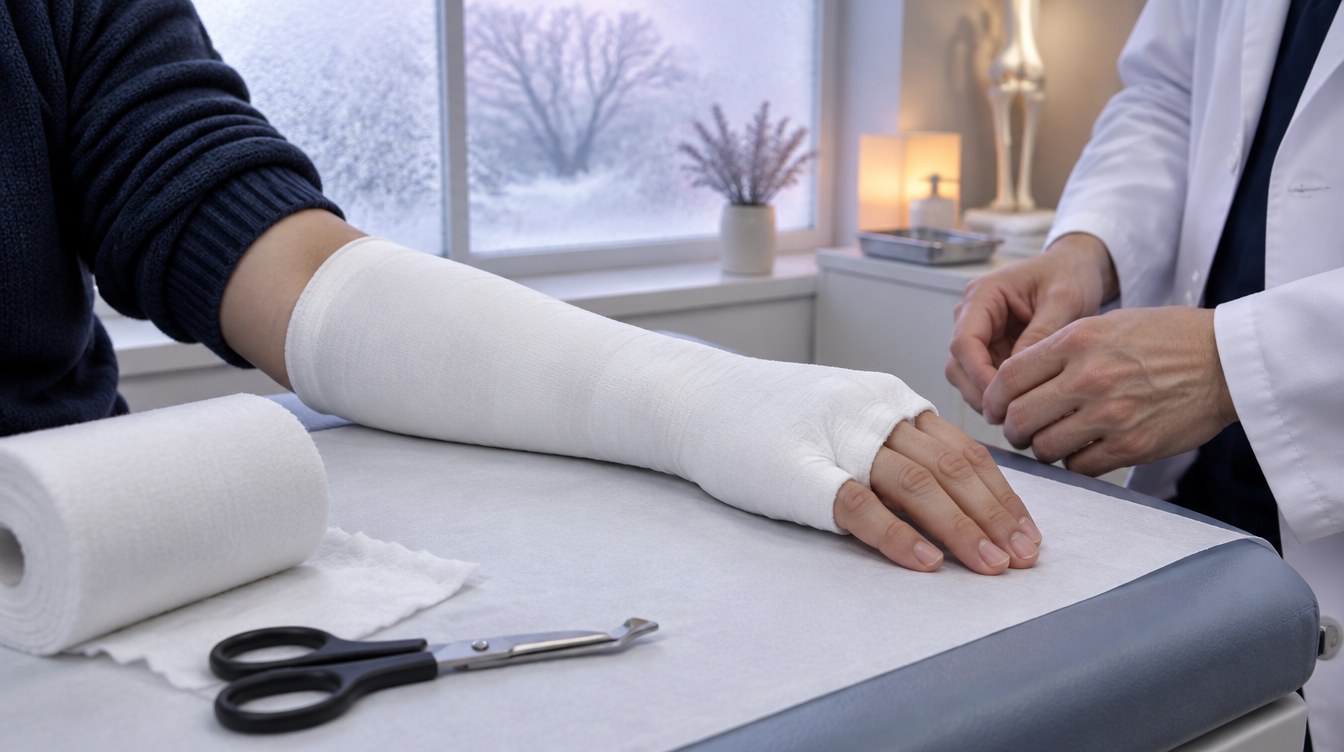
- Treatment (처치): for a sprain or a simple fracture this is often a splint (부목, “half cast” or 반깁스 in everyday Korean) or a full cast (캐스트, called 깁스 in everyday Korean). Some clinics use a removable brace instead.
- Pharmacy: if you get a prescription, take it to any pharmacy (약국); our guide to cold and flu medicine in Korea explains how pharmacies work.
- Follow-up: expect to come back for a check, often with another X-ray, and later for cast removal.
If the doctor suspects ligament damage or a hidden fracture, they may suggest an ultrasound, a CT or an MRI. Ask before you agree whether it is covered by NHIS (급여) or non-covered (비급여), and what it costs. Non-covered prices are set by each clinic.
What an X-ray and cast cost in 2026: the official fees
Korea’s NHIS fees are set nationally. Each procedure has a relative value in points, and the fee is points times a conversion factor. NHIS’s own disclosure lists the 2026 factors as ₩95.6 per point for clinics (의원) and ₩83.8 for hospitals (Pax Medical News reported the same two figures). HIRA’s 2026 fee book gives the points. Here are the items a fall injury typically involves, at a clinic, on a weekday:
| Item (HIRA code) | Points (2026) | Fee at a clinic (points × ₩95.6, our calculation) |
|---|---|---|
| First-visit consultation, clinic (AA154) | 197.12 | ₩18,840 |
| Return-visit consultation, clinic (AA254) | 139.85 | ₩13,360 |
| Ankle or wrist X-ray, 2 views (G7402 / G6402) | 91.31 | ₩8,729 |
| Digital (film-less) add-on, clinic: 1st view + 50 percent for the 2nd | 10.08 + 5.04 | ₩1,446 |
| X-ray total, 2 views, digital | 106.43 | ₩10,170 |
| Short-leg splint, below knee to foot (T6154) | 259.06 | ₩24,760 |
| Short-arm splint, forearm to hand (T6152) | 253.54 | ₩24,230 |
| Short-leg cast without walker (T6060) | 319.07 | ₩30,500 |
| Short-arm cast, forearm to hand (T6030) | 302.14 | ₩28,880 |
| Finger cast (T6090) | 172.43 | ₩16,480 |
Three rules from the same fee book change the totals:
- Cast materials are extra. Plaster bandages, synthetic cast tape, splint rolls and elastic bandages are billed separately as materials; stockinet and cotton padding are included in the cast fee.
- Night and holiday surcharge on casts: if a cast or splint has to be applied as an emergency between 18:00 and 09:00 or on a public holiday, the cast fee goes up by 50 percent.
- Hospital surcharge: hospitals add 5 percent (general hospitals 10, tertiary 15) on procedures such as casts, but not on X-rays. Clinics add nothing.
Small differences in practice: our figures are rounded down to the nearest 10 won, and a Saturday-morning visit (09:00 to 13:00) at a clinic adds 30 percent of the basic consultation fee.
Worked examples: what you actually pay
These are our calculations from the official fees above, for an adult under 65 on a weekday, before materials and medicines. Clinics round the patient share down to the nearest 100 won.
| Scenario | Total NHIS fee | You pay with NHIS | You pay without NHIS |
|---|---|---|---|
| A. Sprained ankle at a clinic: first visit + ankle X-ray (2 views) + short-leg splint | ₩18,840 + ₩10,170 + ₩24,760 = ₩53,770 | 30 percent = about ₩16,100 | At least ₩53,770; clinics may charge their own rate |
| B. Broken wrist at a clinic: first visit + wrist X-ray (2 views) + short-arm cast | ₩18,840 + ₩10,170 + ₩28,880 = ₩57,890 | 30 percent = about ₩17,300 | At least ₩57,890; clinics may charge their own rate |
| C. Follow-up at the clinic: return visit + check X-ray | ₩13,360 + ₩10,170 = ₩23,530 | 30 percent = about ₩7,000 | At least ₩23,530 |
| D. Scenario B at a hospital (병원): first visit ₩17,500 + X-ray ₩8,920 + cast ₩26,580 (with 5 percent surcharge) | ₩53,000 | 40 percent = about ₩21,200 | At least ₩53,000 |
| E. Scenario B at 22:00 at a clinic open late: cast fee +50 percent = ₩43,320 | ₩72,330 (plus any night consultation surcharge) | 30 percent = about ₩21,600 | At least ₩72,330 |
So a broken wrist treated at a clinic, with two follow-ups, comes to roughly ₩31,000 to ₩32,000 for an NHIS member (₩17,300 + 2 × ₩7,000, before materials and medicines). Independent price sites suggest the same order of magnitude: a Doctornow clinician’s answer (2023) put an insured ankle X-ray at about ₩10,000 to ₩20,000, and Modoodoc’s November 2026 review data from 1,018 orthopedic clinics put the average patient-reported cast price at ₩28,026.
What can push the bill up: non-covered extras. HIRA’s 3 September 2026 release on non-covered fees, covering 753 items at 74,449 institutions, used extracorporeal shockwave therapy (체외충격파치료), common in orthopedic clinics, as an example of price spread: ₩70,000 median at one Gyeonggi clinic versus ₩175,000 at the top-priced Seoul clinic. Seoul Economic TV reported the 2026 national average at about ₩77,900. MOHW moved manual therapy (도수치료) into a “managed benefit” category from 1 July 2026. You can compare a clinic’s non-covered prices on HIRA’s website or its 건강e음 app before you agree.
NHIS coverage for foreigners: residents vs visitors
Registered foreign residents on NHIS pay the same copays as Koreans. NHIS’s English guidance says employees are enrolled through their workplace, and other foreign residents are enrolled automatically once they have stayed in Korea for six months (since 16 July 2019), on most visa types including D-2 students, E-2 teachers and F-6 marriage migrants, and that NHIS gives foreigners “the same coverage as it does for Korean citizens”. Our NHIS guide for foreigners covers premiums and start dates.
Visitors and anyone not yet on NHIS pay the whole bill. KHIDI, the government’s medical-tourism agency, explains why foreigners are sometimes charged more: NHIS prices apply only to NHIS members, and for non-covered items each clinic sets its own price. KHIDI adds that foreigners who have been in Korea for more than six months are enrolled in NHIS and then pay the same as Koreans for covered care. Until then:
- Pay, then claim. Keep the receipt (진료비 영수증) and ask for the itemised bill (진료비 세부산정내역서). Your travel insurer may also want a diagnosis certificate (진단서) or a doctor’s note (소견서), which clinics issue for a fee.
- Call your insurer’s assistance line before any surgery or admission.
- For interpretation, the 1330 Korea Travel Hotline helps in several languages. It is not an emergency line; use 119 for that.
Older relatives visiting you? KDCA data show falls get more serious with age: in its 2025 survey, people 80 and over were 19.9 percent of fall patients but 33.1 percent of admissions and 42.5 percent of deaths. Our guide to bone density tests in Korea explains osteoporosis screening, and our explainer on vitamin D results on a Korean blood test covers a related number on checkup reports.
A note on Korea’s new support for fall treatment
On 10 November 2026, MOHW’s 2026–27 winter protection plan, approved at the Cabinet meeting, said the government will pay treatment and recovery costs after falls for 566,000 vulnerable older people from the first quarter of 2027, to ease worries about winter falls on icy roads. It is aimed at the same 566,000 vulnerable older people the government checks on during cold waves, not at foreign visitors or working-age residents, and the details had not been published when we checked on 18 November.
The same plan confirmed that KDCA will again run its cold-related illness surveillance in about 500 emergency rooms this winter. That system counts hypothermia and frostbite, not falls; KDCA normally runs it from 1 December to the end of February, and its 2026–27 launch release had not appeared on KDCA’s press-release board when we checked on 18 November. Our guide to hypothermia and frostbite in Korea’s winter covers last winter’s figures.
Before you go out: KDCA’s ice-day habits
KDCA’s fall page, the National Fire Agency’s winter advice (reported by YTN on 14 February 2026) and Wonju fire station agree on a short list:
- Wear non-slip shoes and take shorter, slower steps.
- Keep your hands out of your pockets while walking (Wonju fire station, January 2026).
- Avoid slopes and pavements covered in water, snow or ice where you can.
- Indoors matters too: wet bathroom and kitchen floors cause falls at home, which KDCA says is where 45.3 percent of fall injuries in its 2025 survey happened.
The National Fire Agency said falls among people 65 and over taken to hospital by ambulance during the Lunar New Year holiday rose from about 230 a day in 2021 to about 400 a day in 2025.
Common problems
- “The clinic is closed.” Many clinics close on Sunday and public holidays. Search 129 or 120 (Seoul’s Dasan call centre) for open clinics, or use E-Gen (e-gen.or.kr), the National Emergency Medical Center’s map of open clinics and pharmacies. If you cannot wait, a local emergency medical institution is cheaper than a regional centre for minor cases.
- “They want to put on a cast, but I fly home in three days.” Ask whether a splint is an option and for a copy of your X-ray images on CD and a doctor’s note in English.
- “My insurer rejected the cast claim.” Some insurance policies pay for a full cast but not a splint, a Korean loss-adjusting firm notes. Check whether your itemised bill shows a cast code (T6010 to T6120) or a splint code (T6151 to T6155).
- “I was charged more than a Korean friend.” If you were not on NHIS, that is legal; NHIS rates apply only to members. Once you are enrolled, show your card and you pay the same as everyone else.
Frequently asked questions
Q. Do I need a referral to see an orthopedic doctor in Korea?
No, not at a clinic (의원) or an ordinary hospital. You can walk into any orthopedic clinic with your residence card or passport. A referral letter is needed only for NHIS rates at a tertiary university hospital outside emergencies.
Q. How much does an X-ray cost in Korea in 2026?
At a clinic, a two-view ankle or wrist X-ray has an NHIS fee of about ₩10,170 in 2026 (our calculation from HIRA’s fee book at ₩95.6 per point), so an NHIS member pays about ₩3,000 for the X-ray itself. Add the consultation fee of ₩18,840 for a first visit. Without NHIS you pay at least the full fee.
Q. How much is a cast for a broken wrist in Korea?
The 2026 NHIS fee for a short-arm cast at a clinic is about ₩28,880, plus materials. With the first visit and an X-ray, the total fee is about ₩57,890, so an NHIS member pays about ₩17,300 at a clinic (30 percent). Applied as an emergency at night or on a holiday, the cast fee rises by 50 percent.
Q. Should I go to the ER for a sprained ankle in Korea?
Usually not, unless the signs are serious: a crack, a bent limb, numbness, cold blue-grey skin, a head injury or being unable to stand. MOHW uses an ankle sprain as an example of a non-urgent (KTAS 5) case, and since 13 September 2024 NHIS patients pay 90 percent of the bill for such cases at larger ERs. If in doubt, call 119.
Q. Does NHIS cover foreigners for fractures and sprains?
Yes, if you are enrolled. NHIS says foreign members get the same coverage as Korean citizens; employees join through work and most other foreign residents are enrolled after six months in Korea. Short-term visitors are not covered and should use travel insurance.
Q. What should I bring to an orthopedic clinic after a fall?
Your residence card or passport (clinics must check photo ID for NHIS rates since 20 May 2024), a payment card, a list of any medicines you take, and your travel-insurance details if you are a visitor. Ask for the receipt and the itemised bill before you leave.
Sources
- HIRA, 2026 fee book (MOHW notice 2026-114, in force 1 June 2026) as published section by section by Docple Check: X-ray fees and digital add-on (Part 2, Ch. 3, Sec. 1): https://check-app.docple-plus.com/sugabook/node/59 ; cast and splint fees (Ch. 9, Sec. 2): https://check-app.docple-plus.com/sugabook/node/123 ; consultation fees (Ch. 1): https://check-app.docple-plus.com/sugabook/node/10 ; institution-type surcharges: https://check-app.docple-plus.com/sugabook/node/5
- NHIS, Conversion factors by year (2026: hospital ₩83.8, clinic ₩95.6; disclosed 23 July 2026): https://www.nhis.or.kr/announce/wbhaec11413m01.do
- Pax Medical News, 2026 fees: clinic ₩95.6, hospital ₩83.8: https://www.paxmedicalnews.com/news/articleView.html?idxno=840
- HIRA, Outpatient copayment rules: https://www.hira.or.kr/dummy.do?pgmid=HIRAA030056020110
- HIRA and MOHW, 2026 non-covered fee disclosure (3 September 2026): https://www.hira.or.kr/bbsDummy.do?brdBltNo=11896&brdScnBltNo=4&pgmid=HIRAA020041000100
- Seoul Economic TV, Shockwave therapy ₩70,000 vs ₩175,000 (3 September 2026): https://www.sentv.co.kr/article/view/sentv202609030052
- KDCA, 2025 injury type and cause statistics (press release, 26 August 2026): https://www.kdca.go.kr/bbs/kdca/42/309202/download.do
- KDCA, Injury Factbook 2026 (press release, 29 October 2026): https://www.kdca.go.kr/kdca/2848/subview.do
- KDCA National Health Information Portal, Falls (낙상), updated 23 October 2026: https://health.kdca.go.kr/healthinfo/biz/health/gnrlzHealthInfo/gnrlzHealthInfo/gnrlzHealthInfoView.do?cntnts_sn=1743
- KDCA, Press-release board (checked 18 November 2026; no 2026–27 cold-illness surveillance launch release yet): https://www.kdca.go.kr/kdca/2848/subview.do
- MOHW via Korea.kr, 2026–27 winter protection plan (10 November 2026): https://www.korea.kr/news/policyNewsView.do?newsId=148975387
- NHIS, Guidance for foreigners (English): https://www.nhis.or.kr/english/wbheaa02900m01.do
- KHIDI Medical Korea, FAQ on foreign patients’ fees (2 June 2025): https://www.medicalkorea.or.kr/korp/notice/faqView.do?faqSn=42
- NHS, Sprains and strains (reviewed 23 April 2024): https://www.nhs.uk/conditions/sprains-and-strains/
- YTN, Falls among older people over the Lunar New Year holiday, National Fire Agency data (14 February 2026): https://www.ytn.co.kr/_ln/0103_202602141130326855
- Yonhap, Wonju fire station: 82 icy-pavement falls in 2026 so far (20 January 2026): https://www.yna.co.kr/view/AKR20260120100400062
- Doctornow, Orthopedic X-ray cost Q&A: https://doctornow.co.kr/content/qna/2d164821ed324e17aa21dc59f9387af1
- Modoodoc, Cast prices (2026, reviews from 1,018 orthopedic clinics): https://www.modoodoc.com/blog/post/360/
- Kyungchung loss adjusters, Cast vs splint codes in insurance claims (17 November 2026): https://www.kyungchung.co.kr/cases/cast-treatment-benefit-half-cast-splint
- Our earlier guide for ER rules and figures (MOHW KTAS examples, the 90 percent rule, emergency management fee): https://en.haesul.com/korea-emergency-room-foreigners/
How we checked: On 18 November 2026 we read the 2026 fee book sections for consultations, X-rays, casts and surcharges, NHIS’s conversion-factor table and English guidance, HIRA’s non-covered release, KDCA’s two injury releases, its fall page and its press-release board, and MOHW’s winter plan. Every won figure in the cost tables is our own calculation from those official points and factors, labelled as such; independent price sites were used only as a cross-check.
This guide is general information, not medical advice. Whether an injury needs an X-ray, a cast or emergency care is for a doctor to decide. In an emergency call 119.
Researched and drafted with AI assistance; checked against the sources listed.