Urine Protein on Korea’s Checkup: What Negative, ± and +1 to +4 Mean, and How to Read Them Next to Your eGFR
Haesul Health desk (AI-assisted). As of 12 November 2026 (KST). Based on the National Health Insurance Service (NHIS) general checkup page and the Ministry of Health and Welfare (MOHW) Health Checkup Implementation Standards (notice no. 2026-6), including the result criteria in Annex 4 and its appendix, plus the Korea Disease Control and Prevention Agency (KDCA) health portal pages on proteinuria, urine tests and chronic kidney disease. Independent cross-checks: the KDIGO 2024 chronic kidney disease guideline, the US National Institute of Diabetes and Digestive and Kidney Diseases (NIDDK), the UK National Health Service (NHS) and a university hospital’s proteinuria page. This is general information, not medical advice. It cannot tell you whether your kidneys are healthy. Only a doctor who knows your history can do that.
Quick answer: Every Korean general checkup includes a urine dipstick test, and the result sheet shows urine protein (요단백) in the kidney row next to serum creatinine and eGFR. Under MOHW Annex 4, negative (−) is Normal A, trace (±) is Normal B (borderline) and +1 or more is “disease suspected”. KDCA says a dipstick reading of 1+ is roughly 30 mg/dL of protein, 2+ about 100, 3+ about 300 and 4+ about 1,000 mg/dL or more. One positive stick is not a diagnosis. Fever, hard exercise, concentrated urine, menstruation or a urinary infection can push it up. The usual next step is a repeat urine test, ideally a first-morning sample, and if protein is still there, a quantitative test (urine albumin- or protein-to-creatinine ratio) read together with your eGFR. KDCA notes that kidney disease can be diagnosed even with an eGFR of 60 or more if protein keeps showing up. The 2026 checkup window closes on Thursday 31 December 2026, 48 days from 13 November.
You open your checkup result sheet and find a “+” or “+2” next to urine protein, with “disease suspected” ticked under kidney disease, while creatinine and eGFR on the same page look normal. This guide explains the official grades, how common a positive result is, why one dipstick can mislead, how to read it next to eGFR, and what to ask at a follow-up visit.

Where urine protein sits on your result sheet
NHIS lists a urine test (요검사) among the common items of every general checkup, together with blood tests that include serum creatinine and eGFR (NHIS general checkup guide). Article 5 of the MOHW Implementation Standards lists “chest X-ray, urine test, blood test” as checkup items (MOHW Implementation Standards, NHIS law service). KDCA’s guide to reading checkup results groups three items as the kidney function tests: urine protein, serum creatinine and eGFR (KDCA, checkup guide).
It is not an age-based add-on: everyone due for the general checkup hands in a urine sample.
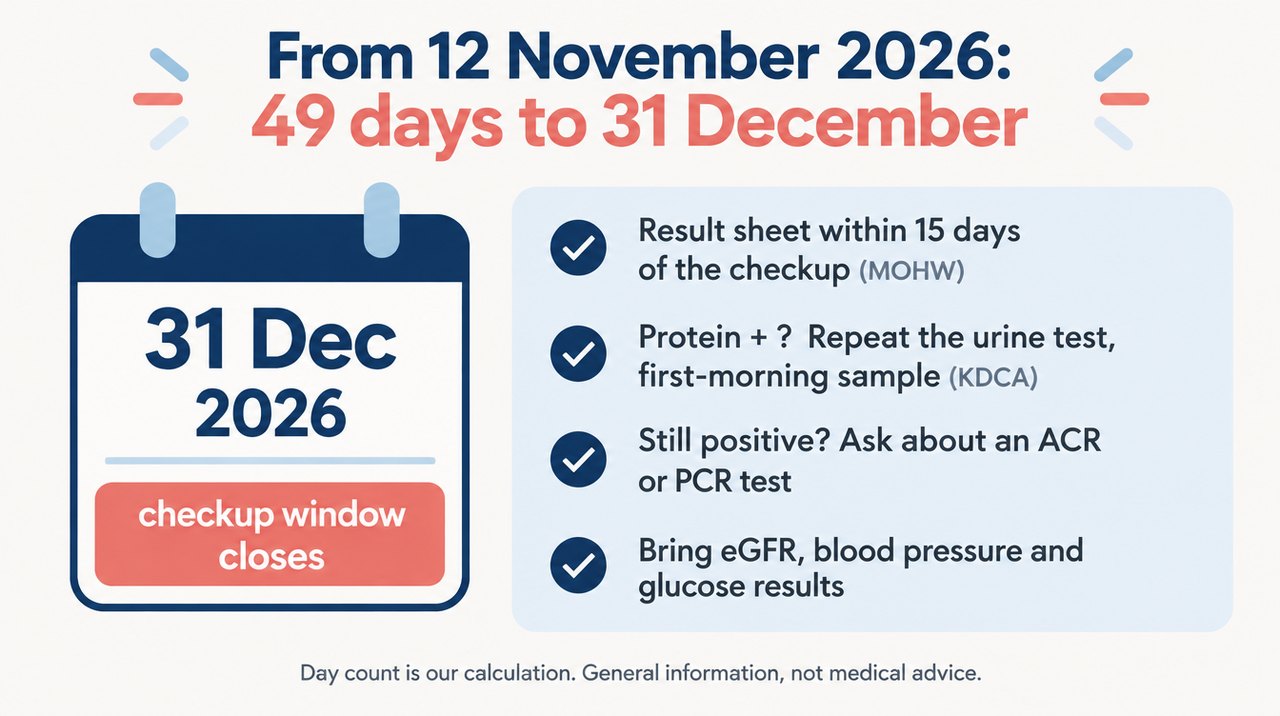
When does the sheet arrive? Article 10 of the Implementation Standards requires the checkup clinic to send the result notice within 15 days of completing the checkup, by post, email or mobile. The NHIS checkup page says the same (MOHW Implementation Standards, Art. 10; NHIS general checkup guide). If you have the checkup on the last possible day, 31 December 2026, the sheet should reach you by about 15 January 2027 (our calculation).
The official grades: negative, ± and +1 or more
The judgement rules come from the appendix to Annex 4 of the MOHW Implementation Standards, “result criteria by test item” (검사항목별 판정기준), under the target condition kidney disease (신장질환) (MOHW Annex 4 appendix). The same row also covers creatinine and eGFR, which is why the three always appear together.
| Kidney row on the result sheet | Normal A | Normal B (borderline) | Disease suspected |
|---|---|---|---|
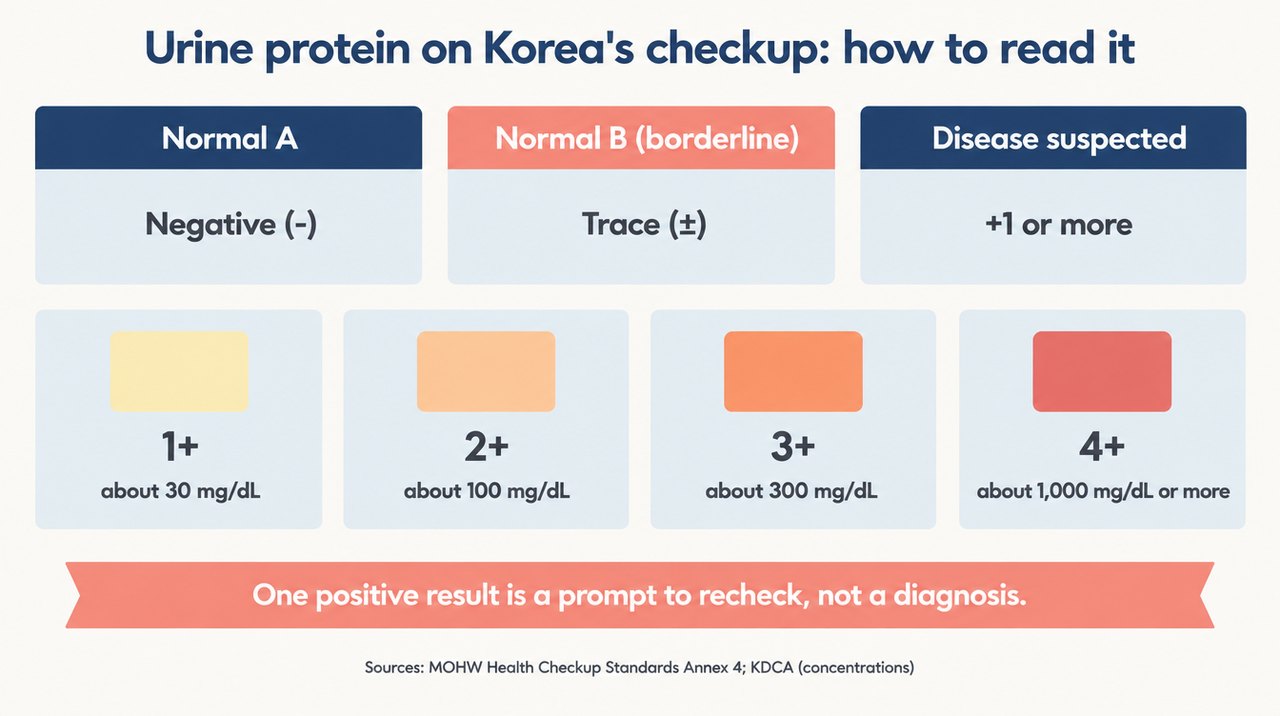
| Urine protein (요단백), dipstick | Negative (−) | Trace (±) (약양성) | Positive, +1 or more |
| Serum creatinine (mg/dL) | 1.5 or less | — | Above 1.5 |
| eGFR (mL/min/1.73 m²) | 60 or more | — | Below 60 |
Source: MOHW Health Checkup Implementation Standards (notice 2026-6), Annex 4 appendix, read from the law.go.kr file. Creatinine and eGFR have no Normal B band.
KDCA’s checkup-reading guide gives the same three steps in plainer words: normal when urine protein is negative, borderline when it is ±, and “proteinuria suspected” when it is +1, +2, +3 or +4 (KDCA, checkup guide).
A dipstick is a strip with chemical pads that change colour. It is semi-quantitative: it estimates protein concentration in one sample, not daily loss. KDCA gives approximate values:
| Dipstick grade | Approximate protein in the sample (KDCA) | Checkup label (MOHW Annex 4) |
|---|---|---|
| Negative (−) | Not detected | Normal A |
| Trace (±) | No figure given (a faint reaction) | Normal B (borderline) |
| 1+ | About 30 mg/dL | Disease suspected |
| 2+ | About 100 mg/dL | Disease suspected |
| 3+ | About 300 mg/dL | Disease suspected |
| 4+ | About 1,000 mg/dL or more | Disease suspected |
Sources: KDCA, urine test and proteinuria pages (concentrations); MOHW Annex 4 appendix (labels). Asan Medical Center’s proteinuria page gives the same 30 / 100 / 300 / 1,000 mg/dL steps.
Two notes on the ± row. First, KDCA’s proteinuria page says a normal dipstick is negative or trace, so ± on its own is not a disease flag (KDCA, proteinuria). The checkup still calls it Normal B, which Annex 4 defines as “no health problem, but self-care and preventive measures are needed” (MOHW Annex 4). Second, Annex 4 defines “disease suspected” as a result that “may develop into disease”, calling for follow-up tests or an accurate diagnosis at a medical institution. It is a prompt to check, not a diagnosis.
How common is a positive result?
More common than many people think. KDCA’s proteinuria page cites national checkup statistics for 2022. Of 17,142,575 people checked, 822,890 had urine protein 1+, 121,095 had 2+, 37,892 had 3+ and 9,736 had 4+ (KDCA, proteinuria).
By our calculation that is 991,613 people with 1+ or more, about 5.8 in every 100 checked, and most of them (about 4.8 in 100) were at the lowest positive grade, 1+. Only about 0.06 in 100 reached 4+. If your sheet shows +1, you are in a large group, which is why the next step is a repeat test, not panic.
Why one positive dipstick is not a diagnosis
Concentration. KDCA says the dipstick reacts to concentration, so concentrated urine can give a false positive and very dilute urine a false negative (KDCA, proteinuria). On checkup mornings you have usually fasted since 9 p.m., as NHIS asks. Asan Medical Center’s page lists very concentrated urine and very alkaline urine among causes of a false-positive protein stick, and dilute urine after drinking a lot of water among causes of a falsely low one (Asan Medical Center, proteinuria).
Temporary (transient) proteinuria. KDCA describes proteinuria that appears on one test and disappears when you retest later. Common causes it lists are fever, strenuous exercise, sleep apnoea, heart failure and stress (KDCA, proteinuria). The KDIGO 2024 guideline lists blood in the urine, menstruation, exercise and a symptomatic urinary infection as factors that raise urine albumin or protein results (KDIGO 2024 CKD guideline, Table 16).
Posture. KDCA’s orthostatic proteinuria (after long standing) is seen mainly in people aged 30 or younger, so it is a less likely explanation at 40 to 60.
What the stick measures. KDCA explains that the dipstick mainly estimates albumin, the main protein in blood. That cuts both ways. In early diabetic kidney disease, KDCA notes that small amounts of albumin (30–300 mg/g on an albumin-to-creatinine ratio) do not show up on an ordinary dipstick, so people with diabetes need a quantitative albumin test at least once a year even when the stick is negative. NIDDK likewise advises people with diabetes to get checked for kidney disease every year (NIDDK, CKD tests and diagnosis).
On the other side, KDCA is clear that persistent proteinuria, protein that shows up on repeated tests, is often linked to kidney disease or a body-wide condition and needs proper evaluation, even when there are no symptoms. Mild proteinuria usually causes none. KDCA says larger amounts can make urine foamy, with small bubbles that stay after flushing, and can cause swelling that starts at the feet and ankles.
Reading urine protein next to creatinine and eGFR
Our guide to creatinine and eGFR on your Korean checkup report covers the blood side. In short, eGFR estimates how well the kidneys filter, while urine protein is a sign of possible kidney damage. NIDDK describes the same pairing: a blood test for GFR and a urine test for albumin, because “a healthy kidney doesn’t let albumin pass into the urine” (NIDDK).
The key point for anyone with a normal eGFR and a positive stick: KDCA’s chronic kidney disease page says CKD can be diagnosed when eGFR stays below 60 for 3 months or more, and also that it can be diagnosed with an eGFR of 60 or more if a urine test shows protein or blood (KDCA, chronic kidney disease). KDIGO defines CKD as abnormalities of kidney structure or function present for at least 3 months, and notes that an eGFR of 60 or more (categories G1 and G2) without other evidence of kidney damage does not meet the definition (KDIGO 2024). So a normal eGFR does not cancel a repeated positive urine result, and one positive stick is not CKD.
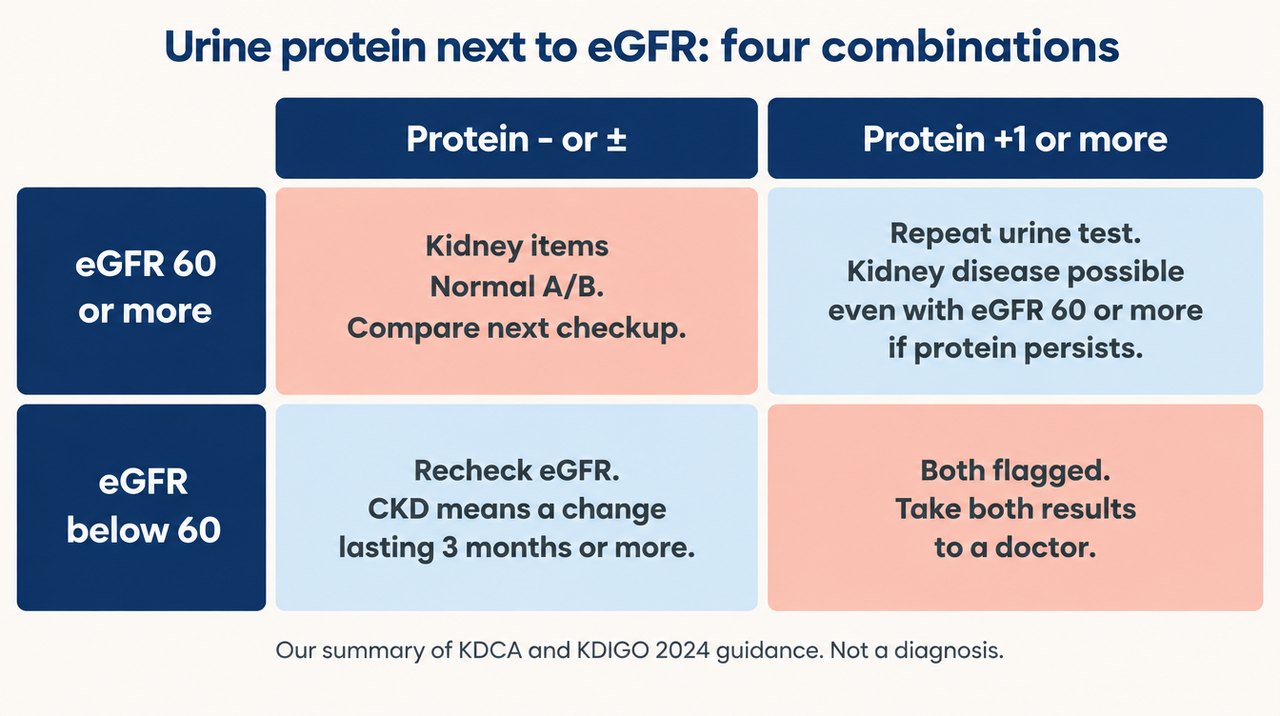
Here is how the four combinations on a checkup sheet line up with that guidance. This is our summary for orientation, not a diagnostic rule:
| Your sheet shows | What the official guidance says | Sensible next step to discuss |
|---|---|---|
| eGFR 60 or more, urine protein − or ± | Kidney items within Normal A / B under Annex 4 | Keep the sheet; compare at the next checkup. If you have diabetes, ask about the yearly albumin test (KDCA) |
| eGFR 60 or more, urine protein +1 or more | “Disease suspected” for protein only; KDCA: kidney disease possible even with eGFR 60 or more if protein persists | Repeat urine test, then a quantitative test if still positive |
| eGFR below 60, urine protein − or ± | “Disease suspected” for eGFR; KDCA/KDIGO: CKD needs the change to last 3 months or more | Recheck eGFR (and creatinine); ask about a urine albumin test |
| eGFR below 60, urine protein +1 or more | Both flags; KDCA: the more albumin at the same eGFR, the higher the risk of kidney failure | Take both results to a doctor rather than waiting for the next checkup |
If a follow-up quantitative test is done, the result is often reported as an albumin-to-creatinine ratio (ACR) in mg/g, or in mg/mmol in some countries. KDCA, KDIGO and the NHS use the same three bands:
| Albuminuria category | ACR (mg/g) — KDCA, KDIGO | ACR (mg/mmol) — KDIGO, NHS | KDIGO term |
|---|---|---|---|
| A1 | Below 30 | Below 3 | Normal to mildly increased |
| A2 | 30–300 | 3–30 | Moderately increased |
| A3 | Above 300 | Above 30 | Severely increased |
Sources: KDCA chronic kidney disease page; KDIGO 2024 Table 3; NHS, chronic kidney disease diagnosis. NIDDK: a urine albumin result of 30 mg/g or less is normal.
The plus signs do not convert neatly into these bands. KDIGO notes that spot samples can over- or underestimate urine albumin because of dilution, and that a ratio to urine creatinine reduces this error, which is why it asks for a quantitative ratio test after a positive stick.
Worked examples (illustrative)
These are made-up readers to show how the tables work. They are not real cases or medical judgements.
Example 1: Woman, 52, urine protein ±, eGFR 95. Annex 4 puts ± in Normal B, and KDCA’s proteinuria page counts trace as within normal. Her creatinine and eGFR are Normal A. Reading: nothing here calls for a kidney work-up; she keeps the sheet to compare next time.
Example 2: Man, 47, urine protein +1, eGFR 98, ran 10 km the evening before the checkup. Protein +1 is “disease suspected”; his eGFR is Normal A. Strenuous exercise is on both KDCA’s and KDIGO’s lists of things that can raise urine protein. Reading: possibly temporary, but only a repeat test, without hard exercise the day before, can show that.
Example 3: Man, 58, urine protein +2, eGFR 72, blood pressure 146/92, takes diabetes medicine. Protein +2 (about 100 mg/dL by KDCA’s table) is “disease suspected”. His eGFR is 60 or more, so it is Normal A by the checkup rule, but KDCA says kidney disease can still be present if protein persists. Diabetes and high blood pressure are the two main causes of chronic kidney disease that KDCA lists. Reading: take the sheet, a medicine list and recent glucose results to his doctor soon, and ask about an ACR test.
Example 4: Woman, 61, urine protein +1, eGFR 56, had a fever the week of her checkup. Fever is on KDCA’s list of transient causes, so the protein result could be temporary. Her eGFR, though, is below 60 and “disease suspected” on its own. Reading: two separate questions. A repeat urine test once she is well, and a recheck of eGFR, because KDCA and KDIGO both judge kidney function over at least 3 months, not on one reading.
What to do next if your sheet says urine protein +
Based on KDCA’s proteinuria, urine-test and chronic kidney disease pages, KDIGO 2024 and NIDDK:
- Don’t ignore it, and don’t panic. “Disease suspected” means a follow-up check is needed; many positives are temporary (KDCA).
- Repeat the urine test. NIDDK says a provider may repeat the urine test one or two more times to confirm a result. KDIGO’s practice point is to repeat tests to confirm after an incidental abnormal result, and to confirm a positive stick with a quantitative laboratory test (KDIGO 2024, Practice Points 1.1.1.2 and 1.3.1.2).
- Give the best sample you can. KDCA’s urine-test page calls the first urine of the morning the ideal sample, advises postponing the test during a period or after heavy exercise, and explains how to take a midstream sample: let roughly the first 30 mL go, then collect the next part (KDCA, urine test). KDIGO also prefers a first-void morning midstream sample.
- If protein is still there, ask about a quantitative test. KDCA lists a 24-hour urine protein test or the simpler spot urine protein-to-creatinine ratio, together with blood tests of kidney function. KDIGO’s order of preference starts with the urine albumin-to-creatinine ratio (ACR). A doctor may add an ultrasound or other tests depending on results (KDCA).
- Bring the rest of your sheet. Blood pressure, fasting glucose and eGFR all matter for kidney risk. KDCA names diabetes and high blood pressure as the main causes of chronic kidney disease, and NIDDK and the NHS both advise regular kidney testing for people with either. Our guides to blood pressure on Korea’s checkup and to metabolic syndrome’s 5 criteria explain those lines.
- Know the cost picture. NHIS’s free confirmatory follow-up after the checkup covers hypertension, diabetes, dyslipidaemia, pulmonary TB, depression or early psychosis, and hepatitis C, until 31 March of the following year. Kidney disease is not on that list (NHIS general checkup guide). Our reading is that a repeat urine test for protein is ordinary insured care with the usual co-payment.
- Look after the basics your doctor will ask about. KDCA’s CKD page recommends a low-salt diet, under 5 g of salt a day, along with not smoking and weight control; KDIGO suggests under 2 g of sodium a day, which it equates to under 5 g of salt. For people with CKD and high blood pressure, both KDCA and KDIGO mention a systolic target below 120 mmHg where tolerated. Treatment choices, including blood-pressure or diabetes medicines that also reduce proteinuria, are for your doctor to decide.
- Get seen promptly if symptoms appear: swelling of the feet, ankles or face, very foamy urine, visible blood in the urine or less urine than usual (KDCA; NHS).

If your 2026 checkup isn’t done yet: 48 days from 13 November
The general checkup window runs from 1 January to 31 December each year, and NHIS says it ends on 31 December. People who missed last year’s checkup can ask NHIS to be added to this year’s list (NHIS general checkup guide). From 12 November there are 49 days until Thursday 31 December 2026 (our calculation).
To help the urine test reflect your kidneys rather than your morning: avoid strenuous exercise the day before; postpone if you are menstruating (KDCA); tell staff about a fever or urinary symptoms; collect a midstream sample as in step 3 above; and still follow NHIS’s fasting rules for the blood tests (nothing after 9 p.m., no food, water or coffee that morning).
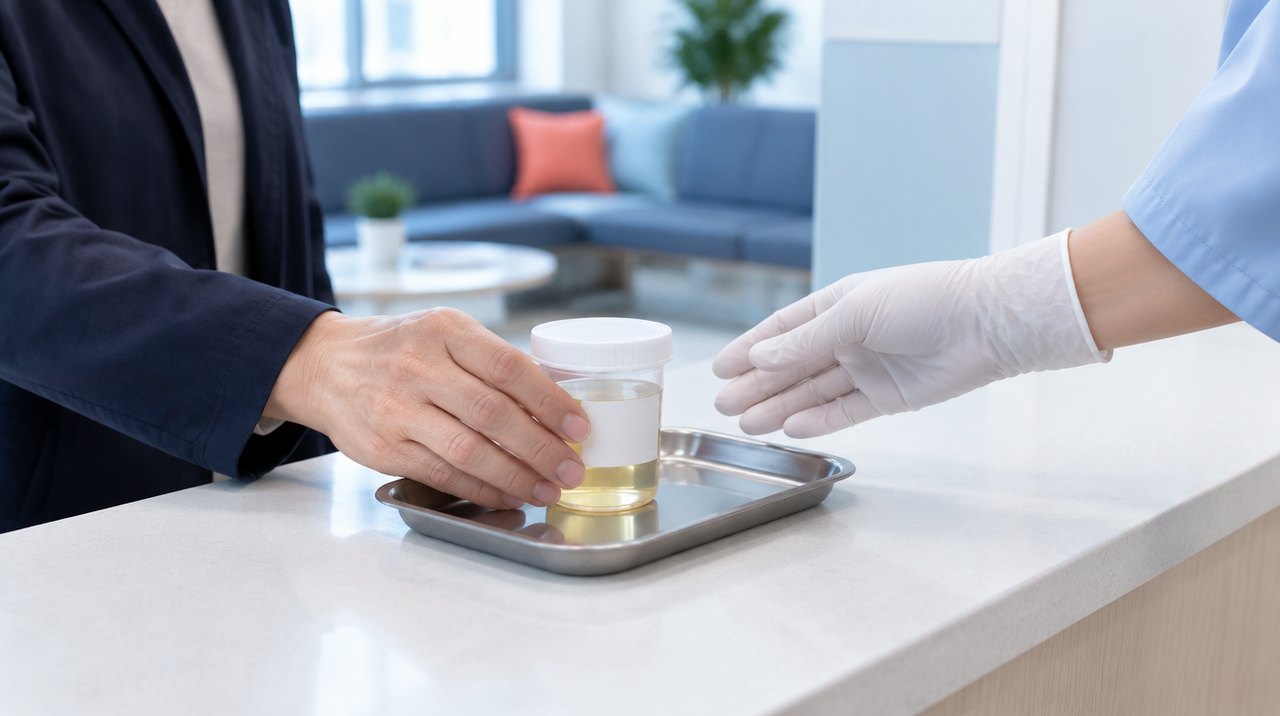
When the sheet arrives, read the kidney row as a set: urine protein, creatinine and eGFR together.
Related reading
- Creatinine and eGFR on Your Korean Checkup Report: the blood side of the same kidney row, with KDCA and NIDDK eGFR stages
- Blood Pressure on Korea’s National Checkup: What 140/90 Means: the free confirmatory visit after a high reading, and why blood pressure matters for the kidneys
- Metabolic Syndrome on Korea’s National Checkup: The 5 Criteria: waist, blood pressure, glucose and lipids, and what to do before 31 December
Frequently asked questions
Q. What do negative, ± and +1 mean for urine protein on Korea’s checkup?
Under MOHW Annex 4, negative (−) is Normal A, trace (±) is Normal B (borderline) and +1 or more is “disease suspected”. KDCA says a dipstick 1+ is roughly 30 mg/dL of protein, 2+ about 100, 3+ about 300 and 4+ about 1,000 mg/dL or more. KDCA counts negative or trace as within normal.
Q. My eGFR is normal but urine protein is +1. Should I worry?
Not on one result, but don’t ignore it. One positive stick can be temporary after fever, hard exercise, concentrated urine, menstruation or a urinary infection. KDCA notes that kidney disease can be diagnosed even with an eGFR of 60 or more if protein keeps showing up, so the next step is a repeat urine test and, if still positive, a quantitative test such as the albumin- or protein-to-creatinine ratio.
Q. Is the repeat urine test free?
NHIS’s free confirmatory tests after the checkup cover hypertension, diabetes, dyslipidaemia, pulmonary TB, depression or early psychosis and hepatitis C, not kidney disease. Our reading is that a repeat urine test is ordinary insured care with the usual co-payment. Ask the clinic when you book.
Q. How can I make the urine test on checkup day more accurate?
KDCA advises a midstream sample, ideally the first urine of the morning, and postponing the test during a period or after heavy exercise. Avoid strenuous exercise the day before, tell the staff about any fever or urinary symptoms, and follow the clinic’s fasting rules for the blood tests.
Q. When is the 2026 checkup deadline, and when will I get the result?
The general checkup window ends on 31 December 2026, 48 days from 13 November. Under the MOHW Implementation Standards the checkup clinic must send the result notice within 15 days, by post, email or mobile, so a checkup on 31 December should be reported by about 15 January 2027.
Sources
- National Health Insurance Service, 일반건강검진 (general checkup guide): urine test, creatinine and eGFR among common items; result notice within 15 days; free confirmatory test list; window 1 Jan–31 Dec; missed-last-year add-on; fasting rules — https://www.nhis.or.kr/nhis/healthin/wbhaca04500m01.do (checked 12 November 2026)
- MOHW, 건강검진 실시기준 (Health Checkup Implementation Standards, notice no. 2026-6), Art. 5 (urine test among checkup items) and Art. 10 (result notice within 15 days by post, email or mobile), NHIS law service full text — https://www.nhis.or.kr/lm/lmxsrv/law/lawFullContent.do?SEQ=80 (checked 12 November 2026)
- MOHW, Annex 4 결과 판정기준 (definitions of Normal A, Normal B, disease suspected) — https://www.law.go.kr/LSW/flDownload.do?flSeq=160922523 (law.go.kr file, read 12 November 2026)
- MOHW, Annex 4 appendix 검사항목별 판정기준 (신장질환: 요단백 음성(−) / 약양성(±) / 양성(+1) 이상; 혈청크레아티닌 1.5 이하 / 1.5 초과; e-GFR 60 이상 / 60 미만) — https://www.law.go.kr/LSW/flDownload.do?flSeq=160922929 (law.go.kr file, read 12 November 2026)
- KDCA National Health Information Portal, 알아두면 도움이 되는 ‘건강검진’ (checkup guide): kidney function tests = urine protein, creatinine, eGFR; urine protein normal −, borderline ±, proteinuria suspected +1 to +4 — https://health.kdca.go.kr/healthinfo/biz/health/ntcnInfo/healthSourc/thtimtCntnts/thtimtCntntsView.do?thtimt_cntnts_sn=7 (checked 12 November 2026)
- KDCA National Health Information Portal, 소변이상(단백뇨) (proteinuria, updated 15 May 2026): dipstick grades and concentrations, transient and orthostatic proteinuria, false positives, 2022 checkup statistics, diagnostic tests, symptoms — https://health.kdca.go.kr/healthinfo/biz/health/gnrlzHealthInfo/gnrlzHealthInfo/gnrlzHealthInfoView.do?cntnts_sn=6711 (checked 12 November 2026)
- KDCA National Health Information Portal, 소변검사 (urine test, updated 18 May 2026): first-morning sample, postpone during menstruation or after heavy exercise, midstream collection, dipstick concentrations — https://health.kdca.go.kr/healthinfo/biz/health/gnrlzHealthInfo/gnrlzHealthInfo/gnrlzHealthInfoView.do?cntnts_sn=5807 (checked 12 November 2026)
- KDCA National Health Information Portal, 만성콩팥병 (chronic kidney disease, updated 12 May 2026): 3-month definition, eGFR 60 or more with proteinuria, albuminuria stages, main causes, salt and blood-pressure targets — https://health.kdca.go.kr/healthinfo/biz/health/gnrlzHealthInfo/gnrlzHealthInfo/gnrlzHealthInfoView.do?cntnts_sn=5457 (checked 12 November 2026)
- Independent: KDIGO 2024 Clinical Practice Guideline for the Evaluation and Management of Chronic Kidney Disease, Kidney International 2024;105(4S):S117–S314 (CKD definition, Tables 2, 3 and 16, Practice Points 1.1.1.2, 1.3.1.1, 1.3.1.2, Recommendations 3.3.2.1 and 3.4.1) — https://kdigo.org/wp-content/uploads/2024/03/KDIGO-2024-CKD-Guideline.pdf (read 12 November 2026)
- Independent: NIDDK, Chronic Kidney Disease Tests & Diagnosis (GFR and urine albumin; UACR 30 mg/g or less normal; repeat test one or two more times; yearly check with diabetes) — https://www.niddk.nih.gov/health-information/kidney-disease/chronic-kidney-disease-ckd/tests-diagnosis (checked 12 November 2026)
- Independent: NHS, Chronic kidney disease — Diagnosis (urine ACR and protein; A1–A3 in mg/mmol; who should be tested) — https://www.nhs.uk/conditions/kidney-disease/diagnosis/ (checked 12 November 2026)
- Independent: Asan Medical Center, 단백뇨 (dipstick 1+ 30, 2+ 100, 3+ 300, 4+ 1,000 mg/dL; false positives with concentrated or alkaline urine; transient proteinuria with fever or heavy exercise) — https://www.amc.seoul.kr/asan/depts/child/K/bbsDetail.do?contentId=259833&menuId=4342 (checked 12 November 2026)
This article is general health information, not medical advice. It does not diagnose any condition and cannot tell you whether your kidneys are healthy. Talk to a doctor about a positive urine protein result, a low eGFR, swelling, visible blood in the urine or any other symptom, and before changing any medicine.