Childhood Vaccinations in Korea for Expat Families: Free NIP Shots, Schedule, Flu 2026-27
Haesul Health desk (AI-assisted). As of 16 November 2026 (KST). Based on the Korea Disease Control and Prevention Agency (KDCA) Vaccination Helper pages (예방접종도우미, nip.kdca.go.kr) on the National Immunization Program, HPV and the 2026-27 child flu programme, KDCA’s 2026 English “Vaccination Guide for Guardians” and its 12-language programme toolkit, KDCA press releases of 6 May, 25 August and 11 September 2026, the KDCA weekly sentinel surveillance bulletin for week 45, and the Yeonsu-gu (Incheon) foreign-resident guide, cross-checked with The Korea Herald, a MAP x Samsung Medical Center guide for migrant families, Newsis and the Kyunghyang Shinmun. General information, not medical advice.
Quick answer: Yes, foreign children can get Korea’s routine childhood vaccines free. KDCA’s National Immunization Program (NIP, 국가예방접종) pays the full cost of 19 vaccines for children aged 12 and under (born on or after 1 January 2013), and a child with an Alien Registration Card is treated exactly like a Korean child. A child with no registration number who is staying 3 months or longer gets a free temporary management number (임시관리번호) at the local public health centre (보건소). Health-insurance (NHIS) enrolment is not a condition. Shots are free only at a designated clinic (위탁의료기관) or a public health centre. This winter the free flu shot covers children from 6 months to 14 years (born 1 January 2012 to 31 August 2026) until 30 April 2027.

This guide is for foreign parents living in Korea: new arrivals with a baby, families moving here with school-age children, and parents whose child was born in Korea but who are unsure what the system covers. It walks through who qualifies, what the 2026 schedule looks like, how to get shots your child already had abroad into the Korean record, where to go, and what to do about flu this winter. Flu is already circulating hard among school-age children (see the flu section below), so if your child has not had this season’s shot, now is the time to book one.
Who qualifies: the rules for foreign children
The NIP is a government programme. It is not run through health insurance, and the same eligibility rules apply whatever your nationality. Here is how KDCA’s 2026 materials sort foreign children:
| Your child’s situation | Free NIP vaccines? | What you use at the clinic | Where |
|---|---|---|---|
| Has an Alien Registration Card (외국인등록증) / registration number | Yes, same as Korean children | The child’s alien registration number on the screening form | Any designated clinic or public health centre |
| Exempt from registration (e.g. children of foreign-mission staff under Immigration Act Article 31) | Yes | Temporary management number from the public health centre | Public health centre first, then designated clinics |
| No registration number, staying in Korea 3 months or longer (including undocumented children) | Yes | Temporary management number, issued in person at the public health centre | Public health centre first, then designated clinics |
| Short stay of under 3 months (e.g. tourists) | No | — | Pay at a private clinic |
| Newborn in Korea with no number yet (first month) | Yes | Baby’s date of birth and sex plus the mother’s details on the screening form | Any designated clinic or public health centre |
Sources: KDCA, 2026 Vaccination Guide for Guardians (English) and the 2026 NIP toolkit (English pages); Yeonsu-gu foreign-resident guide; KDCA 2026 NIP management guideline (read as a search extract, see “How we checked”). Cross-checked with The Korea Herald (1 October 2024) and the MAP x Samsung Medical Center guide (updated 11 October 2026).
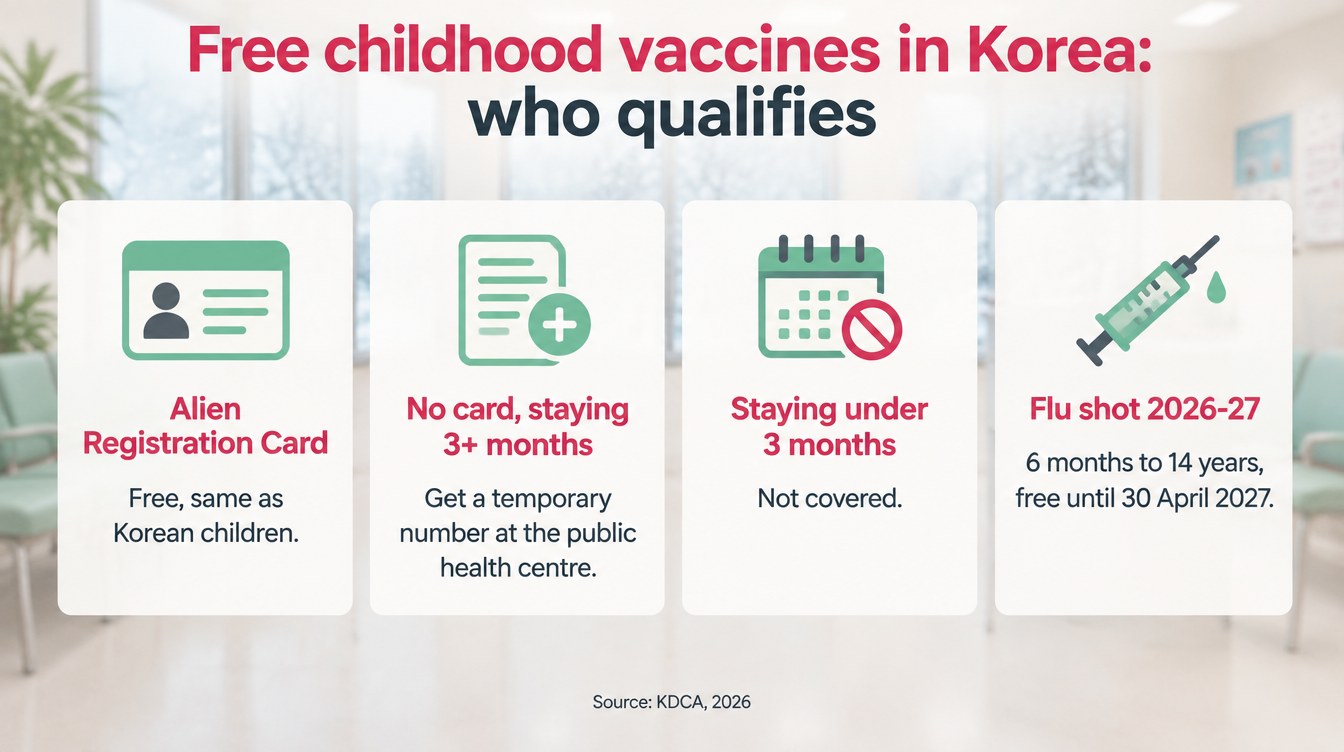
Three points catch families out:
- No insurance? Still free. The Korea Herald’s guide, based on KDCA guidelines, puts it plainly: residents are eligible “regardless of their nationality, immigration status or enrollment in the National Health Insurance scheme.” You do not have to wait for NHIS enrolment, which for most newcomers starts after six months.
- The temporary number is in-person only. The Yeonsu-gu guide says it cannot be issued online or by phone. Bring the guardian’s ID (passport) and the child’s ID (passport or birth certificate). KDCA’s guide says that if no number has been issued before, it is issued on the same day. Once your child receives an alien registration number, ask the public health centre to merge the records under it.
- Vaccination is not the same as cash benefits. Korea’s child allowance requires the child to hold Korean nationality. Free NIP vaccination does not.
Which vaccines are free: the 19 NIP vaccines
KDCA’s NIP page (last reviewed 14 July 2026) lists 19 supported vaccines for children aged 12 and under born on or after 1 January 2013. The programme pays both the vaccine and the administration fee (백신비 및 예방접종 시행비). Older English guides say 18. KDCA’s own 2026 page says 19.
| Vaccine (abbreviation) | Protects against | Age limits that differ (KDCA) |
|---|---|---|
| HepB | Hepatitis B | — |
| BCG (intradermal) | Tuberculosis | Up to 59 months; from 3 months only after a negative TST skin test |
| DTaP, Tdap, Td | Diphtheria, tetanus, whooping cough | — |
| IPV | Polio | — |
| DTaP-IPV, DTaP-IPV/Hib, DTaP-IPV-Hib-HepB | Combination shots (fewer injections) | — |
| Hib | Haemophilus influenzae type b | Up to 59 months (high-risk children beyond) |
| PCV | Pneumococcal disease | Up to 59 months (high-risk children beyond) |
| RV | Rotavirus | Up to 8 months 0 days; first dose by 14 weeks 6 days |
| MMR | Measles, mumps, rubella | — |
| VAR | Chickenpox | — |
| HepA | Hepatitis A | Children born from 1 January 2012 |
| IJEV / LJEV | Japanese encephalitis (inactivated or live) | — |
| HPV (4-valent) | Human papillomavirus | Girls 12-17; boys aged 12 (born 2014) since 6 May 2026 |
| IIV | Influenza | Set each season (see the flu section) |
Source: KDCA Vaccination Helper, NIP programme page and HPV page (nip.kdca.go.kr). Boys’ HPV: KDCA press release of 6 May 2026, also on Government24.
Not covered, so you pay in full: the percutaneous BCG vaccine (경피용), the live Japanese encephalitis vaccine Imojev, and the 9-valent HPV vaccine, according to KDCA. The MAP x Samsung Medical Center guide repeats the same three exclusions. Vaccines outside the NIP list, and any shot given at a clinic that is not designated, are also self-pay. Ask for the price before the injection.
The 2026 schedule at a glance
This is KDCA’s standard schedule (표준예방접종일정) as given in its 2026 English guide for guardians. Doctors adjust it for children who start late. KDCA notes that for DTaP, IPV, Hib, PCV and inactivated Japanese encephalitis, a delay can change the number of doses.
| Age | Vaccines in the standard schedule |
|---|---|
| Birth | Hepatitis B, dose 1 |
| Within 4 weeks | BCG (tuberculosis) |
| 1 month | Hepatitis B, dose 2 |
| 2, 4 and 6 months | DTaP 1-3, polio (IPV) 1-3, Hib 1-3, pneumococcal (PCV) 1-3, rotavirus (2 doses of RV1 or 3 of RV5); hepatitis B dose 3 at 6 months |
| 12-15 months | Hib 4, PCV 4, MMR 1, chickenpox |
| 12-23 months | Hepatitis A 1-2; Japanese encephalitis: inactivated 1-2 or live 1 |
| 15-18 months | DTaP 4 |
| 24-35 months | Inactivated Japanese encephalitis 3 or live dose 2 |
| 4-6 years | DTaP 5, IPV 4, MMR 2 |
| 6 years | Inactivated Japanese encephalitis 4 |
| 11-12 years | Tdap (or Td) |
| 12 years | Inactivated Japanese encephalitis 5; HPV (2 doses, 6-12 months apart, if started at 12-14) |
| Every autumn from 6 months | Influenza |
Source: KDCA, 2026 Vaccination Guide for Guardians (English), “Types of Vaccinations Recommended for Each Age and Period”, and the HPV page for the dose interval.
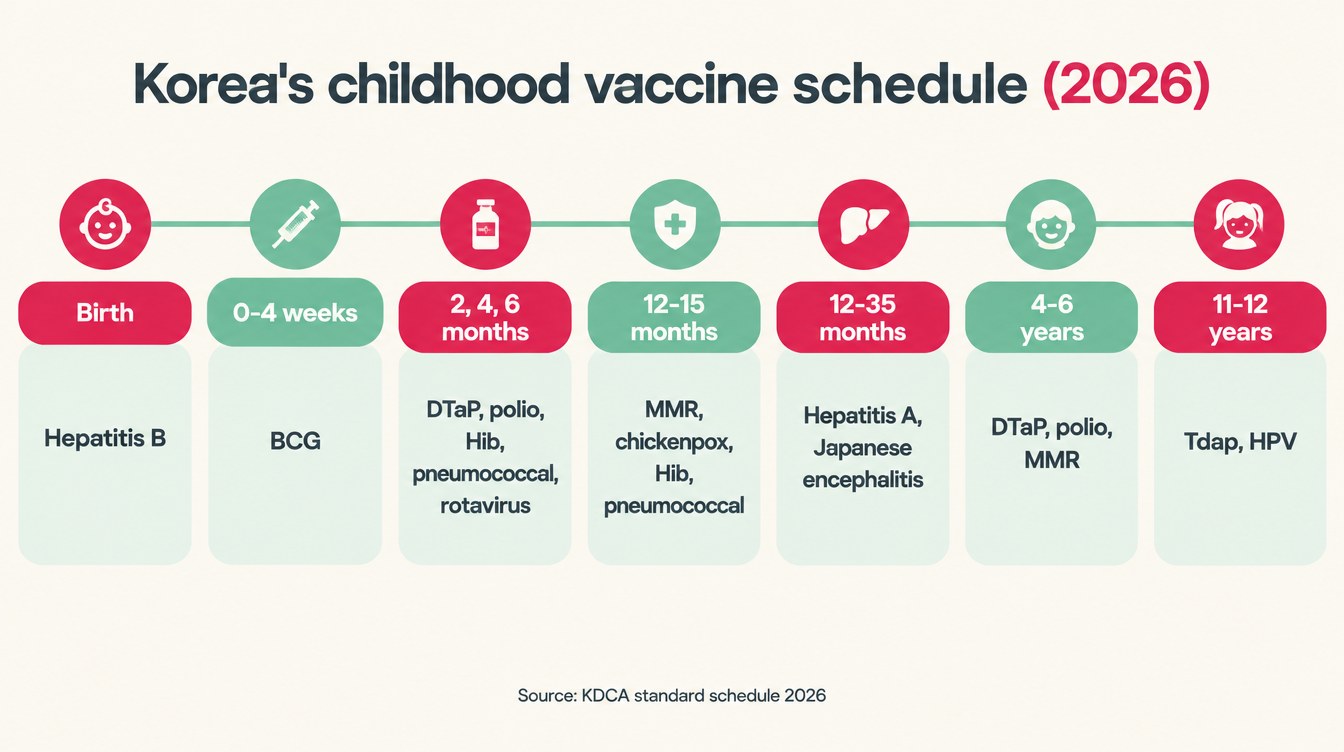
Our count of doses: if you add up the schedule above with the inactivated Japanese encephalitis route and the two-dose rotavirus vaccine, a child receives about 36 doses across 12 vaccine lines by age 12, plus a flu shot each year. Combination vaccines (for example the six-in-one DTaP-IPV-Hib-HepB) cut the number of injections. This is our arithmetic, not a KDCA figure. It is meant to show why keeping the record straight matters, not to replace the doctor’s plan.
To see your own child’s dates, KDCA’s Vaccination Helper has a schedule tool (예방접종 관리 → 우리 가족 예방접종 일정보기): enter the date of birth and it lists what is due.
Worked example: which free shots does each child get this winter?
Here is how the 2026 rules apply to three sample children in a family that arrived in Korea this autumn. The birth-year cut-offs are KDCA’s. The application to each child is ours.
| Child (illustration) | Routine NIP (born 2013 or later) | Hib / PCV (to 59 months) | HPV | Flu 2026-27 (born 2012-01-01 to 2026-08-31) |
|---|---|---|---|---|
| Baby born 10 March 2026 (8 months) | Yes | Yes | No | Yes, 2 doses at least 4 weeks apart (first flu season) |
| Child born 1 June 2022 (4 years) | Yes: catch-up for any missing doses | Yes, until 59 months, which by our count is around May 2027 | No | Yes; 2 doses if this is the first flu vaccine ever |
| Child born 20 February 2014 (12 years) | Yes | No | Yes: girls 12-17, and since 6 May 2026 boys born in 2014 | Yes, 1 dose (age 9 or over) |
| Teenager born 5 May 2012 (14 years) | No (born before 2013), but KDCA lists hepatitis A support from 2012 births, so ask about it | No | Girls yes (born 2008-2014); boys no | Yes, 1 dose. New this season: 14-year-olds were added |
Rules from KDCA’s NIP, HPV and child-flu pages and the 25 August 2026 press release. Ages and the 59-month date are our calculation; confirm catch-up doses with the screening doctor.
Moving here with shots from abroad: register the record
If your child was vaccinated in another country, get those doses into Korea’s Integrated Vaccination Management System so that clinics, schools and daycare can see them. KDCA’s English guide for guardians says to bring an English vaccination certificate, or documents signed or sealed by the medical institution that gave the shots, to the nearest public health centre and ask for registration “to avoid unnecessary and redundant vaccinations.” KDCA’s toolkit gives the same advice to families returning from abroad.
How it works in practice (Yeonsu-gu foreign-resident guide):
- Go in person to the public health centre’s vaccination room (예방접종실). Online or phone registration is not possible.
- Bring the guardian’s ID (passport or ARC), the child’s ID (passport), and the overseas certificate or a stamped or signed record from the clinic abroad.
- Ask the staff to enter the doses (해외 접종력 전산등록). KDCA’s 2026 guideline tells centres to accept these regardless of the family’s address. If a document is unclear or not in English, staff can ask for a notarised translation.
- Check the result on the Vaccination Helper site, then ask the doctor which Korean doses are still due. KDCA’s answer to “What is the vaccination schedule after returning from abroad?” is to follow the schedule of the country you will now live in.
Tip: a handwritten card with no clinic stamp or signature may not be accepted, because KDCA asks for a certificate or a document bearing the vaccinating clinic’s official signature or stamp. KDCA’s guide also says that if a record cannot be found, getting the vaccine again is generally recommended. If you still have time before you move, ask your home clinic for a stamped English summary.
Daycare and school entry need a complete record
Korea requires children entering daycare, elementary school or middle school to show that their mandatory vaccinations are complete (Infectious Disease Control and Prevention Act Article 31, School Health Act Article 10, Child Care Act Article 31, as cited in KDCA’s toolkit). If the record on the Vaccination Helper site is complete, you do not have to hand in a certificate. The Yeonsu-gu guide lists what schools check:
- Elementary school entry: DTaP dose 5, IPV dose 4, MMR dose 2, Japanese encephalitis.
- Middle school entry: Tdap or Td (dose 6), Japanese encephalitis, HPV (listed for girls).
That is the practical reason to register overseas doses early: otherwise the school sees gaps that are not really there.
Where to go: designated clinics or the public health centre
You have two places to get free shots:
- Designated clinics (위탁의료기관): ordinary private paediatric and family clinics that have a contract with the local public health centre. KDCA counts about 23,000 designated clinics nationwide for the flu programme. Search for one on the Vaccination Helper site (위탁의료기관 찾기) by region and by vaccine. KDCA says the clinic list is in Korean and not every clinic stocks every vaccine, so call first.
- Public health centres (보건소): one in every city, county and district. They also issue temporary numbers and register overseas records. KDCA notes that their vaccination conditions can differ by local government, so check before you go.
A clinic that is not designated cannot give the free shot. KDCA’s page says this outright. If the clinic is not designated, you pay.

What to bring and what happens at the visit
- ID and the record: the guardian’s ID, the child’s ARC number or temporary management number, and the vaccination booklet or certificate (KDCA guide).
- The screening form (예진표): KDCA publishes the form in 12 languages, English included. Ask for your language, or fill it in ahead on the Vaccination Helper site. Write the actual date of birth if it differs from the registered one; KDCA bases the schedule on the actual date.
- Text reminders in English: tick the consent box and choose your language. KDCA sends the next-dose reminder in Korean plus one of 12 languages (English, Chinese, Vietnamese, Russian, Mongolian, Japanese, Thai, Filipino, Uzbek, Khmer, Lao, Nepali).
- After the shot: stay 20-30 minutes for observation, then watch the child at home (KDCA toolkit).
- Need an interpreter? KDCA points migrant families to the Danuri call centre, 1577-1366. KDCA’s own call centre is 1339.
If your child develops a fever after a vaccination late on a weeknight or at the weekend, our guide to late-night pharmacies and Moonlight Children’s Hospitals explains which clinics see children after hours. For high fever, seizures, breathing difficulty or swelling of the face, call 119.
Winter 2026-27: the child flu shot
This season KDCA widened the free child flu programme from “6 months to 13 years” to 6 months to 14 years (born 1 January 2012 to 31 August 2026). The vaccine is the trivalent inactivated vaccine, and the programme runs until 30 April 2027 at any designated clinic or public health centre, regardless of your registered address (KDCA, 25 August 2026).
- Two doses at least 4 weeks apart for children from 6 months to under 9 years who are getting a flu vaccine for the first time, whose history is unknown, or who had only one flu dose in total by 30 June 2026 (KDCA child-flu page). Everyone else gets one dose.
- Protection takes about two weeks to build after the shot, the Kyunghyang Shinmun reported when KDCA announced the programme. Some local governments add their own subsidies for people outside the national groups, so ask your public health centre.
- Flu is already high. KDCA issued this season’s flu advisory on 11 September 2026. In week 45 (1-7 November), clinics saw 28.9 flu-like patients per 1,000 outpatients, more than twice this season’s epidemic threshold of 12.9, and up for a third week in a row (KDCA weekly bulletin). Newsis, reporting the same KDCA data, put the rate at 73.5 among children aged 7-12 and said 56.1% of children aged 14 and under had been vaccinated as of 5 November.
The flu programme for adults aged 65 and over and for pregnant women is covered in our COVID and flu vaccine guide. Winter in Korea also brings fine-dust days, and children count as a sensitive group: see our fine dust season guide for the grades and mask rules.
One caution for families without an alien registration number: Wonju’s public health centre says that people with no registration number who cannot be vaccinated free at a designated clinic can get the flu shot at the public health centre. KDCA’s guide says the temporary number works at both. Local practice varies, so call your public health centre first.
Common problems and fixes
- “The clinic charged us.” Check that it is designated and that the vaccine is on the NIP list. Under KDCA’s rules, vaccines outside the list and shots at non-designated clinics are self-pay.
- “Our child’s earlier doses don’t show up.” Ask the clinic that gave them to register them (doses in Korea), or take the overseas certificate to the public health centre (doses abroad).
- “We missed a date.” KDCA’s guide says there is generally no need to start the series again. See a doctor and continue, since late doses can change the count for some vaccines.
- “We can’t download the certificate.” The online certificate (Korean or English, free) needs a Korean digital certificate. Without one, the public health centre will issue it in person.
- “Our temporary number and new ARC number show two records.” Ask the public health centre to merge them.
Parents need a flu shot too? See Flu shot in Korea if you’re under 65 for 2026 clinic prices, the free shot for pregnant women, and what foreign adults should bring.
FAQ
Q. Are childhood vaccines free for foreign children in Korea?
Yes. KDCA’s National Immunization Program pays for 19 vaccines for children aged 12 and under (born on or after 1 January 2013). A child with an alien registration number is treated like a Korean child, and a child without one who stays 3 months or longer can use a temporary management number from the public health centre. Shots are free only at designated clinics and public health centres.
Q. Does my child need national health insurance to get free vaccines?
No. The NIP is a separate government programme. The Korea Herald’s KDCA-based guide says residents qualify regardless of nationality, immigration status or NHIS enrolment, as long as they have lived in Korea for more than three months.
Q. How do I register vaccinations my child had abroad?
Visit a public health centre in person with the guardian’s ID, the child’s passport and an English vaccination certificate, or a record signed or stamped by the clinic abroad. Staff enter the doses into the national system. Registration is not possible online or by phone, and staff can ask for a translation if the document is unclear.
Q. Who can get a free flu shot this winter?
For 2026-27, children from 6 months to 14 years (born 1 January 2012 to 31 August 2026) can get a free trivalent flu shot at designated clinics and public health centres until 30 April 2027. Children under 9 who are having their first flu vaccine get two doses at least 4 weeks apart.
Q. Can tourists or short-term visitors get free child vaccines?
No. KDCA’s guidance limits the temporary management number to foreigners staying 3 months or longer, so short-term visitors under 3 months are not covered and pay at a private clinic.
Q. Which vaccines are not free?
KDCA lists the percutaneous BCG vaccine, the live Japanese encephalitis vaccine Imojev and the 9-valent HPV vaccine as outside the programme. Vaccines not on the NIP list, and any shot at a non-designated clinic, are also paid in full.
General information, not medical advice. Vaccine rules and age limits change each year. Before a visit, check KDCA’s Vaccination Helper or call 1339, and ask your child’s doctor which doses your child needs and when.
Sources
- KDCA Vaccination Helper, National Immunization Program page (19 vaccines; under 12, born from 1 January 2013; age limits; non-NIP vaccines; designated clinics; last reviewed 14 July 2026): https://nip.kdca.go.kr/irhp/infm/goVcntInfo.do?menuLv=1&menuCd=131
- KDCA Vaccination Helper, HPV programme page (girls 12-17; boys born 2014 from 6 May 2026; dose intervals; last reviewed 14 April 2026): https://nip.kdca.go.kr/irhp/infm/goVcntInfo.do?menuLv=1&menuCd=132
- KDCA Vaccination Helper, influenza programme page, children 2026-27 (6 months to 14 years; two-dose rule; last reviewed 25 August 2026): https://nip.kdca.go.kr/irhp/infm/goVcntInfo.do?menuLv=1&menuCd=134
- KDCA, 2026 Vaccination Guide for Guardians (English PDF; schedule by age; temporary control number; overseas records; free English certificate), Vaccination Helper downloads: https://nip.kdca.go.kr/irhp/mngm/goVcntMngm.do?menuCd=36&menuLv=3
- KDCA, 2026 NIP toolkit in 12 languages (English pages: standard schedule 2026, procedure guide, screening form, school-entry rule, overseas records), same downloads page
- KDCA press release, 25 August 2026, 2026-27 influenza vaccination extended to age 14 (about 23,000 designated clinics; trivalent vaccine; any address): https://www.kdca.go.kr/bbs/kdca/42/309201/download.do
- KDCA press release, 6 May 2026, HPV vaccination for 12-year-old boys (via Government24): https://www.gov.kr/portal/ntnadmNews/4740130
- KDCA press release, 11 September 2026, 2026-27 influenza advisory: https://kdca.go.kr/kdca/2848/subview.do?enc=Zm5jdDF8QEB8JTJGYmJzJTJGa2RjYSUyRjQyJTJGMzEyNTkzJTJGYXJ0Y2xWaWV3LmRvJTNG
- KDCA, sentinel surveillance weekly bulletin, week 45 of 2026 (12 November 2026): https://dportal.kdca.go.kr/pot/bbs/BD_selectBbs.do?q_bbsDocNo=20261112163809554&q_bbsSn=1010&q_clsfNo=2
- KDCA, 2026 National Immunization Program management guideline (foreigners, temporary management number, overseas records): https://www.kdca.go.kr/bbs/kdca/55/309600/download.do
- Yeonsu-gu Office (Incheon), living information for foreign residents, vaccination section: https://www.yeonsu.go.kr/main/part/foreigner/living.asp
- Wonju public health centre, 2026-27 influenza vaccination: https://www.wonju.go.kr/health/contents.do?key=3712
- The Korea Herald, “From seasonal flu to TB, some foreign residents eligible for free shots” (1 October 2024): https://www.koreaherald.com/article/3485085
- MAP x Samsung Medical Center, “Children’s Vaccination Guide” (Refugee Life Korea, updated 11 October 2026): https://refugeelifekorea.org/en/news/a-map-x-smc-health-news-no-2-map-x-smc-fb67/
- Newsis, KDCA week-45 flu data (13 November 2026): https://www.newsis.com/view/NISX20261113_0003866616
- Kyunghyang Shinmun, child flu programme extended to 14 (25 August 2026): https://www.khan.co.kr/article/202608251325001
How we checked: On 16 November 2026 (KST) we read the three KDCA Vaccination Helper programme pages, KDCA’s 2026 English guide and 12-language toolkit (PDFs downloaded from the Vaccination Helper site), two KDCA press releases, the week-45 bulletin and the Yeonsu-gu and Wonju pages in full, and matched each rule against The Korea Herald, the MAP x Samsung Medical Center guide, Newsis or the Kyunghyang Shinmun. The KDCA 2026 management guideline PDF would not download from our system, so its lines on short stays, registration-exempt children and overseas records are quoted from a search extract and backed by the KDCA guide and the Yeonsu-gu page. The dose count, ages and dates in the worked example are our own arithmetic.
Researched and drafted with AI assistance; checked against the sources listed.


One Comment