Heart Attack Warning Signs in Korea’s Winter: What KDCA Says to Watch For, Why You Should Call 119 at Once, and the Risks to Check in Your 40s to 60s
Haesul Health desk (AI-assisted). As of 13 November 2026 (KST). Based on the Korea Disease Control and Prevention Agency (KDCA) National Health Information Portal pages on acute myocardial infarction and on heart and brain disease in winter, KDCA’s cardio-cerebrovascular awareness campaign page, and KDCA’s 2023 cardio-cerebrovascular disease incidence statistics (released 30 December 2025). Symptoms cross-checked with the US Centers for Disease Control and Prevention (CDC) and the UK National Health Service (NHS).
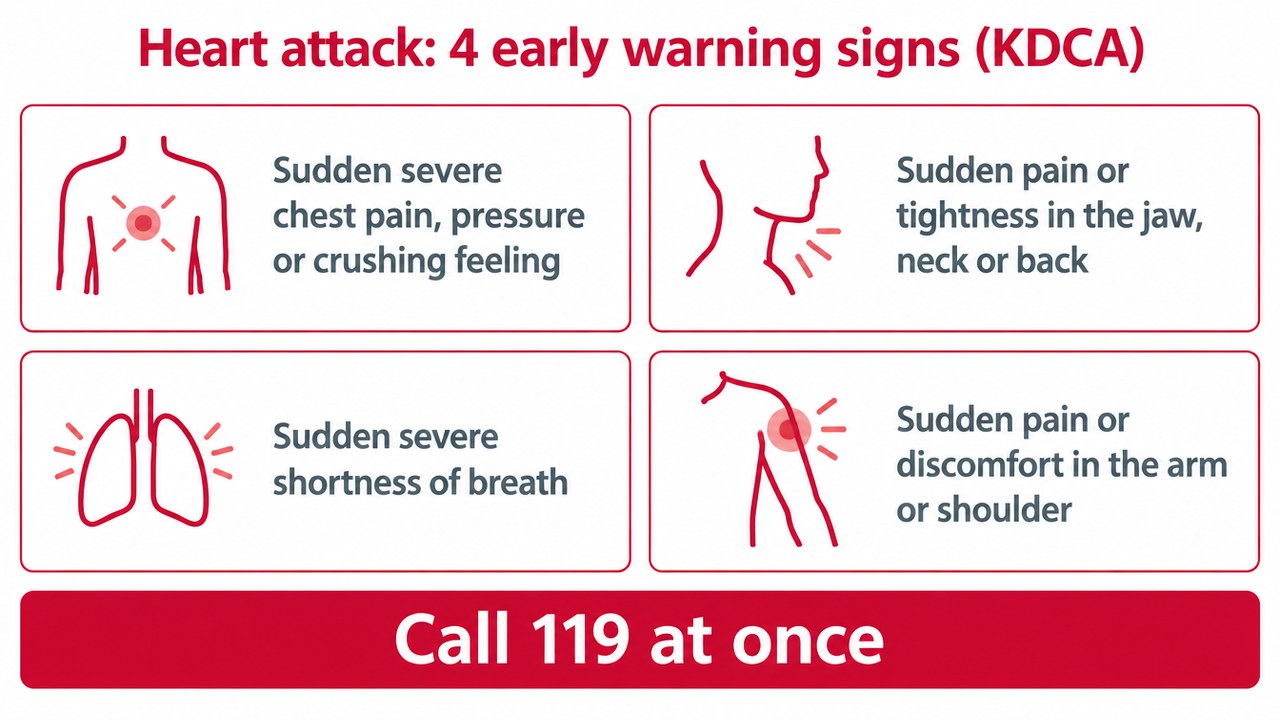
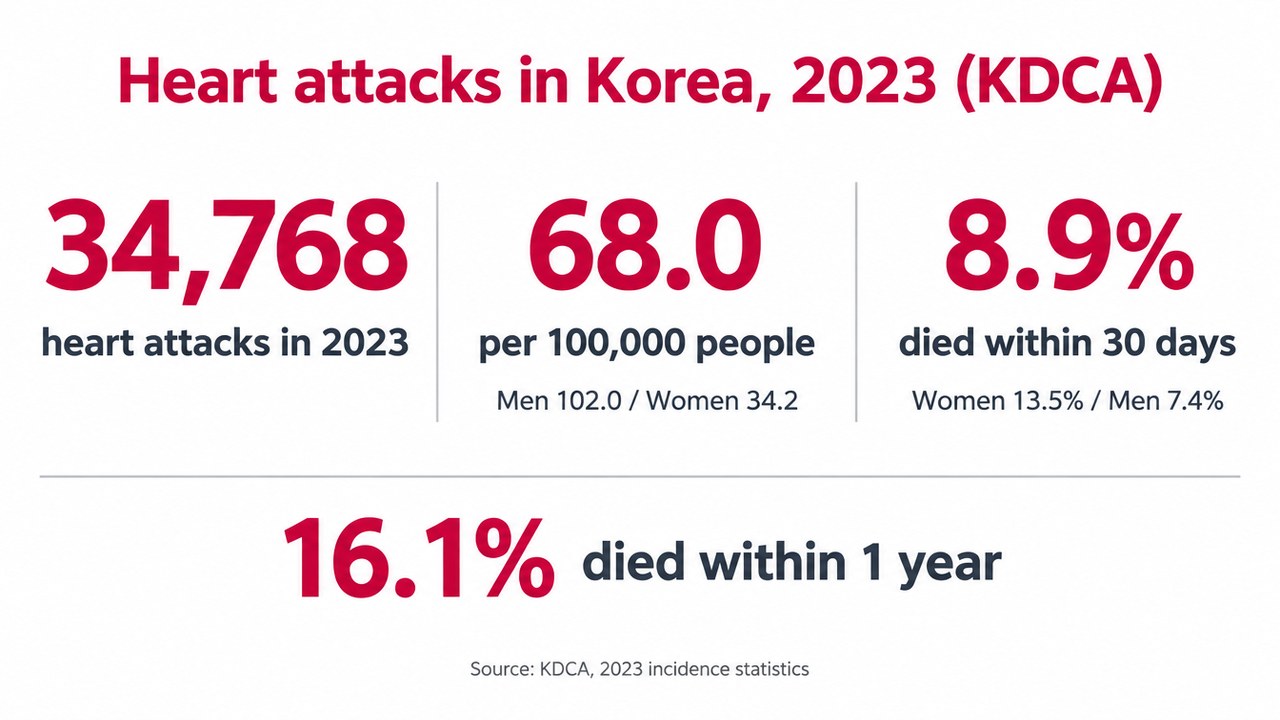
Quick answer: KDCA lists four early warning signs of a heart attack: sudden severe chest pain, pressure or a crushing feeling; sudden severe pain or tightness in the jaw, neck or back; sudden severe shortness of breath; and sudden pain or discomfort in the arm or shoulder. A pale face and cold sweat often come with them. If they appear, call 119 straight away, do not drive yourself, do not wait for family to arrive and do not wait until morning or Monday. KDCA’s portal says the early death rate of acute myocardial infarction is about 30%, and its 2023 statistics count 34,768 heart attacks in Korea that year, 68.0 per 100,000 people. Winter matters: KDCA says cold weather narrows blood vessels and raises blood pressure, and heart and brain deaths cluster in the coldest months and in March.
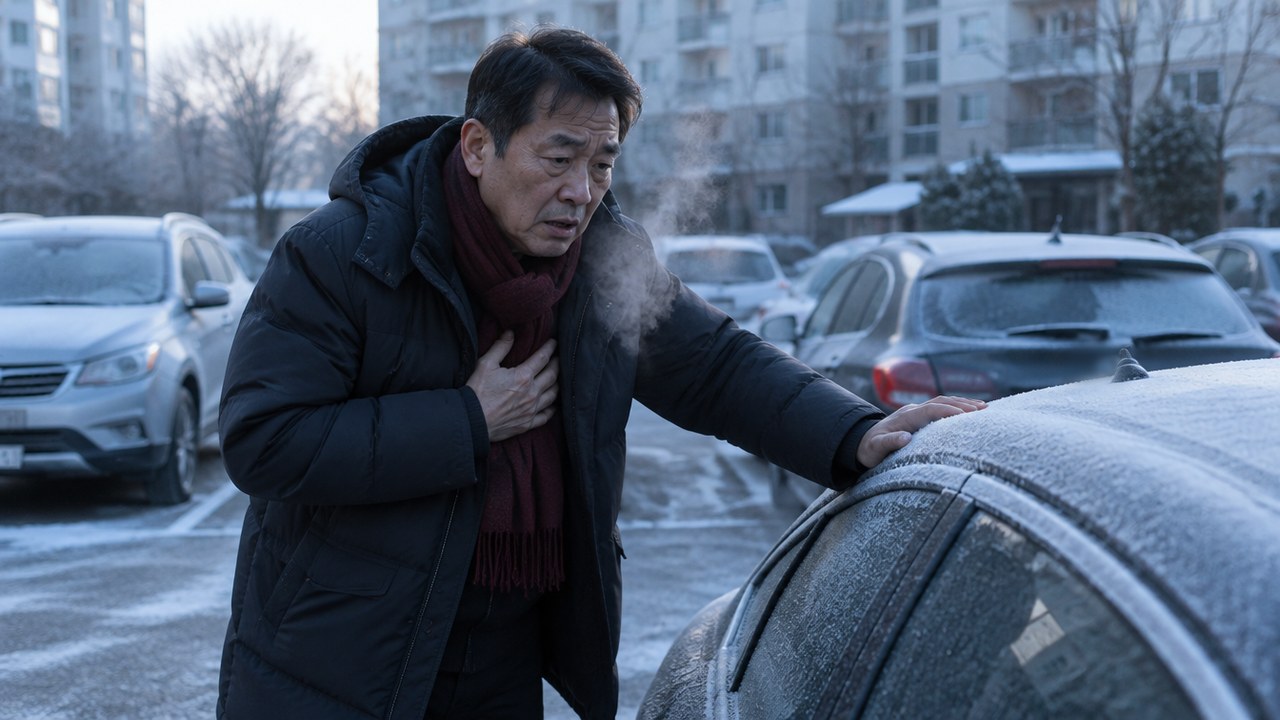
Most people know a heart attack as a man clutching his chest and collapsing. Real heart attacks are often less dramatic and more confusing: a heavy pressure that comes and goes, pain that seems to sit in the jaw or the left arm, breathlessness on the stairs, or an “upset stomach” with a cold sweat. People in their forties to sixties, and the adult children of parents over 65, are the ones most likely to face that moment, at home, at work or on a cold morning walk. This guide sets out what Korea’s health authorities tell people to watch for and what to do, in the order you would need it.
This article does not cover stroke, which has its own set of signs; our separate guide to stroke warning signs is linked at the end.
The four early warning signs KDCA lists
KDCA’s cardio-cerebrovascular awareness page lists these as the early symptoms of a heart attack (심근경색의 조기증상). Each begins with the word suddenly.
| KDCA early warning sign | What it can feel like |
|---|---|
| Sudden severe chest pain, pressure or a crushing feeling | A heavy weight, squeezing or tightness in the centre of the chest |
| Sudden severe pain or tightness in the jaw, neck or back | Pain that seems to start outside the chest |
| Sudden severe shortness of breath | Gasping for breath, unable to finish a sentence |
| Sudden pain or discomfort in the arm or shoulder | Often the left arm, but it can be either side |
KDCA’s portal page on acute myocardial infarction adds detail. The typical pain sits in the middle of the chest and feels like pressing, tightening or wringing. It lasts 30 minutes or more and does not ease with rest or with a nitroglycerin tablet under the tongue. It can spread to the neck, jaw, shoulder and left arm, with a pale face and cold sweat.
The two foreign health services we checked describe the same picture. The CDC lists chest discomfort that lasts more than a few minutes or goes away and comes back; feeling weak, light-headed or faint with a cold sweat; pain in the jaw, neck or back; pain in one or both arms or shoulders; and shortness of breath. The NHS lists crushing or squeezing chest pain that may spread to the arm, neck and jaw, shortness of breath, nausea, a feeling like indigestion, sweating and pale or grey skin.
Signs that are easy to miss
KDCA warns that a heart attack does not always look typical. Its portal says it can show up as breathlessness or dizziness instead of chest pain, and that in older people and people with diabetes there may be no clear symptoms at all, only weakness. Its winter health page adds that vomiting, stomach pain and loss of appetite can lead people to mistake a heart attack for indigestion or a stomach upset.
The CDC adds unusual or unexplained tiredness and nausea or vomiting, and says women are more likely to have these other symptoms.
For families this is the key practical point: if a parent in their seventies with diabetes suddenly says they feel “very weak”, “short of breath” or “like something is stuck in the chest”, and especially if they are pale and sweating, treat it as a possible heart attack, not as a cold.
Why winter raises the risk
KDCA’s monthly health information for November 2021, titled “the winter visitor: myocardial infarction”, says that when the temperature drops sharply, blood vessels contract and blood pressure rises, so heart and brain diseases need extra care. It says that over the previous ten years, deaths from cardio-cerebrovascular disease were highest in the coldest winter months and in March, when the gap between day and night temperatures is large. A later KDCA page (August 2024) repeats that heart and brain disease needs more care in both summer and winter.
What this means in daily life, especially for anyone with high blood pressure, diabetes or a past heart problem:
- Wear a hat, scarf and gloves on cold mornings, and avoid stepping straight from a warm room into freezing air for hard effort.
- Avoid heavy exertion, such as shovelling snow or hurrying uphill, early in the morning in the cold.
- Keep taking blood-pressure and other prescribed medicines through the winter.
What to do in the first minutes
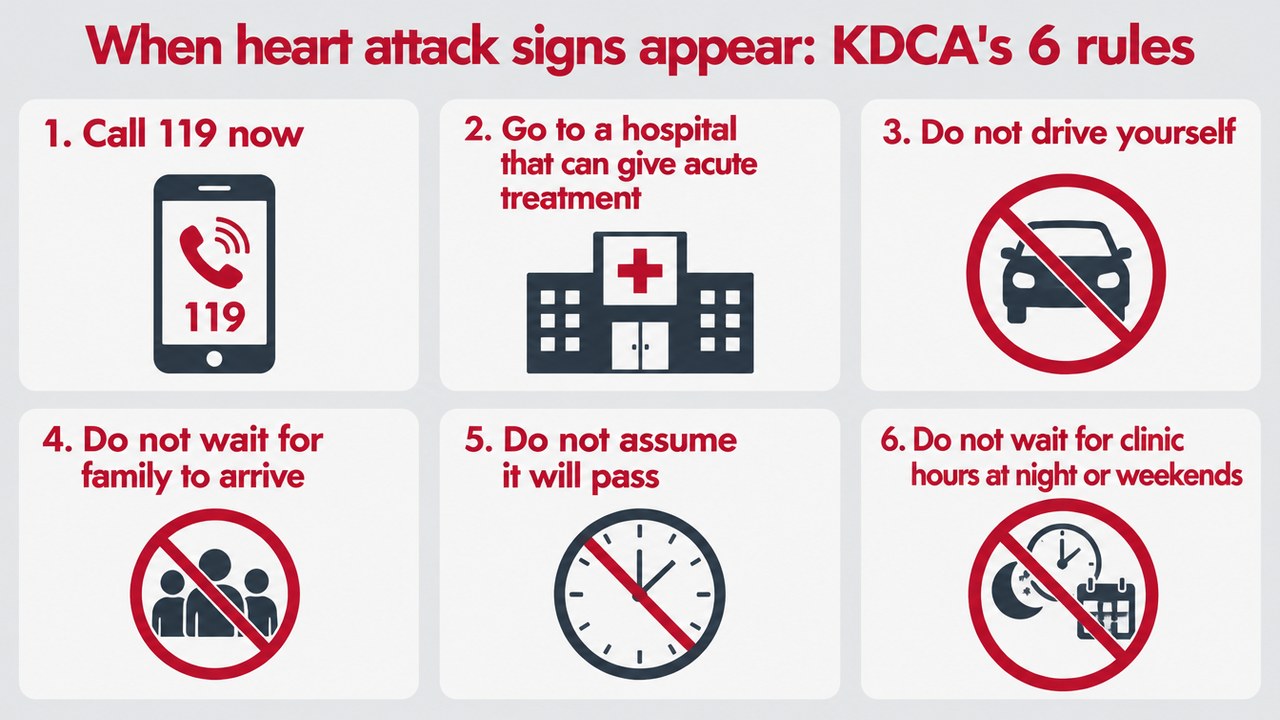
KDCA’s campaign page gives six rules for when early symptoms appear:
- Call 119 for help without delay.
- Go to a hospital that can give acute treatment.
- Do not drive yourself. It is dangerous.
- Do not wait for family to arrive.
- Do not assume the symptoms will pass.
- Do not wait for outpatient hours because it is night or the weekend.
KDCA’s winter page adds: move as little as possible, and do not waste time hoping it will get better or by going to a local clinic, pharmacy or traditional-medicine clinic first. Call 119 and go to a hospital that can perform emergency coronary intervention (opening the blocked artery). In Korea, 119 is the number for both fire and ambulance, and the call is free.
While you wait, the NHS advises sitting on the floor or a chair with your back supported, and taking your own angina spray if you have one. Ask the 119 operator before giving any medicine; the NHS’s aspirin advice is for the UK, and aspirin is not right for everyone.
If the person collapses, does not respond and is not breathing normally, start chest compressions (CPR) and ask the 119 operator to guide you. KDCA’s winter page says 60 to 80% of cardiac arrests happen outside medical facilities, at home, at work or in the street, so the first person on the scene is usually a family member, colleague or passer-by. It says the brain suffers irreversible damage four to five minutes after the heart stops, which is why CPR has to start straight away.
Why every minute counts
KDCA’s portal describes a heart attack as a coronary artery suddenly and completely blocked, so that part of the heart muscle stops getting blood. The longer the blockage lasts, the more muscle dies. KDCA says the most important treatment is to reopen the artery as quickly as possible:
| What happens in hospital (KDCA portal) | Target time |
|---|---|
| Clot-dissolving drug, if emergency intervention is not available | Within about 30 minutes of arrival, for people arriving within 12 hours of chest pain |
| Emergency coronary intervention for the most urgent type (ST-elevation heart attack) | Within about 90 minutes of arrival |
| Coronary intervention for the less urgent type (non-ST-elevation), without special risk factors | Within about 72 hours |
Those clocks only start once you reach the hospital. Calling 119 rather than driving, or waiting for a relative, is what you can do to shorten the time before them.
Korea’s heart attack numbers (KDCA, 2023)
KDCA’s 2023 cardio-cerebrovascular disease incidence statistics, released on 30 December 2025 and based on National Health Insurance and cause-of-death data, give the scale of the problem:
| KDCA 2023 statistic | Figure |
|---|---|
| Heart attacks in 2023 | 34,768 |
| Rate per 100,000 people | 68.0 (men 102.0, women 34.2) |
| Rate among people aged 80 and over | 316.7 per 100,000, the highest of any age group |
| Share that were repeat heart attacks | 9.6% |
| Deaths within 30 days | 8.9% overall; 7.4% of men, 13.5% of women; 14.2% of people 65 and over |
| Deaths within 1 year | 16.1% overall; 13.5% of men, 23.6% of women |
Two patterns stand out. Men have heart attacks about three times as often as women, but women who have one are more likely to die within a month and within a year. KDCA’s statistics do not explain the gap; one possible factor, which the CDC also notes, is that women more often have the less obvious symptoms, which can delay a call for help. And the rate rises steeply with age, so the over-65 parents of today’s forty- and fifty-somethings are the group with the most at stake.
KDCA also notes that heart disease has been Korea’s second leading cause of death, after cancer, for the past ten years.
The risk factors you can check now
KDCA’s portal names atherosclerosis, the build-up and hardening of fatty deposits in the arteries, as the main cause of heart attacks, and lists smoking, high blood pressure, diabetes, high cholesterol and obesity as risk factors. The NHS adds a close relative who has had a heart attack.
For people who already have these conditions, KDCA’s portal gives treatment targets: blood pressure below 130/80 mmHg, HbA1c below 7.0%, and LDL cholesterol below 55 mg/dL. These are targets for people under treatment, set by their doctors; they are not the same as the checkup’s screening lines.
KDCA’s nine rules for preventing heart and brain disease, in short:
- Do not smoke. KDCA says the risk falls by about half about a year after quitting.
- Drink as little alcohol as possible.
- Eat regular, balanced, less salty meals with whole grains, vegetables, beans and fish.
- Exercise for at least 30 minutes every day and sit less.
- Keep a healthy weight and waist size.
- Manage stress.
- Measure your blood pressure, blood sugar and cholesterol regularly. KDCA says people in their forties and over should check them with a doctor regularly.
- If you have high blood pressure, diabetes or high cholesterol, improve your habits and keep taking your treatment.
- Learn the warning signs of stroke and heart attack, and call 119 at once if they appear.

Illustrative scenarios
These are examples to show how the advice applies, not real cases.
- A 58-year-old man on blood-pressure pills feels a tight, heavy pressure in his chest after clearing ice from the car at 7 a.m. It has lasted ten minutes and he is sweating. He should stop, sit down and have someone call 119. He should not drive to the hospital himself or “wait to see if it passes”.
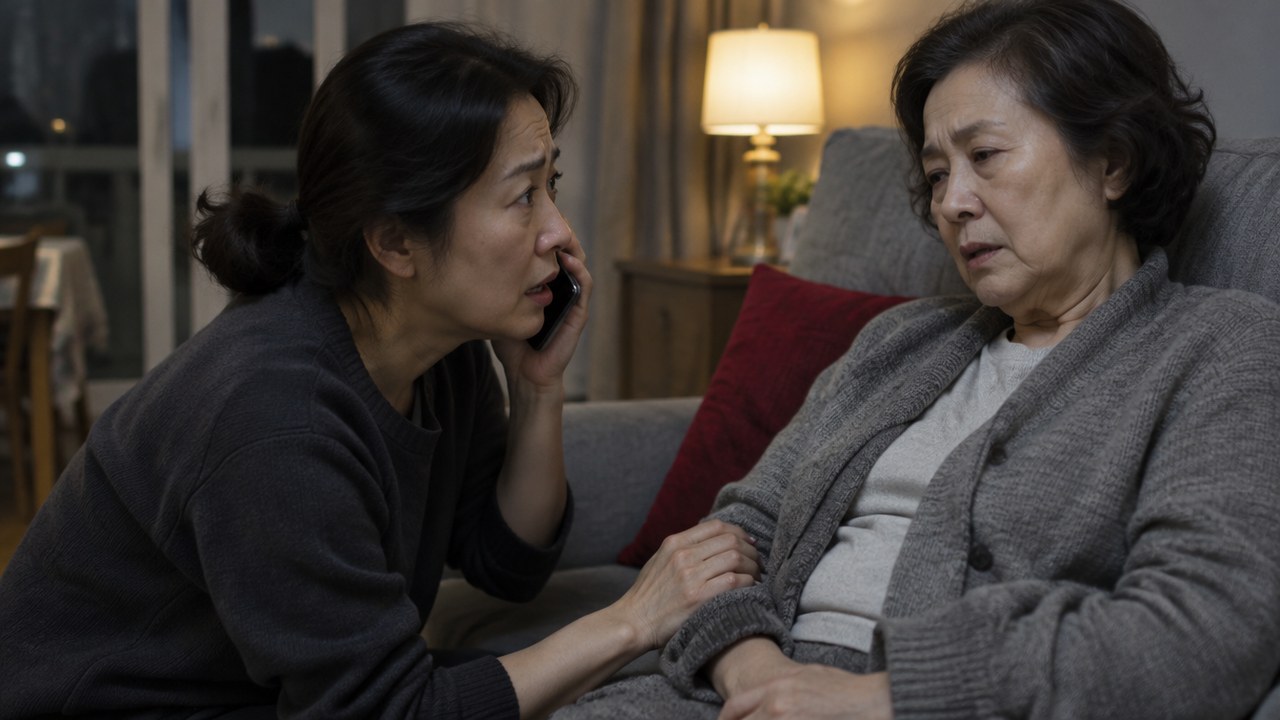
- A 74-year-old mother with diabetes says on a Sunday evening that she feels very weak and short of breath, and looks pale. There is no chest pain. KDCA warns that older people and people with diabetes may have only weakness. Her daughter should call 119 rather than wait for Monday’s clinic.
- A 49-year-old woman has pain in her jaw and left shoulder with nausea while climbing stairs, and it eases when she rests, then comes back. The CDC says chest discomfort that goes away and comes back is a warning sign. She should call 119; if it turns out not to be a heart attack, that is a good outcome, not a wasted call.
What families can do this week
- Write 119 and the nearest large hospital’s emergency room on a note by the phone of any parent over 65.
- Talk through the six KDCA rules with parents, especially “do not wait for family to arrive”.
- Check blood pressure, blood sugar and cholesterol if you have not had your national health checkup this year. The 2026 checkup window runs to 31 December, 48 days from 13 November.
- Learn hands-only CPR in a course near you, so that you can start compressions while the 119 operator guides you.
- Plan for cold mornings: warm clothing, no heavy exertion straight out of a warm house, and medicines taken as prescribed.
Related reading
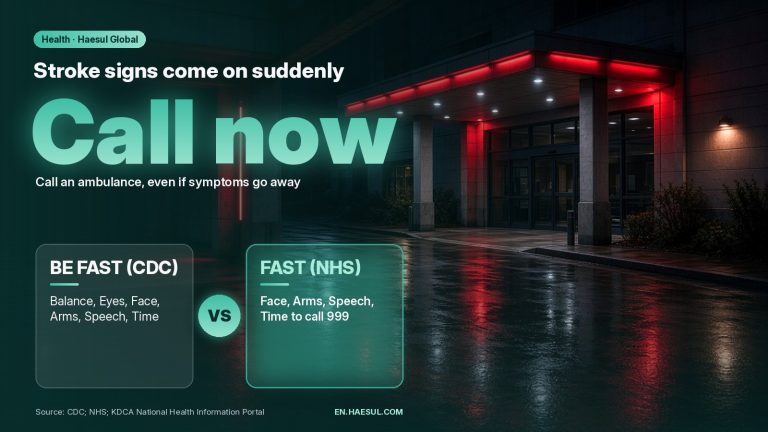
- Stroke signs: the CDC’s BE FAST check, and when to call 911, 999 or 119
- Blood pressure on Korea’s national checkup: what 140/90 means on your result sheet
- Hypothermia and frostbite in Korea’s winter: what KDCA’s cold-illness data say about parents over 65
- LDL cholesterol on Korea’s checkup: what a flag means and the confirmatory test
Frequently asked questions
Q. What are the early warning signs of a heart attack according to KDCA?
KDCA lists sudden severe chest pain, pressure or a crushing feeling; sudden severe pain or tightness in the jaw, neck or back; sudden severe shortness of breath; and sudden pain or discomfort in the arm or shoulder. A pale face and cold sweat often come with them.
Q. How long does heart attack chest pain last?
KDCA’s portal says the typical pain lasts 30 minutes or more and does not ease with rest or nitroglycerin. The CDC says discomfort lasting more than a few minutes, or going away and coming back, is a warning sign. Do not wait 30 minutes to call 119.
Q. Should I drive to the hospital myself if I think I am having a heart attack?
No. KDCA says driving yourself is dangerous and tells people to call 119 without delay, go to a hospital that can give acute treatment and not wait for family to arrive. The NHS gives the same advice.
Q. Can a heart attack happen without chest pain?
Yes. KDCA says it can show up as breathlessness or dizziness, and that older people and people with diabetes may have only weakness. Nausea, stomach pain and a feeling like indigestion can also occur.
Q. Why are heart attacks more common in winter?
KDCA says cold weather makes blood vessels contract and raises blood pressure, and that deaths from heart and brain disease have been highest in the coldest months and in March, when day and night temperatures differ most.
Q. How many heart attacks happen in Korea each year?
KDCA counted 34,768 in 2023, 68.0 per 100,000 people: 102.0 for men and 34.2 for women. 8.9% of patients died within 30 days and 16.1% within a year.
Not medical advice. Warning signs and guidance are as published by KDCA, the CDC and the NHS on 13 November 2026. If you think you or someone else is having a heart attack, call 119 now rather than reading further.
Sources
- KDCA National Health Information Portal, acute myocardial infarction (updated 23 April 2026): https://health.kdca.go.kr/healthinfo/biz/health/gnrlzHealthInfo/gnrlzHealthInfo/gnrlzHealthInfoView.do?cntnts_sn=6770
- KDCA, cardio-cerebrovascular disease awareness campaign (early warning signs and six response rules): https://kdca.go.kr/kdca/3363/subview.do
- KDCA National Health Information Portal, monthly health information, “The winter visitor: myocardial infarction” (November 2021): https://health.kdca.go.kr/healthinfo/biz/health/ntcnInfo/healthSourc/thtimtCntnts/thtimtCntntsView.do?thtimt_cntnts_sn=8
- KDCA National Health Information Portal, monthly health information, heart and brain disease in summer and winter (August 2024): https://health.kdca.go.kr/healthinfo/biz/health/ntcnInfo/healthSourc/thtimtCntnts/thtimtCntntsView.do?thtimt_cntnts_sn=74
- KDCA press release, 2023 cardio-cerebrovascular disease incidence statistics (30 December 2025): https://www.kdca.go.kr/bbs/kdca/42/304183/download.do
- US Centers for Disease Control and Prevention, about heart attack symptoms, risk and recovery (independent cross-check): https://www.cdc.gov/heart-disease/about/heart-attack.html
- NHS, heart attack (independent cross-check, reviewed 31 March 2026): https://www.nhs.uk/conditions/heart-attack/
- Datasom, report on KDCA’s 2023 heart attack statistics (independent cross-check of the headline figure): https://www.datasom.co.kr/news/articleView.html?idxno=207369




4 Comments