Scrub Typhus in Korea: Autumn Symptoms, the Black “Eschar” and How to Prevent It
By the Haesul Global health desk (AI-assisted). Information as of October 16, 2026 (KST).
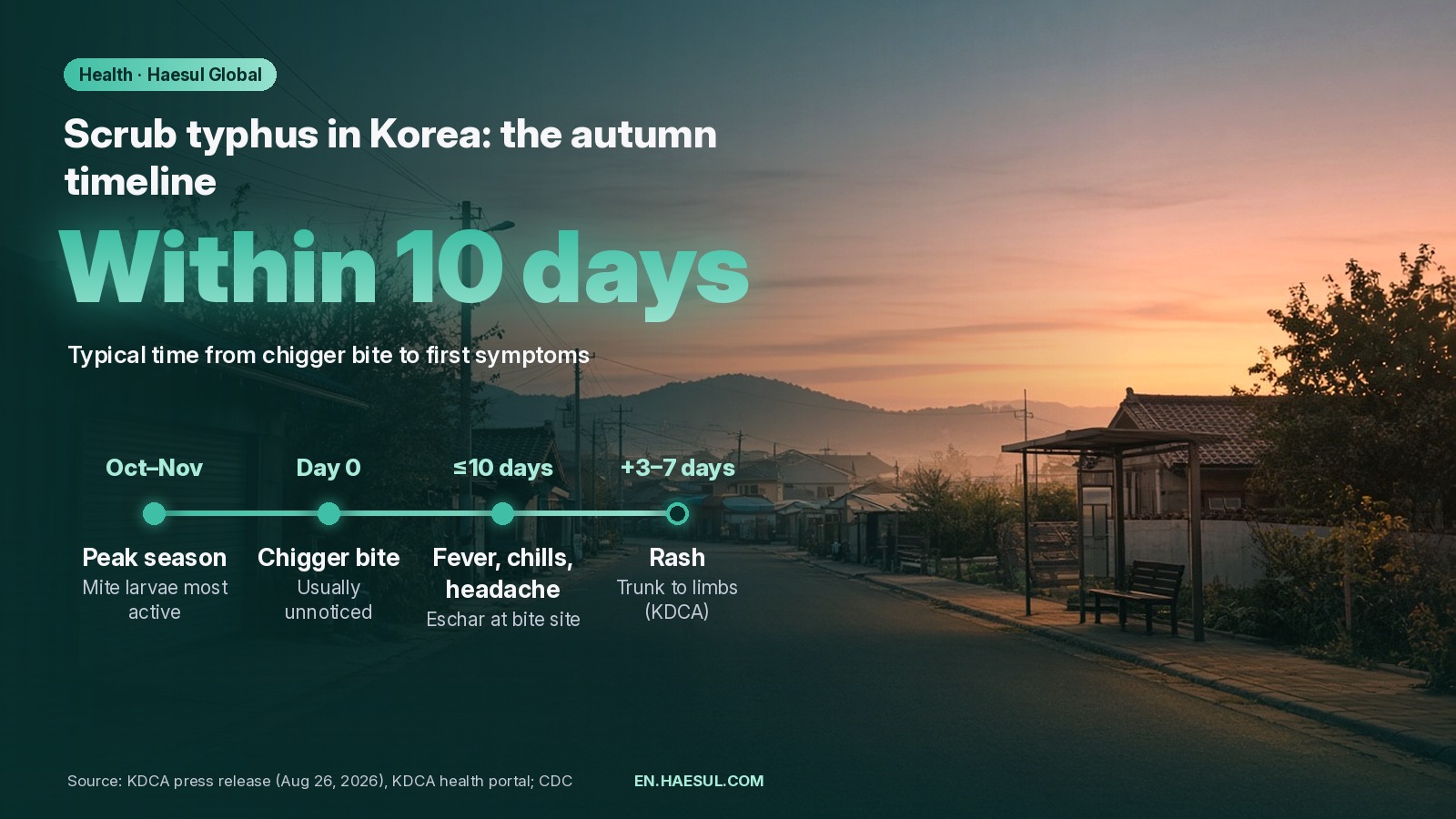
Quick answer: Scrub typhus (쯔쯔가무시증, tsutsugamushi) is caught from the bite of infected larval mites (chiggers). In Korea, cases peak in October and November. Symptoms such as fever, headache and chills usually start within 10 days of the bite, and a dark scab called an eschar often forms where you were bitten. Korea’s KDCA and the US CDC both say to see a doctor if you get these symptoms after time outdoors.
Autumn is when many people in Korea go hiking for the fall colors, pick chestnuts, or help tend family graves (beolcho). It is also scrub typhus season. Here is what Korea’s Disease Control and Prevention Agency (KDCA) and the US Centers for Disease Control and Prevention (CDC) say, side by side.
1) How common is it in Korea?
- KDCA calls scrub typhus Korea’s most common rickettsial disease, found nationwide.
- Reported cases in 2024: 6,268 (KDCA tick-borne disease page, 2015–2024 table). KDCA gives the yearly range differently on two pages: “about 3,000–6,000 patients” (Aug 26, 2026 press release) and “about 5,000–6,000 cases” (tick-borne disease page).
- Cases are concentrated in October and November, when the mite larvae are most active (KDCA press release, health portal and tick-borne disease page).
- Highest rates per 100,000 people: South Jeolla, North Jeolla, South Chungcheong and South Gyeongsang, in that order (KDCA health portal and tick-borne disease page).
- KDCA is monitoring chiggers at 18 sites nationwide from Aug 26 to Dec 16, 2026, with weekly updates on its infectious disease portal (KDCA press release).
Globally, the CDC says most cases occur in rural areas of Southeast Asia, Indonesia, China, Japan, the Indian subcontinent and northern Australia, and that anyone living in or traveling to those areas can be infected. (Korea is not named on that CDC page; KDCA’s data show it is common here.)
Risky activities listed by KDCA include farm work and weekend gardens, harvesting, mowing and grave-tending, picking persimmons or chestnuts, gathering wild greens and leaving marked hiking trails.
2) Symptoms: KDCA and CDC side by side
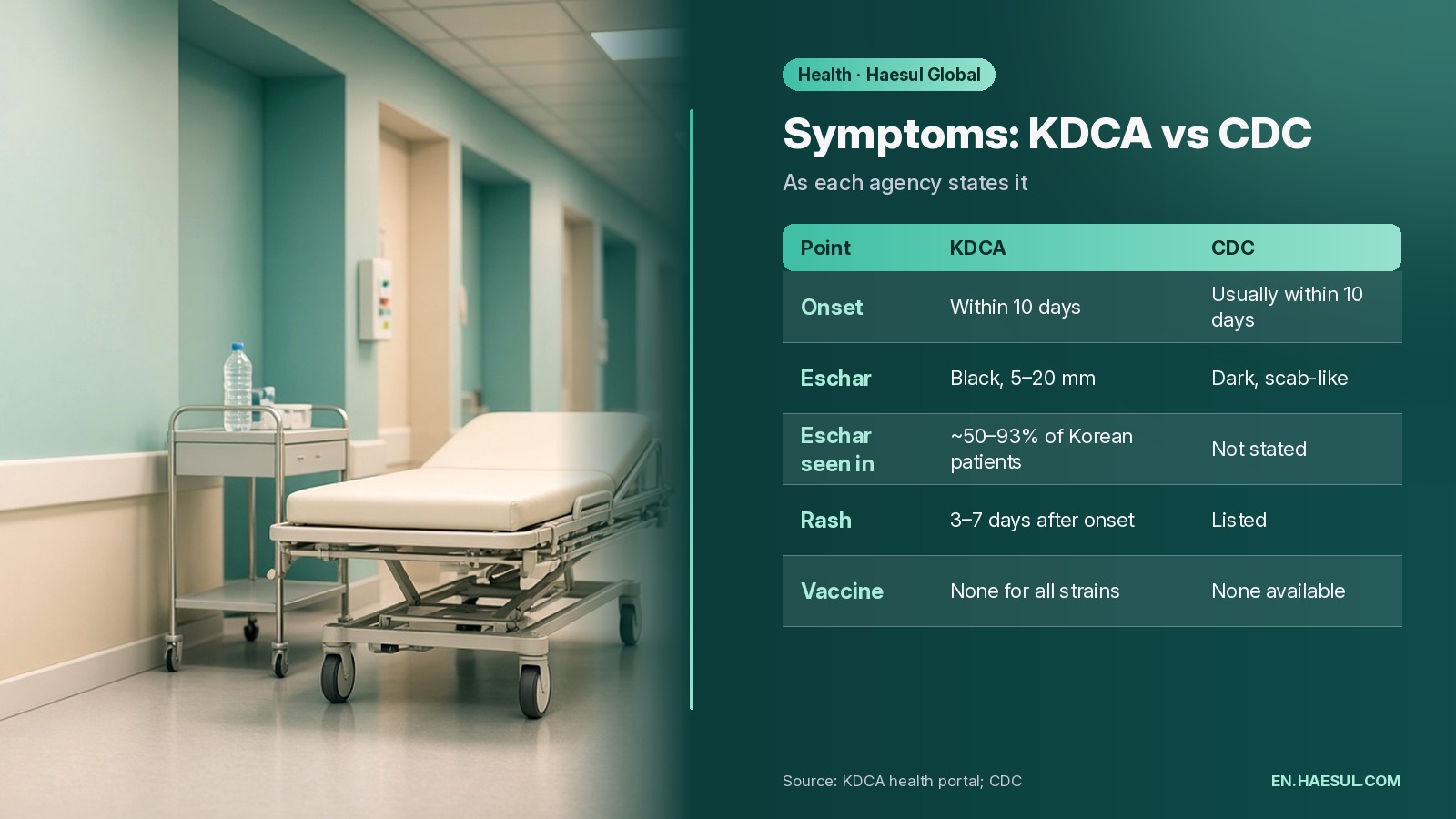
| Point | KDCA (Korea) | CDC (US) |
|---|---|---|
| When symptoms start | Within 10 days (incubation) | Usually within 10 days |
| Main symptoms | Sudden fever, chills, headache; then muscle aches, cough, vomiting, sore throat | Fever and chills, headache, body aches, muscle pain |
| Eschar | Black scab, 5–20 mm, at the bite site; found in about 50–93% of Korean patients | Dark, scab-like region at the bite site |
| Rash | Red, non-itchy rash 3–7 days after onset, spreading from trunk to limbs | Rash listed |
| Other | — | Mental changes (confusion to coma), enlarged lymph nodes |
| Vaccine | No vaccine effective against all strains | No vaccine available |
Where to look for the eschar: KDCA says it often appears in folded, moist skin — under underwear, the armpits and behind the knees — and also in hard-to-see places such as the navel, behind the ears, around the anus and on the scalp. The CDC lists the armpits, under the breast and the groin as common sites.
Why it matters: Untreated, the CDC says scrub typhus can be fatal and may cause organ damage and severe bleeding. KDCA estimates the fatality rate in Korea at about 0.1–0.3%. Both agencies say it is treated with antibiotics prescribed by a doctor (the CDC names doxycycline), and that early treatment works best.
3) Prevention checklist
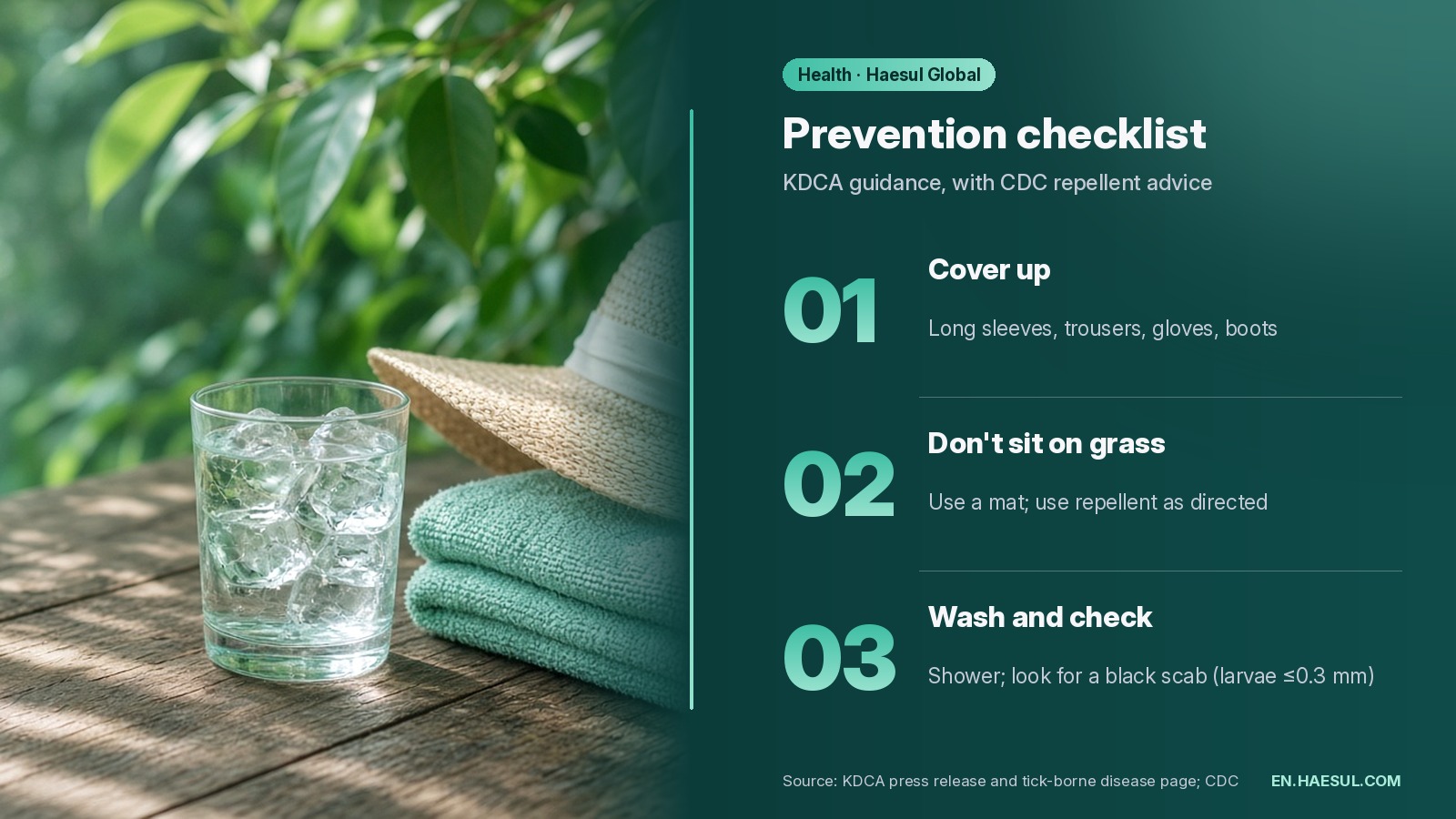
Before and during time outdoors (KDCA; CDC where noted):
- Wear long sleeves, long trousers, a hat, gloves, long socks and boots.
- Don’t sit or lie directly on grass; use a mat, and don’t leave clothes on the grass.
- Use insect repellent, reapplying as directed. The CDC recommends EPA-registered repellents such as DEET on skin and clothing, and 0.5% permethrin on clothing and gear only — never on skin.
- Avoid grass higher than your ankles.
After you get home (KDCA):
- Shake out and wash your clothes right away.
- Shower and check your body for bites or a black scab. Chigger larvae are 0.3 mm or smaller, so you usually can’t see them.
- If symptoms appear, visit a public health center (보건소) or a clinic. The CDC adds: tell your doctor where and when you were outdoors or traveled.
FAQ
Can I get it twice?
Yes. KDCA says because the bacteria have many strains, a person can be infected again.
Is it spread from person to person?
Neither source describes person-to-person spread; both describe infection through chigger bites.
I’m visiting Korea in autumn. Should I worry?
The sources don’t give separate advice for visitors. Both agencies’ guidance applies to anyone outdoors in grassy or brushy areas; KDCA’s data show most cases in rural farming areas.
Is this the same as SFTS?
No. KDCA lists scrub typhus and SFTS as separate tick- and mite-borne diseases. A tick bite often leaves no visible mark, while a chigger bite leaves the black eschar (KDCA).
This article summarizes public information from KDCA and the CDC. It is not medical advice and does not replace a doctor. If you have a fever or other symptoms after time outdoors, contact a clinic or public health center.
Korean-language version: 쯔쯔가무시증 증상 정리 (Naver blog).
Sources
- KDCA press release, “쯔쯔가무시증 유행시기 다가온다, 전국 털진드기 감시 시작” (Aug 26, 2026; last updated Oct 13, 2026; checked Oct 16, 2026) https://www.kdca.go.kr/kdca/2848/subview.do?enc=Zm5jdDF8QEB8JTJGYmJzJTJGa2RjYSUyRjQyJTJGMzEyMzM3JTJGYXJ0Y2xWaWV3LmRvJTNG
- KDCA National Health Information Portal, “쯔쯔가무시증” (updated Apr 17, 2026; checked Oct 16, 2026) https://health.kdca.go.kr/healthinfo/biz/health/gnrlzHealthInfo/gnrlzHealthInfo/gnrlzHealthInfoView.do?cntnts_sn=5261
- KDCA, “진드기매개감염병관리” (last reviewed Sep 29, 2026; checked Oct 16, 2026) https://www.kdca.go.kr/kdca/3396/subview.do
- US CDC, “About Scrub Typhus” (reviewed May 15, 2024; checked Oct 16, 2026) https://www.cdc.gov/typhus/about/scrub.html