Korea Year-End Medical Expense Tax Credit 2026: What Counts, Receipts and How to Upload on Hometax
Haesul Economy desk (AI-assisted). Last checked: 2026-11-10 (KST); countdown updated 2026-11-13; first published 6 November 2026. Medical bills paid by December 31, 2026 count for tax year 2026 — 48 days left. Rates and caps re-read on the NTS special tax-credit page on Nov 10. Based on the National Tax Service (NTS) special tax-credit page, NTS call-centre guidance, tax-specialist reporting of the Income Tax Act rules, and our earlier year-end settlement guides. This is general information, not tax, financial or legal advice. Confirm your own numbers with payroll or a licensed tax adviser before you file.
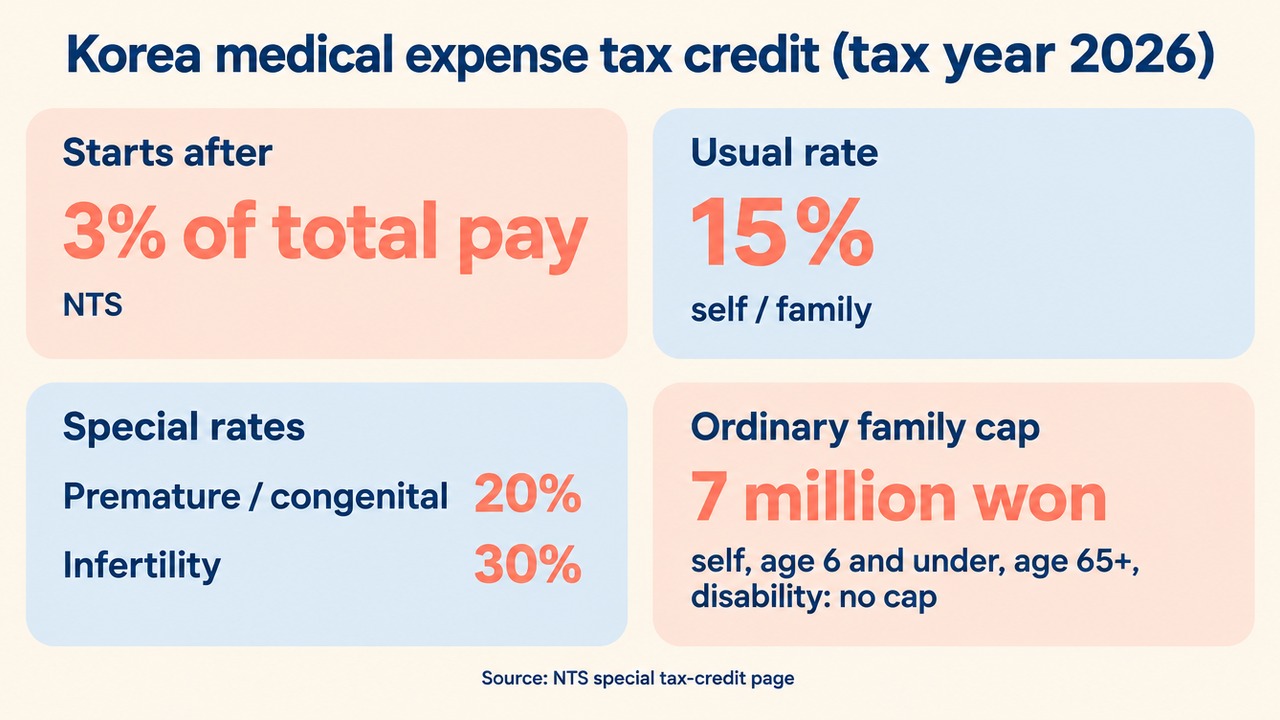
Quick answer: Bills you pay by December 31, 2026 — 48 days left from November 13 — count for 2026 (NTS). Korea’s medical expense tax credit (의료비 세액공제) only starts after your recognised medical spending for the year exceeds 3% of your total pay (총급여). On the excess, the credit is usually 15%. Premature-baby and congenital-anomaly care is 20%, and infertility treatment is 30%, both with no amount cap. Your own care, care for a child aged 6 or under, care for someone aged 65 or over, and care for a registered person with a disability also have no amount cap at 15%. Ordinary medical spending for other basic-deduction family members is capped at ₩7 million a year before the rate is applied. Subtract private insurance reimbursements and NHIS out-of-pocket cap refunds first. Most hospital and pharmacy bills appear in Hometax’s simplified year-end data; missing items need paper receipts for your employer.
Year-end tax settlement (연말정산) turns a year of payroll withholding into your real income tax. Medical spending is one of the special tax credits that reduce calculated tax, not an income deduction. This guide is for tax year 2026 spending (1 January–31 December 2026), settled with employers in early 2027. For the wider timeline, Hometax login steps and the 19% flat-tax choice, see our year-end tax settlement guide for foreigners. The medical credit sits next to the social-insurance lines on your payslip; those four deductions are explained in our payslip guide.

Who can claim, and who is a “basic deduction” patient
According to the NTS, a resident wage earner (not a daily worker) can claim the medical expense tax credit for amounts paid in the tax year for basic-deduction family members, and for this credit the age and income limits that apply to the basic deduction itself are waived. In plain English: you can claim medical bills you paid for a parent, spouse or child who lives with you as a dependant even if that person earns a little or is the “wrong” age for the ₩1.5 million basic deduction.
Non-residents and people who chose the 19% flat tax for foreign workers generally cannot stack ordinary special tax credits such as this one. If you are deciding between progressive rates and the flat rate, read our 19% flat-tax guide first; the flat rate usually wins only at high pay, and it means giving up medical and other credits.
The 3% threshold: why small bills often give zero credit
The NTS rule is simple and often misunderstood. Only the part of recognised medical spending that exceeds 3% of total pay enters the credit calculation. Total pay here is the same 총급여 figure your employer uses for settlement.
| Total pay (총급여) | 3% floor (no credit below this) |
|---|---|
| ₩40,000,000 | ₩1,200,000 |
| ₩50,000,000 | ₩1,500,000 |
| ₩70,000,000 | ₩2,100,000 |
| ₩100,000,000 | ₩3,000,000 |
Source: NTS special tax-credit page (의료비 세액공제: “총급여액의 3%를 초과하는 금액이 의료비 세액공제 대상임”); floor amounts calculated from that rule.
So a worker on ₩50 million who spent ₩1.2 million on recognised care gets no medical tax credit, because the spending never cleared the ₩1.5 million floor. The same worker who spent ₩3.0 million has ₩1.5 million of credit base before rates and caps.
Rates and caps for tax year 2026
The NTS table currently in force (checked 6 November 2026) is:
| Category | Cap on credit base | Credit rate |
|---|---|---|
| Ordinary medical spending for other basic-deduction family members | ₩7,000,000 a year | 15% |
| Yourself; a child aged 6 or under; a person aged 65 or over; a registered person with a disability | No amount cap | 15% |
| Premature baby / congenital anomaly care | No amount cap | 20% |
| Infertility treatment | No amount cap | 30% |
| Postpartum care centre (산후조리원), per birth | ₩2,000,000 | (included in medical credit rules) |
Source: NTS, “세율” special tax-credit page, medical expense table and postpartum note. Independent tax press (Etax News, 2026) reports the same 3% / 15% / 20% / 30% structure and lists vision-correction glasses and contact lenses at up to ₩500,000 per person among eligible domestic items.
Two practical notes:
- “No amount cap” does not mean unlimited cash back. It means there is no ₩7 million ceiling on that category’s credit base. You still only get a percentage of the amount above the 3% floor, and only up to the tax you actually owe.
- Order of the 3% floor matters when you mix categories. Tax-specialist write-ups of the statute describe applying the floor first to ordinary family medical spending, then to uncapped 15% items, then to 20% and 30% items. Your payroll software or Hometax calculator usually does this; if you are close to the line, ask payroll rather than guessing.
Worked example (illustrative payslip inputs)
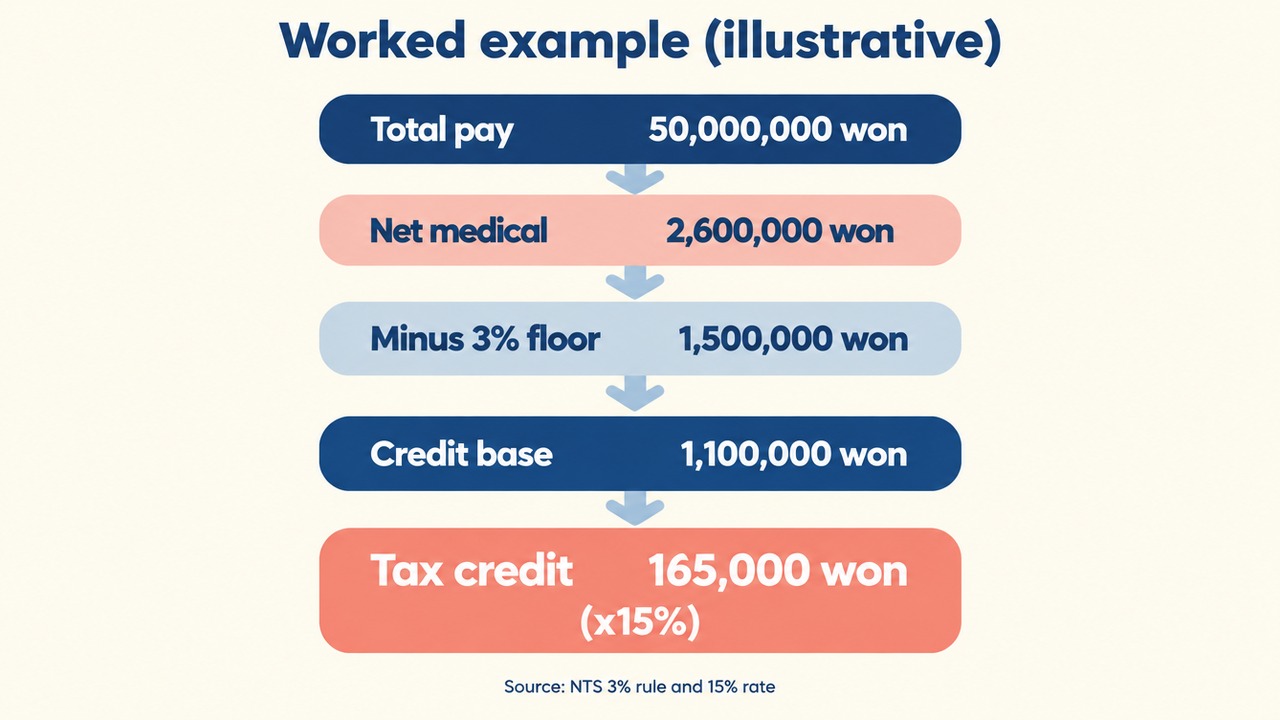
Take a resident employee with ₩50,000,000 total pay in 2026. Recognised medical spending after insurance refunds:
- Self (hospital + pharmacy): ₩2,400,000
- Spouse (ordinary family category): ₩800,000
- Private insurance reimbursement already received on those bills: ₩600,000
Step 1 — net recognised spending. ₩2,400,000 + ₩800,000 − ₩600,000 = ₩2,600,000.
Step 2 — subtract the 3% floor. 3% of ₩50,000,000 = ₩1,500,000. Excess = ₩1,100,000.
Step 3 — apply rates and the family cap. All of this excess is in the 15% band (self is uncapped; spouse’s share is well under ₩7 million). Credit = ₩1,100,000 × 15% = ₩165,000 of national income tax. Local income tax (usually 10% of the national figure) moves in the same direction.
| Step | Amount |
|---|---|
| Gross medical bills | ₩3,200,000 |
| Minus insurance reimbursement | −₩600,000 |
| Recognised medical spending | ₩2,600,000 |
| Minus 3% of ₩50M pay | −₩1,500,000 |
| Credit base | ₩1,100,000 |
| × 15% | ₩165,000 national tax credit |
Sources: NTS 3% rule and 15% rate; reimbursement exclusion on the same NTS page. Payslip figures are illustrative.

What counts — and what the NTS says does not
Typically eligible (domestic): payments to hospitals, clinics and pharmacies for treatment; disability assistive devices and certain medical-equipment purchase or rental; disability activity-support co-pays you actually paid (from spending on or after 1 January 2024); postpartum care centre fees within the ₩2 million-per-birth note; and, as tax-specialist reporting of the Enforcement Decree describes, vision-correction glasses and contact lenses up to ₩500,000 per person.
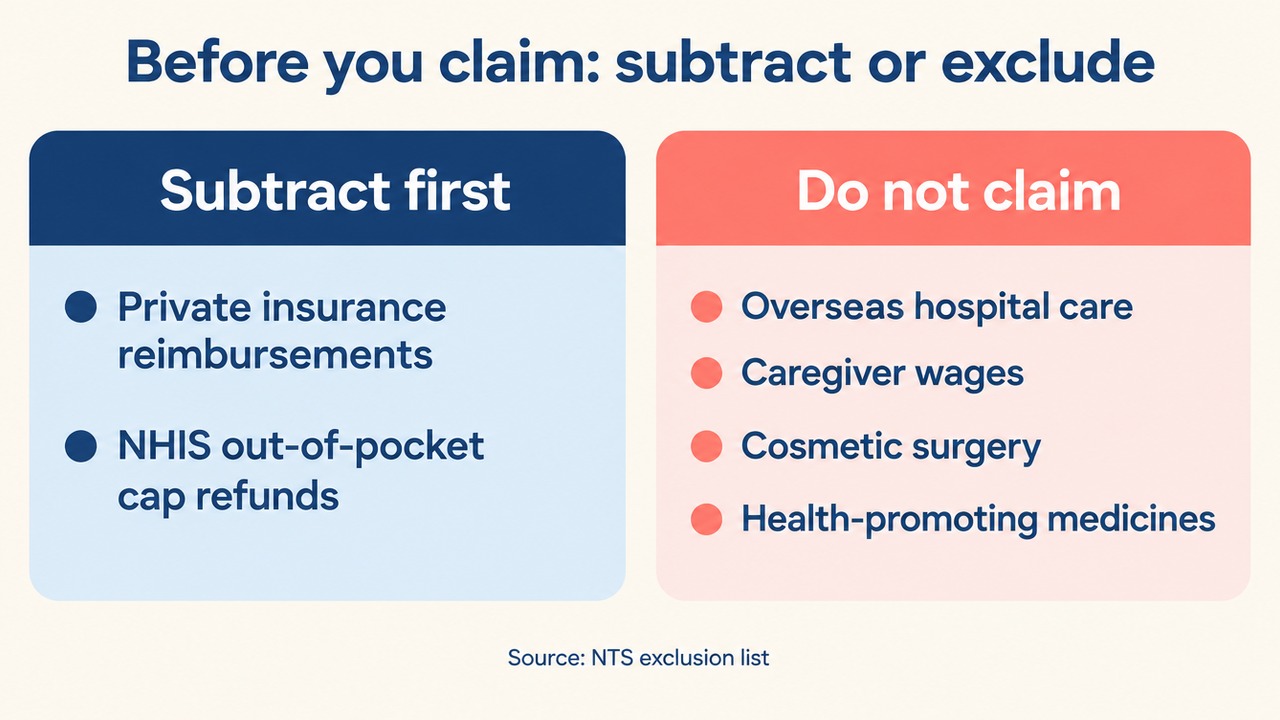
NTS exclusions (do not claim these):
- Amounts later reimbursed by private insurance (실손 and similar)
- NHIS out-of-pocket cap refunds (본인부담금상한제 사후환급금)
- Care at hospitals outside Korea
- Caregiver (간병인) wages
- Cosmetic / plastic surgery and health-promoting medicines (건강증진 의약품)
Etax News’s 2026 fact-check walks through the insurance point with a concrete case: pay ₩1,000,000 in June, receive ₩700,000 from insurance in July, and only ₩300,000 is recognised medical spending. The same article notes that if an NHIS cap refund arrives after you already settled, you may need a correction return for that tax year — usually without a late-payment penalty for that specific adjustment.
Foreign-source medical bills also fail for another reason that matters to expats: the NTS has already told foreign workers that overseas hospital spending does not count in year-end settlement, which matches the exclusion list above. See our settlement guide.
Receipts and Hometax upload
Most Korean hospitals, clinics, pharmacies and insurers already send data to the NTS. In mid-January your simplified year-end file on Hometax usually shows medical lines under the settlement menu. The January 2026 cycle opened the simplified service on 15 January, with corrected issuer data final around 20 January; treat mid-January 2027 as the working expectation until the NTS publishes exact 2027 dates.
What to do:
- Log into Hometax with a certificate (or simple authentication) tied to your alien registration number if you are a foreign resident. Data is matched by ARN, not passport number.
- Open the year-end simplified service and download your medical data PDF.
- Compare it with your own records. If a clinic never reported a bill, get a receipt or medical-expense certificate from that clinic and give it to payroll with your deduction form.
- Subtract any insurance reimbursements and NHIS cap refunds that are not already netted in the file. The NTS call-centre Q&A reminds payroll teams that NTS-provided medical totals are entered as amounts (no separate “count” field).
- If an adult dependant’s data is missing, that person may need to consent to data sharing (부양가족 자료제공 동의) before you can see their lines.
Employers then file a medical expense payment statement where required. You normally do not upload images of every receipt into Hometax yourself for standard settlement; you hand paper proof to payroll when the simplified file is incomplete.
Rechecked on November 10, 2026 (NTS): the table still reads ₩7 million a year at 15% for ordinary basic-deduction dependants; no cap at 15% for yourself, children 6 or under, people 65 or over and people with disabilities; no cap at 20% for premature and congenital-anomaly care; no cap at 30% for infertility treatment; and postnatal-care centres up to ₩2 million per birth. Not deductible: amounts repaid by private (실손) insurance, NHIS out-of-pocket ceiling refunds, care at hospitals abroad, paid caregivers (간병인), and cosmetic surgery or health-supplement purchases. Since January 1, 2024, the out-of-pocket share of disability activity-support services also counts (NTS, read 10 November 2026).
Timing checklist for tax year 2026
| When | Action |
|---|---|
| All of 2026 | Keep clinic receipts and insurance payout notices |
| Mid-January 2027 (expected) | Hometax simplified medical data opens |
| ~20 January 2027 (expected) | Prefer download after issuer corrections settle |
| Before your employer’s internal deadline | Submit deduction form + any paper receipts |
| February 2027 pay | Refund or extra withholding through payroll |
| May 2027 | Global income tax return if you must fix something yourself |
Sources: NTS settlement structure; January 2026 opening dates from NTS/Korea.kr reporting used as the pattern in our settlement guide. Exact 2027 dates were not yet posted as of 6 November 2026.

Other year-end settlement items: education expense tax credit (15%), donation tax credit, housing subscription savings deduction and, for pension withdrawals, private pension tax after 55 (the ₩15 million line).
Frequently asked questions
Q. Which medical bills count for tax year 2026, and how long do I have?
Bills you actually pay between January 1 and December 31, 2026 — 48 days left from November 13. Only spending above 3% of total pay enters the credit; ordinary dependants are capped at ₩7 million at 15%, while your own care, children 6 or under, people 65+ and people with disabilities have no cap (NTS special tax-credit page, checked Nov 10). A bill paid in January 2027 belongs to tax year 2027.
Q. Does every won of hospital spending cut my tax?
No. Only recognised spending above 3% of total pay enters the credit, and then only at 15%, 20% or 30% depending on the category. Small annual bills often produce a zero credit.
Q. I got money back from private insurance. Can I still claim the full hospital bill?
No. The NTS says amounts reimbursed by insurance must be removed. Claim only the net amount you still bear. Etax News’s fact-check uses the same rule.
Q. Is there a hard ₩7 million ceiling on all medical credits?
No. The ₩7 million cap applies to ordinary medical spending for other basic-deduction family members. Spending on yourself, children aged 6 or under, people aged 65 or over, registered disability, premature/congenital care and infertility treatment is not under that ₩7 million cap (rates still apply).
Q. Do foreigners on the 19% flat tax get this credit?
Generally no. The flat tax under the Restriction of Special Taxation Act is an alternative to the normal progressive system with its deductions and special credits. Compare both paths before you choose; see our flat-tax guide.
Q. My Hometax file is missing a clinic bill. What do I do?
Ask the clinic for a receipt or medical-expense certificate and give it to your employer’s payroll team with your year-end deduction form. Do not assume a missing line will appear later if the issuer never reported it under your ARN.
Related reading
- Korea IRP and pension savings tax credit 2026
- Korea credit card and cash receipt deduction 2026
- Korea insurance premium tax credit 2026
Sources
- National Tax Service, Special tax credits / rates page (의료비 세액공제 table) (checked 6 November 2026; re-checked 10 November 2026)
- NTS call centre, Medical expense payment statement Q&A (checked 6 November 2026)
- Etax News, Year-end fact-check: medical credit is net of insurance refunds (checked 6 November 2026)
- Haesul, Korea year-end tax settlement for foreigners 2026
- Haesul, Korea payslip: four social insurance deductions 2026
- Haesul, Korea 19% flat tax for foreign workers
General information only, not tax advice. Written with AI assistance and checked against the sources above. Rules can change; verify against the NTS notice for the January 2027 settlement season before you file.






6 Comments