Renting a Flat in Korea as a Foreigner: Wolse vs Jeonse, Broker Fees and Real Seoul Costs
Haesul Economy desk (AI-assisted). As of 17 November 2026 (KST). Based on the Korea Real Estate Board (REB) October 2026 national housing price survey (released 16 November 2026), the Ministry of Land, Infrastructure and Transport (MOLIT) September 2026 housing statistics (released 30 October 2026), the Seoul Metropolitan Government’s brokerage-fee table, the Housing Lease Protection Act and its Enforcement Decree on the National Law Information Center, the government’s Easy Law guides, the Bank of Korea’s 22 October 2026 rate decision and a MOLIT notice on maintenance-fee advertising, cross-checked with Yonhap, MBN, Gukje News and the Korea Specialty Contractor News. General information, not legal or financial advice.
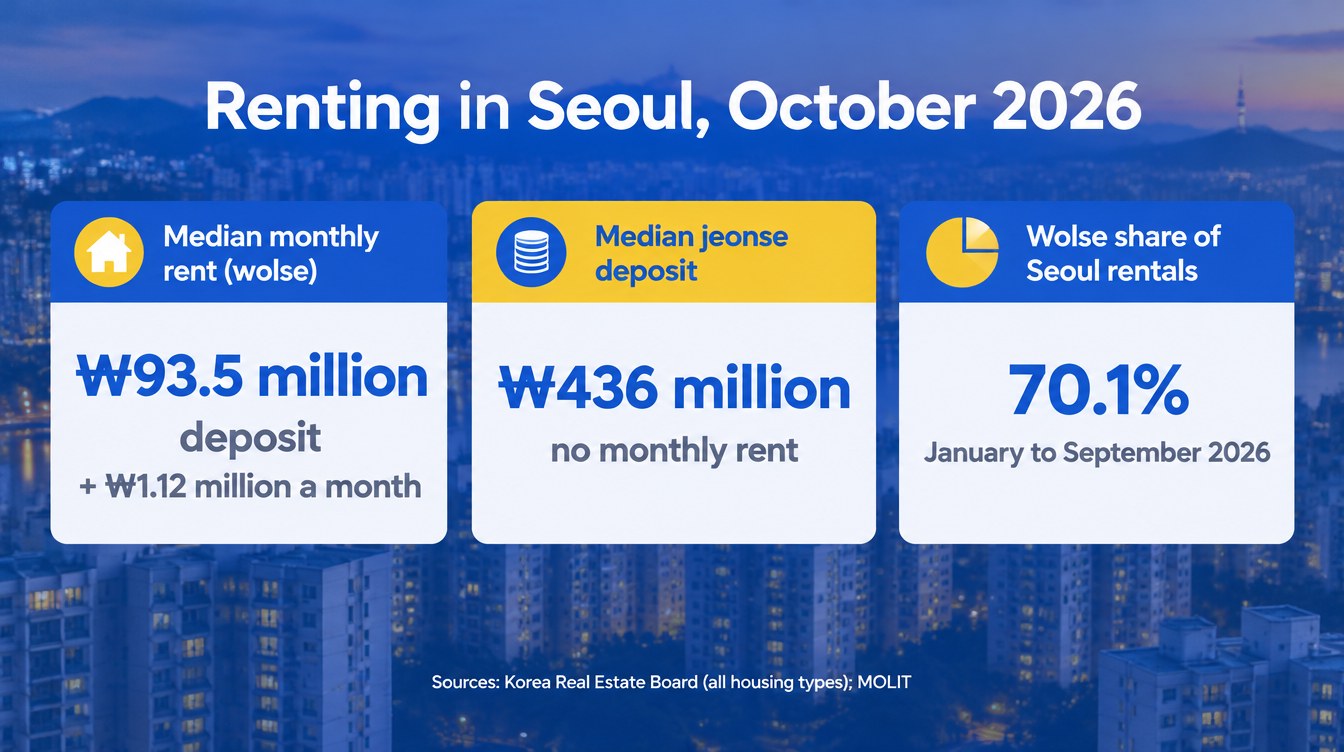
Quick answer: Most foreigners in Korea rent on wolse (월세): a refundable deposit plus monthly rent. Jeonse (전세) means paying one very large deposit and no monthly rent; in Seoul the median jeonse deposit was ₩436,035,000 in October 2026, so it is rarely realistic for a new arrival. The REB’s October survey put Seoul’s median wolse at a ₩93,519,000 deposit plus ₩1,124,000 a month across all housing types (apartments included, so a one-room studio is usually far cheaper). On top of the rent you pay a maintenance fee (관리비) and a broker’s fee (중개보수) that Seoul caps by law: for a typical studio it can be no more than ₩300,000 plus VAT. Our worked table below shows what three common set-ups cost per month.
Why now: rents are still climbing and jeonse keeps shrinking. In the REB survey released on 16 November 2026, Seoul’s monthly-rent index rose 0.77% in October and its jeonse index 0.68%; Seoul’s average jeonse price passed ₩500 million (₩500,980,000, up from ₩497,686,000 in September), as reported by Yonhap. MOLIT’s September statistics show that 70.1% of Seoul’s reported rental contracts from January to September 2026 were wolse, up from 64.3% a year earlier. If you are moving for the spring semester (Korean universities start in March) or starting a new job in the new year, this is the market you will be renting in.
Who this guide is for
This is for foreign residents and new arrivals renting a home in Korea for the first time: students, workers on an E-, D- or F-visa, and families relocating with an employer. It covers privately rented flats found through a licensed broker (공인중개사, gongin junggaesa). Company housing, university dormitories, goshiwon rooms (고시원) and short-term rentals booked on travel platforms work differently and are not covered in detail.
Everything here applies to foreigners in the same way as to Koreans. The Housing Lease Protection Act does not distinguish by nationality, and MOLIT’s lease-reporting FAQ (relayed by Easy Law) states that the reporting duty “does not distinguish between Koreans and foreigners”. The one foreigner-specific difference is how you register your address, which we explain below.
Wolse, jeonse and banjeonse: the three ways to rent
Korea has three common rental structures. They differ in how much cash you hand over at the start and how much you pay each month.
| Type | Korean | What you pay | Best for |
|---|---|---|---|
| Wolse | 월세 (보증부 월세) | A refundable deposit (보증금, bojeunggeum), much smaller than a jeonse deposit, plus monthly rent | Most newcomers, stays of 1–2 years, anyone without a large lump sum |
| Banjeonse | 반전세 | A larger deposit and lower monthly rent (a mix of the two) | People with some savings who want lower monthly rent |
| Jeonse | 전세 | One very large deposit, no monthly rent; the whole deposit is returned at the end | Long-term residents with large savings; carries the biggest deposit risk |
Two numbers explain why most foreigners choose wolse. First, the cash needed: a Seoul jeonse deposit is in the hundreds of millions of won. Second, the risk: with jeonse your whole housing budget sits with the landlord, which is why our guide to protecting a rental deposit in Korea matters most for jeonse and large-deposit wolse tenants. MOLIT’s figures show the market moving the same way: in the nine months to September 2026, 68.6% of reported rental contracts nationwide were wolse (MOLIT counts banjeonse inside wolse), against 62.6% in the same period of 2025 and 51.8% in 2022.
What renting costs in Seoul now: the official figures
The REB publishes average and median prices every month in its national housing price survey. These are the Seoul figures for October 2026 (all housing types: apartments, row houses and detached houses). We read them from Yonhap’s report of the 16 November release and matched the index changes against two other outlets that quoted the same release.
| Seoul, October 2026 (REB) | Average | Median |
|---|---|---|
| Jeonse deposit | ₩500,980,000 | ₩436,035,000 |
| Wolse deposit | ₩148,032,000 | ₩93,519,000 |
| Wolse monthly rent | ₩1,341,000 | ₩1,124,000 |
| Monthly change in rent index | +0.77% (jeonse index +0.68%) | – |
Read these carefully. They include large family apartments, so the average is pulled up by expensive homes. A one-room studio (원룸, wonroom) or a small officetel (오피스텔) usually rents for much less, while apartments in central districts usually cost more. The trend is the useful part: in October the biggest rent rises in Seoul were in Nowon-gu (1.47%), Seongbuk-gu (1.36%) and Dobong-gu (1.02%), according to the same release.
MOLIT’s transaction counts show what kind of homes are actually changing hands. In September 2026, Seoul recorded 59,790 rental contracts: 42,636 wolse and 17,154 jeonse. For January to September, wolse made up 52.7% of Seoul apartment rentals and 78.2% of non-apartment rentals (villas, studios and houses). MOLIT notes that these counts are not national approved statistics; they are contracts that were reported or given a fixed date.
Broker fees: the legal caps in Seoul
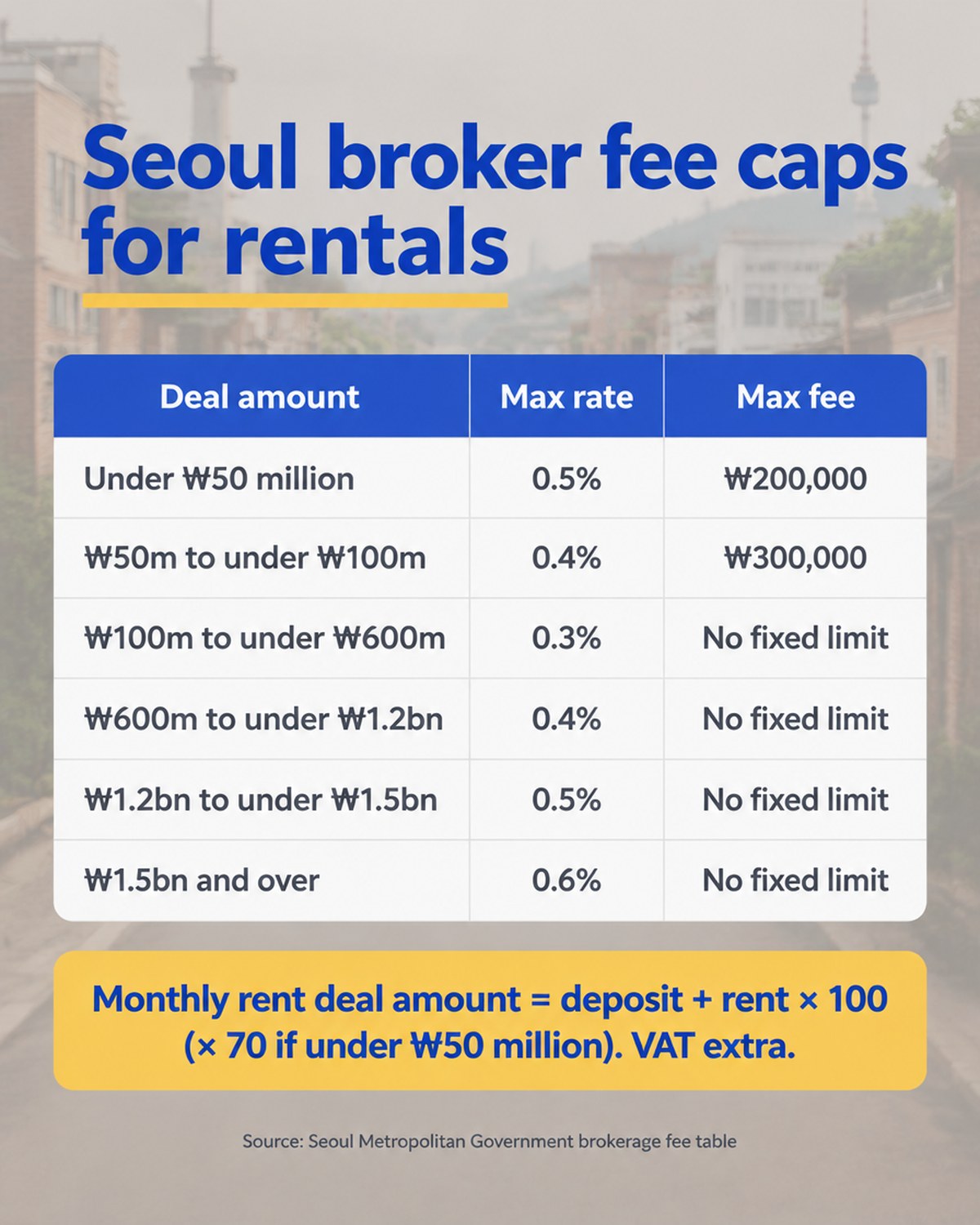
In Korea the tenant and the landlord each pay their own broker’s fee. The fee is not a fixed percentage you have to accept: the law sets a maximum rate and, in the lower bands, a maximum amount, and you and the broker agree a fee at or below it. Each city or province sets its caps by ordinance within the national rule. Seoul’s table, under the Seoul ordinance on housing brokerage fees (Article 2, Table 1, in force since 30 December 2021), is:
| Deal amount (rentals) | Maximum rate | Maximum fee |
|---|---|---|
| Under ₩50 million | 0.5% | ₩200,000 |
| ₩50 million to under ₩100 million | 0.4% | ₩300,000 |
| ₩100 million to under ₩600 million | 0.3% | no fixed limit |
| ₩600 million to under ₩1.2 billion | 0.4% | no fixed limit |
| ₩1.2 billion to under ₩1.5 billion | 0.5% | no fixed limit |
| ₩1.5 billion and over | 0.6% | no fixed limit |
How the “deal amount” works for wolse. For a rental with monthly rent, the deal amount is the deposit + (monthly rent × 100). If that total is under ₩50 million, it is recalculated as deposit + (monthly rent × 70) (Enforcement Rule of the Licensed Real Estate Agents Act, Art. 20(5), as quoted on Seoul’s fee page). For jeonse, the deal amount is simply the deposit.
Three more rules from the same Seoul page are worth knowing:
- VAT is extra. The table excludes value-added tax, so a broker may add VAT on top.
- Officetels are different. An officetel of 85 m² or less with its own kitchen, toilet and bathing facilities is capped at 0.4% for rentals, with no fixed amount limit. Other officetels and non-housing property are capped at 0.9%.
- When you pay. Unless you agree otherwise, the fee is due on the day the deal money is fully paid, which for a rental is usually move-in day.
Charging more than the cap is illegal. Easy Law notes that a broker who takes more can face suspension, cancellation of registration, and up to one year in prison or a fine of up to ₩10 million (Licensed Real Estate Agents Act Arts. 33 and 49), and that the Supreme Court has held any excess to be void and refundable (2005Da32159, 20 December 2007).
Two quick examples (our calculation): – Deposit ₩10,000,000 and rent ₩700,000: deal amount 10,000,000 + 70,000,000 = ₩80,000,000. 0.4% would be ₩320,000, but the cap in that band is ₩300,000. – Deposit ₩3,000,000 and rent ₩400,000: 3,000,000 + 40,000,000 = ₩43,000,000, which is under ₩50 million, so use × 70 instead: 3,000,000 + 28,000,000 = ₩31,000,000. 0.5% = ₩155,000 (under the ₩200,000 cap).
Before you sign, check that the broker is registered. The Seoul Real Estate Information Plaza (land.seoul.go.kr) has a brokerage section where you can look up offices and run the official fee calculator.
Maintenance fees (관리비): what they include and what must be shown
Almost every flat charges a monthly maintenance fee on top of rent. In a small building it is usually a flat amount that may cover cleaning of common areas, the lift, water or internet; in an apartment complex it is itemised and varies with your usage. Electricity and gas are often billed separately, especially in winter (see our guide to Korea’s winter electricity bill).
Since 21 September 2023, MOLIT’s notice on what property listings must show requires brokers advertising small homes such as studios and officetels with a flat maintenance fee of ₩100,000 or more a month to break it down into general management costs, usage charges (electricity, water, heating and so on) and other costs. After a grace period that ended on 31 March 2024, leaving the breakdown out can bring a ₩500,000 fine, and a false or exaggerated fee a ₩5,000,000 fine. In practice: if a listing shows a round “관리비 10만원” with no detail, ask what it includes before you visit.
For apartment complexes, each complex’s actual monthly fees are published on the government’s apartment management information system, K-apt (k-apt.go.kr), run by the REB.
Your rights in the contract: term, renewal and rent increases
The Housing Lease Protection Act (주택임대차보호법) gives tenants several protections. These are the ones that most often matter to foreigners:
- Two-year minimum. A lease with no term or a term under two years is treated as a two-year lease. You, the tenant, may still choose to rely on the shorter term (Art. 4(1)); the landlord cannot. If you sign for one year, you can leave after one year, but the landlord cannot make you leave early.
- One renewal of two years. You can ask to renew once, and the landlord can refuse only for the reasons listed in the Act, such as rent arrears of two months, subletting without consent, or the landlord or their family moving in (Art. 6-3). You must ask between six and two months before the lease ends.
- Increases are capped at 5%. On renewal, or when a rent increase is requested during a lease, the increase may not exceed one-twentieth (5%) of the agreed rent or deposit, and no new increase can be requested within one year of the last one (Art. 7). The Act allows a city or province to set a lower cap by ordinance. Example (our calculation): ₩700,000 rent can rise to at most ₩735,000; a ₩10,000,000 deposit to at most ₩10,500,000.
- Automatic renewal. If neither side gives notice in time (the landlord between six and two months before the end, the tenant at least two months before), the lease renews on the same terms for two years (Art. 6). After an automatic renewal, or a renewal you requested, you can end the lease at any time; it ends three months after the landlord receives your notice (Arts. 6-2 and 6-3(4)).
- Converting deposit to rent is capped. If part of a deposit is converted into monthly rent, the rent added may not exceed the converted amount times the lower of 10% a year or the Bank of Korea base rate plus 2 percentage points (Act Art. 7-2; Enforcement Decree Art. 9). With the base rate held at 3.00% on 22 October 2026, the cap is 5.0% a year. Example (our calculation): converting ₩50,000,000 of deposit can add no more than 50,000,000 × 5% ÷ 12 = ₩208,333 a month. The next rate decision is on 26 November 2026; a change would move this cap.
The foreigner steps: address report, fixed date and lease report
Your deposit is protected only if you register where you live. For foreign residents, the residence change report (체류지 변경신고) at the community service centre, immigration office or online on HiKorea counts as the move-in report, and you have 15 days after moving in to file it (Immigration Act Art. 36). Under the Lease Act, protection against third parties starts the day after you have both moved in and registered (Art. 3(1)).
In Seoul and other reporting areas, a lease with a deposit over ₩60 million or monthly rent over ₩300,000 must also be reported within 30 days of signing, by landlord and tenant together, at the community service centre or on MOLIT’s online system (rtms.molit.go.kr). Missing it can bring a fine of up to ₩1,000,000, and filing the report with your contract also gives you the fixed date (확정일자) that ranks your deposit (Easy Law, citing the Real Estate Transaction Reporting Act). The full order of steps, the HUG deposit guarantee and its costs are in our deposit-protection guide, and the wider first-month checklist is in Living in Korea as a foreigner: your first 90 days.
Worked monthly cost in Seoul: three set-ups (our calculation)
This table is our own calculation. Row A uses example inputs for a typical studio listing, not an official figure. Rows B and C use the REB’s October 2026 Seoul medians. Every row uses the same example maintenance fee of ₩100,000 (the level at which itemised advertising becomes compulsory), spreads the maximum legal broker’s fee over a two-year lease and excludes VAT, electricity, gas and internet.
| A. Studio (example inputs) | B. Seoul median wolse (REB) | C. Seoul median jeonse (REB) | |
|---|---|---|---|
| Deposit (refundable) | ₩10,000,000 | ₩93,519,000 | ₩436,035,000 |
| Monthly rent | ₩700,000 | ₩1,124,000 | ₩0 |
| Deal amount for the fee | ₩80,000,000 | ₩205,919,000 | ₩436,035,000 |
| Maximum broker’s fee | ₩300,000 (cap) | ₩617,757 (0.3%) | ₩1,308,105 (0.3%) |
| Broker’s fee per month over 24 months | ₩12,500 | ₩25,740 | ₩54,504 |
| Example maintenance fee | ₩100,000 | ₩100,000 | ₩100,000 |
| Monthly cash cost | ₩812,500 | ₩1,249,740 | ₩154,504 |
| Cash needed up front (deposit + fee) | ₩10,300,000 | ₩94,136,757 | ₩437,343,105 |
| Lease report needed in Seoul? | Yes (rent over ₩300,000) | Yes | Yes (deposit over ₩60 million) |
Jeonse looks cheapest per month only because the money is tied up in the deposit. One way to compare is the legal conversion cap: at 5.0% a year, the ₩436,035,000 jeonse deposit in row C is “worth” about 436,035,000 × 5% ÷ 12 = ₩1,816,813 a month in rent (our calculation). That money also earns you nothing while it sits with the landlord, and it is all at risk if the landlord cannot repay. For most newcomers, a wolse with a deposit you could afford to lose sleep over, not your life savings, is the safer start.
How to rent a flat: the steps

- Set a budget in two parts: the deposit you can pay up front, and the monthly total (rent + maintenance + utilities). Use the table above as a template.
- Search listings in property apps or by walking into local broker offices in the area you want. Ask for “원룸 월세” (studio, monthly rent) or “오피스텔 월세”.
- Ask four questions for each flat: deposit, monthly rent, what the maintenance fee includes, and the earliest move-in date.
- Check the broker and the property before paying anything: the broker’s registration, and the building’s registry record (등기부등본) for mortgages ahead of your deposit. Our deposit guide explains what to look for.
- Agree the broker’s fee in writing at or below the cap, and ask whether VAT is added.
- Sign the contract and pay the contract deposit (계약금, often a share of the deposit). Make sure the contract names the landlord who is on the registry record.
- On move-in day, pay the balance to the landlord’s own account, then file your residence change report within 15 days and get the fixed date or file the lease report within 30 days.
- Keep records: the contract, receipts for the deposit and the broker’s fee, and photos of the flat on move-in day. If you pay monthly rent, you may also be able to claim Korea’s monthly rent tax credit at year-end settlement.
Common problems
- “The fee is 0.9%.” That rate applies only to non-housing property and to officetels that do not meet the 85 m² and facilities test. For a normal flat in Seoul, use the table above.
- A bigger deposit for a lower rent. Many landlords will swap deposit for rent. The legal 5.0% conversion cap applies when an existing deposit is converted during a lease; for a new contract, use it as a benchmark when you negotiate.
- Leaving early. If you leave before the lease ends, you need the landlord’s agreement, so raise it before you sign; the law gives you a right to end early on three months’ notice only once the lease has been renewed, either automatically (Art. 6-2) or at your request (Art. 6-3(4)).
- Getting the deposit back when you leave Korea. Plan the date with your landlord early and give them your Korean account details. If you then send the money abroad, see our guide to sending money home from Korea for the yearly US$50,000 no-document limit for foreigners.
The jeonse-to-monthly-rent conversion cap moves with the base rate. See Bank of Korea rate decision on 26 November 2026 for what a hold at 3.00% or a hike to 3.25% would mean for loans, savings and the won.
FAQ
Q. What is the difference between wolse and jeonse in Korea?
Wolse (월세) is a refundable deposit plus monthly rent. Jeonse (전세) is one large deposit and no monthly rent, with the whole deposit returned at the end of the lease. In Seoul the October 2026 median jeonse deposit was ₩436,035,000, against a median wolse of a ₩93,519,000 deposit plus ₩1,124,000 a month (REB, all housing types).
Q. How much is the real estate broker fee for renting in Seoul?
Seoul caps the fee by the deal amount: 0.5% up to ₩200,000 under ₩50 million, 0.4% up to ₩300,000 from ₩50 million to under ₩100 million, and 0.3% from ₩100 million to under ₩600 million, plus VAT. For wolse the deal amount is the deposit plus 100 times the monthly rent (70 times if the total is under ₩50 million).
Q. Can foreigners rent a flat in Korea on the same terms as Koreans?
Yes. The Housing Lease Protection Act and the lease-reporting duty apply regardless of nationality. Foreign residents protect their deposit by filing a residence change report within 15 days of moving in, which counts as the move-in report, and by getting a fixed date or filing the lease report.
Q. How much can my landlord raise the rent in Korea?
Under the Housing Lease Protection Act, an increase may not exceed 5% of the agreed rent or deposit, and no new increase can be requested within one year of the last one. You can also ask once to renew the lease for two more years, and the landlord can refuse only for reasons listed in the Act.
Q. What does the maintenance fee (관리비) include?
It varies by building. Since 2023, listings for small homes such as studios and officetels with a flat maintenance fee of ₩100,000 or more a month must break it down into general costs, usage charges such as electricity, water and heating, and other costs. Apartment complexes publish their fees on K-apt.
Q. What is the jeonse-to-wolse conversion rate in 2026?
The legal cap is the lower of 10% a year or the Bank of Korea base rate plus 2 percentage points. With the base rate at 3.00% (held on 22 October 2026), the cap is 5.0% a year, so converting ₩50,000,000 of deposit can add at most about ₩208,333 a month. The next rate decision is on 26 November 2026.
Sources
- Korea Real Estate Board, press release “26.10월 전국주택가격동향” (16 November 2026), report attachment: https://www.reb.or.kr/reb/na/ntt/selectNttInfo.do?mi=9565&bbsId=1154&nttSn=118245
- Yonhap News, Seoul average jeonse passes ₩500 million, October survey figures (16 November 2026): https://www.yna.co.kr/view/AKR20261116074451003
- Gukje News, REB October survey index changes (November 2026): https://www.gukjenews.com/news/articleView.html?idxno=3753807
- Korea Specialty Contractor News, REB October 2026 survey (November 2026): http://www.kscnews.co.kr/news/articleView.html?idxno=37649
- MOLIT, “’26년 9월 주택통계” (30 October 2026), via Korea.kr, PDF attachment: https://www.korea.kr/briefing/pressReleaseView.do?newsId=156787184
- MBN, Seoul apartment wolse share passes 50% (October 2026): https://www.mbn.co.kr/news/life/5225961
- Seoul Metropolitan Government, Seoul Real Estate Information Plaza, brokerage fee table and rules: https://land.seoul.go.kr/land/broker/brokerageCommission.do
- Easy Law (Ministry of Government Legislation), brokerage fee caps and penalties (as of 15 October 2026): https://easylaw.go.kr/CSP/CnpClsMain.laf?ccfNo=2&cciNo=2&cnpClsNo=2&csmSeq=649
- Easy Law, housing lease reporting (as of 15 October 2026): https://easylaw.go.kr/CSP/CnpClsMain.laf?ccfNo=2&cciNo=2&cnpClsNo=5&csmSeq=629
- National Law Information Center, Housing Lease Protection Act (Arts. 3, 4, 6, 6-2, 6-3, 7, 7-2; in force 2 January 2026) and Enforcement Decree Art. 9 (in force 1 July 2026): https://www.law.go.kr/법령/주택임대차보호법
- Bank of Korea, Monetary Policy Decision (22 October 2026): https://www.bok.or.kr/portal/bbs/P0000559/view.do?menuNo=200690&nttId=11065823
- Yonhap News, BOK holds the base rate at 3.00% (22 October 2026): https://www.yna.co.kr/view/AKR20261022055600002
- Bank of Korea, monetary policy meeting dates (next decision 26 November 2026): https://www.bok.or.kr/eng/main/contents.do?menuNo=400020
- MOLIT via Korea.kr, maintenance-fee breakdown required for listings of small homes (21 September 2023): https://www.korea.kr/news/policyNewsView.do?newsId=148920604
- Korea Association of Realtors news, end of the maintenance-fee advertising grace period on 31 March 2024: https://www.karnews.or.kr/news/articleView.html?idxno=15494
How we checked: the broker-fee caps were read on the Seoul city fee page and matched against Easy Law; the lease rules were read in the Act and Decree on the National Law Information Center and matched against Easy Law’s Q&A; the base rate was read on the Bank of Korea’s release and matched against Yonhap. The REB report sits in an attachment we could not open, so the Seoul averages and medians come from Yonhap’s report of the release, with the index changes matched against two other outlets; MOLIT figures were read in MOLIT’s own PDF and matched against MBN. The worked table and examples are our own arithmetic.
This article is general information, not legal or financial advice. Lease terms vary; read your contract and ask a licensed broker, the Korea Legal Aid Corporation (132) or your city’s housing counselling service if anything is unclear. Official information: Seoul brokerage fee table and Easy Law housing lease guide.
Researched and drafted with AI assistance; checked against the sources listed.





3 Comments