Korea Year-End Tax Settlement for Foreigners: Dates, Documents and the 19% Choice (Tax Year 2026)
Haesul Economy desk (AI-assisted). Last checked: 2026-11-06 (KST), based on the National Tax Service (NTS) English year-end settlement manual, NTS guidance pages and Q&A, the Income Tax Act and the Restriction of Special Taxation Act on the Korean Law Information Center, and Ministry of Economy and Finance (MOEF) notices. This is general information, not tax, financial or legal advice. NTS English medical/tax page was unreachable on this refresh; prior verified NTS figures kept.
Quick answer: Settlement season for tax year 2026 is coming: your employer will settle your 2026 income tax in early 2027. What to prep now (November–December): gather receipts that may not auto-load into Hometax (foreign medical bills, overseas tuition, cash donations), confirm your alien-registration-linked certificate works, and decide whether the 19% flat tax beats normal rates for your pay. Exact 2027 Hometax open dates had not been announced as of 6 November 2026; last cycle opened mid-January (15 January 2026). You download your data, give your employer the deduction form plus any paper proof, and the difference is refunded or collected through your February 2027 pay. A government bill would raise the flat rate to 21% for income from 2027, but it is not law yet.
Year-end tax settlement (연말정산, yeonmal jeongsan) is the annual check that turns a year of monthly payroll withholding into your actual income tax. For most salaried people in Korea, Korean or foreign, it replaces filing a tax return yourself. This guide covers the settlement for tax year 2026 (income earned January–December 2026, settled in January–February 2027). It focuses on the process and on where foreigners differ. If you want the full flat-tax rules and a break-even calculation, see our separate guide to the 19% flat tax for foreign workers in Korea.

How the settlement works, in one paragraph
Each month your employer withholds income tax from your pay using a simplified table. Your payslip shows it next to the four social insurance deductions. After the year ends, the employer works out your true tax for the year from your total pay, the deductions and credits you claim, and the tax rates. It then compares that figure with what was already withheld. According to the NTS, if too much was withheld the excess is refunded with your pay, and if too little was withheld the shortfall is deducted from it. If you keep working at the same company, this happens when the employer pays your February salary of the following year. If you leave mid-year, the employer settles your tax with your final month’s pay, so hand over your deduction form and proof before that payday. Your employer then issues a withholding receipt (원천징수영수증). Keep it, because it is the document you will need for visas, loans and any later correction.
The timeline for tax year 2026
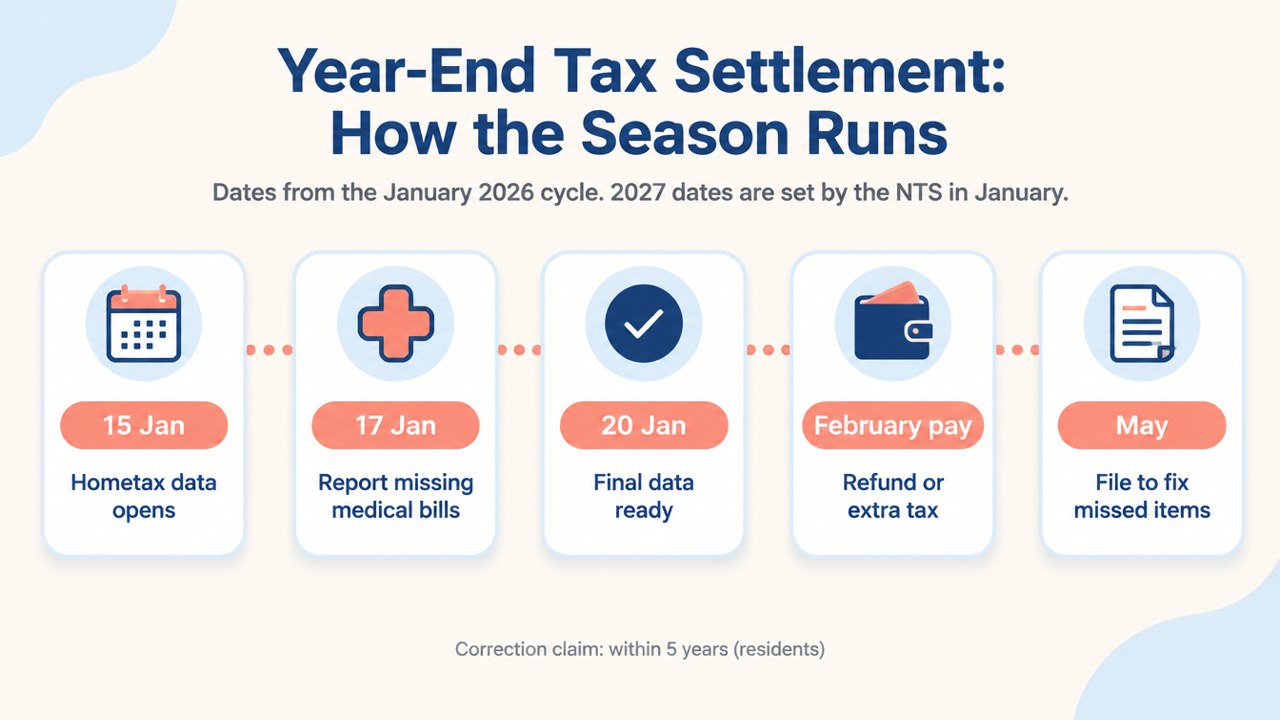
The NTS announces exact dates each January, and the dates for the 2027 season had not been published as of 5 November 2026. The pattern from the last cycle (tax year 2025, run in January 2026) is the best guide:
| Step | Last cycle (tax year 2025) | What to expect for tax year 2026 |
|---|---|---|
| Hometax simplified data opens to employees | 15 January 2026 | Around mid-January 2027 |
| Employers can download staff data in bulk | From 17 January 2026 | Shortly after the opening |
| Deadline to report missing medical expenses to the NTS reporting centre | 17 January 2026 | Check the NTS notice |
| Data corrected by issuers is final | 20 January 2026 | Around 20 January 2027 |
| Refund or extra tax through payroll | February 2026 pay | February 2027 pay |
| Fix anything missed: global income tax return | May | May 2027 |
| Correction claim (resident employees) | Within 5 years | Within 5 years of the payment deadline |
Sources: NTS press release and Korea.kr report of 15 January 2026; Digital Times, 14 January 2026; NTS Q&A; Framework Act on National Taxes art. 45-2.
In January 2026 the NTS said the service carried 45 types of data, including insurance premiums, medical bills, education costs and card spending. Data that issuers correct between 15 and 18 January appears from 20 January. If you are not in a hurry, downloading on or after the 20th avoids gaps.
Step by step: getting your Hometax data as a foreigner
- Get a digital certificate issued with your alien registration number (ARN). The NTS English manual says foreigners log in with a certificate (or simple authentication) issued under the ARN. The simplified service collects data by ARN only, so anything a hospital, insurer or card company registered under your passport number will not appear.
- Check that your name matches. NTS Q&A guidance tells foreigners to make sure the name each issuer holds (including how an English name is spelled) matches the name registered with the tax office. If items are missing, ask the issuer for a paper receipt.
- Open the service. On Hometax go to 장려금·연말정산·기부금 (Incentives · Year-End Settlement · Donations) → 연말정산간소화 (Simplified Year-End Settlement) → 근로자 소득·세액공제 자료 조회, then download the PDF.
- Add family members’ data. Adult dependents, including your spouse, must consent to share their data (부양가족 자료제공 동의) online, by fax or at a tax office. Data for minor children who share your registered address can be viewed without that step. A child who turned adult during the year has to give consent.
- Fill in the deduction report and give it to payroll. Many employers use Hometax’s online form, and others use their own HR system. If you choose the flat tax, you attach the flat-tax application to this same report.
What foreigners need to know that Koreans don’t
Resident or non-resident decides almost everything. Under the Income Tax Act you are a resident if you have a domicile in Korea or have stayed here 183 days or more. Residents can claim the same deductions and credits as Korean employees. Non-residents get only the deduction for themselves, the employee stock ownership association deduction and the taxpayer-association credit. They cannot claim dependants, special income deductions (such as insurance premiums), the card deduction, the child credit, the monthly-rent credit, special tax credits or the foreign tax credit.
Foreign-source pay. A resident foreigner normally adds all salary from Korea and abroad. But if your total time living in Korea over the last 10 years is 5 years or less, foreign-source pay is included only if it is paid in Korea or remitted to Korea, according to the NTS’s January 2026 Q&A for foreign workers.
Family abroad can still count. A resident foreign employee can claim the ₩1.5 million basic deduction for a spouse who lives in the home country, if the spouse’s annual income is ₩1 million or less (₩5 million total pay if they only have wages). The proof must be home-government documents showing the relationship and the spouse’s income, such as a family relationship, marriage or income certificate. Parents or children in the home country who depend on you can also count. In that case you also need evidence that you actually support them, such as remittance records. The NTS says documents from Apostille Convention countries need an apostille, and documents from non-member countries need consular confirmation at a Korean mission.
What doesn’t count. The NTS lists these as not deductible: – medical expenses paid at hospitals abroad; – credit-card spending abroad; – tuition for your children at schools overseas.
Overseas card spending also does not appear in the Hometax data.
Housing savings for a foreign spouse. From contributions made in 2025, the housing subscription savings deduction is open to the spouse of a non-homeowning household head. The NTS confirms this covers a foreign employee who is a resident with total pay of ₩70 million or less: 40% of contributions, up to ₩3 million a year.
Help in English. The NTS foreigner line is 1588-0560. Its January 2026 notice gave the hours as 09:00–18:00 on weekdays, closed 11:30–13:00.

What changed for tax year 2026
These changes are already law and apply to the settlement you will do in early 2027:
| Item | Before | Tax year 2026 |
|---|---|---|
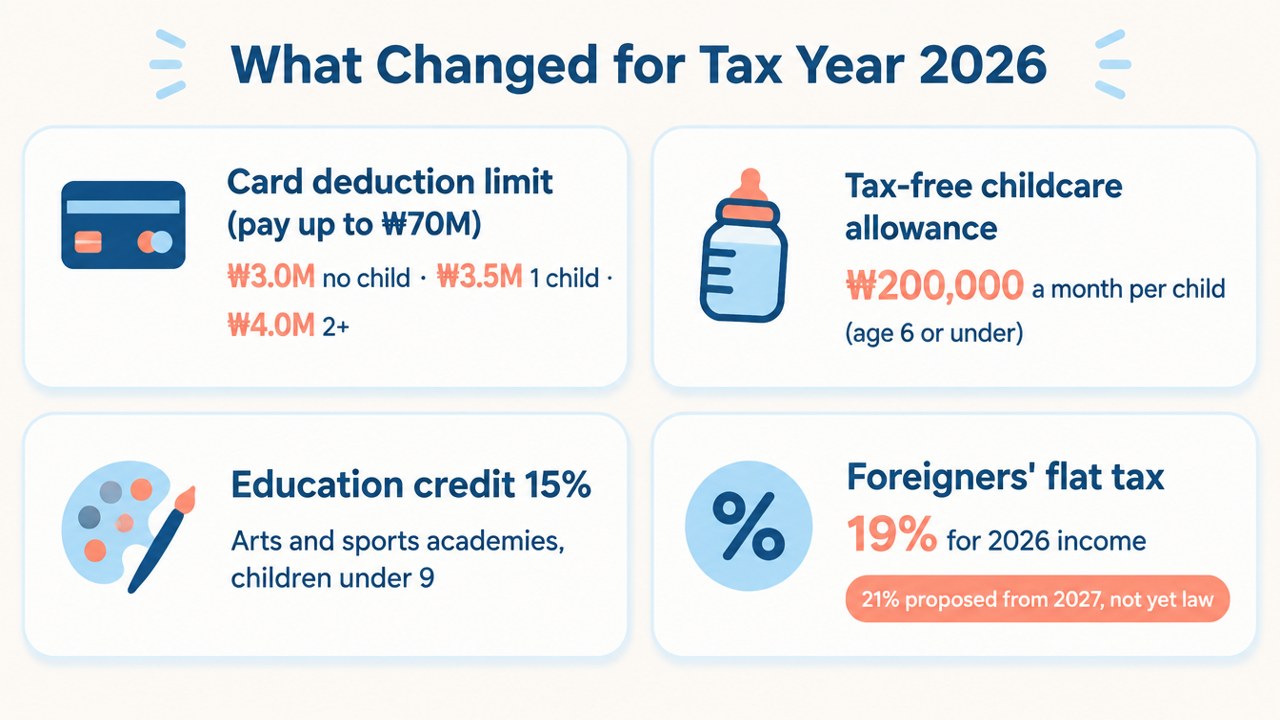
| Card deduction basic limit, total pay ≤₩70M | ₩3.0M | ₩3.0M (no child), ₩3.5M (1 child), ₩4.0M (2+ children) |
| Card deduction basic limit, total pay >₩70M | ₩2.5M | ₩2.5M (no child), ₩2.75M (1 child), ₩3.0M (2+ children) |
| Tax-free childcare allowance (children aged 6 or under) | ₩200,000 a month per worker | ₩200,000 a month per child |
| 15% education credit | Pre-school children’s academy fees | Also arts and sports academy fees for children under 9 |
Sources: MOEF “What’s new” notice on card limits; MOEF via Government24 and Korea.kr, “What changes in 2026” (31 December 2025 / 5 January 2026).
The extra card-deduction limits for traditional markets and public transport stay at ₩3 million (total pay ≤₩70 million) and ₩2 million (above).
The 2026 Tax Revision Bill (announced 3 August 2026, sent to the National Assembly on 3 September) proposes more changes. These include raising the foreigners’ flat rate from 19% to 21% (23.1% with local tax) for income from 1 January 2027, and extending the deadline for starting work in Korea from 31 December 2026 to 31 December 2029. These are proposals. As of 5 November 2026 they had not passed, and even if they pass they would apply to 2027 income, not to the settlement covered here.
Worked example: normal rates vs the 19% flat tax
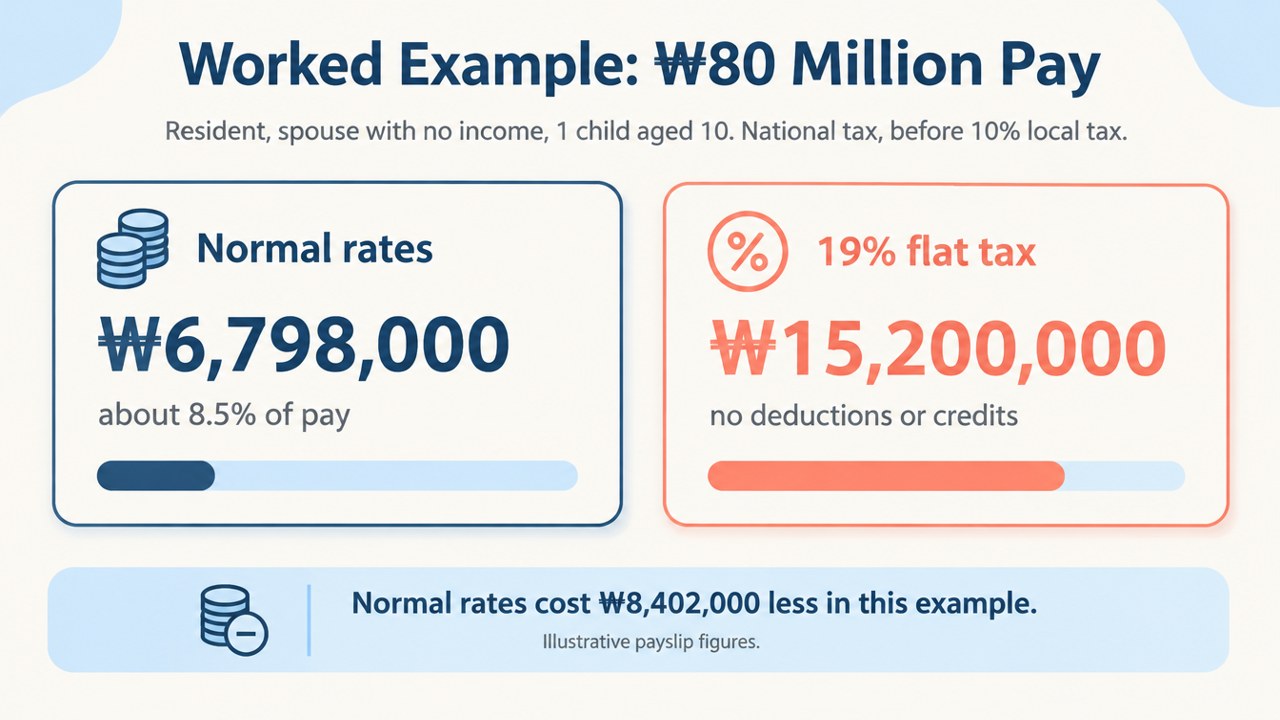
Take a resident foreign employee with total pay of ₩80,000,000 in 2026, no tax-free pay, and a spouse with no income and one child aged 10, both living in Korea. National pension contributions are ₩3,000,000 and health, long-term care and employment insurance contributions are ₩3,300,000. These payslip figures are illustrative. Using the NTS formulas:
| Step | Calculation | Amount |
|---|---|---|
| Earned income deduction | ₩12,000,000 + (₩80M − ₩45M) × 5% | ₩13,750,000 |
| Earned income amount | ₩80,000,000 − ₩13,750,000 | ₩66,250,000 |
| Basic deductions | 3 people × ₩1,500,000 | ₩4,500,000 |
| Pension and insurance deductions | ₩3,000,000 + ₩3,300,000 | ₩6,300,000 |
| Tax base | ₩55,450,000 | |
| Calculated tax | ₩6,240,000 + (₩55.45M − ₩50M) × 24% | ₩7,548,000 |
| Wage income tax credit | Formula gives ₩2,589,400; limit at ₩80M pay | −₩500,000 |
| Child tax credit (1 child aged 8+) | −₩250,000 | |
| Determined national income tax | ₩6,798,000 (about 8.5% of pay) | |
| 19% flat tax on the same pay | ₩80,000,000 × 19% | ₩15,200,000 |
Sources: NTS earned income deduction and tax credit pages; Income Tax Act art. 47, 50 and 55 rates as summarised by PwC; Restriction of Special Taxation Act art. 18-2. Local income tax adds 10% to either figure.
In this case normal rates cost ₩8,402,000 less in national tax. Under the flat tax, the health and employment insurance your employer pays for you is also no longer tax-exempt. The NTS says no exemptions, deductions or credits apply, so the gap would be wider still. The NTS’s answer to “Is the flat rate always better?” is simply that it depends on the individual. It suggests estimating your tax with the simplified data first.
The picture flips at the top. A single resident on ₩250,000,000 with the same ₩3,000,000 pension and ₩9,000,000 insurance contributions has a ₩218,750,000 tax base, ₩63,185,000 calculated tax, a ₩200,000 wage credit and ₩62,985,000 determined tax (about 25.2%). The flat tax would be ₩47,500,000, which is ₩15,485,000 less. For the break-even range and the full eligibility rules, see our flat-tax guide.
How to choose the flat tax, and who can’t
The flat rate is in Restriction of Special Taxation Act article 18-2. It is open to foreign employees who first started work in Korea on or before 31 December 2026, for wages earned within 20 years of that start date. It is not available if you work for a company related to your employer, as defined in the Act. You choose it at settlement by attaching the application to the deduction report you give your employer. You can also ask for 19% to be withheld monthly. The rate applies to total pay including normally tax-free pay. For people already working in Korea on 1 January 2014, that date counts as the first day of work.
If you are near the lower end of the pay scale, for example close to the 2027 minimum wage, the flat tax will almost certainly cost more than normal rates.

A documents checklist for foreign employees
- Alien registration card and a certificate issued under your ARN for Hometax
- Hometax simplified data PDF, downloaded on or after the final-data date if possible
- Paper receipts for anything registered under a passport number or missing from Hometax
- For family abroad: home-government relationship and income documents with an apostille or consular confirmation, plus remittance records for parents or children
- Lease contract and transfer records if you claim the monthly-rent credit (residents only)
- The flat-tax application if you choose 19%
- Afterwards: your withholding receipt for the year
If something goes wrong
If you missed a deduction or your employer made a mistake, you can claim it on a global income tax return in May. A resident employee can also file a correction claim with the tax office. The Framework Act on National Taxes gives withholding taxpayers 5 years from the payment deadline of the settled tax, and the Act excludes non-residents from this route. If you are leaving Korea for good, settle before your last payday, keep the withholding receipt and the Hometax PDF,.
Frequently asked questions
Q. What should foreign employees prep in November–December for year-end settlement?
Collect paper proof that may not appear in Hometax (medical bills issued under a passport number, overseas tuition, cash donations), test that your certificate is tied to your alien registration number, and decide early whether to elect the 19% flat tax. Exact 2027 Hometax open dates had not been published as of 6 November 2026; use last cycle’s mid-January pattern as a guide.
Q. When is year-end tax settlement for tax year 2026 for foreigners in Korea?
It runs in January–February 2027. The NTS had not announced the 2027 dates as of 6 November 2026. In the last cycle, Hometax data opened on 15 January, final data came on 20 January, and the result was paid through February salary.
Q. Can I see my data in Hometax if my insurer or hospital used my passport number?
No. The simplified service collects data only by alien registration number. Ask the issuer for a paper receipt, or ask them to correct the number, and give that to your employer.
Q. Can I claim my spouse who lives in my home country?
Yes, if you are a tax resident and your spouse’s annual income is ₩1 million or less. You need home-government documents showing the marriage and the income, with an apostille or consular confirmation.
Q. Is the 19% flat rate still available for 2026 income?
Yes. It applies to foreigners who started work in Korea by 31 December 2026, for up to 20 years. A government bill would raise it to 21% from 2027 income, but it had not passed as of 5 November 2026.
Q. What can’t foreigners deduct?
Medical bills paid abroad, credit-card spending abroad and tuition at overseas schools are not deductible. Non-residents also cannot claim dependants, special deductions, the card deduction or most credits.
Related reading
- Claiming parents as dependants in Korea (2026)
- Korea Child Allowance 2026: ₩100,000–₩130,000 a Month, Who Qualifies and What Changes in 2027
- Korea year-end medical expense tax credit 2026
- Korea payslip: the 4 social-insurance deductions 2026
- Korea’s 19% flat tax for foreign workers
Sources
- National Tax Service, Foreign Language Manual for 2025 Year-End Tax Settlement (English), posted 6 January 2026 (checked 5 November 2026; byline re-checked 6 November 2026 — NTS English cntntsId=7874 timed out; prior figures kept)
- National Tax Service, Year-end settlement structure and timing (checked 5 November 2026; re-noted 6 November 2026)
- National Tax Service, Earned income deduction (checked 5 November 2026)
- National Tax Service, Tax credits: wage, child, pension, marriage (checked 5 November 2026)
- National Tax Service call centre, Q&A on the simplified year-end settlement service (checked 5 November 2026)
- National Tax Service via Korea.kr, Simplified service opens 15 January and report, 15 January 2026 (checked 5 November 2026)
- National Tax Service via Korea.kr, Year-end settlement for foreign workers, January 2026 (checked 5 November 2026)
- Korean Law Information Center, Income Tax Act art. 47 and art. 50, in force 1 January 2026 (checked 5 November 2026)
- Korean Law Information Center, Restriction of Special Taxation Act art. 18-2 (checked 5 November 2026)
- Korean Law Information Center, Framework Act on National Taxes art. 45-2 (checked 5 November 2026)
- Ministry of Economy and Finance, What’s new: card deduction limit by number of children (checked 5 November 2026)
- Ministry of Economy and Finance via Government24, 2026 changes, 31 December 2025, and Korea.kr, What changes in 2026, 5 January 2026 (checked 5 November 2026)
- Ministry of Economy and Finance, 2026 Tax Revision Bill, 3 August 2026 (checked 5 November 2026)
- Kim & Chang, 2026 tax revision summary (checked 5 November 2026)
- PwC, Republic of Korea: taxes on personal income, last reviewed 2 July 2026 (checked 5 November 2026)
- Money Today, NTS year-end settlement guidance for foreign workers and Q&A, 7 January 2026; Sejung Ilbo, NTS FAQ on foreigners’ year-end settlement, 7 January 2026; Digital Times, simplified service opening, 14 January 2026 (checked 5 November 2026)
This article is general information, not tax, financial or legal advice. Worked examples use illustrative payslip figures. Your result depends on your residency status, pay and family situation, so confirm with your employer’s payroll team, the NTS (1588-0560) or a licensed tax accountant. Prepared by the Haesul Economy desk with AI assistance and checked against the sources above.




8 Comments