Your January 2027 Payslip in Korea: National Pension 9.5% to 10%, Health Insurance Frozen at 7.19%, Long-Term Care Up — Worked in Won
Haesul Economy desk (AI-assisted). As of 11 November 2026 (KST); 49 days from 13 November to the 1 January 2027 rate change. Based on the Ministry of Health and Welfare (MOHW) pension-reform Q&A and national-pension contribution page, the MOHW notice on the national-pension income base (July 2026 – June 2027), MOHW’s 8 September 2026 announcement of the 2027 health insurance rate, MOHW’s 30 October 2026 long-term care committee release, and the Ministry of Employment and Labor (MOEL) draft decree on the employment insurance rate. Independent cross-checks: Yonhap, Maeil Business, Uisinmun (bosa.co.kr) and two Korean payroll guides (AnytimeKit, Dasem). All won amounts in the examples are our own calculations. This is general information, not financial or tax advice.
Quick answer: From January 2027, the National Pension contribution rises from 9.5% to 10.0% of your monthly income base. An employee pays 5.0% (up from 4.75%) and the employer pays the other 5.0%. Self-employed and other “regional” members pay the full 10.0%. Health insurance stays at 7.19% (3.595% each for employee and employer). The long-term care premium rises from 0.9448% to 0.9994% of income, which is 13.90% of your health premium (13.14% in 2026). On a ₩3,000,000 monthly salary, those confirmed changes take about ₩8,320 more a month (₩99,840 a year). On ₩5,000,000, about ₩13,860 more (₩166,320 a year). Calculated by Haesul. A separate government plan would raise employment insurance from 0.9% to 1.0% for employees, but that decree had not been finalised when we checked.
If you are in your 40s or 50s, your take-home pay probably feels fixed: the mortgage, a child’s tuition, a parent’s care bills. So a deduction that changes on 1 January matters even when the amount is small, because it arrives at the same time as the year-end tax settlement and, for many people, a pay review. This guide covers only the 2027 changes. For what each of the four payslip deductions is and the full 2026 rate table, read our earlier guide to Korea’s payslip deductions in 2026; we won’t repeat it here.

What changes on 1 January 2027, line by line
| Payslip line | 2026 | 2027 | Status on 11 Nov 2026 |
|---|---|---|---|
| National Pension (국민연금) | 9.5% total; employee 4.75% | 10.0% total; employee 5.0% | Fixed by the 2025 pension reform law |
| Health insurance (건강보험) | 7.19% total; employee 3.595% | 7.19% (frozen); employee 3.595% | Decided by the Health Insurance Policy Deliberation Committee, 8 Sep 2026 |
| Long-term care (장기요양보험) | 0.9448% of income = 13.14% of the health premium | 0.9994% of income = 13.90% of the health premium | Decided by the Long-Term Care Committee, 30 Oct 2026 |
| Employment insurance (고용보험, unemployment part) | 1.8% total; employee 0.9% | 2.0% proposed; employee 1.0% | Draft decree only (consultation closed 2 Nov 2026) |
| Pension income base (기준소득월액) | ₩410,000 – ₩6,590,000 from July 2026 | Same range until June 2027 | MOHW notice 2026-31 |
Sources: MOHW pension-reform Q&A (“’26 9.5% → ’27 10.0% → … → ’33 13.0%”) and MOHW contribution page (employer 50% / employee 50%; income ₩410,000 – ₩6,590,000 for July 2026 – June 2027); MOHW via Korea.kr, 8 September 2026 (2027 health rate 7.19%); MOHW, 30 October 2026 (long-term care 0.9994%, 13.90%); MOLEG/MOEL notice 2026-450 (employment insurance 1.8% → 2.0% draft). The 2026 long-term care ratio of 13.14% is calculated from 0.9448 ÷ 7.19.
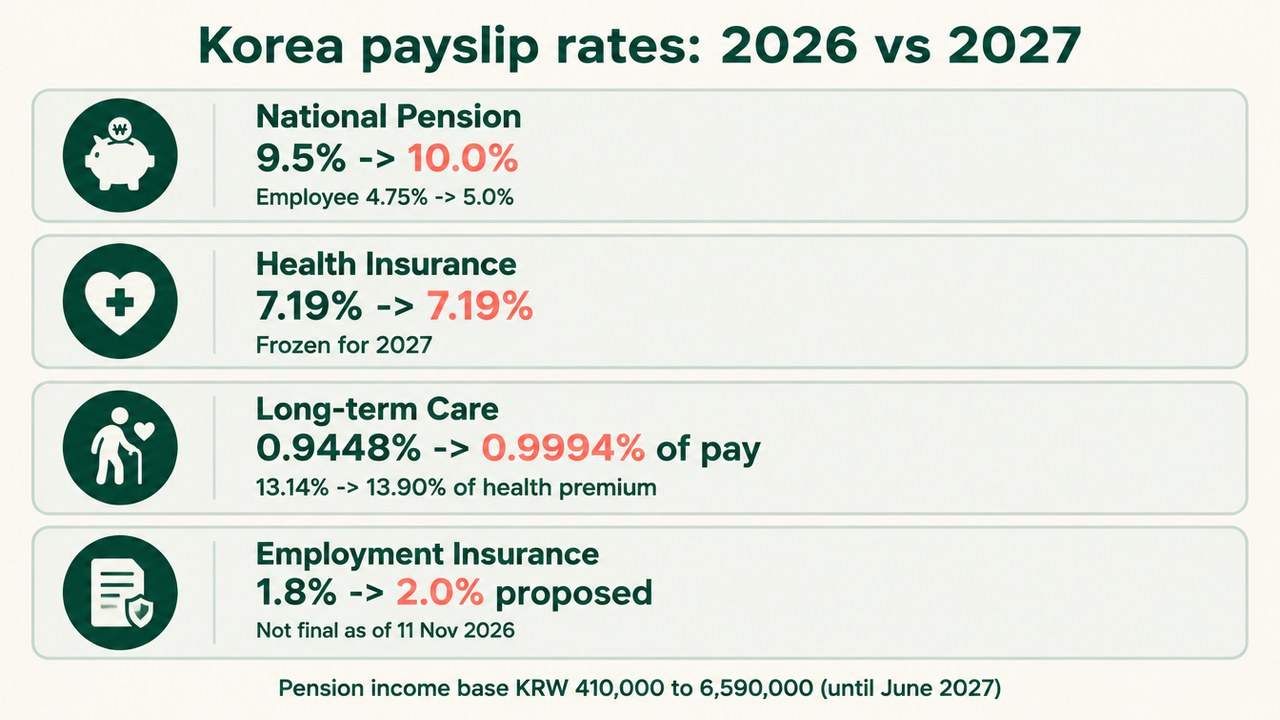
Three things are worth knowing before you read the numbers:
- Only the pension change is written into law already. MOHW’s Q&A sets the schedule as a 0.5-percentage-point rise every year for eight years, from 9.5% in 2026 to 13.0% in 2033. The health and long-term care rates are set by decree each year after a committee decision; both decisions are made, though one Korean payroll guide (AnytimeKit) notes that the decrees themselves still showed the 2026 figures in early November. In practice, payroll systems follow the committee decisions.
- Health insurance does not move, but the long-term care line does. Because long-term care is charged as a percentage of the health premium, your care deduction goes up even though the health deduction stays the same.
- Employment insurance is the open question. MOEL published a draft decree on 22 September 2026 to raise the unemployment-benefit rate from 1.8% to 2.0% (0.1 point more for each side). We show it as a separate column below and flag it as not final.
How each deduction is calculated
You can check your own payslip with three formulas. These are the official rates; the rounding (down to the nearest 10 won) follows what Korean payroll calculators do, so your company’s figure may differ by a few tens of won.
1. National Pension = income base × 5.0% (employee share in 2027). The income base is your reported monthly pay before tax, but MOHW caps it between ₩410,000 and ₩6,590,000 for July 2026 – June 2027. Earn ₩7 million a month and you still pay on ₩6,590,000: ₩329,500 in 2027, up from ₩313,020. Calculated. The range is reset every July, so the cap for July 2027 onwards will be announced next year.
2. Health insurance = monthly pay × 3.595% (employee share, unchanged). A ₩3,000,000 salary gives ₩107,850 in both years.
3. Long-term care = health premium × 13.90% in 2027. MOHW’s own example: a health premium of ₩100,000 a month means a long-term care premium of ₩13,900. The same ₩100,000 health premium carried about ₩13,140 of care premium in 2026 (0.9448 ÷ 7.19). Calculated. Employees split this with the employer like the health premium.
4. Employment insurance = monthly pay × 0.9% today; 1.0% if the draft decree passes.

Worked example: ₩3,000,000 and ₩5,000,000 a month
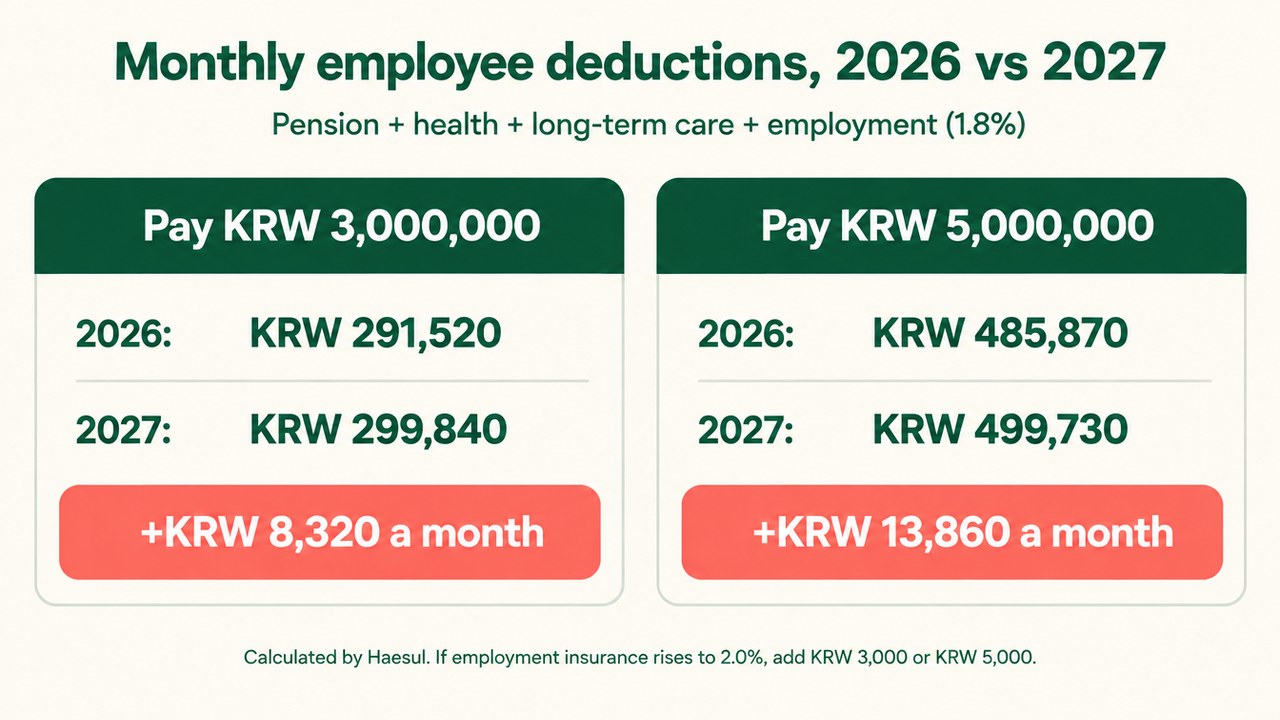
All figures are our calculations for an employee whose pay and income base stay the same in both years. The “2027” column uses only the confirmed changes (pension and long-term care); the last column adds the proposed employment-insurance rise.
Salary ₩3,000,000 a month
| Deduction (employee share) | 2026 | 2027 (confirmed changes) | 2027 if employment insurance goes to 1.0% |
|---|---|---|---|
| National Pension | ₩142,500 (4.75%) | ₩150,000 (5.0%) | ₩150,000 |
| Health insurance | ₩107,850 | ₩107,850 | ₩107,850 |
| Long-term care | ₩14,170 | ₩14,990 | ₩14,990 |
| Employment insurance | ₩27,000 | ₩27,000 | ₩30,000 |
| Total a month | ₩291,520 | ₩299,840 | ₩302,840 |
| Change vs 2026 | — | +₩8,320 a month / +₩99,840 a year | +₩11,320 a month / +₩135,840 a year |
Salary ₩5,000,000 a month
| Deduction (employee share) | 2026 | 2027 (confirmed changes) | 2027 if employment insurance goes to 1.0% |
|---|---|---|---|
| National Pension | ₩237,500 | ₩250,000 | ₩250,000 |
| Health insurance | ₩179,750 | ₩179,750 | ₩179,750 |
| Long-term care | ₩23,620 | ₩24,980 | ₩24,980 |
| Employment insurance | ₩45,000 | ₩45,000 | ₩50,000 |
| Total a month | ₩485,870 | ₩499,730 | ₩504,730 |
| Change vs 2026 | — | +₩13,860 a month / +₩166,320 a year | +₩18,860 a month / +₩226,320 a year |
Calculated by Haesul from the MOHW rates above: pension 4.75% → 5.0%; health 3.595%; long-term care = employee health premium × 0.9448 ÷ 7.19 (2026) or × 0.9994 ÷ 7.19 (2027); employment insurance 0.9% or 1.0%; each line rounded down to 10 won. The ₩3,000,000 rows for 2026 match our 2026 payslip guide. Two independent payroll guides (AnytimeKit, Dasem) give the same pension figures: ₩142,500 → ₩150,000 at ₩3 million.
Above the pension cap: ₩7,000,000 a month
| Deduction (employee share) | 2026 | 2027 (confirmed) |
|---|---|---|
| National Pension (on the ₩6,590,000 cap) | ₩313,020 | ₩329,500 |
| Health insurance | ₩251,650 | ₩251,650 |
| Long-term care | ₩33,060 | ₩34,970 |
| Employment insurance (0.9%) | ₩63,000 | ₩63,000 |
| Total a month | ₩660,730 | ₩679,120 (+₩18,390) |
Calculated. With the proposed 1.0% employment insurance, add ₩7,000 a month (₩686,120).
What the numbers say. Most of the 2027 increase is pension: ₩7,500 of the ₩8,320 at ₩3 million, and ₩12,500 of the ₩13,860 at ₩5 million. The long-term care rise is small in won (₩820 and ₩1,360 a month). If the employment-insurance decree passes, it would add almost as much as the care change at ₩3 million (₩3,000 a month). Put together, the four deductions go from about 9.7% to about 10.0% of a ₩3 million gross salary. Calculated.
When you will actually see it
The new pension rate applies to the January 2027 contribution. MOHW’s contribution page says each month’s premium is due by the 10th of the following month, so the January premium is paid by 10 February 2027 (a Wednesday). Whether you see it on your January or February payslip depends on how your employer deducts: some take the current month’s premium from the same month’s pay, others take the previous month’s. The independent payroll guide we checked (AnytimeKit) says exactly this, so look at both payslips before assuming a mistake.
Two practical checks for the first 2027 payslip:
- Pension line: divide it by your monthly income base. It should come to 5.0% (or 4.75% if the deduction is still December’s premium).
- Long-term care line: divide it by the health line. It should be close to 0.139 in 2027 (it was about 0.131 in 2026). Calculated ratio.
If either looks wrong, ask payroll first, then the National Pension Service (1355) or the National Health Insurance Service (1577-1000).
Self-employed or not on a company payroll
If you are a “regional” member (지역가입자), there is no employer half:
| Item | 2026 | 2027 |
|---|---|---|
| National Pension on reported income ₩2,000,000 | ₩190,000 (9.5%) | ₩200,000 (10.0%) |
| National Pension on reported income ₩3,000,000 | ₩285,000 | ₩300,000 |
| National Pension at the ₩6,590,000 cap | ₩626,050 | ₩659,000 |
| Health premium | Income part at 7.19% + property points | Same 7.19%; ₩211.5 per property point unchanged |
| Long-term care on a ₩100,000 health premium | about ₩13,140 | ₩13,900 (MOHW example) |
Pension amounts calculated from the 9.5% and 10.0% rates; the regional health formula and the unchanged ₩211.5 per property point are from MOHW’s 8 September 2026 announcement.
So a self-employed person reporting ₩3 million pays ₩15,000 more a month for pension alone in 2027. MOHW’s reform Q&A says the government is widening its pension premium support for low-income regional members (half of the premium for up to 12 months, with the income line set by decree), so check with NPS whether you qualify before the January bill.
If you are over 60 and paying in voluntarily to lengthen your record, or making catch-up payments for missed months, the higher rate applies to those premiums too. Our guide to NPS catch-up and voluntary continued enrolment shows how those bills are worked out.

What you get for the higher pension contribution
The 2025 reform raised contributions and benefits together. MOHW’s Q&A says the income replacement rate went up to 43% from 2026 (it would otherwise have fallen to 40% by 2028), and the rate path is fixed:
| Year | Total pension rate | Employee share |
|---|---|---|
| 2026 | 9.5% | 4.75% |
| 2027 | 10.0% | 5.0% |
| 2028 | 10.5% | 5.25% |
| 2029 | 11.0% | 5.5% |
| 2030 | 11.5% | 5.75% |
| 2031 | 12.0% | 6.0% |
| 2032 | 12.5% | 6.25% |
| 2033 onwards | 13.0% | 6.5% |
Source: MOHW reform Q&A (9.5% in 2026, 10.0% in 2027, 13.0% in 2033, 0.5 point a year for eight years). Intermediate years are calculated from that 0.5-point step and match the year-by-year table in AnytimeKit’s reading of the law.
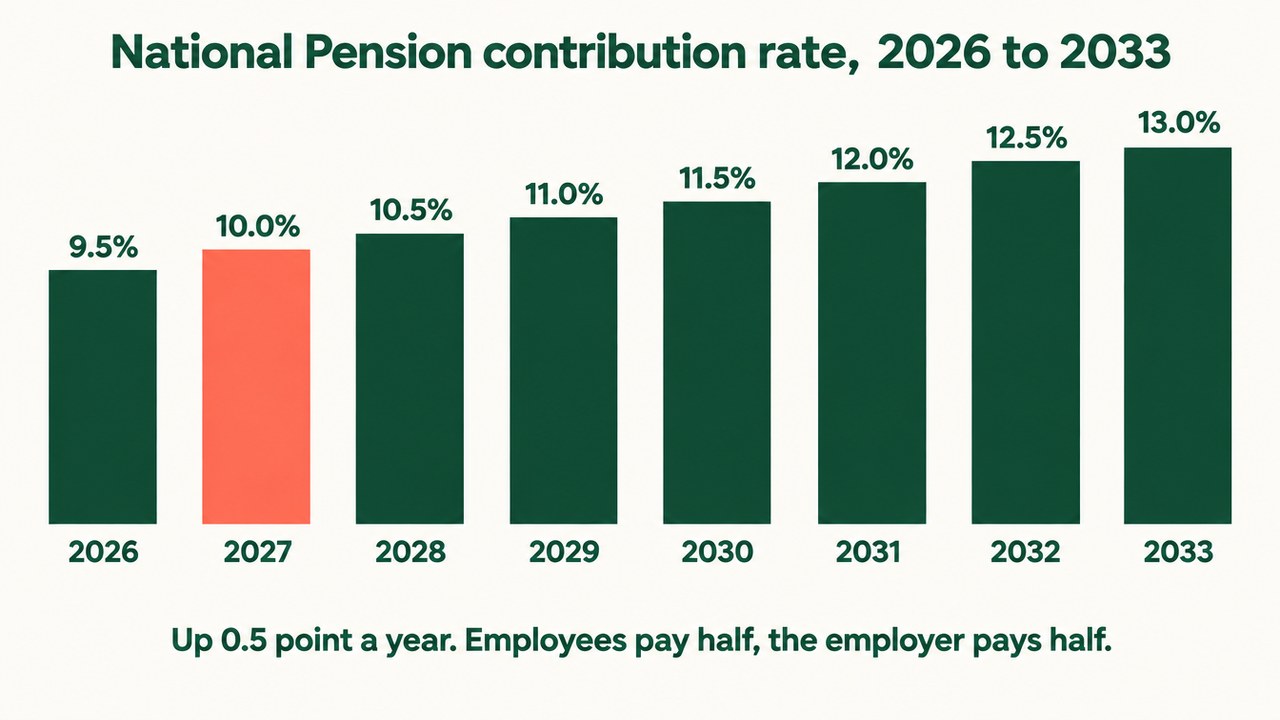
MOHW’s illustration is for an average earner over a full 40-year career who joined in 2026. For someone in their 50s with 20 or 30 years already paid in, the higher rate applies to the years you still contribute before 60, so the total extra cost is smaller than for a new entrant; NPS (1355) can estimate your own pension. When you can draw the pension depends on your birth year; see our guide to the Korean national pension age by birth year.
Why health insurance was frozen and long-term care was not
MOHW said the health rate was held at 7.19% because the fund has run a surplus for five years in a row, held reserves of about ₩30.2 trillion at the end of 2025 (about 3.5 months of spending), and government support for 2027 rises by about ₩1.1 trillion, with higher premium income expected from the semiconductor boom. Yonhap and Uisinmun reported the same reasons.
Long-term care went the other way. MOHW’s 30 October release says care spending grew about ₩2.4 trillion over 2024–2025 while income grew about ₩1.3 trillion, and demand will keep rising in a super-aged society. The rate rose 5.78%, and MOHW estimates the average household care premium goes from ₩19,029 to ₩20,129 a month (+₩1,100). The same release raises home-care limits for long-term care grades 1 and 2 from January; if you care for a parent, our guide to long-term care grades covers what that means.
A short checklist before January
- Note your current pension, health, long-term care and employment lines from your November or December payslip.
- Multiply your income base by 0.25% to see your extra monthly pension (₩7,500 per ₩3 million). Calculated rule of thumb.
- Multiply your health line by 0.139 to estimate the 2027 care line.
- If you run a small business, budget the employer side too: it rises by the same amounts as the employee side for pension and long-term care.
- Watch for MOEL’s final decision on employment insurance before you finalise a 2027 payroll budget.
- If you are self-employed, check with NPS (1355) whether you qualify for the low-income premium support.
Frequently asked questions
Q. How much is the Korean national pension contribution in 2027?
The total rate is 10.0% of your monthly income base, up from 9.5% in 2026. Employees pay 5.0% and the employer pays 5.0%. Self-employed and other regional members pay the full 10.0%. The income base runs from ₩410,000 to ₩6,590,000 until June 2027, so the most an employee pays is ₩329,500 a month (calculated).
Q. Is the health insurance rate going up in 2027?
No. MOHW announced on 8 September 2026 that the 2027 health insurance rate stays at 7.19%, the same as 2026, with 3.595% paid by the employee and 3.595% by the employer. The amount per property point for regional members also stays at ₩211.5.
Q. Why will my long-term care deduction rise if health insurance is frozen?
Because it is charged as a share of the health premium, and that share rises. MOHW’s long-term care committee set the 2027 rate at 0.9994% of income, which is 13.90% of the health premium, up from 0.9448% (about 13.14%) in 2026. A ₩100,000 health premium means a ₩13,900 care premium in 2027.
Q. How much less take-home pay should I expect on ₩3 million or ₩5 million?
With the confirmed pension and long-term care changes, about ₩8,320 a month more in deductions at ₩3,000,000 and about ₩13,860 at ₩5,000,000 (our calculation). If the proposed employment insurance rise to 1.0% for employees goes ahead, add ₩3,000 or ₩5,000 a month.
Q. Is the employment insurance increase to 2.0% confirmed?
Not as of 11 November 2026. MOEL published a draft decree on 22 September 2026 raising the unemployment-benefit rate from 1.8% to 2.0%, and the public comment period ended on 2 November. It still needs to be approved and promulgated. Check your first 2027 payslip or MOEL’s announcements.
Related reading
- Korea Payslip Deductions 2026: What the 4 Social Insurances Take From Your Salary
- Korea National Pension Catch-Up and Voluntary Continue After 60 (2026)
- Korea National Pension Age by Birth Year: When You Can Claim
- Korea’s Long-Term Care Insurance Grades: How Grades 1–5 Work and What You Pay
Sources
- Ministry of Health and Welfare (MOHW), 연금개혁 Q&A (contribution rate ’26 9.5% → ’27 10.0% → … → ’33 13.0%, 0.5 point a year for eight years; income replacement rate 43% from 2026; low-income regional premium support) — https://www.mohw.go.kr/menu.es?mid=a10714060000 (checked 11 November 2026)
- MOHW, 가입대상 및 연금보험료 (premium = income base × rate; employer 50% / employee 50%, others pay in full; income ₩410,000 – ₩6,590,000 for July 2026 – June 2027; due by the 10th of the following month), last updated 30 June 2026 — https://www.mohw.go.kr/menu.es?mid=a10714010100 (checked 11 November 2026)
- National Law Information Center, 국민연금 기준소득월액 하한액과 상한액 (MOHW notice 2026-31: ₩410,000 / ₩6,590,000, July 2026 – June 2027) — https://www.law.go.kr/admRulLsInfoR.do?admRulSeq=2100000274228 (checked 11 November 2026, search extract)
- MOHW via Korea.kr policy briefing, “내년 건강보험료율 7.19%로 동결” (8 September 2026; 2027 health rate 7.19%; ₩211.5 per property point; reserves ₩30.2 trillion; government support +₩1.1 trillion) — https://www.korea.kr/news/policyNewsView.do?newsId=148971474 (checked 11 November 2026)
- MOHW, 2026년 제5차 장기요양위원회 개최 (30 October 2026; 2027 long-term care rate 0.9994% of income, 13.90% of the health premium, +5.78%; average household premium ₩19,029 → ₩20,129; ₩100,000 → ₩13,900 example) — https://www.mohw.go.kr/gallery.es?act=view&bid=0003&list_no=380579&mid=a10505000000 (checked 11 November 2026)
- Ministry of Government Legislation, MOEL notice 2026-450: draft amendment to the Insurance Premium Collection Act Enforcement Decree, art. 12 (unemployment-benefit rate 1.8% → 2.0%; comments 22 September – 2 November 2026) — https://www.moleg.go.kr/lawinfo/makingInfo.mo?lawSeq=88792&mid=a10104010000 (checked 11 November 2026)
- Independent: Yonhap, “내년 건강보험료 안 오른다…보험료율 7.19%로 동결(종합)” (8 September 2026) — https://www.yna.co.kr/view/AKR20260908089851530 (checked 11 November 2026, search extract)
- Independent: Yonhap, “내년 장기요양보험료율 인상…세대당 월평균 1천100원 오른다” (30 October 2026; 0.9994%, 13.90%) — https://www.yna.co.kr/view/AKR20261030093500530 (checked 11 November 2026, search extract)
- Independent: Maeil Business, “내년 장기요양보험료율 5.78% 인상” — https://www.mk.co.kr/news/economy/12191841 (checked 11 November 2026, search extract)
- Independent: Uisinmun (bosa.co.kr), “내년도 건강보험료율 7.19%로 동결” — https://www.bosa.co.kr/news/articleView.html?idxno=3011707 (checked 11 November 2026, search extract)
- Independent: AnytimeKit, “2027년 4대보험 요율표” and “2027년 국민연금 보험료 5.0%로 인상” (law addendum schedule; ₩142,500 → ₩150,000 at ₩3 million; January or February payslip) — https://anytimekit.com/money/four-insurance-2027 (checked 11 November 2026, search extract)
- Independent: Dasem, “2027 국민연금 보험료 인상 4.75%→5%” — https://dasem.app/guide/national-pension-2027-increase (checked 11 November 2026, search extract)
- Independent: Seoul Shinmun and Electronic Times on MOEL’s employment insurance plan (1 September 2026; employee 0.9% → 1.0%) — https://www.etnews.com/20260901000131 (checked 11 November 2026, search extract)
This article is general information, not financial, tax or legal advice. The won amounts are illustrations calculated from the official rates and may differ slightly from your payslip because of rounding, non-taxable allowances and how your employer reports your income base. Confirm your own deductions with your payroll team, the National Pension Service (1355) or the National Health Insurance Service (1577-1000).






One Comment