Korea’s Housing Subscription Savings Deduction for 2026: 40% of Up to ₩3 Million, Who Qualifies, and Why 31 December Matters
Haesul Economy desk (AI-assisted). As of 12 November 2026 (KST). Only deposits made by 31 December 2026 count for tax year 2026, which is 48 days from 13 November. Based on the current text of the Restriction of Special Taxation Act (조세특례제한법) article 87 and Enforcement Decree article 81 on the National Law Information Center (law.go.kr), the National Tax Service (NTS) page on the housing-savings deduction, the NTS 126 helpline Q&A on housing savings, the NTS pages on the housing-lease loan deduction and on tax rates, and Ministry of Land, Infrastructure and Transport (MOLIT) announcements carried on the government’s Korea.kr briefing site. Independent cross-checks: a national daily’s December 2025 report on the NTS year-end changes and two commercial banks’ product terms for the account. This is general information, not tax advice.
Quick answer: If you are an employee in Korea, your total pay for 2026 is ₩70 million or less, and your household owned no home at any point in 2026, you can take 40% of what you paid into a housing subscription savings account (주택청약종합저축) in 2026 off your employment income, on up to ₩3 million of deposits. That is a deduction of up to ₩1.2 million. Since deposits made from 1 January 2025, the spouse of a no-home head of household can claim too, on an account in their own name. Head-of-household status is judged on 31 December 2026, and only money that actually goes in by then counts for 2026. To claim, you must file a no-home confirmation (무주택확인서) with the bank that holds the account by the end of February 2027, once (if you have already filed one, you don’t need to file it again). If you claimed and then close the account within five years of opening it, the bank takes back 6% of the deposits you claimed on, unless an exception applies.
If you are in your 40s or 50s and still renting, this is one of the few year-end items you can still change in November and December. Card spending and medical bills have mostly happened already. The housing subscription account is different: what you pay in during the next seven weeks decides how much of the ₩3 million cap you use. This guide sets out the tests, works through what the deduction is worth in won with local income tax, explains the no-home confirmation and the five-year clawback, and lists the situations where the deduction quietly fails.

The five tests, in one minute
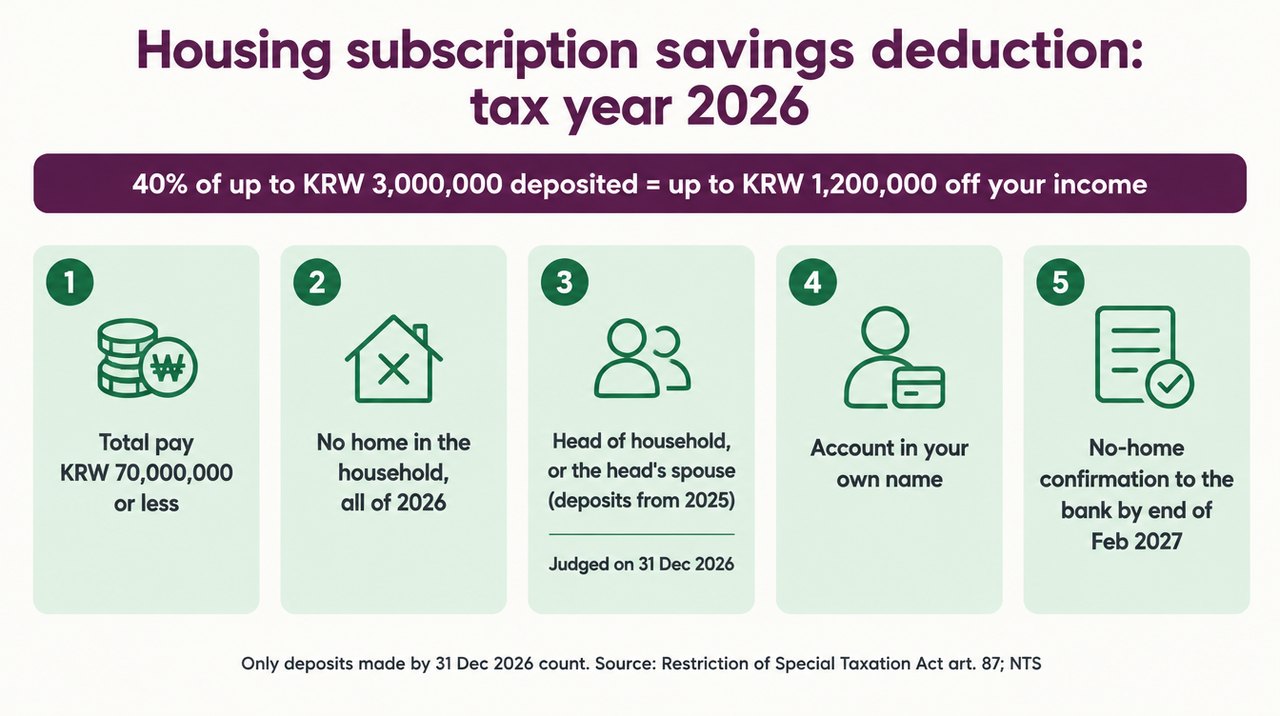
Article 87(2) of the Restriction of Special Taxation Act grants the deduction to a resident who meets all of these for the tax year. The NTS page on the housing-savings deduction says the same in plain language:
- You have employment income. It is deducted from your employment income amount (근로소득금액), so it is a deduction for employees settled through year-end settlement. Day labourers are excluded by the article.
- Your total pay for the year is ₩70 million or less. “Total pay” (총급여액) is the term in Income Tax Act article 20(2): employment income before deductions, leaving out non-taxable items. It is your own pay, measured for the same year (2026).
- Your household owned no home during the year. Not just on 31 December: the NTS says the household must be without a home for the whole year, 1 January to 31 December.
- You are the head of household (세대주), or since 2025 the head’s spouse. Whether you are the head is judged on 31 December. If you became the head during the year, the NTS says all of that year’s deposits count.
- The account is in your own name, and you filed the no-home confirmation with the bank by the end of February of the year after the first year you claim (article 87(4)).
If all five hold, you deduct 40% of your 2026 deposits, with deposits capped at ₩3 million a year, so the deduction tops out at ₩1.2 million. The ₩3 million cap applies from 2024 deposits; before that it was ₩2.4 million (NTS 126 Q&A). Under the current article, the deduction is available for deposits made up to 31 December 2028. The government’s “2026 what changes” briefing listed that extension to 2028.
What changed in 2025: the spouse can claim
Until 2024, only the head of household could claim. The NTS 126 Q&A says the tax-law change means that from deposits made on or after 1 January 2025, the deduction covers “a no-home head of household and spouse”. A spouse who is a household member rather than the head can claim on their own deposits in their own year-end settlement, provided they meet the other tests. The NTS repeated this in its December 2025 briefing on year-end changes, as reported at the time by a national daily.
This matters to many couples in their 40s and 50s. A common case: the head of household earns over ₩70 million and was locked out, while the spouse earns less. From 2025 deposits, the spouse’s own account can qualify if the spouse’s total pay is ₩70 million or less. Two practical points follow from the NTS wording:
- Each person claims on their own account. The NTS says deposits into an account in a dependant’s or a non-earning spouse’s name do not count for the worker. You can’t pay into your spouse’s account and claim it yourself.
- The pay test is personal. The article measures the claimant’s own total pay. Article 87 sets the ₩3 million cap per claimant and sets no joint cap for a couple. That is our reading of the article, so confirm with your payroll team if both of you plan to claim.
“No home”: who counts, and what counts as a home
This is where most failed claims come from. The NTS 126 Q&A and Enforcement Decree article 81(10) define the household broadly. It is you and your spouse, plus your and your spouse’s lineal ascendants and descendants (and their spouses) and siblings who live at the same address and share your livelihood. Any home owned by any of them during the year counts against you. From the NTS answers:
| Situation in 2026 | Can you claim for 2026? (NTS 126 Q&A) |
|---|---|
| Single-person head of household, no dependants, no home | Yes |
| Your parents live with you and own a flat in the provinces | No. Their home counts for your household |
| Your spouse lives at a separate address and owns a home | No. A spouse always counts as the same household |
| You bought a home in 2026 and sold it again within the year | No. You must be without a home for the whole year |
| You bought a home in 2026 | No, not even for the deposits you made before you bought it |
| You only own a residential officetel (주거용 오피스텔) | Yes. The NTS says it isn’t a house under the Housing Act |
| You hold a right to buy a new flat (분양권) but no finished home | Yes, until the flat is completed |
| You co-own a home with a sibling | No. Each co-owner is treated as owning a home |
| You hold a 60% share in an inherited home | No. An inherited home counts for the heir with the largest share |
Timing trap: a home bought on any day of 2026 cancels the whole year’s deduction. If you are about to buy, the NTS answers mean the year of purchase is lost, so the deposits you make that year still help your housing application but don’t cut your tax.

Worked table: what the deduction is worth, with 10% local tax
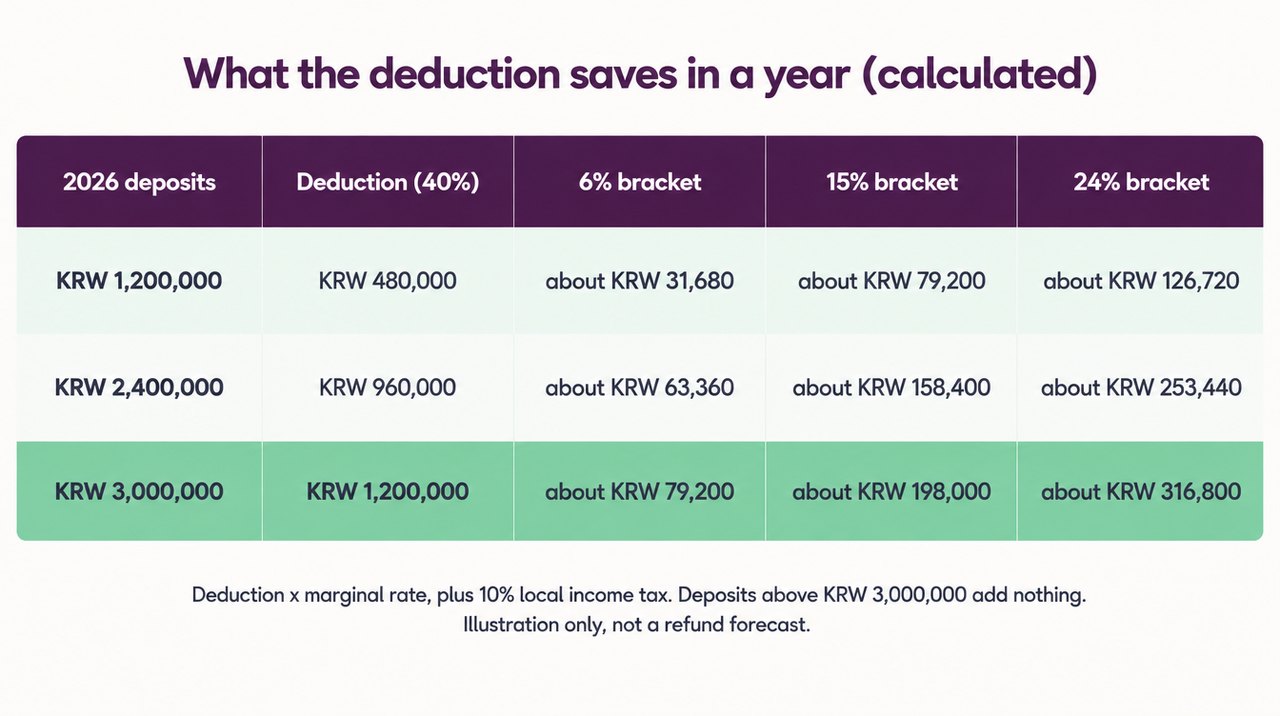
The deduction comes off your income, not off your tax, so its value depends on your marginal rate. The NTS rate table for 2026 is 6% on a tax base up to ₩14 million, 15% from ₩14 million to ₩50 million, and 24% from ₩50 million to ₩88 million. With total pay capped at ₩70 million, most claimants are in one of those three brackets. Local income tax (지방소득세) adds 10% of the income tax, so the combined marginal rates are 6.6%, 16.5% and 26.4%.
The table below is calculated by Haesul: 40% of 2026 deposits (deposits capped at ₩3 million), multiplied by the combined marginal rate. It assumes your tax base stays inside one bracket.
| 2026 deposits | Deduction (40%) | Saving at 6% + 0.6% local | Saving at 15% + 1.5% local | Saving at 24% + 2.4% local |
|---|---|---|---|---|
| ₩1,200,000 (₩100,000 a month) | ₩480,000 | about ₩31,680 | about ₩79,200 | about ₩126,720 |
| ₩2,400,000 (₩200,000 a month) | ₩960,000 | about ₩63,360 | about ₩158,400 | about ₩253,440 |
| ₩3,000,000 (₩250,000 a month) | ₩1,200,000 | about ₩79,200 | about ₩198,000 | about ₩316,800 |
| ₩5,000,000 | ₩1,200,000 (cap) | about ₩79,200 | about ₩198,000 | about ₩316,800 |
How to read it. A renter in the 15% bracket who pays ₩250,000 a month saves about ₩198,000 a year. For the same person, moving from ₩100,000 to ₩250,000 a month is worth about ₩118,800 more (calculated). Anything above ₩3 million a year earns nothing more for tax, though it may still help a housing application.
Why ₩250,000 a month lines up. In 2024 MOLIT raised the monthly amount that counts towards a housing application from ₩100,000 to ₩250,000, effective 1 November 2024. MOLIT said the point was to let savers use the ₩3 million deduction cap in full: ₩250,000 × 12 = ₩3 million. One bank’s product terms show the same: for public-housing applications, monthly payments above ₩250,000 count only as ₩250,000.
Two caps above this one. If you also repay a jeonse or lease loan and take the housing-lease loan repayment deduction (주택임차차입금 원리금 상환액), the NTS says the two deductions together are limited to ₩4 million a year (article 87(5) gives the same limit). Housing savings are also one of the items inside the ₩25 million overall cap on certain income deductions (Restriction of Special Taxation Act art. 132-2, per the NTS rate page). Few employees on ₩70 million or less reach that cap.
Topping up before 31 December
Only what is actually paid in during 2026 counts for 2026 (article 87(2): “paid in the tax year”). For this reason the NTS reminded workers in December 2025 that paying into pension accounts and housing subscription savings by the end of the month could add to their year-end deductions.
- Prepayments count in the year you pay them. The NTS 126 Q&A says amounts you prepay for future months are included in the year they were actually paid, up to the ₩3 million cap. MOLIT’s 2024 notice also let savers who had prepaid at the old ₩100,000 level re-prepay at up to ₩250,000 from the instalments falling due from 1 November 2024.
- The flip side: money prepaid in December 2026 for 2027 instalments counts towards 2026’s ₩3 million, not 2027’s. Plan 2027 deposits with that in mind.
- A short calendar. 31 December 2026 is a Thursday (calculated). Leave a few days’ margin rather than relying on a transfer on the last evening of the year; your bank can tell you its own cut-off times.
The no-home confirmation (무주택확인서): once, by the end of February
Article 87(4)1 says that to take the deduction you must give the bank holding the account a no-home confirmation by the end of February of the year after the first tax year you claim. For tax year 2026, that is the end of February 2027. 28 February 2027 is a Sunday (calculated), so in practice aim for an earlier weekday.
- Once is enough. The NTS says one filing is valid going forward and you don’t need to file every year.
- Only deposits from the first claimed year count. The article covers deposits “made in or after the tax year to which the deduction is first applied”. Deposits from earlier years, before you registered, can’t be claimed back.
- Why the bank needs it. The NTS notes that anyone can open a housing subscription account, whether or not they own a home or are the head of household. The confirmation is what tells the bank, and through it the government, that you are claiming as a no-home household.
- What happens next. Under article 87(10) and Decree article 81, the bank sends the list of people who filed a confirmation to MOLIT by 5 March of the following year. MOLIT checks whether each household was without a home during the year and tells the NTS and the bank by 30 April. So a claim for a household that owned a home is likely to be picked up.
- If you lose eligibility, one bank’s terms say you should ask the bank to cancel your deduction registration, and the deduction stops from that year.
- For the settlement itself, the NTS says to give your employer the deposit certificate (납입증명서) or a copy of the passbook. It usually appears in the Hometax simplified service, which the NTS opened on 15 January for the previous settlement round. If it doesn’t appear, the bank can issue the certificate.

The five-year rule: when the bank takes 6% back
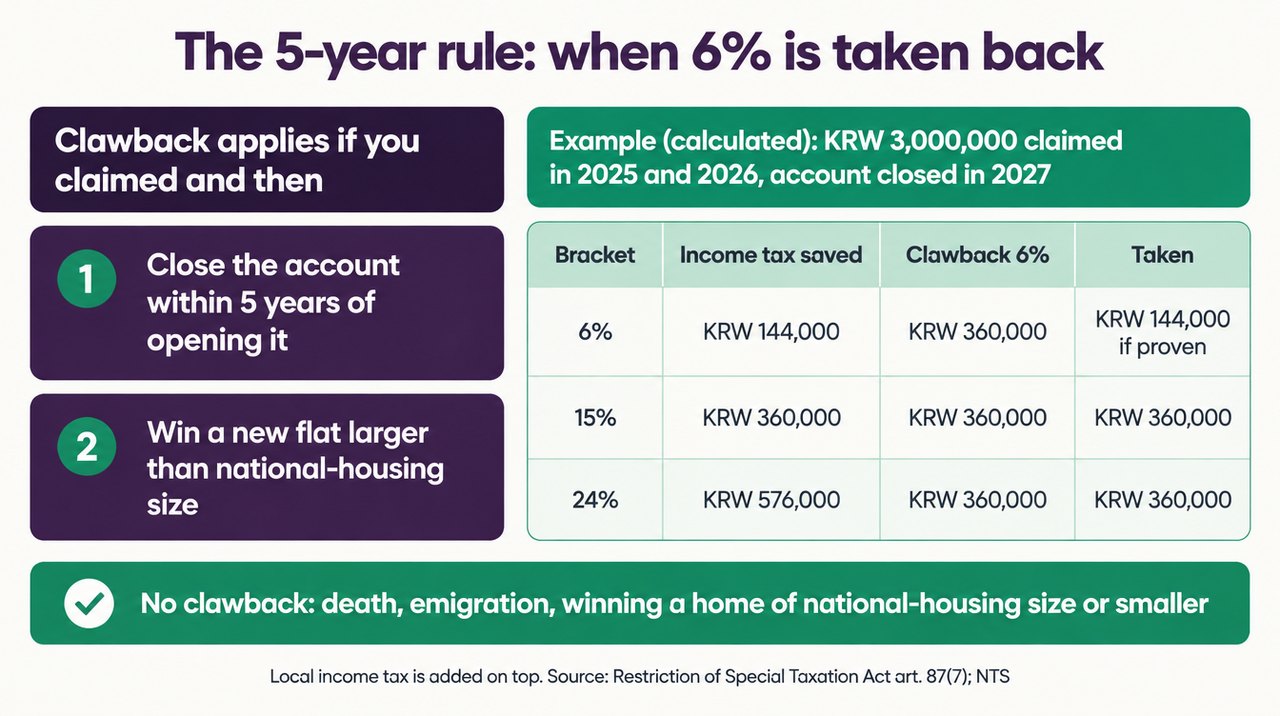
Article 87(7) says that if someone who claimed the deduction then closes the account within five years of opening it, or wins a new flat larger than national-housing size, the bank must take a clawback (추징세액) from the account when it is closed. The clawback is 6% of the total deposits made from the first claimed year onward (each year counted up to ₩3 million). If you prove that the tax you actually saved was less than that, only the amount actually saved is taken. Two banks’ product terms describe the same rule and add that local income tax is charged on top. One gives the combined rate as 6.6%.
Exceptions (no clawback). The NTS lists these: the saver’s death or emigration; winning a home of national-housing size or smaller; switching to the youth version of the account; and, if it happened within six months before closing, a natural disaster, leaving your job, your workplace closing, an injury or illness needing three months or more of hospital treatment or care, or the bank’s licence being suspended or the bank failing.
A worked clawback (calculated). Say you opened the account in 2023, claimed for 2025 and 2026 with ₩3 million each year, and close it in 2027:
| Your marginal rate | Income tax you saved over two years (40% × ₩6M × rate) | Clawback at 6% of ₩6M | What is taken |
|---|---|---|---|
| 6% | ₩144,000 | ₩360,000 | ₩144,000 if you prove the actual saving |
| 15% | ₩360,000 | ₩360,000 | ₩360,000 (the same) |
| 24% | ₩576,000 | ₩360,000 | ₩360,000 |
Local income tax is added on top of each figure. The pattern is simple: 40% × 15% = 6%, so in the 15% bracket the clawback roughly cancels the income tax you saved. In the 24% bracket you keep part of the benefit. In the 6% bracket, proving your actual saving matters.
What this means in your 40s and 50s. Many people in this age group opened their account years ago. If yours is more than five years old, closing it no longer triggers the five-year clawback. The larger-than-national-size win still does. One bank’s terms say that trigger has no time limit. The NTS page on lease loans gives national-housing size as 85 m² of exclusive floor area (100 m² in non-urban eup and myeon areas outside the capital region).
Other ways the deduction fails
- Closing the account during the year for any reason other than winning a home or switching to the youth account means that year’s deposits don’t count (article 87(2) proviso; NTS 126 Q&A).
- Total pay over ₩70 million in 2026, even by a small amount. The test is the year’s own pay, so a year-end bonus can push you over.
- Not the head or the head’s spouse on 31 December, for example an adult child living with parents who is a household member.
- The household owned a home at any point in 2026, including a parent at the same address who owns one.
- The no-home confirmation was never filed, or was filed after the end-February deadline for your first claimed year.
- The rent-credit interaction. Our monthly rent tax credit guide explains that if the head of household already takes the housing-subscription deduction, another household member can’t claim the rent credit in the head’s place. Look at both items together.
A checklist for the next seven weeks
- Pay test: estimate your 2026 total pay, including any December bonus. Over ₩70 million? Check whether your spouse qualifies instead (2025+ deposits).
- Home test: did anyone in your household (including parents at your address) own a home at any point in 2026? If yes, stop here for 2026.
- 31 December status: you are the head of household or the head’s spouse on that date.
- Top-up: check your 2026 deposits so far and decide whether to pay in more (up to ₩3 million in total) before 31 December 2026, 48 days from 13 November.
- Confirmation: if you have never filed a no-home confirmation, file it with the bank holding the account before the end of February 2027 (28 February 2027 is a Sunday).
- Account age: note your opening date. Closing within five years of it after claiming triggers the 6% clawback.
- Related deductions: compare with the card deduction in our credit card and cash-receipt deduction guide. Foreign residents can read our year-end settlement guide for foreigners, which covers the spouse rule as it applies to foreign employees.
Frequently asked questions
Q. How much can I deduct for my housing subscription savings in Korea for 2026?
40% of what you paid into the account in 2026, counting up to ₩3 million of deposits. The largest possible deduction is ₩1.2 million off your employment income. In the 15% tax bracket that saves about ₩198,000 including 10% local income tax (calculated).
Q. I’m not the head of household. Can I still claim?
Yes, if you are the spouse of a no-home head of household. From deposits made on or after 1 January 2025, the spouse can claim on deposits into an account in their own name, in their own year-end settlement, if their total pay is ₩70 million or less and the household owned no home during the year. Other household members, such as an adult child, can’t claim.
Q. Do deposits I make in December 2026 count?
Yes. What counts is the amount actually paid in during 2026, up to 31 December 2026. The NTS says prepayments for future months count in the year they are paid. Money prepaid in December for 2027 instalments therefore counts towards 2026’s ₩3 million cap, not 2027’s.
Q. When do I need to file the no-home confirmation, and do I need to do it every year?
File it with the bank that holds the account by the end of February of the year after the first year you claim. For tax year 2026, that is the end of February 2027. One filing is enough; the NTS says you don’t need to file it again every year. Only deposits made from the first claimed year onward count.
Q. What happens if I close the account after claiming the deduction?
If you close it within five years of opening it, or you win a new flat larger than national-housing size, the bank takes 6% of the deposits you claimed on (counted up to ₩3 million a year), plus local income tax. If you prove your actual tax saving was smaller, only that amount is taken. Death, emigration, winning a home of national-housing size or smaller, and certain events within six months before closing (leaving your job, serious illness, a natural disaster) are exempt. Closing the account during a year also means that year’s deposits don’t count.
Related reading
- Korea Monthly Rent Tax Credit 2026: Rates, the ₩10 Million Cap and the Documents to Submit
- Korea Credit Card and Cash-Receipt Deduction 2026: Rates, Caps and Year-End Tips
- Korea Year-End Tax Settlement for Foreigners: Dates, Documents and the 19% Choice (Tax Year 2026)
Sources
- National Law Information Center, 조세특례제한법 제87조 (주택청약종합저축 등에 대한 소득공제 등), in force 18 September 2026 (Act No. 21467), last amended for this article 23 December 2025 (total pay ₩70M; no-home head of household or spouse; deposits to 31 Dec 2028; ₩3M cap; 40%; mid-year closing; no-home confirmation by the end of February of the following year; ₩4M combined cap; head status on the last day of the tax year; 6% clawback within 5 years or on a larger-than-national-size win; MOLIT check) — https://www.law.go.kr/LSW/lsLawLinkInfo.do?chrClsCd=010202&lsId=001584&lsJoLnkSeq=1000819880 (checked 12 November 2026)
- National Law Information Center, 조세특례제한법 시행령 제81조, in force 18 September 2026 (household definition; exception reasons; bank list to MOLIT by 5 March; MOLIT notice by 30 April) — https://www.law.go.kr/LSW/lsLawLinkInfo.do?chrClsCd=010202&lsJoLnkSeq=1000027150 (checked 12 November 2026, via the official page’s search extract)
- National Tax Service, 주택마련저축 소득공제 (total pay ₩70M; no-home head and spouse from 2025 deposits; own-name account; 40% of up to ₩3M; deposit certificate or passbook copy) — https://www.nts.go.kr/nts/cm/cntnts/cntntsView.do?cntntsId=239022 (checked 12 November 2026)
- NTS 국세상담센터, 자주묻는Q&A 25. 주택마련저축 (household definition and home-ownership cases; head status on 31 December; prepayments; purchase during the year; own-name accounts; mid-year closing; clawback and exceptions; no-home confirmation once, by the end of February) — https://call.nts.go.kr/call/qna/selectQnaInfo.do?ctgId=CTG11896&mi=1318 (checked 12 November 2026)
- National Tax Service, 주택임차차입금 원리금 상환액 소득공제 (combined ₩4M cap with housing savings; national-housing size 85 m² / 100 m²) — https://www.nts.go.kr/nts/cm/cntnts/cntntsView.do?cntntsId=239021 (checked 12 November 2026)
- National Tax Service, 근로소득 과세표준과 산출세액 (₩25M overall deduction cap incl. housing savings; 2026 basic rates 6% / 15% / 24% / 35%) — https://www.nts.go.kr/nts/cm/cntnts/cntntsView.do?mi=6594&cntntsId=7873 (checked 12 November 2026)
- MOLIT via Korea.kr, 청약통장 더 쏠쏠해진다…금리 최고 3.1%로 인상 (25 September 2024; monthly recognised amount ₩100,000 → ₩250,000 from 1 November 2024 to use the ₩3M cap; re-prepayment) — https://www.korea.kr/news/policyNewsView.do?newsId=148934374 (checked 12 November 2026)
- Korea.kr, 달라지는 부동산 제도: 세제·금융 편 – 2026 이렇게 달라집니다 (housing subscription savings tax benefits extended to 2028) — https://www.korea.kr/news/policyFocusView.do?newsId=148958477&pkgId=49500831 (checked 12 November 2026, search extract)
- Independent: Seoul Shinmun, “자녀 공제 10만원 늘고, 무주택 배우자도 청약저축 공제… 달라진 연말정산 혜택” (17 December 2025; NTS briefing: spouse of a no-home head can claim 40% of up to ₩3M if total pay ₩70M or less; pay in by the end of the month) — https://www.seoul.co.kr/news/economy/2025/12/18/20251218012001 (checked 12 November 2026)
- Independent: a commercial bank’s product terms for 주택청약종합저축 (head or spouse; 40% of up to ₩3M, maximum ₩1.2M; confirmation by the end of February; clawback 6% plus local tax; larger-than-national-size win with no time limit; ₩250,000 monthly recognition) — https://nhlink.nonghyup.com/content/nhbank/html/sf/mk/dt/dt10000587.html (checked 12 November 2026, search extract)
- Independent: a second commercial bank’s deduction notice for 주택청약종합저축 (5-year and larger-size clawback; 6.6% including local tax; deduction for deposits to 31 Dec 2028; cancelling the registration when eligibility is lost) — https://oland.kbstar.com/quics?page=C066840 (checked 12 November 2026)
This article is general information, not tax, legal or financial advice. The savings and clawback tables are calculations and illustrations, not a forecast of your refund. Whether you qualify depends on your household’s actual circumstances for the whole of 2026. Confirm with your employer’s payroll team, the bank that holds your account, or the NTS helpline (126) before you file.