Claiming Your Parents as Dependants on Korea’s 2026 Year-End Tax Settlement: The 60+ Age Test, the ₩1 Million Income Test and What a Pension Does to It
Haesul Economy desk (AI-assisted). As of 12 November 2026 (KST), 48 days from 13 November to 31 December, the date on which a dependant’s status for tax year 2026 is judged. Based on the current text of the Income Tax Act (소득세법) articles 50 and 53 on the National Law Information Center (law.go.kr), the National Tax Service (NTS) pension-income page, the NTS 126 helpline Q&A on parents, the 70+ extra deduction and the ₩1 million income test, the Ministry of Government Legislation’s EasyLaw page on tax relief for older people, and the NTS January 2026 press release on the simplified service. Independent cross-checks: KB Think’s dependant guide (January 2026), Bravo My Life (Etoday, 5 November 2026) and Taxnet’s monthly tax journal. This is general information, not tax advice.
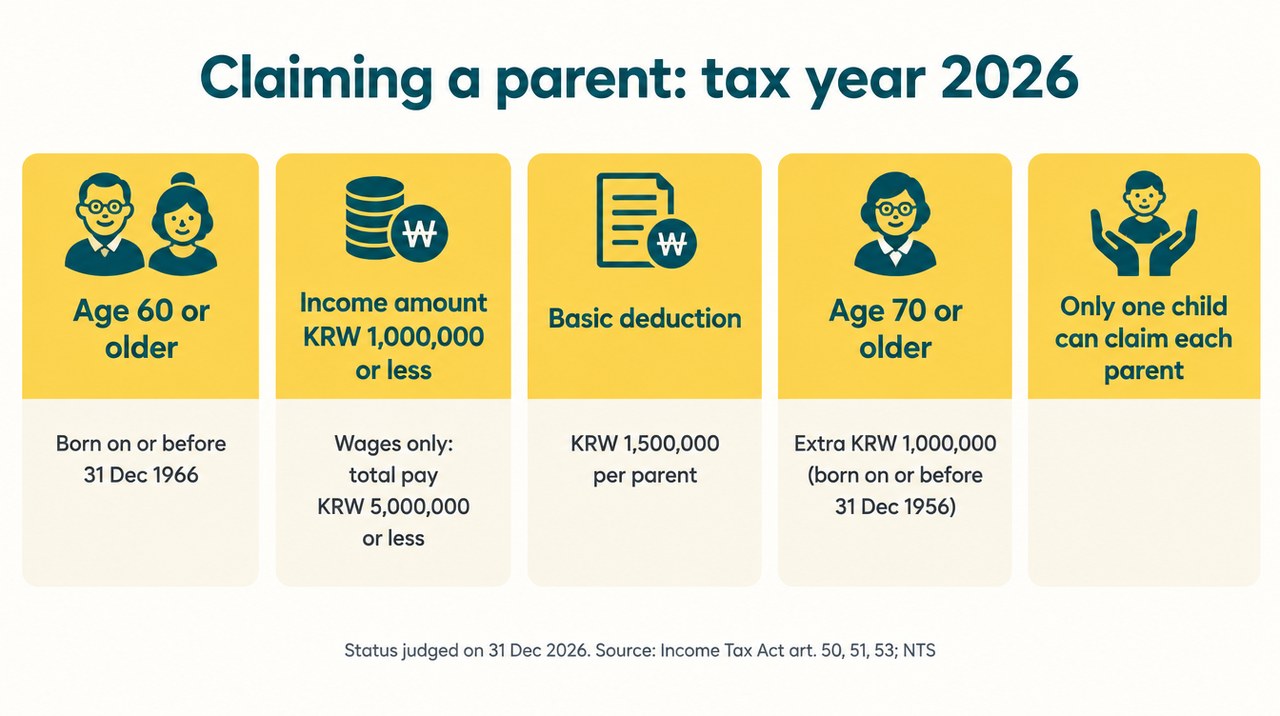
Quick answer: If you are an employee in Korea and you support a parent, you can usually take ₩1.5 million off your taxable income for each parent in the 2026 year-end settlement (부모님 기본공제), plus another ₩1 million if that parent is 70 or older (경로우대 추가공제). For tax year 2026 the parent must be 60 or older, which means born on or before 31 December 1966, and 70+ means born on or before 31 December 1956 (both calculated from the age rule). The parent’s income amount (소득금액) for 2026 must be ₩1 million or less, or total pay of ₩5 million or less if their only income is wages. A parent on the national pension often still passes: according to the NTS, a parent whose only income is a public pension passes if the taxable pension for the year is ₩5,166,667 or less. The basic pension (기초연금) does not count at all. You do not need to live together, but you must actually support them, and only one child can claim each parent. A parent who died during 2026 can still be claimed for 2026.
If you are in your 40s or 50s, this is often the single largest personal deduction you have not checked. Many people assume that a parent who “gets a pension” or “owns a flat” can’t be claimed, or that only the eldest son can claim, or that the parent has to be on your health insurance card. None of those is the rule. The deduction is also a gateway: some other year-end items, such as the insurance premium credit, depend on whether the parent is your basic-deduction dependant. This guide sets out the tests, works through what a national pension does to the ₩1 million income test, shows roughly what the deduction is worth in won, and lists the traps that lead to the NTS clawing the deduction back later.

The four tests, in one minute
Article 50 of the Income Tax Act gives every resident with earned or other “comprehensive” income a basic deduction (기본공제) of ₩1.5 million per person for themselves, a qualifying spouse and each qualifying dependant. For a parent (the law says 직계존속, lineal ascendant, which also covers grandparents and your spouse’s parents), four things must all be true for tax year 2026:
- Relationship. The person is your parent or grandparent, or your spouse’s parent or grandparent. The article’s wording covers the “resident (including the spouse)”, and article 53(3) expressly covers the spouse’s lineal ascendants too. A step-parent who is or was legally married to your parent also counts (Enforcement Decree art. 106(5), per EasyLaw and the NTS Q&A).
- Age. 60 or older. Under article 53(5), you meet an age requirement if there is any day in the tax year on which the person is that age. For 2026, that means anyone born on or before 31 December 1966 (calculated). A parent with a registered disability has no age requirement, though the income test still applies.
- Income. The parent’s income amount (소득금액) for the year is ₩1 million or less, or their only income is wages with total pay of ₩5 million or less. More on what “income amount” means below; it is not the same as money received.
- Support. The parent “shares a livelihood” with you (생계를 같이 하는). For parents, article 53(3) says that a parent living elsewhere because of their housing situation still counts. The NTS describes actual support as the parent lacking independent means and relying mainly on the worker’s income.
If those four hold, you deduct ₩1.5 million for that parent. Under article 51(1)1 (as EasyLaw summarises it), if a basic-deduction dependant is 70 or older, you add an extra ₩1 million (경로우대자 추가공제). For 2026, that is anyone born on or before 31 December 1956 (calculated). The NTS 126 Q&A gives the same rule for the previous year: for tax year 2025 the cut-off was “born on or before 31 December 1955”.
What “₩1 million income amount” really means
This is where most families go wrong, in both directions. The income amount is not the cash a parent receives. The NTS Q&A on the ₩1 million test sets out three rules:
- It is the sum of comprehensive income amount + retirement income amount + capital gains income amount for the year (Income Tax Act art. 50 and enforcement guideline 50-0-2).
- Tax-exempt income and separately taxed income are left out. So the basic pension (기초연금) and basic livelihood benefits do not count, because the NTS says they are not taxable pension income. Survivor’s, disability and similar pensions paid under the public pension laws are tax-exempt and do not count either. Interest and dividends of ₩20 million or less a year, which are taxed at source and not combined, do not count. Pay from day labour (일용근로) does not count however large it is.
- For most income types it is income after the deduction or expenses the law allows: for wages, total pay minus the earned-income deduction; for business income, revenue minus expenses; for pensions, the taxable pension minus the pension-income deduction.
The wages-only shortcut is total pay of ₩5 million or less. If the parent has wages and another type of income, the NTS says you add up the income amounts instead. In its own example, ₩2 million of pay works out to a wage income amount of ₩600,000. That leaves only ₩400,000 of room for everything else.
Two common surprises from the same NTS page:
- A retirement lump sum counts in full. The NTS treats the whole severance payment as the retirement income amount. A parent who retired in 2026 and received more than ₩1 million in severance fails the test for 2026, even if they earned nothing else.
- Selling property can knock a parent out for the year. In the NTS’s own January 2026 example, a father who sold land in August with a ₩20 million gain, and reported it in October, appeared as “over the income limit” in the simplified service and could not be claimed. Owning a home or a car is not itself a problem. What matters is whether a taxable gain or rental income arose (Bravo My Life makes the same point).
Worked table: what a national pension does to the ₩1 million test
The pension-income deduction is set by Income Tax Act article 47-2 and shown on the NTS pension-income page. On the taxable pension for the year (총연금액), it is:
| Taxable pension for the year | Pension-income deduction (NTS) |
|---|---|
| ₩3.5 million or less | The full amount |
| Over ₩3.5M up to ₩7M | ₩3.5M + 40% of the amount over ₩3.5M |
| Over ₩7M up to ₩14M | ₩4.9M + 20% of the amount over ₩7M |
| Over ₩14M | ₩6.3M + 10% of the amount over ₩14M (deduction capped at ₩9M) |
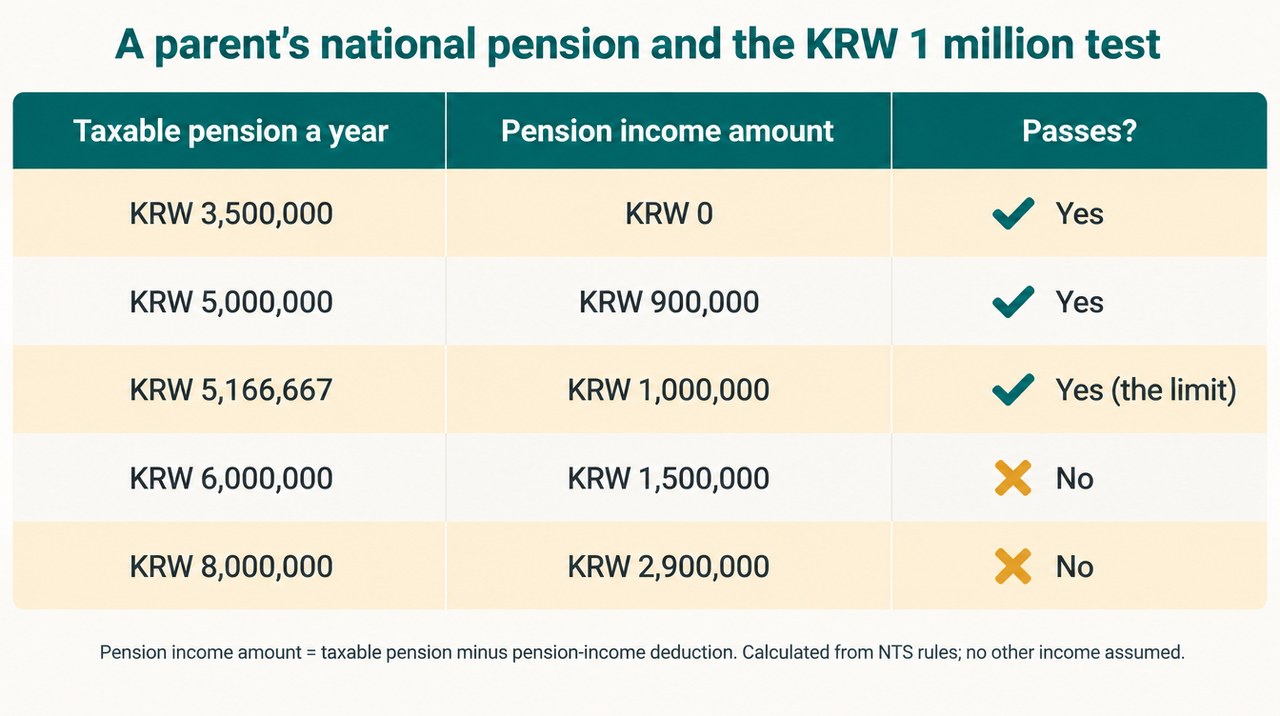
The pension income amount = taxable pension − pension-income deduction. Applying the NTS table, assuming the parent has no other income, gives these results (calculated by Haesul):
| Parent’s taxable pension in 2026 | Pension-income deduction | Pension income amount | Passes the ₩1M test? |
|---|---|---|---|
| ₩3,000,000 | ₩3,000,000 | ₩0 | Yes |
| ₩3,500,000 | ₩3,500,000 | ₩0 | Yes |
| ₩5,000,000 | ₩4,100,000 | ₩900,000 | Yes |
| ₩5,166,667 | ₩4,166,667 | ₩1,000,000 | Yes, this is the limit |
| ₩6,000,000 | ₩4,500,000 | ₩1,500,000 | No |
| ₩8,000,000 | ₩5,100,000 | ₩2,900,000 | No |
So the break-even point is a taxable pension of about ₩5.17 million a year, roughly ₩430,000 a month if spread evenly (calculated). The NTS 126 Q&A prints the same figure: a parent whose only income is a public pension passes if the yearly taxable pension is ₩5,166,667 or less, and its ₩5 million example gives a ₩900,000 income amount. Bravo My Life (5 November 2026) gives the same rounded ₩5.16 million threshold.
The key word is taxable. For the national pension, only the part of the old-age pension that comes from contributions made from 1 January 2002 is taxed. The NTS describes pension money based on pre-2002 contributions as “excluded from tax” (과세제외), and the National Pension Service (NPS) and KB’s retirement desk describe the same split. A parent who started contributing in the 1990s and receives, say, ₩700,000 a month may therefore have a taxable pension well under ₩5.17 million. You can’t tell from the bank deposit. Ask the NPS (helpline 1355) or check the parent’s pension withholding receipt for the taxable pension amount (과세대상 연금액). Bravo My Life points to the NPS online “old-age pension year-end settlement mock calculation” for this. The same logic applies to civil-servant and other public pensions: the NTS says a father who retired as a civil servant before 2002 and lives only on that pension can be claimed.
Private pensions (a pension savings account or IRP) work differently. If the parent’s private pension income is ₩15 million or less a year, they can choose separate taxation, and separately taxed pension income is left out of the ₩1 million test. If they choose to combine it with other income instead, it counts. The NTS’s ₩7 million example gives a ₩2.1 million income amount if combined, which fails, but the parent passes if they choose separate taxation. Above ₩15 million, the NTS says the parent passes only if they choose the 15% separate rate when filing.
Living apart, siblings, and who gets to claim
Living apart is fine. Article 53(3) treats a parent who lives separately “according to housing circumstances” as sharing your livelihood. The NTS gives the example of parents (including parents-in-law) living in the countryside: you can claim them if you actually support them, they meet the age and income tests, and no sibling claims them. Being on someone’s health insurance card is irrelevant. The NTS and EasyLaw both say that a parent being registered as your brother’s health-insurance dependant does not stop you claiming them if you are the one who supports them.
Support has to be real. The NTS says that a child who lives with a parent is presumed to support them unless there is a special reason. A child who lives apart proves support with records such as regular living-cost transfers to the parent’s bank account. Sending a little money now and then is not always enough. In one NTS example, a mother lives with a father who has wage income. Because the father is supporting her, a child who pays part of her living costs can’t claim her.
Only one person can claim each parent. Article 50(3) says a dependant who could be claimed by more than one resident is deducted by one of them. The NTS says the child who actually supports the parent claims. If two or more children can show support, the rule is (Enforcement Decree art. 106(2)):
- the child who claimed that parent in the previous tax year, then
- the child with the higher income for the year.
The extra ₩1 million can’t be split off. The NTS 126 Q&A says the eldest son can’t take the basic deduction while the younger son takes the 70+ extra deduction. Whoever takes the basic deduction for the parent takes the extra deduction too. The 70+ extra and the disability extra (₩2 million) can both apply to the same parent.
Parents who have emigrated don’t count. The NTS says that a Korean worker’s parent who has moved abroad and lives there is not “living apart for housing reasons”, so they can’t be claimed. (Foreign residents supporting parents in their home country are a different case, which the NTS allows with documents. See our guide to the year-end settlement for foreigners.)

If a parent died in 2026
You can still claim them for 2026. Article 53(4) says status is judged on the last day of the tax year, but for someone who died before then it is judged on the day before death. The NTS 126 Q&A confirms that a mother who died in July can be claimed with both the basic deduction and the 70+ extra, provided she met the age and income tests. The year after death, the claim stops. In January 2026 the NTS said it removes the data of dependants who died before the start of the tax year from the simplified service.
What the deduction is worth, in won
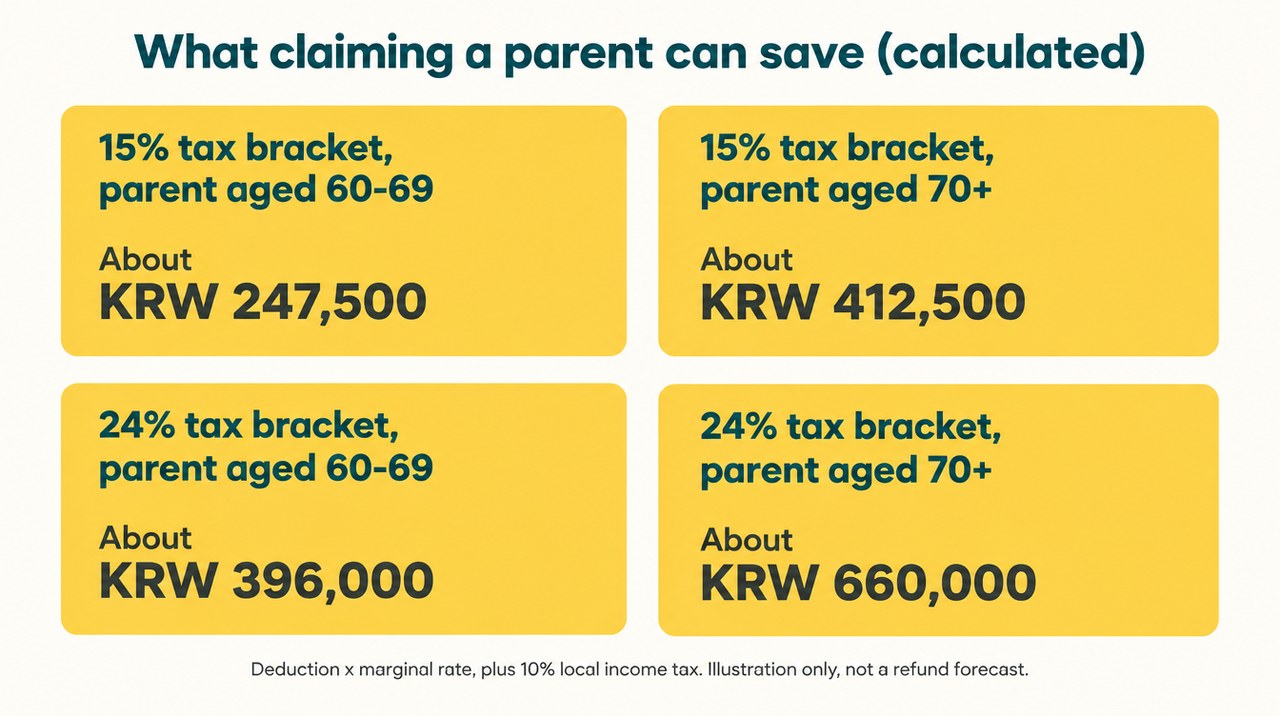
The basic deduction comes off your income, not off your tax, so its value depends on your marginal rate. NTS’s rate table for 2026 starts at 6% (tax base up to ₩14M), then 15% (to ₩50M), 24% (to ₩88M) and 35% (to ₩150M), and local income tax adds 10% of the income tax. Multiplying the deduction by those rates gives a rough guide (calculated by Haesul, assuming your tax base stays inside one bracket):
| Your marginal rate | One parent aged 60–69 (₩1.5M) | One parent aged 70+ (₩2.5M) | Two parents both 70+ (₩5M) |
|---|---|---|---|
| 6% (+0.6% local) | about ₩99,000 | about ₩165,000 | about ₩330,000 |
| 15% (+1.5% local) | about ₩247,500 | about ₩412,500 | about ₩825,000 |
| 24% (+2.4% local) | about ₩396,000 | about ₩660,000 | about ₩1,320,000 |
| 35% (+3.5% local) | about ₩577,500 | about ₩962,500 | about ₩1,925,000 |
These are illustrations, not refund forecasts. Your final tax also depends on credits and on the rule (art. 51(3), per EasyLaw) that personal deductions can’t be larger than your income amount. For a typical 50-something employee in the 15% or 24% bracket, two parents in their 70s are worth something like ₩0.8 to 1.3 million a year. That is why siblings argue about it.
What claiming a parent also unlocks, and what it doesn’t
- Insurance premiums: a protection policy you pay for that covers a parent counts for the 12% insurance credit only if the parent is your basic-deduction dependant. Both the age test and the income test apply. See our insurance premium tax credit guide.
- Medical bills: medical expenses you pay for a parent count for the medical credit without the age and income tests. You can still claim a parent’s hospital bills even if their pension is too high for the basic deduction. In January 2026 the NTS said that medical data for such dependants is still shown in the simplified service. See our medical expense tax credit guide.
- Education: a parent’s general education costs do not count for you (only special-education costs for a disabled parent do).
How the claim is checked, and the 31 December date
The parent’s status for 2026 is fixed by the situation on 31 December 2026, which is 48 days from 13 November. The age rule is met if the birthday falls on any day of the year. The income test uses the whole year’s income, including November and December.
When the settlement data opens in January, the NTS flags dependants who are over the limit. In 2026 the simplified service opened on 15 January. The NTS said its “over the income limit” list used business, other, retirement and capital-gains income reported up to October, plus wage income for the first half of the year. The NTS warned that not being on the list does not mean you qualify: you still have to check the full year’s income. If the timetable repeats, the service for tax year 2026 should open around 15 January 2027, but the NTS has not announced the date yet (expectation based on the 2026 opening).
For a parent’s data to show up in your simplified service, the parent has to consent to share data on Hometax (KB Think describes the path). If a parent can’t do this, payroll will usually accept paper proof such as a family relationship certificate (가족관계증명서). The NTS says that once you have filed these papers with your employer, you don’t have to file them again each year unless something changes.
If you are not sure about a parent’s income (for example, rental or business income that won’t be final until the May tax return), the NTS’s advice in a similar spouse case is to leave the person out at the January settlement. If their income amount later turns out to be ₩1 million or less, claim the deduction when you file your own May return. Taxnet’s tax journal gives the same advice. Going the other way is the costly mistake. The NTS says that a dependant whose real income exceeds ₩1 million is an improper deduction, which can be clawed back with additional tax, even if the income was never reported.
A checklist before 31 December
- Birth year: born on or before 31 Dec 1966 (60+) for the basic deduction; on or before 31 Dec 1956 (70+) for the extra ₩1 million.
- Pension: get the taxable pension amount from the NPS or the withholding receipt, not the bank total. Taxable public pension of ₩5,166,667 or less with no other income passes.
- Other 2026 income: severance pay, part-time wages, a taxable gain on a property sale, rental income or financial income above ₩20 million can each break the test.
- Who claims: agree among siblings now. One child claims each parent, and the one who claims the basic deduction takes the 70+ extra too.
- Proof of support if you live apart: regular transfers to the parent’s account.
- Consent: ask the parent to approve data sharing on Hometax before January, or prepare a family relationship certificate.
- Read the related credits: insurance premiums and medical expenses.

Frequently asked questions
Q. How old does my parent have to be to claim them in Korea’s 2026 year-end tax settlement?
60 or older at any point in 2026, which means born on or before 31 December 1966 (calculated from Income Tax Act article 53(5)). A parent with a registered disability has no age limit. For the extra ₩1 million elderly deduction, the parent must be 70 or older, which means born on or before 31 December 1956.
Q. My mother gets the national pension. Can I still claim her?
Often, yes. The test is her income amount, not the money she receives. For a public pension, that is the taxable pension minus the pension-income deduction. The NTS says a parent whose only income is a public pension passes if the yearly taxable pension is ₩5,166,667 or less. Only the part of the national pension that comes from contributions made from 2002 is taxable. The basic pension (기초연금) and survivor’s pensions do not count at all.
Q. Do my parents have to live with me or be on my health insurance?
No. A parent living elsewhere because of their housing situation still counts if you actually support them, for example with regular transfers to their account. Health-insurance registration does not decide who supports a parent. A parent who has emigrated and lives abroad can’t be claimed by a Korean resident worker.
Q. Can my brother and I both claim our father, or split the deductions?
No. Only one child can claim each parent. If more than one child can prove support, the child who claimed the parent the year before takes priority, then the child with the higher income. The child who takes the ₩1.5 million basic deduction also takes the ₩1 million 70+ extra deduction. They can’t be split between siblings.
Q. My father died in 2026. Can I still claim him this year?
Yes. For someone who died during the year, status is judged on the day before death. If he met the age and income tests, you can claim the basic deduction and, if he was 70 or older, the extra ₩1 million for 2026. You can’t claim him from 2027.
Related reading
- Korea Child Allowance 2026: ₩100,000–₩130,000 a Month, Who Qualifies and What Changes in 2027
- Korea Insurance Premium Tax Credit 2026: 12% on Up to ₩1 Million, and Whose Policies Actually Count
- Korea Year-End Medical Expense Tax Credit 2026: What Counts, Receipts and How to Upload on Hometax
- Korea Year-End Tax Settlement for Foreigners: Dates, Documents and the 19% Choice (Tax Year 2026)
Sources
- National Law Information Center, 소득세법 제50조 (기본공제), in force 1 January 2026, amended 23 December 2025 (₩1.5M per person; lineal ascendants 60+; ₩1M income amount or ₩5M wages only; disability removes the age limit; one resident claims a shared dependant) — https://www.law.go.kr/lsLawLinkInfo.do?chrClsCd=010202&lsJoLnkSeq=1001061037 (checked 12 November 2026, via the official page text)
- National Law Information Center, 소득세법 제53조 (생계를 같이 하는 부양가족의 범위와 그 판정시기), in force 1 January 2026 (parents living apart for housing reasons; status on the last day of the year or the day before death; age met on any day of the year) — https://www.law.go.kr/lsLawLinkInfo.do?chrClsCd=010202&lsJoLnkSeq=1001060915 (checked 12 November 2026)
- National Law Information Center, 소득세법 제47조의2 (연금소득공제), in force 1 July 2026 (deduction capped at ₩9M) — https://law.go.kr/LSW/lsLinkCommonInfo.do?chrClsCd=010202&lsJoLnkSeq=1029623705 (checked 12 November 2026, search extract)
- National Tax Service, 연금소득금액 계산방법 (pension income amount = total pension − pension-income deduction; deduction table) — https://www.nts.go.kr/nts/cm/cntnts/cntntsView.do?cntntsId=7889 (checked 12 November 2026, search extract) and 연금소득 page (public pension settlement structure; personal deductions ₩1.5M and 70+ ₩1M; tax rate table) — https://www.nts.go.kr/nts/cm/cntnts/cntntsView.do?cntntsId=7888&mi=6608 (checked 12 November 2026, search extract)
- NTS 국세상담센터, 연말정산 자주묻는Q&A “연간소득금액 100만원?” (non-taxable and separately taxed income excluded; national pension ₩5,166,667; pre-2002 public pensions; survivor’s pensions; private pensions; basic pension; severance; capital gains) — https://call.nts.go.kr/call/qna/selectQnaInfo.do?ctgId=CTG11934&mi=1318 (checked 12 November 2026)
- NTS 국세상담센터, 연말정산 자주묻는Q&A 10. 부모(조부모) (step-parents; death in the year; parents in the countryside; emigrated parents; health insurance card; who claims when several children apply; proof of support) — https://call.nts.go.kr/call/qna/selectQnaInfo.do?ctgId=CTG11923&mi=1318 (checked 12 November 2026)
- NTS 국세상담센터, 연말정산 자주묻는Q&A 15. 경로우대자 공제 (70+; tax year 2025 cut-off born on or before 31 December 1955; death in the year; no split between siblings; stacks with the disability deduction) — https://call.nts.go.kr/call/qna/selectQnaInfo.do?ctgId=CTG11928&mi=1318 (checked 12 November 2026)
- Ministry of Government Legislation, EasyLaw 노인 관련 세금 공제 (₩1.5M per parent 60+; ₩1M income or ₩5M wages; 70+ extra ₩1M; health-insurance registration not decisive; personal deductions capped at income amount) — https://www.easylaw.go.kr/CSP/CnpClsMainBtr.laf?ccfNo=3&cciNo=4&cnpClsNo=1&csmSeq=1963 (checked 12 November 2026)
- National Tax Service press release, 「연말정산 간소화 서비스」, 1월 15일(목) 개통합니다 (14 January 2026; over-limit dependant list based on income to October and first-half wages; deceased dependants’ data excluded; medical data still shown) — https://www.nts.go.kr/nts/na/ntt/selectNttInfo.do?bbsId=1028&mi=2201&nttSn=1347979 (checked 12 November 2026)
- Independent: KB Think (KB Kookmin Bank), “연말정산 부양가족 공제 기준부터 신청 방법까지” (7 January 2026; relationship, age and income tests; 70+ extra ₩1M; no double claims between siblings; data-sharing consent) — https://kbthink.com/year-end-tax/dependant-deduction.html (checked 12 November 2026)
- Independent: Bravo My Life (Etoday), “따로 사는 부모님, 연말정산에 올려도 될까?” (5 November 2026; parents living apart; taxable public pension about ₩5.16M; basic pension excluded; private pension separate taxation; siblings) — https://bravo.etoday.co.kr/view/atc_view/20413 (checked 12 November 2026)
- Independent: Taxnet monthly tax journal, “연말정산 부당공제와 사후관리 (Ⅰ)” (income amount formula; severance over ₩1M fails; leave out uncertain dependants and claim later) — https://www.taxnet.co.kr/contents/journalweekly/taxtation/taxtation-detail?id=258&webbookId=262 (checked 12 November 2026, search extract)
- Independent: KB Think / KB Goldenlife, “국민연금 받을 때 세금 내야 하나요?” (only national pension from 2002 contributions taxed; survivor’s and disability pensions excluded) — https://kbthink.com/main/asset-management/pension-n-old-age/kb-goldenlife/2024/kb-goldenlife-240621.html (checked 12 November 2026, search extract)
This article is general information, not tax, legal or financial advice. Amounts in the tables are calculations and illustrations, not a prediction of your refund. Whether you can claim a parent depends on your family’s actual circumstances and the parent’s full-year income. Confirm with your employer’s payroll team, the NPS (1355) for pension figures, or the NTS helpline (126) before you file.