Korea Private Pension Tax After 55: The ₩15 Million Line, the 3.3% to 5.5% Rates and When 16.5% Makes Sense
Haesul Economy desk (AI-assisted). As of 13 November 2026 (KST). Based on the National Tax Service (NTS) pages on pension income and its withholding rates, the NTS 126 call-centre answers on pension income filing, the current text of Income Tax Act article 129 on the National Law Information Center (law.go.kr) and the official reason for the December 2025 amendment (Act No. 21221). Independent cross-checks: the Korea Workers’ Compensation and Welfare Service (COMWEL) webzine, the Korean Institute of Certified Public Accountants’ CPA News and a tax-guide site’s worked comparison. This is general information, not tax or financial advice.
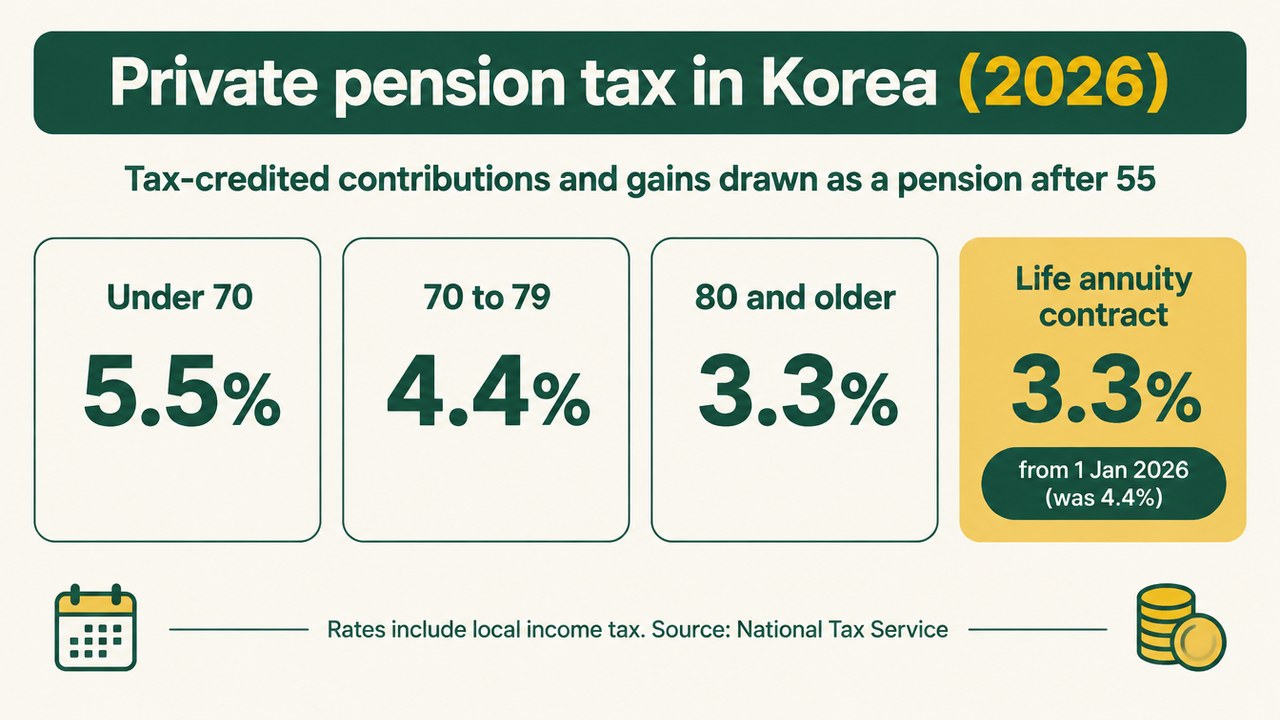
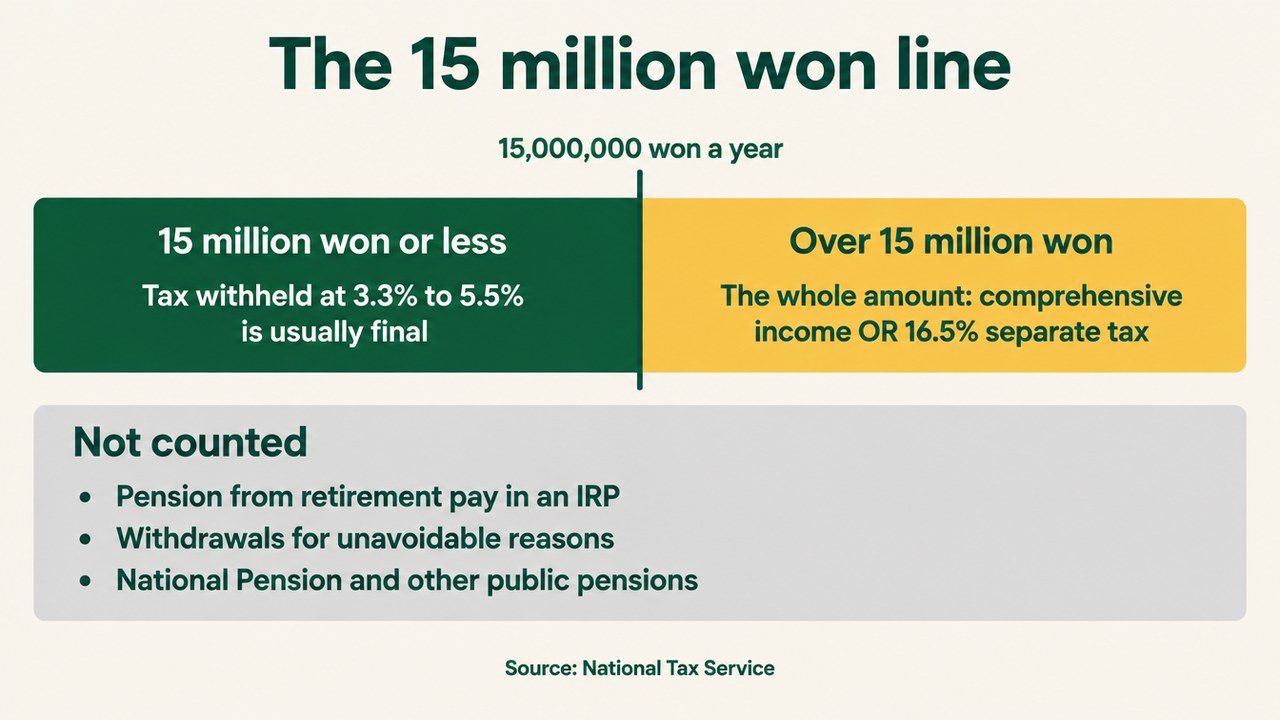
Quick answer: When you draw a pension in Korea from a pension savings account (연금저축) or an IRP after 55, the part that came from tax-credited contributions and investment gains is taxed at a low flat rate when it is paid: 5.5% under 70, 4.4% from 70 to 79 and 3.3% from 80 (local income tax included). From 1 January 2026, a qualifying life annuity contract is taxed at 3.3% at any age (it was 4.4%). If that kind of pension income stays at ₩15 million a year or less, the tax withheld usually ends the matter. Above ₩15 million, the whole amount, not just the excess, must either be added to your comprehensive income in May or taxed separately at 16.5%, whichever you choose. Pension money that came from retirement pay, money taken out for an unavoidable reason and the National Pension do not count towards the ₩15 million.

If you are in your late fifties or sixties and have started, or are about to start, drawing money from a pension savings account or an individual retirement pension account (IRP, 개인형퇴직연금), the most common worry is simple: “How much of this will the tax office take, and will I have to file anything?” The answer depends on three things: where the money in the account came from, your age on the day it is paid, and how much you draw in a calendar year.
This guide covers the tax on the pension itself once it starts, which is what Korean tax law calls private pension income (사적연금소득). It does not repeat two related topics we have covered separately. The tax on retirement pay that you leave in an IRP and draw as a pension (70%, 60% or 50% of the retirement income tax) is in our retirement pay tax guide. The year-end tax credit for paying into these accounts, and the 16.5% charge if you cash them out early, is in our IRP and pension savings tax credit guide.
Step one: find out where the money in your account came from
A single IRP or pension savings account can hold money from very different sources, and Korean law taxes each of them differently when it comes out. Your provider keeps track of this and can show you the split, usually in the account’s tax-information screen. Roughly, there are four buckets:
| Money in the account | When drawn as a pension (after 55) | Counts towards the ₩15 million? |
|---|---|---|
| Contributions you did not claim a tax credit for | Not taxed again | No |
| Contributions you did claim a tax credit for | Private pension income tax (5.5%, 4.4% or 3.3%) | Yes |
| Investment gains in the account | Private pension income tax (5.5%, 4.4% or 3.3%) | Yes |
| Retirement pay moved into the IRP (이연퇴직소득) | 70% of the retirement income tax in years 1 to 10, 60% in years 11 to 20, 50% after year 20 | No, always taxed separately |
The NTS pension income page lists the withholding rates for the second and third rows and the 70% / 60% / 50% formula for the fourth. Its page on how pension income is calculated says retirement money drawn as a pension is taxed separately whatever the amount, and so is tax-credited money taken out for medical reasons, a natural disaster or another unavoidable reason. Only what is left is compared with the ₩15 million line.
This matters because many people look at the whole balance and think “I will draw ₩25 million a year, so I am over the line”. If ₩15 million of that is retirement pay, only the other ₩10 million counts.
The rates withheld when each payment is made
For tax-credited contributions and investment gains drawn as a pension, the provider withholds tax on each payment. The NTS table, which matches Income Tax Act article 129(1)5-2, gives national income tax of 5%, 4% or 3%. Local income tax adds 10% of that, which is where the familiar 5.5%, 4.4% and 3.3% come from.
| Who is being paid (NTS; Income Tax Act art. 129(1)5-2) | National income tax | Including local income tax |
|---|---|---|
| Under 70 on the payment date | 5% | 5.5% |
| 70 to 79 | 4% | 4.4% |
| 80 or older | 3% | 3.3% |
| Life annuity contract (paid until death, cannot be cancelled) | 3% (4% before 2026) | 3.3% |
Two details are easy to miss. First, the age is your age on the day each payment is made, so the rate drops automatically the month you turn 70 and again at 80. Second, when a payment meets two rows at once, for example a 72-year-old on a life annuity, the law applies the lower rate.
The life annuity change is new this year. The official reason for Act No. 21221 (passed 23 December 2025, in force 1 January 2026) says the withholding rate on tax-credited money and gains received under a life annuity contract was cut “from 4/100 to 3/100” to support stable retirement income. The NTS table marks it as applying to pension payments from 1 January 2026, and the CPA News list of 2026 changes reports the same cut. Ask your provider whether your product is a life annuity in the tax-law sense. A plan that simply pays out over a long fixed period is not the same thing.
The ₩15 million line: what happens on each side
The NTS page on pension income sets out the rule in four lines. Leaving aside retirement money and unavoidable-reason withdrawals:
- If the rest of your private pension income is ₩15 million a year or less, it is taxed separately. The tax withheld at payment is the final tax, and you do not add it to your income in May. You may still choose to add it if that works out cheaper (more on that below).
- If it is more than ₩15 million, it becomes part of your comprehensive income, or you can choose, when you file in May, to have it taxed separately at 15% (16.5% with local income tax).
The NTS 126 call-centre answers add the history. The line was ₩12 million for income up to 2023 and is ₩15 million from 2024 income. The option to pay a flat 15% on amounts above the line applies to pension payments from 1 January 2023. COMWEL’s webzine for workers describes the same rule from the 2024 change: below ₩15 million the low 3.3% to 5.5% applies, and above it you compare comprehensive taxation with the 16.5% separate rate.
The most important point is the one people get wrong most often. If you cross ₩15 million, the choice applies to the whole year’s private pension income, not only the part above ₩15 million. A worked comparison on a tax-guide site, which we checked against the NTS tables below, makes the same point.
In one line: ₩15 million or less, the 3.3% to 5.5% withheld is normally the end of it. One won more, and the whole amount goes into May’s return as either comprehensive income or a flat 16.5%.
Comprehensive or 16.5%: how the comparison works
If you are over the line, the choice turns on your other income. The NTS page gives the steps for comprehensive taxation:
- Start with your total pension amount. This is public pensions such as the National Pension plus private pensions, minus anything excluded or tax-free.
- Subtract the pension income deduction (연금소득공제), capped at ₩9 million:
| Total pension amount (NTS; Income Tax Act art. 47-2) | Pension income deduction |
|---|---|
| ₩3.5 million or less | The whole amount |
| ₩3.5 million to ₩7 million | ₩3.5 million + 40% of the amount over ₩3.5 million |
| ₩7 million to ₩14 million | ₩4.9 million + 20% of the amount over ₩7 million |
| Over ₩14 million | ₩6.3 million + 10% of the amount over ₩14 million (maximum ₩9 million) |
- Add your other comprehensive income (for example wages, business income or rental income), subtract personal deductions such as the ₩1.5 million basic deduction, and apply the basic income tax rates. NTS lists them as 6% up to ₩14 million of taxable income, 15% up to ₩50 million (minus ₩1.26 million), 24% up to ₩88 million (minus ₩5.76 million) and so on.
The 16.5% route is simpler. You pay 15% national tax plus local tax on the year’s private pension income, with no pension income deduction and no progressive rates. Whichever you choose, the tax already withheld during the year is credited against the bill.
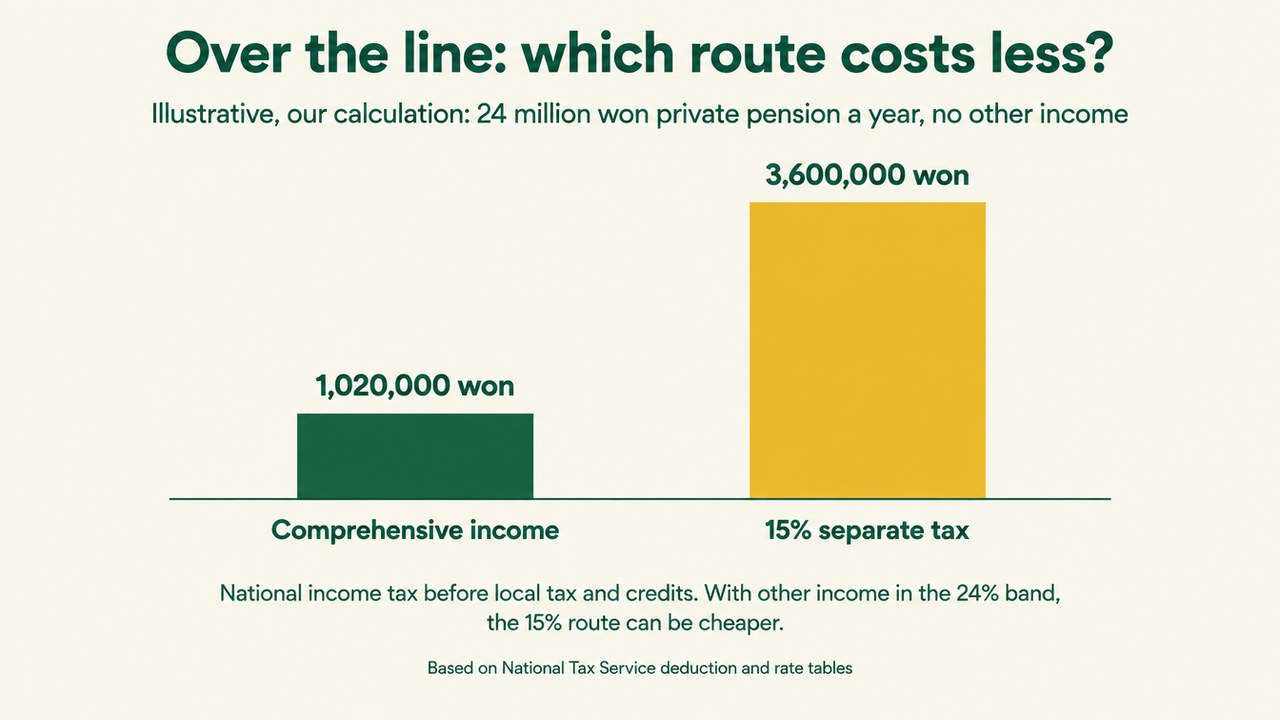
So the rule of thumb follows from the numbers. If you have little other income, comprehensive taxation usually wins, because the pension income deduction and the 6% and 15% bands keep the bill low. If your other income already puts you in the 24% band or higher, the flat 15% is often cheaper.

Worked examples (illustrative, our calculation)
These examples use only the NTS deduction table and basic rates above. They show national income tax before local income tax and before any tax credits, assume a single person with only the ₩1.5 million basic deduction, and assume no National Pension or other public pension. Real returns differ. Treat them as a way to see the shape of the choice, not as your bill.
Example A: ₩14.4 million a year (₩1.2 million a month), age 63, no other income. This is under the ₩15 million line, so the provider withholds 5.5%, which is ₩792,000 over the year including local tax, and nothing needs to be filed. If the person instead chose to add it to comprehensive income: deduction ₩6.34 million, pension income ₩8.06 million, minus ₩1.5 million = ₩6.56 million taxable at 6% = ₩393,600 national tax (about ₩433,000 with local tax). On these assumptions the comprehensive route would cost less, which is why the law lets you opt in. The picture changes as soon as there is a National Pension or other income, because those share the same deduction and bands.
Example B: ₩24 million a year (₩2 million a month), no other income. Over the line, so there is a choice. Comprehensive: deduction ₩6.3 million + 10% of ₩10 million = ₩7.3 million; pension income ₩16.7 million; minus ₩1.5 million = ₩15.2 million taxable; tax = ₩15.2 million × 15% − ₩1.26 million = ₩1,020,000. Separate at 15%: ₩24 million × 15% = ₩3,600,000. Comprehensive is far cheaper here. The tax-guide comparison we cross-checked reaches the same ₩1.02 million and ₩3.6 million.
Example C: the same ₩24 million, but wages already put the person’s taxable income above ₩50 million. The ₩16.7 million of pension income would then sit in the 24% band (assuming it stays below ₩88 million), which is about ₩4,008,000 of extra national tax. The separate 15% route costs ₩3,600,000, so in this case the 16.5% route is cheaper, by roughly ₩408,000 before local tax.
Why 31 December matters this year
The ₩15 million is counted per calendar year (the NTS rule says “a year”). Pension payments in December 2026 fall into the 2026 total, and payments in January 2027 fall into 2027’s. If your 2026 total is close to ₩15 million, one extra withdrawal this December can push the whole year’s private pension income into May’s return. That deadline is 48 days from 13 November.
Practical steps before year-end, all of them our reading of the rules rather than official advice:
- Ask your provider (or each provider, if you have several accounts) for your 2026 year-to-date private pension income, split by source. The line counts all your pension accounts together.
- If you are just under ₩15 million and do not need the money now, consider whether a December withdrawal can wait until January.
- If you are already well over, work out whether comprehensive taxation or 16.5% suits you, using your 2026 income, before you file in May 2027.
- Remember the separate annual pension receipt limit in the first ten years of drawing a pension. Money taken above that limit is treated as a non-pension withdrawal and taxed more heavily. We explain the limit in the retirement pay guide.
Where the National Pension fits in
Public pensions, meaning the National Pension and the occupational pensions for civil servants, teachers and the military, are not part of the ₩15 million test. NTS says they are always included in comprehensive income for income from 2013 onwards. If the public pension is your only income and the pension service has already done the year-end settlement, you may not need to file.
Where they do matter is the arithmetic. If you file comprehensive income, the total pension amount in the deduction table is public and private pensions added together, and the deduction is applied once. A worked example that ignores your National Pension will therefore overstate the deduction and understate the tax. If you receive both, the comparison between comprehensive taxation and 16.5% needs to include them. The NTS 126 line or your local tax office can run it with your actual figures.

Ways people in their late fifties and sixties keep the tax low
- Know your buckets. Ask your provider how much of each payment is taxable private pension income, and remember that retirement money in an IRP does not count towards ₩15 million.
- Spread withdrawals. About ₩1.25 million a month from tax-credited money and gains is ₩15 million a year. Keeping under that, if your needs allow, keeps the low withholding as the final tax.
- Let age work for you. The rate falls from 5.5% to 4.4% at 70 and to 3.3% at 80. A COMWEL article notes that people who still have wages or business income after 55 can save tax by starting the pension later.
- Check the life annuity option. From 2026, a qualifying life annuity pays 3.3% at any age. It cannot be cancelled, so it is a long-term decision, not a tax trick.
- Do the May comparison when you are over the line. Do not assume 16.5% is automatic. If your other income is low, comprehensive taxation may cost much less.
- Avoid unplanned lump sums. Cashing out tax-credited money outside the pension rules is taxed at 16.5% as other income. See our IRP and pension savings tax credit guide for that rule and the ISA-to-pension transfer in our ISA guide.
If your home is your main asset rather than a pension account, our housing pension guide covers the reverse-mortgage route, which works differently.
Related reading
- Korea retirement pay tax: lump sum or pension from an IRP
- Korea IRP and pension savings tax credit 2026: what to fund before 31 December
- Korea’s ISA account in 2026: limits, tax-free amount and maturity
- Korea’s housing pension in 2026: how the reverse mortgage works
Frequently asked questions
Q. What tax is taken from a pension savings or IRP pension in Korea?
For tax-credited contributions and investment gains drawn as a pension after 55, the provider withholds 5.5% if you are under 70, 4.4% from 70 to 79 and 3.3% from 80 (local income tax included). A qualifying life annuity is taxed at 3.3% from 1 January 2026. Money you never claimed a credit for is not taxed again, and retirement pay in an IRP has its own rate.
Q. If I draw more than ₩15 million a year, is only the excess taxed more?
No. Once your private pension income (excluding retirement money and unavoidable-reason withdrawals) is over ₩15 million, the whole year’s amount is either added to your comprehensive income or taxed separately at 16.5%, and you choose which when you file in May.
Q. Is comprehensive taxation or the 16.5% option cheaper?
It depends on your other income. With little other income, comprehensive taxation is usually cheaper because of the pension income deduction and the 6% and 15% bands. If your other income already puts you in the 24% band or higher, the flat 15% (16.5% with local tax) is often cheaper. Compare both with your real figures.
Q. Does my National Pension count towards the ₩15 million?
No. Public pensions are always part of comprehensive income and are not part of the ₩15 million test. But if you file comprehensive income, public and private pensions are added together before the pension income deduction, so the National Pension does affect the calculation.
Q. Do I need to file a tax return if I stay under ₩15 million?
Usually not for that pension income, because the tax withheld at payment is the final tax. You may still choose to include it in comprehensive income if that is cheaper, and you may need to file anyway for other income.
Q. When does the ₩15 million reset?
It is counted per calendar year, so payments made by 31 December 2026 count for 2026 and payments from 1 January 2027 count for 2027.
Not tax or financial advice. Rules are as published by NTS and on law.go.kr on 13 November 2026; your provider’s tax information and your own income decide the actual figures. For a personal answer, call the NTS 126 line or visit your local tax office.
Sources
- National Tax Service, “연금소득” (pension income: withholding rates by age, life annuity 3% from 2026, retirement-pay pension formula): https://www.nts.go.kr/nts/cm/cntnts/cntntsView.do?cntntsId=7888&mi=6608
- National Tax Service, pension income amount, pension income deduction and separate-taxation rules: https://www.nts.go.kr/nts/cm/cntnts/cntntsView.do?cntntsId=7889
- National Tax Service 126 call-centre FAQ on pension income filing (₩15 million from 2024, ₩12 million before; 15% option from 2023; public pensions): https://call.nts.go.kr/call/qna/selectQnaInfo.do?mi=1441
- National Tax Service, basic income tax rate table: https://www.nts.go.kr/nts/cm/cntnts/cntntsView.do?cntntsId=7675&mi=2304
- Income Tax Act article 129 (withholding rates), version in force 1 January 2026, National Law Information Center: https://www.law.go.kr/LSW/lsLawLinkInfo.do?chrClsCd=010202&lsId=001565&lsJoLnkSeq=1000821176&print=print
- Reason for amendment, Income Tax Act No. 21221 (23 December 2025): https://www.law.go.kr/LSW/lsRvsDocInfoR.do?lsiSeq=280405
- Korea Workers’ Compensation and Welfare Service webzine, retirement pension tax tips (independent cross-check): https://webzine.comwel.or.kr/vol152/sub12.html
- KICPA CPA News, “2026년부터 바뀌는 주요 제도” (independent cross-check of the life annuity cut): https://news.kicpa.or.kr/news/articleView.html?idxno=2211
- Semmaru tax guide, private pension over ₩15 million: comprehensive vs 15% separate (independent cross-check of the worked example): https://semmaru.kr/guide/pension-income-over-1500-comprehensive-vs-separate/