Korea’s Education Expense Tax Credit in 2026: 15% Back, ₩3 Million per School Child, ₩9 Million per University Student
Haesul Economy desk (AI-assisted). As of 11 November 2026 (KST); 48 days from 13 November to the 31 December payment cutoff. Based on the current text of the Income Tax Act (소득세법) article 59-4(3) and Enforcement Decree article 118-6 on the National Law Information Center (law.go.kr), the National Tax Service (NTS) page on special tax credits and the NTS year-end settlement Q&A. Independent cross-checks: four Korean tax guides written in October–November 2026 (Gyesankok, Sobinote, Routinelab, Calcmoney) and an NTS-interpretation case note on prepaid tuition. This is general information, not tax advice.
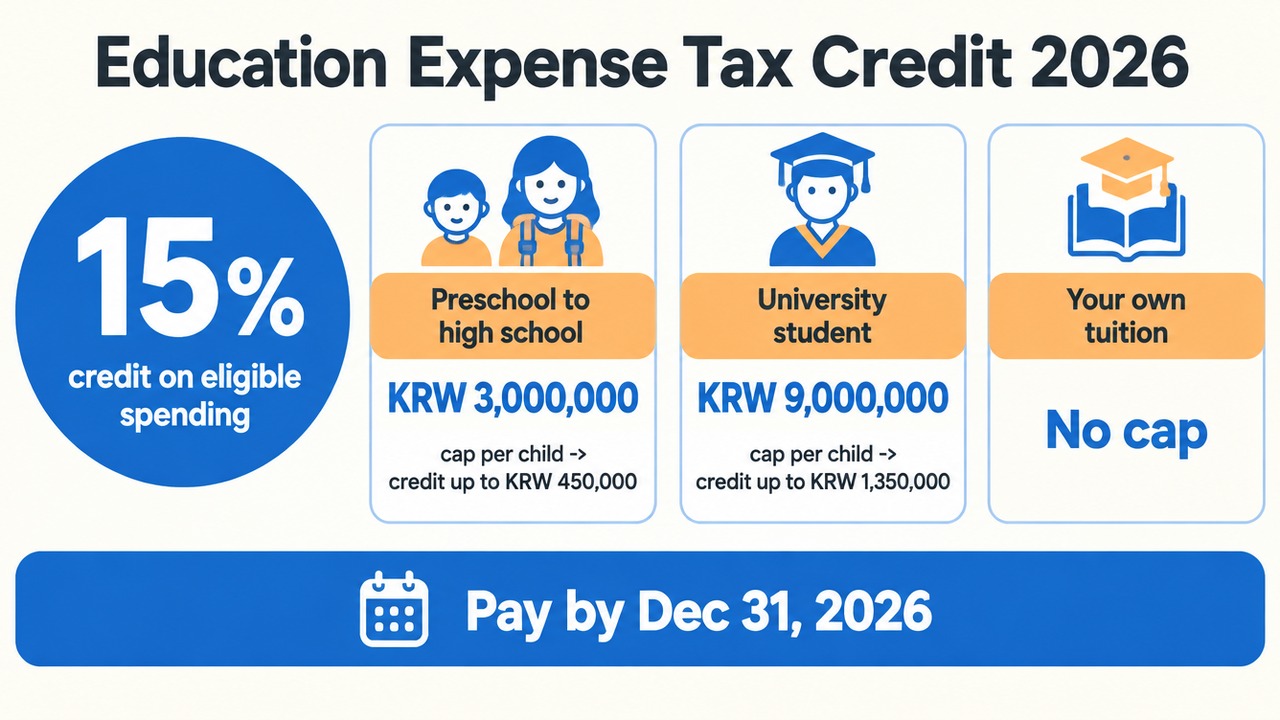
Quick answer: If you have earned income in Korea, the education expense tax credit (교육비 세액공제) gives you back 15% of tuition and other qualifying education costs you paid in 2026. The yearly amount that counts is capped at ₩3 million per child for preschool and for elementary, middle and high school, and ₩9 million per child for university. Your own education costs have no cap. Spending on a spouse or child’s graduate school, on your parents’ courses, or on tuition a child paid with a student loan does not count for you. From 2026 payments, the old rule that excluded a family member who earned more than about ₩1 million a year is gone (law amended 23 December 2025). Only costs paid by 31 December 2026 count for this tax year, which is 49 days away from 12 November.
If you are in your 40s, 50s or early 60s, you are probably paying for an exam year, a university bill or a young adult who is still studying. The credit is one of the few year-end settlement items that rewards exactly that, and it is easy to lose through a paperwork gap rather than a rule. This guide covers who counts, what the caps really mean (including a trap in the uniform and field-trip limits), what is not covered, a worked calculation in won, and what to do before the end of December.

How the credit works in one minute
The credit comes straight off your tax bill. It is not a deduction from income. Under Income Tax Act article 59-4(3), a resident with earned income (일용근로자, daily workers, are excluded by NTS) multiplies the qualifying education spending by 15% and subtracts that amount from the calculated income tax (종합소득 산출세액) for the year. A ₩1 million qualifying bill is worth ₩150,000 whether your tax rate is 6% or 24%.
Two practical points follow:
- It only helps if you owe tax. The credit cannot reduce your tax below zero, and the education, medical and insurance credits share that ceiling (Calcmoney, an independent guide, cites Income Tax Act article 61 for this). Families with a very low calculated tax may not see the whole amount.
- It follows the person who pays and claims the child. NTS says that where both parents work, the parent who takes the child’s basic deduction (기본공제) is the one who can claim the child’s education credit. Do not split the same bill between you.
NTS also says the credit counts only costs paid during the period you were working, leave of absence included. Fees paid before you started the job or after you left do not count.
Who counts, and what the caps are
The law (art. 59-4(3)) separates three groups. The caps are per person, per year.
| Whose education | What counts | Yearly cap that counts | Credit at 15% |
|---|---|---|---|
| You | Schools, university, graduate school, part-time university courses, vocational training courses, repayments of an eligible student loan | No cap | 15% of the amount |
| Spouse, child, adopted child, sibling, foster child who is your basic-deduction dependant | Preschool, elementary, middle, high school: ₩3,000,000 per person. University student: ₩9,000,000 per person. Graduate school: not eligible | ₩3M or ₩9M | Up to ₩450,000 or ₩1,350,000 |
| A dependant with a disability (parents included) | Special-education fees paid to designated social welfare facilities or approved bodies | No cap | 15% of the amount |
Sources: NTS special-credit page (cntntsId=7874) for the 15%, the ₩3M/₩9M caps and the exclusion of graduate-school students and parents; law.go.kr Income Tax Act art. 59-4(3) for the groups and the 2026 wording. Gyesankok and Routinelab (independent) show the same table.
What “dependant” means here. The education credit applies to a family member who qualifies for the basic deduction. The law now reads “without limits on age or income” (나이 및 소득의 제한을 받지 아니하되). Age was never a test, so a 25-year-old son in university can count. The income test is new. The law as amended on 23 December 2025 removed it for education costs paid on or after 1 January 2026 (article 59-4(3) as in force from 2026; the amendment’s transitional rule applies it to payments after the law took effect). Until 2025, a child who earned more than ₩1 million in annual income (about ₩5 million in salary) could not be claimed, even if you paid the whole tuition. That is the biggest change for parents of university students who have part-time jobs, and many guides written before 2026 are out of date on it.
Two cautions about this change:
- NTS’s own pages have not all been updated. The NTS year-end Q&A page we read on 11 November 2026 still says “age: no requirement, income: requirement only”. The law text on law.go.kr is the later source, and the independent guides (Calcmoney, Gyesankok, Sobinote) all read it as removing the income limit from 2026 payments. If your child earns well above ₩1 million, check with your employer’s payroll team or the NTS helpline (126) before you rely on it.
- A sibling must still live with you. A brother, sister or sibling-in-law qualifies only if registered at your address and sharing your living costs, or away temporarily for school (NTS Q&A). A child does not have to live with you.
Who is left out. Your parents’ classes (a senior-college course, for example), a son-in-law’s or daughter-in-law’s tuition (they are not basic-deduction dependants) and any graduate-school bill except your own. The table below in “What does not count” lists the rest.
What costs count
Enforcement Decree article 118-6 lists the qualifying costs. These are the main ones, read in the current text (in force 1 October 2026):
| Cost | Rule |
|---|---|
| Tuition, entrance fee, childcare fees, course fees and other public charges | Counts |
| School meals | Counts at schools, kindergartens, childcare centres (and, for preschoolers, academies and sports facilities) |
| Textbooks | Counts when bought through the school |
| School uniform | Middle and high school only, up to ₩500,000 per student per year |
| After-school programme fees and special-activity fees | Counts, including books bought at the school; for school after-school classes, books bought elsewhere also count with a certificate |
| School field trips and experiential learning | Counts when it is part of the school curriculum, up to ₩300,000 per student per year |
| University entrance exam fee (the CSAT application fee) and university application fees | Counts |
Source: law.go.kr Enforcement Decree art. 118-6(1) (read in full on 11 November 2026). The uniform cap of ₩500,000 and the field-trip cap of ₩300,000 are also stated in the NTS year-end Q&A and match the independent guides.
The uniform and field-trip caps are inside the ₩3 million, not on top of it. This is the point guides often blur. A middle-school child’s total counted amount is still capped at ₩3 million. The ₩500,000 and ₩300,000 are sub-limits for those two items. If you spent ₩650,000 on uniforms, only ₩500,000 goes into the total. A trip that cost ₩450,000 adds only ₩300,000. Routinelab’s worked example shows the same treatment.
Kindergarten and daycare. For children not yet in elementary school, the credit covers kindergarten and childcare tuition, and also academy and sports-facility fees for monthly classes held at least once a week (decree art. 118-6(7)). NTS’s Q&A says an English academy for a kindergartener counts, a taekwondo school for a preschooler counts, but a home-visit workbook service, a department-store culture centre class and a welfare-centre class do not. The NTS Q&A also says a daycare entrance charge, field-trip fee and vehicle charge are not covered, because they are actual-cost items rather than the legal childcare fee. If your child started elementary school this year, academy fees paid in January and February before enrolment still count.
New for 2026: arts and sports classes in elementary grades 1–2. The 2025 amendment (art. 59-4(3)1마) adds fees paid to academies teaching the arts (예능) and to sports facilities for a child who is under 9 or in grade 2 or below on 31 December, for monthly classes held at least once a week (decree art. 118-6(8)–(10)). It applies to fees paid from 1 January 2026. Academic subjects in an academy, such as maths or English, are not included for a school-age child (NTS Q&A: academy fees of elementary, middle and high school students do not qualify). The amounts still sit inside the ₩3 million for that child.

What does not count
| Not covered | Why (source) |
|---|---|
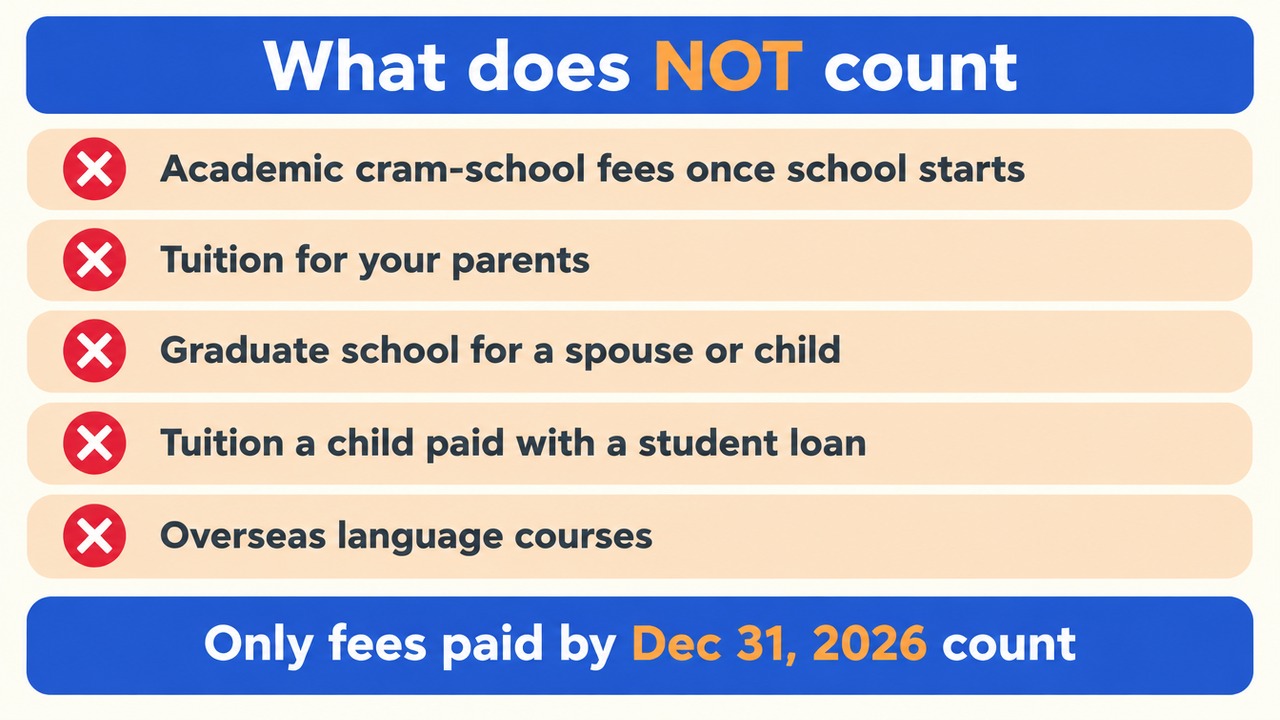
| Academic cram-school (hagwon) fees for children already in elementary school or above | Only preschoolers, and the new grades 1–2 arts/sports exception, qualify (NTS Q&A; decree art. 118-6) |
| Your parents’ tuition or classes | Parents are excluded unless they are disabled dependants (NTS special-credit page) |
| Spouse’s or child’s graduate school | Excluded by art. 59-4(3)1 |
| Tuition a child paid using a student loan | Excluded for the parent. The child can claim the repayments later as their own cost (NTS Q&A) |
| Repaying your child’s student loan for them | Not claimable by the parent (NTS Q&A) |
| Scholarships and tuition support that are tax-exempt | Subtracted from the amount (decree art. 118-6(2)). That covers school, workplace, company welfare fund and organisation scholarships |
| Unauthorised overseas and alternative schools; overseas language courses | Not an eligible school (NTS Q&A) |
| Living-expense loans | Only the tuition part of a student loan counts for the borrower (decree art. 118-6(12)) |
Sources: law.go.kr art. 59-4(3) and decree art. 118-6; NTS year-end Q&A item 39 (read in full on 11 November 2026). The loan rule is also in Routinelab (independent).
Student loans: who claims what. If your child is a student and takes a government student loan to pay the semester fee, you cannot claim that fee. When your child later has a job and repays the loan, the child can claim the repayment (principal and interest on the tuition part) as their own education cost with no cap. If you are the borrower and a student yourself, NTS says you can choose to claim either when you pay tuition or when you repay.
A worked calculation, in won
All amounts are illustrative. The 15% rate and the caps come from the NTS special-credit page and law.go.kr art. 59-4(3).
| Scenario | What was paid in 2026 | Amount that counts | Credit (15%) |
|---|---|---|---|
| Kindergarten child | Tuition and fees ₩3,600,000 | Capped at ₩3,000,000 | ₩450,000 |
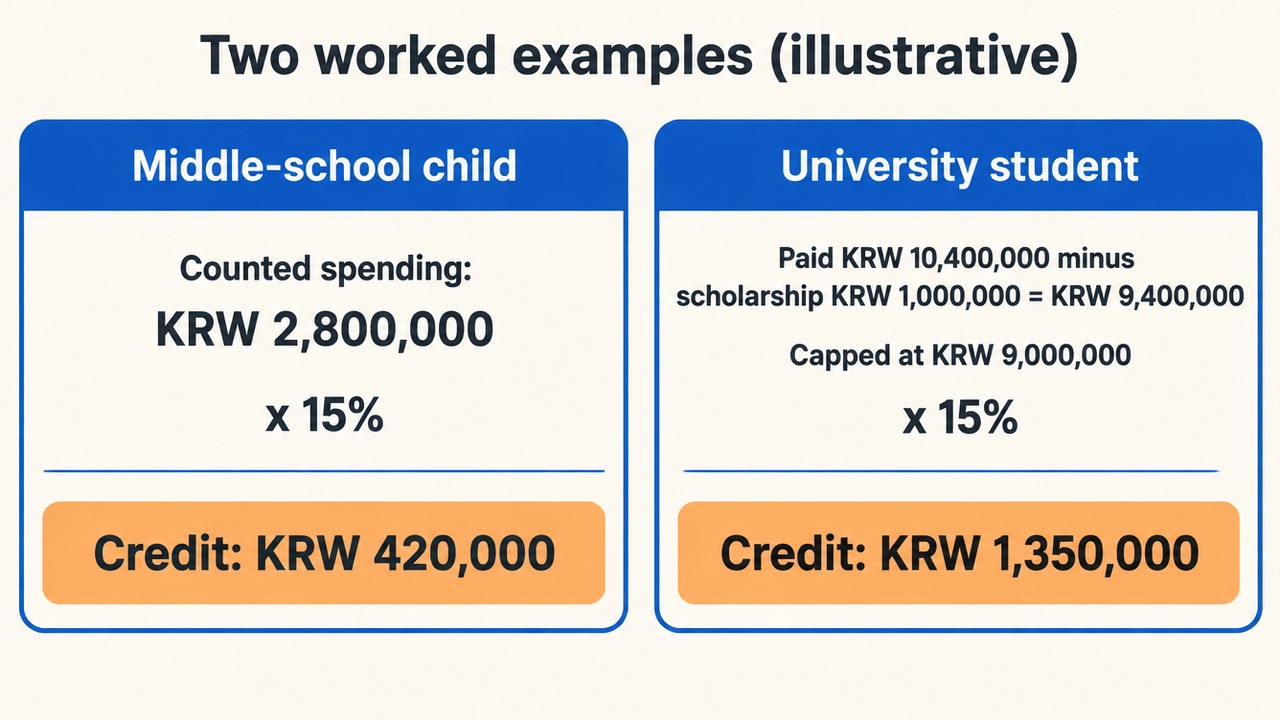
| Middle-school child | After-school ₩1,200,000 + meals ₩800,000 + uniform ₩650,000 + field trips ₩450,000 | ₩1,200,000 + ₩800,000 + ₩500,000 (uniform cap) + ₩300,000 (trip cap) = ₩2,800,000, under the ₩3M cap | ₩420,000 |
| High-school child | Tuition, meals and after-school ₩4,000,000 | Capped at ₩3,000,000 | ₩450,000 |
| University student | Tuition ₩10,400,000, scholarship from the university ₩1,000,000 | ₩9,400,000 after the scholarship, capped at ₩9,000,000 | ₩1,350,000 |
| You, part-time master’s (your own cost) | ₩5,000,000 | ₩5,000,000, no cap | ₩750,000 |
Calculated. A family with one high-school and one university child would add the two credits: ₩450,000 + ₩1,350,000 = ₩1,800,000, if the calculated tax is at least that high.
Notice what the caps do. In the university example, the ₩1,000,000 scholarship costs you nothing in credit: even after subtracting it, ₩9,400,000 is still above the ₩9,000,000 cap. In the high-school row, ₩1,000,000 of spending earns no credit at all. Check your own totals against the cap before you decide whether an extra December payment changes anything.
When the money must be paid: the 31 December cutoff
The credit counts costs paid in the tax year (해당 과세기간에 지급). For the 2026 settlement, the date that matters is when you paid, not the semester it belongs to. Three points matter now:
- Pay by 31 December 2026 for the cost to be in this year’s settlement. NTS’s Q&A confirms the credit follows the year you paid (for example, tuition paid for a university student during a leave of absence counts in the year it was paid). An independent case note on an NTS interpretation says tuition prepaid in December for the next semester is generally counted in the year paid.
- A prepaid university entrance fee counts in the year of enrolment, not the year you paid it. NTS’s Q&A has an example: a student accepted through early admission in August 2025 and paying the entrance fee that year can only claim it in the 2026 settlement, because the student is not a university student until the entrance ceremony. If your child is a high-school senior who has already been accepted, do not assume a December payment lands in the 2026 settlement for the university cap. Ask the university for the payment certificate and check how it is classed.
- A mid-year change in school level combines the caps. NTS’s Q&A example: a student who moved from high school to university in the same year has the high-school spending counted within its own ₩3 million, and the university spending counted, with the combined total subject to the ₩9 million university cap.

How to claim: Hometax and paper certificates
Most education costs show up automatically in the simplified year-end settlement service (연말정산간소화) on Hometax, if the school submitted the data. Not all of it does. The NTS proof-of-payment table says the following:
| Item | Certificate you may need | Shown in the simplified service? |
|---|---|---|
| Tuition and university fees | Education-fee payment certificate from the school | Yes |
| Preschool academy fees | Education-fee payment certificate from the academy | No |
| School uniform | Payment certificate from the shop | Yes (check the uniform purchase list) |
| School after-school books bought outside the school | An after-school textbook purchase certificate | No |
| Special-education fees for a disabled dependant | Education-fee certificate plus proof of the facility’s status | No |
| Student-loan repayment | Certificate from the Korea Scholarship Foundation or similar | Yes |
| Overseas school costs | Enrolment certificate and payment proof | No |
Source: NTS 국세상담센터 year-end settlement proof table, 교육비 (checked 11 November 2026).
For a uniform bought directly from a shop with a credit card or cash receipt, NTS says the purchase appears on Hometax under the education-fee section’s uniform list. You then match it to the child. If it does not appear, ask the shop for an education-fee payment certificate. For a uniform bought through the school’s group purchase, the school normally submits it for you.
If you forget something, you may not lose it. NTS’s Q&A says an education cost left out of an earlier year’s settlement can be added by filing an amended claim (경정청구) for that year. Ask the tax office about the time limit that applies to you.
A checklist before 31 December
- List every child and write the school level on 31 December (preschool, school, university, graduate).
- Add up what you have already paid for 2026 and compare it with the ₩3 million or ₩9 million cap. If you are well below the cap and a bill is due in January, ask the school whether it accepts payment in December. If you are already above the cap, paying more gains nothing.
- Find out which scholarships your child received. They reduce the amount that counts.
- Check whether a child’s part-time earnings were the reason you did not claim before. For 2026 payments, that barrier is gone.
- Ask each academy for the payment certificate if you paid for a preschool child’s classes.
- If your family pays the fee by student loan, ask who will repay it.
- Make sure the basic deduction is claimed on the same person (the parent who claims the child claims the education credit).
- Read the other year-end credits that interact with this one: our guides to the medical expense tax credit and the IRP and pension savings tax credit.
Frequently asked questions
Q. What is the Korean education expense tax credit rate and cap in 2026?
It is 15% of qualifying education costs paid in the tax year. The amount that counts is capped at ₩3 million per child for preschool and for elementary, middle and high school, and ₩9 million per child for university. That means a maximum credit of ₩450,000 or ₩1,350,000 per child. Your own education costs have no cap, and special-education fees for a disabled dependant have no cap either.
Q. Can I claim my child’s graduate school or my own?
Your own graduate school, part-time university courses and vocational training count with no cap. A spouse’s or child’s graduate-school fees do not count, in Korea or abroad. A university student’s fees count up to ₩9 million. Tuition for your parents does not count unless the parent is a disabled dependant.
Q. Does my university child’s income still matter in 2026?
Under the law as amended on 23 December 2025, the income limit no longer applies to education costs paid from 1 January 2026, so a part-time job should not block the credit. The earlier limit was about ₩1 million in annual income (about ₩5 million in salary). Some NTS help pages still show the old wording, so confirm with your payroll team if your child earns a lot.
Q. Are cram-school fees and school uniforms covered?
Academic cram-school fees are covered only for children before elementary school. For 2026 payments, arts and sports classes are also covered for children under 9 or in grade 2 or below, if they are held monthly and at least once a week. Uniforms count for middle and high school students only, up to ₩500,000 per student a year, and field trips up to ₩300,000. Both limits sit inside the ₩3 million cap.
Q. Do fees I pay in December count for 2026?
Yes, costs paid by 31 December 2026 count for the 2026 tax year, generally in the year paid. One exception: a university entrance fee paid early, before your child actually enrols, is claimed in the year the child becomes a university student, according to an NTS example. Keep the payment certificate either way.
Related reading
- Korea Year-End Medical Expense Tax Credit 2026: What Counts, Receipts and How to Upload on Hometax
- Korea IRP and Pension Savings Tax Credit 2026: What to Fund Before 31 December
- Korea Year-End Tax Settlement for Foreigners: Dates, Documents and the 19% Choice (Tax Year 2026)
Sources
- National Tax Service (NTS), 특별세액공제 page (education credit 15%; self: full amount; spouse, children, siblings and adopted children: ₩3M preschool to high school and ₩9M university per person; graduate school not eligible; disability special-education costs including parents; parents’ general education excluded) — https://www.nts.go.kr/nts/cm/cntnts/cntntsView.do?cntntsId=7874&mi=2227 (checked 11 November 2026)
- National Law Information Center, 소득세법 제59조의4 (특별세액공제) ③, in force 1 July 2026, amended 23 December 2025 (15%; “without limits on age or income”; groups; ₩3M/₩9M caps; graduate school and student-loan exclusions; new grades 1–2 arts and sports clause) — https://law.go.kr/LSW/lsLinkCommonInfo.do?chrClsCd=010202&lsJoLnkSeq=1001061140 (checked 11 November 2026)
- National Law Information Center, 소득세법 시행령 제118조의6 (교육비 세액공제), in force 1 October 2026 (qualifying costs; uniform ₩500,000; field trip ₩300,000; school meals; textbooks; exam and application fees; scholarship exclusion; preschool and grade 1–2 academy rules; student loans) — https://www.law.go.kr/LSW/lsLawLinkInfo.do?chrClsCd=010202&lsJoLnkSeq=1000226980 (checked 11 November 2026)
- NTS 국세상담센터, 연말정산 자주묻는Q&A 39. 교육비세액공제 (academies, uniforms, field trips, student loans, siblings, graduate school, early-admission entrance fee, school-level change, couples) — https://call.nts.go.kr/call/qna/selectQnaInfo.do?ctgId=CTG11910&mi=1318 (checked 11 November 2026)
- NTS 국세상담센터, 연말정산 증빙서류 table for education costs — https://call.nts.go.kr/call/qna/openPrufView.do?prufHtml=sub00_%EC%97%B0%EB%A7%90%EC%A0%95%EC%82%B0_%EA%B5%90%EC%9C%A1%EB%B9%84 (checked 11 November 2026)
- Independent: Gyesankok, “연말정산 교육비 세액공제 2026 — 공제율 15%, 대학생 900만 원 한도” (law read 16 October 2026; income test removed from 2026 payments) — https://gyesankok.com/guide/education-expense-credit (checked 11 November 2026)
- Independent: Sobinote, “연말정산 교육비 세액공제 2026: 초등 1·2학년 예체능 학원비 새로 포함” — https://www.wow101.co.kr/education-expense-tax-credit-2026/ (checked 11 November 2026)
- Independent: Routinelab, “교육비 세액공제, 2026년분은 자녀 소득 있어도 15%” (worked example with uniform and field-trip sub-limits) — https://key.routinelab.net/education-tax-credit-checklist-2026/ (checked 11 November 2026)
- Independent: Calcmoney, “아르바이트하는 대학생 자녀도 교육비 공제: 2026년 소득요건 폐지 정리” (law 7 November 2026; siblings; tax ceiling) — https://calcmoney.kr/blog/education-credit-income-limit-2026 (checked 11 November 2026)
- Independent: CaseNote, NTS interpretation on prepaid university tuition and the year of the credit — https://casenote.kr/국세청/법인46013-307-c85c5d (checked 11 November 2026, search summary)
This article is general information, not tax, legal or financial advice. Amounts in the examples are illustrations, not a prediction of your refund. Whether you can claim a dependant, and how much tax you owe, depends on your own situation. Confirm with your employer’s payroll team or the NTS helpline (126) before you file.