
Korea’s 19% Flat Tax for Foreign Workers: When It Actually Saves Money
haesul.com Economy desk (AI-assisted). Last checked: 2026-11-12 (KST); first published 31 October 2026. Under the current law you must start work in Korea by December 31, 2026 — 48 days from November 13. Article 18-2 and the government’s 2026 tax bill were re-read on Nov 12. Originally checked October 30, 2026 (KST) against the National Tax Service notice and the PwC Korea tax summary. This is general information, not tax or legal advice.
Short answer: Two dates matter. Under the current law the flat rate is open only to foreign workers who start work in Korea by December 31, 2026 (48 days from November 13), and the government’s 2026 tax bill would raise it from 19% to 21% (about 23.1% with local tax) from January 1, 2027 — not passed as of November 12 (Art. 18-2; MOFE bill; KPMG). Foreign employees in Korea can choose a 19% flat income tax (about 20.9% with local tax) for up to 20 years from their first day of work, if they start by Dec 31, 2026. The catch: you lose every deduction and credit. It usually helps only higher earners whose normal effective rate is above 19%.
What the flat-tax option is
Korea taxes most employees at progressive rates of 6% to 45% (plus local income tax). A foreign employee can instead elect a single 19% rate on their Korean employment income. According to the National Tax Service (NTS) year-end settlement notice of January 7, 2026, the election is available for up to 20 years from the date you first started work in Korea, and Korea had more than 700,000 foreign workers in scope of year-end settlement guidance.
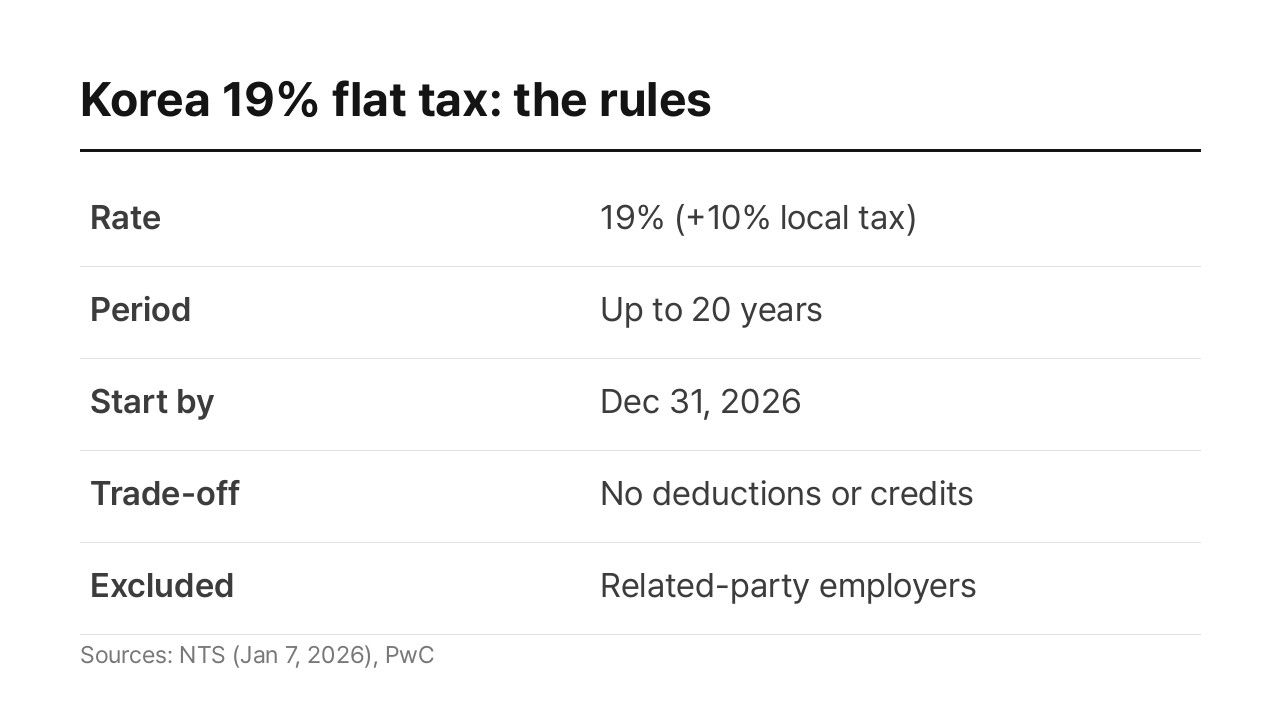
The rules at a glance
| Item | Rule |
|---|---|
| Rate | 19% flat on employment income (local income tax extra) |
| Period | Up to 20 years from first day of work in Korea |
| Start-date cutoff | Work must start in Korea by Dec 31, 2026 (Restriction of Special Taxation Act Art. 18-2; PwC summary) |
| Trade-off | No deductions, exemptions or tax credits |
| Excluded | Employees of a company in a special relationship (e.g. 30%+ shareholding) |
| How | Choose it in year-end settlement via your employer, or in your May filing |
Local income tax is 10% of national income tax, so the combined flat rate works out to about 20.9% (19% × 1.1, our calculation).

Rechecked on November 12, 2026 (law.go.kr / MOFE): Article 18-2(2) of the Restriction of Special Taxation Act (version in force 18 September 2026) still lets a foreign employee who first starts work in Korea on or before 31 December 2026 pay 19% of employment income as income tax for tax years ending within 20 years of that first day, excluding work for a related company; the Enforcement Decree (Art. 16-2) still asks for the flat-rate application with the year-end settlement or May return, or a monthly withholding application by the 10th of the following month. The Ministry of Finance and Economy’s bill (Notice No. 2026-211, 4 August 2026) would raise the special rate from 19% to 21%. KPMG’s summary of the same proposal says it would take effect on 1 January 2027 and extend the start-by date to 31 December 2029, putting the combined rate at 23.1%. As of 12 November we found no passed amendment; Korea’s annual tax bills are usually voted on in December. What it means for the worked example below (our calculation): on KRW 150 million, flat tax is KRW 28.5 million at 19% but KRW 31.5 million at 21%, so the flat option would no longer beat a KRW 31 million progressive bill (Art. 18-2, law.go.kr; MOFE bill on the National Participation Legislation Center; KPMG Flash Alert 2026-235; read 12 November 2026).
Who usually benefits
The flat rate is applied to gross pay, with no earned-income deduction. That is why it only pays off at higher salaries, where the top progressive brackets (35%, 38%, 40%, 45%) bite. A mid-salary employee with a spouse, children, insurance premiums, card spending and pension savings usually ends up with a lower effective rate under the normal system, because all of those deductions and credits disappear under the flat option.
Rough rule of thumb (not advice): if your normal calculated tax, divided by gross pay, is above 19%, the flat rate may save money; if it is below, stay progressive.

Worked example
Example (illustrative only): you earn KRW 150 million and your payroll team’s normal year-end calculation shows national income tax of KRW 31 million. That is about 20.7% of gross. Under the flat option, tax would be 150M × 19% = KRW 28.5 million, about KRW 2.5 million lower before local tax. If the same calculation showed KRW 25 million (16.7%), the flat option would cost you about KRW 3.5 million more.
Always compare both totals from the actual settlement figures. Ask payroll to run both.

How to elect it
- Through your employer: tell payroll during year-end settlement (January to February) and submit the flat-tax application with your deduction forms.
- Through your own filing: if you missed it, you can choose it in the May comprehensive income tax filing for the year.
- Check the details: ask payroll how the election is applied in later years and confirm your first work date on record.
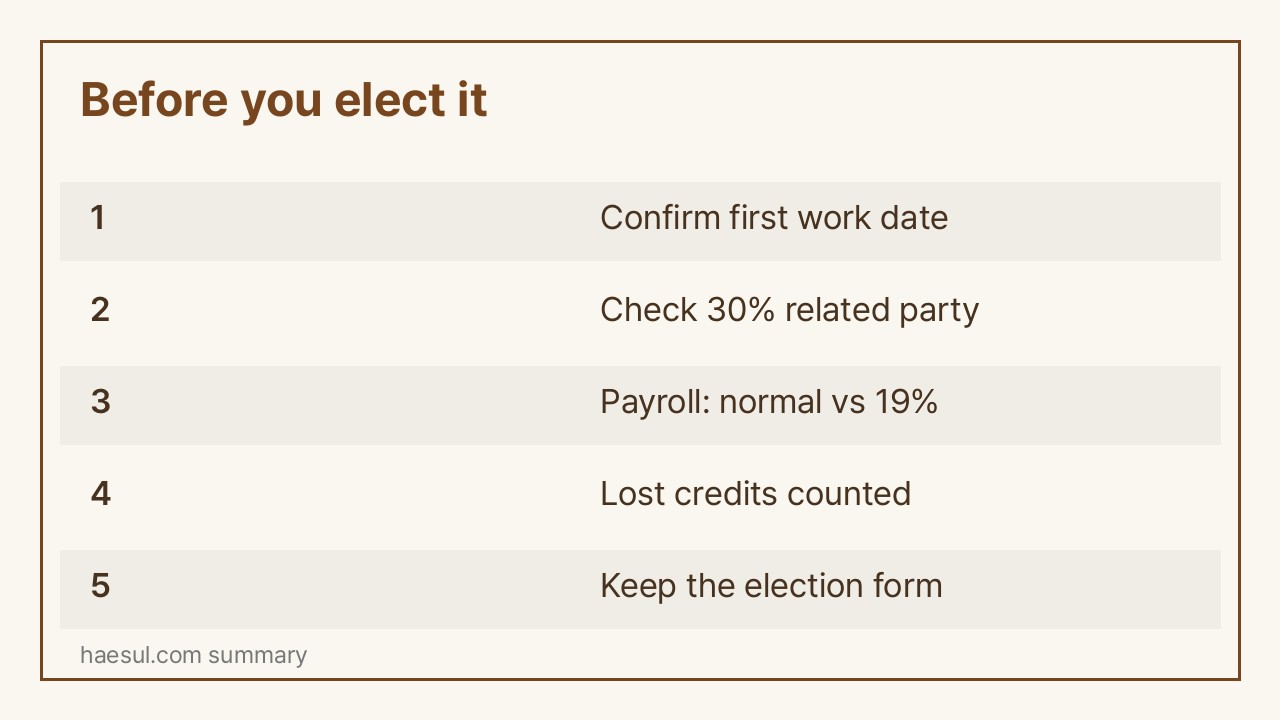
Checklist before year-end settlement
1) Confirm your first working day in Korea (and that it is before Dec 31, 2026) 2) Check whether your employer is a related party (30%+ shareholding) 3) Get payroll to compute normal tax vs 19% on gross pay 4) Remember you lose credits such as pension savings and medical expenses 5) Keep a copy of the election form
FAQ
Q. What is the flat tax rate for foreigners in Korea?
A single 19% rate on employment income, plus local income tax of 10% of that tax, about 20.9% in total.
Q. How long can I use the 19% flat tax?
Up to 20 years from the date you first started working in Korea, per the National Tax Service.
Q. Does the flat tax apply if I start work in 2027?
The PwC summary says it applies to foreign workers who start working in Korea by December 31, 2026. Check later law changes before relying on it.
Q. Can I still claim deductions under the flat tax?
No. All deductions, exemptions and tax credits are forfeited when you choose the flat rate.
Q. Who cannot choose the flat tax?
Foreign employees working for a company in a special relationship with them, such as holding 30% or more of the shares.
Q. Will the flat tax still be 19% in 2027?
Not if the government’s bill passes. The Ministry of Finance and Economy’s 2026 tax bill (Notice No. 2026-211) raises the special rate to 21% (about 23.1% with local tax), and KPMG’s summary says it would apply from January 1, 2027 and move the start-by date from December 31, 2026 to December 31, 2029. As of November 12, 2026 the law still reads 19% with a December 31, 2026 start-by date (48 days from November 13), so check the December vote with payroll before your 2027 withholding is set.
Related guides
- Living in Korea as a Foreigner: The Practical Guide
- Korea National Health Checkup by Age: What Expats Get
- Korea Mortgage Rates: COFIX and the BOK Decision
Related reading
- Korea minimum wage 2027: ₩10,700 an hour from January 1
- Korea unemployment benefits: the 2027 floor rises to ₩68,480
- Korea year-end tax settlement for foreigners 2026
Sources
- National Law Information Center, Restriction of Special Taxation Act Article 18-2 (foreign workers, 19%, start by 31 December 2026), checked November 12, 2026
- Ministry of Finance and Economy, Restriction of Special Taxation Act amendment bill (Notice No. 2026-211, 4 August 2026): special rate 19% → 21%, checked November 12, 2026
- KPMG, GMS Flash Alert 2026-235: flat rate increase and sunset extension (11 September 2026), checked November 12, 2026
- National Tax Service, year-end settlement guidance for foreign workers, press release Jan 7, 2026 (nts.go.kr), checked October 30, 2026
- PwC Worldwide Tax Summaries, Republic of Korea – Individual – Taxes on personal income (https://taxsummaries.pwc.com/republic-of-korea/individual/taxes-on-personal-income), checked October 30, 2026
This is not tax advice. Written with AI assistance and fact-checked against official sources.





5 Comments