Korea Donation Tax Credit 2026: Rates, Receipts and What to Give Before 31 December
Haesul Economy desk (AI-assisted). As of 8 November 2026 (KST), based on the National Tax Service (NTS) year-end settlement guide to donation credits, the NTS call-centre Q&A on donation credits, Article 58 of the Restriction of Special Taxation Act on law.go.kr, and the Ministry of the Interior and Safety (MOIS) Hometown Love Donation pages. This is general information, not tax, financial or legal advice. Confirm your own case with payroll, the NTS helpline (126) or a licensed tax adviser.
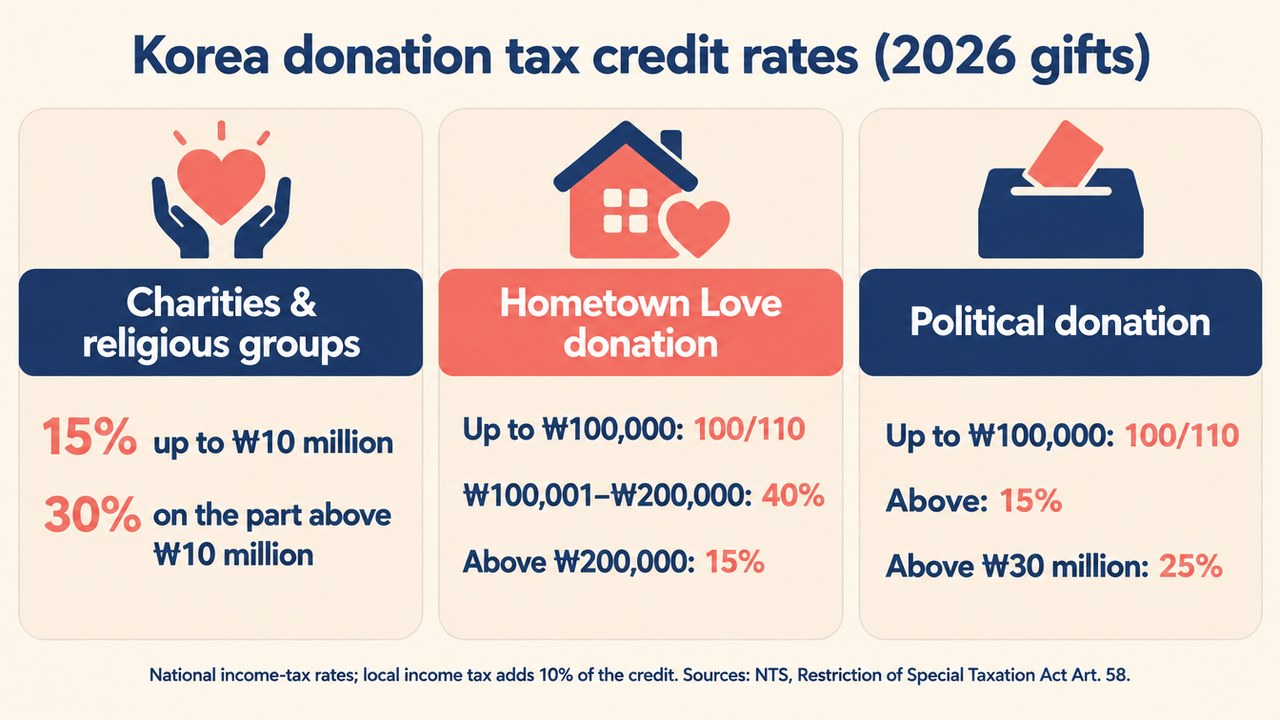
Quick answer: In Korea, gifts to qualifying charities and religious bodies earn a donation tax credit (기부금 세액공제) of 15% of the eligible amount up to ₩10 million a year and 30% on the part above ₩10 million. Hometown Love donations (고향사랑기부금) to a local government you don’t live in are credited at 100/110 up to ₩100,000, 40% on ₩100,001–₩200,000 (new for gifts made from 1 January 2026), and 15% above ₩200,000 up to the ₩20 million annual cap. Local income tax adds 10% of each credit, which is why MOIS quotes 100%, 44% and 16.5%. Only money actually paid by 31 December 2026 counts for the 2026 tax year, which you settle with your employer in early 2027.
Donation credits are one of the few year-end settlement (연말정산) items you can still change in November and December. Unlike card spending, which needs to clear a 25%-of-pay threshold before it helps, a donation credit starts working from the first won, as long as you have income tax to offset. This guide explains the categories, rates, receipt rules and a few worked examples. For the full settlement timeline, Hometax login steps and the 19% flat-rate option for foreign workers, see our year-end tax settlement guide for foreigners.

Who can claim a donation credit
The NTS guide says the credit is available to a resident (거주자) who paid qualifying donations during the tax year. People whose only income is business income are excluded, but business-income earners who are covered by year-end settlement are included. Employees therefore claim it through their employer’s settlement in January and February.
Whose donations count is narrower than many people expect:
- Your own donations: every category counts, including political, Hometown Love, special (특례), employee stock ownership association (우리사주조합) and general (일반) donations.
- Your dependants’ donations: only special and general donations count. A dependant here means someone you claim as a basic deduction (기본공제대상자): spouse, lineal ascendants and descendants, siblings and so on. The NTS call-centre Q&A notes that the age test does not apply for this purpose; only the income test does. Its own example is a 25-year-old child’s charity gift that the parent can still claim.
- Political and employee-stock-association donations: only the ones you paid yourself. Hometown Love donations are also credited to the donor only, according to MOIS.
That means a 55-year-old who claims a non-earning spouse and a student child as dependants can gather their charity receipts too, but not a Hometown Love gift made in the spouse’s name.
The four kinds of donation and their rates
Korean tax law sorts donations into groups, and each group has its own rate and its own ceiling. The table below uses the national income-tax rates the NTS publishes, with the 2026 Hometown Love band from the amended Article 58.
| Type of donation | Typical examples | National credit rate | Who can claim | Unused credit carried forward? |
|---|---|---|---|---|
| Special (특례기부금) | Gifts to the state or local governments, national defence funds, disaster relief | 15% up to ₩10M; 30% on the part above ₩10M (combined with general) | You and dependants | Yes, up to 10 years |
| General (일반기부금) | Designated social-welfare, cultural and academic bodies; churches, temples and other religious bodies | Same 15% / 30% (combined with special) | You and dependants | Yes, up to 10 years |
| Hometown Love (고향사랑기부금) | A city, county or province where you are not registered as living | 100/110 up to ₩100,000; 40% on ₩100,001–₩200,000; 15% above ₩200,000 (30% for special disaster areas within the set period) | You only | No |
| Political (정치자금기부금) | Party or registered support association via the election commission | 100/110 up to ₩100,000; 15% above; 25% on the part above ₩30M | You only | No |
The 15%/30% split is applied to the combined eligible amount of special, employee-stock-association and general donations, not to each receipt. Only the slice above ₩10 million gets 30%; the first ₩10 million is always at 15%. The NTS page also reminds readers that 2021–2022 gifts had temporary higher rates (20%/35%), which matters only if you are carrying old unused amounts forward.
There is also a ceiling on the eligible amount, which is a share of your income. The NTS call centre and the taxpayer-federation summary describe it like this: special donations up to 100% of earned-income amount (근로소득금액, pay after the earned-income deduction); non-religious general donations up to 30%; and a tighter calculation (10%, plus a non-religious allowance) when religious-body gifts are included. Most salaried people giving a few hundred thousand won a year never reach these ceilings. They matter mainly for large gifts or tithes on modest pay.
What changed in 2026: the Hometown Love 40% band
The Hometown Love Donation scheme started on 1 January 2023. You give to a local government other than the one where your resident registration (주민등록) address is; for example, MOIS says a Suwon resident can give anywhere except Gyeonggi Province and Suwon City. The individual annual cap rose from ₩5 million to ₩20 million from 1 January 2025, and the local government may send a thank-you gift (답례품, often regional food) worth up to 30% of the donation.
For gifts made from 1 January 2026, the band between ₩100,000 and ₩200,000 jumped from 15% to 40% under Article 58 of the Restriction of Special Taxation Act (amended 23 December 2025). With local income tax that is the 44% figure MOIS and the official Hometown Love e-eum (고향사랑e음) portal advertise. One small trap: the general NTS donation page still shows “15% above ₩100,000” for Hometown Love gifts, because it was written for 2025 gifts. For money you give in 2026, the amended law and the MOIS figures are the ones that apply.
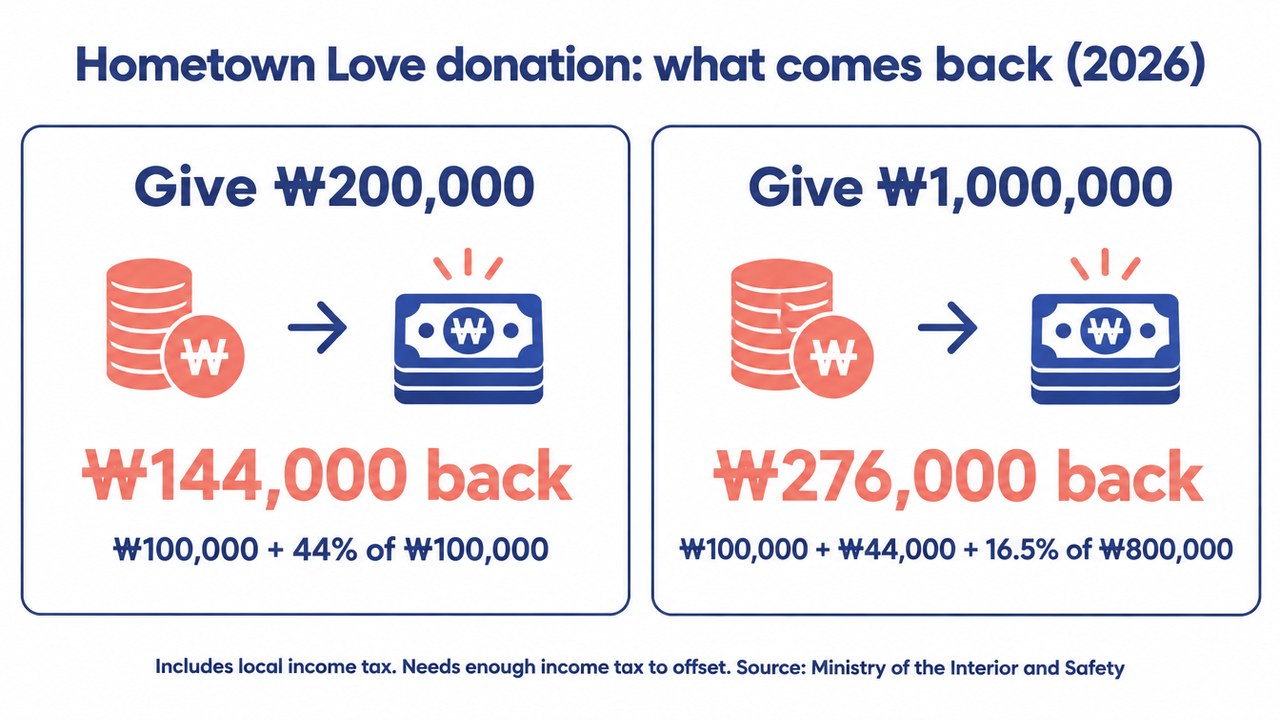
MOIS’s own worked examples, which include local income tax:
| You give (2026, ordinary local government) | Credit back (income tax + local tax) | How it is built |
|---|---|---|
| ₩100,000 | ₩100,000 | 100/110 national + 10% local |
| ₩200,000 | ₩144,000 | ₩100,000 + 44% of ₩100,000 |
| ₩1,000,000 | ₩276,000 | ₩100,000 + ₩44,000 + 16.5% of ₩800,000 |
| ₩1,000,000 to a special disaster area (within 3 months of declaration) | ₩408,000 | ₩100,000 + ₩44,000 + 33% of ₩800,000 |
Add the thank-you gift (up to ₩60,000 of goods on a ₩200,000 donation), and you can see why the ₩200,000 level became a popular target this year. MOIS has also announced a 2026 tax-reform plan that would give higher rates from 2027 for gifts above ₩100,000 to struggling non-capital regions. That plan still needed parliamentary approval when it was announced in August, so it does not change anything for 2026 gifts.

Worked examples for 2026 gifts
These examples are calculated from the official rates above. They assume you have enough income tax to absorb the credit and that the gift is within the income ceiling. Figures are national income tax; the local-tax line adds 10% of the national credit.
| Reader situation | Donations in 2026 | National credit (calculated) | With local tax (calculated) |
|---|---|---|---|
| A 48-year-old employee giving ₩30,000 a month to a registered welfare charity | ₩360,000 general | ₩54,000 | ₩59,400 |
| The same employee who also gives ₩200,000 to a rural county | + ₩200,000 Hometown Love | + ₩130,909 | + ₩144,000 |
| A 60-year-old couple: husband gives ₩3M to his church, wife (a dependant with no income) gives ₩1.2M to a children’s charity | ₩4.2M general (combined) | ₩630,000 | ₩693,000 |
| A senior executive gives ₩12M to a foundation designated as a general donation body | ₩12M | ₩10M × 15% + ₩2M × 30% = ₩2,100,000 | ₩2,310,000 |
These rows also assume the gifts fit under the income ceilings; the church gift in the couple example, for instance, needs an earned-income amount of roughly ₩30 million or more for the 10% religious ceiling (calculated). Two more caveats. First, the credit cannot exceed the tax you owe. If your other credits already cut your income tax to near zero, extra donations may not produce a refund, but special and general donations that could not be used can be carried forward for up to 10 years, and the NTS says carried-forward amounts are used first in later years. Hometown Love, political and employee-stock-association gifts cannot be carried forward. Second, the couple example only works because the tithe and the charity gift are both “general” donations from the claimant and a dependant who passes the income test; if the wife had given to a Hometown Love fund instead, it would not count on the husband’s settlement.
Receipts: what Hometax shows and what you must collect
The year-end settlement simplified-data service (연말정산 간소화 서비스) on Hometax pulls in many donation records automatically from mid-January. Hometown Love donations made through the e-eum portal are passed to the NTS and appear there, according to the NTS-linked guidance. Charities that file electronic receipts also show up.
But not every organisation sends data. The NTS guide lists the paperwork as a donation receipt (기부금 영수증) and a donation statement (기부금명세서) submitted to your employer, and says that if a gift doesn’t appear in the simplified service you can get the receipt from the organisation. In practice that means:
- Ask small churches, temples and local associations for a paper or PDF receipt in December or early January, showing the organisation name, its registration number and the donation code.
- Check that the organisation is actually a designated body. Similar-sounding groups are not always eligible; the NTS public-interest corporation disclosure and the receipt’s donation code are the places to confirm it.
- Keep proof of payment (bank transfer records) with each receipt, especially for in-kind gifts, which need a value confirmed by the organisation.
- If you miss a receipt during January, you can still claim later through a correction filing (경정청구), but it is much simpler to submit it with your settlement.
Foreign residents: what to watch
Foreign workers who are tax residents in Korea and settle through their employer can claim donation credits on the same rules. Three practical points:
- The 19% flat-rate option: foreign workers who choose the single 19% rate generally give up most deductions and credits, so a donation credit only helps if you settle under the normal progressive method. Our settlement guide explains the trade-off.
- Political donations: the Seoul Election Commission’s notice on the NTS site says foreigners cannot make political support donations, so that row in the table is for Korean nationals.
- Hometown Love: the scheme is built around your registered address. If you are unsure whether your registration qualifies, check on the e-eum portal before paying rather than assuming you can claim.
A December checklist
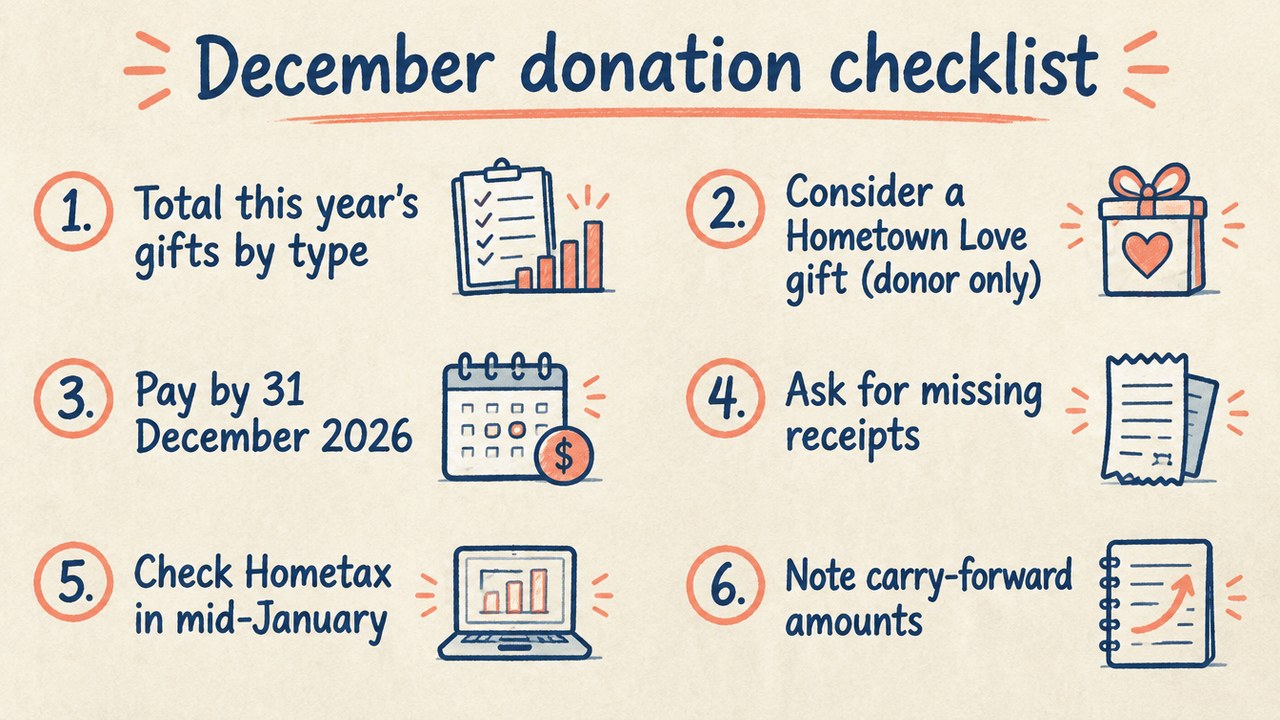
- Add up what you and your dependants have given since January, by category.
- Decide whether a ₩100,000 or ₩200,000 Hometown Love gift makes sense for you (it is credited to you only).
- Make any final gifts early enough that the money leaves your account on or before 31 December 2026.
- Ask for missing receipts from organisations that don’t file electronically.
- In mid-January, check the Hometax simplified data and compare it with your list; hand your employer the missing receipts and a donation statement.
- If an amount couldn’t be used because your tax was already low, check that it is recorded for carry-forward.

How donations fit with your other year-end items
A donation credit sits alongside the other special credits. If you are still planning December, compare it with the IRP and pension savings tax credit, which needs deposits by 31 December, and the credit card and cash receipt deduction, which only helps above 25% of your pay. If a parent’s hospital bills are large this year, the medical expense tax credit may be worth more than an extra donation. One point to remember: special credits for insurance, medical, education and donations replace the ₩130,000 standard tax credit (표준세액공제) for employees, according to the taxpayer-federation summary of the NTS rules. If your total special credits come to less than ₩130,000, the standard credit applies instead.
Frequently asked questions
Q. How much is the donation tax credit in Korea for 2026?
For special and general donations, 15% of the eligible amount up to ₩10 million and 30% of the part above ₩10 million, against national income tax. Local income tax adds 10% of the credit. Hometown Love and political donations follow separate formulas.
Q. Is the Hometown Love donation credit really 44% in 2026?
Yes, for the band between ₩100,000 and ₩200,000 given from 1 January 2026. The law sets 40% of national income tax, and local income tax adds 10% of that, so MOIS quotes 44%. A ₩200,000 gift gives back ₩144,000 in MOIS’s example, if you owe enough tax.
Q. Can I claim my spouse’s or parents’ donations?
Only their special and general donations, and only if they are your basic-deduction dependants. The NTS says the age test is waived for this but the income test still applies. Political and Hometown Love gifts count only for the person who gave them.
Q. What if my donation isn’t in the Hometax simplified data?
Ask the organisation for a donation receipt and give it to your employer with a donation statement. The NTS guide says receipts can be issued by the organisation when the simplified service doesn’t show them.
Q. Can unused donation credits be carried forward?
Special and general donations that exceed the ceiling or your tax can be carried forward for up to 10 years and are used first in later years. Political, Hometown Love and employee-stock-association donations cannot be carried forward.
Sources
- National Tax Service, year-end settlement personalised guide: donation tax credit (eligible donors, rates, order, documents) — https://www.nts.go.kr/nts/cm/cntnts/cntntsView.do?cntntsId=239040&mi=40978 (checked 8 November 2026)
- NTS call centre, frequently asked questions 40: donation tax credit (dependants, political donation example, 15%/30% rate) — https://call.nts.go.kr/call/qna/selectQnaInfo.do?ctgId=CTG11911&mi=1318 (checked 8 November 2026)
- Restriction of Special Taxation Act, Article 58 (Hometown Love donation credit, amended 23 December 2025), National Law Information Center — https://www.law.go.kr/lsLinkCommonInfo.do?lsJoLnkSeq=1029627749 (checked 8 November 2026)
- Ministry of the Interior and Safety, Hometown Love Donation scheme (cap, thank-you gifts, 44%/16.5%/33% examples) — https://www.mois.go.kr/frt/sub/a06/b06/hometownLovedonation/screen.do (checked 8 November 2026)
- Hometown Love e-eum, donation guide (2026 rate rise, ₩200,000 and ₩1,000,000 examples) — http://www.ilovegohyang.go.kr/donation/guide1.html (checked 8 November 2026)
- Korea.kr policy briefing, 9 February 2026: Hometown Love 10–20만원 band raised to 44% — https://www.korea.kr/news/policyNewsView.do?newsId=148959271 (checked 8 November 2026)
- MOIS press release, 10 August 2026: 2027 regional preferential credit plan (pending legislation) — https://www.mois.go.kr/frt/bbs/type010/commonSelectBoardArticle.do?bbsId=BBSMSTR_000000000008&nttId=128567 (checked 8 November 2026)
- Korea Taxpayers Association, earned-income year-end settlement table (ceilings, standard credit) — https://www.koreatax.org/tax/taxpayers/work/new_93.html (checked 8 November 2026)
- NTS Seocho office notice: Seoul Election Commission political support donations (foreigners excluded) — https://in.nts.go.kr/seocho/na/ntt/selectNttInfo.do?mi=5848&nttSn=147203 (checked 8 November 2026)
This article is general information, not tax, financial or legal advice. Rules depend on your residency, income and the organisation you give to; confirm with your employer’s payroll team, the NTS (126) or a licensed tax adviser.