Korea’s 2027 Budget for Foreign Residents: The ₩820.9 Trillion Plan and 2 December Vote
Haesul Economy desk (AI-assisted). As of 19 November 2026 (KST). Based on the Ministry of Planning and Budget’s 2027 budget proposal (1 September 2026), the Ministry of Finance and Economy’s 2026 Tax Revision Bill (3 August 2026), Ministry of Health and Welfare and Ministry of Employment and Labor releases, the Constitution and the National Assembly Act, and National Assembly News ON, cross-checked with Yonhap, Newsis, KPMG and ChosunBiz. General information, not financial or tax advice.
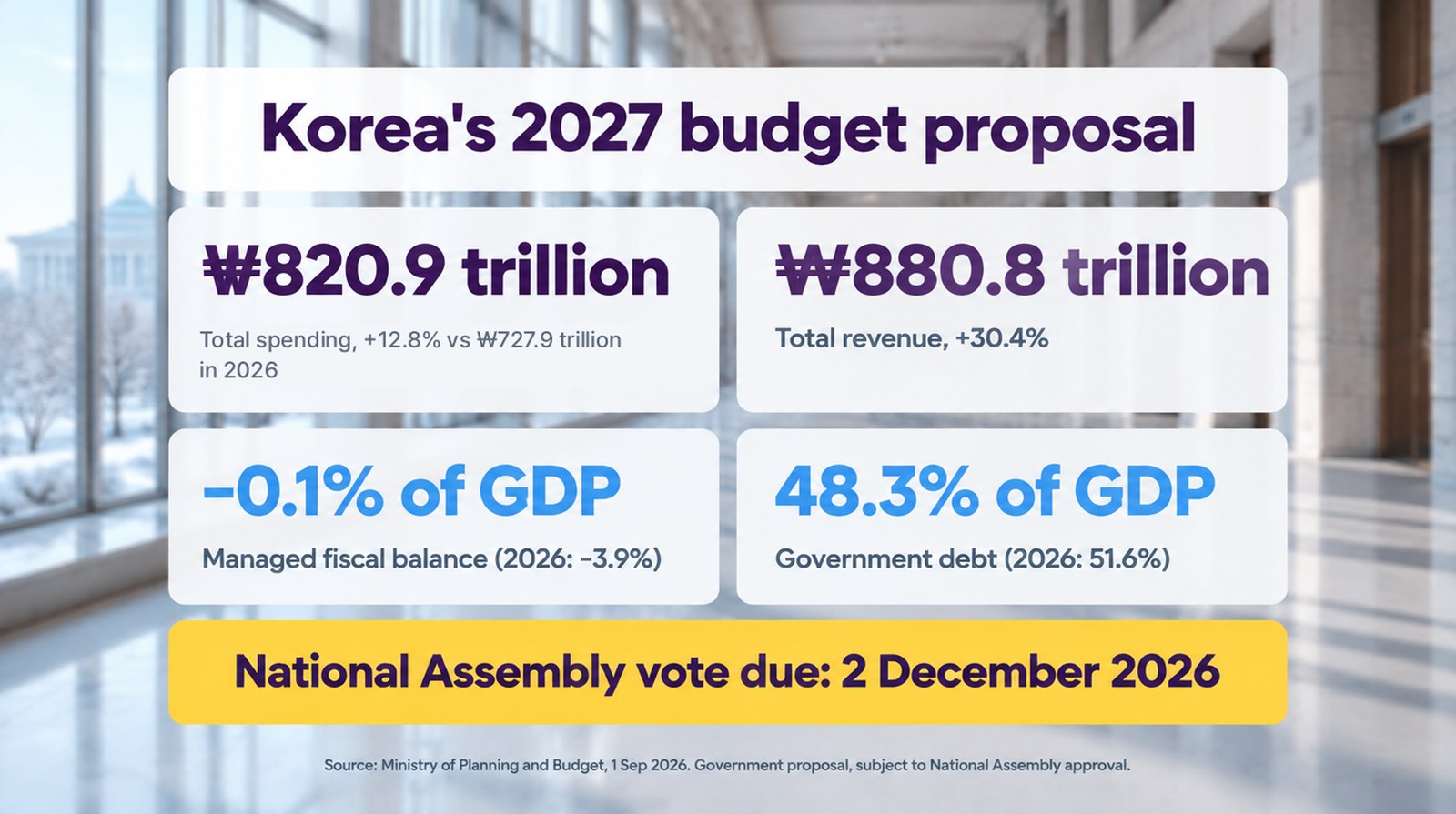
Quick answer: The government’s 2027 budget proposal sets total spending at ₩820.9 trillion, up 12.8 percent from the 2026 original budget of ₩727.9 trillion, with total revenue of ₩880.8 trillion. It is still a proposal: the National Assembly is cutting and adding items now, and the Constitution says it must decide by Wednesday 2 December 2026. For foreign residents, the bigger changes sit in the tax bills that travel with the budget (the proposed rise of the foreign-worker flat tax from 19 to 21 percent) and in decisions already taken (the 2027 health insurance rate stays at 7.19 percent).

Why now: the Assembly’s budget adjustment subcommittee began line-by-line cuts and increases on 16 November and held its fourth meeting on 19 November. As of 19 November 2026 the constitutional deadline is 13 days away. Whatever passes will shape your 2027 payslip, some benefits and the programmes that serve foreign workers.
Who this guide is for
- Foreign employees paid through a Korean payroll, especially anyone who uses or is thinking about the 19 percent flat tax.
- Foreign residents on NHIS (employee or regional members) who want to know whether premiums change in January 2027.
- Migrant workers and their employers who use the foreign worker support centres.
- Marriage migrants and families who want to know which new family benefits might apply to them.
- Anyone following Korea’s economy: students, investors and visitors trying to read the headlines about a “super budget”.
The proposal in numbers
The Ministry of Planning and Budget (기획예산처, MPB), which now prepares the budget, published these headline figures on 1 September 2026; the cabinet approved the plan that day and it was sent to the National Assembly on 3 September. Yonhap’s English summary of the same day reports identical totals (and converts the spending total to about US$595 billion at its exchange rate on 1 September).
| ₩ trillion | 2026 original budget | 2026 after supplementary budget | 2027 proposal | Change vs 2026 original |
|---|---|---|---|---|
| Total revenue | 675.2 | 700.6 | 880.8 | +205.6 (+30.4 percent) |
| Total spending | 727.9 | 753.0 | 820.9 | +93.0 (+12.8 percent) |
| Managed fiscal balance | −107.8 (−3.9 percent of GDP) | −107.6 (−3.8 percent) | −3.1 (−0.1 percent) | +3.8 points of GDP |
| Government debt | 1,413.8 (51.6 percent of GDP) | 1,412.8 (50.6 percent) | 1,519.8 (48.3 percent) | −3.3 points of GDP |
Three things explain the unusual shape:
- Tax revenue jumps. National tax revenue is projected at ₩584.4 trillion, up ₩194.2 trillion from ₩390.2 trillion, which MPB attributes mainly to corporate and income tax from the semiconductor boom.
- A new “Future Fund” (미래대응기금). MPB plans a ₩162.3 trillion fund built from tax revenue above the 10-year trend line. ₩45.4 trillion of it would be spent in 2027 on youth, growth industries, regions and education; about ₩104.4 trillion would be held as surplus funds, and new government bond issuance would be cut by ₩12.5 trillion.
- Cuts elsewhere. The ministry says it cut ₩38.6 trillion of discretionary spending (closing more than 2,100 programmes) and ₩69 trillion of mandatory spending, partly through a reform of the education grant to local offices.
Where the money goes
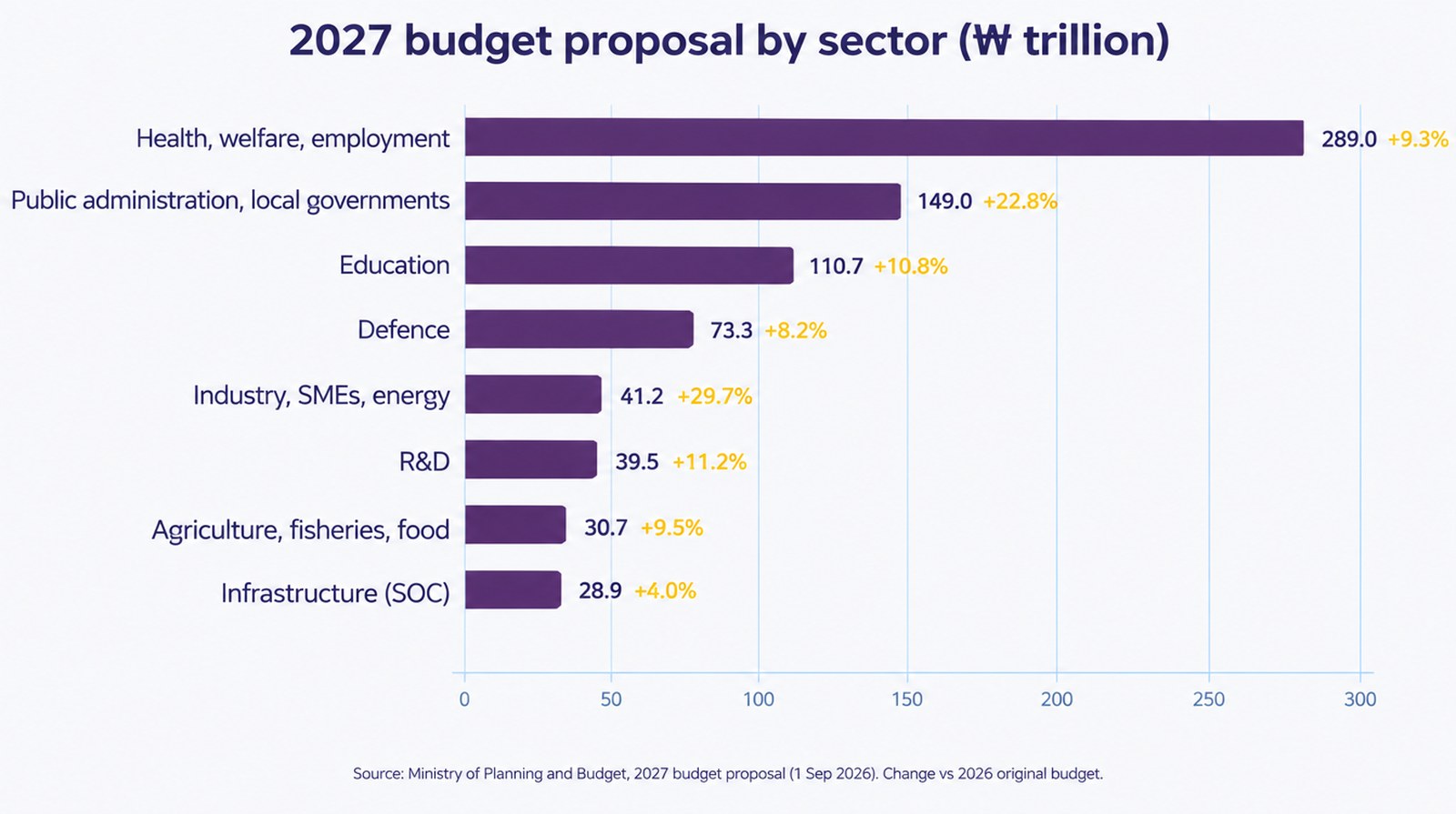
The proposal splits spending into 12 sectors. The table lists the official figures; the “share” column is our own calculation against the ₩820.9 trillion total. Sector figures overlap slightly (they add up to ₩824.4 trillion), so treat the shares as approximate.
| Sector | 2026 original (₩ trillion) | 2027 proposal (₩ trillion) | Change (official) | Share of total (our calc) |
|---|---|---|---|---|
| Health, welfare, employment | 264.4 | 289.0 | +9.3 percent | 35.2 percent |
| Public administration, local governments | 121.4 | 149.0 | +22.8 percent | 18.2 percent |
| Education | 99.9 | 110.7 | +10.8 percent | 13.5 percent |
| Defence | 67.7 | 73.3 | +8.2 percent | 8.9 percent |
| Industry, SMEs, energy | 31.8 | 41.2 | +29.7 percent | 5.0 percent |
| R&D | 35.5 | 39.5 | +11.2 percent | 4.8 percent |
| Agriculture, forestry, fisheries, food | 28.0 | 30.7 | +9.5 percent | 3.7 percent |
| Infrastructure (SOC) | 27.7 | 28.9 | +4.0 percent | 3.5 percent |
| Social order, safety | 27.3 | 28.8 | +5.3 percent | 3.5 percent |
| Environment | 13.9 | 14.6 | +5.2 percent | 1.8 percent |
| Culture, sports, tourism | 9.6 | 11.6 | +20.4 percent | 1.4 percent |
| Diplomacy, unification | 7.0 | 7.1 | +1.1 percent | 0.9 percent |
How to read it: more than a third of the proposal goes to health, welfare and employment, the sector that pays for pensions, health insurance subsidies and job programmes. The fastest growth is in industry and energy (+29.7 percent) and in transfers to local governments (+22.8 percent). Defence is split out on a new basis this year: MPB moved the Military Pension Fund into the defence line, so defence is not directly comparable with older reports.
The timetable to 2 December
| Date (2026) | Step | Source |
|---|---|---|
| Tue 1 September | Cabinet approves the 2027 budget proposal | MPB; Yonhap |
| Thu 3 September | Proposal submitted to the National Assembly (deadline: 120 days before the fiscal year) | Yonhap; Dong-A Ilbo |
| Fri 30 October | Budget committee public hearing | National Assembly News ON |
| 4–12 November | Budget committee questioning and ministry-by-ministry review | National Assembly News ON |
| From Mon 16 November | Budget adjustment subcommittee: line-by-line cuts and increases (planned to run to 20 November) | Yonhap; Newsis |
| Mon 30 November | Statutory end of committee review; full committee vote planned that day | National Assembly Act Art. 85-3; Yonhap |
| Tue 1 December | If review is unfinished, the budget is treated as referred to the plenary session, unless the Speaker and the floor leaders agree otherwise | National Assembly Act Art. 85-3 |
| Wed 2 December | Constitutional deadline: the Assembly “shall decide” the budget 30 days before the fiscal year starts | Constitution Art. 54(2) |
| Fri 1 January 2027 | Fiscal year 2027 starts | Constitution Art. 54 |
Is the deadline always met? No. Automatic referral puts the budget on the plenary agenda; it does not pass it. If no budget is passed by 1 January, the Constitution (Art. 54(3)) lets the government keep spending only on the running of institutions set up by law, on spending that law makes mandatory, and on projects already approved, until a budget passes. This is often called a “quasi-budget” (준예산). Treat 2 December as a legal deadline, not a guaranteed date: the Assembly can and sometimes does vote later in December.
Where the parties stand (as reported, not our view): the governing Democratic Party says it wants to keep the overall total and the Future Fund while adjusting individual items; the main opposition People Power Party says it will seek cuts of more than ₩27 trillion, including the whole Future Fund, which it argues weakens the Assembly’s control over spending (Newsis and Yonhap, 15–16 November). In the subcommittee’s first days, several energy, AI and regional items were put on hold or sent back for more data, and the Future Fund was left for a later session (Financial News/Newsis and Aju Business Daily, 17 November).
What changes for foreign residents
Most of the budget is not about foreigners specifically. These are the 2027 items with a direct, checkable effect on foreign residents, and their status as of 19 November 2026.
| Item | What is proposed or decided | Status on 19 November | Who it affects |
|---|---|---|---|
| Foreign-worker flat tax (외국인근로자 단일세율) | Rate from 19 to 21 percent (23.1 percent with local income tax) for income from 1 January 2027; the window to start work in Korea and use it extended from 31 December 2026 to 31 December 2029 | Government tax bill before the Assembly; the law in force still says 19 percent | Foreign employees who elect the flat tax |
| Health insurance rate | Stays at 7.19 percent of pay in 2027; property points for regional members stay at ₩211.5 | Decided by MOHW’s health insurance policy committee on 8 September; not part of the Assembly vote | Every NHIS member, including registered foreigners |
| NHIS state subsidy | Government support raised by about ₩1 trillion, to about ₩13.7 trillion | In the budget proposal; can change in the vote | Indirect: keeps the fund stable |
| VAT refund on hotel stays for foreign tourists | Ends after 30 June 2027 (current law runs to 31 December 2028) | Government tax bill before the Assembly | Short-term visitors at participating hotels |
| Foreign worker support centres | 19 to 26 centres; foreign worker management budget from ₩13.8 billion to ₩15.9 billion; new basic safety and health training (₩1.2 billion) and accident-prevention support (₩1 billion) | In MOEL’s budget proposal | Migrant workers (E-9, H-2 and others) and their employers |
| Standard median income | +6.70 percent for a 4-person household (₩6,929,885 a month) from 1 January 2027 | Decided by MOHW on 28 July | The small group of foreign residents eligible for basic livelihood benefits, such as some marriage migrants raising a Korean child |
| Monthly rent tax credit | Annual rent ceiling from ₩10 million to ₩12 million | Government tax bill before the Assembly | Eligible tenants (see our monthly rent credit guide for who can claim) |
| New family cash benefits | ₩1 million marriage support subsidy; universal child allowance for ages 0–12; a new child endowment | In the budget proposal; detailed rules not yet set | Mostly tied to Korean nationality today; MPB’s release does not say foreigners qualify |
Two of these deserve a closer look because they change money in your account.
The flat tax: what 21 percent would mean
Under the Special Tax Treatment Control Act, Article 18-2, a foreign employee can choose to pay a single rate on total employment income instead of the normal 6 to 45 percent progressive rates, with no deductions or credits. The Ministry of Finance and Economy’s bill would raise that single rate to 21 percent “taking into account tax equity with domestic workers”. The local income tax (10 percent of the national tax) comes on top in both cases.
Worked example (our calculation, flat-tax route only, before social insurance):
| Annual employment income | At 19 percent + local tax (20.9 percent) | At 21 percent + local tax (23.1 percent) | Extra tax a year |
|---|---|---|---|
| ₩60,000,000 | ₩12,540,000 | ₩13,860,000 | ₩1,320,000 |
| ₩100,000,000 | ₩20,900,000 | ₩23,100,000 | ₩2,200,000 |
| ₩150,000,000 | ₩31,350,000 | ₩34,650,000 | ₩3,300,000 |
The difference is simply 2.2 percent of income. At ₩60 million the normal progressive route is usually cheaper anyway, so the flat tax mostly matters to higher earners; our 19 percent flat tax guide works through when it actually saves money. If the bill passes as written, you can still compare both methods and choose the better one each year at year-end tax settlement.
Health insurance: unchanged rate, same deduction
Because the 2027 rate stays at 7.19 percent, an employee’s share stays at 3.595 percent (the employer pays the other half). On a monthly salary of ₩3,000,000 that is ₩107,850 in both 2026 and 2027 (our calculation: ₩3,000,000 × 3.595 percent). Long-term care insurance and the national pension do change in January; our January 2027 payslip guide shows those lines, and if you pay as a regional member, see why the November regional bill changed.

A short checklist for foreign residents
- After the vote, check whether the flat-tax bill passed and at what rate. Tax bills are often passed in the same plenary session as the budget. If you elect monthly flat-tax withholding, ask payroll which rate it will use from January 2027 pay.
- Starting a Korean job in 2027? The flat-tax option currently requires starting work by 31 December 2026; the bill would extend this to 31 December 2029. Do not assume it until the law is amended.
- Expect no change in your NHIS rate. Your health line moves only if your pay changes; long-term care and pension lines do change.
- Check benefit rules, not headlines. New family cash benefits are announced in the budget, but eligibility (nationality, resident registration) is set in each law. Ask your local community centre (주민센터) or call 129.
- Watch the minimum wage separately. It is not part of the budget vote: the 2027 rate of ₩10,700 an hour was set earlier (see our 2027 minimum wage guide).
- Visitors booking hotels for late 2027: the hotel VAT refund may end after 30 June 2027 if the bill passes; shopping refunds are a separate scheme (see our tourist tax refund guide).
Common misunderstandings
- “The budget sets my tax rate.” It does not. The budget is a spending and revenue plan; tax rates change only through tax laws, which the Assembly votes on separately (often the same day).
- “₩820.9 trillion is final.” It is the government’s proposal. The Assembly can cut items and, with government consent, add or increase them (Constitution Art. 57), so the passed total usually differs.
- “Automatic referral means automatic approval.” Referral only puts the budget to a plenary vote.
- “A bigger budget means higher taxes.” The proposal assumes higher revenue mainly from corporate and income tax on a semiconductor boom, not a general rate rise; MPB projects the managed fiscal deficit at 0.1 percent of GDP.
For the economic backdrop, see our guides to the Bank of Korea rate decision on 26 November and third-quarter GDP.
Frequently asked questions
Q. When does Korea’s National Assembly have to pass the 2027 budget?
By Wednesday 2 December 2026, 30 days before the fiscal year starts on 1 January 2027, under Article 54 of the Constitution. If the budget committee has not finished by 30 November, the budget is referred to the plenary session on 1 December.
Q. How big is Korea’s 2027 budget proposal?
Total spending of ₩820.9 trillion, up 12.8 percent from ₩727.9 trillion in the 2026 original budget, with total revenue of ₩880.8 trillion. The Assembly can change these figures before it votes.
Q. Will the 19 percent flat tax for foreign workers rise to 21 percent in 2027?
Only if the Assembly passes the government’s tax bill. The bill would apply 21 percent (23.1 percent with local tax) to income from 1 January 2027 and extend eligibility to people who start work in Korea by 31 December 2029. As of 19 November 2026 the law in force still says 19 percent.
Q. Will my NHIS health insurance premium go up in 2027?
The rate will not. The 2027 health insurance rate stays at 7.19 percent of pay, decided on 8 September 2026, so an employee still pays 3.595 percent. Long-term care insurance, charged on top, does change.
Q. Can foreign residents get the new child and marriage benefits in the budget?
The budget release does not say so, and today’s child allowance requires Korean nationality for the child. The detailed rules for the new benefits are set in law later, so check with your community centre or call 129 before you count on them.
Q. What happens if the budget is not passed by 2 December?
Nothing stops on 2 December; the Assembly can still pass it later in December. If no budget passes by 1 January, the government may only fund legally required spending, the running of statutory institutions and already-approved projects until it does.
Related guides
- Korea’s 19 percent flat tax for foreign workers: when it actually saves money
- Your January 2027 payslip in Korea: pension, health insurance and long-term care
- Why your regional health insurance bill changed in November 2026
- Korea health insurance for foreigners in 2026
- Korea minimum wage 2027
- Bank of Korea rate decision, 26 November 2026
Sources
- Ministry of Planning and Budget, 2027 Budget Proposal (English press release, 1 September 2026): https://mpb.go.kr/web/main/file/download/uu/a2061cd3296c443da2fb1079c37f2cdc
- Ministry of Planning and Budget, 2027년도 예산안 및 2026~2030년 국가재정운용계획 발표 (8 September 2026): https://www.mpb.go.kr/web/main/bbs/f_0005/2722
- Ministry of Finance and Economy, 2026 Tax Revision Bill (3 August 2026): https://english.mofe.go.kr/pc/selectTbPressCenterDtl.do?boardCd=N0001&seq=6455
- Special Tax Treatment Control Act, Article 18-2 (law in force, law.go.kr): https://www.law.go.kr/lsLinkCommonInfo.do?lsJoLnkSeq=1033490259
- National Assembly Act, Article 85-3 (law.go.kr): https://law.go.kr/lsLinkCommonInfo.do?chrClsCd=010202&lsJoLnkSeq=1017064577
- Constitution of the Republic of Korea, Articles 54 and 57 (law.go.kr): https://www.law.go.kr/법령/대한민국헌법
- Ministry of Health and Welfare, 15th Health Insurance Policy Deliberation Committee briefing (8 September 2026): https://www.korea.kr/briefing/policyBriefingView.do?newsId=156780681
- Ministry of Health and Welfare, 2027 standard median income (28 July 2026): https://www.korea.kr/news/policyNewsView.do?newsId=148968956
- Ministry of Employment and Labor, 2027 budget proposal ₩38.9537 trillion (4 September 2026): https://www.moel.go.kr/news/enews/report/enewsView.do?news_seq=19885
- Government24, services for foreigners (basic livelihood special rule): https://www.gov.kr/portal/foreigner/ko/m030302
- National Assembly News ON, budget committee public hearing and schedule (30 October 2026): https://www.naon.go.kr/naon/articleList/contents.do?menuNo=2400011&pageIndex=1&pageListId=naonToday&storyId=bbbc9817-fc56-4d10-a791-0ae35dde246b
- Yonhap, Gist of proposed state budget for 2027 (1 September 2026): https://en.yna.co.kr/view/AEN20260901000600320
- Yonhap, 2027 budget ₩820.9 trillion and the Future Fund (1 September 2026): https://www.yna.co.kr/view/AKR20260901004000002
- Yonhap, subcommittee review begins (16 November 2026): https://www.yna.co.kr/view/AKR20261115034300001
- Yonhap, 4th budget adjustment subcommittee meeting (19 November 2026): https://www.yna.co.kr/view/PYH20261119088500013
- Newsis, parties’ positions as the subcommittee opens (15 November 2026): https://www.newsis.com/view/NISX20261115_0003868599
- Financial News / Newsis, first day of the subcommittee (17 November 2026): https://www.fnnews.com/news/202611170047126224
- Aju Business Daily, AI budget dispute in the subcommittee (17 November 2026): https://www.ajunews.com/view/20261117174030187
- Dong-A Ilbo, budget submitted to the Assembly (3 September 2026): https://www.donga.com/news/Politics/article/all/20260903/134600032/1
- Yonhap, 2027 health insurance rate frozen at 7.19 percent (8 September 2026): https://www.yna.co.kr/view/AKR20260908089851530
- KPMG, GMS Flash Alert 2026-235, flat tax for foreign employees (11 September 2026): https://kpmg.com/xx/en/our-insights/gms-flash-alert/2026/flash-alert-2026-235.html
- Newspim, hotel VAT refund for foreign tourists to end early (7 August 2026): https://www.newspim.com/news/view/20260807000669
- ChosunBiz, 2027 labour budget (1 September 2026): https://prod.chosunbiz.com/en/en-society/2026/09/01/K7SE2VEOEVF7DJLBZD772P6MQQ/
How we checked: the budget totals, fiscal balance, debt and sector table were read in MPB’s English press release and matched against Yonhap’s English summary and MPB’s Korean release; the timetable was read in the National Assembly Act and the Constitution on law.go.kr and matched against National Assembly News ON, Yonhap and Newsis; the flat-tax, hotel VAT and rent-credit items were read in MOFE’s 2026 Tax Revision Bill and matched against KPMG, Newspim and the law in force; the NHIS rate and median income were read in MOHW releases on Korea.kr and matched against Yonhap; foreign worker centres were read in MOEL’s budget release and matched against ChosunBiz. The share column and the worked examples are our own arithmetic. Party positions are attributed to the outlets that reported them.
This article is general information, not financial or tax advice. The figures are the government’s proposals and may change when the National Assembly votes; check the final law, ask your employer’s payroll team or the National Tax Service (126) before you make decisions. Official information: Ministry of Planning and Budget and National Tax Service.
Researched and drafted with AI assistance; checked against the sources listed.