Protecting a Rental Deposit in Korea as a Foreigner: Address Report, Fixed Date and HUG
Haesul Economy desk (AI-assisted). As of 14 November 2026 (KST). Based on Government24’s residence-change page, the Ministry of Government Legislation’s Easy Law guide (English), the Korea Housing & Urban Guarantee Corporation (HUG) FAQ and product pages, the Seoul Housing Portal, Jongno-gu Office, and reporting by The Korea Times and Yonhap.
Quick answer: If you hold a residence card (ARC) and pay a deposit on a Korean home, three things protect it, and the order matters. Move in and file a residence change report (체류지 변경신고) within 15 days; for registered foreigners this counts as the Korean “move-in report” (전입신고). Get a fixed date (확정일자) stamped on your lease, which costs ₩600 at a community service centre or ₩500 online. Then, if the home and lease qualify, apply for HUG’s jeonse deposit return guarantee (전세보증금반환보증), which HUG says registered foreign tenants can join, before half of your lease term has passed. On a ₩200 million two-year jeonse, the guarantee costs from about ₩408,000 to ₩736,000 at HUG’s published rates (our calculation, below).

Korean leases ask for deposits that look enormous to most newcomers. A monthly-rent flat (wolse, 월세) usually needs a deposit of several months’ rent or more, and a jeonse (전세) lease swaps monthly rent for a single lump sum that can run to hundreds of millions of won. Our first-90-days guide to living in Korea covers housing in one short section. This post goes further: what each protection actually does for a foreign tenant, in what order to do it, what it costs, and what it does not cover.
This is general information, not legal advice. Housing law is technical, and a lawyer or a licensed agent should check any contract you are unsure about.
Who this applies to
- Registered foreigners with a residence card who rent a home under a jeonse or wolse lease. The Housing Lease Protection Act (주택임대차보호법) was written for Korean nationals, but Easy Law, the government’s plain-language law site, says a foreign tenant who has completed alien registration and reported a change of residence is protected as an exception, because Article 88-2(2) of the Immigration Act says those two filings replace resident registration and the move-in report.
- Overseas Koreans (F-4) use a domestic residence report (국내거소신고) instead, which HUG’s FAQ treats the same way.
- Short-term visitors who have not registered (for example, a 90-day stay) have nothing to file, so they cannot meet the address requirement. A Korean law firm’s guide on Lawtalk makes the same point: without registration, a short-stay tenant has possession but no public record of it.
The three protections, and what each one does
| Protection | Korean name | What it gives you | Where and cost |
|---|---|---|---|
| Move in + residence change report | 체류지 변경신고 (counts as 전입신고) | “Opposing power” (대항력): you can hold a new owner or buyer to your lease. Starts at 00:00 the day after you have both moved in and reported. | Community service centre, district office, immigration office, or HiKorea online. Free. Within 15 days of moving in. |
| Fixed date on the lease | 확정일자 | Together with the above, “priority repayment” (우선변제권): in an auction you are paid ahead of creditors who registered later. | Community service centre, registry office or court, or the Supreme Court’s Internet Registry Office (iros.go.kr). ₩600 in person, ₩500 online. |
| HUG deposit return guarantee | 전세보증금반환보증 | If the landlord cannot return the deposit when the lease ends, HUG pays it and pursues the landlord. | HUG branches, partner banks, or apps. Annual premium of 0.097% to 0.211% of the guaranteed amount. |
Sources: Government24 and Easy Law for the report; Easy Law and Jongno-gu Office for the fixed date; HUG FAQ and the Seoul Housing Portal for the guarantee. The Korea Times (12 November 2026) describes the same first two steps for foreign tenants.
The first two are legal protections that cost almost nothing. The third is a paid guarantee product with its own eligibility test. None of them cleans up a property that was risky before you signed, which is why the checks in the next section come first.
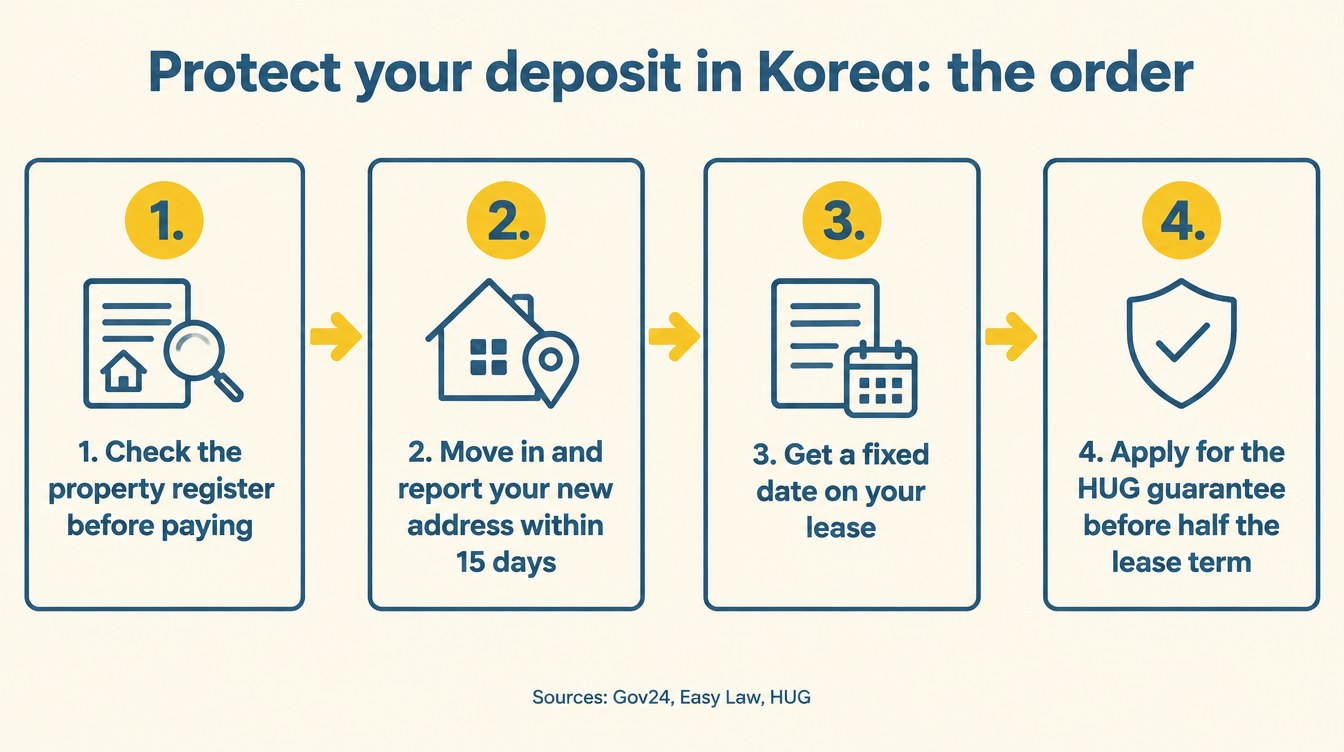
The order of steps
Before you pay: check the property
Easy Law’s English guide lists the checks to make before signing: compare the deposit with the property’s market price, read the certified copy of the real estate register (등기사항전부증명서) for the owner, mortgages and other rights, check the building register for unauthorised construction, confirm the person signing is the registered owner, and check that the landlord has no overdue national or local taxes. It also says to re-check the register on the day you pay the balance, before paying, because rights can change between viewing and signing.
The Korea Times interview of 12 November 2026 with real-estate adviser Kim Tae-soo gives the same advice from the market side: pull a fresh register on signing day, walk away from a property with a provisional seizure or an auction notice, and treat heavy mortgages as a warning sign. He also notes that building-code violations can make a property ineligible for deposit-return guarantees, so check the building register before you rely on one.
Day 1: move in and report your new address
File the residence change report as soon as you move in. Government24 says a registered foreigner must report a new place of stay within 15 days of moving in, at the immigration office for the new address or at the city, county or district office or community service centre (주민센터), with no fee. Bring your passport or residence card and proof that you live there, such as the lease. You can also file online through HiKorea, but Government24 notes that an online filing does not write the new address on the back of your card, and Guro-gu Office’s page says the online route closes once the 15 days have passed, after which you must go to the immigration office in person.
The 15 days are a filing deadline, not a grace period for your protection. Your opposing power starts only at 00:00 on the day after you have both moved in and reported. A Korean lawyer’s explainer on Lawtalk gives the example of a tenant who moves in on the 1st, reports on the 14th and finds a mortgage registered on the 10th: the tenant ranks behind it. Report on moving day if you can.
Missing the deadline is also an offence under Article 36 of the Immigration Act, punishable by a fine of up to ₩1 million according to the government’s Study in Korea portal.
Same day: get the fixed date
The fixed date proves your lease existed on that date, and with the address report it gives you priority repayment. Jongno-gu Office lists three ways to get one: at the community service centre for the home, with ID and the lease (₩600); online at the Supreme Court Internet Registry Office with a digital certificate (₩500); or automatically, free, when you file a lease report (below). Independent guides by Korean legal-information sites give the same ₩600 and ₩500 fees, citing the fee rules of the Ministry of Justice and the Supreme Court.
Many tenants do the address report and the fixed date at the same community service centre visit.
Within 30 days: the lease report, if it applies
Easy Law says a lease with a deposit over ₩60 million or monthly rent over ₩300,000 must be reported within 30 days of signing, and that submitting the lease with the report counts as applying for a fixed date. Jongno-gu Office says the report is free and that the fixed date fee is waived when you file both together at the community service centre. Reporting can be done before the move-in report.
Before half the term: the HUG guarantee
HUG’s FAQ includes a table answering whether foreigners and overseas Koreans can join: for the deposit return guarantee, a foreign tenant can, provided they meet the Housing Lease Protection Act requirements, which HUG lists as alien registration, the residence change report and possession for opposing power, plus a fixed date for priority repayment. The Seoul Housing Portal’s summary of the product also says individuals, corporations and foreigners can apply.
According to the Seoul Housing Portal and HUG’s mobile application page, the main conditions are:
- Deadline: for a new lease, before half of the lease term has passed, counted from the later of the balance-payment date and the move-in report date.
- Lease: at least one year, signed through a licensed real estate agent, with no clause banning the transfer or pledge of the deposit claim.
- Deposit cap: ₩700 million or less in the Seoul metropolitan area (Seoul, Gyeonggi, Incheon) and ₩500 million or less elsewhere.
- Value test: the deposit plus any senior debt must be within the house price times 90%. Senior debt must be within 60% of that value.
- Register: no auction, seizure, provisional seizure or similar on the title, and the building and land must both belong to the landlord.
- Housing type: apartments, residential officetels, multi-unit and multi-household houses, detached houses and senior housing. Non-residential “neighbourhood living facilities” (근린생활시설) do not qualify, and an officetel must be marked as residential on the lease or the agent’s disclosure.
- Documents for the mobile route: the lease with its fixed date, a move-in household list (전입세대열람내역서) issued within a month, proof of paying the deposit and a resident-register document (foreign residents should ask which residence-card certificate HUG accepts instead).
On 14 November 2026 HUG’s mobile application page said applications for apartments and officetels through the mobile channel were temporarily unavailable because of a surge in applications, except where the landlord is a company. The same page says partner banks’ branches accept all housing types, so a branch visit is the fallback.
If you rent with a large deposit plus monthly rent (반전세), ask HUG on 1566-9009 whether your deposit qualifies before you rely on the guarantee; the product pages are written around jeonse.
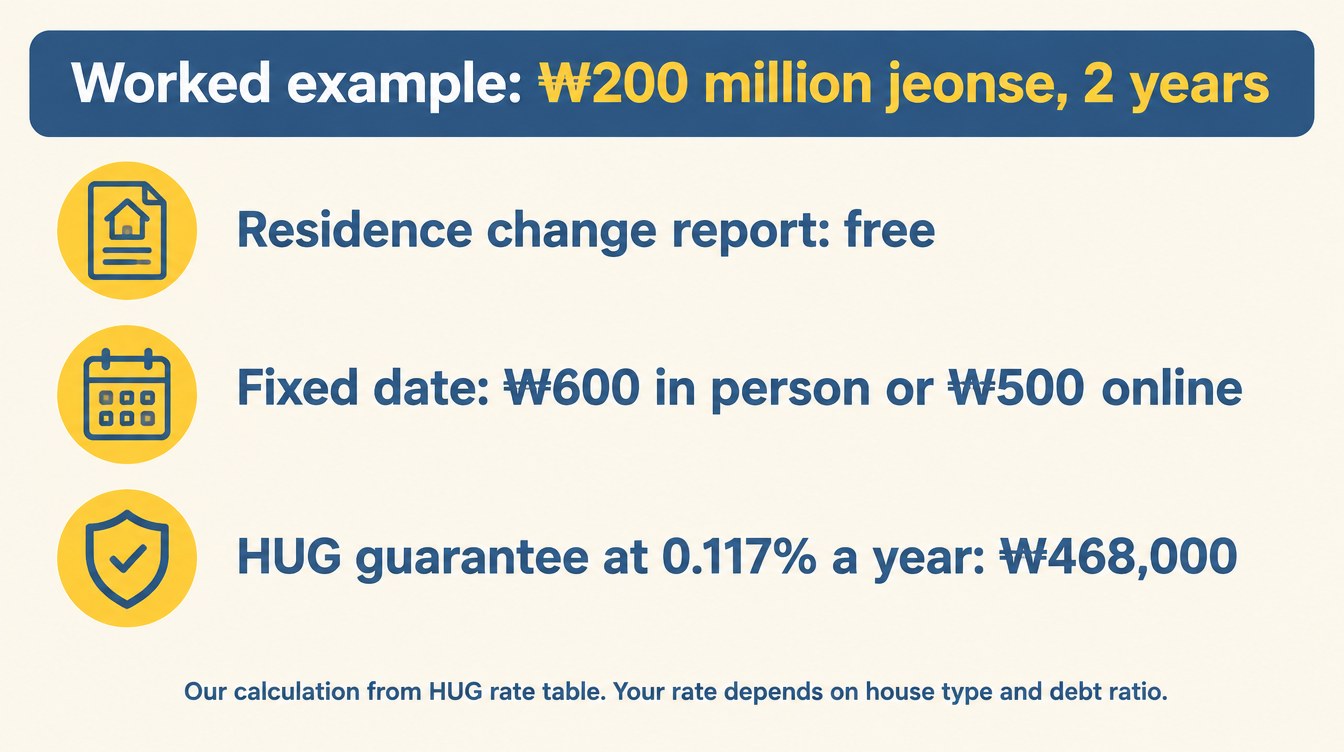
What it costs: worked example
HUG’s premium is the guaranteed amount times the annual rate times the lease days divided by 365. The rate depends on the deposit band, whether the home is an apartment, and the “debt ratio” (senior debt plus your deposit, divided by the house value). The Seoul Housing Portal publishes the full table, and HUG’s FAQ gives the same overall range of 0.097% to 0.211% a year. Yonhap reported that HUG moved to this range from 0.115% to 0.154% in a reform applied from 31 March 2025; HUG’s own mobile page still shows the old range in one line, so go by the full table.
| Deposit band | Apartment (debt ratio ≤70% / ≤80% / >80%) | Other housing (≤70% / ≤80% / >80%) |
|---|---|---|
| ₩100 million or less | 0.097% / 0.117% / 0.137% | 0.111% / 0.142% / 0.172% |
| Over ₩100m to ₩200m | 0.102% / 0.124% / 0.146% | 0.117% / 0.151% / 0.184% |
| Over ₩200m to ₩500m | 0.107% / 0.131% / 0.154% | 0.124% / 0.161% / 0.197% |
| Over ₩500m | 0.113% / 0.138% / 0.164% | 0.132% / 0.172% / 0.211% |
Source: Seoul Housing Portal, HUG jeonse deposit return guarantee summary, read 14 November 2026.
Example (our calculation): a ₩200 million jeonse on a two-year (730-day) lease in a villa, which counts as “other housing”, with a debt ratio of 70% or less:
- HUG premium: ₩200,000,000 × 0.117% × 730 ÷ 365 = ₩468,000 for the two years.
- If the same deposit were in an apartment at the lowest debt-ratio band: ₩200,000,000 × 0.102% × 2 = ₩408,000.
- If the villa’s debt ratio were above 80%: ₩200,000,000 × 0.184% × 2 = ₩736,000.
- Fixed date: ₩600 in person or ₩500 online (or free with a lease report at the community service centre).
- Residence change report: free.
HUG’s mobile page says applying through the app and paying in one go each earn a 3% discount. The Seoul Housing Portal lists larger discounts for groups such as low-income, newlywed or multicultural households (the multicultural discount applies to marriage migrants with a Korean spouse), and HUG’s FAQ adds a 10% surcharge where senior debt exceeds 50% of the house value. The Seoul Housing Portal adds that the premium qualifies for a year-end tax credit on guaranteed deposits up to ₩300 million. If you rent with monthly payments too, our monthly rent tax credit guide covers the separate credit on the rent itself.
A second layer for small deposits
Easy Law lists the “small-sum tenant” rule: if your deposit is under a regional ceiling and you had opposing power before an auction was registered, part of the deposit is paid ahead of even earlier secured creditors. Its table shows Seoul at a deposit of ₩165 million or less with up to ₩55 million protected, overcrowding-control zones outside Seoul (and Sejong, Yongin, Hwaseong, Gimpo) at ₩145 million with ₩48 million, and other areas down to ₩75 million with ₩25 million. This is a single official source and the figures are set by decree, so check the current table before relying on it. The Korea Times article mentions the same rule without figures.
Common mistakes
- Reporting late. The 15-day deadline avoids a fine but leaves you unprotected until the day after you report.
- Moving your registration out early. Easy Law’s Korean pages cite Supreme Court rulings that a tenant who moves their registration away loses opposing power and only regains it from the new report. If you must leave before the deposit is returned, ask about a lease registration order (임차권등기명령) first.
- Wrong address details. In a multi-unit building, the unit number on your report must match the lease and the register.
- Relying on the guarantee for a risky property. HUG reviews the property and can refuse it; the guarantee is not automatic.
- Waiting past half the lease. After that point, HUG’s standard product is closed to you for that lease.
What to do this week if you have just signed
- Book or file the residence change report for moving day.
- Get the fixed date the same day, or file the lease report if your lease is over the ₩60 million / ₩300,000 thresholds.
- Keep copies: the stamped lease, the report receipt or your card with the new address, and proof of every deposit payment.
- Note the HUG deadline: half your lease term from the later of the balance payment and the report.
- Keep your NHIS address up to date too; our health insurance for foreigners guide explains how premiums and visa extensions are linked.
Still choosing a flat? See Renting a flat in Korea as a foreigner for wolse vs jeonse, October 2026 Seoul rents and deposits, the legal broker-fee caps and a worked monthly budget.
FAQ
Q. Can a foreigner get the same deposit protection as a Korean tenant?
Yes, if you are a registered foreigner. Easy Law says a foreign tenant who has completed alien registration and reported a change of residence is protected under the Housing Lease Protection Act, because the Immigration Act says those filings replace resident registration and the move-in report. Unregistered short-stay visitors cannot meet the address requirement.
Q. Is the residence change report the same as a Korean move-in report (전입신고)?
For legal purposes, yes. Article 88-2(2) of the Immigration Act says alien registration and the residence change report replace resident registration and the move-in report. You file it within 15 days of moving in, free, at a community service centre, district office, immigration office or online through HiKorea.
Q. How much does a fixed date cost?
₩600 at a community service centre, court or registry office, or ₩500 online through the Supreme Court Internet Registry Office. It is free when it is granted through a lease report filed at the community service centre.
Q. Can foreigners join HUG’s jeonse deposit return guarantee?
HUG’s FAQ says yes for tenants who meet the Housing Lease Protection Act requirements: alien registration, the residence change report and possession, plus a fixed date. The property and lease must also pass HUG’s review, including the ₩700 million (capital area) or ₩500 million (elsewhere) deposit cap.
Q. When is it too late to apply for the HUG guarantee?
For a new lease, once half of the lease term has passed, counted from the later of the balance-payment date and the move-in report date. For a renewed lease, HUG’s mobile page says from one month before the old lease ends until half of the renewed term has passed.
Q. Does a fixed date protect me if the house already had a big mortgage?
No. Priority repayment ranks you ahead of creditors registered after you, not before. That is why checking the register before paying, and again on the day you pay the balance, comes first.
General information, not legal or financial advice. Rules are as published by Government24, Easy Law, HUG and the Seoul Housing Portal on the dates above. For immigration questions call the Immigration Contact Center on 1345; for the guarantee call HUG on 1566-9009.
Sources
- Government24, “Report of change of residence for foreigners” (외국인 체류지변경신고), read 14 November 2026: https://www.gov.kr/mw/AA020InfoCappView.do?CappBizCD=12700000026
- Easy Law (Ministry of Government Legislation), “Lease (Lump-sum Deposit Lease) Agreements”, English: https://m.easylaw.go.kr/MOM/SubCsmOvRetrieve.laf?ccfNo=1&cciNo=1&cnpClsNo=1&csmSeq=2495&langCd=700101
- HUG, FAQ on the jeonse deposit return guarantee (foreign tenants table, premium range, senior-debt limit): https://www.khug.or.kr/khmb/m/hg/gg/relax/relaxsub3.jsp
- HUG mobile, jeonse deposit return guarantee product page (documents, deposit cap, deadline, mobile notice): https://onestop.khug.or.kr/webView/webBiz/apply/goods001
- Seoul Housing Portal, “Jeonse deposit return guarantee” (conditions and full premium table): https://housing.seoul.go.kr/site/main/content/sh01_060400
- Jongno-gu Office, new-resident guide (lease report, fixed date fees): https://app.jongno.go.kr/search/newResidents
- Study in Korea (government portal), residence and stay information (15-day rule and fine): https://cdn.studyinkorea.go.kr/mn/life/residenceAndStayInfo.do
- Guro-gu Office, online residence change report for foreigners (15-day online window): https://www.guro.go.kr/www/contents.do?key=1639
- The Korea Times, “Renting in Korea: What foreign residents should know before signing” (12 November 2026): https://www.koreatimes.co.kr/economy/20261112/renting-in-korea-what-foreign-residents-should-know-before-signing
- Yonhap News, HUG premium reform to 0.097%–0.211% (23 January 2025): https://www.yna.co.kr/view/AKR20250123190900003
- Lawtalk, explainer by a Korean lawyer on foreign tenants’ opposing power and the residence change report: https://www.lawtalk.co.kr/posts/193384
- Minwon Wiki (lifebase), fixed date fees by channel: https://minwon.lifebase.kr/wiki/lease-fixed-date/
How we checked: We read the Government24, Easy Law, HUG, Seoul Housing Portal and Jongno-gu pages on 14 November 2026 and matched the 15-day rule, the foreigner equivalence and the HUG conditions against The Korea Times, Lawtalk and Yonhap. The national law database (law.go.kr) was under maintenance on 14 November, so statute wording comes from Easy Law’s citations; the worked premiums are our own calculations from the published table.
Researched and drafted with AI assistance; checked against the sources listed.





2 Comments