Blood Pressure on Korea’s National Checkup: What 140/90 Means on Your Result Sheet
Updated 6 November 2026 · General health information, not medical advice. Only your doctor can interpret your results or decide on treatment.
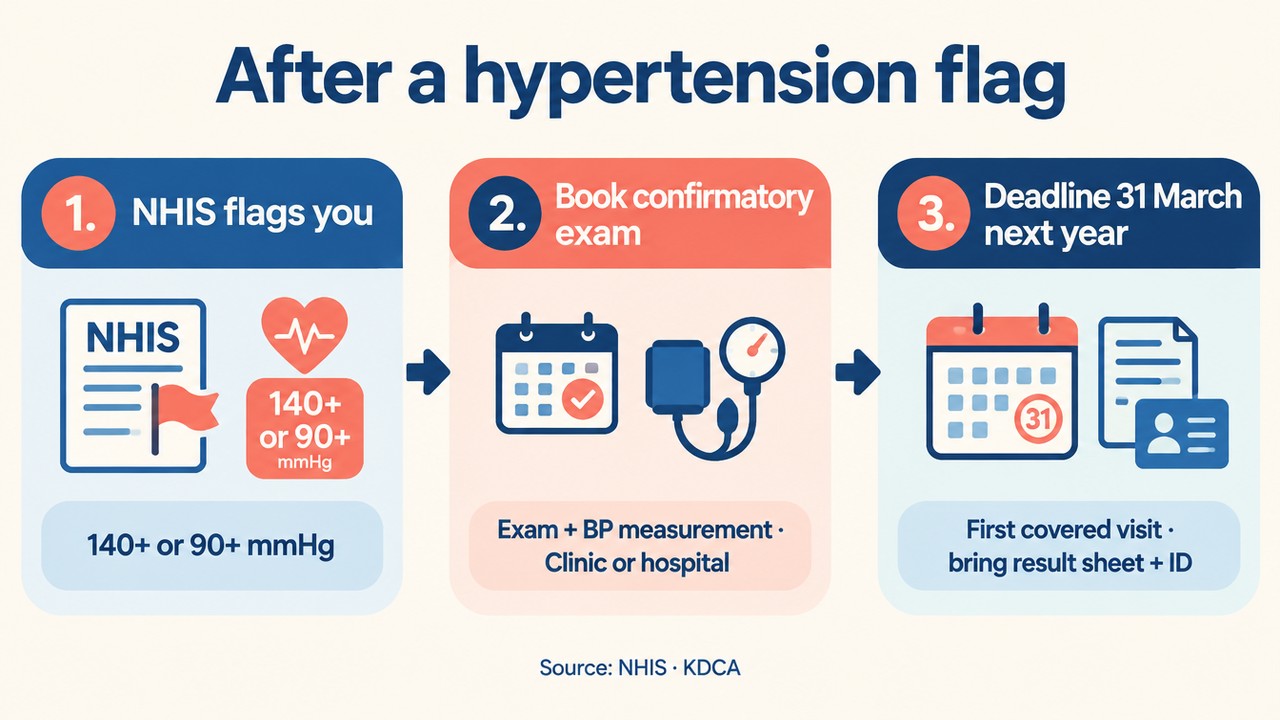
Quick answer: On Korea’s national (NHIS) general checkup, blood pressure is a common item every cycle. The official annex codes under 120/80 mmHg as normal A, 120–139 or 80–89 as normal B (borderline), and 140 or higher or 90 or higher as a hypertension disease-suspected flag. A flag is not a diagnosis. If you are flagged, NHIS covers one first confirmatory visit (examination plus blood-pressure measurement) at a clinic or hospital until 31 March of the year after your checkup. Bring your result sheet and ID. For how US, UK, WHO and Korea clinical guidelines label the same numbers, see our agency-by-agency ranges guide.

Blood pressure is on every free general checkup
Unlike the lipid panel (every four years for men from 24 and women from 40), blood-pressure measurement sits in the common item list. NHIS lists it with height, weight, waist, vision, hearing, chest X-ray, the basic blood panel, urine protein and the oral exam. If you are due for the general checkup this year, your result sheet will show a systolic/diastolic pair.
Who is invited, and how often, depends on insurance status: regional insured people and dependents aged 20 and over usually every two years; office workers on the biennial track every two years; non-office (production) workers every year. That schedule is about eligibility, not about skipping the BP cuff — when you attend, BP is measured. Age windows and expat enrolment are covered in our national checkup by age for expats. If December is approaching and you still have not booked, see the Dec 31 deadline and catch-up guide.
The NHIS flag table for blood pressure (official annex)
Korea’s Health Checkup Implementation Standards, Annex 4 appendix (검사항목별 판정기준), sets the lines the national result sheet uses. Units are mmHg:
| Item | Normal A | Normal B (borderline) | Disease suspected |
|---|---|---|---|
| Systolic | Under 120 | 120–139 | 140 or higher |
| and | or | or | |
| Diastolic | Under 80 | 80–89 | 90 or higher |
Sources: Annex 4 appendix PDF from law.go.kr (flSeq 160922523), opened 6 November 2026; NHIS general checkup page lists blood pressure as a common item and hypertension as a confirmatory pathway.
Read the and / or carefully. Normal A needs both numbers under the cut. Borderline and disease-suspected fire if either the systolic or the diastolic band is hit. So 138/78 is borderline (systolic in 120–139). 118/92 is disease-suspected (diastolic 90+). 142/88 is disease-suspected (systolic 140+).
The judgment codes on the sheet include 정상A, 정상B(경계), 일반 질환의심, 고혈압·당뇨병·이상지질혈증 질환의심, and 유질환자 (already diagnosed and on drug treatment). Only the hypertension disease-suspected path starts the free confirmatory visit for BP. Borderline is a lifestyle-and-self-care signal, not the free-visit ticket. Already on blood-pressure medicine is a known-patient code, not a new flag.
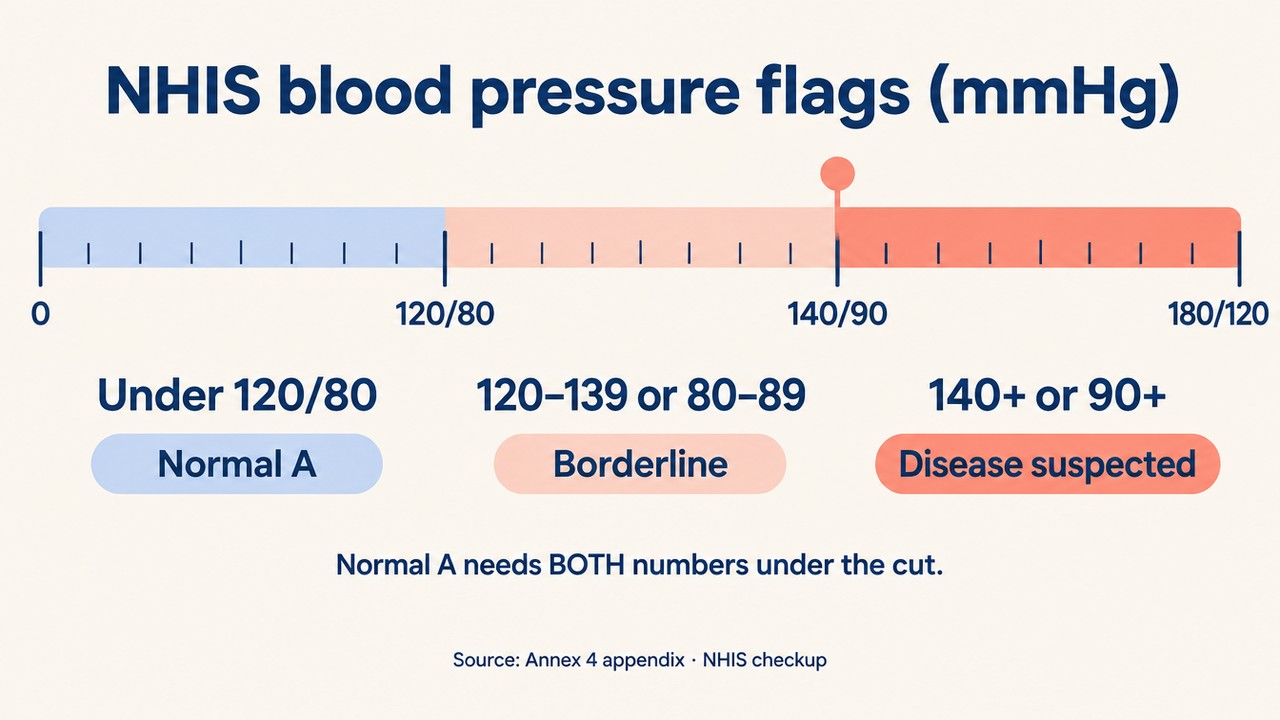
What 140/90 means here — and what it does not
On the result sheet, 140/90 is the screening flag that unlocks one covered confirmatory visit. It is the same numeric line KDCA uses when it defines hypertension for adults as systolic 140 or higher or diastolic 90 or higher, with normal under 120/80. That clinical definition and the NHIS annex line match at the top cut — but they answer different questions. The annex decides what the free national program prints and what free follow-up it pays for. A clinician decides whether you have hypertension after repeat readings, history and, often, out-of-office numbers.
This article stays on the flag and follow-up window. Agency labels for the bands in between (US “stage 1” at 130/80 versus Korea/UK/WHO keeping hypertension at 140/90) are compared in our blood pressure ranges by agency post. Do not retitle that post in your head: a 134/84 on a Korean checkup is borderline (normal B) for the free-visit benefit, even if a US consumer page would call it stage 1.
MedlinePlus (NHLBI) also notes that providers usually take two or more readings at separate appointments before diagnosing high blood pressure, and that high pressure often has no symptoms. A single checkup cuff reading is a useful screen, not a finished diagnosis.
Home readings vs the clinic cuff on checkup day
Checkup BP is a clinic-style measurement on the day you attend. People can run higher in a medical setting (white-coat hypertension) or look fine in clinic while running high at home or at work (masked hypertension). KDCA’s hypertension page describes both patterns and stresses out-of-office measures — home BP and 24-hour ambulatory monitoring — because a single office reading can mislead.
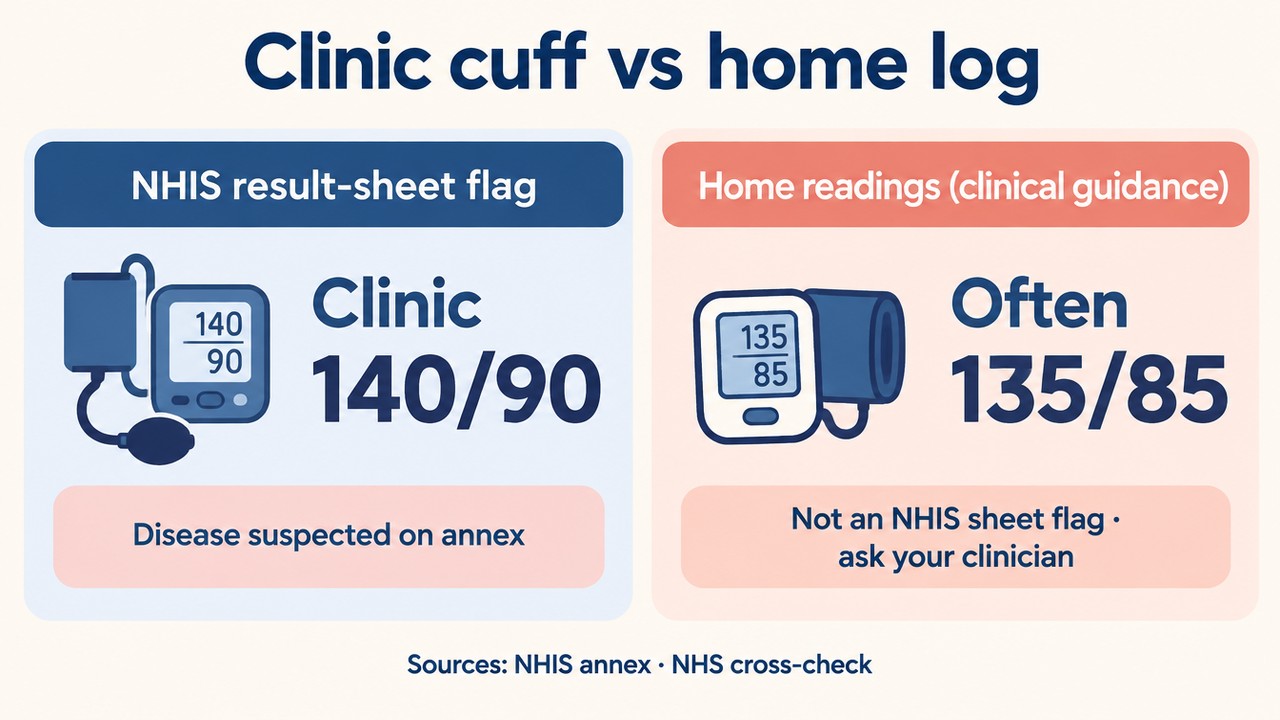
Home thresholds are not printed as NHIS result-sheet flags. Clinical guidance used in Korea (and mirrored on the KDCA portal’s hypertension page via the 2022 Korean Society of Hypertension classification) treats home averages differently from clinic averages. As an independent cross-check, the UK NHS states blood pressure is usually considered high at 140/90 or higher when checked by a healthcare professional, and 135/85 or higher when checked at home. Those NHS home numbers are not Korea NHIS annex rules; they illustrate why your clinician may ask for a home log even when your checkup printed 142/88.
KDCA’s monthly hypertension Q&A gives practical home-measurement habits (not NHIS flags): use a validated upper-arm automatic monitor; sit with back supported and feet on the floor; rest 1–2 minutes; avoid smoking, alcohol and caffeine for at least 30 minutes beforehand; measure in the morning within an hour of waking (after urinating, before breakfast and BP medicine) and again before bed; take two or more readings and use the average; record date, time and which arm. Bring several days of logs to the confirmatory visit if your clinician asks.

The confirmatory window after a hypertension flag
NHIS’s general checkup page states the confirmatory (확진검사) rules for hypertension as follows:
| Rule | Detail |
|---|---|
| Who | People whose general checkup result is disease-suspected for hypertension (also listed: diabetes, dyslipidemia, pulmonary TB, depression or early psychosis, hepatitis C) |
| Hypertension visit content | Examination (진찰) and blood-pressure measurement |
| Where | Clinic or hospital (의원·병원). Not a dental, Korean-medicine, long-term-care or psychiatric hospital for this pathway |
| Deadline | Until 31 March of the year after the checkup |
| Cost | First confirmatory visit: no out-of-pocket for the covered items. Extra tests or medicines beyond that covered visit can cost money |
| What to bring | Result notification sheet + ID |
Sources: NHIS general checkup page (확진검사; “검진 다음연도 3월 31일까지”); KDCA national checkup page (고혈압: 진찰 및 상담, 혈압 측정; first visit co-pay waived).
Example: If your 2026 checkup prints 148/92 as hypertension disease-suspected, the free confirmatory examination-and-measurement window runs through 31 March 2027. Miss that date and ordinary outpatient co-pays apply.
Older KDCA FAQ text on the same portal still mentions a 31 January line in one answer block; the live NHIS page says 31 March. This article follows NHIS. If your paper letter shows a printed deadline, obey the letter in your hand.
What happens at the confirmatory visit
For hypertension the covered items are a doctor’s examination and blood-pressure measurement, not a free package of every cardiovascular lab. The clinician reviews your result sheet, medicines, symptoms and risk factors, may repeat clinic readings, and may ask for a home log. Kidney numbers on the same checkup sheet (creatinine and eGFR) often travel with BP in that conversation — see our creatinine and eGFR guide.
KDCA notes that untreated high pressure can damage heart, brain, kidney and eye vessels, while most people have no early symptoms. MedlinePlus likewise lists heart attack, stroke, heart failure and kidney failure among long-term risks when pressure stays high. Neither source treats one screening number as a full diagnosis, and neither replaces urgent care for chest pain, sudden weakness, trouble speaking, severe headache with neurological signs, or readings in a crisis range with symptoms.

Frequently asked questions
Q. What blood pressure makes the Korean national checkup flag me?
Systolic 140 mmHg or higher, or diastolic 90 mmHg or higher, is the disease-suspected line on the official annex. 120–139 or 80–89 is borderline (normal B). Under 120 and under 80 is normal A.
Q. Is the follow-up after a hypertension flag completely free?
The first confirmatory visit — examination plus blood-pressure measurement — is covered with no out-of-pocket charge until 31 March of the following year, at a clinic or hospital on the NHIS list. Extra tests or prescriptions beyond that covered visit can generate ordinary co-pays.
Q. My checkup shows 135/85. Do I get the free visit?
Not from that clinic line alone. 135/85 sits in normal B (borderline) on the NHIS annex (120–139 or 80–89). The free confirmatory path needs the disease-suspected band (140+ or 90+). Borderline still deserves a conversation about lifestyle and, if your clinician asks, a home log. Do not confuse the NHS/home 135/85 clinical threshold with the Korean result-sheet flag.
Q. How often does the free checkup measure blood pressure?
Every time you take the general checkup. BP is a common item, not a sex- or age-limited add-on like lipids. Eligibility is usually every one or two years depending on your insurance track.
Q. Does a high reading on checkup day mean I already have hypertension?
No. It is a screening flag. Diagnosis needs a clinician’s judgment, often with repeat clinic readings and out-of-office measures. Seek urgent care for chest pain, sudden weakness, trouble speaking, or very high readings with severe symptoms — do not wait for a routine confirmatory slot.
Sources
- NHIS, General health checkup (일반건강검진) — common items (혈압측정), confirmatory rules for hypertension, deadline 31 March next year (checked 6 November 2026)
- Health Checkup Implementation Standards, Annex 4 / Annex 4 appendix PDF — BP normal A / B / disease-suspected lines (checked 6 November 2026)
- KDCA National Health Information Portal, 건강검진(국가건강검진) — hypertension confirmatory = examination and BP measurement; first visit co-pay waived (checked 6 November 2026)
- KDCA, Hypertension (고혈압) — clinical definition 140/90; white-coat and masked patterns; home/ambulatory role (checked 6 November 2026)
- KDCA, monthly hypertension Q&A — home measurement method (checked 6 November 2026)
- MedlinePlus / NHLBI, High Blood Pressure — diagnosis usually needs two or more readings; adult category table (cross-check only; checked 6 November 2026)
- NHS, Blood pressure test — clinic 140/90 vs home 135/85 (independent cross-check, not NHIS rules; checked 6 November 2026)
- Haesul, Blood pressure ranges by agency
- Haesul, Korea national health checkup by age (expats)
- Haesul, Korea health checkup Dec 31 deadline
- Haesul, Creatinine and eGFR on a Korean checkup
This article is general health information, not medical advice. It was written with AI assistance and fact-checked against the sources above. Only your doctor can interpret your results and decide on tests or treatment.




9 Comments