Metabolic Syndrome on Korea’s National Checkup: The 5 Criteria (Waist 90/85 cm, BP, Glucose, Triglycerides, HDL) and What to Do Before 31 December
Haesul Health desk (AI-assisted). As of 10 November 2026 (KST), based on the Korea Disease Control and Prevention Agency (KDCA) National Health Information Portal page on metabolic syndrome (updated 23 April 2026), the National Health Insurance Service (NHIS) general checkup page and its metabolic-syndrome notice, and the official checkup judgment table (Health Checkup Implementation Standards, Annex 4 appendix, on law.go.kr). Independent cross-check of the five criteria: Seodaemun-gu Public Health Center’s metabolic syndrome programme page. This is general information, not medical advice. Only your doctor can interpret your results.
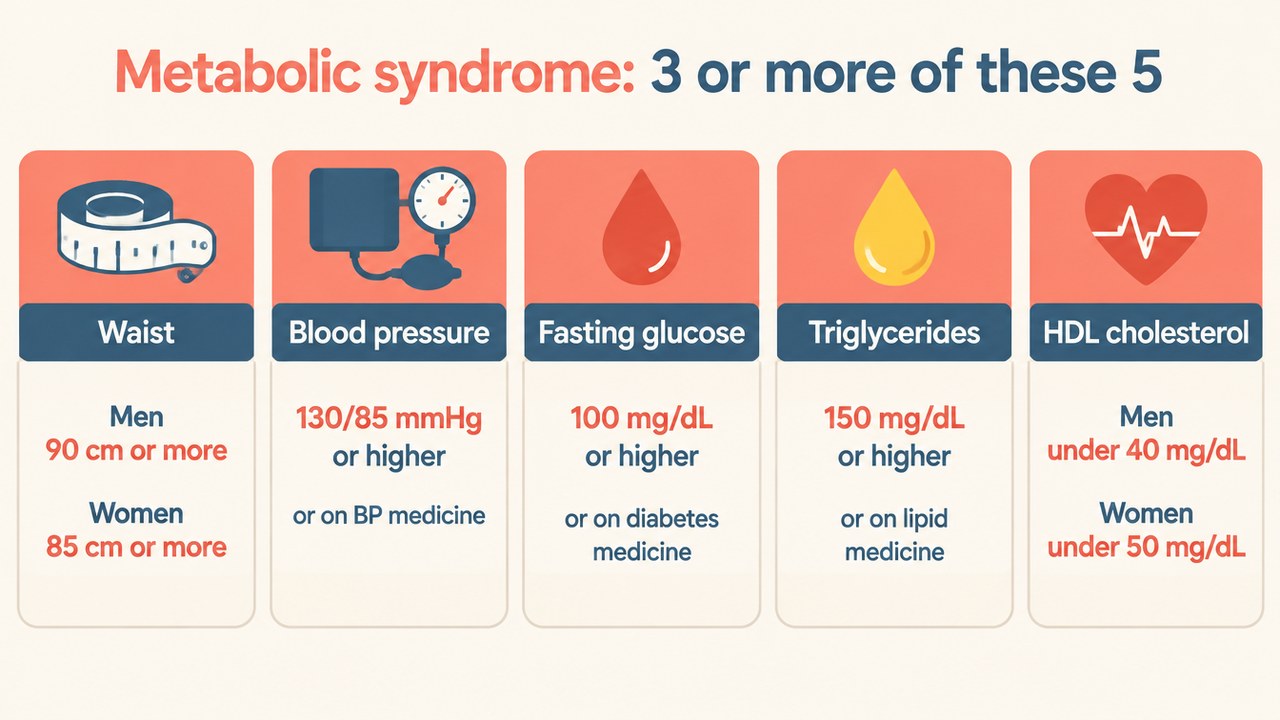
Quick answer: In Korea, metabolic syndrome (대사증후군) means having 3 or more of these 5: a waist of 90 cm or more for men or 85 cm or more for women; blood pressure of 130/85 mmHg or higher (or taking blood-pressure medicine); fasting glucose of 100 mg/dL or higher (or taking diabetes medicine); triglycerides of 150 mg/dL or higher; and HDL cholesterol under 40 mg/dL for men or under 50 for women. Most of these lines sit below the “disease suspected” lines on the national checkup result sheet. A sheet with no red flags can still add up to metabolic syndrome. The 2026 checkup window closes on Thursday 31 December 2026, 48 days from 13 November. If a flag sends you for a confirmatory visit, you have until 31 March 2027.
Many people in their 40s, 50s and 60s get their checkup result, see “normal B (borderline)” next to blood pressure, glucose and triglycerides, and put it in a drawer. No single number looks alarming. Metabolic syndrome is about how many of them cluster together. KDCA describes it as not one disease but a state in which several findings that raise the risk of diabetes, heart disease and stroke overlap. This guide shows how to count your own five numbers from a Korean result sheet, why your checkup may show only three of them this year, and what to do before the year ends.

The 5 criteria, side by side with your result sheet
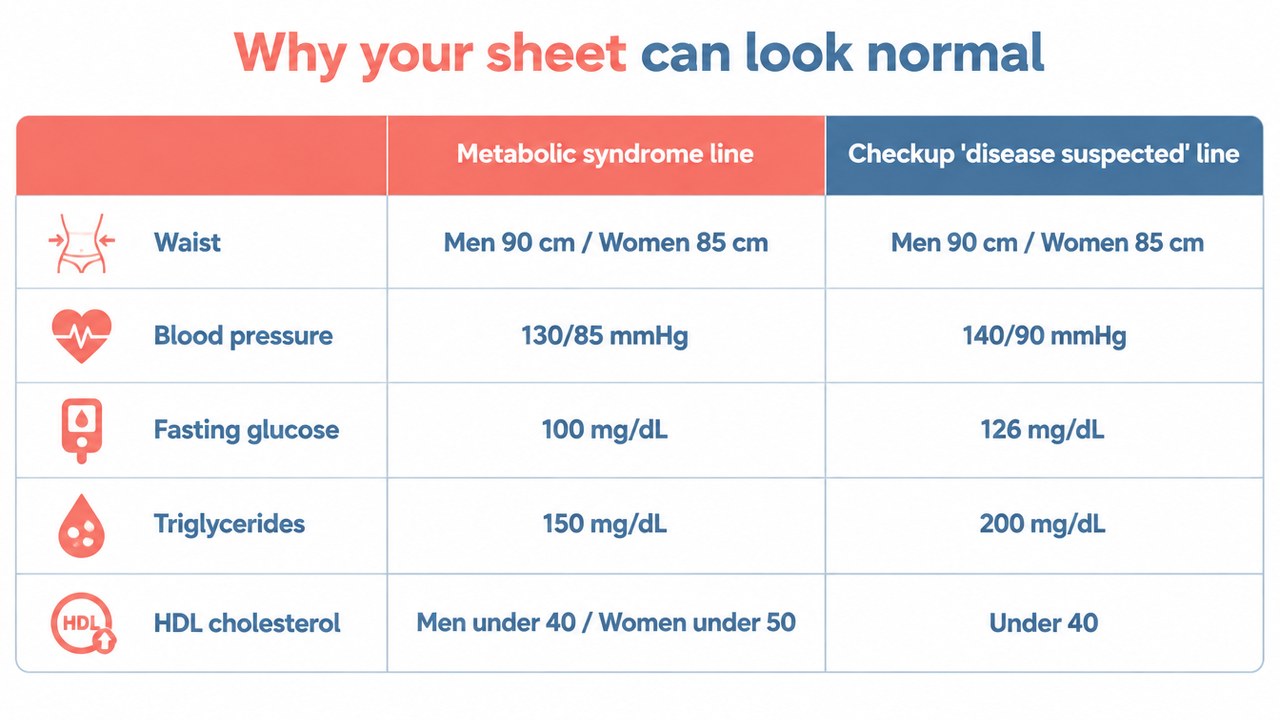
KDCA says metabolic syndrome is defined when three or more of five components are present. In Korea the US NCEP criteria are commonly used, with the waist line adjusted for Koreans. NHIS lists the same five numbers in its metabolic-syndrome notice. The national checkup, however, prints its own judgment lines, set by the official judgment table (Annex 4 appendix). Here they are together:
| Component | Metabolic-syndrome line | National checkup “disease suspected” line | Checkup “normal B (borderline)” band |
|---|---|---|---|
| Waist (허리둘레) | Men ≥ 90 cm, women ≥ 85 cm | Men ≥ 90 cm, women ≥ 85 cm (obesity row) | — |
| Blood pressure | ≥ 130/85 mmHg or on BP medicine | ≥ 140 or ≥ 90 mmHg | 120–139 or 80–89 |
| Fasting glucose | ≥ 100 mg/dL or on diabetes medicine | ≥ 126 mg/dL | 100–125 |
| Triglycerides (중성지방) | ≥ 150 mg/dL | ≥ 200 mg/dL | 150–199 |
| HDL cholesterol | Men < 40, women < 50 mg/dL | < 40 mg/dL (both sexes) | 40–59 |
Sources: NHIS metabolic syndrome notice (webzine, July 2024); KDCA metabolic syndrome page (definition, 3 of 5); Health Checkup Implementation Standards Annex 4 appendix (judgment lines). Cross-check: Seodaemun-gu Public Health Center (same five lines; adds “or on medicine” for BP, glucose and triglycerides).
Read the table from left to right and the problem is obvious. Only the waist line is the same on both. For blood pressure, glucose and triglycerides, the metabolic-syndrome line falls inside the checkup’s borderline band. For women, an HDL of 40–49 is “borderline” on the sheet but counts toward metabolic syndrome. So someone can have four of five components and see only one “disease suspected” box, or none if the waist is just under the line.
Which of the 5 numbers your 2026 checkup actually shows
The NHIS general checkup page lists the common items measured at every checkup: height, weight, waist, vision, hearing, blood pressure, chest X-ray, a blood panel including fasting glucose, urine and an oral exam. Triglycerides and HDL are not common items. They are part of the lipid panel, which NHIS runs only in certain years:
| Who | Lipid panel years (total cholesterol, HDL, triglycerides, LDL) |
|---|---|
| Men aged 24 and over | Every 4 years: 24, 28, 32 … 40, 44, 48, 52, 56, 60, 64 … |
| Women aged 40 and over | Every 4 years: 40, 44, 48, 52, 56, 60, 64 … |
Source: NHIS general checkup page (성·연령별 검사 항목).
So in a non-lipid year, your sheet shows only three of the five components. If two of those three are already over the metabolic-syndrome line, you cannot tell from the sheet whether you have it. That depends on triglycerides and HDL, which were not measured. In that case it is worth asking a clinic about a lipid test rather than waiting up to four years. Our LDL cholesterol checkup guide explains the lipid flags in detail.
Who is invited and how often depends on your insurance status. NHIS says the general checkup is every 2 years for most people (every year for non-office workers), for heads of regional households, employees, and household members and dependants aged 20 and over. The checkup period runs 1 January to 31 December.

Worked readings: three example result sheets
These are illustrative numbers, not real patients, counted against the five lines above.
Example 1: man, 52 (a lipid year). Waist 92 cm, BP 132/84, fasting glucose 104, triglycerides 180, HDL 42.
| Component | Value | Metabolic-syndrome line met? | Checkup judgment |
|---|---|---|---|
| Waist | 92 cm | Yes (≥ 90) | Disease suspected (obesity row) |
| Blood pressure | 132/84 | Yes (systolic ≥ 130) | Normal B |
| Fasting glucose | 104 | Yes (≥ 100) | Normal B |
| Triglycerides | 180 | Yes (≥ 150) | Normal B |
| HDL | 42 | No (men: under 40) | Normal B |
Count: 4 of 5. That meets the metabolic-syndrome definition. Yet none of the hypertension, diabetes or dyslipidemia boxes is “disease suspected”, so this sheet does not open the free confirmatory pathway described below. The useful step is to take the sheet to a family doctor and ask about it.
Example 2: woman, 51 (not a lipid year). Waist 84 cm, BP 128/86, fasting glucose 103. Triglycerides and HDL not measured (her last lipid panel was at 48).
- Waist 84: under 85, so no. BP 128/86: diastolic ≥ 85, so yes. Glucose 103: yes.
- Count: 2 of the 3 visible. Whether she has metabolic syndrome depends on triglycerides and HDL. A woman’s HDL under 50 or triglycerides of 150 or more would make it 3. Her next scheduled lipid panel is at 52, so asking a clinic about a lipid test now would answer the question sooner.
Example 3: man, 60 (a lipid year), already on blood-pressure medicine. Waist 88 cm, BP 124/78 on treatment, fasting glucose 98, triglycerides 160, HDL 38.
- Waist no (under 90). BP: yes, because taking BP medicine counts even when the reading is controlled. Glucose no. Triglycerides yes. HDL yes (under 40).
- Count: 3 of 5. That meets the definition. Here HDL 38 is also below the checkup’s “disease suspected” line of 40. That can trigger the dyslipidemia confirmatory visit, while his blood pressure is coded as an existing condition (유질환자).
For the blood-pressure and glucose lines in more detail, see our blood pressure 140/90 guide and our HbA1c and fasting glucose guide.
Why it matters: what KDCA says
- It is common. KDCA, citing the Korean Society of CardioMetabolic Syndrome’s 2024 fact sheet, says about 1 in 4 adults aged 19+ (24.9%) had metabolic syndrome in 2019–2021, and about half (47.0%) of those aged 65+. Abdominal obesity rose from 24.2% (2007–2009) to 33.2% (2019–2021), and high blood glucose from 23.7% to 32.2%.
- It raises the risk of other diseases. KDCA says it raises the risk of diabetes, high blood pressure, chronic kidney disease and heart and brain blood-vessel disease, and is linked to some cancers.
- It has no symptoms before complications appear. KDCA says that when one component is found, the others should be looked for actively.
- Age and menopause. Risk rises with age. KDCA notes that over 65 it is higher in women than in men, probably because of hormonal changes after menopause.
What to do before 31 December 2026
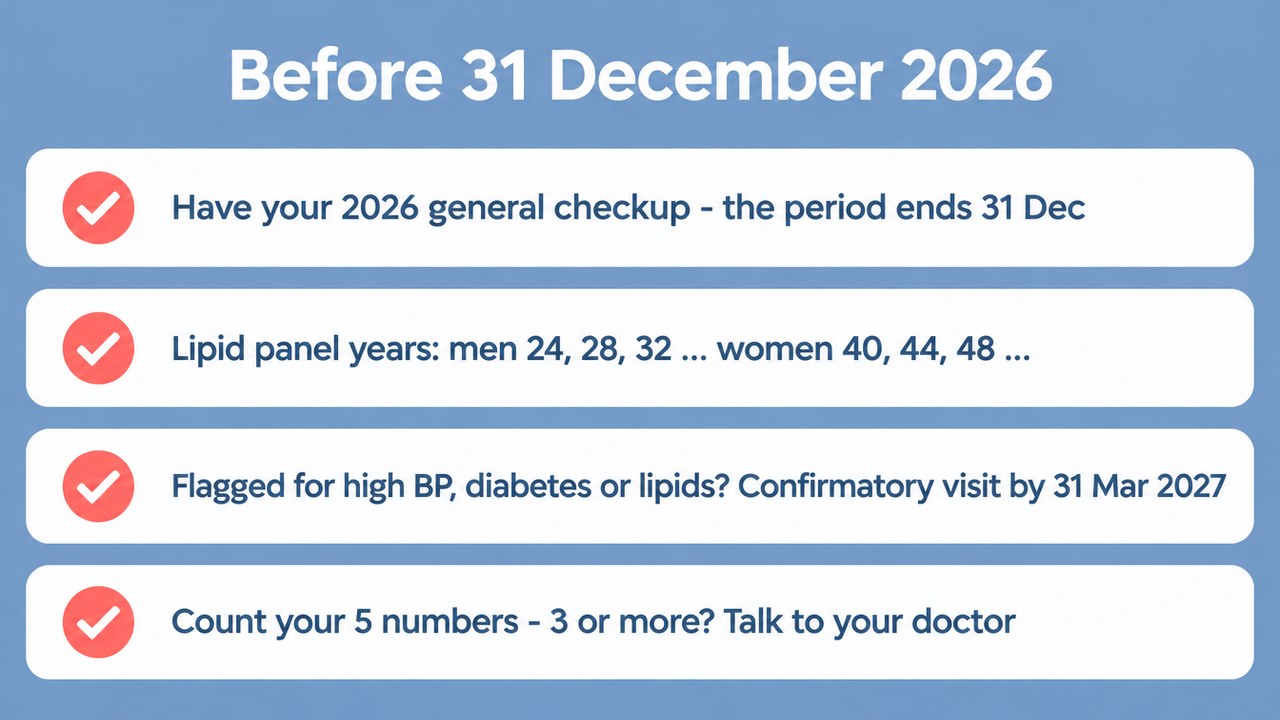
- Have your 2026 checkup if you haven’t. The general checkup period ends on 31 December. NHIS asks you to fast from 9 pm the night before (at least 8 hours if you go in the afternoon), because results can differ if you have eaten. If you missed last year’s checkup, NHIS says you can apply to be added to this year’s list.
- Count your five numbers using the table above, including any medicines you take for blood pressure, diabetes or lipids.
- If you have a “disease suspected” flag for hypertension, diabetes or dyslipidemia, NHIS covers a confirmatory visit at a clinic or hospital (의원·병원) until 31 March of the following year, so 31 March 2027 for a 2026 checkup. It covers an exam plus blood-pressure measurement for hypertension; an exam, fasting glucose and HbA1c for diabetes; and an exam for dyslipidemia. Bring the result sheet and ID. Other tests cost extra.
- If you have no flag but 3 or more components, as in Example 1, book an ordinary appointment with a family doctor and bring the sheet. A borderline sheet does not open the free confirmatory pathway.
- If it’s a non-lipid year and you are at 2 visible components, ask about a lipid test so you know your triglycerides and HDL.
- Use the free support. NHIS’s metabolic-syndrome notice (July 2024) describes a follow-up service for people with one or more risk factors: an explanatory leaflet, counselling with priority for BP ≥ 140/90 or glucose ≥ 126, and a 24-week self-management programme in The건강보험 app (건강프로그램 → 대사증후군 건강관리). Many district public health centres also run five-item metabolic checks with counselling. For example, Seodaemun-gu’s centre serves residents and local workers aged 20–69, by appointment, fasting from 10 pm the night before. Check your own district’s 보건소.

The lifestyle targets KDCA lists
KDCA’s page describes these general targets. Your doctor will tailor them, especially if you take medicine:
- Weight: losing 3–5% of body weight starts to reduce insulin resistance and cardiovascular risk. For people with obesity, the first goal is 5–10% within 6 months.
- Eating: eating about 500 kcal a day less than you need can mean losing roughly 0.5–1 kg a week. KDCA advises cutting saturated fat to under 7% of calories, cutting refined carbohydrates and sugar, and choosing whole grains. It also mentions the DASH eating pattern.
- Activity: 2.5–5 hours a week of moderate exercise, such as brisk walking or cycling, or 1–1.5 hours of vigorous exercise, spread through the week and at least 10 minutes at a time.
- Smoking, alcohol, sleep and stress: stop smoking, avoid heavy drinking, sleep around 7 hours, and manage chronic stress, which KDCA links to roughly double the risk.
Frequently asked questions
Q. What are the metabolic syndrome criteria in Korea?
Three or more of five: waist 90 cm or more for men or 85 cm or more for women; blood pressure 130/85 mmHg or higher or on BP medicine; fasting glucose 100 mg/dL or higher or on diabetes medicine; triglycerides 150 mg/dL or higher; HDL cholesterol under 40 mg/dL for men or under 50 for women.
Q. Does the national health checkup diagnose metabolic syndrome?
The result sheet judges each item against its own lines, which for blood pressure, glucose and triglycerides are higher than the metabolic-syndrome lines. You count the five components yourself, or a doctor does. A borderline-only sheet can still add up to metabolic syndrome.
Q. Why are triglycerides and HDL missing from my result?
The lipid panel is not a yearly common item. NHIS runs it every 4 years for men from 24 and women from 40 (ages 40, 44, 48, 52 and so on). In other years your sheet shows only waist, blood pressure and fasting glucose.
Q. What waist size counts as abdominal obesity in Korea?
90 cm (about 35 inches) or more for men and 85 cm (about 33 inches) or more for women. The national checkup uses the same line in its obesity row, and NHIS and public health centres use it for metabolic syndrome.
Q. What is the deadline for the 2026 checkup and the follow-up test?
The 2026 general checkup must be done by 31 December 2026. If the result is “disease suspected” for hypertension, diabetes or dyslipidemia, the covered confirmatory visit at a clinic or hospital runs until 31 March 2027.
Sources
- Korea Disease Control and Prevention Agency, National Health Information Portal, “대사증후군” (updated 23 April 2026): definition (3 of 5 components), Korean use of NCEP criteria with a Korean waist line, prevalence 24.9% / 47.0% (2019–2021, citing the KSCMS Metabolic Syndrome Fact Sheet 2024), trends, risks, no symptoms, lifestyle targets — https://health.kdca.go.kr/healthinfo/biz/health/gnrlzHealthInfo/gnrlzHealthInfo/gnrlzHealthInfoView.do?cntnts_sn=6781 (confirmed 10 November 2026)
- National Health Insurance Service webzine (July 2024), “검진결과 사후관리 사업 (대사증후군)”: the five numeric criteria, the follow-up service for 1+ risk factors, counselling priority, 24-week app programme — https://www.nhis.or.kr/static/alim/paper/oldpaper/202407/sub/section4_7.html (confirmed 10 November 2026)
- National Health Insurance Service, 일반건강검진 (general checkup): common items incl. waist, BP, fasting glucose; lipid panel every 4 years for men 24+ and women 40+; confirmatory tests until 31 March of the following year; checkup period 1 Jan–31 Dec; fasting instructions — https://www.nhis.or.kr/nhis/healthin/wbhaca04500m01.do (confirmed 10 November 2026)
- Health Checkup Implementation Standards, Annex 4 appendix (검사항목별 판정기준), law.go.kr file dated 14 January 2026: BP 120/80 · 140/90; waist 90/85; fasting glucose 100/126; triglycerides 150/200; HDL 60/40 — https://www.law.go.kr/LSW/flDownload.do?flSeq=160922523 (confirmed 10 November 2026 from a copy downloaded on 8 November 2026)
- Independent: Seodaemun-gu Public Health Center, 대사증후군사업 (same five lines with “or on medicine” for BP, glucose and triglycerides; 20–69 programme, fasting from 10 pm) — https://sdm.go.kr/health/contents/improve/metabolicSyndrome (confirmed 10 November 2026)
This article is general health information, not medical advice. It does not diagnose metabolic syndrome or any disease. Talk to your doctor about your own results, medicines and targets, especially before changing diet or exercise if you have heart, kidney or other conditions.




2 Comments