Hypothermia and Frostbite in Korea’s Winter: What KDCA’s Cold-Illness Data Say About Parents Over 65, and What Families Can Do Before 1 December
Haesul Health desk (AI-assisted). As of 11 November 2026 (KST). Based on the Korea Disease Control and Prevention Agency (KDCA) cold-related illness emergency-room surveillance page, KDCA press releases of 1 December 2025, 13 February 2026 and 10 March 2026, KDCA’s National Health Information Portal and its climate-health hazard pages, and the Ministry of Health and Welfare (MOHW) 2026–27 winter protection plan of 10 November 2026. Independent cross-checks: the US Centers for Disease Control and Prevention (CDC), Newsis, Yonhap News, Bosa (Medical Daily) and Hankyoreh. This is general information, not medical advice.
Quick answer: In Korea’s last winter (1 December 2025 to 28 February 2026), emergency rooms reported 364 people with cold-related illness (한랭질환) and 14 estimated deaths, up from 334 and 8 the winter before (KDCA). 57.4% of patients were 65 or older, and 11 of the 14 deaths (78.6%) were in that age group. Almost 4 in 5 cases were hypothermia (79.7%). Most happened outdoors (75.0%): by the roadside, near home and, for 17.0%, at home. Cases peaked between 6 and 9 a.m. Five of the 14 people who died had dementia or another cognitive impairment. KDCA’s surveillance for the new season normally runs from 1 December to the end of February in about 500 emergency rooms, with daily figures on its website. If an older parent lives alone, walks out early, drinks, or has memory problems, now is the time to plan.
Most of us think of hypothermia as something that happens to hikers or people lost in the snow. Korea’s own data tell a different story. The typical case in the KDCA surveillance is an older person, often over 80, found by a road or near their own home on an ordinary winter morning. Some are inside their own homes. This guide explains what cold-related illness means in Korea’s official definition, what last winter’s numbers show by age, place and time, the warning signs, the first aid KDCA recommends, and a practical checklist for families of a parent aged 65 or more, including a parent living with dementia.
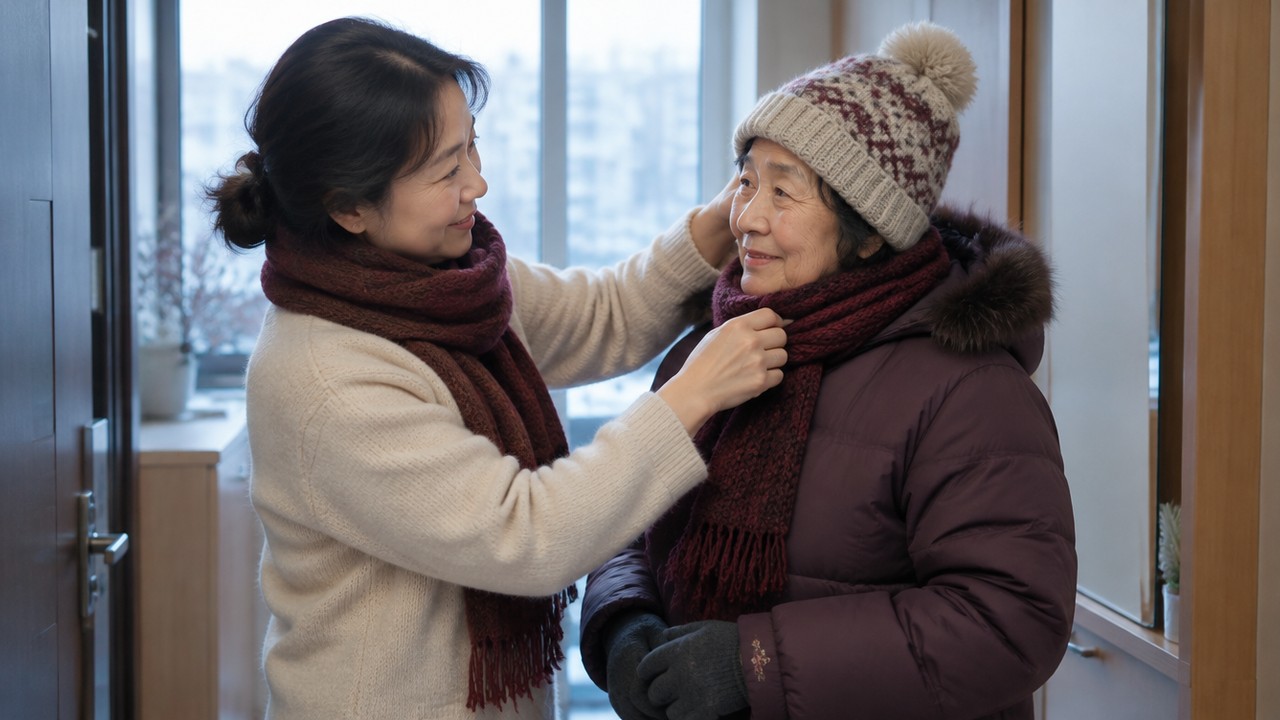
What “cold-related illness” (한랭질환) means
KDCA defines cold-related illness as illness directly caused by cold that can harm the body. It splits it into two groups (KDCA Health Hazard Information System):
- Whole-body (systemic): hypothermia (저체온증). The body cannot hold its normal temperature and the core temperature drops below 35°C. Core means the temperature inside the body, usually measured in the oesophagus or rectum. KDCA notes that armpit or mouth readings are less accurate.
- Local: frostbite (동상), chilblains (동창), and immersion hand or foot (침수병·침족병). Frostbite is tissue that freezes. Chilblains are inflamed small blood vessels after exposure to cold that is above freezing. Immersion injury comes from hands or feet staying in cold water (10°C or below) or in wet, cold shoes for a long time.
KDCA’s National Health Information Portal grades hypothermia by core temperature: 32–35°C mild, 28–32°C moderate, below 28°C severe (KDCA, 저체온증). The CDC uses the same threshold in Fahrenheit: if a person’s temperature is below 95°F (35°C), get medical attention immediately (CDC, Preventing Frostbite).
Why older people? KDCA explains that in older adults the autonomic nervous system and blood-vessel defences weaken. Their bodies are slower to narrow surface blood vessels and shiver to keep heat in. So cold that a younger adult would tolerate can tip an older person into hypothermia. KDCA also lists thyroid and adrenal underactivity, low blood sugar, sleeping pills and alcohol as factors that make hypothermia more likely.
How KDCA tracks it: the emergency-room surveillance from 1 December
Every winter since 2013, KDCA has run the cold-related illness emergency-room surveillance system (한랭질환 응급실감시체계). Here is how it works, according to KDCA’s own description (KDCA surveillance overview):
- Who reports: emergency departments that volunteer, about 500 across the country (512 on 1 December 2025).
- When: December to February. The 10 March 2026 release states the period as “1 December to the last day of February each year”.
- What is reported: people with cold-related illness caused by a cold wave, and estimated deaths from it.
- How: hospital → local public health centre → province or city → KDCA. Hospitals report by 10 a.m. the next day.
- Where to see it: KDCA posts the running totals on its website by 4 p.m. every day (kdca.go.kr → 정책정보 → 기후변화 → 한파/한랭질환 → 신고현황).
What’s confirmed for 2026–27, and what isn’t yet: on 10 November 2026, MOHW’s 2026–27 winter protection plan, approved at the Cabinet meeting, said the government will run the cold-illness monitoring system centred on about 500 emergency rooms this winter (Korea.kr, 10 November 2026; also reported by Bosa and Yonhap). As of 11 November, KDCA had not yet published its 2026–27 launch release. Last year’s came out on 1 December 2025. Going by KDCA’s standing rule, the new season would run from Tuesday 1 December 2026 (18 days from 13 November) to Sunday 28 February 2027. Those day counts are our calculation. Check KDCA for the official start.
Last winter in numbers (KDCA, 2025–26 season)
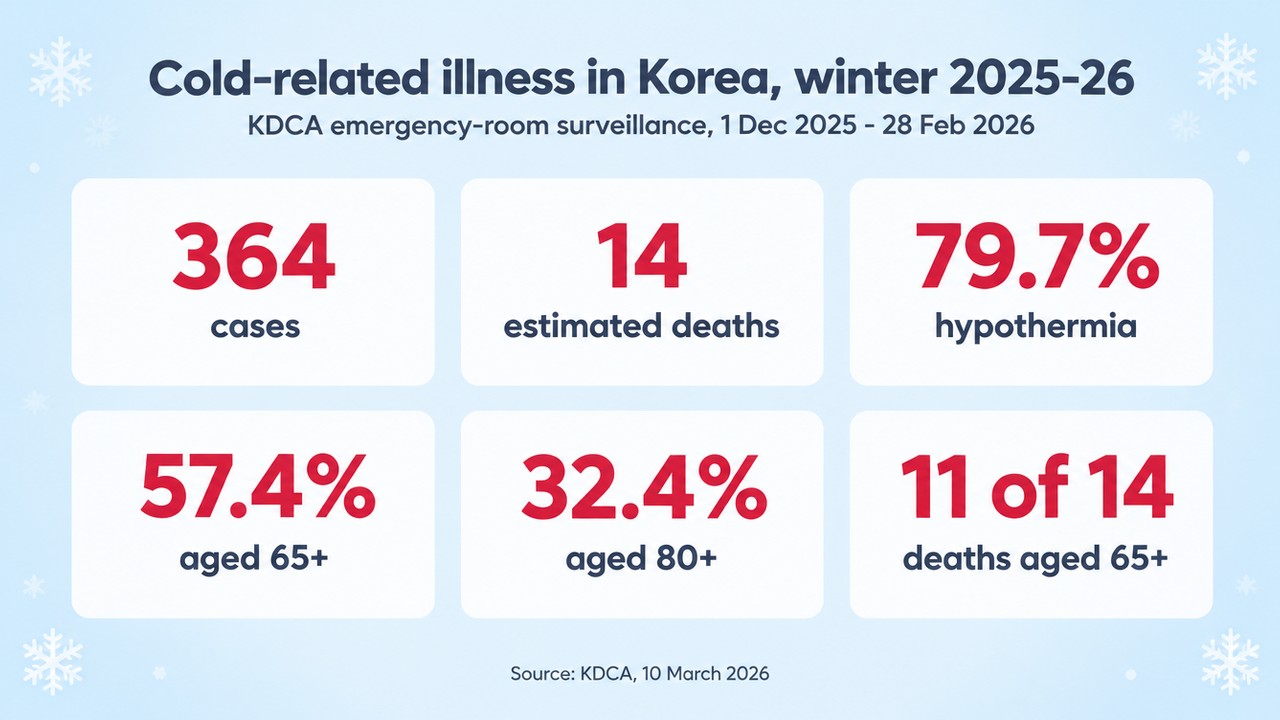
KDCA’s season summary of 10 March 2026 is the most complete official count (KDCA press release, 10 March 2026). Newsis reported the same headline numbers that day (Newsis).
- 364 patients, 14 estimated deaths, against 334 and 8 in 2024–25: 1.09 times as many patients and 1.75 times as many deaths.
- Hypothermia was the main condition in 79.7% (290 people), and all 14 estimated deaths were attributed to hypothermia.
- Men 64.6% (235), women 35.4% (129).
- 65 and over: 57.4% (209 people), and 11 of the 14 deaths (78.6%).
- 80 and over: 32.4% (118 people), and 8 of the 14 deaths (57.1%).
- 5 of the 14 people who died (35.7%) had dementia or another cognitive impairment.
The surprising part is the weather. MOHW says last winter’s national average temperature was 1.1°C, warmer than the normal 0.5°C, yet cases and deaths still rose. KDCA’s release adds that cold-wave days rose by 0.9 (4.3 to 5.2), while the average daily low was 0.3°C higher (−4.4°C to −4.1°C, Korea Meteorological Administration data). A mild winter on average does not protect a frail parent on the few bitter mornings.
Table 1. Cold-related illness by age group, 2025–26 season (1 Dec 2025 – 28 Feb 2026)
| Age group | Patients | Share of 364 (calculated, except 80+) |
|---|---|---|
| Under 40 | 62 | 17.0% |
| 40–49 | 26 | 7.1% |
| 50–59 | 39 | 10.7% |
| 60–69 | 68 | 18.7% |
| 70–79 | 51 | 14.0% |
| 80 and over | 118 | 32.4% (KDCA) |
| 65 and over (overlaps the rows above) | 209 | 57.4% (KDCA) |
| Total | 364 | 100% |
Source: KDCA 10 March 2026 release, annex table by age. The under-40 row adds KDCA’s 0–9 (2), 10–19 (23), 20–29 (21) and 30–39 (16) rows. Shares other than the 80+ and 65+ rows are our calculation from KDCA’s counts and are rounded.
The single largest group is people aged 80 and over. That one group had nearly as many patients as everyone aged 40 to 69 put together (118 against 133), and it accounted for more than half of the deaths (8 of 14).
Table 2. Five winters at a glance
| Season | Patients | Estimated deaths | Aged 65+ | 65+ share (calculated) |
|---|---|---|---|---|
| 2021–22 | 300 | 9 | 141 | 47.0% |
| 2022–23 | 447 | 12 | 189 | 42.3% |
| 2023–24 | 400 | 12 | 206 | 51.5% |
| 2024–25 | 334 | 8 | 183 | 54.8% |
| 2025–26 | 364 | 14 | 209 | 57.4% |
Source: KDCA 10 March 2026 release, “최근 5년간 운영결과” annex. The 65+ share is our calculation, except 2025–26 (KDCA).
Total cases go up and down with the weather, but the share of older patients has risen in each of the last three winters, from 42.3% to 57.4%. The 2025–26 death count (14) was the highest of the five winters shown.
Where and when it happens: the morning walk and the doorstep
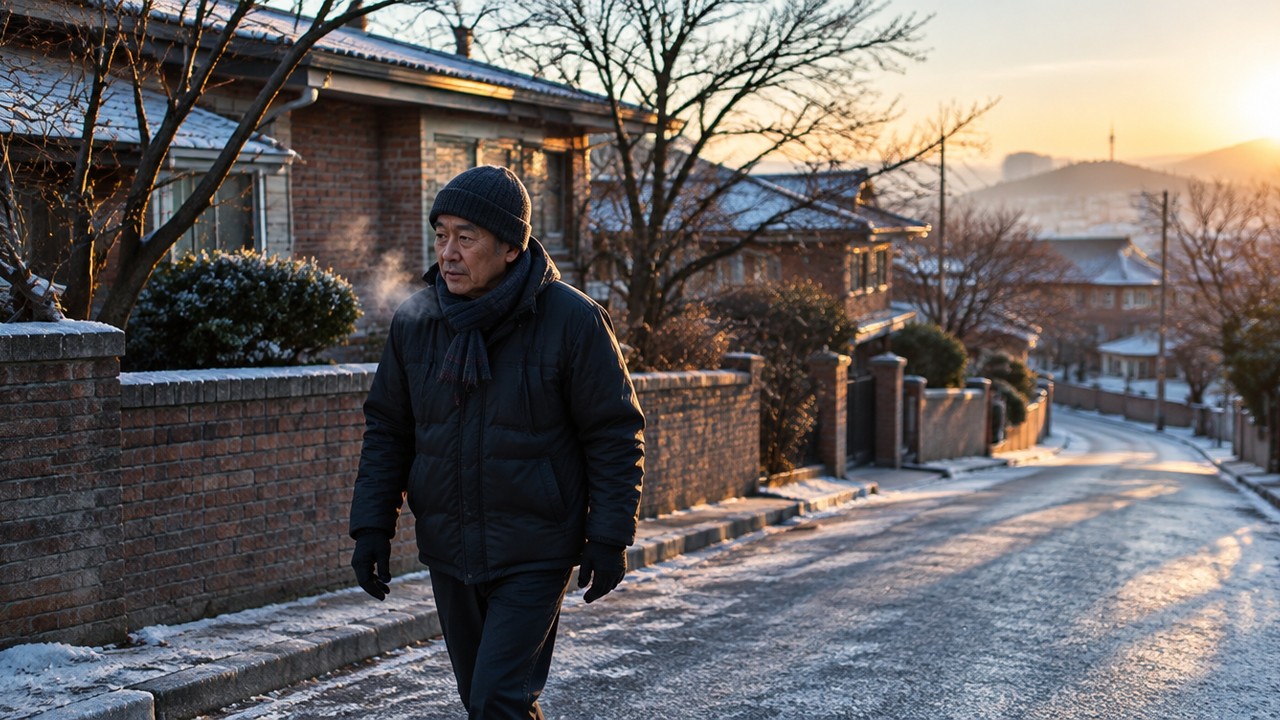
KDCA’s location data are the most useful part for families (KDCA, 10 March 2026):
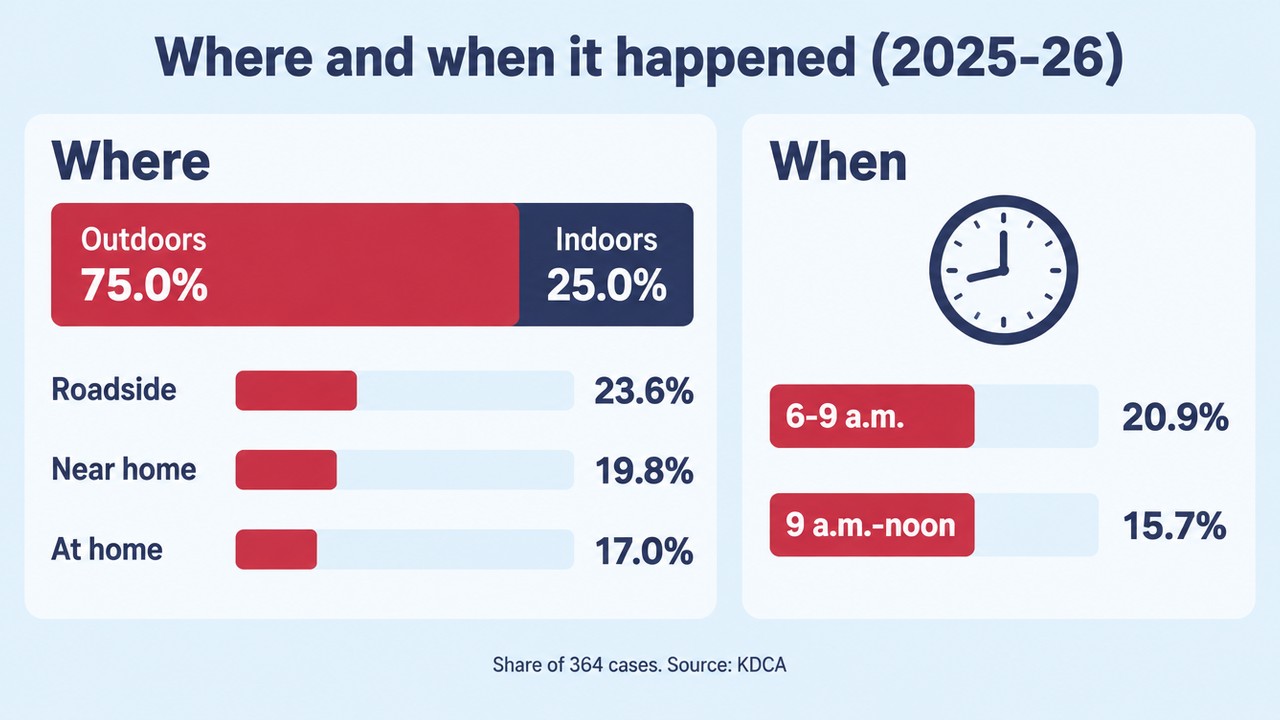
- Outdoors 75.0% (273), indoors 25.0% (91).
- The top three places were the roadside 23.6% (86), around the home 19.8% (72) and inside the home 17.0% (62). Mountains (33) and riversides or beaches (38) came well behind.
- Among people aged 65 and over (209), the top places were around the home 27.3% (57), the roadside 24.4% (51) and at home 22.0% (46). Together that is 73.7% (our calculation): roughly 3 in 4 older patients fell ill on ordinary streets or in and around their homes, not on a mountain.
- Time of day: the peak was 6–9 a.m. (20.9%, 76 people), then 9 a.m.–noon (15.7%, 57). Together that is 36.5% of cases before noon (our calculation; Newsis rounds it to 36.6%). KDCA links this to air that has cooled overnight and advises care with morning activity.
By region, Gyeonggi had the most patients (71, 19.5%). Per 100,000 people, Gangwon was highest (2.1), then Gyeongbuk (1.7) and Chungbuk (1.5).
KDCA’s 13 February 2026 release, which covered the season up to 11 February, added two more risk signals (KDCA/Gov24, 13 February 2026). 17.0% of patients by then had dementia recorded as a coexisting condition. And in the season before (2024–25), 21.3% of patients had been drinking. KDCA explains that alcohol briefly makes you feel warmer, but you then lose heat through the skin, and being drunk stops you noticing that you are getting cold.
Why dementia changes the risk
Dementia came up in every KDCA release this year for a reason. A person with cognitive impairment may not feel or say that they are cold. They may go out in house clothes, lose their way back, or sit somewhere cold without realising the danger. KDCA’s commissioner said in March that because deaths were concentrated among older people with cognitive impairment, “carers’ attention and effort to keep older people from being exposed to cold waves is very important”.
The 2026–27 government plan names this group directly. MOHW says that older people with dementia, who face a high risk of cold-related illness, will get ID tags (인식표) to prevent going missing and access to the wandering-detection service in the 치매체크 (Dementia Check) app. Users of dementia relief centres (치매안심센터) will also get guidance on what to do in a cold wave (Korea.kr; Bosa). If your parent took the cognitive screening on the national checkup, our guide to Korea’s checkup cognitive test from 66 explains the KDSQ-C score and the next steps to a dementia relief centre.
Warning signs: hypothermia and frostbite
Hypothermia (KDCA): it starts with strong shivering, especially in the arms and legs. As the temperature falls further, shivering stops. Movement becomes slow and clumsy, memory and judgement slip, and speech becomes slurred. Without help the person becomes drowsy and can lose consciousness. KDCA adds that people with hypothermia may show unexplained mood changes and irritability, struggle to make decisions, and complain of tiredness. The CDC lists the same adult signs: shivering, exhaustion, confusion, fumbling hands, memory loss, slurred speech and drowsiness. It also notes that hypothermia can happen in cool weather above 40°F (about 4°C) if someone is wet from rain, sweat or cold water.
A practical point for families: shivering stopping is not a sign of recovery. KDCA describes shivering fading as the temperature drops further, and notes that below a core temperature of 30°C the shivering defence no longer works.
Frostbite (KDCA and CDC): it usually affects the nose, ears, cheeks, chin, fingers and toes. KDCA describes red skin with pain or tingling at first, then numbness, blisters and swelling, and in the worst cases amputation. The CDC adds that the skin may look white or greyish-yellow and feel unusually firm or waxy. Because the area goes numb, the person often does not notice until someone else points it out.
First aid KDCA recommends (until help arrives)
For suspected hypothermia (KDCA Health Hazard Information System):
- If body temperature is below 35°C or the person loses consciousness, call 119 straight away.
- Move them somewhere warm as quickly as possible.
- Take off wet clothes and wrap them in blankets.
- Only if they are fully conscious, give a warm drink (not alcohol) and something sweet such as chocolate. Never give drinks to someone who is not fully awake, because of the risk of choking.
- Keep talking so they stay awake until the ambulance comes.
- If they have no pulse or don’t seem to be breathing, start CPR until 119 arrives.
KDCA’s portal adds detail: warm the centre of the body (armpits, chest and belly) with a hot pack or hot-water bottle wrapped in a towel so it doesn’t burn the skin. Warming the arms and legs first can make the core temperature drop further. Handle the person gently, because rough movement can trigger dangerous heart rhythms.
For suspected frostbite (KDCA; CDC):
- Getting to a medical facility quickly matters most.
- If treatment isn’t available right away, move indoors and soak the area in warm water at 37–39°C for 20–40 minutes. The water should feel comfortable on skin that isn’t frostbitten. Don’t do this if the area could freeze again.
- Put dry sterile gauze between frostbitten fingers or toes and raise the area a little.
- Don’t walk on frostbitten feet, rub the area or rub it with snow, warm it with hot water, heating pads, lamps or radiators (numb skin burns easily), burst blisters, or drink alcohol or caffeine or smoke.
A checklist for families of a parent aged 65 or over
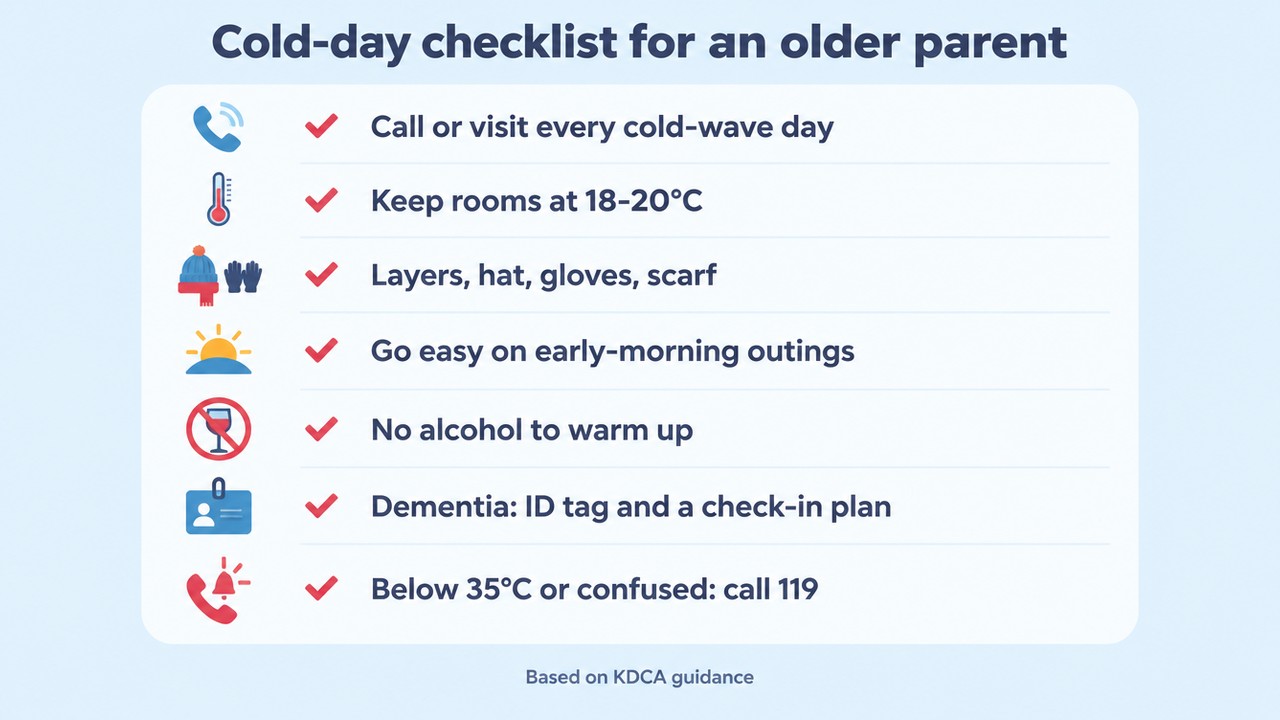
This list comes from the KDCA guidance and the MOHW plan cited above. Use it to plan with your parent and their doctor, not as a substitute for medical advice.
Before December
- Talk about mornings. Last winter’s cases peaked at 6–9 a.m. KDCA warns that strenuous early-morning activity in winter can raise blood pressure and worsen heart and brain blood-vessel disease. Agree on later, shorter walks on cold-wave days.
- Check the home. 17.0% of cases happened at home. KDCA’s winter respiratory guidance suggests keeping rooms at 18–20°C with 40–60% humidity. If heating bills are the reason a parent keeps the boiler low, see whether they can still apply for the energy voucher. Our guide to applying for Korea’s energy voucher by 31 December 2026 explains who qualifies.
- Clothing ready by the door: a hat, gloves or mittens, a scarf, a water-resistant coat and boots, and loose layers. That is the CDC’s list; KDCA likewise asks people to wear warm winter clothing and keep their body warm.
- Review medicines and conditions with the doctor. KDCA names sleeping pills, thyroid or adrenal underactivity and low blood sugar as hypothermia risk factors. Its winter guidance also notes that blood vessels narrow and blood pressure rises in winter, and heart attacks and strokes become more common. Our guide to what 140/90 means on Korea’s checkup covers home blood-pressure readings.
- If your parent has dementia: ask the local dementia relief centre (치매안심센터) about the ID tag and the 치매체크 app’s wandering alert. Keep a recent photo and agree who checks in on them each day.
On cold-wave days
- Call or visit every day. The government’s own plan steps up daily phone or home checks on high-risk older people when a cold-wave warning is issued. Families can do the same.
- No alcohol “to warm up”. 21.3% of 2024–25 patients had been drinking.
- Know the nearest cold-shelter (한파쉼터). The government plans about 64,000 of them this winter. During a cold-wave warning, at least one per town or neighbourhood (읍면동) stays open until 10 p.m. (Korea.kr; Yonhap).
- Watch for the signs: slurred speech, confusion, clumsiness, unusual irritability, or shivering that suddenly stops. Below 35°C or not fully conscious: call 119.
If you live far away
- Ask whether your parent is enrolled in local welfare check-ins or the emergency safety service for people living alone, which uses fire detectors and emergency call buttons (about 278,000 households are covered this winter, MOHW). The welfare consultation line is 129.
Worked example (illustrative)
Illustrative only, built from the patterns in KDCA’s data. Not a real case.
Mrs Park is 81 and lives alone in a low-rise villa in Gyeonggi. She has early memory problems and usually walks to the corner shop at 7 a.m. Here is how her daughter’s plan maps onto the KDCA findings:
| Risk in KDCA data | Mrs Park’s situation | What the family agreed |
|---|---|---|
| 80+ = 32.4% of cases, 57.1% of deaths | Age 81 | Daily phone check from 1 December |
| Peak time 6–9 a.m. (20.9%) | 7 a.m. walk | Shop run moved to late morning; groceries delivered on cold-wave days |
| Roadside / around the home = 65+ top places | Walks alone on an icy lane | Hat, gloves, scarf, non-slip boots by the door |
| Dementia in 5 of 14 deaths | Early memory loss | Asked the 치매안심센터 about an ID tag and the 치매체크 app |
| At home = 17.0% of cases | Keeps the boiler low to save money | Checked energy voucher eligibility before 31 December |
What this article does not cover
KDCA’s surveillance counts only people seen in participating emergency rooms. KDCA’s regional reports call it sample surveillance, not a full count. The figures are provisional and may differ from Statistics Korea’s cause-of-death data. Falls on ice, heart attacks and strokes in cold weather are separate problems and are not counted as cold-related illness. The new government support for treatment costs after falls on ice for vulnerable older people (from Q1 2027, per MOHW) is outside the scope of this guide.
Related reading
- Korea’s checkup cognitive test from 66: what the KDSQ-C score means
- Korea’s energy voucher: how to apply by 31 December 2026
- Blood pressure on Korea’s national checkup: what 140/90 means
Frequently asked questions
Q. How many people got cold-related illness in Korea last winter?
KDCA’s emergency-room surveillance recorded 364 patients and 14 estimated deaths between 1 December 2025 and 28 February 2026, up from 334 patients and 8 deaths in 2024–25. Hypothermia made up 79.7% of cases, and 57.4% of patients were 65 or older.
Q. When does KDCA’s 2026–27 cold-illness surveillance start?
KDCA runs it every year from 1 December to the end of February, with daily figures posted on its website by 4 p.m. On 10 November 2026 the government confirmed that about 500 emergency rooms will take part this winter. KDCA’s own 2026–27 launch release had not been published as of 11 November 2026, so check kdca.go.kr in early December.
Q. What body temperature counts as hypothermia?
A core body temperature below 35°C (95°F), according to both KDCA and the CDC. KDCA grades 32–35°C as mild, 28–32°C as moderate and below 28°C as severe, and notes that armpit or mouth thermometers don’t measure core temperature accurately. If the temperature is below 35°C or the person is not fully conscious, call 119.
Q. Can older people get hypothermia indoors?
Yes. Last winter, 25.0% of cases happened indoors, and 17.0% inside the person’s own home. Among patients aged 65 and over, 22.0% fell ill at home. KDCA explains that older bodies are slower to conserve heat, so a cold room can be enough.
Q. Why is dementia such a big risk factor?
People with cognitive impairment may not notice or report the cold, may go out without warm clothes, or may get lost. In 2025–26, 5 of the 14 people who died (35.7%) had dementia or another cognitive impairment. The 2026–27 government plan offers ID tags and the 치매체크 app’s wandering alert for people with dementia.
Sources
- KDCA, 한랭질환 응급실감시체계 개요 (surveillance overview: ~500 ERs, Dec–Feb, reported by 10 a.m. next day, posted daily by 4 p.m.) — https://www.kdca.go.kr/kdca/3382/subview.do (checked 11 November 2026)
- KDCA, 2025-2026절기 겨울철 한랭질환자 364명, 전년대비 1.09배·사망자는 1.75배 발생 (press release, 10 March 2026, incl. 5-season annex) — https://www.kdca.go.kr/bbs/kdca/42/305792/download.do (checked 11 November 2026)
- KDCA, 설 연휴 대비 한랭질환 주의 당부 (press release, 13 February 2026; via Gov24) — https://www.gov.kr/portal/ntnadmNews/4645164 (checked 11 November 2026)
- KDCA, 겨울철 한파 대비 「한랭질환 응급실감시체계」 운영 시작 (press release, 1 December 2025) — https://www.kdca.go.kr/kdca/2847/subview.do?enc=Zm5jdDF8QEB8JTJGYmJzJTJGa2RjYSUyRjQxJTJGMjE1NDk2JTJGYXJ0Y2xWaWV3LmRvJTNG (checked 11 November 2026)
- KDCA Health Hazard Information System, 한파 / 한랭질환 (definitions, signs, first aid, older adults, winter FAQ) — https://health.kdca.go.kr/healthhazard/clmtInfo/heatWaveInfo (checked 11 November 2026)
- KDCA National Health Information Portal, 저체온증 (updated 22 July 2026) — https://health.kdca.go.kr/healthinfo/biz/health/gnrlzHealthInfo/gnrlzHealthInfo/gnrlzHealthInfoView.do?cntnts_sn=3690 (checked 11 November 2026)
- MOHW via Korea.kr, 겨울철 144만 가구에 에너지바우처 지급…위기가구 40만 명 발굴 (2026–27 winter protection plan, 10 November 2026) — https://www.korea.kr/news/policyNewsView.do?newsId=148975387 (checked 11 November 2026)
- Independent: CDC, Preventing Frostbite (incl. hypothermia signs, 95°F threshold, high-risk groups, first aid) — https://www.cdc.gov/winter-weather/prevention/preventing-frostbite.html (checked 11 November 2026)
- Independent: Newsis, 추웠던 지난 겨울…한랭질환 사망자 1년새 1.75배 증가 (10 March 2026) — https://www.newsis.com/view/NISX20260310_0003541639 (checked 11 November 2026)
- Independent: Bosa (Medical Daily), 정부, 올 겨울 한랭질환 감시 강화 (10 November 2026) — https://www.bosa.co.kr/news/articleView.html?idxno=3016064 (checked 11 November 2026)
- Independent: Yonhap News, 겨울철 위기가구 40만명 추가발굴…내년부터 우선 긴급지원 30만원 (10 November 2026) — https://www.yna.co.kr/view/AKR20261109149500530 (checked 11 November 2026)
- Independent: Hankyoreh, 내년부터 저소득 가구 긴급한 ‘생계 위기’ 땐 30만원 우선 지급 (November 2026; 334→364 cases, 8→14 deaths, 11 aged 65+) — https://www.hani.co.kr/arti/society/rights/1286608.html (checked 11 November 2026)
This article is general health information, not medical advice. It cannot diagnose hypothermia, frostbite or any other condition. If someone may have hypothermia, call 119. Talk to a doctor about your parent’s own health, medicines and winter plans.




4 Comments