Creatinine and eGFR on Your Korean Checkup Report: What the Kidney Numbers Mean, per KDCA and NIDDK
By the Haesul Global health desk (AI-assisted). Last checked: 2026-11-10 (KST); countdown updated 2026-11-13. The 2026 general checkup window closes in 48 days (December 31, 2026). Figures rechecked on NHIS (HTTP 200; blood tests include 혈청크레아티닌, e-GFR; period 1.1–12.31), KDCA chronic kidney disease (updated May 12, 2026; eGFR below 60 for three months or more), and NIDDK tests & diagnosis (GFR of 60 or more in the normal range; less than 60 may mean kidney disease). This is not medical advice.
Quick answer: Get the creatinine / eGFR row of your Korea checkup done by December 31, 2026 — 48 days left from November 13 (NHIS). Korea’s national health checkup includes serum creatinine and eGFR (NHIS, KDCA). Creatinine is a waste product from muscle that the kidneys filter out. eGFR is an estimate of kidney filtering calculated from creatinine. Both the US NIDDK and Korea’s KDCA treat an eGFR below 60 as the line where kidney disease becomes a concern. One result is not a diagnosis; ask your doctor what yours means.
If your checkup report (건강검진 결과통보서) shows “혈청크레아티닌” (serum creatinine) and “e-GFR” in the blood test section, here is how two official health sources explain them.
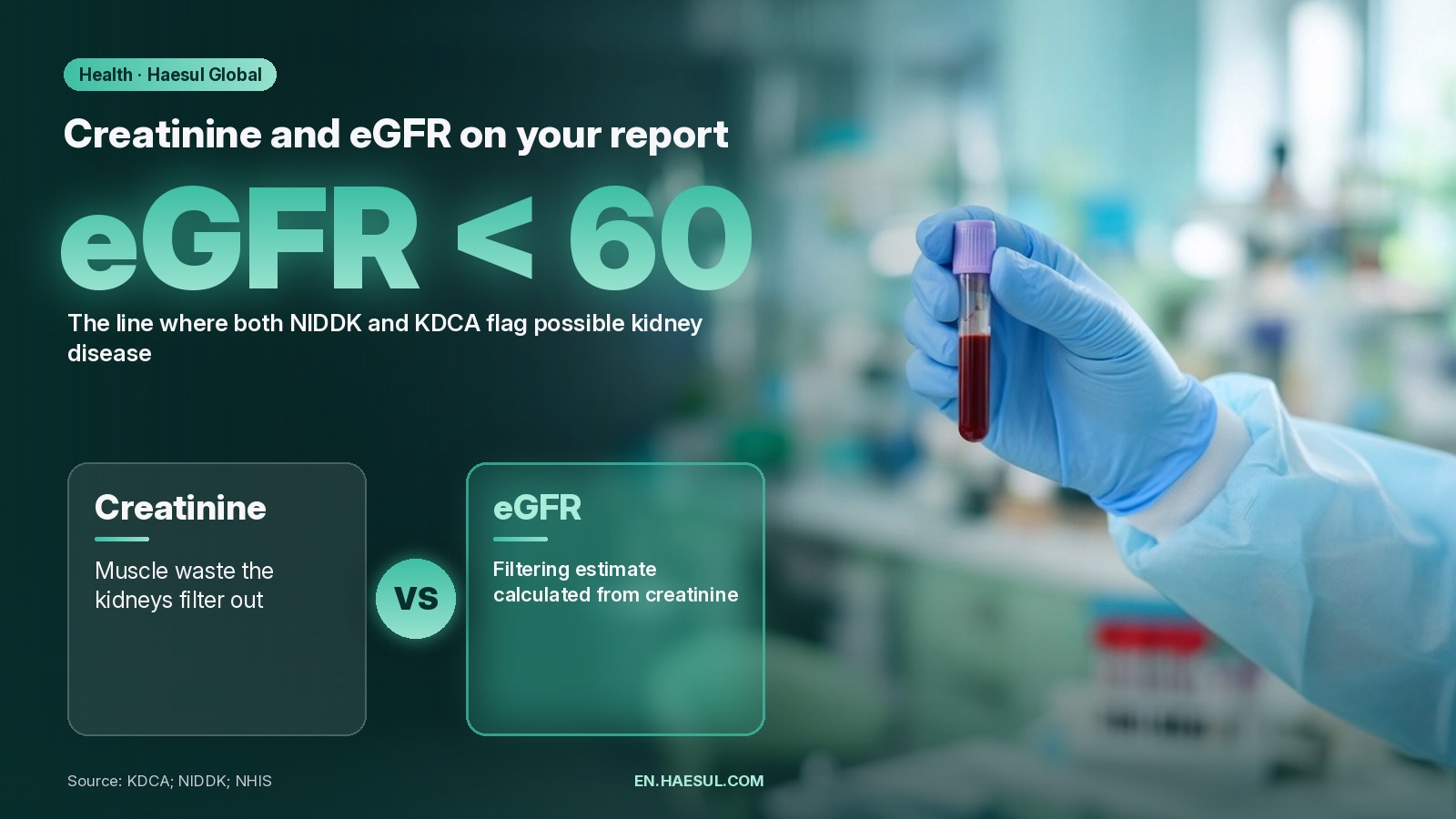
1) The two numbers at a glance
| Serum creatinine | eGFR (estimated glomerular filtration rate) | |
|---|---|---|
| What it is | A waste product from normal muscle breakdown, removed by the kidneys | An estimate of how much blood the kidneys filter, calculated from creatinine (plus age and sex) |
| Unit | mg/dL | mL/min/1.73 m² |
| Direction | Higher can mean the kidneys are clearing less | Lower means less filtering |
| Sources | KDCA; NIDDK; MedlinePlus | KDCA; NIDDK; MedlinePlus |
Sources: KDCA, chronic kidney disease, KDCA, clinical chemistry tests, NIDDK, MedlinePlus, creatinine, MedlinePlus, eGFR.
Creatinine reference range (according to KDCA): 0.7–1.4 mg/dL for adults. This range is from KDCA only. MedlinePlus says what counts as normal for you depends on your muscle mass, diet, age and activity, so compare your result with the range printed on your own report.
2) How the agencies read eGFR
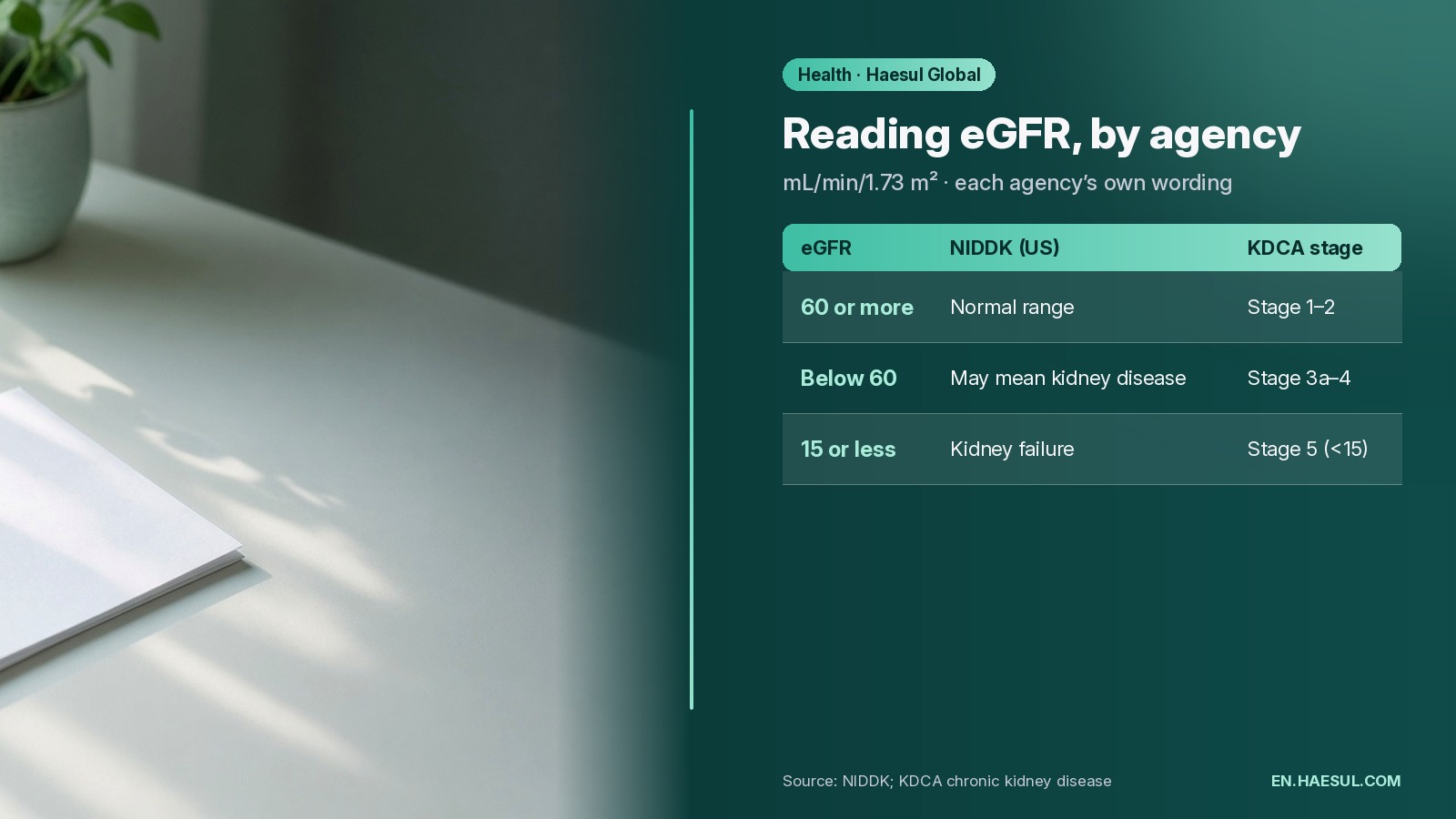
| eGFR (mL/min/1.73 m²) | NIDDK (US) | KDCA (Korea) stage |
|---|---|---|
| 90 or more | “60 or more is in the normal range” | Stage 1 (above 90) |
| 60–89 | (normal range) | Stage 2 |
| 45–59 / 30–44 | “Less than 60 may mean you have kidney disease” | Stage 3a / 3b |
| 15–29 | Stage 4 | |
| Below 15 | “15 or less is called kidney failure” | Stage 5 |
- The KDCA stages are according to KDCA (KDCA). The quoted wording is NIDDK’s (NIDDK). MedlinePlus uses similar bands. It says 60–90 “may mean early-stage kidney disease” and that how these general ranges apply to you is for your provider to explain (MedlinePlus).
- Time matters. According to KDCA, chronic kidney disease can be diagnosed when eGFR stays below 60 for three months or more. One low reading on its own doesn’t meet that definition.
- Age. KDCA says GFR normally falls gradually with age. MedlinePlus says eGFR varies with factors such as age and body size.
3) Why one number isn’t the whole story
- Muscle and diet move creatinine. People with more muscle can have higher creatinine (KDCA, MedlinePlus). MedlinePlus adds that dehydration, intense exercise, muscle injury or a diet high in meat can raise it without a kidney problem, and that muscle loss can lower it.
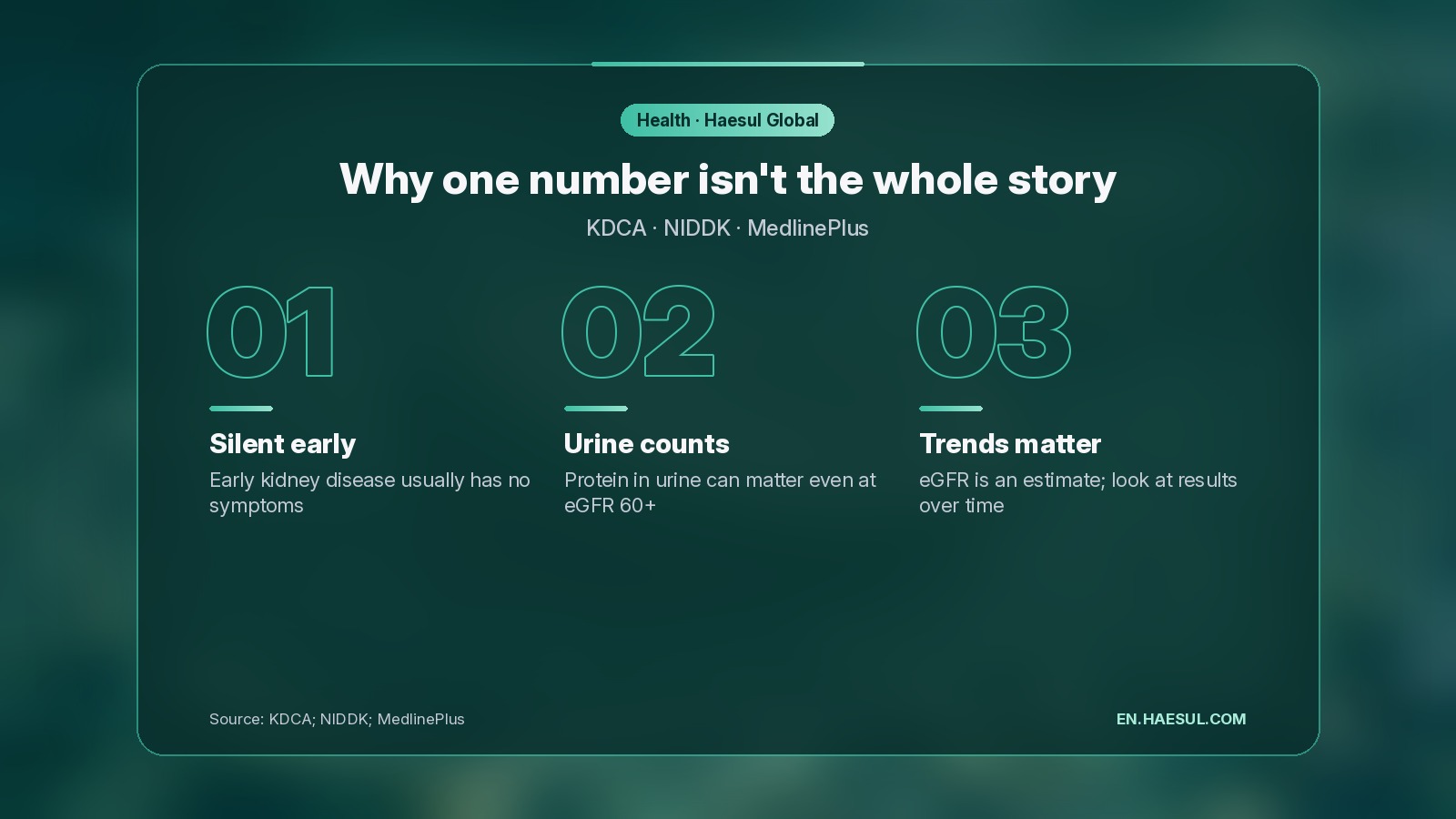
- eGFR is an estimate. NIDDK says every eGFR equation is imprecise, and that health care teams should look at trends over time rather than a single result. Results should also be compared using the same equation (NIDDK, GFR equations). MedlinePlus likewise says eGFR “isn’t a perfect test” (MedlinePlus).
- The urine test counts too. KDCA says kidney disease can be diagnosed even with an eGFR of 60 or more if a urine test shows protein or blood (KDCA). NIDDK uses a urine albumin test alongside eGFR: a urine albumin-to-creatinine ratio of 30 mg/g or less is normal (NIDDK). KDCA’s albuminuria grade 1 is likewise below 30 mg/g. The Korean general checkup includes a urine test (NHIS).
- Early kidney disease is usually silent. Both NIDDK and KDCA say early disease usually has no symptoms and shows up only in tests (NIDDK, KDCA).
4) Who should pay closer attention
- Diabetes and high blood pressure are among the main causes listed by KDCA. NIDDK lists them among the reasons to get checked, along with heart disease and a family history of kidney failure (KDCA, NIDDK).
- How common it is in Korea (according to KDCA): In 2022, 7.6% of Korean adults had chronic kidney disease, rising to 21.6% among people aged 70 and over. KDCA is the only source for these figures.
- What to ask your doctor: whether the result needs a repeat test, whether a urine albumin test is needed, and how often to recheck. These questions follow from the NIDDK and KDCA guidance above.
For the rest of the checkup report, see our guides to liver enzymes AST and ALT and to which tests the Korean checkup adds by age.
FAQ
When does the 2026 checkup that includes creatinine and eGFR end? December 31, 2026 — 48 days left from November 13. NHIS lists serum creatinine and e-GFR among the general checkup blood tests and says the checkup period runs January 1–December 31 each year (NHIS, checked Nov 8).
Do I need to fast for creatinine? The national checkup asks you to fast from 9 p.m. the night before because it includes other tests such as fasting glucose (NHIS). KDCA says most serum tests need no special preparation. MedlinePlus says you may be told to avoid meat for 24 hours before a creatinine test. Follow your clinic’s instructions.
Can I raise my eGFR? NIDDK says you can’t raise your GFR, but you can try to keep it from going lower. Ask your doctor what that means for you.
My creatinine is slightly above the range on my report. Do I have kidney disease? Not necessarily. MedlinePlus says a single high result can’t diagnose a specific condition and you will likely need retesting or other tests. KDCA’s definition requires changes that last three months or more.
This article summarizes public information from KDCA, NHIS, NIDDK and MedlinePlus (US National Institutes of Health). It is not medical advice. Ask a doctor to interpret your results. Don’t start or stop medicines, supplements or diets on your own.
Korean-language version: 크레아티닌 수치와 사구체여과율 (Naver blog).
Related reading
- Korea health checkup Dec 31 deadline and catch-up
- HbA1c and fasting glucose on a Korean checkup
- Hemoglobin / anemia on a Korean checkup
Sources
- KDCA National Health Information Portal, “만성콩팥병” (chronic kidney disease; updated May 12, 2026; checked Oct 18, 2026) https://health.kdca.go.kr/healthinfo/biz/health/gnrlzHealthInfo/gnrlzHealthInfo/gnrlzHealthInfoView.do?cntnts_sn=5457
- KDCA National Health Information Portal, “임상 화학 검사” (clinical chemistry tests; updated Apr 17, 2026; checked Oct 18, 2026) https://health.kdca.go.kr/healthinfo/biz/health/gnrlzHealthInfo/gnrlzHealthInfo/gnrlzHealthInfoView.do?cntnts_sn=5531
- KDCA National Health Information Portal, “건강검진(국가건강검진)” (updated June 1, 2026; checked Oct 18, 2026) https://health.kdca.go.kr/healthinfo/biz/health/gnrlzHealthInfo/gnrlzHealthInfo/gnrlzHealthInfoView.do?cntnts_sn=6671
- National Health Insurance Service, “일반건강검진” (general health checkup guide) (checked Oct 18, 2026) https://www.nhis.or.kr/nhis/healthin/wbhaca04500m01.do
- NIDDK (US National Institutes of Health), “Chronic Kidney Disease Tests & Diagnosis” (last reviewed Oct 2016; checked Oct 18, 2026) https://www.niddk.nih.gov/health-information/kidney-disease/chronic-kidney-disease-ckd/tests-diagnosis
- NIDDK, “Glomerular Filtration Rate Equations” (last reviewed May 2025; checked Oct 18, 2026) https://www.niddk.nih.gov/research-funding/research-programs/kidney-clinical-research-epidemiology/laboratory/glomerular-filtration-rate-equations
- MedlinePlus (US National Library of Medicine), “Creatinine Test” (checked Oct 18, 2026) https://medlineplus.gov/lab-tests/creatinine-test/
- MedlinePlus, “Estimated Glomerular Filtration Rate (eGFR) and GFR Tests” (checked Oct 18, 2026) https://medlineplus.gov/lab-tests/estimated-glomerular-filtration-rate-egfr-and-gfr-tests/




4 Comments