Hemoglobin on a Korean Checkup: What the Anemia (혈색소) Row Means for Men and Women
Haesul Health desk (AI-assisted). As of 8 November 2026 (KST), based on the National Health Insurance Service (NHIS) general checkup item list, the Ministry of Health and Welfare Health Checkup Implementation Standards (Annex 4 and its item-by-item appendix), Korea Disease Control and Prevention Agency (KDCA) pages on anemia, complete blood count and checkup-result reading, KDCA Public Health Weekly Report figures, Seoul National University Hospital’s medical library, MedlinePlus, the US National Heart, Lung, and Blood Institute (NHLBI), and Yonhap’s report of NHIS year-end guidance. This is general information, not medical advice. Talk to a doctor about your own results and symptoms.
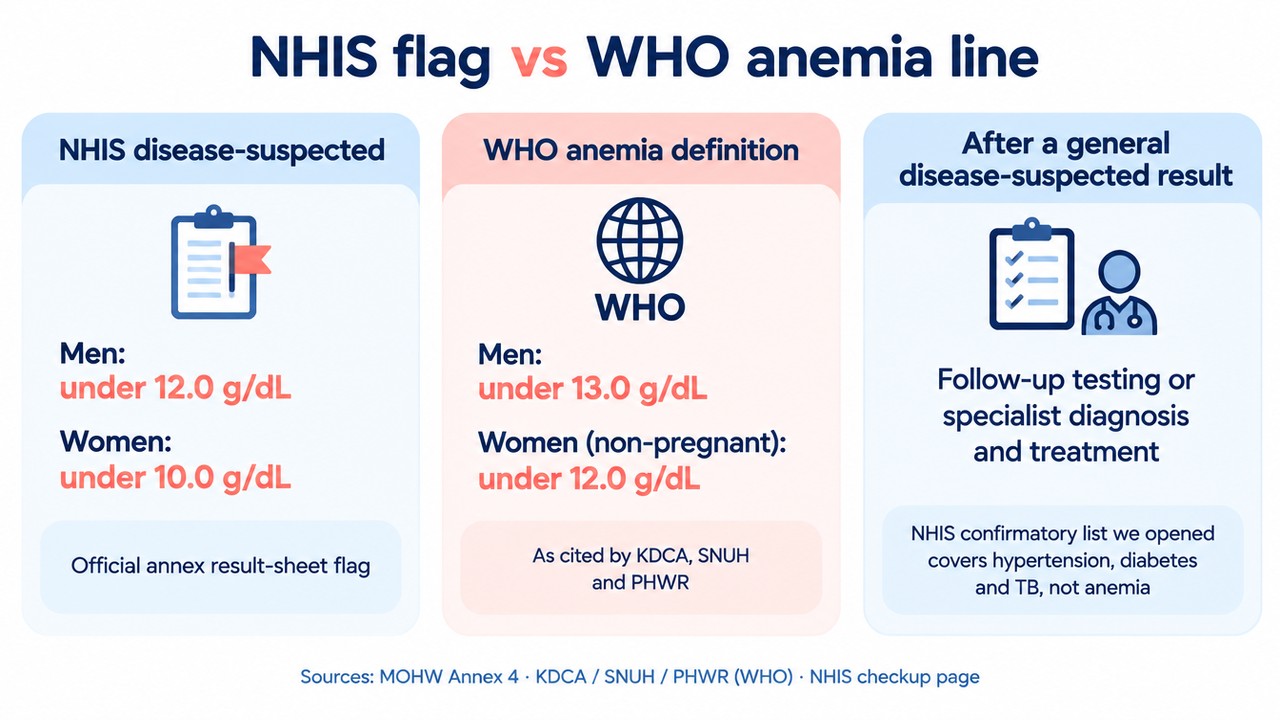
Quick answer: Hemoglobin (혈색소) is a common blood test on Korea’s national general checkup, used to screen for anemia. On the official result-sheet bands, normal A is 13.0–16.5 g/dL for men and 12.0–15.5 g/dL for women. Borderline (normal B) is 12.0–12.9 g/dL for men and 10.0–11.9 g/dL for women. The sheet’s disease-suspected line is under 12.0 g/dL for men and under 10.0 g/dL for women. Those disease-suspected lines are not the same as the World Health Organization (WHO) anemia definition cited by KDCA and Seoul National University Hospital (under 13.0 g/dL for men, under 12.0 g/dL for non-pregnant women). A flagged row is a signal to follow up, not a diagnosis of anemia.
If you are in your 40s, 50s or 60s and have just opened a Korean result sheet, the 혈색소 line is easy to glance past. It sits among the other common blood rows — fasting glucose, liver enzymes and kidney markers — and it is reported in g/dL. The national programme uses it as an anemia screen, not as a full blood count. That distinction matters: a number outside the printed band tells you to talk to a doctor, not what kind of anemia you might have, and not whether you should start an iron tablet on your own. For the rest of what may be due this year, see our Korea national health checkup by age guide.

Who gets hemoglobin on the national general checkup
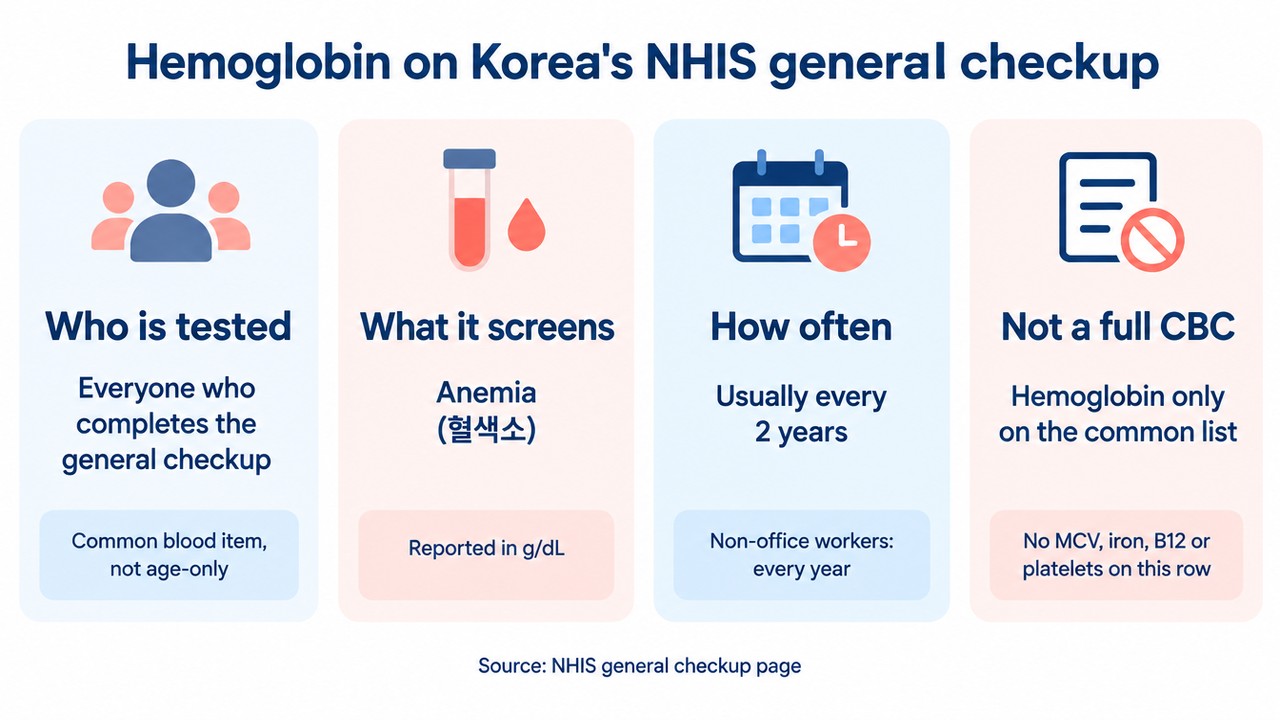
NHIS lists hemoglobin (혈색소) among the common blood tests on the general checkup (일반건강검진), together with fasting glucose, AST, ALT, γ-GTP, serum creatinine and eGFR. It is not an age-restricted extra in the way the lipid panel is. If you are eligible for this year’s general checkup and you complete it, hemoglobin should appear on the result sheet.
| Item | National general checkup rule |
|---|---|
| Test | Hemoglobin (혈색소), in g/dL |
| Who receives it | Everyone who completes the general checkup — it is a common item, not a sex- or age-only extra |
| What it screens for on the annex | Anemia (빈혈) |
| What it is not | A complete blood count (CBC). The NHIS common list does not include white cells, platelets, hematocrit or red-cell indices such as MCV |
| How often the checkup itself runs | Usually every 2 years; non-office workplace subscribers are invited every year |
| Cost of the general checkup | NHIS and Yonhap describe it as available with no out-of-pocket charge for eligible people |
Sources: NHIS general checkup page (common items and intervals); Yonhap, 8 October 2026, reporting NHIS year-end guidance; NHIS English benefits page (general checkup “free of charge”).
The same NHIS page says regional household heads and members aged 20 and over, workplace dependents aged 20 and over, and Medical Aid recipients aged 20 to 64 are usually invited every two years. Workplace subscribers follow the office (every two years) or non-office (every year) rule. People aged 65 and over on Medical Aid follow a separate older-adult path.
In 2026 the invitation for the usual two-year cycle goes to people born in even-numbered years. Yonhap’s 8 October 2026 report of NHIS guidance says this year’s general-checkup targets are people aged 20 and over born in an even year, that regional household heads and workplace subscribers are targets regardless of age, and that people who missed last year’s national checkup can ask to be added until 31 December 2026. Call NHIS on 1577-1000, or check the 건강보험 app, to see your own record. As of 13 November 2026, that deadline is 48 days away. Our 31 December deadline and catch-up guide walks through the booking steps.
A hemoglobin test itself does not require special preparation, according to MedlinePlus and the KDCA complete-blood-count page. The national checkup also measures fasting glucose, though, so you will usually be asked to fast for the visit. If you are not sure, follow the instructions on your appointment notice. Hemoglobin is also not the same test as HbA1c (당화혈색소), which reflects average blood sugar; MedlinePlus makes that distinction explicit. HbA1c is not on the NHIS common list. Our HbA1c and fasting glucose guide covers that pair.
How to read the 혈색소 row on the result sheet
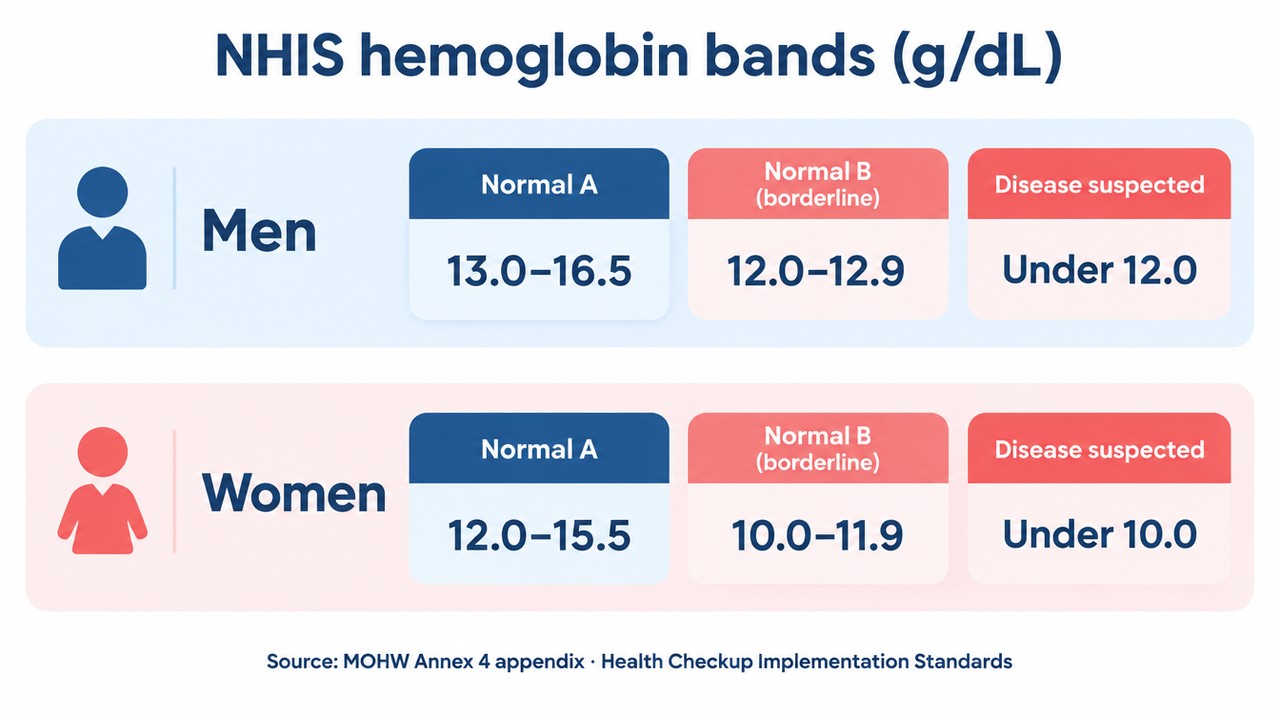
Korea’s Health Checkup Implementation Standards (건강검진 실시기준) set the lines the national sheet uses. Annex 4 describes the overall judgment codes. The item-by-item appendix to Annex 4 gives the hemoglobin numbers, in g/dL:
| Hemoglobin (g/dL) | Normal A | Normal B (borderline) | Disease suspected |
|---|---|---|---|
| Men | 13.0–16.5 | 12.0–12.9 | Under 12.0 |
| Women | 12.0–15.5 | 10.0–11.9 | Under 10.0 |
Source: Health Checkup Implementation Standards, Annex 4 appendix (검사항목별 판정기준), opened via law.go.kr (file sequences 160922523 and 160922929) on 8 November 2026. An earlier published version of the same annex (file sequence 136957885) prints the same hemoglobin bands.
The annex does not print a separate fourth column for a high result. Normal A stops at 16.5 g/dL for men and 15.5 g/dL for women. If your printed number sits above that band, read the range printed next to your own result and ask the doctor what the sheet is showing — do not assume a category we cannot see on the annex.
Annex 4 explains what the judgment words mean in plain language:
| Code on the sheet | What the annex says it means |
|---|---|
| 정상A (normal A) | The checkup found you to be in good health |
| 정상B (borderline) | No health abnormality was found, but self-care and prevention — diet, habits, environment — are needed |
| 일반 질환의심 (general disease suspected) | There is a possibility of illness developing, so you need follow-up testing or an accurate diagnosis and treatment at a specialist medical institution |
A hemoglobin result in the disease-suspected band is an anemia screen that feeds this general disease-suspected path, not the separate hypertension / diabetes / dyslipidemia box. Annex 4 also has codes for people already on treatment for listed conditions. That distinction matters for what happens next.
A KDCA monthly note on reading checkup results (November 2021, citing the implementation standards and a counseling manual) explains the same test more simply: it calls 13–16.5 g/dL in men and 12–15.5 g/dL in women “normal”, and it calls hemoglobin under 13 g/dL in men or under 12 g/dL in women “suspected anemia” (빈혈 의심). That two-band version matches the lower edge of normal A and folds borderline and disease-suspected together. The official annex is more precise, and it is the table printed above that the national sheet is built from. If your letter shows both a number and a code, read both.

How the Korean sheet differs from WHO and lab “normal” ranges
This is the comparison that most often surprises people — especially women whose number sits in the 10s.
KDCA’s complete-blood-count page, Seoul National University Hospital’s medical library, and KDCA’s Public Health Weekly Report all present the WHO definition of anemia as hemoglobin:
| Group | WHO anemia definition, as cited by KDCA, SNUH and PHWR |
|---|---|
| Adult men | Under 13.0 g/dL |
| Adult non-pregnant women | Under 12.0 g/dL |
| Pregnant women | Under 11.0 g/dL |
SNUH states the same adult and pregnancy lines and attributes them to WHO. PHWR uses those adult lines (plus age-specific child lines) when it reports how common anemia is in Korea. These are WHO definitions as Korean official and hospital pages present them. They are not Korea’s NHIS disease-suspected flags.
Lab “reference ranges” are a third language again. They describe where many healthy people’s results fall, and they vary by laboratory, age, sex and altitude:
| Source | Adult men | Adult women | What it is |
|---|---|---|---|
| NHIS annex, normal A | 13.0–16.5 g/dL | 12.0–15.5 g/dL | National screening band |
| NHIS annex, disease suspected | Under 12.0 g/dL | Under 10.0 g/dL | National flag that the annex ties to follow-up or specialist care |
| WHO anemia definition (via KDCA, SNUH, PHWR) | Under 13.0 g/dL | Under 12.0 g/dL (non-pregnant) | International anemia definition |
| NHLBI, typical CBC “normal range” | 14 to 17 g/dL | 12 to 15 g/dL | US consumer range; NHLBI notes it varies |
| MedlinePlus hemoglobin encyclopedia | 13.8 to 17.2 g/dL | 12.1 to 15.1 g/dL | Common lab-style range; “may vary slightly among laboratories” |
| KDCA CBC page, reference range | 14.0–17.5 g/dL | 12.3–15.3 g/dL | Reference interval on KDCA’s test explainer |
So a woman with hemoglobin 11.2 g/dL is inside Korea’s normal B (borderline) band and would meet the WHO anemia definition cited by KDCA and SNUH. A man with 12.4 g/dL is likewise borderline on the Korean sheet and under the WHO adult-male line of 13.0. Neither example is a diagnosis. Both are reasons to ask a doctor rather than file the letter away because the word “정상” appeared next to the row.
MedlinePlus also notes that a result outside a reference range does not always mean you have a condition that needs treatment. Living at high altitude, diet, activity, some medicines, dehydration, smoking and some genetic conditions can affect hemoglobin. NHLBI similarly says altitude, age and race can shift typical ranges. Use the printed Korean band for what the national sheet is saying, and use your doctor’s assessment for what the number means for you.
Worked readings (illustrations, not diagnoses)
These combinations are made up to show how the tables work. They are not advice for any real person.
A woman in her early 50s, hemoglobin 11.2 g/dL. On the official annex this is normal B (borderline) for women (10.0–11.9). The KDCA educational note would group anything under 12 g/dL as “suspected anemia”. WHO’s definition, as cited by KDCA and SNUH, would also call 11.2 anemia in a non-pregnant woman. The sheet is not telling her that she “has anemia”. It is telling her the number sits below the usual adult female line used internationally, even if it has not crossed Korea’s under 10.0 disease-suspected flag. That is a conversation to have with a doctor, especially if she has heavy periods, fatigue, dizziness or shortness of breath.
A man in his late 50s, hemoglobin 12.4 g/dL. On the annex this is normal B for men (12.0–12.9). It is below the WHO adult-male line of 13.0 g/dL. Borderline, on Annex 4, means no abnormality was declared but self-care and prevention are needed. It is not a free pass to ignore symptoms, and it is not a diagnosis.
A woman in her 50s, hemoglobin 9.6 g/dL. This sits in the annex disease-suspected band for women (under 10.0) and well under the WHO line of 12.0. Annex 4 says a general disease-suspected result means follow-up testing or an accurate diagnosis and treatment at a medical institution. That is the point of the flag: find out why the number is low, not guess an iron brand.
What a flag is — and what usually happens next
A low or borderline hemoglobin on the national sheet is a screening signal. It is not a diagnosis of iron-deficiency anemia, vitamin-deficiency anemia, anemia of chronic disease, or anything else. KDCA’s anemia page is blunt about the next step: if anemia is found, finding the cause matters as much as treating the number, and treating first without looking for a cause can delay the diagnosis of whatever produced the low hemoglobin.
The national checkup measures hemoglobin only. It does not report the rest of a CBC. KDCA’s CBC page and MedlinePlus describe how clinicians usually go further after a low hemoglobin: a complete blood count, including the size of the red cells (MCV), and, depending on the picture, iron studies, vitamin B12, folate and a reticulocyte count. NHLBI lists the same CBC building blocks (red cells, hemoglobin, hematocrit, MCV) and notes that doctors sometimes look for a source of bleeding, including in the digestive tract, when that is clinically appropriate. Those extra tests are a clinician’s decision. They are not automatically included in the free general checkup.
What about a free confirmatory visit? The NHIS general-checkup page we opened says confirmatory testing (확진검사) at a clinic or hospital is for people whose result is disease-suspected for hypertension, diabetes or pulmonary tuberculosis. The NHIS English benefits page likewise says people suspected of high blood pressure or diabetes will have a second test for that. Neither page lists anemia or hemoglobin as a confirmatory-test condition. By contrast, a blood-pressure flag of 140/90 has a clearly described confirmatory path, which we explain in our Korea blood-pressure checkup guide.
That does not mean a hemoglobin flag can be ignored. Annex 4 still says a general disease-suspected result means you need follow-up testing or a proper diagnosis and treatment at a medical institution. If your paper result letter prints a follow-up instruction or a clinic recommendation, follow the letter in your hand. Bring the result sheet and photo ID to the appointment.
KDCA lists several broad groups of anemia. The most common, it says, is iron-deficiency anemia, which it describes as found in one in five women, half of pregnant women and 3% of men. The body needs iron to make hemoglobin; too little iron in the diet, heavy monthly blood loss, pregnancy, or slow chronic bleeding (KDCA mentions ulcers, colon polyps or colon cancer as examples of slow loss) can empty iron stores. Other groups on the same page include vitamin B12 or folate deficiency, anemia of chronic disease (including kidney disease), bone-marrow problems, and hemolysis, where red cells are destroyed faster than they are replaced. MedlinePlus similarly lists iron, B12 and folate deficiency, chronic kidney disease, cancer, blood loss and inherited conditions among possible causes of a low hemoglobin.
Two practical cautions from KDCA are worth taking into the consulting room:
- Do not start an iron tablet on your own just because you feel tired, or because one row looks low. KDCA says excess iron can be harmful, and that iron-deficiency anemia is not corrected by food alone — prescribed iron is the usual treatment after iron deficiency is confirmed, often for months, while the cause of the loss or shortage is also addressed.
- Seek care promptly if low hemoglobin comes with black stools, bloody stools or unexplained weight loss, or if the number keeps falling or drops sharply from a previous checkup. Those are reasons to be assessed, not to wait for the next two-year letter.
Symptoms that can go with anemia, according to KDCA, include fatigue, weakness, pale skin, a fast or irregular heartbeat, shortness of breath, chest pain, dizziness, trouble thinking clearly, cold or tingling limbs, and headache. Early anemia can be so mild that it is missed. MedlinePlus adds that mild or slowly developing anemia may cause no obvious symptoms at first. Feeling tired does not by itself mean anemia is present — KDCA notes that many other conditions cause dizziness or fatigue — and a low number without symptoms still deserves a proper look.
If you are in your 40s, 50s or 60s
Korea’s official survey numbers help explain why this row is not only a “young women’s issue”.
KDCA’s Public Health Weekly Report dated 15 October 2026, drawing on the 2024 Korea National Health and Nutrition Examination Survey, puts age-standardised anemia prevalence at ages 10 and over at 7.4% overall in 2024 — 2.5% in men and 12.7% in women, both lower than in 2023. Women had a higher rate than men at every age, and both sexes were around 20% among people in their 70s and older. PHWR defines those survey cases using hemoglobin under 13 g/dL in men and under 12 g/dL in non-pregnant women aged 15 and over (under 11 g/dL in pregnant women) — the WHO-style lines, not the NHIS disease-suspected flags of under 12.0 / under 10.0.
The previous PHWR note (23 October 2025, 2023 survey), which the KDCA anemia page still summarised when it was updated on 6 October 2026, reported 3.3% in men and 14.8% in women in 2023, with rates around 20% in men aged 70 and over and in women in their 40s as well as women aged 70 and over. For a woman reading a year-end 2026 letter in her 40s, that 2023 age pattern is the reason a borderline or flagged 혈색소 row is not unusual — and still worth investigating rather than dismissing.
A woman in her 40s. Heavy periods are a classic route to iron loss, and KDCA flags menstruating women as a higher-risk group for iron-deficiency anemia. A result of 11.0-something may be only “borderline” on the Korean sheet and still sit under the WHO female line of 12.0. Questions worth asking include whether the doctor wants a full CBC and iron studies, whether periods have been heavier, and whether any gut symptoms need attention.
A woman in her 50s. This is a common age to sit the checkup during the menopause transition, when periods may be irregular or have recently stopped. A flagged or borderline hemoglobin is still a reason to look for a cause rather than assume it is “just hormones” or to start iron without a plan. If you also have a fasting-glucose flag, those are separate rows with separate follow-up rules; our glucose guide covers that line.
A man in his 50s or 60s. Overall anemia is less common in Korean men (2.5% in the 2024 survey). When a man’s hemoglobin falls into borderline or disease-suspected territory, clinicians often want to understand why — diet can play a part, but KDCA also lists slow digestive-tract blood loss among the ways iron stores are emptied. That is a reason to mention black stools, visible blood, a change in bowel habit or unexplained weight loss, not a reason to conclude anything from the screening number alone.
Someone in their 60s. KDCA notes that anemia in older adults often travels with chronic illness, iron deficiency or poor nutrition, and that the symptoms can be easy to miss because they are not specific. The same checkup already records blood pressure, glucose, lipids in some years, and kidney markers. Bring the whole sheet, not only the 혈색소 line.
If you still need to book the 2026 checkup itself, even birth years (and people added after a missed 2025 invitation) should finish by 31 December 2026 — 48 days after 13 November. December slots fill up, so earlier is better. Check your targets on the NHIS website or the 건강보험 app, or call 1577-1000.
Questions worth taking to the doctor
These are conversation starters, not a script that replaces clinical judgment:
- Where does my exact number sit on the printed Korean bands — normal A, borderline, or disease-suspected — and what follow-up does this clinic recommend?
- Do I need a complete blood count (including MCV) and tests for iron, vitamin B12 or folate?
- Could blood loss (including heavy periods or bleeding in the gut) be part of the picture? Which symptoms should I watch for?
- How does this result fit with my other rows, medicines and long-term conditions?
- If iron deficiency is confirmed, how long would treatment last, and how will we check that the cause has been addressed? KDCA says iron treatment for confirmed iron-deficiency anemia often continues for months, including after the hemoglobin has recovered, until stores are rebuilt.
Frequently asked questions
Q. What does low hemoglobin mean on a Korean checkup?
It means the 혈색소 row came in below the band the national sheet uses for your sex. For men, the official annex calls 12.0–12.9 g/dL borderline and under 12.0 g/dL disease-suspected. For women, 10.0–11.9 g/dL is borderline and under 10.0 g/dL is disease-suspected. Low hemoglobin is how the programme screens for anemia. It does not, by itself, say which type of anemia is present or what treatment you need. That takes a doctor, and usually more tests than the checkup itself provides.
Q. Anemia cutoff men vs women Korea — which number should I use?
Use the table printed on your result sheet, which follows the official annex: men, normal A 13.0–16.5 g/dL, borderline 12.0–12.9, disease-suspected under 12.0; women, normal A 12.0–15.5, borderline 10.0–11.9, disease-suspected under 10.0. Separately, KDCA, SNUH and PHWR present the WHO anemia definition as under 13.0 g/dL for men and under 12.0 g/dL for non-pregnant women (under 11.0 in pregnancy). A woman at 11.2 g/dL can be “borderline” on the Korean sheet and still meet that WHO definition. Ask your doctor how to read your own number against both ideas.
Q. Is hemoglobin tested on every NHIS general checkup?
Yes, if you complete the general checkup. NHIS lists hemoglobin among the common blood tests, alongside fasting glucose, liver enzymes, creatinine and eGFR. It is not limited to certain ages the way cholesterol is. Eligible people usually attend every two years; non-office workplace subscribers are invited every year. In 2026 the usual two-year invitation goes to even birth years, and the checkup must be done by 31 December.
Q. Is a hemoglobin flag the same as an anemia diagnosis?
No. A flag is a screening result. Diagnosis, according to KDCA and MedlinePlus, usually involves a history, an examination and further blood tests, and then a search for the cause. Do not treat the word “질환의심” or “빈혈 의심” on a letter as a final label, and do not start iron or other supplements on the strength of the screening row alone.
Q. Do I get a free confirmatory visit after a low hemoglobin result?
Not on the NHIS pages we opened. Those pages describe confirmatory testing (확진검사) for people flagged for hypertension, diabetes or pulmonary tuberculosis, and the English NHIS page mentions a second test for suspected high blood pressure or diabetes. Anemia is not on that list. The official annex still says a general disease-suspected result means you need follow-up testing or diagnosis and treatment at a medical institution, so book that conversation with a doctor and follow any instruction printed on your own result letter.
Sources
- National Health Insurance Service, general checkup policy page (targets, intervals, common blood tests including hemoglobin; confirmatory testing listed for hypertension, diabetes and pulmonary tuberculosis) — https://www.nhis.or.kr/nhis/policy/wbhada19700m01.do (confirmed 8 November 2026)
- National Health Insurance Service, English insurance-benefits page (general checkup free of charge; second test mentioned for suspected high blood pressure or diabetes) — https://www.nhis.or.kr/english/wbheaa02600m01.do (confirmed 8 November 2026)
- Ministry of Health and Welfare, Health Checkup Implementation Standards, Annex 4 and Annex 4 appendix (judgment codes; hemoglobin bands by sex) — https://www.law.go.kr/LSW/flDownload.do?flSeq=160922523 and https://www.law.go.kr/LSW/flDownload.do?flSeq=160922929 (confirmed 8 November 2026)
- KDCA National Health Information Portal, “빈혈” (definition, types, symptoms, iron-treatment cautions, when to seek care; page updated 6 October 2026) — https://health.kdca.go.kr/healthinfo/biz/health/gnrlzHealthInfo/gnrlzHealthInfo/gnrlzHealthInfoView.do?cntnts_sn=1104 (confirmed 8 November 2026)
- KDCA National Health Information Portal, “총혈구검사” (WHO anemia definition as cited there; CBC reference ranges; no special preparation) — https://health.kdca.go.kr/healthinfo/biz/health/gnrlzHealthInfo/gnrlzHealthInfo/gnrlzHealthInfoView.do?cntnts_sn=5446 (confirmed 8 November 2026)
- KDCA, monthly health note “알아두면 도움이 되는 건강검진” (November 2021; hemoglobin described as normal at 13–16.5 g/dL in men and 12–15.5 in women, and as suspected anemia under 13 / under 12) — https://health.kdca.go.kr/healthinfo/biz/health/ntcnInfo/healthSourc/thtimtCntnts/thtimtCntntsView.do?thtimt_cntnts_sn=7 (confirmed 8 November 2026)
- KDCA, Public Health Weekly Report, 15 October 2026: “빈혈 유병률 추이, 2015–2024년” (2024 age-standardised prevalence ages 10+: 7.4% overall, 2.5% men, 12.7% women; about 20% at ages 70+) — https://www.phwr.org/journal/view.html?doi=10.56786/PHWR.2026.19.39.3 (confirmed 8 November 2026)
- KDCA, Public Health Weekly Report, 23 October 2025: “빈혈 유병률 추이, 2014–2023년” (2023: 3.3% men, 14.8% women; about 20% in men 70+ and in women in their 40s and 70+) — https://www.phwr.org/journal/view.html?uid=979&vmd=Full (confirmed 8 November 2026)
- Seoul National University Hospital medical library, “빈혈 [anemia]” (WHO adult, child and pregnancy lines as cited by SNUH) — https://www.snuh.org/health/nMedInfo/nView.do?category=DIS&medid=AB000023 (confirmed 8 November 2026)
- MedlinePlus, “Hemoglobin Test” and “Hemoglobin” encyclopedia (what the test is; not the same as HbA1c; common adult ranges 13.8–17.2 / 12.1–15.1 g/dL; causes of low and high results) — https://medlineplus.gov/lab-tests/hemoglobin-test/ and https://medlineplus.gov/ency/article/003645.htm (confirmed 8 November 2026)
- MedlinePlus, “Anemia” encyclopedia (types, symptoms, further tests; reviewed 29 January 2026) — https://medlineplus.gov/ency/article/000560.htm (confirmed 8 November 2026)
- NHLBI, “Anemia — Diagnosis” (CBC components; adult hemoglobin ranges 14–17 g/dL in men and 12–15 g/dL in women; possible further tests; last updated 18 December 2025) — https://www.nhlbi.nih.gov/health/anemia/diagnosis (confirmed 8 November 2026)
- Yonhap News, 8 October 2026: NHIS urges checkups before year-end; even-year births in 2026; general checkup with no out-of-pocket charge; last year’s missed checkups can be added by 31 December — https://www.yna.co.kr/view/AKR20261008065100530 (confirmed 8 November 2026)
- WHO publication page, “Guideline on haemoglobin cutoffs to define anaemia in individuals and populations”, published 5 March 2024 (page opened; full cutoff table in the PDF was not retrieved, so adult WHO numbers in this article are those cited by KDCA, SNUH and PHWR) — https://www.who.int/publications/i/item/9789240088542/ (confirmed 8 November 2026)
This article is general information, not medical advice. It does not diagnose or interpret your own result. If you have unexplained fatigue, dizziness, shortness of breath, chest pain, black or bloody stools, or unexplained weight loss, see a doctor without waiting for the next checkup invitation.




One Comment