Korea’s Checkup Cognitive Test from 66: What the KDSQ-C Score Means and What to Do Next
Haesul Health desk (AI-assisted). As of 9 November 2026 (KST), based on the National Health Insurance Service (NHIS) general health checkup page, the Ministry of Health and Welfare (MOHW) Health Checkup Implementation Standards (result criteria annex, the KDSQ-C questionnaire form and the general checkup result sheet, Korean Law Information Center), the MOHW early dementia screening programme page, and the Government24 (gov.kr) entry for dementia relief centre services. Independent cross-checks: district public health centre pages (Michuhol-gu and Yeonsu-gu, Incheon), the Anti-Corruption and Civil Rights Commission’s 2019 recommendation on sharing checkup results with dementia centres, and an independent Korean health explainer on the KDSQ-C. This is general information, not medical advice. Talk to a doctor about memory concerns, results and follow-up.
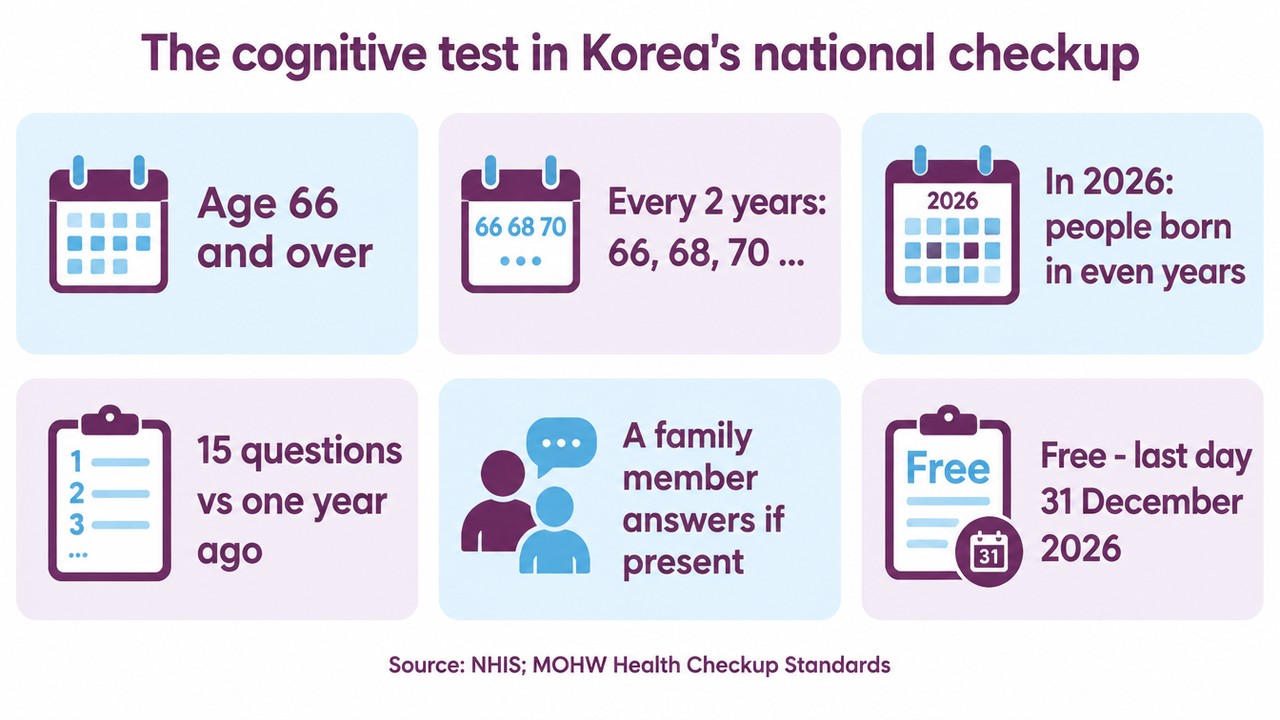
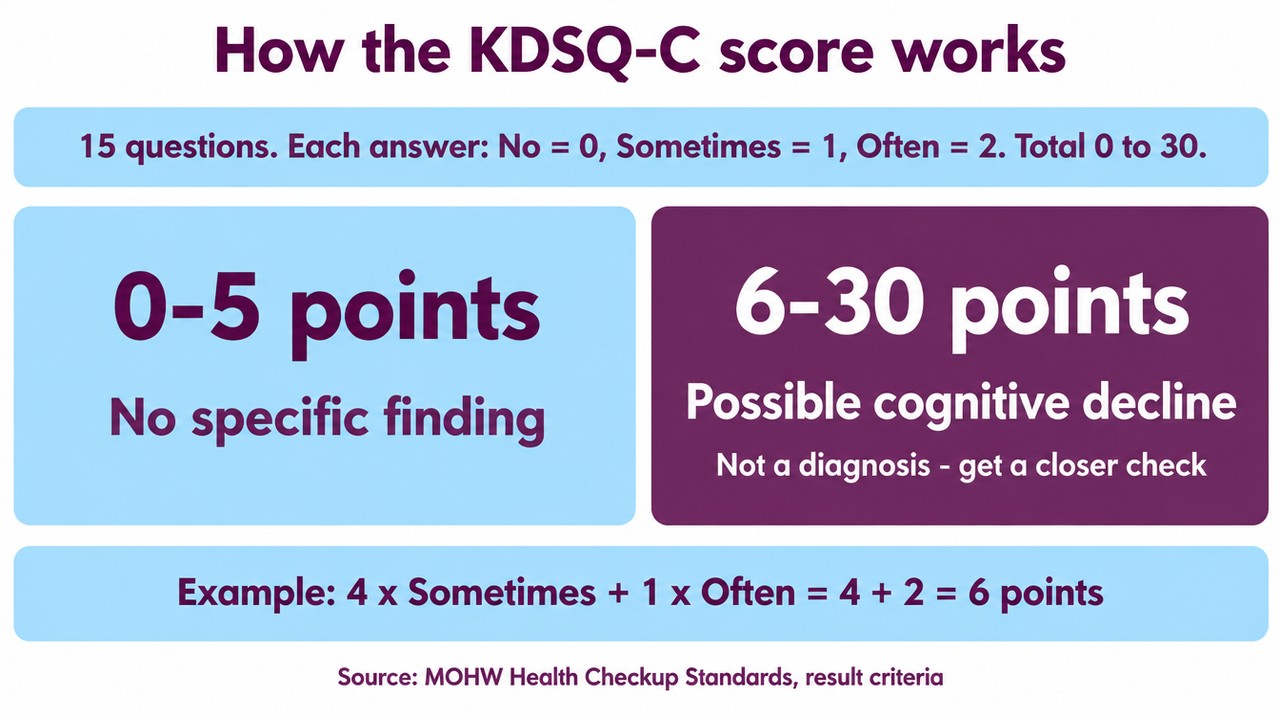
Quick answer: From age 66, Korea’s free national general health checkup includes a short cognitive function test (인지기능장애검사), repeated every two years (66, 68, 70 and so on). It is a 15-question form called the KDSQ-C that compares the person’s memory and daily functioning now with one year ago; a family member who comes along answers it, otherwise the person answers. Each question scores 0, 1 or 2, so the total runs from 0 to 30. 0–5 points is reported as “no specific finding”; 6 points or more is “possible cognitive decline” (인지기능 저하 의심). That is a reason for a closer look — usually a free screening test at the local dementia relief centre (치매안심센터) — not a dementia diagnosis. The 2026 checkup year ends on 31 December, 48 days from 13 November.
Many adult children in their 40s and 50s only learn about this test when a parent’s result sheet arrives with a line they do not recognise. This guide explains who gets the test in 2026, what the questions cover, how the score works, and the next steps and costs if the result says “possible cognitive decline”. For the full list of what Korea’s checkup offers at each age, see our national health checkup by age guide.

Who gets the cognitive test in 2026
The NHIS general checkup page lists the cognitive impairment test (인지기능장애검사) among the age-specific items: 66 and over, every two years, with the example ages “66, 68, 70, …”. The general checkup itself runs every two years by birth-year parity, and 2026 is the year for people born in even years. Because age in the checkup is counted as the calendar year minus the birth year, every even-birth-year person aged 66 or over in 2026 is on an even age — exactly the ages the NHIS table lists.
| Born in | Age in 2026 | Cognitive test in 2026? |
|---|---|---|
| 1960 | 66 | Yes (first time) |
| 1958 | 68 | Yes |
| 1956 | 70 | Yes |
| 1950 | 76 | Yes |
| 1959 | 67 | No — next in 2027 at 68 |
| 1961 | 65 | No — first test in 2027 at 66 |
Calculated from the NHIS general checkup page (66+ every 2 years; checkup every 2 years, non-office workers every year) and the 2026 even-birth-year schedule. Your own NHIS checkup notice is the final word.
Who qualifies for the general checkup at all? NHIS lists regional heads of household, employee subscribers, and household members and dependants aged 20 or over (plus Medical Aid recipients aged 20–64; Medical Aid recipients outside that range have a separate life-transition checkup, listed as its own programme by NHIS). The general checkup, including this questionnaire, is free (Yonhap, 8 October 2026). If you lost the notice, NHIS (1577-1000) can reissue it, or you can print a checkup confirmation from the NHIS website. NHIS also notes that someone who missed last year’s checkup can ask to be added to this year’s list — see our Dec 31 checkup deadline and catch-up guide.
What the KDSQ-C asks
The questionnaire is printed as form 13 of the MOHW checkup standards. Its instruction line asks the person filling it in to compare the current state with one year ago, and says that if a family member came along, the family member fills it in; if not, the person fills it in. There are 15 statements, each answered “no” (0 points), “sometimes / a little” (1 point) or “often / a lot” (2 points). In plain English, they cover:
- not knowing the month or the day of the week;
- not finding things they put down;
- asking the same question again and again;
- forgetting appointments;
- going to fetch something and coming back without it;
- hesitating because names of things or people won’t come;
- asking again because they did not follow a conversation;
- getting lost or wandering;
- weaker calculation than before (for example, prices or change);
- a change in personality;
- clumsier with appliances they used to handle (washing machine, rice cooker);
- less able to keep a room or the house tidy;
- not choosing clothes that suit the situation;
- difficulty getting somewhere alone by public transport (problems caused by joint pain or other physical limits don’t count);
- not wanting to change underwear or clothes even when dirty.
Because the questions are about change over a year, the most useful answers come from someone who sees the person regularly. If you are the adult child going along to the checkup, it helps to think about concrete recent examples before you arrive. If the person and the family see things differently, say so to the checkup doctor.

How the score works
The MOHW result criteria annex and the result-sheet form use a simple two-way split:
| KDSQ-C total | Result sheet wording | What it means |
|---|---|---|
| 0–5 points | 특이소견 없음 — no specific finding | No sign of decline on this questionnaire |
| 6–30 points | 인지기능 저하 의심 — possible cognitive decline | Worth a closer assessment; not a diagnosis |
Sources: MOHW Health Checkup Implementation Standards, result criteria annex and general checkup result-sheet form (2026), Korean Law Information Center.
Worked examples: three sample questionnaires
These are illustrative, calculated by us from the scoring rule above (0 / 1 / 2 points per question, 15 questions, cut-off 6).
| Example | Answers | Total | Result sheet |
|---|---|---|---|
| A — mother, 66 | “Sometimes” on items 2 and 6; “no” on the other 13 | 1 + 1 = 2 | No specific finding |
| B — father, 70 | “Sometimes” on items 2, 4, 5 and 6; “often” on item 3 | 1 + 1 + 1 + 1 + 2 = 6 | Possible cognitive decline |
| C — mother, 76 | “Often” on items 3, 4 and 8; “sometimes” on items 1, 9, 11 and 14 | 2 × 3 + 1 × 4 = 10 | Possible cognitive decline |
| Maximum | “Often” on all 15 | 15 × 2 = 30 | Possible cognitive decline |
Example B shows how quickly the threshold is reached: a handful of everyday memory slips marked “sometimes”, plus one repeated-question habit marked “often”, adds up to 6. That is why a “possible cognitive decline” result is common enough that it should prompt a calm follow-up, not panic. Equally, example A is not proof that everything is fine: if the family notices new, persistent problems, they can ask a doctor or the dementia relief centre without waiting for the next checkup.
What “possible cognitive decline” means — and what it doesn’t
The KDSQ-C is a questionnaire, not a brain test. It picks up reported changes, and those changes can have many causes: low mood or depression, poor sleep, hearing or eyesight problems, side effects of medicines, thyroid or vitamin problems, or the early stages of dementia. A score of 6 or more tells you that a closer look is sensible. It does not give a diagnosis, and it does not by itself give a long-term care grade.
Several things on the same checkup can help the conversation with a doctor. People aged 66 and over also get a physical function check (at 66, 70 and 80), a whisper hearing test, and — at 66 — bone density for women and the new lung function test. If you want the background on those, see our guides to the bone density test at 54, 60 and 66 and the lung function test at 56 and 66.
There is also a privacy step worth knowing. The checkup consent form (form 12 of the standards) asks whether NHIS may share a “possible cognitive decline” result with the public health centre and the dementia relief centre for follow-up. If you agree, the local centre may contact you; if you decline, you can still go to the centre yourself. The Anti-Corruption and Civil Rights Commission recommended this sharing in 2019, after finding that checkup cognitive results were not reaching the dementia centres.
Next steps: the dementia relief centre
Every city, county and district has a dementia relief centre (치매안심센터) inside or attached to its public health centre — Government24 counts 256 nationwide. They provide counselling, registration, early screening, case management, day “shelters” with memory and activity programmes, and family support. You apply at the centre for your registered address or where you actually live. The national dementia call centre is 1899-9988.
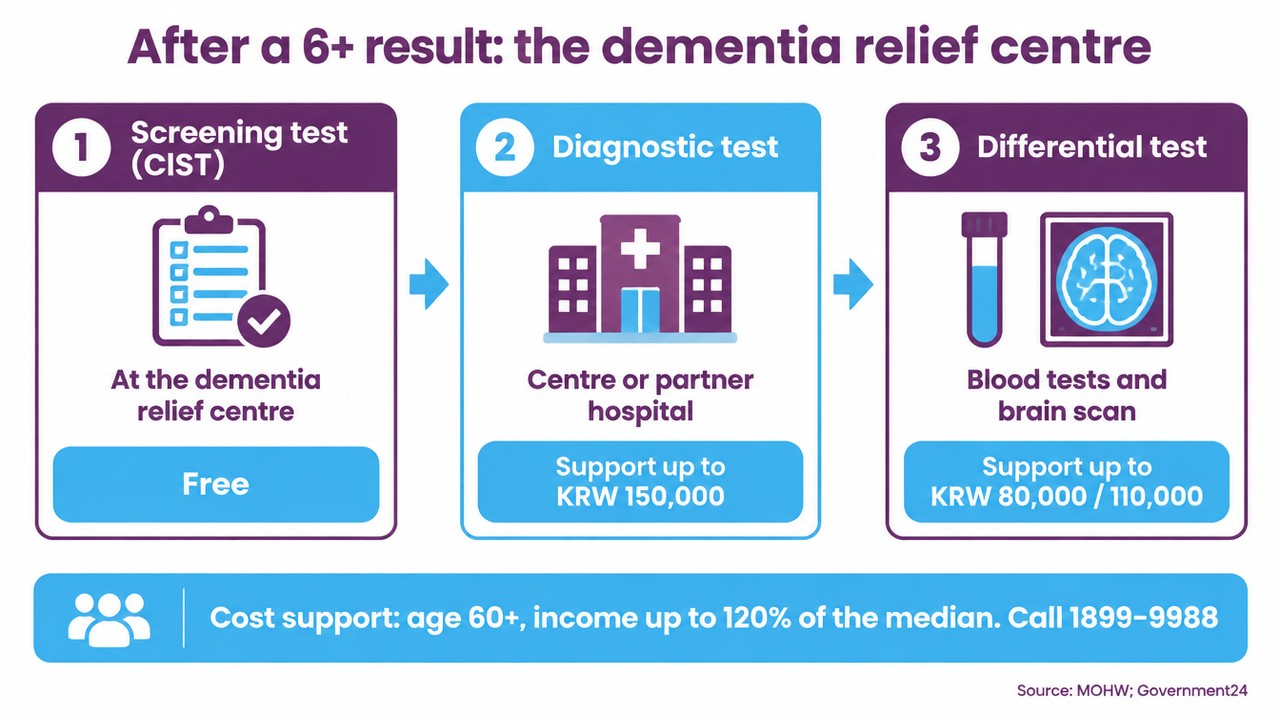
MOHW describes the centre’s early screening in three steps:
| Step | What happens | Where | Cost to you |
|---|---|---|---|
| 1. Screening test (CIST) | Short pen-and-paper cognitive screening with a staff member | Dementia relief centre | Free for anyone not already diagnosed with dementia |
| 2. Diagnostic test | Detailed neurocognitive testing and a specialist’s assessment | Centre (free) or a partner hospital | If referred to a partner hospital: actual cost refunded up to ₩150,000 for eligible incomes |
| 3. Differential test | Blood tests and brain imaging to find the cause | Partner hospital | Up to ₩80,000 (clinic/hospital/general hospital) or ₩110,000 (tertiary hospital) for eligible incomes |
Sources: MOHW early dementia screening programme page; Government24 dementia relief centre services (updated 26 February 2026). Support covers the patient’s share of insured items only, within the caps.
Who gets the cost support — a worked income check
The cost support in steps 2 and 3 applies to people aged 60 or over (younger people with early-onset dementia can also be selected, per MOHW) whose household income is at or below 120% of the standard median income. For 2026, MOHW’s standard median income is ₩2,564,238 a month for one person and ₩4,199,292 for two. 120% of those is:
| Household (for this test) | 2026 median income | × 120% | Monthly ceiling |
|---|---|---|---|
| 1 person (the patient) | ₩2,564,238 | ₩3,077,085.6 | about ₩3,077,080 |
| 2 people (patient + spouse) | ₩4,199,292 | ₩5,039,150.4 | about ₩5,039,150 |
Calculated; the district centres in Michuhol-gu and Yeonsu-gu (Incheon) publish the same 2026 ceilings, ₩3,077,080 and ₩5,039,150. The check is based on the household’s health insurance premium, so ask the centre to run it for you. Basic livelihood recipients and near-poverty households count as meeting the test.
If dementia is diagnosed and the person takes dementia medicine, low-income patients (also 120% of median) can get help with the copayment for dementia medicine and the same-day consultation, up to ₩30,000 a month (Government24). The centre can also connect the family to long-term care insurance; our long-term care grade guide explains the cognitive-support grade and how to apply.

A practical plan for families
Before the checkup: check the NHIS notice for “인지기능장애검사”. If you can, go along: the form is meant to be answered by an accompanying family member. Think of two or three concrete changes from the past year (or the absence of any).
On the result sheet: find the line “인지기능장애검사”. It will show either 특이소견 없음 (0–5) or 인지기능 저하 의심 (6 or more). The result sheet is normally sent within 15 days of the checkup.
If it says 6 or more: ask the checkup doctor to explain it, then book the free CIST screening at the dementia relief centre (call first; centres work by appointment), or see a neurologist or psychiatrist. Bring the result sheet, a list of current medicines, glasses and hearing aids, and your notes on what has changed.
If it is 0–5 but you’re still worried: you don’t need to wait two years. The centre’s screening is open to any resident not already diagnosed.
Before 31 December: if your parent was born in an even year and is 66 or over, and has not had the 2026 checkup, there are 48 days left from 13 November.
Frequently asked questions
Q. At what age does Korea’s national checkup test for dementia?
From 66. The NHIS general checkup lists the cognitive impairment test (인지기능장애검사) for people aged 66 and over, every two years (66, 68, 70 …). In 2026 that means people born in even years, such as 1960 (66) or 1956 (70).
Q. What does a KDSQ-C score of 6 mean?
A score of 6 or more out of 30 is reported as “possible cognitive decline” (인지기능 저하 의심). It means a closer assessment is worthwhile — usually a free screening test at the local dementia relief centre — but it is not a diagnosis of dementia. 0–5 points is “no specific finding”.
Q. Who answers the questionnaire — the patient or the family?
The form says that if a family member came along, the family member fills it in; otherwise the person fills it in. The questions compare the present with one year ago, so someone who sees the person regularly usually gives the most accurate picture.
Q. How much does dementia screening cost in Korea?
The checkup questionnaire is part of the free general checkup, and the CIST screening at a dementia relief centre is free for anyone not already diagnosed. For people aged 60+ with household income at or below 120% of the median, diagnostic tests at a partner hospital are refunded up to ₩150,000 and differential tests up to ₩80,000 or ₩110,000.
Q. Does a “possible cognitive decline” result give my parent a long-term care grade?
No. The checkup result is a screen. A long-term care grade needs a separate application to NHIS, a home assessment and a doctor’s opinion; the dementia relief centre can help you start that process if a diagnosis follows.
Sources
- National Health Insurance Service, 일반건강검진 (general health checkup: eligibility, every 2 years / non-office yearly, 인지기능장애검사 66+ every 2 years, result sheet within 15 days, checkup year 1 January – 31 December) — https://www.nhis.or.kr/nhis/healthin/wbhaca04500m01.do (confirmed 9 November 2026)
- MOHW Health Checkup Implementation Standards, annex: 검사항목별 판정기준 (KDSQ-C 0–5 no specific finding; 6–30 possible cognitive decline) — https://www.law.go.kr/LSW/flDownload.do?flSeq=160922929 (confirmed 9 November 2026, via search extract)
- MOHW Health Checkup Implementation Standards, form 6: 일반건강검진 결과통보서 (result sheet: 인지기능장애검사 0–5 / 6+) — https://www.law.go.kr/LSW/flDownload.do?flSeq=160922671 (confirmed 9 November 2026, via search extract)
- MOHW Health Checkup Implementation Standards, form 13: 인지기능장애 평가도구 (KDSQ-C, 15 items, 0/1/2 points, compared with 1 year ago, family answers if present) — https://www.law.go.kr/flDownload.do?bylClsCd=200203&flNm=%5B%EB%B3%84%EC%A7%80+13%5D+%EC%9D%B8%EC%A7%80%EA%B8%B0%EB%8A%A5%EC%9E%A5%EC%95%A0+%ED%8F%89%EA%B0%80%EB%8F%84%EA%B5%AC&flSeq=160922813 (confirmed 9 November 2026, via search extract)
- MOHW Health Checkup Implementation Standards, form 12: result-use consent (sharing “possible cognitive decline” results with dementia relief centres) — https://www.law.go.kr/LSW/flDownload.do?bylClsCd=200203&flSeq=148392403 (confirmed 9 November 2026, via search extract)
- MOHW, 치매조기검진사업 (early dementia screening: CIST → diagnostic → differential; 60+, 120% of median; ₩150,000 / ₩80,000–110,000) — https://www.mohw.go.kr/menu.es?mid=a10712010100 (confirmed 9 November 2026, via search extract)
- Government24 (gov.kr), 치매관리 서비스 (치매안심센터) (256 centres; free screening; cost caps; ₩30,000/month treatment support; call centre 1899-9988; updated 26 February 2026) — https://www.gov.kr/portal/rcvfvrSvc/dtlEx/135200000080 (confirmed 9 November 2026)
- MOHW, 2026 standard median income notice (1 person ₩2,564,238; 2 people ₩4,199,292) — https://www.mohw.go.kr/board.es?act=view&bid=0026&list_no=1487112&mid=a10409020000 (confirmed 9 November 2026, via search extract)
- Michuhol-gu Public Health Centre (Incheon), 치매조기검진사업 (2026 ceilings ₩3,077,080 / ₩5,039,150; CIST free; updated 1 October 2026) — https://www.michuhol.go.kr/clinic/content.do?sq=563 (confirmed 9 November 2026, via search extract)
- Yeonsu-gu Public Health Centre (Incheon), 치매조기검진 사업 (same 2026 ceilings; CIST → CERAD-K → differential) — https://www.yeonsu.go.kr/clinic/health/dementia/checkup.asp (confirmed 9 November 2026, via search extract)
- Anti-Corruption and Civil Rights Commission, 2019 press release on sharing checkup KDSQ results with dementia relief centres — https://www.acrc.go.kr/board.es?act=view&bid=4A&list_no=9142&mid=a10402010000 (confirmed 9 November 2026, via search extract)
- Yonhap News, 8 October 2026, “올해 국가건강검진은 짝수년도 출생자” (free general checkup; even birth years in 2026) — https://www.yna.co.kr/view/AKR20261008065100530 (confirmed 9 November 2026)
- Morning Study Senior, “건강검진 인지기능장애 6점 이상 결과·다음 검사” (independent explainer: KDSQ-C 0–5 / 6–30; family answers; referral to clinic or dementia centre) — https://morningstudy.com/senior/health/cognitive-screening-kdsq-c-result/ (confirmed 9 November 2026, via search extract)
This article is general information, not medical advice. A screening questionnaire is not a diagnosis. If someone has sudden confusion, weakness on one side of the body or trouble speaking, call 119 straight away.




5 Comments