Hepatitis C Test at 56 in Korea: Who Gets It, What It Costs, and What a Positive Result Means
By the Haesul Global health desk (AI-assisted). Last checked: 2026-11-10 (KST); countdown updated 2026-11-13. The 2026 general checkup window that includes the age-56 hepatitis C test closes in 48 days (December 31, 2026). Rechecked on the NHIS general checkup guide (HTTP 200 on Nov 8; C형간염검사 at 56; period 1.1–12.31). This is not medical advice; only your doctor can interpret your results.
Quick answer: Since 1 January 2025, Korea’s national general health checkup has included a hepatitis C (HCV) antibody test at age 56. Age is counted by calendar year, so in 2026 the test is for people born in 1970, whatever their birthday. The antibody test is part of the general checkup, which NHIS provides free of charge. An antibody positive result is not a diagnosis: it can mean a current infection or one that cleared or was treated in the past. The next step is an HCV RNA test. From 2026, KDCA refunds your out-of-pocket cost for the consultation and RNA test, once, up to ₩70,000, at any clinic or hospital, including general and tertiary hospitals. Have your checkup by 31 December 2026 — 48 days left from November 13, then have the RNA test and file the refund claim (Government24 or your public health centre) by 31 March 2027. If the RNA test confirms infection, KDCA says 8–12 weeks of oral direct-acting antivirals cure 98% or more of patients.

Who gets the test in 2026
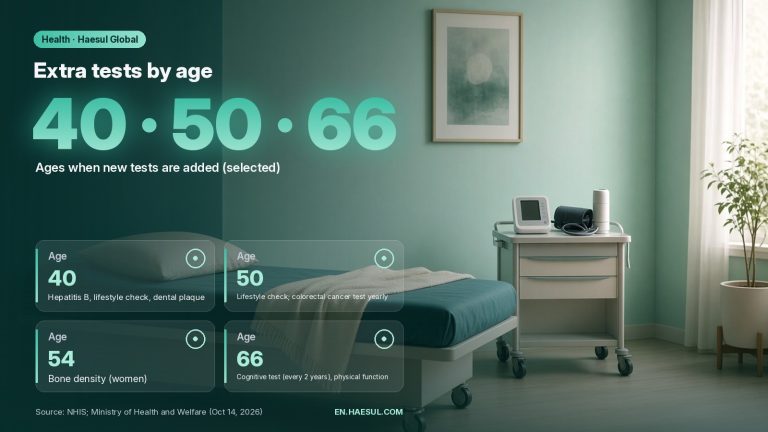
The rule is short. The National Health Insurance Service (NHIS) lists a hepatitis C test (C형간염검사) at age 56 among the sex- and age-specific items of the general health checkup (일반건강검진). It sits next to the hepatitis B test at 40, lung function at 56 and 66, and bone density for women at 54, 60 and 66.
Two details trip people up:
- “56” means the year you turn 56. KDCA’s 2026 programme guide names the 2026 group as people born in 1970. A city public health centre page (Mokpo) spells it out: the age is the calendar-year age (연나이), and your birth month and day don’t matter. So someone born in December 1970 is in the 2026 group even though they’re still 55 for most of the year.
- It’s a one-time item. The test belongs to age 56, not every checkup. People born in 1969 had it in 2025, the first year. People born in 1971 are due in 2027.
The general checkup itself runs every two years (every year for non-office workers). Odd birth years usually fall in odd calendar years and even in even, and 56 always lands in your scheduled year: born 1970, even year, checkup due in 2026. The checkup covers NHIS household heads and employee subscribers, plus household members and dependants aged 20 and over. Medical Aid recipients are covered up to 64. Foreign residents enrolled in NHIS are part of the same checkup system; see our guide to Korea’s national health checkup by age for the full list of what’s added at each age.
You can check whether you’re on this year’s list on the NHIS website or app (건강검진 대상조회) or by calling 1577-1000.
Why Korea added it, and why at 56
KDCA (the Korea Disease Control and Prevention Agency) announced the decision on 4 July 2024, after the second National Health Screening Committee meeting on 3 July. Its reasoning, published on the government portal korea.kr:
- Most people with hepatitis C have no symptoms, so it’s often found only after it has damaged the liver. KDCA puts the share of acute infections without symptoms at 70–80%.
- Left untreated, it can lead to chronic hepatitis, cirrhosis and liver cancer. Citing the Korean Association for the Study of the Liver, KDCA says 10–15% of liver cancers in Korea are caused by hepatitis C.
- There’s no vaccine, but there is a cure, so finding it early is what counts.
In December 2025 KDCA added another reason. Citing Statistics Korea’s 2024 cause-of-death data, it said liver cancer is the leading cause of cancer death for people in their 40s and 50s. Hepatitis C is one of its causes.
KDCA’s weekly journal (Public Health Weekly Report, June 2026) says earlier feasibility studies and a 2020 pilot found screening at 56 cost-effective. Several countries screen everyone: korea.kr’s 2024 article names Japan, Taiwan and Egypt. The US, Australia and France test higher-risk groups.
What it costs you
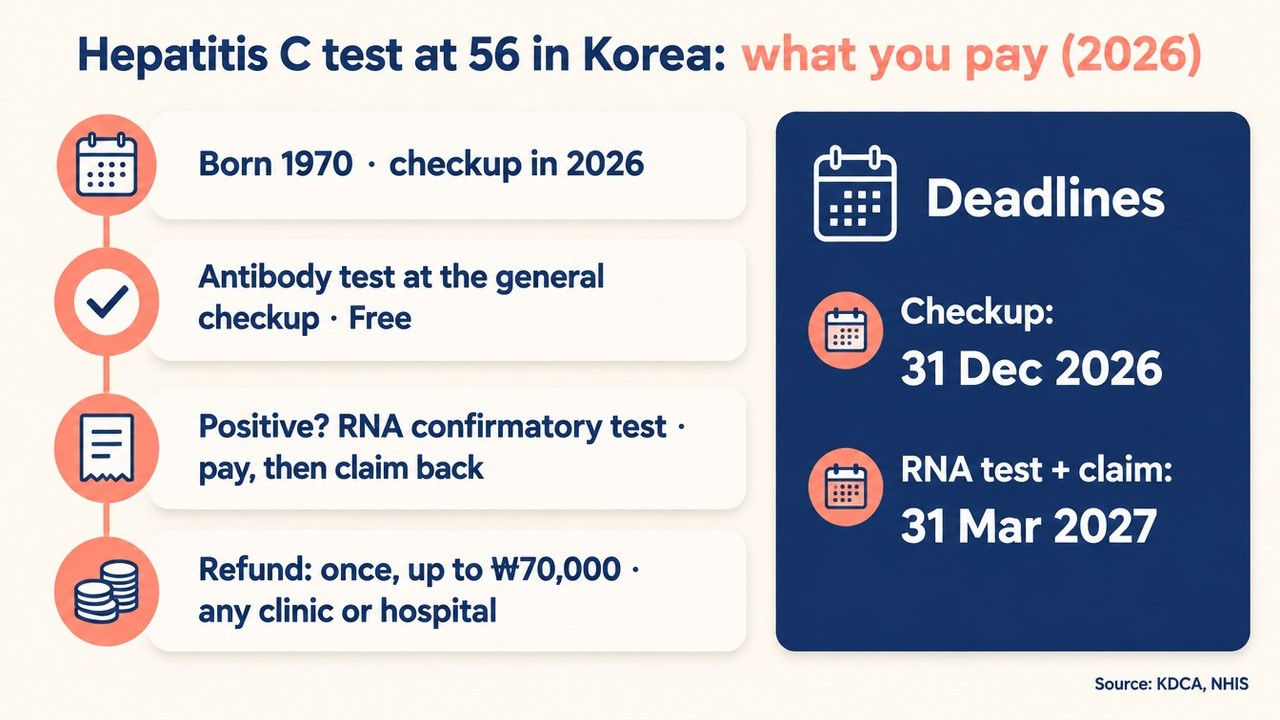
Here’s the 2026 cost picture, step by step, from the official rules:
| Step | What happens | Cost to you | Deadline |
|---|---|---|---|
| 1. General checkup at 56 | Blood sample; HCV antibody test is one of the items | Nothing (NHIS covers the general checkup in full) | 31 December 2026 |
| 2. Result notice | Clinic sends results by post or email | Nothing | Within 15 days of the checkup |
| 3. RNA confirmatory test (if antibody positive) | Consultation plus HCV RNA test at a clinic or hospital | You pay at the counter, then claim it back | Test by 31 March 2027 |
| 4. Refund claim | Government24 (보조금24, “C형간염 확진검사비 지원”) or public health centre | Refund of out-of-pocket consultation + RNA test fee, once, up to ₩70,000 | Claim by 31 March 2027 |
| 5. Payment | KDCA reviews and texts you the decision | Paid to your bank account | Within 3 months |
Sources: NHIS general health checkup page; KDCA press release and programme guide, 23 December 2025; NHIS English benefits page (“General Health checkup expenses: Free of Charge”).
The ₩70,000 is a cap, not a fixed payment. KDCA refunds the out-of-pocket amount shown on your itemised bill for the consultation and one RNA test, whether quantitative or qualitative, up to that limit.
What changed for 2026. In 2025, the refund applied only if the RNA test was done at a clinic or ordinary hospital (병·의원); a general or tertiary hospital didn’t qualify. From 2026, KDCA has extended it to all levels of medical institution, including general and tertiary hospitals, with the ₩70,000 cap. The NHIS page now lists the HCV follow-up test at clinics, hospitals, general hospitals and tertiary hospitals. It also notes that dental clinics, Korean-medicine clinics, nursing hospitals and psychiatric hospitals don’t count for these follow-up tests.
What you’ll need for the claim, according to KDCA’s form:
- the itemised bill (진료비 상세내역) from the hospital, showing amounts per item. A card slip or the year-end tax receipt (진료비납입확인서) is not accepted;
- a document showing your checkup antibody result was positive, such as the general checkup result notice. You can download it from the NHIS site;
- a copy of your bankbook in your own name; and
- proof of relationship, only if someone else applies for you.
Two limits from KDCA’s Q&A: only one test, once is refunded, and a genotype test (유전자형 검사) isn’t covered because it isn’t a confirmatory test. If you took an HCV test privately before the programme, it can’t be refunded retroactively.
Antibody test vs RNA test: what each result means
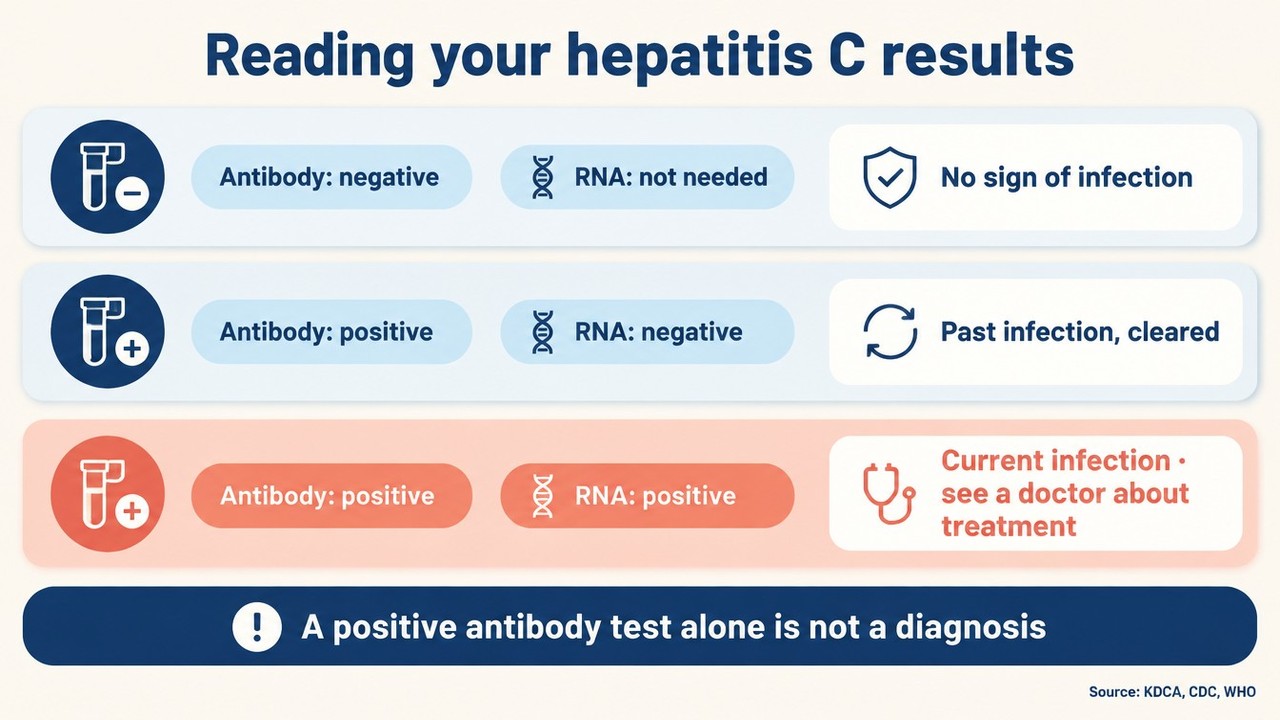
This is where most of the worry comes from, so here’s what each result means. The antibody test asks “has this person ever had hepatitis C?” The RNA test asks “is the virus there now?”
| Antibody (anti-HCV) | RNA (HCV RNA) | What it generally means | Usual next step |
|---|---|---|---|
| Negative (non-reactive) | Not needed | No sign of past or current infection | Nothing further from the checkup. If you had a possible exposure in the last 6 months, ask about retesting (CDC) |
| Positive (reactive) | Negative | Past infection that has cleared, on its own or after treatment | Talk to your doctor about what, if anything, to watch |
| Positive (reactive) | Positive | Current infection confirmed | See a doctor about treatment |
Sources: KDCA (a positive antibody result can mean a current infection or a past infection that was treated); CDC “Testing for Hepatitis C” (reviewed 2 November 2026); WHO hepatitis C fact sheet (28 July 2026).
A few facts from the official sources:
- Antibodies stay. The US CDC explains that once infected, you keep HCV antibodies in your blood whether you cleared the virus, were cured, or still have it. That’s why a positive antibody test alone can’t tell you whether you’re infected now.
- Some people clear it on their own. The WHO says about 30% (15–45%) of people infected clear the virus within six months without treatment, which is why WHO says the RNA test is “needed to confirm chronic infection and the need for treatment”.
- The RNA test is the diagnosis. KDCA’s case definition for hepatitis C is detection of the virus’s genetic material (RNA) in blood. In the national programme, that’s the test KDCA pays for.
- A previous diagnosis doesn’t disqualify you. KDCA’s Q&A says that even if you’ve had hepatitis C before, you’re eligible for the RNA refund if your 56 checkup antibody result was positive and you then had the RNA test.
In the US, CDC notes the lab often runs the RNA test automatically on the same blood sample when the antibody is positive (a “reflex” test). Korea’s checkup doesn’t do that yet: you go back for a second visit. KDCA’s own June 2026 report says introducing reflex testing should be considered.

The first year: how many people followed through
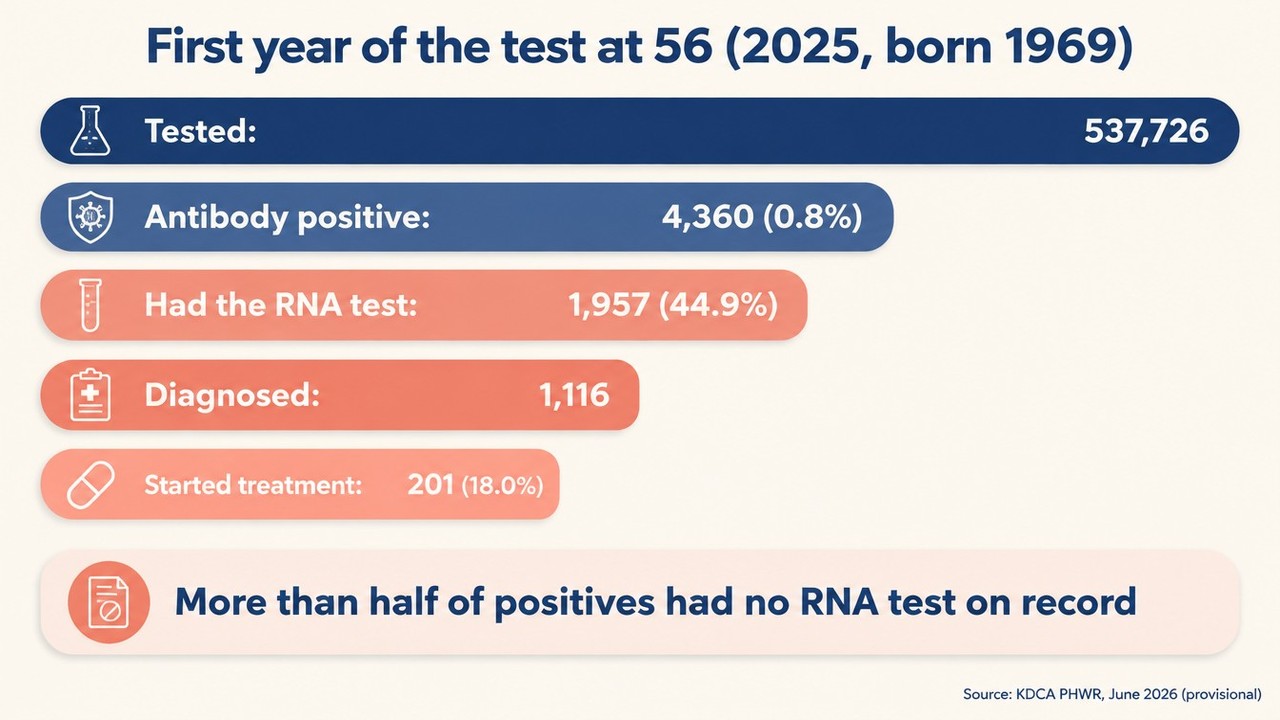
KDCA and NHIS published the first-year results in June 2026. They show what happens at each step, and where people drop out:
| 2025 (people born in 1969) | Number | Share |
|---|---|---|
| Invited to the 56 checkup | 762,852 | |
| Had the checkup | 537,726 | 70.5% of those invited |
| HCV antibody positive | 4,360 | 0.8% of those tested (men 0.9%, women 0.7%) |
| Had the RNA confirmatory test | 1,957 | 44.9% of antibody positives |
| Diagnosed with hepatitis C after the RNA test (estimate) | 1,116 | 57.0% of those RNA-tested |
| Prescribed antiviral treatment | 201 | 18.0% of those diagnosed |
Source: KDCA, Public Health Weekly Report 19(28), 30 June 2026, “2025 national health screening results for hepatitis C at age 56” (NHIS claims data to the end of April 2026; provisional).
Two things stand out. First, the test is finding people: reported cases among those born in 1969 were about twice the average for other ages in their 50s, and 57.6% were diagnosed through a health checkup. That share was 14.8% in 2023 and 20.2% in 2024. KDCA’s December 2025 interim count showed reports at age 56 up 35% on the year before.
Second, more than half of the people with a positive antibody result had no RNA test on record. Of those diagnosed, fewer than one in five had started treatment by the cut-off. The authors say both figures may be underestimates because of claims-data lags, and that treatment can take time to start. Still, the gap is why KDCA widened the refund to all hospitals, began sending KakaoTalk notification messages (알림톡) to antibody-positive people in April 2026, and started follow-up checks 16 weeks after diagnosis from May 2026.
The authors also name out-of-pocket treatment cost and low awareness, since most infected adults feel well, as barriers to treatment. We couldn’t confirm a current treatment price from an official source, so ask your hospital what you’d pay before you start.
If the RNA test is positive: what the official sources say about treatment
A confirmed infection is serious, but it’s curable. The official sources describe treatment like this:
- Tablets, not injections. Treatment uses direct-acting antivirals (DAAs), taken by mouth for 8–12 weeks.
- High cure rates. KDCA says DAAs taken for 8–12 weeks cure 98% or more; its fact sheet puts treatment success at 98–99%. The WHO says DAAs cure more than 95% of people. CDC says treatments “can cure most people with hepatitis C within 8–12 weeks”.
- The regimen is the doctor’s call. KDCA lists several DAA regimens used in Korea. Which one you take depends on your tests, liver condition and other medicines. That decision is for your doctor, not for an article.
- The antibody stays positive. There’s no vaccine, and both CDC and WHO note that people who are cured, or who cleared the virus, still test positive for HCV antibodies. Future checks rely on the RNA test, not the antibody test.
Because hepatitis C can damage the liver quietly, your doctor may also look at your liver enzyme results. If your checkup showed a raised ALT or AST, see our explainer ALT blood test high? What elevated ALT and AST can mean. Note that normal liver enzymes don’t rule out hepatitis C.
How it spreads, and how it doesn’t. KDCA lists shared or reused needles and syringes, transfusion and organ transplant, dialysis, sexual contact, mother-to-child transmission, and tattoos or piercings. KDCA says it is not spread by sharing meals, hugging, holding hands or coughing, and people with hepatitis C don’t need to be isolated. People without symptoms can still pass it on through blood.
Three scenarios: your 40s, 50s and 60s
These examples apply the official rules to common situations. They’re illustrations, not advice.
In your 40s: born 1980. You had (or will have) the hepatitis B test at 40. Hepatitis C isn’t on your national checkup yet. If the programme continues unchanged, your HCV antibody test comes in 2036, the year you turn 56. If you have a reason to think you were exposed, such as a past transfusion, a tattoo or a needle-stick at work, you don’t have to wait for 56. Ask a doctor about testing, at your own cost, outside the checkup.
In your 50s: born 1970. 2026 is your year. Book your general checkup before 31 December. Our guide to the checkup deadline and catch-up rules explains what happens if you miss it. If the antibody result is positive, go to any clinic or hospital that does national checkup follow-ups, take your result notice and ID, have the RNA test, and keep the itemised bill. File the refund by 31 March 2027. If you were born in 1971, your turn is 2027.
In your 60s: born 1964. You were 56 in 2020, before the programme started, so you won’t be offered the HCV antibody test on the national checkup. KDCA’s Q&A says it is a new programme, so tests paid privately in earlier years aren’t refunded. You can ask your doctor whether a test makes sense for you. For context, the US CDC recommends that all adults be tested at least once in their lifetime. That’s US guidance, not the Korean programme rule. A self-paid test outside the checkup isn’t covered by the KDCA refund.

A short checklist for 56-year-olds
| To do | Why |
|---|---|
| Check you’re on the 2026 list (NHIS app/site or 1577-1000) | The HCV item is tied to your birth year (1970 in 2026) |
| Have the general checkup by 31 December 2026 | The checkup period ends on 31 December |
| Read the HCV line on your result notice | Arrives within 15 days, by post or email |
| If positive: book the RNA test, bring the result notice and ID | NHIS asks you to bring both for follow-up tests |
| Ask for the itemised bill (진료비 상세내역) | Card slips and tax receipts aren’t accepted |
| Claim on Government24 or at your public health centre by 31 March 2027 | Refund up to ₩70,000, once; decision by text, payment within 3 months |
| If the RNA test is positive, ask your doctor about treatment and its cost | Cure rates are high, but fewer than one in five started treatment in year one |
For questions about the refund, KDCA’s call centre is 1339. For checkup eligibility, call NHIS on 1577-1000.
Frequently asked questions
Q. When does the 2026 checkup that includes the age-56 hepatitis C test end?
December 31, 2026 — 48 days left from November 13. NHIS states the general checkup period runs January 1–December 31 each year, and lists a hepatitis C test (C형간염검사) at age 56 among the sex- and age-specific items (NHIS guide, checked Nov 8).
Q. Who gets the hepatitis C test on Korea’s national checkup?
People who turn 56 in the current year and have their NHIS general health checkup. Age is counted by calendar year, so in 2026 that’s everyone born in 1970, regardless of birthday. The test started on 1 January 2025 with people born in 1969.
Q. Is the hepatitis C test at 56 free?
The antibody test is part of the general health checkup, which NHIS provides free of charge. If it’s positive, you pay for the RNA confirmatory test at the hospital and then claim back your out-of-pocket consultation and test cost, once, up to ₩70,000, via Government24 or your public health centre by 31 March of the following year.
Q. My hepatitis C antibody test was positive. Do I have hepatitis C?
Not necessarily. A positive antibody result means you’ve been infected at some point. You may still have the virus, or it may have cleared on its own or after treatment. Only an HCV RNA test shows a current infection, so book it and talk to your doctor.
Q. Can I have the RNA test at a big university hospital and still get the refund?
From 2026, yes. KDCA extended the refund to all levels of medical institution, including general and tertiary hospitals, with a cap of ₩70,000. In 2025 only clinics and ordinary hospitals qualified. Dental, Korean-medicine, nursing and psychiatric hospitals don’t count for checkup follow-up tests.
Q. Can hepatitis C be cured?
According to KDCA, 8–12 weeks of oral direct-acting antiviral treatment cures 98% or more of patients; the WHO puts it at more than 95%. Whether and how to treat depends on your tests and health, so your doctor makes that decision. There’s no vaccine, and your antibody test stays positive after a cure.
Related reading
- Korea health checkup Dec 31 deadline and catch-up
- Korea colon cancer screening: free FIT at 50+
- Liver enzymes AST/ALT, per MedlinePlus and KDCA
Sources
- Korea Disease Control and Prevention Agency, Press release: from 2026, hepatitis C confirmatory test support at 56 extended to general hospitals (with programme guide, Q&A and claim form), 23 December 2025 (checked 5 November 2026)
- Korea.kr (KDCA), Hepatitis C added to the national checkup this year; confirmatory test cost supported, 21 January 2025 (checked 5 November 2026)
- Korea.kr (KDCA), Free hepatitis C test at 56 from next year, 4 July 2024 (checked 5 November 2026)
- National Health Insurance Service, General health checkup: items by age, follow-up tests, checkup period (checked 5 November 2026)
- National Health Insurance Service (English), Insurance benefits: health checkups (checked 5 November 2026)
- KDCA, Public Health Weekly Report 19(28), 2025 national health screening results for hepatitis C at age 56, 30 June 2026 (checked 5 November 2026)
- Mokpo City Public Health Centre, Hepatitis C confirmatory test cost support (checked 5 November 2026)
- US Centers for Disease Control and Prevention, Testing for hepatitis C, reviewed 2 November 2026 (checked 5 November 2026)
- World Health Organization, Hepatitis C fact sheet, 28 July 2026 (checked 5 November 2026)
- Yonhap News, Hepatitis C antibody test added to the national checkup at 56, 21 January 2025 (checked 5 November 2026)
- The Hankyoreh, Hepatitis C confirmatory test support at 56 extended to all medical institutions from next year, 23 December 2025 (checked 5 November 2026)
This article is general health information, not medical advice. It was written with AI assistance and fact-checked against official sources. Only your doctor can interpret your results and decide on tests or treatment.




5 Comments