Vitamin D on a Korean Blood Test: Deficiency Cut-Offs and Who Gets Tested
Haesul Health desk (AI-assisted). As of 6 November 2026 (KST), based on MedlinePlus (NIH) vitamin D test guidance, the NIH Office of Dietary Supplements professional fact sheet (Food and Nutrition Board / NASEM serum bands), NHIS general-checkup item lists, and Endocrine Society 2024 guidance as an independent cross-check. This is general information, not medical advice. Talk with a licensed clinician about your own results; do not start, stop or change supplements from a blog post alone.
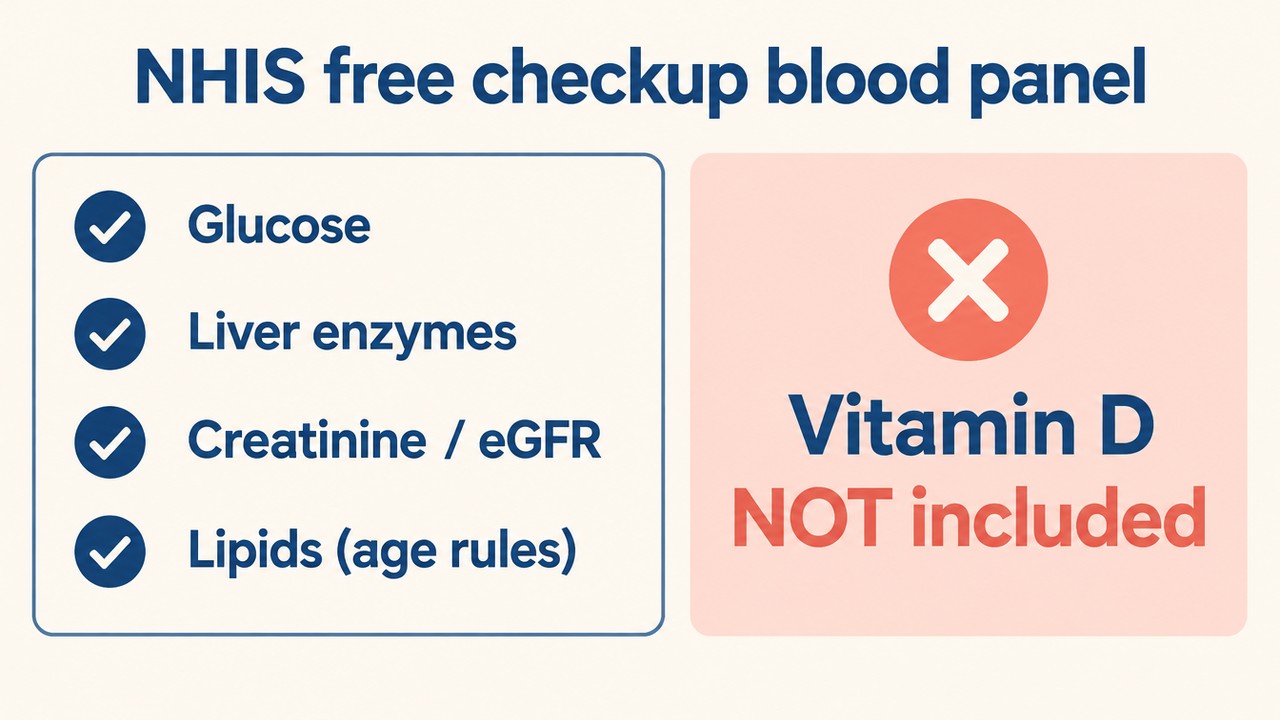
Quick answer: The standard blood marker is 25-hydroxyvitamin D (25-OH vitamin D, 25(OH)D). On the Food and Nutrition Board / NIH bands used internationally: under 12 ng/mL (30 nmol/L) is associated with deficiency risk; 12 to under 20 ng/mL is generally inadequate; 20 ng/mL (50 nmol/L) or higher is generally adequate for bone health in healthy people. Korean osteoporosis / skeletal-health practice commonly treats ≥20 ng/mL as the skeletal target as well. Vitamin D is not part of Korea’s free NHIS general checkup blood panel — if you want the number, it is usually an add-on ordered by a clinic. Routine screening of healthy adults without a reason is not recommended by MedlinePlus-linked Endocrine Society 2024 guidance.
Bone-related checkup items that are on the NHIS calendar — for example the age-based bone-density test — are covered in our bone density test Korea guide. Other common lab lines appear in uric acid / gout ranges and the national checkup by age for expats.

What the lab is actually measuring
MedlinePlus explains the pathway in one sentence worth remembering: before your body can use vitamin D from sun, food or supplements, the liver converts it to 25-hydroxyvitamin D. That is the form most blood tests report, because it reflects overall stores better than the short-lived active kidney product (1,25-dihydroxyvitamin D), which is reserved for special calcium / kidney work-ups.
Results may list total vitamin D, or separate D2 and D3 that sum to the total. For day-to-day reading, total 25(OH)D is the number clinicians discuss.
Cut-offs: read the unit and the guideline
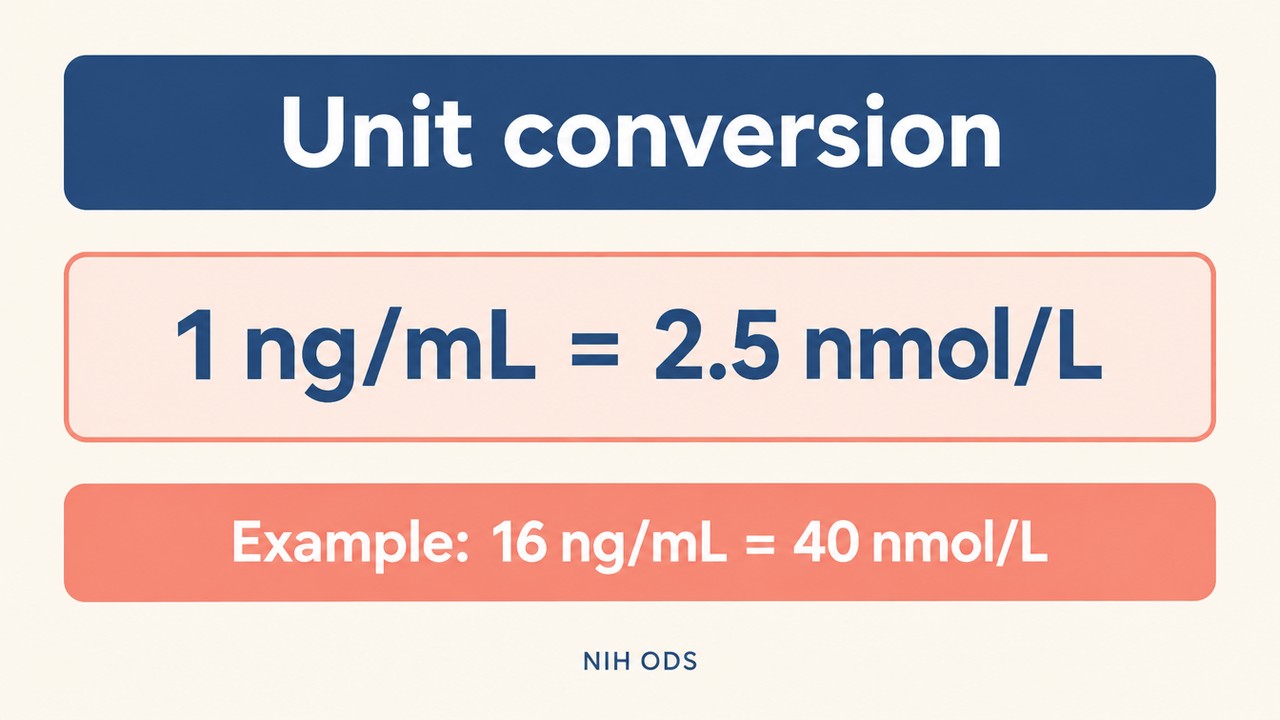
Labs in Korea often print ng/mL. Some overseas printouts use nmol/L. Conversion used by NIH ODS:
- 1 ng/mL ≈ 2.5 nmol/L
- 1 nmol/L ≈ 0.4 ng/mL
Headline bands (Food and Nutrition Board / NIH ODS)
| Serum 25(OH)D | Approx. nmol/L | FNB / NIH health status wording |
|---|---|---|
| < 12 ng/mL | < 30 | Associated with deficiency (rickets / osteomalacia risk) |
| 12 to < 20 ng/mL | 30 to < 50 | Generally inadequate for bone and overall health |
| ≥ 20 ng/mL | ≥ 50 | Generally adequate for bone and overall health in healthy people |
| > 50 ng/mL | > 125 | Linked to potential adverse effects (especially at still higher levels) |
Source: NIH Office of Dietary Supplements — Vitamin D Health Professional Fact Sheet, Table 1 (FNB / NASEM). Checked 2026-11-06.
How Korean practice often lines up
Peer-reviewed Korean clinical summaries note that the Ministry of Health and Welfare and osteoporosis physician guidelines treat ≥20 ng/mL as appropriate for skeletal health — the same headline sufficiency line as the FNB table. Separately, some local clinics still display older Endocrine Society-style labels that called <20 ng/mL “deficient” and <30 ng/mL “insufficient.” The 2024 Endocrine Society guideline, as summarised on the NIH ODS sheet, no longer sets those sufficiency cut-offs for healthy people and does not recommend routine 25(OH)D testing in healthy individuals.
Practical reading tip: when your Korean result sheet shows a coloured flag, ask which guideline the lab used. A value of 18 ng/mL is “inadequate” on the FNB table and may look “deficient” on an older clinic scale that used 20 as the deficiency line.
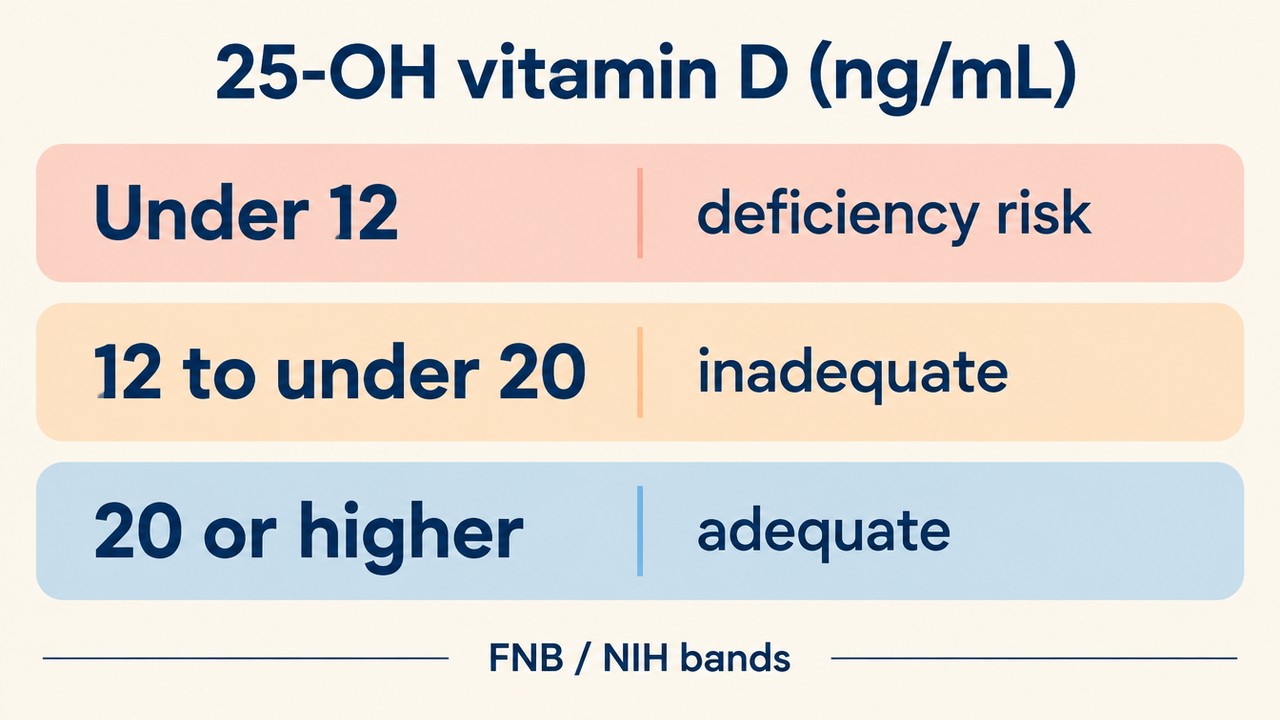
Is vitamin D in Korea’s free national checkup?
No — not as a standard NHIS general-checkup blood item.
The live NHIS general-checkup page lists common blood tests such as hemoglobin, fasting glucose, AST, ALT, γ-GTP, serum creatinine and eGFR, plus age/sex items such as lipids, hepatitis B/C, lung function, bone density (women at 54 / 60 / 66), cognition and depression screening. 25-OH vitamin D is not on that list.
So:
- Your free checkup can flag bone density or other issues that prompt a clinician to order vitamin D later.
- The vitamin D level itself is usually a separate, paid (or insurance-covered under specific diagnostic codes) test ordered at a clinic or hospital.
- Do not assume “I did the national checkup, so my vitamin D was checked.”

Who typically gets tested
MedlinePlus says routine vitamin D testing is not recommended for everyone. A clinician may order 25(OH)D when there is a bone-related diagnosis or symptom pattern, or a higher-risk situation, for example:
- Osteomalacia, osteopenia, osteoporosis, or rickets concerns
- Bone pain, muscle weakness, fragility fractures
- Very limited sun exposure (indoor lifestyle, full covering outdoors, high-latitude winters)
- Malabsorption (celiac disease, inflammatory bowel disease, some bariatric surgery)
- Kidney or liver disease that affects vitamin D activation
- Medicines that interact with vitamin D status (certain steroids, orlistat, some others — discuss with your clinician)
- Monitoring after a clinician has already prescribed replacement
Breastfed infants and some children with low dietary intake are called out on MedlinePlus as groups clinicians watch carefully — often with supplementation guidance, not only with blood tests.
The Endocrine Society 2024 disease-prevention guideline (cited on NIH ODS) suggests empirical supplementation in selected groups (for example children/teens 1–18, adults 75+, pregnancy, prediabetes) in specific contexts, while still not backing population-wide blood screening of healthy adults.
Worked example: reading three sample results
Illustrative only. Not a diagnosis.
| Printed total 25(OH)D | FNB / NIH band | What to ask the clinician (examples) |
|---|---|---|
| 9 ng/mL | Deficiency-associated (<12) | Confirm assay, symptoms, calcium, whether replacement is needed |
| 16 ng/mL | Inadequate (12–<20) | Sun/diet/supplement history; whether bone density or calcium work-up is next |
| 28 ng/mL | Adequate (≥20) on FNB table | May still be “low” on an older clinic scale that wanted 30 — clarify the lab’s reference |
Conversion check for the middle row: 16 ng/mL × 2.5 = 40 nmol/L, which sits in the FNB “30 to <50 nmol/L” inadequate band.
If you already have a bone-density T-score from the NHIS age schedule, bring both papers to the visit. Our bone density post explains the free test ages (54, 60, 66 for women) and T-score labels.

How the blood draw works (and what not to DIY)
MedlinePlus: ordinary venous blood draw; no special fasting is usually required for 25(OH)D, but tell the clinician about all supplements and medicines. Stopping a prescribed medicine on your own to “clean” a result is unsafe.
High levels from supplement overuse can cause nausea, constipation, muscle weakness and, in severe cases, organ and vessel damage. Toxicity from sun exposure alone is not the usual story — excess almost always traces to pills. Upper intake levels on the NIH sheet run up to 100 mcg (4,000 IU)/day for most older children and adults; that is a safety ceiling, not a target dose.
How this fits next to other Korea checkup numbers
| Item | On free NHIS general checkup? | Typical reason you see it |
|---|---|---|
| Fasting glucose / lipids / liver enzymes / creatinine | Yes (with age rules) | Standard panel |
| Bone density (women 54 / 60 / 66) | Yes at those ages | Osteoporosis screen |
| Uric acid | Often clinic add-on / symptom-driven | Gout work-up — see our uric-acid guide |
| 25-OH vitamin D | No (not on the standard list) | Clinician-ordered when indicated |
Use the checkup-by-age expat guide to see which free items appear in your birth-year slot, then ask the clinic separately if a vitamin D add-on is warranted.
Frequently asked questions
Q. What vitamin D number counts as deficient on a blood test?
On the Food and Nutrition Board / NIH table, under 12 ng/mL (30 nmol/L) is associated with deficiency. 12 to under 20 is generally inadequate; 20 or higher is generally adequate for bone health in healthy people.
Q. Is vitamin D included in Korea’s free NHIS general checkup?
No. The standard checkup blood list does not include 25-OH vitamin D. Bone density at set ages is separate and also does not automatically produce a vitamin D result.
Q. Should every healthy adult in Korea get a vitamin D blood test?
Not routinely. MedlinePlus states routine testing is not for everyone; Endocrine Society 2024 guidance (via NIH ODS) does not recommend routine testing of healthy individuals without a clinical reason.
Q. My Korean lab flagged me below 20 ng/mL but NIH says deficiency starts under 12. Which is right?
They answer different questions. <12 is the FNB deficiency-associated band; 20 is the common sufficiency line for skeletal health (also used in Korean skeletal-health practice). Ask which reference your lab printed.
Q. Can I fix a low result with more midday sun instead of seeing a doctor?
Sun helps some people make vitamin D, but UV also raises skin-cancer risk, and low results can reflect absorption or kidney/liver problems. MedlinePlus advises discussing food and supplements with a clinician rather than unsupervised high-dose sun or mega-dose pills.
Sources
- MedlinePlus — Vitamin D Test (25(OH)D; routine testing not for everyone; who may need testing) — https://medlineplus.gov/lab-tests/vitamin-d-test/ (checked 2026-11-06)
- NIH Office of Dietary Supplements — Vitamin D Fact Sheet for Health Professionals (FNB serum table; Endocrine Society 2024 no routine testing note) — https://ods.od.nih.gov/factsheets/VitaminD-HealthProfessional/ (checked 2026-11-06)
- NHIS — General checkup page (common blood items; age-specific list including bone density — no vitamin D) — https://www.nhis.or.kr/nhis/healthin/wbhaca04500m01.do (checked 2026-11-06)
- Endocrine Society 2024 clinical practice guideline on vitamin D for disease prevention (cross-check via NIH ODS citations; no routine healthy-adult screening cut-offs) — Demay et al., J Clin Endocrinol Metab 2024
- Korean clinical review noting MOHW / osteoporosis guideline skeletal target ≥20 ng/mL (independent practice context; not a substitute for NHIS rules) — e.g. discussion in Nutrients / Korean journal summaries citing ≥20 ng/mL skeletal cut-off
Disclaimer
This article is for general information only. It is not medical advice, not a diagnosis, and not a dosing guide. Laboratory reference ranges, insurance coverage for add-on tests, and treatment decisions belong to your clinician and the testing laboratory. If you have bone pain, muscle weakness, a fragility fracture, kidney or liver disease, or you take medicines that affect vitamin D, seek personal medical care.
Related on en.haesul.com: Bone density test Korea · Uric acid normal range Korea · National health checkup by age