Korea Lung Cancer Screening: Who Qualifies at 54–74, What a Pack-Year Is and How to Book Before 31 December
Haesul Health desk (AI-assisted). As of 8 November 2026 (KST), based on the National Health Insurance Service (NHIS) cancer screening policy page, the National Cancer Center (NCC) national cancer screening programme page, the National Medical Center (NMC) health promotion centre page, the Korean Academy of Tuberculosis and Respiratory Diseases (KATRD) patient page, and the 2019 Ministry of Health and Welfare (MOHW) announcement shared by the NCC. This is general information, not medical advice. Talk to a doctor about your own risk, symptoms and results.
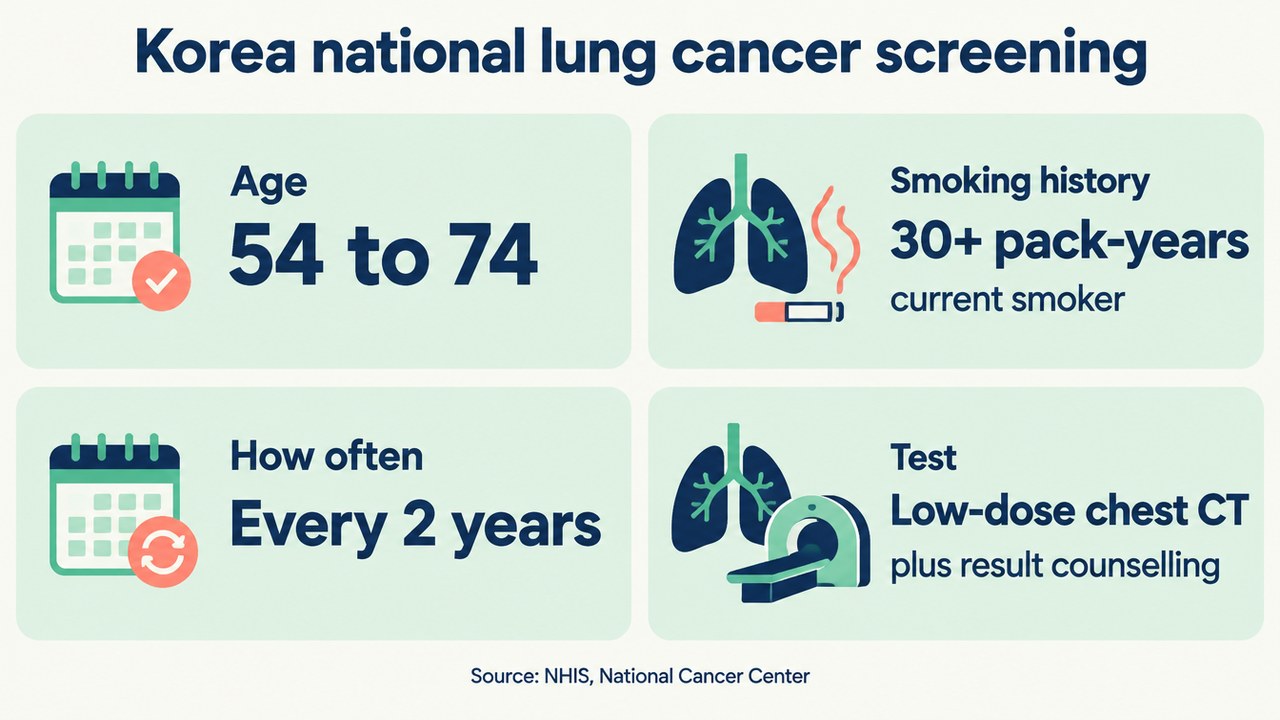
Quick answer: Korea’s national lung cancer screening (국가폐암검진) is for men and women aged 54 to 74 who are at high risk, meaning a smoking history of 30 pack-years or more (packs per day × years smoked) and current smoking, as recorded on a recent national health checkup or NHIS stop-smoking programme questionnaire. People who were screened as high-risk and later quit stay eligible for 15 years after quitting, up to age 74. The test is a low-dose chest CT every 2 years, followed by a results consultation. NHIS pays 90% and you pay 10%; people in the lowest 50% of health-insurance premiums and Medical Aid recipients pay nothing. Like the other national cancer screenings, this year’s invitation must be used by 31 December.
Lung cancer screening is the newest of Korea’s six national cancer screenings. It started in July 2019, after a change to the Cancer Control Act enforcement decree that MOHW announced on 7 May 2019. It differs from the stomach, breast, colon, cervical and liver programmes in one important way: you are selected not by age alone but by your smoking history as written on a questionnaire. That makes the invitation easy to miss, especially for people in their late 50s and 60s who smoked heavily for decades. If you have not had your general health checkup this year either, our Korea national health checkup by age guide explains what else is due.

Who is eligible in 2026
The NHIS cancer screening table lists lung cancer screening for people aged 54–74 who belong to the high-risk group (폐암발생 고위험군). It gives three ways to be counted as high-risk:
| Route into the high-risk group | What NHIS checks |
|---|---|
| National health checkup questionnaire | In the 2 years before the screening year, your general or life-transition checkup questionnaire recorded a smoking history of 30 pack-years or more and current smoking |
| NHIS stop-smoking treatment programme | In the 2 years before the screening year, the questionnaire you filled in to join the programme recorded 30 pack-years or more |
| Already screened as high-risk | You had national lung screening as high-risk, then quit: eligible for up to 15 years after quitting, until age 74 |
The NCC page says the same and adds that the screening cycle is 2 years and the method is low-dose chest CT (저선량 흉부 CT). The MOHW 2019 announcement defined the high-risk group as current smokers with 30 or more pack-years plus anyone the health minister designates by notice. The KATRD patient page notes that, like other cancer screenings, eligible people are selected from the questionnaire data and notified by post.
Two consequences are worth stating plainly:
- Someone who quit years ago, before ever being screened, is generally not in the programme, because the questionnaire route requires current smoking. Former smokers who were never screened should still talk to a doctor about risk; the programme rules are not a medical verdict.
- What you wrote on your checkup questionnaire matters. If you under-reported your smoking, the system may not pick you up. The fix is not to change history but to answer accurately at your next checkup and ask NHIS (1577-1000) or a screening centre about your status.
What a pack-year is, with examples
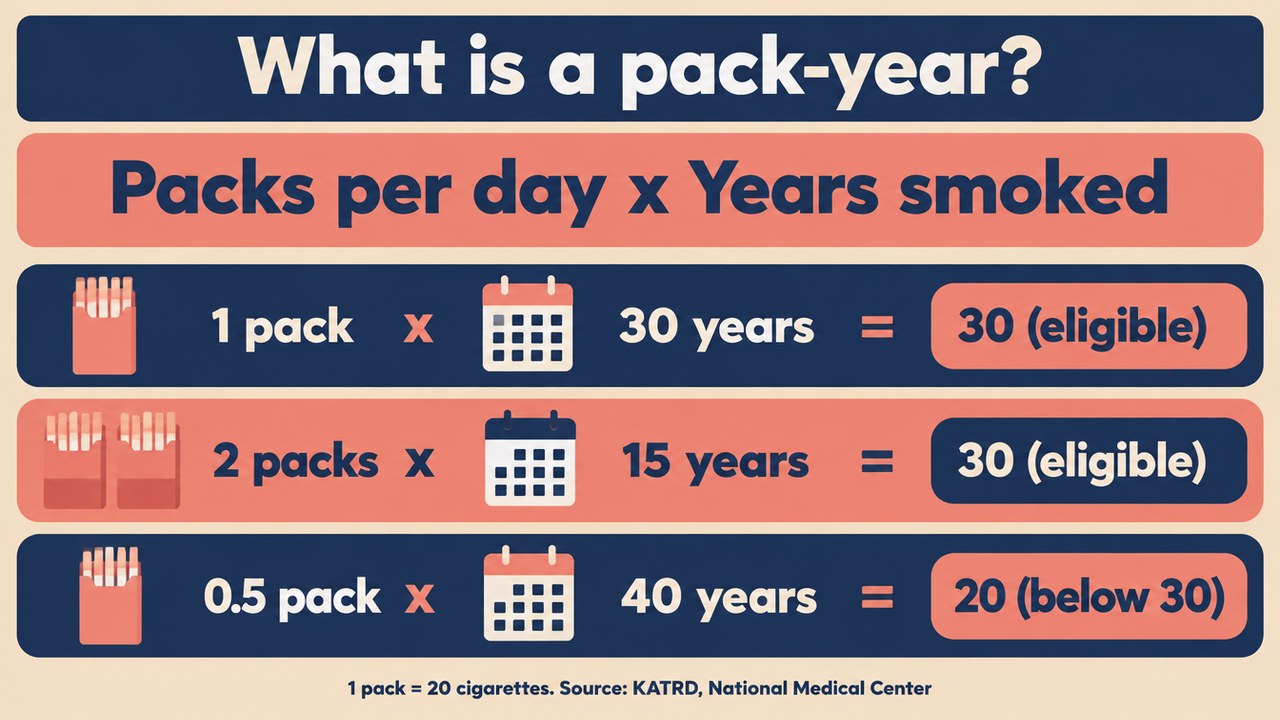
A pack-year (갑년) is the number of packs smoked per day multiplied by the number of years smoked. The NMC defines one pack as 20 cigarettes. The KATRD page gives two examples that both reach 30.
| Smoking history | Calculation | Pack-years | Reaches 30? |
|---|---|---|---|
| 1 pack a day for 30 years | 1 × 30 | 30 | Yes |
| 2 packs a day for 15 years | 2 × 15 | 30 | Yes |
| 1.5 packs a day for 25 years | 1.5 × 25 | 37.5 | Yes (calculated) |
| Half a pack a day for 40 years | 0.5 × 40 | 20 | No (calculated) |
| 10 cigarettes a day for 35 years, then 1 pack a day for 10 years | 0.5 × 35 + 1 × 10 | 27.5 | No (calculated) |
The last rows are our own illustrations using the official formula. If your habit changed over time, add each period separately. A long, moderate habit can fall short of 30 while a shorter heavy one passes, which is why the number on the form, not just “years smoked”, decides the invitation.
What it costs
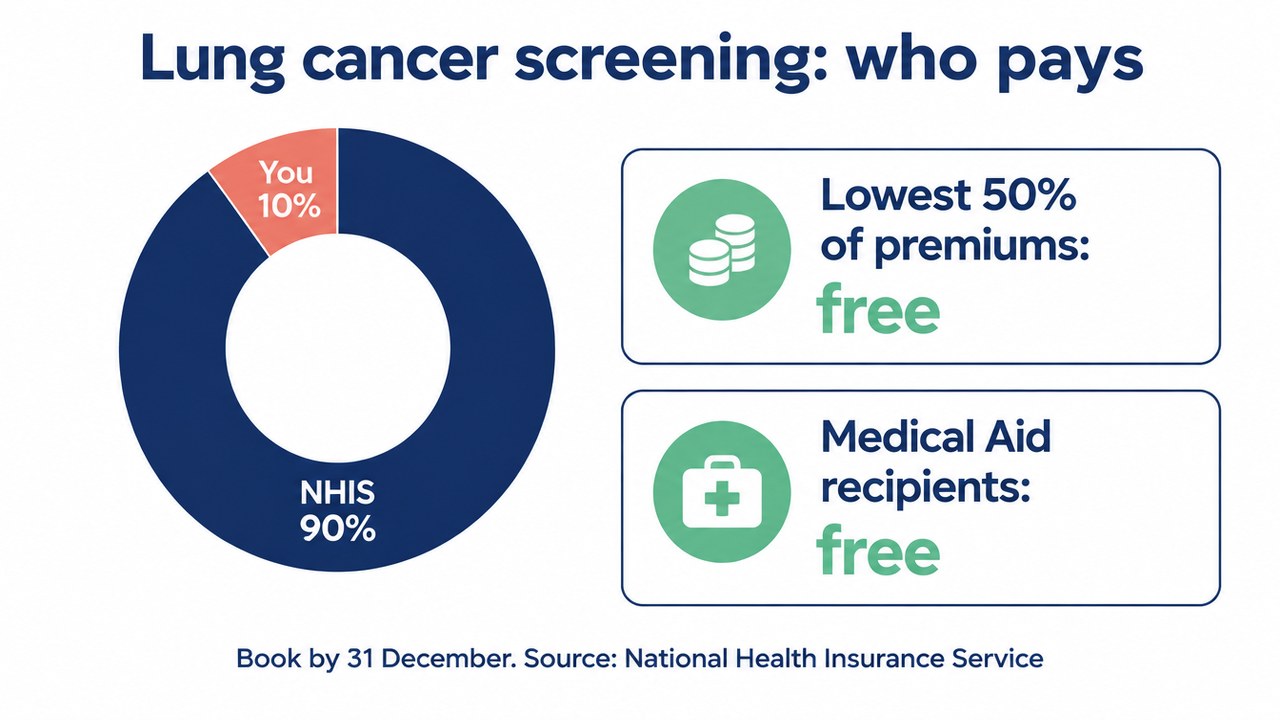
The NHIS cost rule for national cancer screening is NHIS 90%, you 10%. Cervical and colon screening are fully covered; lung, stomach, breast and liver are on the 90/10 split. People whose health-insurance premium in November of the previous year falls in the lowest 50%, plus Medical Aid recipients, pay nothing.
When the programme was announced in 2019, MOHW said the screening cost about ₩110,000 and the patient share would be about ₩10,000. That is a 2019 estimate; today’s fee schedule may differ, so check the amount with the screening centre when you book.
| Your status | What you pay for the national lung screening |
|---|---|
| Ordinary NHIS subscriber or dependant | 10% of the screening fee |
| Premium in the lowest 50% (previous November) | Nothing |
| Medical Aid recipient | Nothing |
| Extra tests the doctor orders after an abnormal result | Normal insurance rules for diagnosis, not the screening programme |
What happens on the day
The screening test is a chest CT scan taken at a low radiation dose, as the name says; the screening centre will explain how the scan is done and what to bring. Afterwards the national programme includes a results consultation (사후 결과 상담), as the NMC page describes, and the NCC programme pairs screening with stop-smoking support for people who still smoke.
Results usually fall into “no significant finding”, “nodule that needs a follow-up scan at a set interval” or “finding that needs further tests soon”. Many small nodules are not cancer, and the follow-up interval is a clinical decision. This post does not interpret results; your doctor does.
Why screening is limited to high-risk smokers
The KATRD page explains that low-dose CT screening has proven benefit in high-risk people, but benefit has not been shown in low-risk people, so screening them is not recommended. Screening also carries harms such as false alarms and extra scans. That is why the Korean programme draws its line at 54–74 and 30 pack-years rather than inviting every adult. It also notes that Korea’s 2015 national cancer screening guideline committee recommended annual low-dose CT for high-risk people, while the national programme runs every 2 years. If you are high-risk and have questions about the interval, that is a conversation for your doctor.
Scenarios for 50s and 60s readers
| Reader | Situation | What it means under the programme |
|---|---|---|
| 56-year-old office worker | Has smoked a pack a day since age 22 (34 pack-years), still smokes, wrote this on his 2025 checkup form | Fits all criteria; look for this year’s invitation or ask NHIS |
| 63-year-old retiree | Smoked 1.5 packs a day for 30 years (45 pack-years), quit at 60, was screened as high-risk at 58 | Still eligible: screened as high-risk, within 15 years of quitting, under 75 |
| 61-year-old shop owner | Smoked a pack a day for 35 years but quit at 50, never screened | Not selected by the questionnaire route (not a current smoker); ask a doctor about personal risk |
| 52-year-old with 40 pack-years | Still smokes | Too young for the programme until 54; stop-smoking support is available now |
| 75-year-old heavy smoker | Still smokes | Over the programme’s upper age; discuss with a doctor |
These are illustrative cases built from the NHIS and NCC rules, not individual advice.
How to book before 31 December
- Check whether you’re on the list. Look for the NHIS screening notice, or check your screening targets on the NHIS website or app, or call NHIS on 1577-1000.
- Find a designated lung screening centre. Not every clinic doing general checkups is designated for lung CT. NHIS lets you search designated screening institutions.
- Book early. Health screening centres get busy in November and December, when many people catch up before the year-end deadline. Our checkup deadline guide covers the year-end crunch in more detail.
- Bring ID and your insurance details. Answer the smoking questions on the day accurately.
- Book the results consultation if it isn’t given on the spot, and keep the follow-up date your doctor sets.
- Ask about stopping smoking. NHIS runs a stop-smoking treatment programme, and stopping is the single most important step a smoker can take for lung health.
If you are also due for other screenings this year, you can often book them together. Our guides cover stomach cancer screening with gastroscopy for everyone 40+ and colon cancer screening with the free FIT test from 50.

How lung screening fits with the other five national cancer screenings
| Cancer | Who | How often | Test |
|---|---|---|---|
| Stomach | 40+ | 2 years | Gastroscopy |
| Liver | 40+ high-risk (cirrhosis, hepatitis B/C) | 6 months | Liver ultrasound + AFP blood test |
| Colorectal | 50+ | 1 year | Faecal occult blood test; colonoscopy if abnormal |
| Breast | Women 40+ | 2 years | Mammography |
| Cervical | Women 20+ | 2 years | Pap smear |
| Lung | 54–74 high-risk | 2 years | Low-dose chest CT |
Source: NCC national cancer screening programme table and NHIS cancer screening table.
Frequently asked questions
Q. Who can get free or cheap lung cancer screening in Korea?
Men and women aged 54 to 74 who are in the high-risk group: a recorded smoking history of 30 pack-years or more and current smoking, or people screened as high-risk who quit within the last 15 years. NHIS pays 90%; the lowest 50% of premium payers and Medical Aid recipients pay nothing.
Q. How do I calculate pack-years?
Multiply packs per day by years smoked, with one pack counted as 20 cigarettes. One pack a day for 30 years, or two packs a day for 15 years, both equal 30 pack-years.
Q. I quit smoking. Can I still get the national lung CT?
If you were already screened under the programme as high-risk, you stay eligible for up to 15 years after quitting, until age 74. If you quit before ever being screened, the questionnaire route requires current smoking, so ask a doctor about your personal risk.
Q. How often is the national lung cancer screening?
Every 2 years, with a low-dose chest CT and a results consultation.
Q. Is low-dose CT recommended for non-smokers?
The Korean Academy of Tuberculosis and Respiratory Diseases says benefit has been shown in high-risk people but not in low-risk people, so screening low-risk people is not recommended. Discuss any symptoms or family history with a doctor.
Sources
- National Health Insurance Service, cancer screening policy page (targets, cycle, lung high-risk criteria, 90/10 cost and exemptions) — https://www.nhis.or.kr/nhis/policy/wbhada19800m01.do (checked 8 November 2026)
- National Cancer Center, national cancer screening programme (six-cancer table, lung high-risk definition, 15-year rule) — https://www.ncc.re.kr/main.ncc?uri=manage01_4 (checked 8 November 2026)
- National Cancer Center press archive: MOHW announcement of 7 May 2019 adding lung screening from 1 July 2019 (about ₩110,000 fee, about ₩10,000 patient share) — https://www.ncc.re.kr/prBoardView1.ncc?nwsId=5499 (checked 8 November 2026)
- National Medical Center health promotion centre, cancer screening (pack-year definition, results counselling) — https://www.nmc.or.kr/health/contents/cancer_checkup (checked 8 November 2026)
- Korean Academy of Tuberculosis and Respiratory Diseases, lung cancer early detection (pack-year examples, low-risk not recommended) — https://www.lungkorea.org/general/disease/disease_04_b.php (checked 8 November 2026)
This article is general information, not medical advice. It does not diagnose or interpret results. For symptoms such as a persistent cough, coughing up blood, chest pain or unexplained weight loss, see a doctor without waiting for a screening invitation.






4 Comments