HbA1c and Fasting Glucose on a Korean Checkup: What 100, 126 and 6.5% Mean
Haesul Health desk (AI-assisted). Last checked: 2026-11-10 (KST); countdown updated 2026-11-13, based on KDCA, the national health checkup criteria, MedlinePlus and the US CDC. The 2026 general checkup window closes in 48 days (December 31, 2026). This is not medical advice; talk to your doctor about your own results.
Quick answer: Get the fasting-glucose / HbA1c row of your Korea checkup done by December 31, 2026 — 48 days left from November 13 (NHIS). On the national sheet, fasting glucose below 100 mg/dL is normal, 100–125 is impaired fasting glucose, and 126+ is suspected diabetes. HbA1c: below 5.7% normal, 5.7–6.4% prediabetes, 6.5%+ diabetes range. One high result is a flag, not a diagnosis. Confirmatory follow-up timing follows the NHIS / KDCA windows on your sheet (often into early next year).

Where these numbers appear on your result sheet
The general health checkup run by Korea’s National Health Insurance Service (NHIS) reports one blood sugar number: fasting blood glucose (공복혈당), in mg/dL. It sits in the “diabetes” row of the result sheet (일반건강검진 결과통보서), next to blood pressure, cholesterol, kidney and liver tests. The national checkup criteria (건강검진 실시기준, Annex 4) list the fasting glucose cut-offs, and HbA1c is not one of the items in that general checkup table.
So where does an HbA1c number come from? Usually from a private or employer-paid checkup package, or from a clinic that runs extra tests after your fasting glucose came back high. If your sheet shows both numbers, read each against its own scale below.
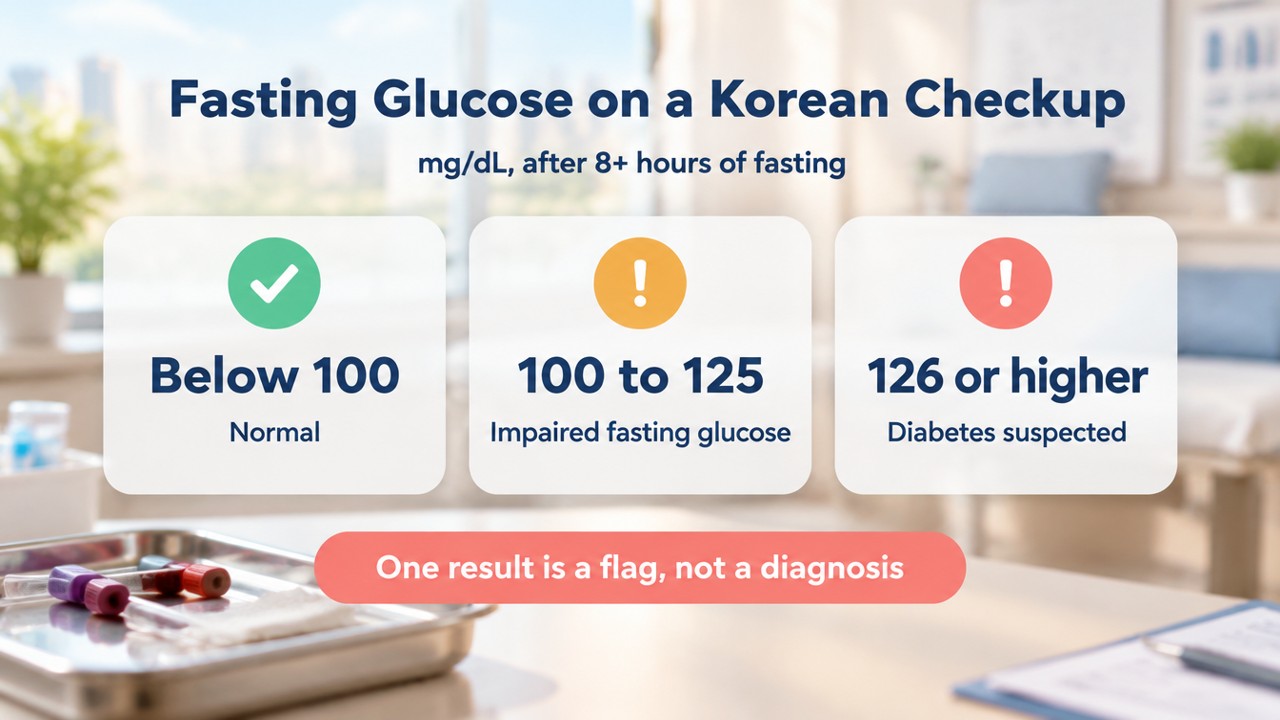
Fasting glucose: the 100 and 126 lines
| Fasting glucose (mg/dL) | Korean checkup label | What it means |
|---|---|---|
| Below 100 | 정상 (Normal A) | Normal fasting level |
| 100–125 | 공복혈당장애 의심 (Normal B / borderline) | Impaired fasting glucose, a form of prediabetes |
| 126 or higher | 당뇨병 의심 (Disease suspected) | In the diabetes range; needs confirmation |
| Already on treatment | 유질환자 | Existing diabetes |
Sources: NHIS checkup criteria Annex 4 and result sheet form (law.go.kr); KDCA National Health Information Portal, diabetes.
“Fasting” means no calories for at least 8 hours, according to the KDCA. If you had a sweet coffee on the way to the checkup, the number is not a true fasting value, so tell the doctor.
The KDCA notes that people with impaired fasting glucose are at higher risk: 5–8% progress to diabetes within one year.
HbA1c: the 5.7 and 6.5% lines
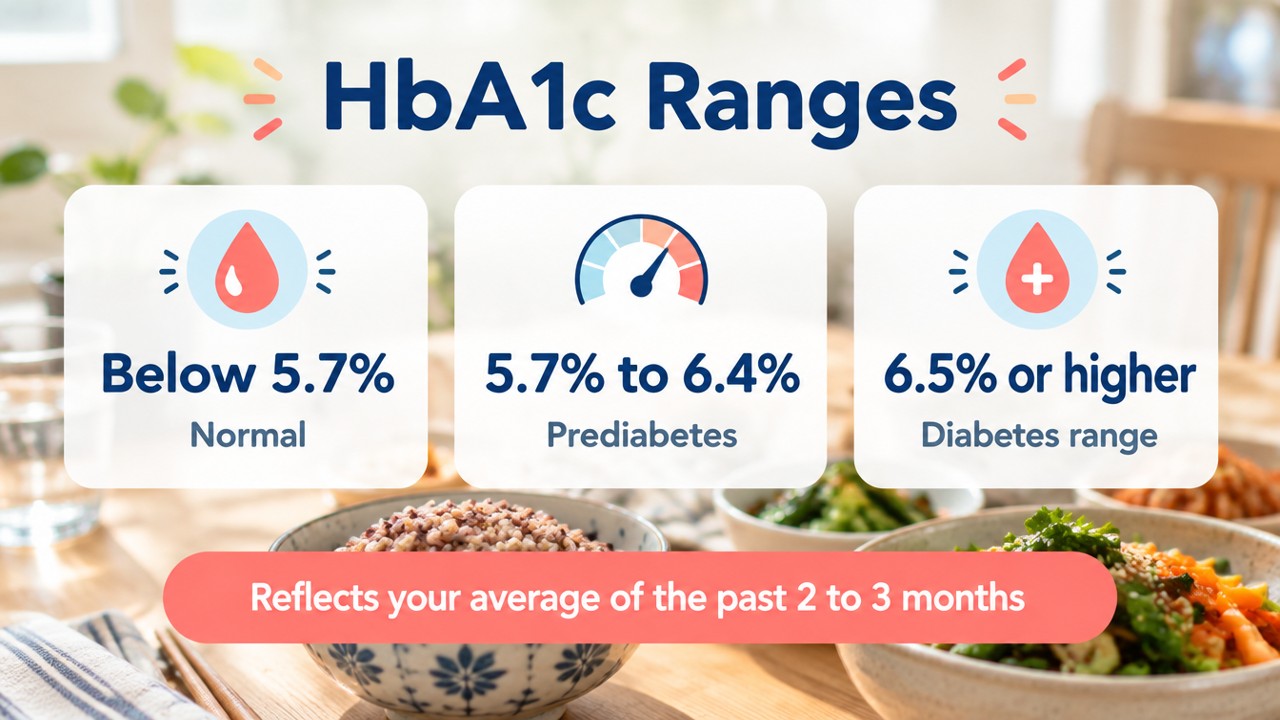
HbA1c (glycated haemoglobin, 당화혈색소) measures how much sugar is stuck to your red blood cells. Because red cells live for a few months, it reflects your average blood sugar over the past 2 to 3 months. It does not require fasting.
| HbA1c | Category |
|---|---|
| Below 5.7% | Normal |
| 5.7–6.4% | Prediabetes |
| 6.5% or higher | Diabetes range |
Korea (KDCA, following the Korean Diabetes Association) and the US (MedlinePlus, CDC) use the same cut-offs.
HbA1c can be misleading if you have anaemia or another blood disorder, kidney failure or liver disease, according to MedlinePlus. The KDCA gives the same caution for anaemia, cirrhosis and reduced kidney function. If one of those applies to you, your doctor may rely more on glucose tests. Our creatinine and eGFR guide explains how kidney function is reported on the same checkup.
Worked example: translating HbA1c into a glucose number
The CDC publishes a conversion from HbA1c to estimated average glucose (eAG). It shows why 6.5% and 126 mg/dL line up so closely.
| HbA1c | Estimated average glucose (mg/dL) |
|---|---|
| 6% | 126 |
| 7% | 154 |
| 8% | 183 |
| 9% | 212 |
| 10% | 240 |
Source: CDC, A1C test.
Example (our illustration, not a diagnosis): a 52-year-old’s sheet shows fasting glucose 118 mg/dL and, from an add-on test, HbA1c 6.1%.
- Fasting 118 is between 100 and 125, so the checkup flags impaired fasting glucose.
- HbA1c 6.1% is between 5.7 and 6.4%, so it is in the prediabetes range too.
- Neither number reaches 126 or 6.5%, so this is not diabetes by the KDCA criteria.
- The KDCA screening guidance puts fasting 110–125 or HbA1c 6.1–6.4% in a higher-risk band where an oral glucose tolerance test (OGTT) is worth considering. Fasting 100–109 or HbA1c 5.7–6.0% means retesting every year, and an OGTT is considered if BMI is 23 or higher.
Now change one number: if the same person’s HbA1c had been 6.7%, they would meet one diabetes criterion. The KDCA says that criterion has to be repeated on a different day unless two different criteria (for example fasting ≥126 and HbA1c ≥6.5%) are met in the same blood sample.
How diabetes is actually diagnosed
According to the KDCA, any one of the following meets the definition of diabetes:
- HbA1c 6.5% or higher
- Fasting plasma glucose 126 mg/dL or higher (after 8+ hours without food)
- 200 mg/dL or higher two hours into a 75 g oral glucose tolerance test
- Classic symptoms (heavy thirst, frequent urination, unexplained weight loss) plus a random glucose of 200 mg/dL or higher
For the first three, a repeat test on a different day is needed. The Korean Diabetes Association’s 2025 guideline notes that in Korean data, the fasting glucose test alone picked up only about 55.7% of people with diabetes. That is one reason doctors often add HbA1c or an OGTT when fasting glucose is borderline.
What to do after a “diabetes suspected” flag
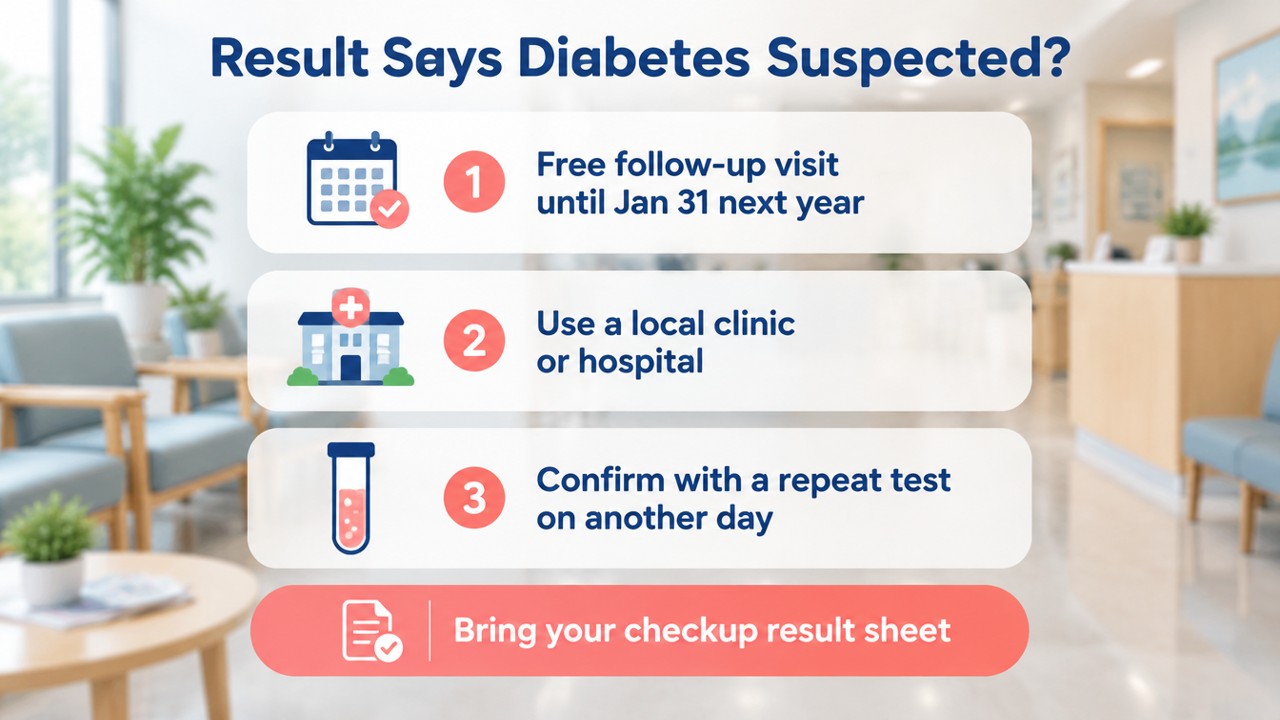
The national result sheet itself spells out a benefit that many people miss: if your checkup flags suspected hypertension or diabetes, you can have one first follow-up consultation and tests at a clinic or hospital (excluding general and tertiary hospitals) with no out-of-pocket charge until 31 January of the year after your checkup. If your 2026 checkup flagged you, that window runs to 31 January 2027.
Practical steps:
- Bring your result sheet to a local clinic (의원) or hospital (병원).
- Expect a repeat fasting glucose and/or HbA1c, and possibly an OGTT.
- Ask what your target is. The KDCA notes the Korean Diabetes Association’s type 2 target is HbA1c below 6.5%, with below 7% commonly used in type 1 and below 7.5% for many older adults. Targets are individual, so your doctor sets yours.
If you have not done your 2026 checkup yet, see our guide to the December 31 checkup deadline and catch-up rules. Cholesterol is usually the next row people worry about; our cholesterol ranges guide covers LDL 130 and 160.
Who is at risk, and what helps
The KDCA’s diabetes page cites a prevalence of 13.8% among Korean adults aged 30 and over (2018 data) and 27.6% among people aged 65 and over. Prevalence passes 10% for men from their 40s and women from their 50s. The KDCA recommends annual screening from age 40, or from age 30 if you have risk factors.
For prediabetes, the KDCA highlights lifestyle steps: at least 150 minutes of moderate exercise a week, and losing 5–10% of body weight if your BMI is 23 or higher. The CDC suggests rechecking every 1 to 2 years if you have prediabetes.
Frequently asked questions
Q. When does the 2026 checkup that includes fasting glucose end?
December 31, 2026 — 48 days left from November 13. NHIS states the general checkup period runs January 1–December 31 each year (NHIS guide).
Q. Is a fasting glucose of 100 to 125 on a Korean checkup diabetes?
No. It is flagged as impaired fasting glucose (공복혈당장애 의심), a prediabetes range. Diabetes starts at 126 mg/dL and must be confirmed with a repeat test.
Q. Does the Korean national checkup include HbA1c?
The general NHIS checkup reports fasting glucose. HbA1c usually comes from a private checkup package or a follow-up test at a clinic.
Q. What HbA1c level means diabetes?
6.5% or higher is in the diabetes range; 5.7% to 6.4% is prediabetes; below 5.7% is normal. A result should be confirmed on another day.
Q. Do I need to fast for an HbA1c test?
No. HbA1c reflects the past 2 to 3 months and does not require fasting, but fasting glucose needs at least 8 hours without food.
Q. Is the follow-up visit after a diabetes flag free?
Yes, once. If the national checkup flags suspected diabetes or hypertension, one first consultation and tests at a clinic or hospital (not a general or tertiary hospital) are free until 31 January of the following year.
Sources
- Korea Disease Control and Prevention Agency, National Health Information Portal, Diabetes (당뇨병), updated 23 October 2026 (checked 4 November 2026)
- National health checkup criteria (건강검진 실시기준), Annex 4 result criteria and general checkup result sheet form, law.go.kr (checked 4 November 2026)
- MedlinePlus (US National Library of Medicine), Hemoglobin A1C (HbA1c) Test (checked 4 November 2026)
- US Centers for Disease Control and Prevention, A1C test for diabetes and prediabetes (checked 4 November 2026)
- Korean Diabetes Association, 2025 Clinical Practice Guidelines for Diabetes (checked 4 November 2026)
This article is not medical advice. It was written with AI assistance and fact-checked against official sources. Talk to your doctor about your own results.
Related reading




7 Comments