Korea Monthly Rent Tax Credit 2026: Rates, the ₩10 Million Cap and the Documents to Submit
Haesul Economy desk (AI-assisted). As of 9 November 2026 (KST), based on the National Tax Service (NTS) monthly-rent credit guide, Article 95-2 of the Restriction of Special Taxation Act and Article 95 of its Enforcement Decree (both read on the Korean Law Information Center), the NTS page on rent cash receipts, the Framework Act on National Taxes, Korea.kr policy briefings, the Ministry of Finance and Economy’s 2026 tax-revision page and Korean Institute of CPAs news. This is general information, not tax advice. Check your own case with your employer’s payroll team, Hometax or the NTS call centre (126).
Quick answer: For rent you pay in 2026, a salaried worker in Korea who heads a home-owning-free household, earns total pay of ₩80 million or less (global income of ₩70 million or less) and rents a home of 85㎡ or less, or with a standard price of ₩400 million or less, can take 17% of the rent (total pay ₩55 million or less and global income ₩45 million or less) or 15% (above that, up to ₩80 million) off their income tax. Only ₩10 million of rent a year counts, so the most the credit can be is ₩1.7 million or ₩1.5 million (calculated). Your lease address must match your resident registration address. You claim it in the January–February 2027 year-end settlement with three documents: a resident registration copy, a copy of the lease and proof of payment. Two 2026 changes help couples living apart and families with three or more children; a ₩12 million cap is only a proposal for rent paid from 2027.
If you are in your 40s, 50s or 60s and paying 월세 (monthly rent) rather than 전세 (a lump-sum deposit), this is one of the few year-end tax items where the money is large and the paperwork is simple. A worker paying ₩700,000 a month can be looking at well over ₩1 million of credit. But the rules are strict on a few points people trip over: who in the household claims, whether the address on the lease matches the address on your resident registration, and whether you also slipped the same rent into the card-and-cash-receipt deduction. This guide walks through each one, with a worked calculation from the official rates. For the wider year-end picture, see our Korea year-end tax settlement guide.

Who can claim the monthly-rent credit for 2026
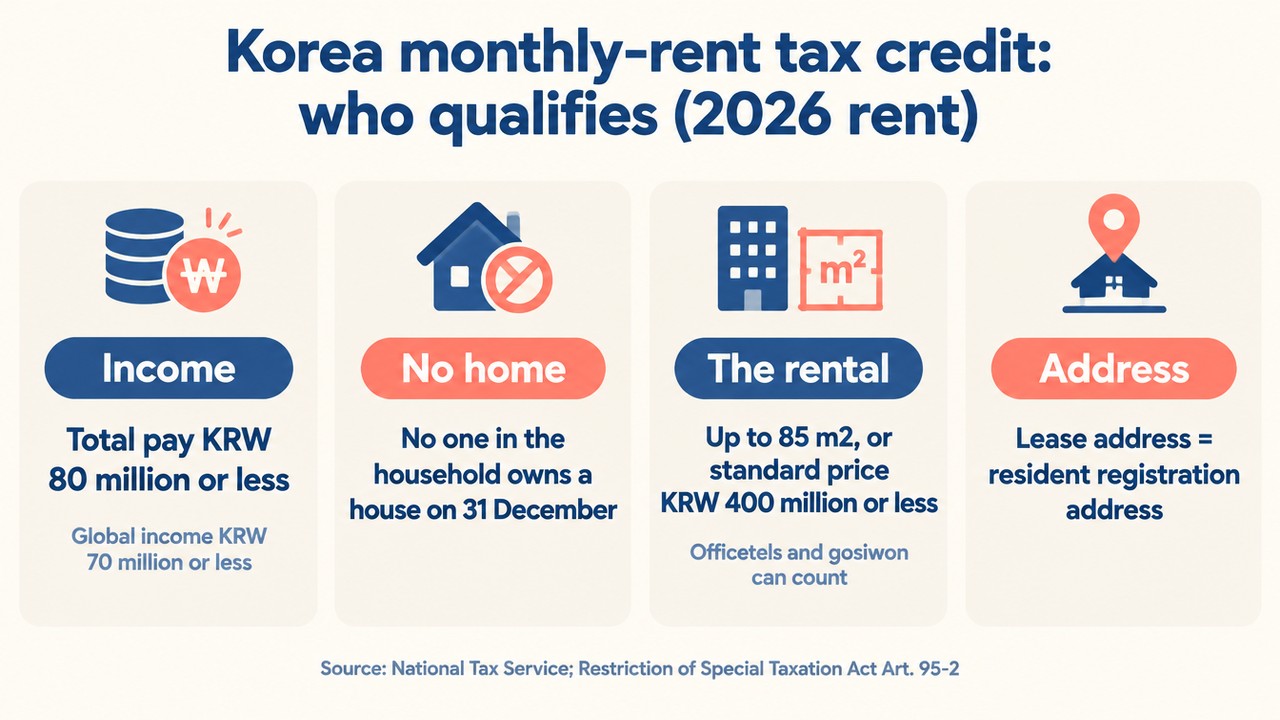
The NTS guide and Article 95-2 of the Restriction of Special Taxation Act (조세특례제한법) set four tests. You need to pass all of them.
| Test | Rule for rent paid in 2026 | Where it comes from |
|---|---|---|
| Income | A worker with wage income whose total pay (총급여) is ₩80 million or less; excluded if global income (종합소득금액) is over ₩70 million | NTS guide; RSTA Art. 95-2(1) |
| No home | On 31 December (the last day of the tax year), the household owns no house. The claimant is the head of household, or a household member if the head takes none of the housing deductions | NTS guide; RSTA Art. 95-2(1) |
| The rental | A home of national-housing size (85㎡ of exclusive floor area) or a standard price (기준시가) of ₩400 million or less. Residential officetels and gosiwon count | NTS guide; Decree Art. 95(2) |
| Address and contract | The address on the lease matches the address on your resident registration, and the lease is in your name or the name of a basic-deduction dependant | NTS guide; Decree Art. 95(2) |
Sources: NTS, “월세액 세액공제” guide; Restriction of Special Taxation Act Art. 95-2 and Enforcement Decree Art. 95, as in force on 9 November 2026 (Korean Law Information Center).
A few details from the decree are worth knowing:
- Household means you and your spouse, plus direct ascendants, descendants and siblings (yours and your spouse’s) who live with you at the same address and share living costs. Your spouse counts as the same household even if you live apart.
- The 85㎡ line is the “national housing size” in the Housing Act. Outside the capital region, in towns and townships (읍·면) that are not urban areas, that size is 100㎡.
- For a multi-household house (다가구주택), the floor area is judged per unit, not for the whole building.
- Registered foreign residents and overseas Koreans with a domestic residence report can claim if they meet the same tests, with their registered stay address standing in for the resident registration address.
The housing-deduction rule matters in practice. If the head of household is already taking the rent credit, the housing-subscription savings deduction (주택청약종합저축) or the housing-loan deductions, another member of the household cannot step in and claim the rent credit in their place.
How much: the two rates and the ₩10 million cap
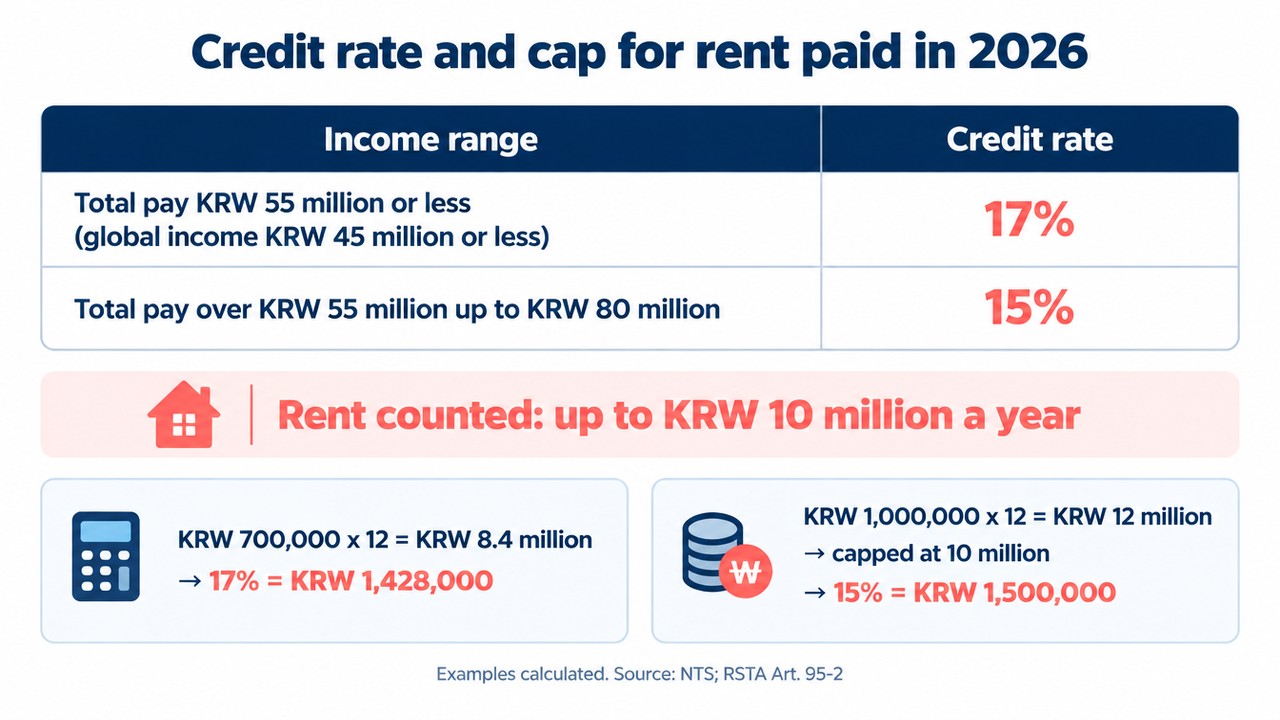
The credit is a percentage of the rent, taken off your calculated income tax (종합소득산출세액). The law sets two rates and one cap:
| Your 2026 income | Credit rate | Rent counted (cap) | Largest possible credit (calculated) |
|---|---|---|---|
| Total pay ₩55 million or less, and global income ₩45 million or less | 17% | ₩10 million a year | ₩10,000,000 × 17% = ₩1,700,000 |
| Total pay over ₩55 million up to ₩80 million (global income ₩70 million or less) | 15% | ₩10 million a year | ₩10,000,000 × 15% = ₩1,500,000 |
| Total pay over ₩80 million, or global income over ₩70 million | No credit | — | — |
Source: RSTA Art. 95-2(1); NTS guide. Maximum amounts calculated by Haesul.
Notice the second condition on the 17% row. If you have other income — rental income, a business, or large financial income — your global income can push you into the 15% band, or out of the credit entirely, even when your salary alone looks low.
Worked examples
These use the official rates and cap. They assume you pass every test above and that the rent is the only amount under the lease (no maintenance fee mixed in).
| Example | Monthly rent | Months paid in 2026 | Rent paid | Rent counted | Rate | Credit (calculated) |
|---|---|---|---|---|---|---|
| A — total pay ₩48 million | ₩700,000 | 12 | ₩8,400,000 | ₩8,400,000 | 17% | ₩1,428,000 |
| B — total pay ₩68 million | ₩700,000 | 12 | ₩8,400,000 | ₩8,400,000 | 15% | ₩1,260,000 |
| C — total pay ₩68 million | ₩1,000,000 | 12 | ₩12,000,000 | ₩10,000,000 (cap) | 15% | ₩1,500,000 |
| D — total pay ₩48 million, moved in on 1 July | ₩600,000 | 6 | ₩3,600,000 | ₩3,600,000 | 17% | ₩612,000 |
Calculations by Haesul from RSTA Art. 95-2(1) rates and cap.
Example D follows the decree’s method (we rounded to whole months; the decree’s day count can differ slightly): the rent counted is the total rent due over the lease, divided by the number of days in the lease, multiplied by the days you actually rented in the tax year. If you moved in mid-year, only that part of the year counts.
Two limits on what you actually get back:
- The credit comes off your calculated tax. If your tax for the year is smaller than the credit, the unused part is not paid to you as cash. Your real refund depends on your tax and your other credits.
- Rent above ₩10 million in a year is treated as if it did not exist for this credit. In Example C, ₩2 million of rent earns nothing.

What changed for 2026: couples living apart and families with three children
Two changes apply to rent paid from 1 January 2026, so they show up for the first time in the settlement you will do in early 2027.
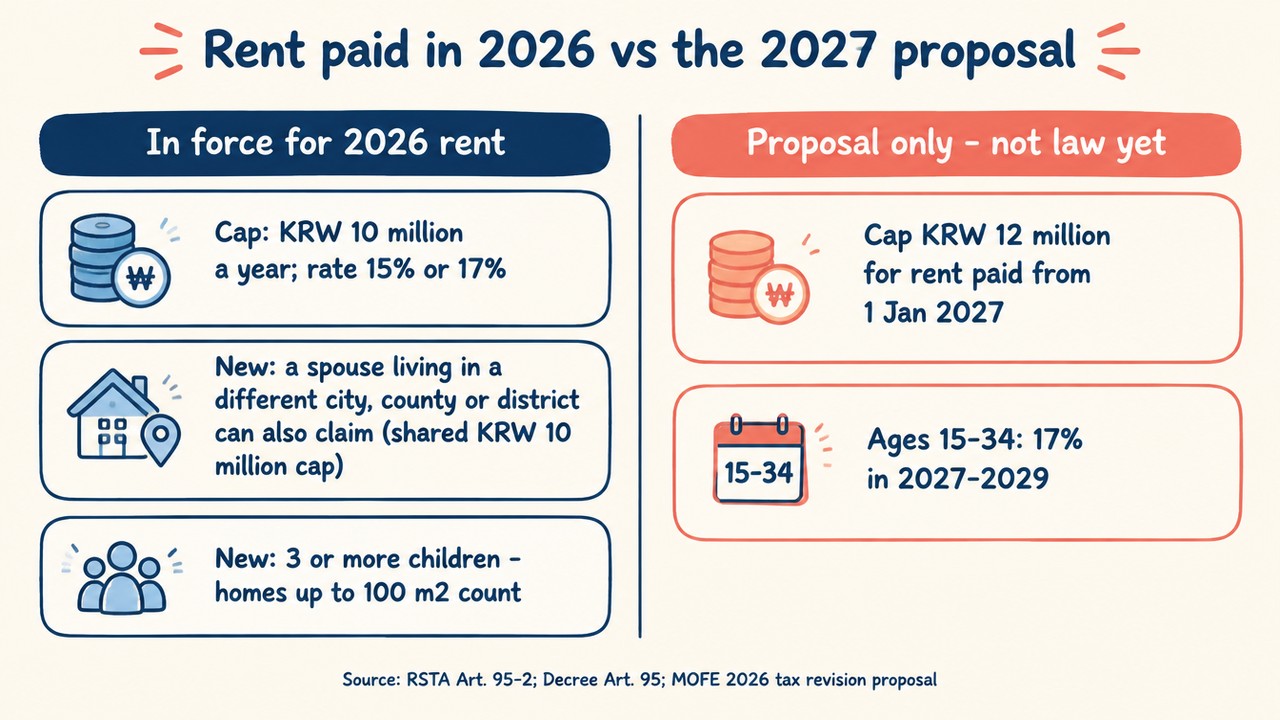
1. A spouse living in a different city, county or district can claim too. Until 2025, a married couple counted as one household, so only one of them could take the rent credit. The December 2025 amendment added Article 95-2(2): if the head of household takes the credit, a spouse who also meets all the tests can take it as well. The decree (Art. 95(5)) adds two conditions: the spouse’s address must be in a different 시·군·구 (city, county or autonomous district) from the head’s, and any relatives living with the spouse must not own a house on 31 December. The ₩10 million cap is shared: if the couple’s rent adds up to more than ₩10 million, the excess is cut from the spouse’s amount.
| Couple example (each passes every test) | Head of household | Spouse | Couple total |
|---|---|---|---|
| Rent paid in 2026 | ₩7,000,000 | ₩5,000,000 | ₩12,000,000 |
| Rent counted (₩10M shared cap) | ₩7,000,000 | ₩3,000,000 (₩2,000,000 cut) | ₩10,000,000 |
| Credit at 17% for both (calculated) | ₩1,190,000 | ₩510,000 | ₩1,700,000 |
Rule: RSTA Art. 95-2(2), Decree Art. 95(5); summary in Korea.kr “2026 이렇게 달라집니다” (23 January 2026) and KICPA news (24 December 2025). Calculation by Haesul.
This is aimed at weekend couples (주말부부): for example, one spouse renting near a job in Sejong while the other rents in Seoul. Two addresses in different districts of the same city count as different 구, but two addresses in the same district do not.
2. Families with three or more children get a bigger size limit. If your basic-deduction dependants include three or more children or grandchildren (adopted and foster children count), the home may have up to 100㎡ of exclusive floor area, wherever it is, or a standard price of ₩400 million or less. Everyone else keeps the 85㎡ (100㎡ in rural towns and townships) rule.
Not law yet: the ₩12 million cap and 17% for young workers
You may have seen headlines that the cap is rising to ₩12 million. The government’s 2026 tax revision proposal, announced in August 2026, would raise the cap from ₩10 million to ₩12 million for everyone and give workers aged 15 to 34 the 17% rate regardless of pay band for 2027–2029. The ministry’s examples say a worker on ₩70 million paying ₩1 million a month would go from ₩1.5 million to ₩1.8 million of credit, or to ₩2.04 million if aged 15–34. Reports of the proposal say it would apply to rent paid from 1 January 2027. It still has to pass the National Assembly, so do not use it for rent you paid in 2026.
Documents to submit, and how to claim
The NTS lists three documents to give your employer at the year-end settlement:
- Resident registration copy (주민등록표등본) — shows your address and household, so the payroll team can match it to the lease.
- A copy of the lease (임대차계약증서 사본) — showing the tenant, the address, the period and the rent.
- Proof of payment — bank transfer receipts, deposit slips (무통장입금증) or similar records of the rent actually paid.
The credit applies only if you apply for it (RSTA Art. 95-2(3)). Do not assume the rent will be filled in for you from the Hometax simplified data; the NTS asks you to hand the documents to your employer.
A practical order for the next few weeks:
- Now (November–December): check that your resident registration address matches the lease exactly, including unit number. If you moved in during 2026, check when your move-in report (전입신고) was registered.
- Gather 12 months of transfers. Rent paid in cash with no record is the hardest to prove. Pay from a bank account to the landlord named on the lease where you can.
- Separate maintenance fees. If one transfer covers rent and maintenance, keep the lease or a landlord statement showing what part is rent.
- January–February 2027: submit the three documents with your deduction form to your employer.
If your employer’s settlement misses the credit, you can claim it in the May 2027 global income tax return, or file a correction claim (경정청구). The Framework Act on National Taxes (Art. 45-2) allows a correction claim within five years after the statutory deadline, and the same rule applies to year-end-settled wage tax.
Do not double-claim with rent cash receipts
If your landlord is not a business, the NTS lets a tenant report the rent on Hometax so that a cash receipt is issued for each month’s rent; that receipt can go into the credit-card and cash-receipt deduction (see our card and cash-receipt deduction guide). The NTS is explicit that the same rent cannot be used for both the monthly-rent credit and the cash-receipt deduction, and that a duplicate claim can later be clawed back. If your simplified data shows rent cash receipts and you are taking the rent credit, ask payroll to remove those receipts from your card total.

Common reasons a claim fails
| Situation | Why it fails or shrinks |
|---|---|
| You bought a home in December 2026 | The no-home test is checked on 31 December, so the whole year’s rent is out |
| Your parent, who lives with you and owns a flat, is on your resident registration | The household (people living with you and sharing costs) must own no house |
| The lease is in your adult child’s name and they are not your dependant | The contract must be in your name or a basic-deduction dependant’s name |
| Your registration is still at your old address | The lease address and resident registration address must match |
| You and your spouse both rent in the same 구 | The spouse claim needs addresses in different 시·군·구 |
| Total pay ₩52 million, but rental income lifts global income above ₩45 million | You drop to 15%; over ₩70 million global income, no credit at all |
| Rent ₩1.1 million a month | Only ₩10 million a year counts; ₩3.2 million earns nothing |
Rules from RSTA Art. 95-2 and Decree Art. 95; examples by Haesul.
If you are in your 40s, 50s or 60s
- Renting after a home sale. Many people in their 50s sell a home and rent for a while. If no one in the household owns a house on 31 December 2026, the rent paid this year can qualify, even for the months before the sale — but if you bought another home before year-end, it cannot.
- Living with an elderly parent. If your parent lives with you and still owns a house, the household test can fail. Whether a parent counts as part of the household depends on sharing the address and living costs; check before you count on the credit.
- Supporting a child who rents. The lease can be in a basic-deduction dependant’s name, but the credit still belongs to the claimant who meets the income and household tests, and the address must match. Do not try to claim a non-dependant adult child’s rent.
- Stacking with other year-end items. The rent credit sits alongside the medical expense tax credit and the IRP and pension savings credit. All of them come off the same calculated tax, so a very large total may not be fully usable in one year.
Frequently asked questions
Q. What is the monthly rent tax credit rate in Korea for 2026?
For rent paid in 2026, the rate is 17% if your total pay is ₩55 million or less and your global income is ₩45 million or less, and 15% if total pay is over ₩55 million up to ₩80 million (with global income of ₩70 million or less). Above that, there is no credit. Only ₩10 million of rent a year counts, so the largest credit is ₩1.7 million at 17% or ₩1.5 million at 15% (calculated).
Q. Which documents do I need for the 월세 tax credit?
The NTS lists three: a resident registration copy (주민등록표등본), a copy of the lease, and proof of payment such as bank transfer receipts or deposit slips. Give them to your employer with your deduction form at the January–February 2027 year-end settlement. The credit applies only when you claim it, so do not rely on the Hometax simplified data to fill it in.
Q. Can both spouses claim the monthly rent credit in 2026?
Yes, from rent paid on or after 1 January 2026, if the head of household takes the credit and the spouse also meets every test, lives at an address in a different city, county or district (시·군·구), and the relatives living with the spouse own no house. The couple shares one ₩10 million cap; any excess is cut from the spouse’s amount.
Q. Is the cap ₩12 million now?
Not for 2026 rent. The ₩12 million cap, and a flat 17% for workers aged 15–34 in 2027–2029, are part of the government’s 2026 tax revision proposal. Reports say they would apply to rent paid from 1 January 2027, and they still need National Assembly approval. Rent paid in 2026 uses the ₩10 million cap.
Q. I forgot to claim the rent credit in an earlier year. Can I still get it?
Usually, yes. You can claim it in the May global income tax return, or file a correction claim (경정청구) on Hometax or at your tax office. The Framework Act on National Taxes allows a correction claim within five years after the statutory deadline. You will need the same documents for the year in question, and you cannot also have used that rent for the cash-receipt deduction.
Sources
- National Tax Service, “월세액 세액공제” (eligibility, housing, rates, ₩10 million cap, three documents) — https://nts.go.kr/nts/cm/cntnts/cntntsView.do?cntntsId=239025 (confirmed 9 November 2026)
- Restriction of Special Taxation Act, Art. 95-2 (월세액에 대한 세액공제), in force 18 September 2026, incl. para. (2) added 23 December 2025 — https://www.law.go.kr/LSW/lsLinkProc.do?joNo=009502&lsNm=%EC%A1%B0%EC%84%B8%ED%8A%B9%EB%A1%80%EC%A0%9C%ED%95%9C%EB%B2%95&mode=11 (confirmed 9 November 2026)
- Enforcement Decree of the Restriction of Special Taxation Act, Art. 95 (household, housing incl. 100㎡ for three children, rent calculation by days, foreigners, spouse conditions) — https://www.law.go.kr/LSW/lsLinkProc.do?joNo=009500&lsNm=%EC%A1%B0%EC%84%B8%ED%8A%B9%EB%A1%80%EC%A0%9C%ED%95%9C%EB%B2%95+%EC%8B%9C%ED%96%89%EB%A0%B9&mode=11 (confirmed 9 November 2026)
- National Tax Service, “현금거래 확인신청 제도 / 주택임차료 신고” (rent cash receipts; not combinable with the rent credit) — https://www.nts.go.kr/nts/cm/cntnts/cntntsView.do?cntntsId=7798 (confirmed 9 November 2026)
- National Tax Service notice, 7 January 2026, “연말정산 월세세액공제(현금영수증공제 중복불가)” — https://www.nts.go.kr/nts/na/ntt/selectNttInfo.do?nttSn=1347700 (confirmed 9 November 2026)
- Framework Act on National Taxes, Art. 45-2 (correction claims within five years) — https://www.law.go.kr/LSW/lsLinkProc.do?joNo=004502&lsNm=%EA%B5%AD%EC%84%B8%EA%B8%B0%EB%B3%B8%EB%B2%95&mode=11 (confirmed 9 November 2026)
- Korea.kr (Ministry of Land, Infrastructure and Transport), 23 January 2026, “달라지는 부동산 제도: 세제·금융 편” (spouse claim, couple cap ₩10 million, 100㎡ for three children) — https://www.korea.kr/news/policyFocusView.do?newsId=148958477&pkgId=49500831 (confirmed 9 November 2026)
- CPA News (Korean Institute of Certified Public Accountants), 24 December 2025, “2026년부터 바뀌는 주요 제도” — https://news.kicpa.or.kr/news/articleView.html?idxno=2211 (confirmed 9 November 2026)
- Korea.kr (NTS), 11 August 2026, “청년, 중산·서민층 주거비 부담 완화 ‘월세 세액공제’” (2026 tax revision proposal: ₩12 million cap, 17% for ages 15–34 to 2029, examples) — https://www.korea.kr/news/policyNewsView.do?newsId=148969841 (confirmed 9 November 2026)
- Ministry of Finance and Economy, “2026년 세제개편안” policy page (월세세액공제 한도 1,000→1,200만원; youth 17% to 2029) — https://mofe.go.kr/2026/taxlaw.do (confirmed 9 November 2026)
- Money Today, 12 August 2026, “월세 공제 한도 1200만원으로… 청년은 소득 관계없이 17%” (applies to rent paid from 1 January 2027) — https://www.mt.co.kr/estate/2026/08/12/2026081213423162342 (confirmed 9 November 2026)
This article is general information, not tax advice. Rules can change with each year’s tax law. Your actual credit depends on your own income, household and tax liability; confirm with your employer, Hometax or the NTS call centre (126) before you file.





2 Comments