Back or Neck Pain in Korea: Orthopedics, Korean Medicine or Physio, NHIS Cover and Costs
Haesul Health desk (AI-assisted). As of 19 November 2026 (KST). Based on the 2026 national fee schedule (Ministry of Health and Welfare notice 2026-114, in force from 1 June 2026), the National Health Insurance Service (NHIS) conversion factors for 2026, the Ministry of Health and Welfare (MOHW) releases on manual therapy (1 July 2026), chuna therapy (26 March 2019) and the herbal-medicine pilot (28 April 2024), MOHW’s spine MRI coverage rules (from 1 March 2022) and the Health Insurance Review and Assessment Service (HIRA) non-covered price data. Independent cross-checks: Yonhap, News1 (via Financial News), the Korean Medical Association’s newspaper, two HIRA price-data sites and the UK’s NHS. General information, not medical advice.
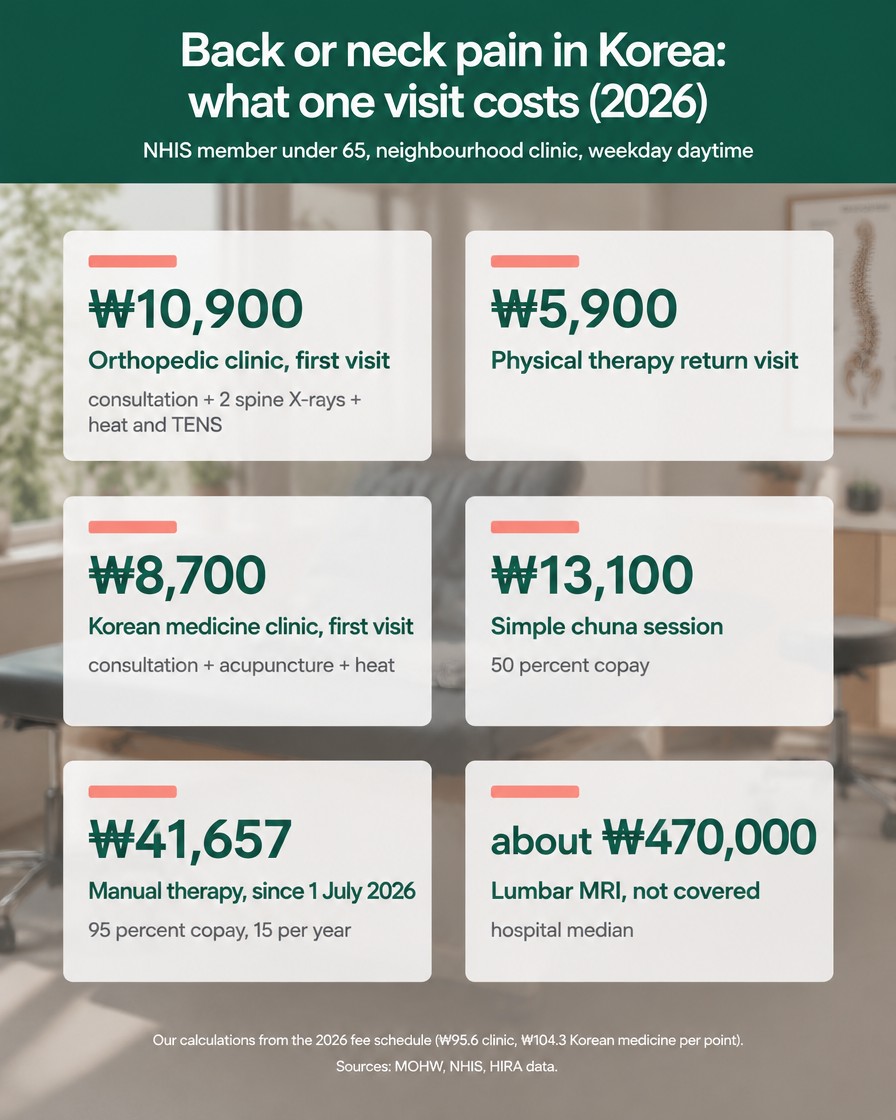
Quick answer: For ordinary back or neck pain in Korea, start at a neighbourhood orthopedic clinic (정형외과, jeonghyeong-gwa) or a Korean medicine clinic (한의원, hanuiwon). Both accept walk-ins and both are covered by NHIS. Korea has no stand-alone physiotherapy practices: physical therapy (물리치료) is ordered by a doctor and given inside a clinic or hospital. With NHIS, a first orthopedic visit with two spine X-rays and a heat-and-electrotherapy session costs about ₩10,900, and each later therapy visit about ₩5,900. A first Korean medicine visit with acupuncture is about ₩8,700, and a simple chuna session adds about ₩13,100 (all our calculations from the 2026 fee schedule, under-65 NHIS members, weekday daytime). Manual therapy (도수치료) now has one national price: ₩43,850 a session, of which you pay ₩41,657, since 1 July 2026. Call 119 at once if back pain comes with numbness in both legs, numbness around the genitals or bottom, or loss of bladder or bowel control.

Why now: winter and long desk hours are when many people notice a stiff neck or a sore lower back, and the rules changed this year. From 1 July 2026, MOHW moved manual therapy into a new “managed benefit” (관리급여) category with one fixed price and an annual cap, ending a market where MOHW says a session averaged about ₩110,000. On 19 November 2026, News1 reported (via Financial News) that two large insurers saw manual-therapy claims fall by about 90 percent, while claims for other non-covered musculoskeletal treatments such as stretch-and-spray therapy (신장분사치료) rose. For patients, that means one thing: ask which part of your bill is covered and which is not before you agree to extras. Separately, the government’s herbal-medicine insurance pilot, which covers some lumbar disc patients, is scheduled to end on 31 December 2026.
Who this applies to
- Foreign residents on NHIS (employees, students and anyone enrolled after six months in Korea) pay the same copays as Korean members. Our guide to NHIS for foreigners explains enrolment and premiums, and if you’re a regional (self-employed or non-employee) member, our explainer on why the regional NHIS bill changed in November 2026 covers the bill side.
- Visitors and anyone not yet on NHIS pay the full fee. Our worked examples show the full amounts too.
- The figures below are for adults under 65 at a neighbourhood clinic (의원 or 한의원) on a weekday during normal hours. Hospitals add a surcharge of 5 to 15 percent and charge higher copays; Saturday mornings, nights and holidays cost more.
Three doors: orthopedics, Korean medicine and physical therapy
| Orthopedic clinic (정형외과) | Korean medicine clinic (한의원) | Physical therapy (물리치료) | |
|---|---|---|---|
| Who treats you | Medical doctor (also: rehabilitation medicine 재활의학과, pain clinic 마취통증의학과, neurosurgery 신경외과) | Doctor of Korean medicine (한의사) | Licensed physical therapist, on a doctor’s order |
| Typical first visit | Examination, X-ray, pain medicine or injection, physical therapy | Examination, acupuncture, heat, sometimes cupping or chuna | Heat packs, ultrasound, TENS or interferential current, exercise |
| Imaging | X-ray on site; MRI at some clinics or at a hospital | Usually none; go to a medical clinic for X-ray or MRI | None |
| Covered by NHIS | Consultation, X-ray, physical therapy, most medicines | Consultation, acupuncture, moxibustion, cupping, chuna (50 or 80 percent copay) | Basic physical therapy (30 percent at clinics); manual therapy at 95 percent |
| Usually not covered | Most spine MRI, shockwave, prolotherapy | Most herbal medicine | Therapy for “fatigue” or posture correction |
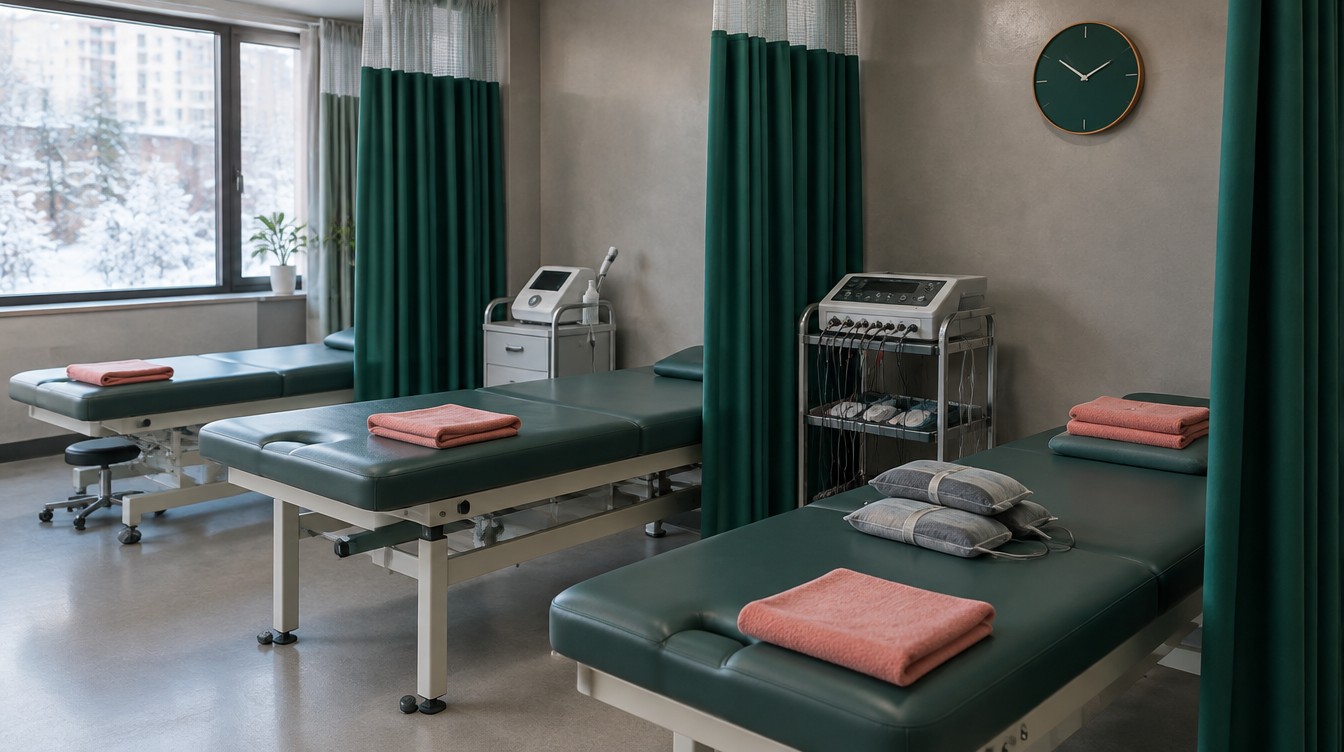
Physical therapy is not a separate door. Korea’s Medical Service Technologists Act defines physical therapists as working under a doctor’s (or dentist’s) direction, and the Ministry of Government Legislation ruled in 2015 that they can’t treat patients outside a medical institution, even with a doctor’s prescription. In practice you book an orthopedic or rehabilitation clinic, the doctor examines you and prescribes therapy, and the clinic’s therapy room (물리치료실) treats you, often the same day.
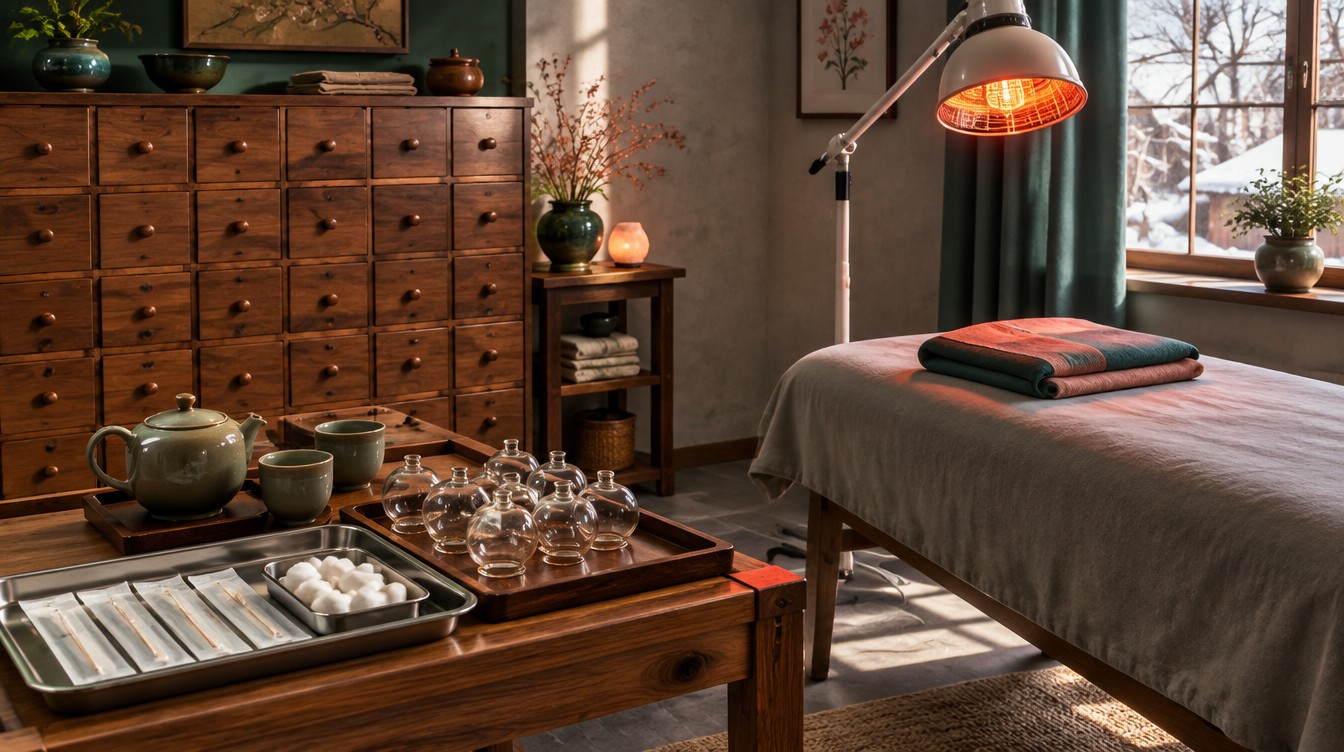
Korean medicine is a separate, licensed profession with its own clinics and its own NHIS fee book. Acupuncture (침, chim), moxibustion (뜸, tteum), cupping (부항, buhang) and chuna (추나, a hands-on manipulation technique) are all on the NHIS list. A 한의원 has its own heat and cold therapies on the Korean medicine fee list rather than doctor-ordered physical therapy, and for an X-ray or MRI you’d go to a medical clinic or hospital. Many people try one and then the other; NHIS doesn’t stop you seeing both, though you can’t claim two chuna or two manual-therapy sessions on the same day.
What NHIS covers for back and neck pain
Covered at the normal clinic copay (30 percent): the consultation, standard X-rays, basic physical therapy (superficial heat, deep heat such as therapeutic ultrasound, TENS or interferential current, traction, therapeutic exercise), and in Korean medicine clinics the consultation, acupuncture, electro-acupuncture, moxibustion, cupping and heat or cold therapy. In the 2026 fee book, a first visit at a clinic is 197.12 points and a 한의원 first visit 152.06 points. NHIS’s 2026 conversion factors are ₩95.6 per point for medical clinics and ₩104.3 for Korean medicine.
Chuna (추나요법): covered since 8 April 2019, up to 20 sessions a year per patient across all clinics. MOHW set the copay at 50 percent, except complex chuna for conditions other than a herniated disc or spinal stenosis, at 80 percent. Chuna is outside the annual out-of-pocket cap.
Manual therapy (도수치료): since 1 July 2026 it is a “managed benefit” with a fixed ₩43,850 per 30-minute session and a 95 percent copay, so you pay ₩41,657 and NHIS pays ₩2,193. MOHW’s Q&A sets these conditions:
- It’s for musculoskeletal conditions with ongoing pain or loss of function (low back pain, spinal stenosis, joint stiffness and similar), done one-to-one by a doctor or physical therapist.
- You must first have basic physical therapy or simple rehabilitation at least 4 times over at least 2 weeks (it can be at another clinic).
- Maximum 2 sessions a week and 15 a year (24 after surgery or a fracture with clear joint stiffness, on the doctor’s judgment); one session per day however many areas are treated; for 2026 the 15 count runs from 1 July.
- Manual therapy for fatigue or “body shape correction” is non-covered, and neither NHIS nor private medical insurance pays for it.
Spine MRI: covered only in set cases. Since 1 March 2022 the rules cover suspected tumours, infection, fractures, dislocation and some other spinal diseases, and degenerative problems (disc, stenosis) only when there are clear neurological findings: marked radiating pain with muscle weakness of grade 4 or below, a worsening neurological deficit, or cauda equina syndrome. Then it is covered once at diagnosis, with the clinic filing a standard results form. A “just to check” MRI for back pain is non-covered.
Herbal medicine (첩약): usually non-covered. Under MOHW’s second-stage pilot (29 April 2024 to 31 December 2026), lumbar disc herniation is one of six covered conditions, at participating clinics only: 30 percent copay at a 한의원, up to 20 days of medicine per condition a year. MOHW put the cost at roughly ₩40,000 to ₩80,000 for 10 days. We found no announcement of what replaces the pilot after 31 December 2026.
What it costs in 2026: the fee-schedule numbers
These are NHIS prices: points from the 2026 fee book times the 2026 conversion factor. Clinics (의원 and 한의원) carry no type surcharge. Each row is the total fee before your copay (our calculation).
| Item (fee-book code) | Points | Total fee |
|---|---|---|
| First visit, medical clinic (AA154) | 197.12 | ₩18,840 |
| Return visit, medical clinic (AA254) | 139.85 | ₩13,360 |
| Lumbar or cervical spine X-ray, 2 views, digital (G4502/G4102 + PACS) | 116.60 | ₩11,140 |
| Superficial heat (hot pack), same day as deep heat (MM010 at 50 percent) | 5.29 | ₩500 |
| Deep heat, e.g. therapeutic ultrasound (MM020) | 15.08 | ₩1,440 |
| TENS or interferential current (MM070) | 46.95 | ₩4,480 |
| Cervical or pelvic traction (MM051/MM052) | 85.88 / 86.11 | ₩8,210 / ₩8,230 |
| Manual therapy, managed benefit | fixed | ₩43,850 |
| First visit, Korean medicine clinic (10100) | 152.06 | ₩15,850 |
| Return visit, Korean medicine clinic (10200) | 95.98 | ₩10,010 |
| Pattern diagnosis fee, first visit (40400) | 44.32 | ₩4,620 |
| Acupuncture, one region (40011) / two or more regions (+50 percent) | 39.03 / 58.55 | ₩4,070 / ₩6,100 |
| Electro-acupuncture (40091) | 40.03 | ₩4,170 |
| Wet cupping, one region (40312) | 94.24 | ₩9,820 |
| Heat therapy in Korean medicine (40700) | 24.12 | ₩2,510 |
| Simple / complex / special chuna (40710/40720/40730) | 252.43 / 426.19 / 653.29 | ₩26,320 / ₩44,450 / ₩68,130 |
Clinic X-ray rule: the second view adds 50 percent of the first-view PACS points. Rounded down to ₩10.
Worked examples: what you actually pay
Our calculations for an NHIS member under 65, 30 percent copay at clinics (50 or 80 percent for chuna, 95 percent for manual therapy), bills rounded down to ₩10 and copays to ₩100. Medicines from a pharmacy are extra.
| Scenario | Total fee | You pay (NHIS) | No insurance |
|---|---|---|---|
| A. Orthopedic first visit: consultation + 2 spine X-rays + hot pack, ultrasound and TENS | ₩36,420 | about ₩10,900 | ₩36,420+ |
| B. Return visit for physical therapy (consultation + same therapy) | ₩19,800 | about ₩5,900 | ₩19,800+ |
| C. Manual therapy session + return-visit consultation | ₩57,210 | about ₩45,700 (₩41,657 + ₩4,000) | ₩57,210+ |
| D. Korean medicine first visit: consultation + pattern diagnosis + acupuncture (2+ regions) + heat | ₩29,100 | about ₩8,700 | ₩29,100+ |
| E. Korean medicine return visit + simple chuna | ₩44,950 | about ₩18,600 (₩5,500 + ₩13,100) | ₩44,950+ |
| F. Complex chuna, herniated disc (50 percent) / other conditions (80 percent) | ₩44,450 | ₩22,200 / ₩35,500 | ₩44,450+ |
| G. Four weeks of orthopedic care: visit A + 7 therapy visits (B) | ₩175,020 | about ₩52,200 | ₩175,020+ |
“No insurance” is the NHIS price in full. KHIDI, the government’s medical-tourism agency, notes that NHIS prices apply only to NHIS members and that clinics set their own prices for non-covered care, so visitors may be charged more. Ask for the price first.
Non-covered extras to ask about. HIRA’s price data for 2026 show a wide spread:
- Lumbar spine MRI (non-covered): median about ₩470,000 at 1,020 hospitals reporting (₩450,000 at hospitals, ₩520,000 at general hospitals, about ₩790,000 at tertiary hospitals), with prices from ₩200,000 to ₩995,000 (Mediharu and EUMC, both compiling HIRA data, October to November 2026).
- Extracorporeal shockwave therapy (체외충격파): HIRA’s 3 September 2026 release used it as its price-gap example, ₩70,000 median at one Gyeonggi clinic against ₩175,000 at the top-priced Seoul clinic; Seoul Economic TV put the national average at about ₩77,900.
- Stretch-and-spray, prolotherapy and “pain-free signal” therapy are non-covered and, per the 19 November News1 report, increasingly billed since manual therapy got its fixed price.
You can look up a clinic’s own non-covered prices on HIRA’s website or its 건강e음 app before you go.
Which one should you choose?
This is not a treatment recommendation; it’s how the system is set up.
- You want a diagnosis or an X-ray, or the pain followed a fall or lifting injury: orthopedic clinic. Our guide to slipping on ice in Korea covers fractures, X-rays and casts.
- You want physical therapy: orthopedic or rehabilitation medicine clinic. Look for one with its own therapy room (물리치료실).
- You want acupuncture, cupping or chuna: Korean medicine clinic. Chuna’s 20-session limit counts across all clinics in the calendar year.
- You’d like English: university hospitals’ international centres and some clinics speak English, but a hospital costs more and a tertiary hospital needs a referral for NHIS rates. Our guide to seeing a doctor in English in Korea lists the options and the referral rule.
- A tingling or painful patch of skin on one side, followed a few days later by a one-sided rash, can be shingles (NHS) rather than a back problem; see a doctor or pharmacist early. Our shingles vaccine guide covers the vaccine side.
When to call 119 instead
The UK’s NHS (back pain page, reviewed 5 March 2026) lists these as reasons to call an ambulance or go to an emergency department. In Korea, call 119 (free, fire and ambulance) if back pain comes with:
- pain, tingling, weakness or numbness in both legs;
- loss of feeling around the genitals or anus;
- trouble peeing, or losing control of your bladder or bowels;
- chest pain; or
- it started after a serious accident, such as a car crash.
The NHS also says to get urgent medical help if you feel hot, cold or shivery and unwell with the pain, or if severe pain starts suddenly or gets worse quickly, and to see a doctor if it hasn’t improved after a few weeks, wakes you at night, or comes with unexplained weight loss. Our guide to going to the ER in Korea as a foreigner explains 119, triage and the higher ER copay for minor cases.
Your visit, step by step
- Pick a clinic on Naver Map or Kakao Map by searching 정형외과 or 한의원. Many neighbourhood clinics open on Saturday mornings; the consultation costs a little more then (a 30 percent add-on to the base consultation fee between 09:00 and 13:00).
- Bring your ARC or passport. NHIS members are checked by ID at reception since 20 May 2024.
- At reception (접수), say “허리가 아파요” (heo-ri-ga a-pa-yo, my lower back hurts) or “목이 아파요” (mo-gi a-pa-yo, my neck hurts).
- Before any extra, ask “급여예요, 비급여예요?” (geu-byeo-ye-yo, bi-geu-byeo-ye-yo, is it covered or not covered?) and “얼마예요?” (eol-ma-ye-yo, how much?).
- Pay at the desk and ask for a receipt (진료비 영수증) and, for travel insurance, an itemised bill (진료비 세부산정내역서).
- For interpretation, the 1330 Korea Travel Hotline helps in several languages (not an emergency line).
Common problems
- “The clinic offered manual therapy on my first visit.” For NHIS cover you need at least 4 basic therapy sessions over 2 weeks first, except in some post-surgery cases. Otherwise it’s the non-covered “wellness” kind, paid in full.
- “My bill had a large non-covered line.” Look at the itemised bill. Shockwave, stretch-and-spray or an MRI are non-covered; NHIS physical therapy at a clinic is a few thousand won.
- “I used up my chuna sessions.” After 20 a year, chuna is non-covered until 1 January.
- “I want an MRI to be sure.” Without the neurological findings listed above, a spine MRI is non-covered (median about ₩470,000 at hospitals). Ask the doctor whether it would change the treatment.
- “Can I see a physical therapist without a doctor?” Not in Korea’s insured system; the therapist works on a doctor’s order inside a clinic or hospital.
Frequently asked questions
Q. Is acupuncture covered by national health insurance in Korea?
Yes. At a Korean medicine clinic (한의원), the consultation, acupuncture, electro-acupuncture, moxibustion and cupping are NHIS-covered at the normal 30 percent clinic copay. A first visit with acupuncture on two or more body regions and heat therapy comes to about ₩8,700 for an NHIS member under 65 (our calculation from the 2026 fee schedule). Herbal medicine is mostly not covered.
Q. How much is physical therapy in Korea?
Basic physical therapy is ordered by a doctor and given inside the clinic. With NHIS, a return visit with a hot pack, ultrasound and TENS costs about ₩5,900 at a neighbourhood clinic (our calculation: ₩19,800 total at 30 percent). Without insurance the same visit is at least ₩19,800. Manual therapy is separate: ₩43,850 per session since 1 July 2026, of which the patient pays ₩41,657.
Q. What is chuna and how much does it cost with NHIS?
Chuna is a hands-on manipulation technique done by a doctor of Korean medicine. NHIS covers up to 20 sessions a year at a 50 percent copay, or 80 percent for complex chuna when the problem is not a herniated disc or spinal stenosis. A simple chuna session costs about ₩13,100 for the patient at a 한의원, complex chuna about ₩22,200 (disc) or ₩35,500 (other conditions), our calculations from 2026 fees.
Q. Does NHIS cover a spine MRI for back pain?
Only in set cases. Since 1 March 2022 a spine MRI is covered for suspected tumours, infection, fractures and some other spinal diseases, and for a disc or stenosis only with clear neurological findings such as marked radiating pain with muscle weakness, a worsening deficit or cauda equina syndrome. Otherwise it is non-covered; HIRA data put the median lumbar MRI price at about ₩470,000 at hospitals.
Q. Do I need a referral to see an orthopedic doctor in Korea?
No. Neighbourhood orthopedic, rehabilitation and Korean medicine clinics take walk-ins and need no referral. A referral is needed only to pay NHIS rates at a tertiary (university) hospital. Bring your ARC or passport, because NHIS members are checked by ID at reception.
Q. When is back pain an emergency?
Call 119 if back pain comes with numbness, tingling or weakness in both legs, loss of feeling around the genitals or anus, trouble controlling your bladder or bowels, chest pain, or if it started after a serious accident. Get urgent care if you also feel feverish and unwell or the pain is severe and getting worse quickly.
Sources
- 2026 national fee schedule (MOHW notice 2026-114, in force 1 June 2026) via Docple Check’s republication: consultations (AA154 197.12, AA254 139.85, 10100 152.06, 10200 95.98): https://check-app.docple-plus.com/sugabook/node/10 ; basic physical therapy (MM010, MM015, MM020, MM070): https://check-app.docple-plus.com/sugabook/node/82 ; simple rehabilitation (traction MM051/MM052): https://check-app.docple-plus.com/sugabook/node/83 ; X-rays (G4102, G4502, PACS note): https://check-app.docple-plus.com/sugabook/node/59 ; Korean medicine procedures (acupuncture, cupping, moxibustion, chuna): https://check-app.docple-plus.com/sugabook/node/135 ; type surcharges (none for clinics): https://check-app.docple-plus.com/sugabook/node/5
- NHIS, Conversion factors by year (2026: hospital ₩83.8, clinic ₩95.6, Korean medicine ₩104.3; disclosed 23 July 2026): https://www.nhis.or.kr/announce/wbhaec11413m01.do
- MOHW press release, Manual therapy managed benefit from 1 July 2026 (₩43,850, 95 percent, 2 a week / 15 a year / 24 exceptions; average ₩110,000 before), with the Q&A attachment: https://www.korea.kr/briefing/pressReleaseView.do?newsId=156769072
- Yonhap, Manual therapy covered up to twice a week and 15 a year (2 July 2026): https://www.yna.co.kr/view/MYH20260702003400038 ; Yonhap fact check (8 July 2026; 2 weeks and 4 sessions of basic therapy first): https://www.yna.co.kr/view/AKR20260707170500518
- News1 via Financial News, Manual therapy claims fall about 90 percent after managed benefit (19 November 2026; ₩41,657 patient / ₩2,193 NHIS): https://www.fnnews.com/news/202611190605529231
- MOHW press release, Chuna therapy covered by NHIS (26 March 2019; 50 or 80 percent; from 8 April 2019): https://www.mohw.go.kr/board.es?act=view&bid=0027&cg_code=&list_no=348728&mid=a10503010100&tag=
- Yonhap, Chuna covered from 8 April 2019, up to 20 a year (26 March 2019): https://www.yna.co.kr/view/AKR20190326029100017 ; Sosaeng Korean medicine clinic wiki, “simple, complex and special chuna” (2026 rules, 16 November 2026): https://www.isosaeng.com/chuna-wiki/
- MOHW press release, Second-stage herbal medicine insurance pilot (28 April 2024; 29 April 2024 to 31 December 2026; lumbar disc herniation; 30 percent at clinics; 20 days): https://www.mohw.go.kr/board.es?act=view&bid=0027&list_no=1481206&mid=a10503010200
- Korean Medical Association newspaper (Doctors News), Spine MRI coverage expanded from 1 March 2022, MOHW Q&A: https://www.doctorsnews.co.kr/news/articleView.html?idxno=143471 ; Korean Hospital Association notice on the same change: https://www.kha.or.kr/kha_daegu/daegu-notice.do?articleNo=38485&attachNo=357305&mode=download
- Mediharu, Lumbosacral spine MRI non-covered prices (HIRA data, 20 October 2026): https://mediharu.com/nonpay/HE1110000 ; EUMC price compiler, same item (HIRA data, 7 November 2026): https://eumc.co.kr/item.php?cd=HE1110000
- HIRA, 2026 non-covered price disclosure release (3 September 2026; shockwave example): https://www.hira.or.kr/bbsDummy.do?brdBltNo=11896&brdScnBltNo=4&pgmid=HIRAA020041000100 ; Seoul Economic TV on the same release (3 September 2026): https://www.sentv.co.kr/article/view/sentv202609030052
- Medical Service Technologists Act, Article 2 (physical therapists), National Law Information Center: https://law.go.kr/LSW/lsLinkCommonInfo.do?lsJoLnkSeq=1017253033 ; Ministry of Government Legislation interpretation 15-0142 (27 March 2015; Article 1-2 “under a doctor’s direction”; no physical therapy outside medical institutions): https://www.law.go.kr/LSW/expcInfoP.do?expcSeq=314949&mode=2
- KHIDI Medical Korea, FAQ on foreign patients’ fees: https://www.medicalkorea.or.kr/korp/notice/faqView.do?faqSn=42
- NHS, Back pain (reviewed 5 March 2026): https://www.nhs.uk/conditions/back-pain/ ; NHS, Neck pain: https://www.nhs.uk/conditions/neck-pain/ ; NHS, Shingles: https://www.nhs.uk/conditions/shingles/
- Our guides: ER for foreigners (ID check at reception from 20 May 2024; 119): https://en.haesul.com/korea-emergency-room-foreigners/ ; seeing a doctor in English (referral rule): https://en.haesul.com/doctor-in-english-korea/
How we checked: On 19 November 2026 (KST) we read the 2026 fee-book sections for consultations, X-rays, physical therapy and Korean medicine, NHIS’s conversion-factor table, MOHW’s manual-therapy release and Q&A, its chuna and herbal-pilot releases, and the spine MRI coverage Q&A, then calculated each cost from points times the conversion factor. Every won figure in the cost tables is our calculation; non-covered prices come from HIRA data as compiled by two independent sites.
This guide is general information, not medical advice. Whether you need imaging, physical therapy, Korean medicine or emergency care is for a doctor to decide. For numbness in both legs, loss of bladder or bowel control, or chest pain, call 119. For health questions, KDCA’s 1339 call centre runs 24/7 (mainly infectious disease); for interpretation, call 1330.
Researched and drafted with AI assistance; checked against the sources listed.