Uric Acid Normal Range on a Korean Blood Test: What 6, 6.8 and 7 mg/dL Mean, and When It Is Gout
Updated 5 November 2026 · General health information, not medical advice. Only your doctor can interpret your results.
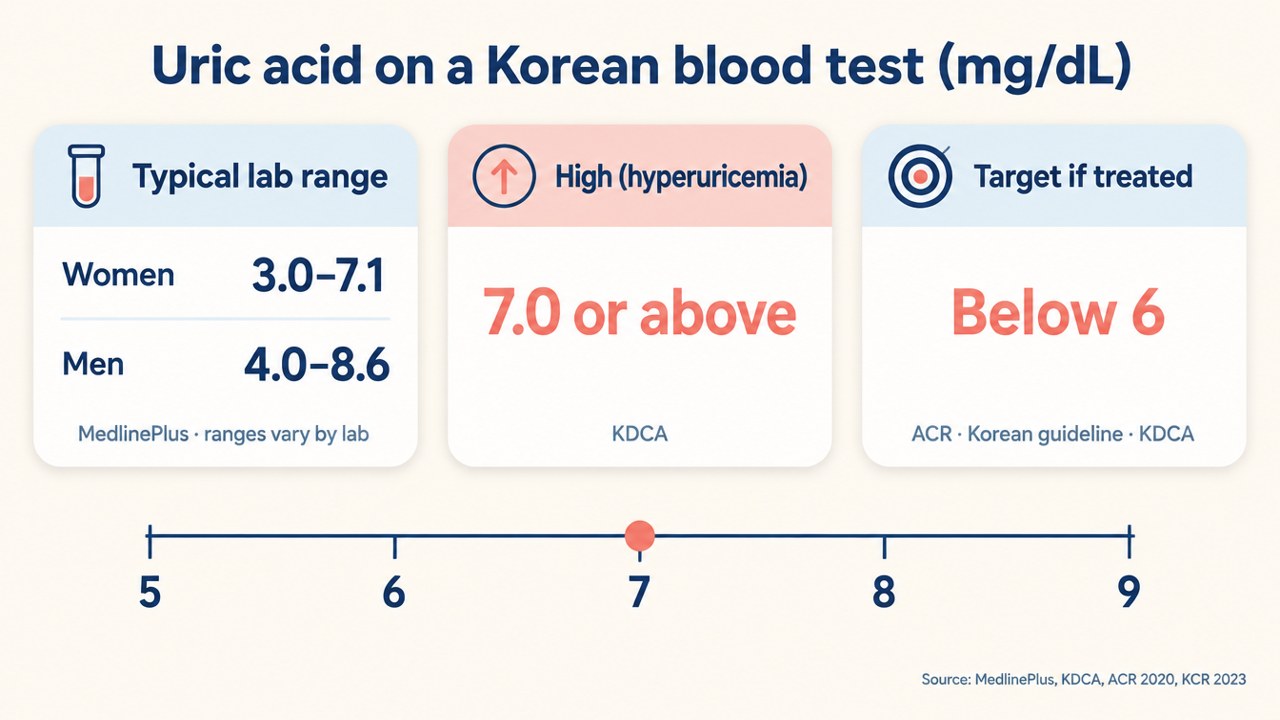
Quick answer: Korean labs report uric acid in mg/dL. Korea’s disease agency (KDCA) calls 7.0 mg/dL or above “hyperuricemia” (high uric acid). The “normal” range printed on your report depends on the lab: the US National Library of Medicine (MedlinePlus) gives 3.0–7.1 mg/dL for women and 4.0–8.6 mg/dL for men, while KDCA describes typical levels of about 3–6 mg/dL in men and 2–5 mg/dL in women. A high number on its own is not gout. KDCA says about 95% of people with high uric acid and no symptoms never go on to have symptoms, and neither the American College of Rheumatology nor the Korean College of Rheumatology recommends routine urate-lowering medicine for high uric acid alone. Uric acid is not part of the standard free NHIS general health checkup. You can add it at a checkup centre for a small fee (one centre lists ₩2,640) or ask a clinic to order it.

Is uric acid on the free NHIS checkup? No
Many people in their 40s, 50s and 60s assume their national health checkup already measures uric acid. It doesn’t. The National Health Insurance Service (NHIS) general checkup page lists the blood tests everyone gets: hemoglobin, fasting blood glucose, AST, ALT, γ-GTP, serum creatinine and eGFR. Age-based extras include a cholesterol panel, hepatitis B at 40 and hepatitis C at 56. Uric acid isn’t on either list. KDCA’s national checkup page gives the same common items.
Korean rheumatologists have pointed out the gap themselves. In a September 2024 interview with the medical newspaper Whosaeng (후생신보), Professor Hong Seung-jae, then head of the Korean College of Rheumatology’s gout study group, said the national checkup “currently has no test that measures uric acid” and argued that this inexpensive test should be added.
| What you get | Includes uric acid? | Notes |
|---|---|---|
| NHIS general checkup, common blood tests | No | Hemoglobin, fasting glucose, AST, ALT, γ-GTP, creatinine, eGFR |
| NHIS general checkup, age-based items | No | e.g. cholesterol panel, hepatitis B (40), hepatitis C (56) |
| Paid add-on at a checkup centre | Yes, if you ask | Non-covered (비급여) item; price set by each institution |
| Clinic visit with a doctor’s order | Yes | Covered visit; you pay the usual outpatient share |
Sources: NHIS general health checkup page; KDCA National Health Information Portal, “건강검진(국가건강검진)”; Whosaeng (후생신보), 27 September 2024.
So when people say “my checkup said my uric acid is high”, the number usually came from a private checkup package, a company checkup with extra items, or a test a doctor ordered. The national checkup does cover kidney function (creatinine and eGFR), which matters for uric acid. Our guide to creatinine and eGFR on a Korean checkup explains those two lines.
The numbers: normal range, “high” and treatment targets
Several different numbers come up in conversations about uric acid, and they mean different things. Some are reference ranges (what most healthy people have), one is a cut-off for calling a level high, one is the point where urate starts to form crystals in the body, and some are treatment targets for people who already have gout.
| Number (mg/dL) | What it is | Who uses it |
|---|---|---|
| Women 3.0–7.1 · Men 4.0–8.6 | A typical lab reference (“normal”) range | MedlinePlus (US National Library of Medicine) |
| Men about 3–6 · Women about 2–5 | Typical levels in healthy adults | KDCA National Health Information Portal |
| 7.0 or above | Hyperuricemia (high uric acid) | KDCA |
| Above 6.8 | Level used to define asymptomatic hyperuricemia | American College of Rheumatology (ACR) 2020 guideline |
| Below 6 | Treatment target for everyone on urate-lowering medicine | ACR 2020; Korean College of Rheumatology 2023; KDCA (6.0 or below) |
| 5.0 or below | Stricter target with tophi or severe gout | KDCA |
Sources: MedlinePlus “Uric acid – blood” (reviewed 1 April 2025); KDCA “통풍” (updated 18 May 2026); ACR 2020 Guideline for the Management of Gout; Korean College of Rheumatology 2023 gout guideline (J Rheum Dis 2023;30:141).
Why the “normal” range on your report may differ
The two ranges in the table don’t match: the MedlinePlus upper limit for men is 8.6 mg/dL, while KDCA describes typical male levels of about 3–6 mg/dL. MedlinePlus itself notes that normal ranges “may vary slightly among different laboratories”. Each lab sets its reference range from its own methods and population, so always read your result against the range printed next to it. Ask your doctor if it sits close to a line.
Sex and age make a real difference. KDCA explains that after puberty men’s uric acid runs about 1–2 mg/dL higher than women’s, and that female hormones help keep women’s levels lower until menopause. A national Korean study using 2016 KNHANES data (Kim et al., Clinical Rheumatology, 2018) found an average level of 5.83 mg/dL in men and 4.36 mg/dL in women.
Converting mg/dL to µmol/L (calculated)
Korean reports use mg/dL, but UK and European sources often use µmol/L. To convert, multiply by about 59.5. This figure is our own calculation from the molar mass of uric acid (about 168 g/mol), so it is approximate.
| mg/dL | µmol/L (calculated, approx.) |
|---|---|
| 5.0 | 297 |
| 6.0 | 357 |
| 6.8 | 405 |
| 7.0 | 416 |
| 9.0 | 535 |
Calculated values, rounded; not from a lab report. Use your own lab’s units and range.
High uric acid is not the same as gout
Uric acid is a normal waste product. Your body makes it when it breaks down purines, substances found in your own cells and in some foods. Most of it leaves through the kidneys. When levels stay high, urate can form needle-shaped crystals in and around joints. When the immune system reacts to those crystals, the result is a gout attack (a “flare”).
The US National Institute of Arthritis and Musculoskeletal and Skin Diseases (NIAMS) and KDCA describe gout in four stages:
- Asymptomatic hyperuricemia. Uric acid is high but you have no symptoms. Most people stay at this stage.
- Acute flare. Sudden, intense pain, swelling, heat and redness in a joint, often starting at night. KDCA says 85–90% of first attacks involve one joint, most often the big toe. NIAMS and the NHS say a flare usually settles within one to two weeks.
- Intercritical period. No symptoms between attacks. KDCA notes that 60–80% of people have a second attack within two years if nothing changes.
- Chronic gout with tophi. Lumps of urate under the skin and around joints. KDCA says this takes about 10 years on average to develop without treatment.
KDCA is clear that a high uric acid level alone is not enough to diagnose gout. Many people with high levels never get gout. A firm diagnosis comes from finding urate crystals in fluid taken from the joint and examined under a polarizing microscope. The NHS says the same: a GP can do a uric acid blood test, and if the diagnosis is still unclear, a sample of fluid may be taken from the joint.

When does a high result matter?
If you have no symptoms
This is the most common situation after a checkup. The official guidance is reassuring:
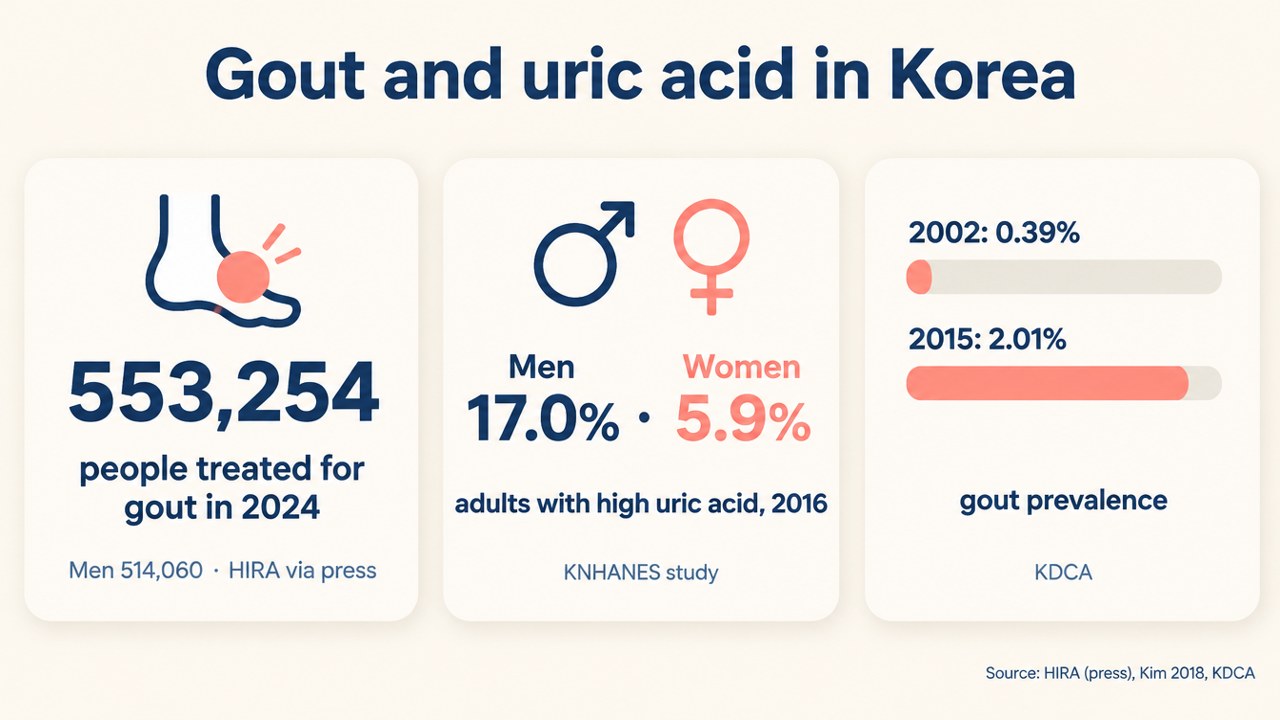
- KDCA states that about 95% of people with asymptomatic hyperuricemia never develop symptoms.
- The ACR 2020 guideline cites observational data showing that, even among people with levels above 9 mg/dL, only 20% developed gout within five years. It estimates that 24 people with high uric acid would need medicine for three years to prevent a single gout flare.
- For that reason the ACR conditionally recommends against starting urate-lowering medicine for asymptomatic hyperuricemia (above 6.8 mg/dL, with no past flare and no tophi).
- The Korean College of Rheumatology’s 2023 guideline made no recommendation on treating asymptomatic hyperuricemia to protect the heart or kidneys, because the balance of benefit and harm was not clear.
- NIAMS also notes that many people with high blood urate never develop gout.
None of this means the number should be ignored. High uric acid often appears alongside high blood pressure, weight gain, diabetes and kidney problems. A 2023 review of gout in Korea (Ahn, Journal of Rheumatic Diseases) found that 79% of Korean gout patients had hypertension, 49% had obesity and 33% had diabetes. So a high result is a good reason to look at the rest of the report with your doctor: blood pressure, glucose and HbA1c (see our HbA1c and fasting glucose guide), cholesterol and triglycerides (see our cholesterol ranges guide) and kidney function.
If you have had a gout flare
In this case the uric acid number becomes a treatment tool. According to KDCA, urate-lowering treatment is generally recommended if you have:
- two or more attacks a year
- urate kidney stones
- tophi
- joint damage
- kidney complications
The ACR recommends against routinely starting medicine after a first flare, with exceptions: chronic kidney disease stage 3 or worse, a level above 9 mg/dL, or kidney stones. Once you are on treatment, the ACR, the Korean guideline and KDCA all aim for a level below 6 mg/dL. KDCA suggests 5.0 mg/dL or below for people with tophi or severe disease. The NHS stresses taking uric acid-lowering medicine regularly, even when you feel fine.
Staying on treatment is the hard part. The Korean review found that more than 80% of patients were prescribed urate-lowering medicine but only 35% were still taking it five years later.
One point is specific to Korean patients. The ACR guideline conditionally recommends a genetic test for HLA-B*58:01 before starting allopurinol in people of Southeast Asian descent, naming Korean as an example. This gene variant is linked to a rare but serious skin reaction. The Korean review reports the variant in 7–12% of Koreans with chronic kidney disease. Whether you need the test is your doctor’s decision. Just know it exists so you can ask.
When to get help quickly
The NHS advises getting urgent medical help if a joint suddenly becomes very painful, hot and swollen and you also have a high temperature or feel generally unwell, because that can be a joint infection rather than gout. In Korea, that means going to a hospital emergency room or calling 119 rather than waiting for a clinic appointment.
How common is this in Korea?
| Measure | Figure | Source |
|---|---|---|
| Adults with hyperuricemia, 2016 (age-standardized) | 11.4% overall · men 17.0% · women 5.9% | KNHANES analysis, Kim et al. 2018; Ahn 2023 review |
| Gout prevalence (NHIS claims data) | 0.39% in 2002 → 2.01% in 2015 | KDCA; Ahn 2023 review |
| People treated for gout, 2024 | 553,254 (men 514,060) | HIRA statistics, as reported by Skyedaily and Minju Sinmun |
| People treated for gout, 2022 → 2023 | 509,699 → 535,100 | HIRA statistics, as reported by Skyedaily |
Sources: Kim Y, Kang J, Kim GT, Clin Rheumatol 2018 (abstract); Ahn JK, J Rheum Dis 2023;30(2):88–98; KDCA “통풍”; Skyedaily, 15 September 2025; Minju Sinmun, 26 June 2026. The 11.4% study defined hyperuricemia as above 7 mg/dL in men and above 6 mg/dL in women, which differs from KDCA’s single 7.0 line. HIRA figures are counts of people treated, quoted from press reports.
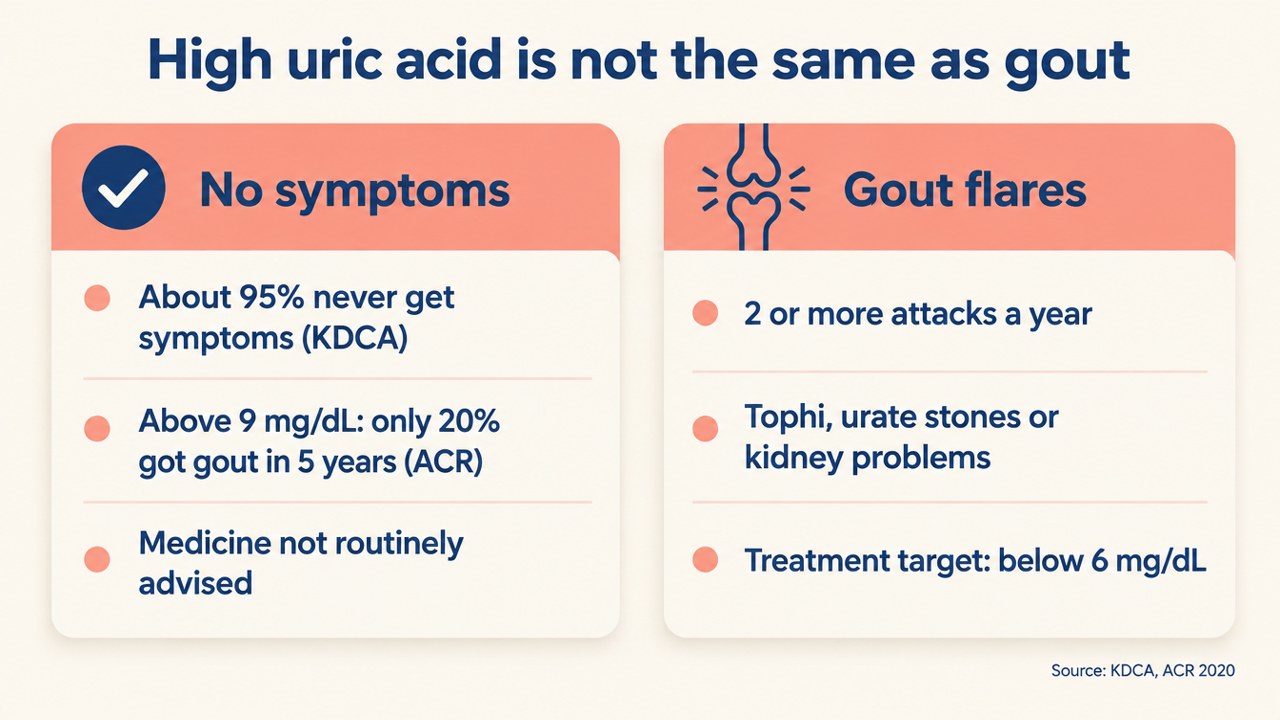
Gout is mainly a men’s condition in Korea. KDCA puts the male-to-female ratio at about 3–3.8 to 1. In 2024 HIRA statistics, men made up about 93% of patients (514,060 of 553,254; our calculation). KDCA says first attacks usually come between the 30s and 50s. NIAMS notes that women are more likely to develop gout after menopause.
Where to get tested in Korea, and what it costs
You have three realistic options.
1. Add it to your checkup. Most checkup centres sell uric acid as a non-covered add-on. As one example, the Korea Association of Health Promotion (한국건강관리협회) Seoul West branch posts ₩2,640 for uric acid (요산) on its non-covered price list, effective 1 January 2026. Prices are set by each institution and vary, so check your centre’s list (비급여 진료비) before you go.
2. Ask a local clinic (의원). If you have joint symptoms, or your doctor wants to follow up a high result, it is a covered test. Under NHIS rules you pay a share of the cost of a covered outpatient visit, and that share depends on the type of institution:
| Type of institution | Your outpatient share (NHIS) | If the covered cost were ₩20,000, you’d pay (calculated) |
|---|---|---|
| Clinic (의원) | 30% | ₩6,000 |
| Hospital (병원) | 40% | ₩8,000 |
| General hospital (종합병원), city area | 50% | ₩10,000 |
| Tertiary hospital (상급종합병원) | 60% | ₩12,000 |
Source for percentages: NHIS English “Benefits” page. The ₩20,000 figure is a made-up example, not a real fee; actual totals depend on the visit and tests. General hospitals in eup/myeon areas charge 45%.
3. Rheumatology at a hospital. People with repeated flares, tophi or kidney problems are usually managed by rheumatology. A tertiary hospital charges the highest outpatient share, so for most people a clinic is a sensible first step.
Before the test
MedlinePlus says you usually shouldn’t eat or drink for four hours before a uric acid blood test unless told otherwise. If it is part of a national checkup, follow the checkup’s own rule: NHIS asks you to fast from 9 pm the night before. Tell the doctor about all your medicines. MedlinePlus lists aspirin and niacin among those that can affect results, and KDCA and NIAMS note that diuretics (“water pills”) raise uric acid. Do not stop a prescribed medicine to get a “better” number. KDCA specifically says not to stop low-dose aspirin just to lower uric acid.
Food, drink and weight: what the official sources say
Diet matters, but less than many people think. KDCA notes that diet alone lowers uric acid by only about 1.0 mg/dL. That helps someone at 7.5, but it won’t bring 10 down to 6. Here is what the sources agree on:
- Alcohol. KDCA says about half of gout patients drink heavily, and NIAMS lists alcohol as a risk factor. The NHS suggests staying within 14 units a week.
- Sugary drinks and fructose. NIAMS, the NHS and MedlinePlus all mention sugar-sweetened drinks or fructose.
- Purine-rich foods. MedlinePlus lists red meat, organ meats such as liver and kidney, and some seafood (shellfish, anchovies, sardines, trout and tuna).
- Coffee. KDCA says black coffee doesn’t need to be restricted.
- Weight. Lose weight gradually. The NHS advises against crash diets, and MedlinePlus lists obesity as a cause of high uric acid.
- Fluids. MedlinePlus lists dehydration among the causes of a high result.
No supplement, tea or “detox” product is a proven substitute for these steps or for prescribed treatment.

Questions to ask your doctor
- “What range does this lab use, and how far above it am I?”
- “Is this one result, or has it been high on earlier checkups too?”
- “Could any of my medicines, such as a diuretic or low-dose aspirin, be raising it? Should anything change? (I won’t stop anything myself.)”
- “Given my kidney function, blood pressure and glucose, is there anything else to check?”
- “If I have had joint pain, should the joint fluid be tested?”
- “If I start treatment, what is my target, and how often will you re-check?”
- “Before allopurinol, do I need an HLA-B*58:01 test?”
Three illustrative scenarios
These are made-up examples to show how the guidance fits together. They are not advice for any real person.
A man in his 40s, 7.6 mg/dL on a company checkup, no joint pain. This is above KDCA’s 7.0 line, so it counts as hyperuricemia. With no symptoms, neither the ACR nor the Korean guideline recommends starting medicine just for the number. A sensible next step is to talk to a clinic doctor about alcohol, sugary drinks and weight, check blood pressure and glucose, and re-test at the next checkup.
A woman in her 50s, 6.4 mg/dL after menopause. This is inside the MedlinePlus women’s range (3.0–7.1) but above KDCA’s typical 2–5. Women’s levels often rise after menopause, as KDCA explains. Read it against your own lab’s range, and mention it if you ever have a sudden hot, swollen joint.
A man in his 60s, two big-toe attacks this year, on a diuretic for blood pressure. Two attacks a year is one of KDCA’s reasons for urate-lowering treatment. The doctor may review the diuretic, check kidney function, consider the HLA-B*58:01 question before allopurinol, and aim for below 6 mg/dL, with regular re-tests.
Frequently asked questions
Q. What is the normal uric acid range in Korea?
It depends on the lab, so use the range printed on your report. KDCA describes typical levels of about 3–6 mg/dL in men and 2–5 mg/dL in women, and treats 7.0 mg/dL or above as hyperuricemia. MedlinePlus gives a common lab range of 3.0–7.1 mg/dL for women and 4.0–8.6 mg/dL for men.
Q. Is uric acid included in the NHIS national health checkup?
No. The NHIS general checkup’s common blood tests are hemoglobin, fasting glucose, AST, ALT, γ-GTP, creatinine and eGFR. Uric acid isn’t among them. You can add it as a paid item at a checkup centre or ask a clinic to order it.
Q. My uric acid is 7.5 mg/dL but nothing hurts. Do I need medicine?
Not automatically. KDCA says about 95% of people with high uric acid and no symptoms never develop symptoms. The ACR conditionally recommends against medicine for asymptomatic hyperuricemia, and the Korean guideline made no recommendation for it. Discuss lifestyle, kidney function and other risk factors with your doctor.
Q. Can a normal uric acid level rule out gout?
No. KDCA says the uric acid level alone can’t confirm or exclude gout. Diagnosis rests on symptoms and, ideally, finding urate crystals in joint fluid. If you have a sudden, hot, swollen joint, see a doctor even if your last result was normal. Seek urgent care if you also have a fever.
Q. How much does a uric acid test cost in Korea?
As a checkup add-on it is a small non-covered fee. One Korea Association of Health Promotion branch lists ₩2,640 for 2026, but every institution sets its own price. Ordered by a doctor for symptoms, it is covered, and you pay the usual NHIS outpatient share (30% at a clinic).
Sources
- MedlinePlus (US National Library of Medicine), Uric acid – blood, reviewed 1 April 2025 (checked 5 November 2026)
- MedlinePlus, Uric Acid Test (checked 5 November 2026)
- NIAMS (US NIH), Gout, December 2023 (checked 5 November 2026)
- NHS (UK), Gout (checked 5 November 2026)
- KDCA National Health Information Portal, 통풍 (Gout), updated 18 May 2026 (checked 5 November 2026)
- KDCA National Health Information Portal, 건강검진(국가건강검진) (checked 5 November 2026)
- NHIS, General health checkup (일반건강검진) (checked 5 November 2026)
- NHIS, Benefits (English) (checked 5 November 2026)
- FitzGerald JD et al., 2020 American College of Rheumatology Guideline for the Management of Gout, Arthritis Care Res 2020 (checked 5 November 2026)
- Korean College of Rheumatology, 2023 Korean guidelines for the management of gout, J Rheum Dis 2023;30(3):141 (checked 5 November 2026)
- Ahn JK, Epidemiology and treatment-related concerns of gout and hyperuricemia in Korean, J Rheum Dis 2023 (checked 5 November 2026)
- Kim Y, Kang J, Kim GT, Prevalence of hyperuricemia in the general Korean population, Clin Rheumatol 2018 (checked 5 November 2026)
- Whosaeng (후생신보), “요산 검사, 국가 건강검진 항목에 반드시 포함돼야”, 27 September 2024 (checked 5 November 2026)
- Skyedaily, 통풍 환자 55만 명 돌파, 15 September 2025, citing HIRA (checked 5 November 2026)
- Minju Sinmun, 통풍 신약 상용화 초읽기, 26 June 2026, citing HIRA (checked 5 November 2026)
- Korea Association of Health Promotion, Seoul West branch, 비급여 진료비 (non-covered fees), effective 1 January 2026 (checked 5 November 2026)
This article is general health information, not medical advice. It was written with AI assistance and fact-checked against official sources. Only your doctor can interpret your results and decide on tests or treatment.




One Comment