Korea Breast Cancer Mammography Screening: Who Qualifies at 40+, How Often, and What You Pay
By the Haesul Global health desk (AI-assisted). Last checked: 2026-11-10 (KST); countdown updated 2026-11-13. The 2026 cancer screening window closes in 48 days (December 31, 2026). Rechecked on the NHIS cancer screening guide (read on Nov 9: women 40+ every 2 years by mammography; NHIS 90% / you 10%, lower 50% and Medical Aid pay nothing; period 1.1–12.31 with no extension). General health information, not medical advice; your doctor interprets your own results.
Quick answer: If you are a woman 40+ due this year, book the mammogram by December 31, 2026 — 48 days left from November 13 (NHIS). Under Korea’s National Cancer Screening Program, women aged 40 and over are offered breast cancer mammography screening every two years. The standard test is a mammogram (유방촬영). For most NHIS subscribers, the National Health Insurance Service pays 90% and you pay 10%. If your premium was in the lower 50% (based on November of the previous year) or you are on Medical Aid, you pay nothing. In 2026 (an even year), women born in an even-numbered year are typically on the biennial list. Book by 31 December 2026 (48 days left). Mammography is a screening X-ray, not a diagnosis; a dense-breast note or a callback for more imaging is common and usually not cancer.

Who is eligible in 2026
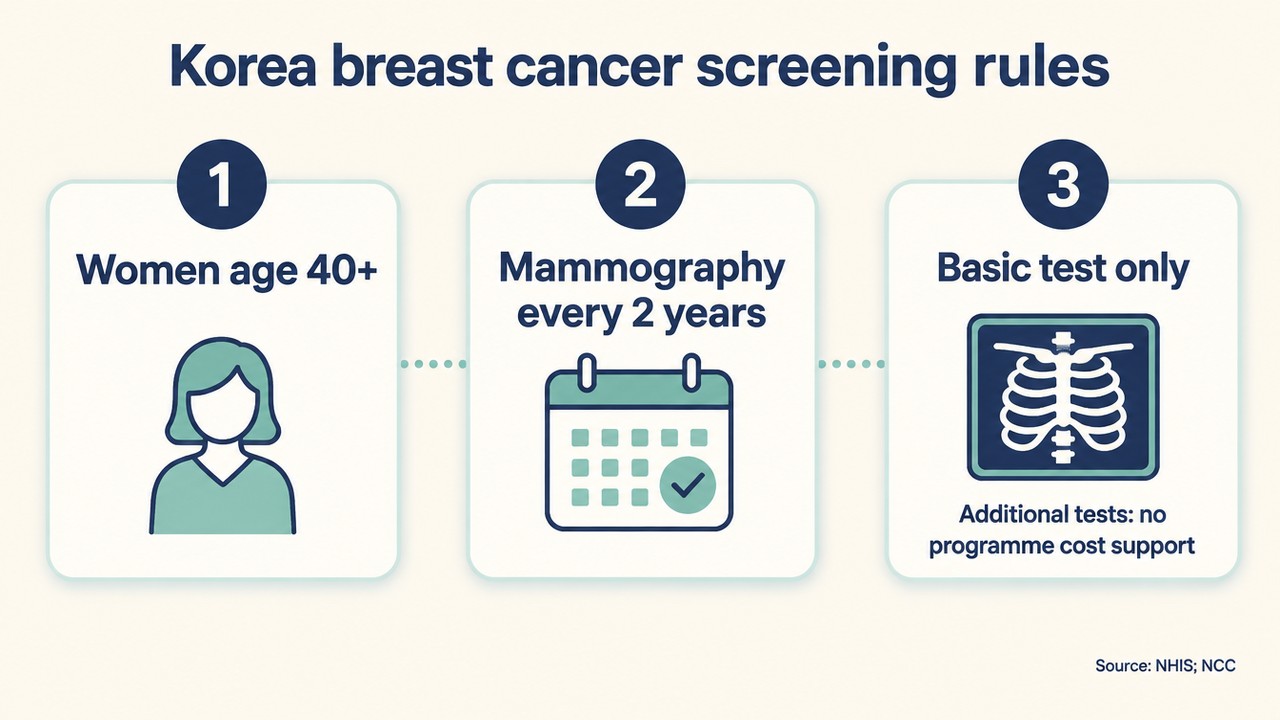
Korea’s national programme covers six cancers. For breast cancer, both the National Cancer Information Center (cancer.go.kr, last updated 3 August 2026) and the National Health Insurance Service (NHIS) state the same rule: women aged 40 and over, every two years, by mammography. Men are not on the national breast-cancer screening list. National Health Insurance Ilsan Hospital and the National Cancer Center’s national cancer-control pages repeat the same age, interval and method.
That is the programme rule. Separately, the National Cancer Center’s 2015 breast-cancer screening recommendation (still published on cancer.go.kr as of 17 July 2026) focuses evidence on women aged 40 to 69 having mammography every two years, and notes that evidence that mammography reduces breast-cancer deaths in women 70 and over is weaker. In practice the NHIS and cancer.go.kr programme tables still list 40+ women without an upper age cut-off, so check your own invitation rather than assuming you age out.
The two-year cycle usually follows birth year: even-year births in even calendar years, odd-year births in odd calendar years. Korea.kr’s March 2026 checkup briefing explains that pattern for the national checkup, and a October 2026 medical-press summary of the breast programme says that in 2026 women born in an even year are the ones invited. Confirm on the NHIS site or The건강보험 app (건강검진 대상조회) or by calling 1577-1000—do not rely on birth year alone if your notice says otherwise.
Foreign residents enrolled in NHIS are covered the same way as Korean nationals: eligibility follows insurance membership and age, not passport. For the wider checkup map by age, see Korea’s national health checkup by age for expats. Women hitting life-transition ages 54, 60 or 66 may also get a free bone-density scan in the same year—covered in our bone density test guide (free at 54, 60, 66).
One deferral rule matters if you are already a registered breast-cancer patient. NHIS’s 건강iN cancer-screening guide says women under the breast-cancer co-payment special case (유방암 산정특례) are left off the screening list, but you can still ask to be added if you want the programme mammogram. That is the same pattern NHIS uses for several other cancer checks.
What you pay (and when it is free)
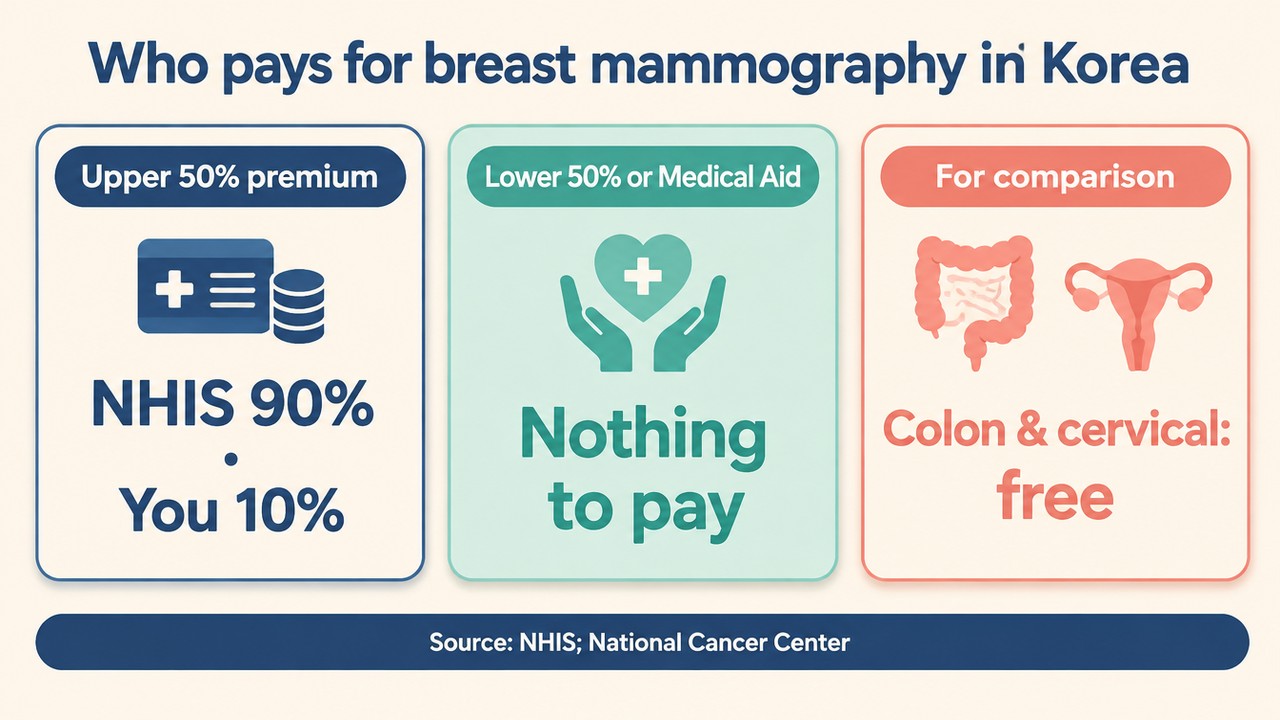
Breast screening is not free for every NHIS member the way colorectal and cervical screening are. NHIS’s cancer-screening cost page is clear:
| Who you are | What you pay for breast mammography |
|---|---|
| NHIS subscriber, premium in the upper 50% (prior November) | You 10%, NHIS 90% |
| NHIS subscriber, premium in the lower 50% (prior November) | Nothing |
| Medical Aid (의료급여) recipient | Nothing |
| Colorectal stool test or cervical Pap (for comparison) | NHIS pays 100% for everyone |
Sources: NHIS cancer screening page; NHIS 건강iN; NHIS English benefits page; National Cancer Information Center cost page (S1T553C556). The lower-50% cut uses your premium from November of the previous year.
So if you have heard that “cancer screening is free,” that is true for colorectal and cervical screening for everyone, and for breast screening only if you are in the lower-50% tier or on Medical Aid. The NHIS English benefits page states the same 90/10 split for cancer checkups, with colorectal and cervical as the no-co-payment exceptions. Your own free/paid status comes from NHIS (prior-November premium), not from a blog table.
Extras outside the national item—such as a breast ultrasound ordered because of dense tissue, asymmetry or a cyst—are not supported as programme “additional tests.” The National Cancer Information Center’s method table (S1T553C555) lists breast screening as mammography for the basic exam and states no cost support (비용지원 없음) for additional tests. NHIS Ilsan Hospital likewise notes ultrasound may be needed separately for asymmetry or cysts. Those follow-ups are billed under ordinary outpatient rules, not the national 90/10 mammogram line.
What the mammogram is
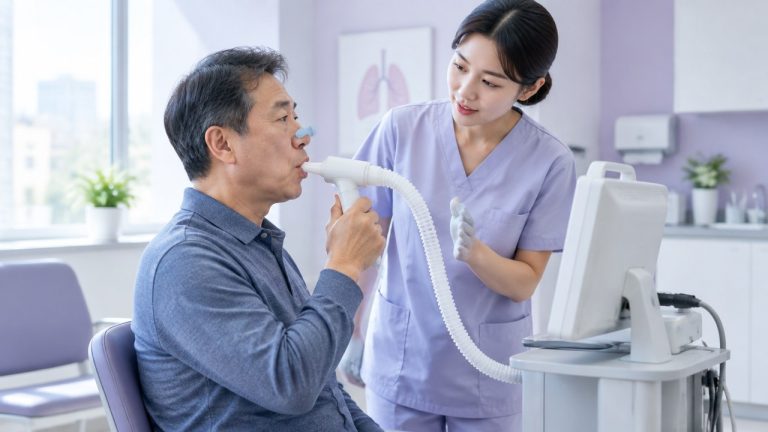
A mammogram is a low-dose X-ray of the breast. The US Centers for Disease Control and Prevention (CDC) and the US National Cancer Institute (NCI) both describe it as the main screening tool that can find cancer before it is large enough to feel. Korea’s programme uses that same basic method: cancer.go.kr lists 유방촬영 (mammography) as the breast-cancer screening test.
At NHIS Ilsan Hospital’s national checkup centre, a screening mammogram takes about 5 to 10 minutes. You undress above the waist; each breast is imaged twice (top-to-bottom and angled), for four views in total. Compression between plates is required for a clear image and a lower radiation dose. Discomfort varies; the hospital tells patients to speak up if pain is severe. NCI likewise notes that compression can hurt and suggests avoiding deodorant, powder or lotion on the chest and underarms on the day of the exam, and not booking right before or during a heavy menstrual period when breasts are more tender.
Hospital-level cautions that are useful to know (attributed to NHIS Ilsan Hospital’s own page, not as nationwide law):
- If you recently had a COVID-19 vaccine, wait at least six weeks before a screening mammogram, because temporary lymph-node swelling can confuse the images.
- Tell the technologist about implants, paraffin or filler beforehand.
- Breastfeeding: the hospital advises waiting until six months after weaning.
- A screening mammogram within the past year is generally not repeated for screening alone, because radiation itself is a risk factor when exams stack up without a clinical reason.
Dense breasts, ultrasound, and what “abnormal” usually means
Korean women are often told they have dense breasts (치밀유방). That finding is common and does not by itself mean cancer. NCI explains that dense tissue can hide masses on a mammogram and that radiologists also report density on the screening report. NHIS Ilsan Hospital notes that mammography is still useful for spotting calcifications, while ultrasound may be added later if the team needs to look at asymmetry or cysts. Ultrasound is not the national screening method, and NCC says additional breast tests have no programme cost support; Korean Breast Cancer Society commentary reported in October 2026 likewise said dense breasts do not automatically require extra tests for every woman.
The US CDC lists screening harms that apply everywhere: false positives (something looks suspicious but is not cancer), false negatives, anxiety from callbacks, and a small radiation exposure from repeated X-rays. NCI adds that most people called back for more imaging do not turn out to have cancer. A callback means more pictures—or, less often, a biopsy—not a diagnosis.
Symptoms are a different path from screening. Do not wait for your next even-year slot if you notice a change. CDC warning signs include a new lump in the breast or underarm, thickening or swelling, skin dimpling or irritation, nipple pulling-in or discharge (other than breast milk), change in size or shape, or breast pain. The National Cancer Information Center’s Korean guidance, as summarised in medical press, similarly flags a painless lump, nipple discharge, nipple retraction, or new skin creasing. See a doctor; screening is for people without those symptoms.
How to book before 31 December

The screening year runs 1 January to 31 December, and NHIS’s 건강iN guide says there is no extension of that window. December fills up fast. Our guide to Korea’s 31 December checkup deadline and catch-up rules covers booking, ID and missed years; the same calendar applies to cancer screening slots.
Practical steps:
- Confirm you are on the 2026 breast-screening list (NHIS web/app or 1577-1000).
- Bring your ID and the checkup/cancer-screening notice NHIS mailed (or a reissued copy from the call centre).
- Book a designated cancer-screening clinic—searchable on NHIS 건강iN.
- Ask when and how results arrive; NHIS and the National Cancer Information Center both say the clinic notifies you within 15 days of completing the exam (post or email).
- If the report asks for more imaging, follow that clinic path; supplemental ultrasound is usually separate from the free/10% national mammogram line item.
How breast screening sits next to other cancer checks
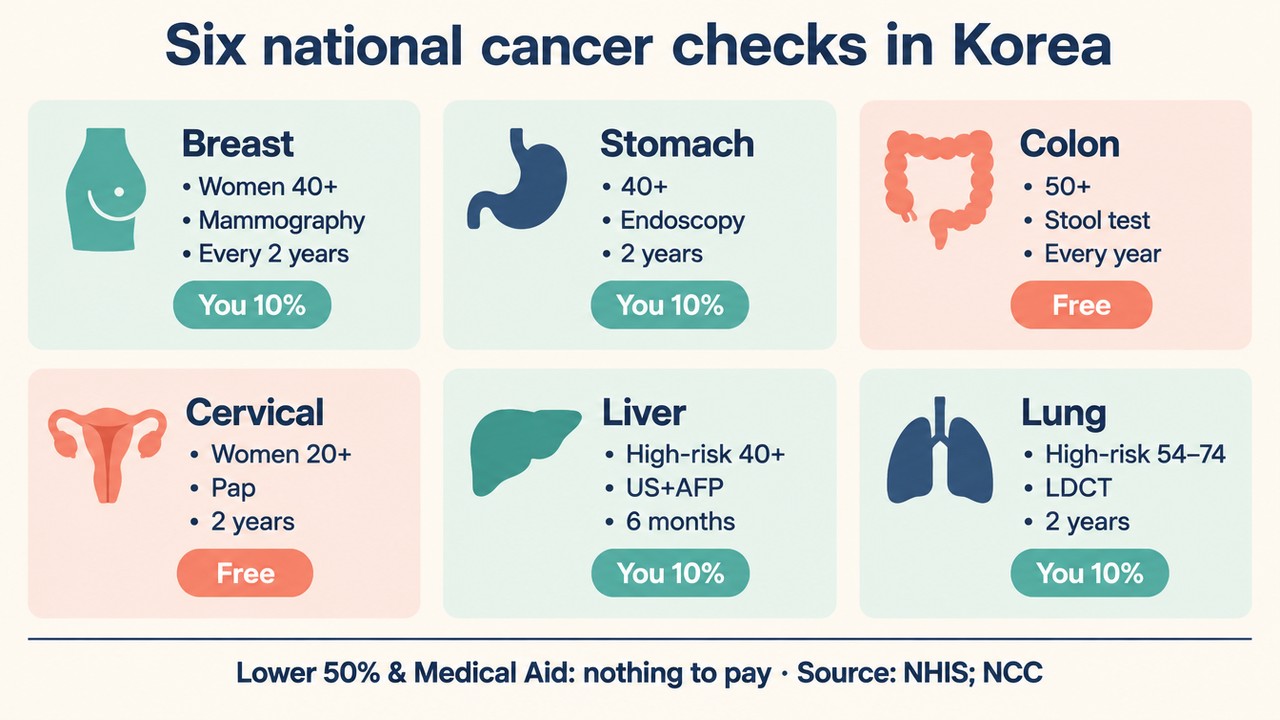
Putting the national table in one place helps when you are deciding what to book this year:
| Cancer | Who | Interval | National method | Typical cost (upper 50%) |
|---|---|---|---|---|
| Stomach | Men & women 40+ | 2 years | Endoscopy (or upper GI series if needed) | You 10% |
| Breast | Women 40+ | 2 years | Mammography | You 10% |
| Colorectal | Men & women 50+ | Every year | Stool occult-blood test (FIT/FOBT) | Free (NHIS 100%) |
| Cervical | Women 20+ | 2 years | Pap smear | Free (NHIS 100%) |
| Liver | High-risk 40+ | 6 months | Ultrasound + AFP blood test | You 10% |
| Lung | High-risk ages 54–74 | 2 years | Low-dose chest CT | You 10% |
Sources: cancer.go.kr national cancer screening table (updated 3 August 2026); NHIS cancer screening page. Lower 50% and Medical Aid pay nothing across these cancer checks.
Breast and stomach often land in the same even/odd birth-year window, while colorectal runs every year from 50. That is why November and December get crowded for women in their 40s and 50s who still have both gastroscopy and mammography left.
Frequently asked questions
Q. When does the 2026 breast cancer screening window close?
December 31, 2026 — 48 days left from November 13. NHIS says the cancer screening period runs January 1–December 31 every year with no extension. If you missed last year, NHIS can add you to this year’s list on request, but the cost may differ, so call 1577-1000 first (NHIS cancer screening guide, checked Nov 9).
Q. Who gets Korea breast cancer mammography screening?
Women aged 40 and over who are on the National Cancer Screening Program list. The test is mammography every two years. Confirm on the NHIS site, The건강보험 app, or by calling 1577-1000.
Q. How much does mammography cost under NHIS?
Most subscribers pay 10%; NHIS pays 90%. If your prior-November premium was in the lower 50%, or you receive Medical Aid, you pay nothing. Colorectal and cervical screening are free for everyone; breast is not.
Q. I have breast-cancer special-case status (산정특례). Am I still invited?
NHIS defers women under the breast-cancer co-payment special case from the screening list. You can still ask to be re-registered if you want the programme mammogram. Call 1577-1000 or use the NHIS checkup-eligibility tools.
Q. Does “dense breasts” on my report mean I have cancer?
No. Dense tissue is common, especially among Korean women, and it can make mammograms harder to read. It is not a cancer diagnosis. Extra ultrasound is decided case by case and is not the national screening test.
Q. I’m a foreigner with NHIS. Am I eligible?
Yes, if you are enrolled in National Health Insurance and meet the age and invitation rules. Eligibility follows NHIS membership. Use the same 건강검진 대상조회 tools or call 1577-1000 (overseas +82-33-811-2001).
Related reading
- Korea stomach cancer screening: gastroscopy at 40+
- Free bone density test at 54, 60 and 66 (women)
- Korea cervical cancer screening: Pap and HPV
Sources
- National Health Insurance Service, Cancer screening: eligibility, intervals and cost (checked 7 November 2026)
- National Health Insurance Service (건강iN), Cancer screening guide: breast rules, deferral, cost, period (checked 7 November 2026; re-checked 9 November 2026)
- National Health Insurance Service (English), Insurance benefits: cancer checkup 90/10; colorectal and cervical no co-payment (checked 7 November 2026)
- National Cancer Information Center, Eligibility, Intervals and methods (breast: mammography; additional tests no cost support), Results within 15 days and cost (checked 7 November 2026)
- National Cancer Information Center, National Cancer Screening Program overview table (updated 3 August 2026; checked 7 November 2026)
- National Cancer Information Center, Breast cancer: early detection recommendation (40–69) (updated 17 July 2026; checked 7 November 2026)
- National Cancer Center, National cancer screening programme (checked 7 November 2026)
- National Health Insurance Ilsan Hospital, National checkup centre: breast cancer screening (checked 7 November 2026)
- Korea.kr (policy briefing), National checkup by even/odd birth year, 20 March 2026 (checked 7 November 2026)
- K Medical News, National breast screening: age 40+, 2-year mammography, 10% co-pay, 5 October 2026 (checked 7 November 2026)
- US Centers for Disease Control and Prevention, Screening for breast cancer and Symptoms of breast cancer (updated 22 September 2026; checked 7 November 2026)
- US National Cancer Institute, Mammograms (updated 2 December 2025; checked 7 November 2026)
This article is general health information, not medical advice. It was written with AI assistance and fact-checked against official sources. Only your doctor can interpret your results and decide on tests or treatment.


4 Comments